Shahree Vyaas's Blog, page 12
August 11, 2024
Creative Urbanism, Installation, mixed techniques on wood W 400 x H240 cm x D50 cm
This installation critiques urbanism for potentially perpetuating a systemic gentrify-cation, emphasizing that the ideal of creating cultural-historical homogenic modern real estate overlooks the economic realities faced by many inhabitants of poorer neighborhoods, which often cannot sustain such developments. The European subsides for such projects are too often getting into the pockets of real estate project developers, while the neighbourhood’s original habitants are getting dispersed towards the city’s suburbs.
Instead of promoting inclusive amenities that build community, urbanists tend to engage in technical debates about zoning standards and housing units without genuinely considering the needs of all community members, particularly marginalized groups.
This installation introduces the Fantasy Method of Urban Design, an experimental approach that encourages urbanists to envision future developments through the lens of three influential texts: Utopia, by Thomas More (1516); Frankenstein, by Mary Shelley (1818); and The Hitchhiker’s Guide to the Galaxy, by Douglas Adams (1978).
By expanding their understanding of social and political complexities, this method seeks to inspire Urbanists with narratives of change rather than to escape into elitist culturalism, highlighting the importance of responding to contemporary urban challenges with creative thinking.


August 6, 2024
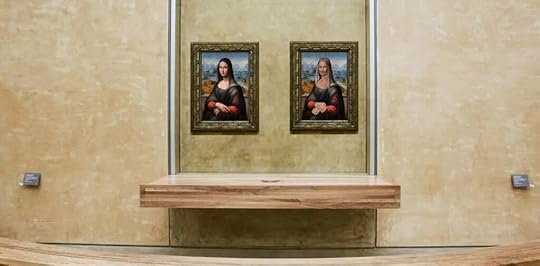
Mona Lisa at 82.
Are there more people who wonder how La Gioconda would have looked like 60 years after Leonardo painted her when she was in her prime? I did the exercise and then incorporated it with an adapted version of the original painting.
July 28, 2024
Will “Cat Lady” become the next taboo word?
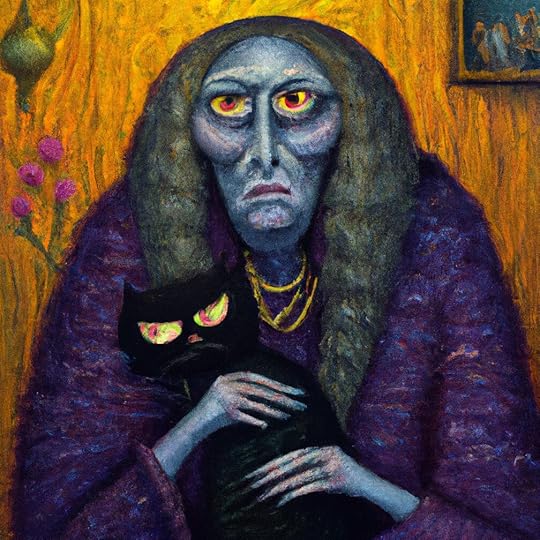
The urban dictionary defines a cat lady as “A woman, usually middle-aged or older, who lives alone with no husband or boyfriend, and fills the empty lonely void in her life with as many cats as she can collect in one place“.
It looks that because some aspiring vice-president gave the word some new meaning, it might become a new taboo word in the woke dictionary.
The word has been around for a while and now a whole bunch of people are considering to add it to the fucking-nigger-list because one person gave his own interpretation to it during a Fox-News broadcast. So all the cat ladies got their daggers out and decided they didn’t want to be associated with the label anymore.
Do we really want to attribute that much power to one politician and a rather conservative news channel?
As the saying goes: the anti-campaign is very often the campaign.
July 27, 2024
my great-grandfather.
If you could bring back one dinosaur, which one would it be?
July 24, 2024
Phases of Wisdom, digital collage of previous works, triptych on canvas 140 x 60 by Shaharee Vyaas.
This triptych represents three components of wisdom: 1) general knowledge of life, 2) acknowledgement of uncertainty and despair, 3) sense of humor.
July 23, 2024
About Transcribing Finnegans Wake in plain English.
The primary transcription goal of Finnegans Wake into Here Comes Everybody’s Karma was to open Joyce’s Opus Magnum for a wider reading public by replacing the foreign language idiosyncrasies with an English equivalent and by streamlining Joyce’s sibylline prose.
This required me to engage with the prose of Finnegans Wake that goes beyond that of simply transcribing the text in readable English.
While the foreign language idiosyncrasies in Finnegans Wake are often open constructs that gave place to multiple interpretations, transcribing this novel into plain English required choices to be made which interpretation would fit best with my interpretation of Finnegans Wake.
I chose to interpret the novel from a personal cryptomathematical perspective by placing the novel into a contemporary context that reflects the links that can be laid between Finnegans Wake and some Asiatic philosophical tenets, quantum mechanics, and the system theory.
Finnegans Wake consists of four books that Joyce just named Book 1,2,3, and 4. In Here Comes Everybody’s Karma the books and their chapters were given titles, thus giving some structure to an otherwise labyrinthic tale.
One cannot overlook the thematic resonance of reincarnation in Finnegans Wake, a pivotal tenet within various Eastern spiritual traditions, which mirrors the cyclical rhythm of time and being explored within the depths of Joyce’s labyrinthine prose. By artfully intertwining elements of Eastern philosophical wisdom, the enigmatic principles of quantum mechanics, the intricate interconnectedness underscored by system theory, and the boundless realm of literature, “Finnegans Wake” transcends conventional boundaries of reality and plunges readers into an enthralling exploration of the interconnected tapestry of ideas that collectively shape our understanding of the vast universe in which we dwell.
The intricate interconnectedness of characters and events within James Joyce’s monumental work, “Finnegans Wake,” serves as a profound reflection upon the concept of karma, where individual actions reverberate throughout the narrative with far-reaching consequences. This interplay reflects a cosmic dance of cause and effect, wherein characters are symbolically reborn, embodying the perpetual cycle of existence central to both profound Eastern Philosophy and the artistic tapestry of the novel itself. The overarching cyclical motif within the narrative echoes the transient nature of personal identity and the ceaseless evolution of consciousness, echoing the timeless Eastern concept of samsara, the eternal wheel of life, death, and rebirth.
Quantum mechanics, on the other hand, challenges our traditional notions of reality by suggesting that particles can exist in multiple states simultaneously and that observation plays a crucial role in determining outcomes. It introduces a fascinating perspective on the multiple realities and possibilities that exist simultaneously, mirroring the fragmented and non-linear structure of Finnegans Wake. The uncertainty principle, entanglement, and superposition of states resonate with the novel’s intricate narrative layers and the characters’ interconnected stories, suggesting a fluid and dynamic interpretation of reality. This idea coincides with the themes of uncertainty and interconnectedness in “Finnegans Wake,” where characters and events are intertwined in a complex web of relationships that defy conventional linear narratives.
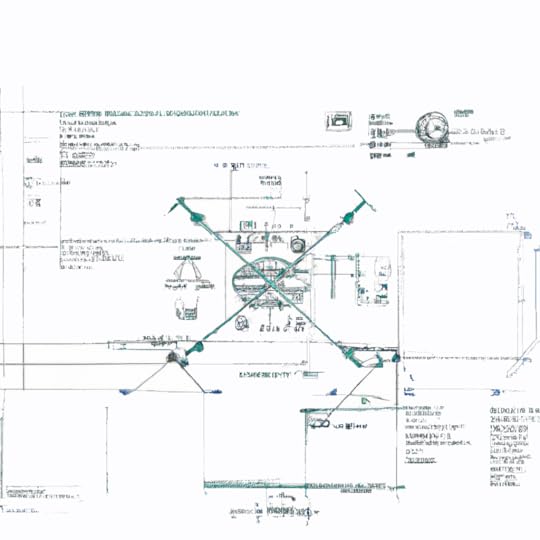
The novel’s storytelling architecture, replete with intricate systems and interwoven narratives, reflects a holistic interconnectedness strikingly reminiscent of the fundamental principles proposed within system theory.
Take for example the fractal complexity of the novel. Fractals are mathematical shapes that have been used to model patterns that repeat on many different scales. Looking at a coastline map, we cannot tell the scale; a fractal coast looks similar at all scales. As the map is enlarged, more details appear, but the general character of the coast remains unchanged over several orders of magnitude. This self-similarity is typical of fractals
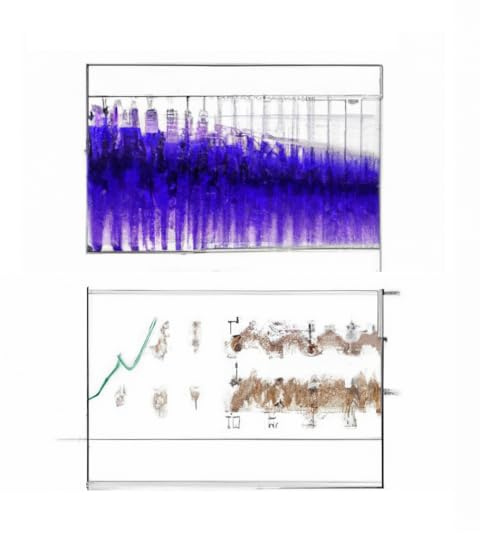
Short sentences can ease comprehension but can become tedious. Longer more complex sentences can be more expressive but also more demanding. Writers intuitively vary sentence length for stylistic and aesthetic ends. The distribution of sentence lengths can reveal hidden aspects of literary works. Mathematical tools like spectrum analysis, wavelet decomposition and multifractals can be used to analyze sentence length variability.
The structure of Finnegans Wake was virtually indistinguishable from a purely mathematical fractal. Of course, the fractality of a literary text can never match the ideal: a mathematical fractal can be magnified interminably while the number of sentences in a book is finite.
The spread of fractal dimension provides an index of complexity. The complexity index of Finnegans Wake, with its exploration of the mental labyrinths of the dream state, was 0,74, while that of Here Comes Everybody’s Karma approaches that of 0.63 because some of the longer sentences in Finnegans Wake have been broken up into smaller ones to enhance its readability.
Short sentences can ease comprehension but can become tedious. Longer more complex sentences can be more expressive but also more demanding. Writers intuitively vary sentence length for stylistic and aesthetic ends. The distribution of sentence lengths can reveal hidden aspects of literary works.
This marriage of form and content underscores the inherent complexity and interdependence that define not only the fictional world within the novel but also the broader cosmic landscape that we inhabit. By engaging with themes of karma, dharma, reincarnation, quantum mechanics, and system theory, Joyce’s magnum opus challenges us to reconsider our understanding of reality, consciousness, and the fundamental nature of the universe. As HCEK navigates the labyrinthine depths of “Finnegans Wake,” we are invited to contemplate the eternal dance of creation and destruction, the fluidity of identity, and the enduring quest for meaning in a universe governed by both order and chaos.
References:
Joyce, J. (1939). Finnegans Wake. Faber and Faber.
Bohr, N. (1934). Atomic theory and the description of nature. Nature, 133, 793-794.
Bertalanffy, L. V. (1968). General System Theory: Foundations, Development, Applications. George Braziller.
Capra, F. (2010). The Tao of Physics: An Exploration of the Parallels between Modern Physics and Eastern Mysticism. Shambhala Publications.
Pingta Ku (2021) “The abnihilisation of the etym”: Finnegans Wake’s Entanglement in Quantum Ideality.” Concentric: Literary and Cultural Studies, March 2021: 129-148 DOI: 10.6240/concentric.lit.202103_47(1).0007
Smith, J. (2008). The essence of Eastern philosophy. New York: Routledge.
Stanisław Drozdz, et al, 2016: Quantifying origin and character of long-range correlations in narrative texts. Info. Sci. 331, 32-44.
SZCZEPANIK LIDIA “Sandhyas Sandhyas Sandhyas!” Indian Thought in Finnegans Wake, Studia Litteraria Universitatis Iagellonicae Cracoviensis 9 (2014), z. 4, s. 303–310 doi:10.4467/20843933ST.14.025.3072
July 20, 2024
Being Water, digital collage of previous works, canvas 80 x 80 cm, 2024.
The background of this work is based upon the concept of dynamics that challenges our perception of fixed borders and boundaries. The seven oceans are an example to illustrate how the arbitrary lines imposed by humans can limit our understanding of the interconnected systems of the world. Dynamics blurs the distinctions between land and sea, creating a complex and ever-changing landscape. By embracing this interconnectedness, we can adjust our perspective to better appreciate the diversity and beauty of our natural world. Being water is being dynamic.
The center of the painting reminds us of the importance of big bodies of water, that cannot be overstated. They provide necessary sustenance for all life on earth, from vegetable matter to animals to minerals. Without water, organic life would not exist, as it is necessary for the growth and survival of plants, animals, and humans. The oceans also play key roles in regulating the earth’s climate and weather patterns. Whether it be a river, lake, or ocean, water is the source of all life and holds an immense significance in our ecosystem.
On top in the middle you see a big X. In algebra, the letter ‘x’ is often used to represent an unknown quantity or variable. X is a concept that rethinks the sources, uses, and representations of water. The idea behind X is that there are vast quantities of water that vapor in the atmosphere to be transported by winds, sometimes thousands of kilometers, to remote regions where it can act as a source of moisture for agriculture and other uses. By understanding the dynamics of this phenomenon, it may be possible to develop new strategies for managing water resources. The concept of an unknown quantity or variable is relevant here since the movements and distribution of these flying rivers in the atmosphere can be difficult to predict.
At the bottom i painted a smaal figurine, to remind that us that Being Human = Being Water
From the perspective of a Promethean creature, being a human is being water. Their view of humans is that they are made up of water. Our bodies are composed of about 60% water. Water regulates our body temperature, helps in the digestion of food, and supports our metabolism. Humans cannot survive without water for more than a few days. Therefore, being a human is synonymous with being water. It forms the foundation of our existence.
Humans constantly adapt and change their environments, much like water that can shape its surroundings. They are fluid in their ways of life and can be found in various forms across the world. Humans also possess incredible potential for growth and transformation, much like water molecules that can shift endlessly between solid, liquid and gas states. However, humans can also be unpredictable and dangerous, like a wild river that can overflow and flood its banks. Humanity is a powerful and dynamic force, much like water.
July 6, 2024
The Infinite Universe of Pi.
Although I have at this instance a very busy schedule, it seems that I can’t keep going without distracting myself every now and then with some artistic project.
The idea for this work occurred to me during the night and I couldn’t focus on anything else till I had it worked out.
It’s a digital art project that consists of the first 50.000 digits of the enigmatic number Pi, used as an example to illustrate that the structures of the universe are basically mathematical.
June 24, 2024
Literary Criticism and the Systems Theory
Although I’m not really thinking that someone missed my weekly ramblings about all the innuendo that occasionally flutters from my brain through my finger tops into my blog, I still want to acknowledge towards those who do that I’m still alive and rambling.
I’m still one of those old fashioned guys who believe that the off line life should have precedence over my online presence. I know that this goes against all modern commercial and artistical practices, but when I spend too much time on the internet, it has a tendency to suck me into some wormhole that leaves me with no time to deal with the world outside the matrix (although my wife claims that I spend the bulk of my time in my own universe, which consists of a 100 sqm studio).
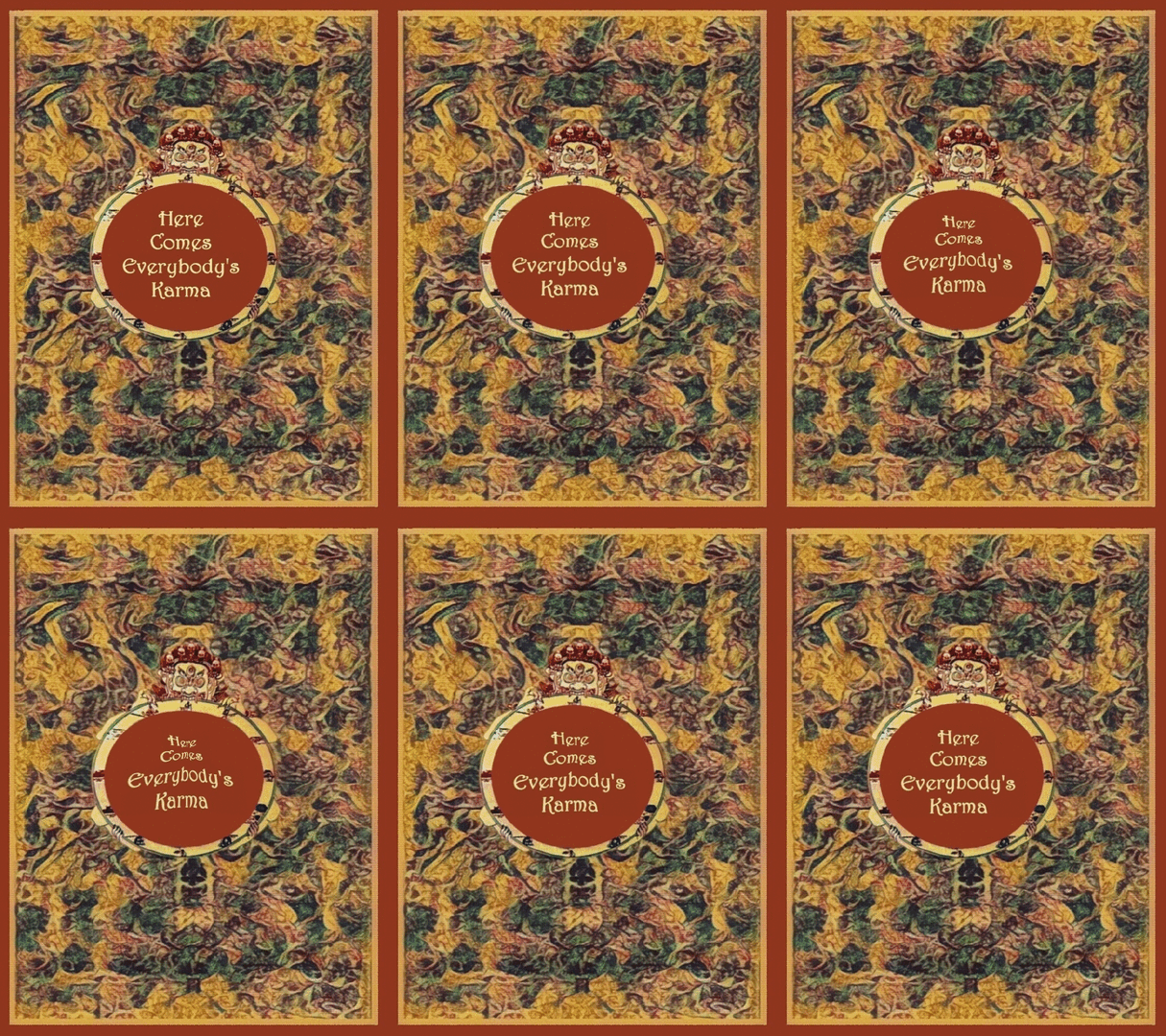
Last week I have been rubbing shoulders in Dublin with some readers of Here Comes Everybody’s Karma, which is my transcription of Finnegans Wake in plain English, larded with some self-made illustrations at the Bloomsday Festival in Dublin. Those who didn’t hear about it yet, can see a video presentation of this book by clicking on the cover below this paragraph.
I had some interesting encounters with a couple of literary critics in the margins of the Bloomsday festival, what caused me to drag up, polish, and reformat an old essay about a system theory approach of literary criticism.
This essay focuses on the mathematical structure of the driving forces behind the literary phenomena. If the ideal of the “unity of science”, bridging both diverse contents and cultural differences can be achieved at all, this will be done via mathematization.
A first advantage of this method of treating as an ensemble the totality of publications and their determinants is the elimination of many controversies in literature as to the causes of some sociological phenomena. In the history of literary theory these questions have been discussed to the point, not of the conversion of the disputants, but of the exhaustion of their faculties.
Yet when a synthetic view of information exchange, writing, publishing, distribution and social effects is taken, we see at once that each of the alternatives of the preceding questions contains a partial truth; that the sum of the partial truths is not the whole truth; that the proper weight and place of each partial truth may be specified; and that the ensemble of the determining conditions may be mathematically expressed.
A second advantage of the synthetic method is that it enables one to know when a literary problem has reached a solution. Here, a distinction should be made in the meaning of the word “solution” according as one sees it from the point of view of the mathematical, or of the synthetic method. The problem is solved by the mathematical method when there are as many independent equations as there are unknown quantities in the problem. From the point of view of the synthetic method, however, this is only half of the solution: over and above the presentation of the abstract simultaneous equations, proof must be supplied that the equations themselves may be empirically derived and, consequently, that the problem admits of a real solution.
Those among you who’re interested in reading more can download a free kindle copy of this essay on this Amazon link between 24 and 26 of June. Please leave a review after you finished.
I have a buzzy festival and exposition agenda ahead for the second part of this year, of which I’m hoping to find time later to communicate about on this blog.
May 24, 2024
About The Hole in the Wall.
On page 69 of Finnegans Wake we read:
“Now by memory inspired, turn wheel again to the whole of the wall. Where Gyant Blyant fronts Peannlueamoore There was once upon a wall and a hooghoog wall a was and such a wall- hole did exist.”, transcribed in HCEK p. 85 as: “Once, inspired by memory, turn the wheel again to witness the grandeur of the entire wall. Where Tyrant Blunt confronts Penn-lie-more, there once existed a majestic, towering wall, adorned with a magnificent wall hole.”
These fragments are referring to a very real pub in the vicinity of Phoenix Park, known as The Hole in the Wall (formerly known as Black Horse Tavern). The Hole in the Wall pub is located in the district of Ashtown just north of Phoenix Park, and the phrase “turn wheel again” refers to the turnstile (or turnpike) set in a hole in the adjacent Phoenix Park wall.
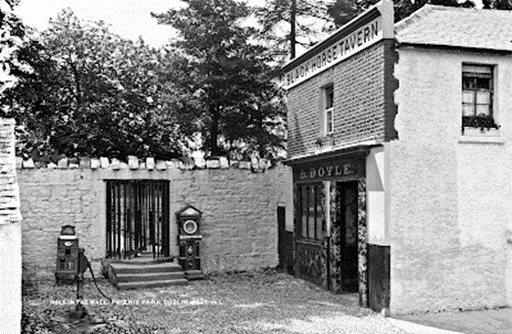
In Finnegans Wake, the door serves as a threshold between wakefulness and deep sleep, symbolizing a gateway. The book itself is likened to a door or gate, with Joyce’s sigla resembling a portal. The gate is guarded by two giant pencils, reminiscent of obelisks, which represent duality and harmony in Egyptian culture. This duality mirrors the themes of unity and opposites present in Finnegans Wake which this publication places into the context of Dharma and Karma, which are cyclical Asiatic philosophical principles.
The Lithuanian artist Benediktas Gylys gave recently this Joycean gate theme a modern interpretation by installing next to the writer’s statue in Dublin an audiovisual live-link that connects it to New York.
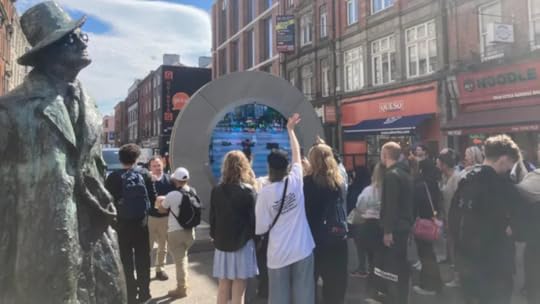
The portal is set to become a fixture of Dublin’s streetscape throughout the summer and runs until the autumn. In the coming months, there will be cultural performances at each city’s portal to be enjoyed by people in the other city via the livestream. From July, the Dublin portal will also connect to other global city destinations in Poland, Brazil and Lithuania.
Though it might, from a commercial point of view, not be the wisest decision to launch a book in a pub instead of in a book store, the choice of this location wants to illustrate how the novel is embedded in the local folklore and its surrounding area.
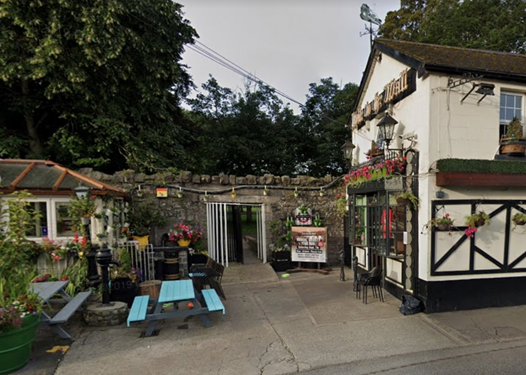
On the 11th of June of 2024 “Here Comes Everybody’s Karma” will be launched at the Hole in the Wall Pub nearby Phoenix Park in Dublin between 6 – 8pm.