Shahree Vyaas's Blog, page 15
April 6, 2024
Here Comes Everybody’s Karma (4)
Opposite this ethereal spectacle beyond Hill Sixty, lies a hollowed realm! At the terraced fort’s edges, resonates the lurking presence of the cunning adversaries, eagerly anticipating the opportune moment for their deceptive maneuvers. Hence, as the clouds roll by, Jamey, one can enjoy a splendid view of the grandeur of our majestic mount, now the esteemed Wellington National Museum.
In the verdant distance lies the picturesque Waterloo’s countryside and the two pristine little villages, which add a delightful charm to the landscape. They appear so endearingly whimsical amidst the foliage, truly a sight to behold! Penetrators are welcome to explore the museum grounds free of charge.
Those of Welsh and Paddy Patkin’s descent, a mere shilling! Disabled or ailing members of the old guard can discover a push wheelchair to satisfy their butt’s needs. To obtain access, seek the passkey from the caretaker, the esteemed Mistress Kate. Gratuity appreciated
Finnegan’s Wake
While over against this belles’ alliance beyind Ill Sixty, ollollowed ill! bagsides of the fort, bom, tarabom, tarabom, lurk the ombushes, the site of the lyffing-in-wait of the upjock and hockums. Hence when the clouds roll by, jamey, a proudseye view is enjoyable of our mounding’s mass, now Wallinstone national museum, with, in some greenish distance, the charmful waterloose country and the two quitewhite villagettes who hear show of themselves so gigglesomes minxt the follyages, the prettilees! Penetrators are permitted into the museomound free.
Welsh and the Paddy Patkinses, one shelenk! Redismembers invalids of old guard find poussepousse pousseypram to sate the sort of their butt. For her passkey supply to the janitrix, the mistress Kathe. Tip.


April 3, 2024
Here Comes Everybody’s Karma (3)
Mighty was the first to don armor and claim a name: Wassail Booslaeugh of Riesengeborg. His heraldic crest, emblazoned in green with shimmering silver embellishments, displayed a fearsome, horned he-goat in pursuit. His shield was divided horizontally, with radiant archers drawn on a deep blue background. Huzzah for the husband wielding his hoe.
Ho ho ho, Master Finn, you shall become Master Finnegan! The morning has arrived, and oh, you are divine! The evening approaches, and alas, you are like sour wine! Ha ha ha, Master Funn, you are to be fine once more!
Finnegan’s Wake
Of the first was he to bare arms and a name: Wassaily Booslaeugh of Riesengeborg. His crest of huroldry, in vert with ancillars, troublant, argent, a hegoak, poursuivant, horrid, horned. His scutschum fessed, with archers strung, helio, of the second. Hootch is for husbandman handling his hoe.
Hohohoho, Mister Finn, you’re going to be Mister Finnagain! Comeday morm and, O, you’re vine! Sendday’s eve and, ah, you’re vinegar! Hahahaha, Mister Funn, you’re going to be fined again!
April 1, 2024
Here Comes Everybody’s Karma (2)
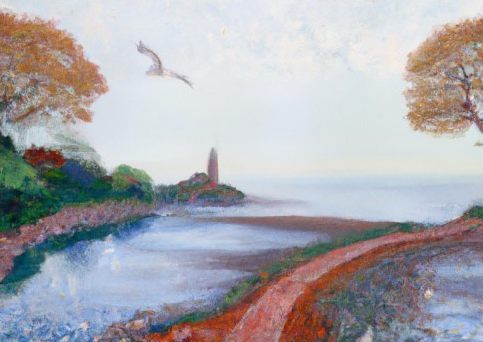
Past the original dwelling of Eve and Adam, the river extends from the curve of the shore to the bend of the bay, leads us through a conveniently traversable village of recurrence back to Howth Castle and its surrounding areas.
Sir Tristram, a player of love’s music, crossing the short sea, had recently returned from North America to wage his unprecedented war on the isolated isthmus of Europe Minor. Furthermore, the towering rocks near the Oconee stream, while constantly doubling their mischievous ways, had not yet proclaimed themselves to the astonished inhabitants of Laurens County.
Not a single voice had yet called out in excitement or alarm, nor had a playful child disrupted the serene presence of the wise old Isaac. Even though all seemed harmonious in appearance, the twins, Sosie and Esther, had yet to be provoked into anger by the misdeeds of Nath and Joe. Not even a measure of malt brewed by Jhem or Shen, illuminated by the gentle glow of a flickering flame, could be seen creating patterns on the reflective surface of the water.
Finnegan’s Wake
riverrun, past Eve and Adam’s, from swerve of shore to bend of bay, brings us by a commodius vicus of recirculation back to Howth Castle and Environs.
Sir Tristram, violer d’amores, fr’over the short sea, had passencore rearrived from North Armorica on this side the scraggy isthmus of Europe Minor to wielderfight his penisolate war: nor had topsawyer’s rocks by the stream Oconee exaggerated themselse to Laurens County’s gorgios while they went doublin their mumper all the time: nor avoice from afire bellowsed mishe mishe to tauftauf thuartpeatrick not yet, though venissoon after, had a kidscad buttended a bland old isaac: not yet, though all’s fair in vanessy, were sosie sesthers wroth with twone nathandjoe. Rot a peck of pa’s malt had Jhem or Shen brewed by arclight and rory end to the regginbrow was to be seen ringsome on the aquaface.
March 27, 2024
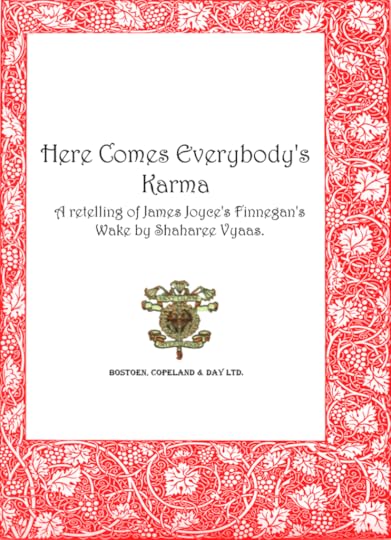
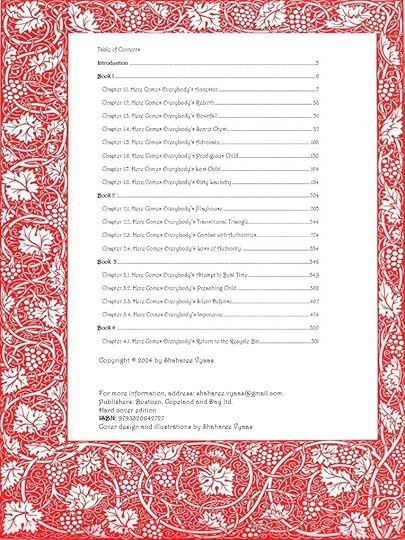
Here Comes Everybody’s Karma
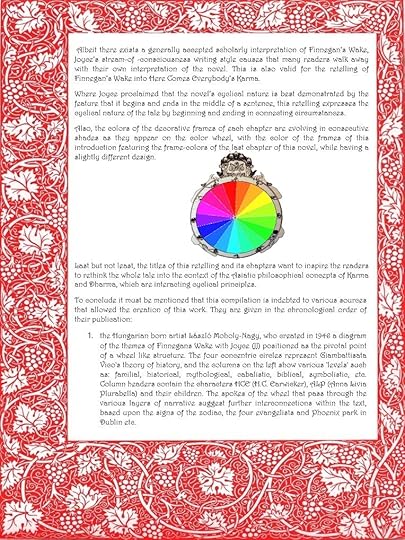
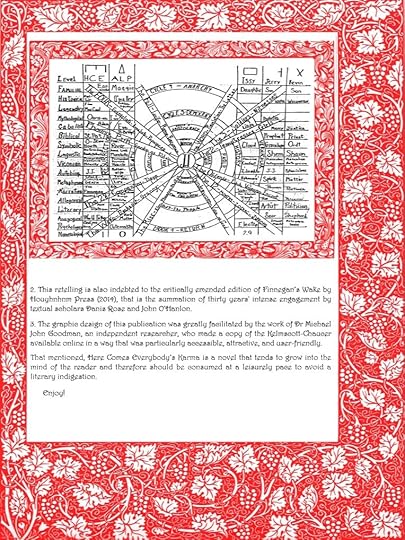
After being absent on this forum for a couple of months, I can now resurface with a new project that has been absorbing all my time and energy. I’m planning to launch this novel during the Bloomsday Festival in Dublin between June 10th and 17th.
February 19, 2024
Being Busy
Hallo beautiful people on the internet.
Probably few people will have noticed that I’ve been fading out of the internet during the last two months. This trend will probably continue till the summer, because I’m working on a exciting new project that absorbs most of my time, energy, and attention.
At this stage the whole concept is still shrouded in secrecy and this will probably remain so till early July.
The only noticeable creative thing I can share with you is a new addition to my working station, a Martian Chair, which is basically an Ikea chair that I have been upgrading a bit.
See you all in a couple of months with the unveiling of my latest dada.
Shaharee
December 10, 2023
Poetry in the Dark. Acrylic on canvas 120 x 120 cm by Shaharee Vyaas (2023)
‘Darkness’: A Poem by Lord Byron
I had a dream, which was not all a dream.
The bright sun was extinguish’d, and the stars
Did wander darkling in the eternal space,
Rayless, and pathless, and the icy earth
Swung blind and blackening in the moonless air;
Morn came and went—and came, and brought no day,
And men forgot their passions in the dread
Of this their desolation; and all hearts
Were chill’d into a selfish prayer for light:
And they did live by watchfires—and the thrones,
The palaces of crowned kings—the huts,
The habitations of all things which dwell,
Were burnt for beacons; cities were consum’d,
And men were gather’d round their blazing homes
To look once more into each other’s face;
Happy were those who dwelt within the eye
Of the volcanos, and their mountain-torch:
A fearful hope was all the world contain’d;
Forests were set on fire—but hour by hour
They fell and faded—and the crackling trunks
Extinguish’d with a crash—and all was black.
The brows of men by the despairing light
Wore an unearthly aspect, as by fits
The flashes fell upon them; some lay down
And hid their eyes and wept; and some did rest
Their chins upon their clenched hands, and smil’d;
And others hurried to and fro, and fed
Their funeral piles with fuel, and look’d up
With mad disquietude on the dull sky,
The pall of a past world; and then again
With curses cast them down upon the dust,
And gnash’d their teeth and howl’d: the wild birds shriek’d
And, terrified, did flutter on the ground,
And flap their useless wings; the wildest brutes
Came tame and tremulous; and vipers crawl’d
And twin’d themselves among the multitude,
Hissing, but stingless—they were slain for food.
And War, which for a moment was no more,
Did glut himself again: a meal was bought
With blood, and each sate sullenly apart
Gorging himself in gloom: no love was left;
All earth was but one thought—and that was death
Immediate and inglorious; and the pang
Of famine fed upon all entrails—men
Died, and their bones were tombless as their flesh;
The meagre by the meagre were devour’d,
Even dogs assail’d their masters, all save one,
And he was faithful to a corse, and kept
The birds and beasts and famish’d men at bay,
Till hunger clung them, or the dropping dead
Lur’d their lank jaws; himself sought out no food,
But with a piteous and perpetual moan,
And a quick desolate cry, licking the hand
Which answer’d not with a caress—he died.
The crowd was famish’d by degrees; but two
Of an enormous city did survive,
And they were enemies: they met beside
The dying embers of an altar-place
Where had been heap’d a mass of holy things
For an unholy usage; they rak’d up,
And shivering scrap’d with their cold skeleton hands
The feeble ashes, and their feeble breath
Blew for a little life, and made a flame
Which was a mockery; then they lifted up
Their eyes as it grew lighter, and beheld
Each other’s aspects—saw, and shriek’d, and died—
Even of their mutual hideousness they died,
Unknowing who he was upon whose brow
Famine had written Fiend. The world was void,
The populous and the powerful was a lump,
Seasonless, herbless, treeless, manless, lifeless—
A lump of death—a chaos of hard clay.
The rivers, lakes and ocean all stood still,
And nothing stirr’d within their silent depths;
Ships sailorless lay rotting on the sea,
And their masts fell down piecemeal: as they dropp’d
They slept on the abyss without a surge—
The waves were dead; the tides were in their grave,
The moon, their mistress, had expir’d before;
The winds were wither’d in the stagnant air,
And the clouds perish’d; Darkness had no need
Of aid from them—She was the Universe.
November 19, 2023
Salvador did’nt know it.
This canvas depicts Dali breaking away from his familiar persona and adopting a gesture of ignorance, a departure from his self-proclaimed genius status.
Known for his aura of arrogance and omniscience, Dali was often perceived by the majority of the Parisian surrealists in the 1920s as Avida Dollars, an artist teetering on the edge of being a conman. Considered more of a maniac with a unique mustache, he relied on attention-grabbing stunts to sustain his fame.
Dali viewed mistakes as sacred and refrained from correcting them; instead, he rationalized and elevated them through his paranoiac-critical method, which he described as a spontaneous and irrational way of understanding the world through the critical and systematic objectivity of delirious phenomena.
With his “Paranoid Critical” technique, Dali aimed to establish connections between unrelated objects by employing optical illusions and juxtaposing images. Throughout this process, maintaining his artistic integrity was paramount to him, as he strived to materialize the images of his concrete irrationality with utmost precision, proclaiming, “My whole ambition in the pictorial domain is to materialize the images of my concrete irrationality with the most imperialist fury of precision.”
This approach ultimately captivates and engages audiences, highlighting the uniqueness and ingenuity of Dali’s artistic expression of his ignorance. The genius of Dali lays not into the image of himself he liked to project, but into his artistic representations of the vastness of the human ignorance.
November 17, 2023
Salvador and his dead brother
Born in the shadow of his brother’s tragic death, Salvador Dalí carried the burden of his brother’s spirit throughout his life. Dalí’s parents named him Salvador in remembrance of his deceased sibling, a practice shrouded in superstitious disfavor in their region of Spain. This connection to his brother’s fate deeply affected Dalí, evident in his belief that their namesake transmitted the first brother’s destiny to him. In his autobiography “Unspeakable Confessions,” Dalí titled the opening chapter “How to Live with Death,” a stark depiction of his own demise. The haunting presence of his brother’s spirit pervaded his artwork, evidenced by the symbolism of shadows, hidden faces, and reflections in pieces such as “Metamorphosis of Narcissus.” This unremitting influence seemed to pursue Dalí relentlessly, as if his dead brother’s spectral presence sought to trap him in the realm of Hades. In describing his association with his brother’s shadow, Dalí acknowledged the touch of madness that enveloped his artistic journey.
November 15, 2023
Salvador the Showman
Salvador Dali, the surrealist artist known for his unorthodox theatrics, had an unwavering belief in his own genius. From a young age, he aspired to be admired by the world, even if it meant being despised and misunderstood.
Born to a middle-class family in Spain in 1904, Salvador Dalí displayed ruthless ambition from an early age, as revealed in his autobiography, The Secret Life of Salvador Dalí. His aspirations unfolded in a fascinating progression, with dreams of becoming a cook at the age of six and envisioning himself as Napoleon at seven. At age sixteen he penned in his diary , “I will be a genius, and the world will admire me. Perhaps I’ll be despised and misunderstood, but I’ll be a genius, a great genius—I’m certain of it.”
This sentiment embodies the relentless drive that propelled Dalí to become a household name and solidify his place in the annals of art history. Early on is his career, at one remarkable evening in Paris, Gala, Dali’s wife, proclaimed that her husband was a true genius to a French aristocrat, Prince Jean-Louis de Fossini-Lousing. This encounter led to the establishment of the “Zodiac” club in 1932, where twelve members became sponsors of Dali. Each month, one member contributed 2.5 thousand francs for one of Dali’s captivating paintings. Along his journey, Dali courted controversy, as he both trampled on his female admirers and showed support for the Spanish dictator Francisco Franco.
His distinctive creations remain instantly recognizable, a testament not only to his artistic prowess but also to his savvy public relations efforts.
His provocative and captivating artworks have now become some of the most recognizable in art history, thanks in part to his successful public relations strategies. Dali’s larger-than-life personality and penchant for self-promotion led him to create a museum dedicated to himself, a testament to his consummate showmanship in his hometown Figueres.
November 13, 2023
Salvador the Philosopher
For Dali, the surreal was not just a style or a form of art, but a pathway to tap into the depths of our subconscious and explore the intricate layers of the human psyche. He believed that logic and reason could only take us so far, and true innovation and creativity lay in embracing the irrational and the unknown. Dali’s masterpieces were infused with symbolism and concealed messages, often reflecting his own obsessions and fears. In his Mystical Manifesto, he identified himself as a mystic in the Spanish tradition, drawing parallels between his ecstatic mystical experiences and the imaginative interpretation of contemporary scientific breakthroughs. Embracing what he called “militant Spanish mysticism,” Dali sought to rejuvenate modern painting, intertwining techniques and religious iconography from the Italian Renaissance with his understanding of recent scientific discoveries, particularly nuclear energy and quantum physics. According to Dali, it was the mystical and uniquely individualistic artist, in a state of ecstasy, who possessed the ability to unravel the mysteries of our time and reveal the new “golden sections” embedded within the soul.