Shahree Vyaas's Blog, page 19
August 12, 2023
Credit card.


 View all responses
All the rest you can eventually buy by using it, while there exists nothing else that you can trade for a credit card.


August 7, 2023
Being Human = Being Water
From the perspective of a Promethean creature, being a human is being water. Their view of humans is that they are made up of water. Our bodies are composed of about 60% water. Water regulates our body temperature, helps in the digestion of food, and supports our metabolism. Humans cannot survive without water for more than a few days. Therefore, being a human is synonymous with being water. It forms the foundation of our existence.
Humans constantly adapt and change their environments, much like water that can shape its surroundings. They are fluid in their ways of life and can be found in various forms across the world. Humans also possess incredible potential for growth and transformation, much like water molecules that can shift endlessly between solid, liquid and gas states. However, humans can also be unpredictable and dangerous, like a wild river that can overflow and flood its banks. Humanity is a powerful and dynamic force, much like water.
July 1, 2023
Women of the 8th Sea: Mixed techniques on canvas 40,6 x 40,6 cm by Shaharee Vyaas.
The 8th Sea challenges the notion that water can be controlled and manipulated for human purposes. One example is the port of Hamburg, a site steeped in colonial history and exploitation of resources. The idea of The Seven Seas is also questioned, challenging the arbitrary boundaries imposed by humans on a vast and interconnected system.
This painting serves as a lens through which to understand the connections and complexities of our globalized world. The image provokes reflection and analysis of the interrelationships between land, people, and water.
Women of the 8th Sea
The 8th Sea challenges the notion that water can be controlled and manipulated for human purposes. One example is the port of Hamburg, a site steeped in colonial history and exploitation of resources. The idea of The Seven Seas is also questioned, challenging the arbitrary boundaries imposed by humans on a vast and interconnected system.
This painting serves as a lens through which to understand the connections and complexities of our globalized world. The image provokes reflection and analysis of the interrelationships between land, people, and water.
June 24, 2023
Design for a cosmological clock
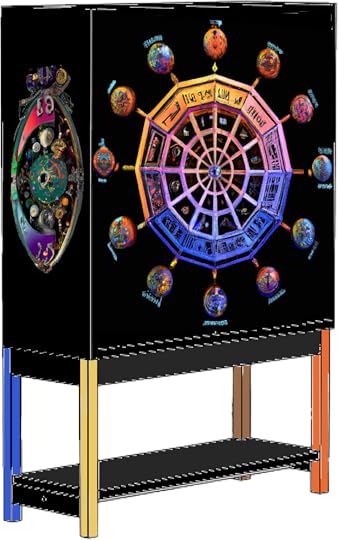
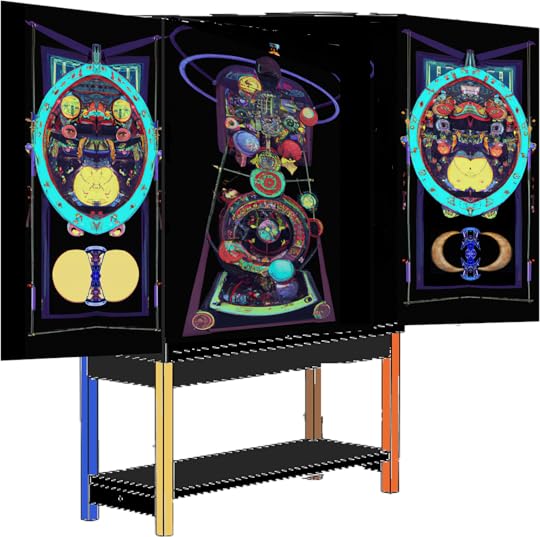
This is a project that I have been working on and off over the past two years. Only last week it reached a design that pleased me enough to show it to my better half. She kind of liked its esthetics but after a short pause she frowned and asked me: “How does it work? What does it do?” .
I had (and still have) no clue. It made me feel like a mad scientist who produced an useless invention. Obviously it indicates the time of the day and just like a coocoo clock it opens the doors to give a light show on the hour with the little devices at the bottom of the inside of the door turning around, but apart from that: no clue.
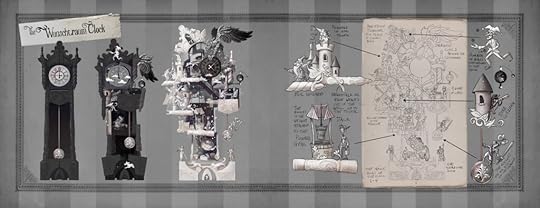
Its concept has been inspired by the “Wunschtraum Clock”, a device that features prominently in a novel called the “Night Circus” by Erin Morgenstern (very entertaining book: I recommend it). The Wunschtraum Clock is ever present in the circus and it shows that all things are tied to time. As its hands slowly tick down the cycle of the night, the clock’s elaborate chiming mechanisms thematize the mundane.
Adam Sanford, at that time an art student in his final semester, chose to take this literary device to a higher, more tangible, stage. The result was the following:
This inspired me to do something similar that would reflect the cosmical cycle theme that runs through most of my literary and artistic activities.
But up to this stage, the cosmological clock only indicates the hour and gives once an hour a two minutes light and sound show. If anyone among you have some more ideas that can be incorporated in this concept (without changing it drastically), please let me know.
June 15, 2023
The Dark Sides of Religion (part 5/5): Replenishing at the Well of Justification. Mixed technics on canvas 45 x 45 cm by Shaharee Vyaas.
In this work I’m focusing on extreme fundamentalists who believe that their religion gives them the right to tell everyone else what they are and are not allowed to do and commands them to kill certain non-believers.
Religious pogroms and crusades are of all times. One of the most venerated saints and theological teachers of the catholic church called for a crusade against the Islam with the words “Cursed be he who does not stain his sword with blood.” And then there is the infamous inquisition who killed 30,000 to 300,000 people (The last execution of the Inquisition was in Spain in 1826. This was the execution by garroting of the Catalan school teacher Gaietà Ripoll for purportedly teaching Deism in his school.) Some fundamentalist Christian churches in the USA are still calling up their members to kill people that go against their teachings.
Another contemporary example is the Jihad that motivates some Muslim extremist to wage war against everyone who doesn’t share their believes. Although the jihad has always been an important part of the Islamic tradition, in recent years some Muslims have maintained that jihad is a universal religious obligation for all true Muslims to join the jihad to promote a global Islamic revolution.
And then you have the extremist Hindus who wage a war against Muslims and Christians alike. Or the Buddhist extremists who’re waging a genocidal war against the Rohingya Muslim minority in Myanmar.
June 13, 2023
The Dark Sides of Religion (part 4/5): Patriarchies. Mixed technics on canvas 45 x 45 cm by Shaharee Vyaas.
The religions of the book – Judaism, Christianity and Islam – all have a male God and have scriptures and histories of interpreting those scriptures which are patriarchal. The characteristics of a Patriarchal System are Male Domination, Male Identification, Male Centeredness, and Obsession with Control.
Patriarchy examples include hiring practices that discriminate against women, exclusion of women from decision-making, institutional discrimination against women, and the relegation of women to the domestic sphere.
While the history of patriarchy in the Middle East is complex, male dominance evolved historically alongside the growth of Islamic nations. Over the next four decades, Christians will remain the largest religious group, but Islam will grow faster than any other major religion. If current trends continue, by 2050 the number of Muslims will nearly equal the number of Christians around the world. Feminist Gerda Lerner traces a “creation of patriarchy” in Islam through the continual repetition of male-dominated rituals and events in Islamic society overtime.
One of the main reasons that made Rushdie’s book the Satanic Verses so controversial is that those verses called for the worshipping of a female deity called Al-Lat, thus putting a time bomb under the existing patriarchal order. Muslim scholars are divided over the authenticity of those verses and their retraction, depending upon the sources they rely upon, measured against the majority of Muslim scholars who proclaim their prophet’s infallibility as a ground to determine those sources as blaspheming confabulations. Also non-Muslim scholars are divided over the historical veracity of the sources that mention the satanic verses.
Transhumance
Lavagna – Italy, May 29th 2023 – CON-TEMPORARY Art Observatorium and Jizaino present the group exhibition “TransHumance”.
Wearable high-tech, augmented reality, cybernetic prostheses, microchip implants, are the first steps of the transhumanism that herds human beings like cattle toward an alleged human-machine singularity. Does the human being desires to be free from the natural body’s caducity? What is the meaning of preserving the individual’s intellect in cyberspace? Which perspectives would immortality offer? Wouldn’t be more desirable to train our natural body and our innate potentialities relying on the resources and rebirth capability offered by nature?
TransHumance – Toward the precipitation of Self
19 June – 9 July 2023
CON-TEMPORARY Art Observatorium
Corso Buenos Aires 42 11
Lavagna, Italy
Opening hours: all days from 10.00 to 18.00 booking on http://www.ctao.eu
Free entrance
The group art exhibition curated by Abramo Tepes Montini features digital and traditional painting, photography, graphics and video artworks by Iryna Calinicenco, Bobby Kim Ling Chen, Andrew Cheung, Martin Del Carpio, Elina, Ian Haig, Magdalena Hejzlarová, Erika Kassnel-Henneberg, Lucien.Art, Jeremy Pellington, Nina Sumarac, Shaharee Vyaas and Andrzej Wojciechowski.
In the previous group exhibition, entitled Escapism, we addressed the issue about the always more penetrating and totalitarian oppression and control exerted on the individual by the political and governmental system, which implements the old method of “carrot and stick” to forcedly push the masses. If the “stick” is oppression, TransHumance wants to investigate one of the brand new “carrots” that today the system of power tries to feed to peoples: the trivial benefits of a transition toward the digitalisation and the artificial sophistication of the person, as a prodrome of transhumanism, leading to epochal anthropological implications and prime philosophic and ethical dilemmas.
The transhumanism would be an ideology that, starting from the union between man and the robotic and/or computer machine into the so-called “singularity”, would shift mankind toward another phase, a goal: the post-humanism, that is an era where the natural human being will be outdated, extinct, evolved into something that will not be human any more, since the prefix post- itself always specify the end of an era, in this case of the human being.
http://ctao.eu/
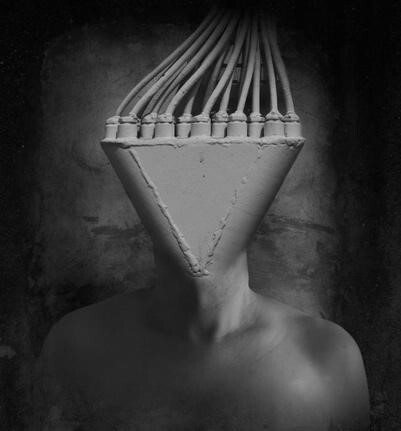
Andrzej Wojciechowski, Hybrid 3
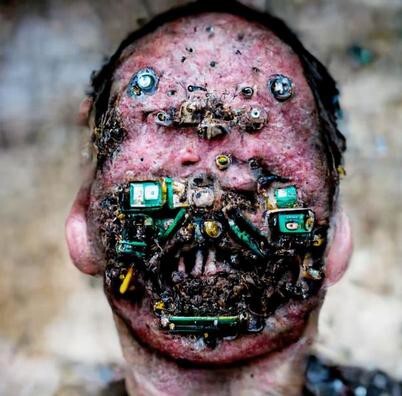
Ian Haig, Useless Eaters
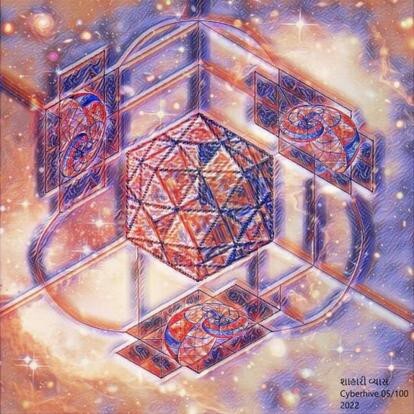
Shaharee Vyaas, CYBERHIVE
June 12, 2023
The Dark Sides of Religion (part 3/5): Nirvana. Mixed technics on canvas 45 x 45 cm by Shaharee Vyaas.
Nirvana in Buddhism is a transcendent state in which there is neither suffering, desire, nor sense of self, and the subject is released from the effects of karma and the cycle of death and rebirth. Gurus talk about the universal mind and about the futility of power, knowledge, and material desires.
Looked upon from a darker perspective, it can be perceived as a system of control used to play on peoples subconscious mind to give up their conscious state by turning them into a walking zombie. How many Gurus do walk their talk?
Heaven, Nirvana, and all our other personal ideas of a perfect world may be a long way off but I’m still believing that we can experience pieces of the best of what’s to come right here. Right now, in this very real World.
June 6, 2023
The Dark Sides of Religion (part 2/5): Brahman’s Social Order. Mixed technics on canvas 45 x 45 cm by Shaharee Vyaas.
The evil of India’s caste practice is almost as old as the gods, and is the most noxious and evolved example today of how humans attempt to impose superiority and suffering on others by virtue of their birth. Hindu texts speak of four tiers, or varnas, making up a broader caste pyramid in society. On top are the Brahmins or priestly caste, the Kshatriyas or warrior class and the Vaisyas or merchant class. At the bottom come the Shudras or laboring castes. The rest do not even count: outcastes.
The British Raj incorporated varnas into its imperial system of rule, perpetuating the caste system, with the outcaste “untouchables”, now known as Dalits, facing immense discrimination for their “polluted” labours, including the removal of human waste.
To their credit, the founders of the Indian republic confronted the iniquity. The affirmative action enshrined in India’s constitution, mostly written by a Dalit intellectual, B.R. Ambedkar, was a world first. Despite this, inhuman and degrading treatment of over 165 million people in India still continues, been justified on the basis of caste. Caste divisions in India dominate in housing, marriage, employment, and general social interaction-divisions that are reinforced through the practice and threat of social ostracism, economic boycotts, and physical violence.