
Thomas Frey's Blog, page 22
June 11, 2020
Four “Impossible” Situations, Four Solutions, and Ten Predictions for the Future

We are on the verge of an explosive transformation!
We are on the verge of an explosive transformation!
Futurist Kevin Kelly is often quoted as saying, “The future happens very slowly, and then all at once!” This happens to be one of those “all at once” moments!
We live in an incredibly fragile society on an incredibly fragile earth. And to many of us, it feels like it’s breaking apart at the seams.
As I said months ago, it is impossible to have this many top-down decisions without having a huge number of unintended consequences. And we’re seeing the first of many. But much like an earthquake with countless aftershocks, many more are sure to follow.
The year 2020 will go down in U.S. history marked by two pivotal events (so far), the Covid-19 pandemic followed by the gruesome murder of George Floyd.
One of the reasons the George Floyd murder struck such a nerve is because it tapped into people’s growing fear of “big brother,” and getting trapped in a system, with endless legal proceedings that make no sense, costing boatloads of money that no one can afford.
As with all of my columns, my role is not to debate what’s right or wrong but rather to take an objective observer position to focus on what the future holds.
What we’re witnessing isn’t just a pandemic erupting into a race war, but rather a one-two punch forcing an overhaul of countless systems.
As a first step, this will force a total revamping of the U.S. Justice System. My sense is that if it doesn’t happen this time around, the next aftershock will be exponentially worse.
Based on century old thinking, justice in the U.S. has been portrayed as a locked prison cell with thousands of police, lawyers, DAs, jailers, bail bondsmen, prison guards, and judges feeding off the penalties and hardships of the accused.
Incarceration is a one-size-fits-all form of punishment that takes a huge number of people, that don’t fit well in society, and forces them all together into tiny spaces.
This primitive way of thinking, coupled with a highly contagious pandemic, creates a series of impossible situations – impossible rules and impossible tools for managing impossible expectations.

These two challenges have been both a unifying force and a divider of worlds!
Four “Impossible” Problem Sets
Throughout history the hallmark of a great nation has been its ability to resolve conflict, and virtually every nation struggles with this fundamental role of government.
The four aspects of U.S. government that make it an “impossible situation” are:
1. 90,000 Forms of Government
The total number of governmental bodies in the U.S. is approaching a staggering number – 90,000. Every city, county, state, and special taxing district has its own governing body with its own elected officials. Taking on many of the characteristics of a living, breathing organism, these governmental organizations are constantly fighting for influence, control, and survival.
Each of these governmental entities has an ability to create and enforce its own laws, rules, and regulations. Working with a limited number of tools at their disposal, governments have resorted to using laws and regulations to solve virtually every conceivable problem. The sheer volume of laws emerging from these 90,000 rule-making bodies is truly staggering.
2. 18 Million Laws
Rest assured, 18 million is only a guess. But the U.S. currently has the greatest number of laws of any country at any time in history. No one knows exactly how many laws there are simply because there is no central repository for them.
Lavrenti Beria, the infamous head of the Soviet secret police under Joseph Stalin, once said, “Show me the man and I’ll show you the crime.” In the Soviet Union, they could always find some crime to pin on anyone they chose to target. With 90,000 forms of government all creating new laws on a monthly basis, virtually no one can feel like they’re completely compliant.
3. 17,985 Law Enforcement Agencies
There are currently 17,985 U.S. police agencies in the United States. These include City Police Departments, County Sheriff’s Offices, State Police, Highway Patrol and Federal Law Enforcement Agencies.
Under the control of these law enforcement agencies; are 1,719 state prisons, 109 federal prisons, 1,772 juvenile correctional facilities, 3,163 local jails, and 80 Indian Country jails as well as in military prisons, immigration detention facilities, civil commitment centers, state psychiatric hospitals, and prisons in the U.S. territories.
4. 2.3 Million Prisoners
There are nearly 2.3 million people in the nation’s prisons and jails, which represents a 500% increase over the last 40 years.
In 2017, blacks represented 12% of the U.S. adult population but 33% of the sentenced prison population. Whites accounted for 64% of adults but 30% of prisoners. Hispanics represented 16% of the adult population and accounted for 23% of inmates.
Beginning in 1980, a series of law enforcement and sentencing changes launched the “tough on crime” era causing a dramatic growth in U.S. incarceration rates. Since the official “War on Drugs” started in the 1980s, the number of people incarcerated for drug offenses in the U.S. skyrocketed from 40,900 in 1980 to 452,964 in 2017.
In 2008 the United States had around 25% of the world’s prison population.
Harsh sentencing laws like mandatory minimums, combined with cutbacks in parole release, kept people in prison for longer periods of time.
Research has shown that incarceration is particularly ineffective at reducing certain kinds of crimes like youth crimes and drug offenses. Also, people tend to “age out” of crime. Studies indicate crime starts to peak in the mid- to late- teenage years and begins to decline when individuals are in their mid-20s. After that, crime drops sharply as adults reach their 30s and 40s.
Four Possible Solutions
The U.S. currently has too few check-and-balance systems for impeding the excessive law-writing now taking place.
For this reason, here are four possible remedies for both limiting and correcting the current systems:
1. Public Access Requirement
Mandate that all laws be posted on one central website that everyone can access. Any laws not posted on this website should be deemed unenforceable.
2. Sunset Provision
Mandate that any law that has not been enforced over the past 20 years must be removed. Archaic laws become irrelevant and should again be deemed unenforceable.
3. Simplification Requirement
Mandate that all laws must be written on an 8th grade comprehension level. Any law not certified as being on this comprehension level should also be deemed unenforceable.
4. Code of Government Ethics
Mandate that no governmental entity be allowed to profit directly or indirectly from the enforcement of its own laws. The control of wealth is just as insidious as taking ownership of it. Whenever there’s a direct profit motive linked to law enforcement, the nature of government changes, and our humanity becomes compromised.

There are many scenarios we can envision, but these are the ones that have risen to the top!
Ten Predictions
Part of my role as a futurist is to read the weak signals and assess their implications. Here are ten predictions based on today’s far-reaching current events.
1. Mass exodus from the inner cities.
In only a few months, the inner city lifestyle has been drained of all its energy. High-density housing is now bad, and the advantage of walking to work has lost much of its appeal.
2. Poor neighborhoods get poorer.
As money becomes increasingly digital in nature, it will tend to flow to where it is most easily managed.
3. Mass exodus of personnel from police forces.
Suddenly being part of a police force is no longer viewed as an honorable profession.
4. Many inner city retail stores will never reopen.
Both entrepreneurs and insurance companies will view the uncertainty of storefronts in specific neighborhoods as far too risky.
5. Government agencies will become more fortified.
Violence scares people. The people in government that people most rely on for support will become more insulated than ever.
6. Tiny homes are out, the “home fortress” is in.
Most will move towards a “home fortress” way of thinking, complete with fortified home security, home office, home schooling, home entertainment, and in-home cooking-dining-entertaining.
7. “Contact phobia” will continue to permeate our thinking.
Social distancing is becoming a new way of life in the minds of architects, meeting planners, real estate developers, city planners, and more.
8. The biggest job transition in all history.
Business interruptions are extremely messy, and temporary layoffs are being replaced with permanent ones. Some will view this as a great time to switch careers, while others will think about starting their own business.
9. Conspiracy theories become the new reality.
With so many conflicting reports, contrary statistics, and opposing opinions, all happening against a backdrop of fake new and purposeful hacker distortions, perception becomes the new reality.
10. The next system implosion will be the U.S. tax code
With a tax code ill-equipped to adjust to our wild economic roller coaster coupled with emerging technology making many tax provisions irrelevant, such as electric cars not paying oil tax for road maintenance, a complete rewriting of the tax code is long overdue.
Every day we view the world through a different lens!
Final Thoughts
We are entering a period of great turmoil. During this period of massively distorted truth, the pawns become almost indistinguishable from the chess players.
While the age of heavy guns and hardware is ending, a new age of bio, cyber, and mind wars is just beginning. The concept of imminent risk and menacing danger is being reframed around non-intuitive, non-visible, and non-obvious threats.
Most countries are amping up their AI detection networks designed around making invisible threats visible. Every border crossing, international terminal, and port of entry will have growing levels of sensor, video, and audio detection and we will see an explosion of drone fleets, quickly turning into swarms to add coverage.
Border walls will become simultaneously visual and physical, audibly acoustic, digitally obvious, aromatically distinct, and tactically discernible.
The goal will be that no germ, virus, bacteria, fungi, or protozoa will have the power to cross a border undetected.
At the same time, with Europe taking the lead on the “right to be forgotten,” we’ll soon see a number of similar causes, driven by tech innovation, like the “right to be digitally invisible,” the “right to be physically invisible,” and the “right to be totally undetectable.”
Anyone crossing a border should expect the equivalent of a full cavity search, done imperceptibly, and without the human touch, using remote scanners, swarmbots, and AI networks.
So what am I missing? These are certainly challenging times and I’d love to hear your thoughts.
Translate This Page
Select LanguageAfrikaansAlbanianAmharicArabicArmenianAzerbaijaniBasqueBelarusianBengaliBosnianBulgarianCatalanCebuanoChichewaChinese (Simplified)Chinese (Traditional)CorsicanCroatianCzechDanishDutchEnglishEsperantoEstonianFilipinoFinnishFrenchFrisianGalicianGeorgianGermanGreekGujaratiHaitian CreoleHausaHawaiianHebrewHindiHmongHungarianIcelandicIgboIndonesianIrishItalianJapaneseJavaneseKannadaKazakhKhmerKoreanKurdish (Kurmanji)KyrgyzLaoLatinLatvianLithuanianLuxembourgishMacedonianMalagasyMalayMalayalamMalteseMaoriMarathiMongolianMyanmar (Burmese)NepaliNorwegianPashtoPersianPolishPortuguesePunjabiRomanianRussianSamoanScottish GaelicSerbianSesothoShonaSindhiSinhalaSlovakSlovenianSomaliSpanishSudaneseSwahiliSwedishTajikTamilTeluguThaiTurkishUkrainianUrduUzbekVietnameseWelshXhosaYiddishYorubaZulu
#goog-gt-tt {display:none !important;}
.goog-te-banner-frame {display:none !important;}
.goog-te-menu-value:hover {text-decoration:none !important;}
.goog-text-highlight {background-color:transparent !important;box-shadow:none !important;}
body {top:0 !important;}
#google_translate_element2 {display:none!important;}
Search for:
Recent Posts
Four “Impossible” Situations, Four Solutions, and Ten Predictions for the Future
The Drivable Office: RVs, Motorcoaches, 5th Wheels, and Campers Become the Remote Office of the Future.
During periods of great chaos, comes great opportunities!
Categories
Artificial Intelligence
Business Trends
Future of Agriculture
Future of Banking
Future of Education
Future of Healthcare
Future of Transportation
Future of Work
Future Scenarios
Future Trends
Futurist Thomas Frey Insights
Global Trends
Predictions
Social Trends
Technology Trends
Speaking TopicsFuture of Healthcare – “Is Death our only Option?
Future of AI
Future of Industries
By Futurist Thomas Frey, author of 'Epiphany Z – 8 Radical Visions Transforming Your Future'

The post Four “Impossible” Situations, Four Solutions, and Ten Predictions for the Future appeared first on Futurist Speaker.


June 4, 2020
The Drivable Office: RVs, Motorcoaches, 5th Wheels, and Campers Become the Remote Office of the Future.
The Drivable Office: RVs, Motorcoaches, 5th Wheels, and Campers Become the Remote Office of the Future.

Have you considered becoming part of the emerging drivable mobile office generation?
The coronavirus has been a catalyst for remote work and 31% of people surveyed said that COVID-19 was the trigger that allowed remote work at their company.Yes, there has been a massive shift to working from home and 88% of organizations in the U.S. have encouraged or required their employees to work from home and 91% of teams in the Asian Pacific Region have implemented ‘work from home’ arrangements since the outbreak.
A recent Gardner study showed business endurance was a top concern for C-level executives with 71% worried about continuity and productivity during the pandemic.
However, remote work has done more than insure continuity, it’s had a positive impact on workforce retention, so much so that organizations should expect 75% of their staff to ask for expanded remote work hours in the future.
Managed correctly, remote work will dramatically boost productivity. Gardner concluded that remote workers are 35-40% more productive than people who work in corporate offices.
For the company, 77% of executives agree that it will lower operating expenses.
Because of this, remote work is here to stay and 74% of companies plan to permanently shift to more remote work as we move into the post-Covid era.
With these changes permeating business culture, workers are now being unleashed to explore far more exotic lifestyles by taking their work with them as they explore the world.
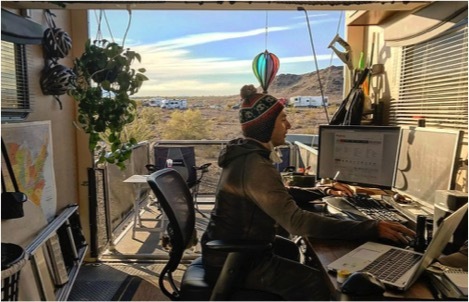
Waking up each morning to a radically new lifestyle can be quite liberating!
Developing Mobile Work-Life Strategies
For many, summer is the time to hit the road in a camper or RV, taking time off work to see the country from the comfort of a home on wheels.
But many free-spirited adventurers are now thinking summer never has to end. Taking advantage of the growing ubiquity of wireless Internet, the RV or camper can easily be converted into a drivable mobile office.
As of last year, 8.9 million American households owned RVs, and a smaller subset included roughly a half-million who lived full-time on the road. But it’s hard to know exactly how many of those full-timers and part-timers have actually learned how to work from the road.
After Covid-19, the nature of telework is making it easier than ever to work without a fixed physical location.
Naturally one of the critical components of having a remote office is good Wi-Fi. According to KOA CEO Pat Hittmeier, almost all 485 KOA campgrounds sites across the country have free Wi-Fi.
When Wi-Fi is not in range, those doing business on the go will turn to network air cards or satellite dishes.
We have seen a recent explosion of people opting to take their work in this fashion. A record number of RVs, motorcoaches, fifth wheel campers, and trailers are currently in the process of being converted into both office and living spaces.
If you ask why they’ve chosen to do their work from a recreational vehicle, many will cite the freedom that comes with a mobile lifestyle.
Whether they’re working from an RV park in Tuscan, a hotel room in Seattle, or their grandmother’s farm in Indiana, both their work-life and family-life will undergo a number of transitions along the way.

Mobile offices don’t need to be fancy, they only need to be functional!
Establishing a Mobile Base of Operations
Mobile offices don’t need to be fancy, they only need to be functional! [/caption]People tend to forget the importance of their local traffic patterns, because where they go and people they meet with on a semi-regular basis is important.
For example, moving into a new city they’ll need to find good referrals for doctors, dentists, chiropractors, auto mechanics, and veterinarians.
While most interactions with bankers, accountants, and lawyers can be done remotely, getting an engine repaired, finding an electrician, plumber, or new tires will require adding a few new contacts to a smartphone.
Even coordinating the delivery of an Amazon package can be a challenge.
Those who are on specialty diets such as vegan, gluten-free, lactose-free, or vegetarian may have trouble finding restaurant options in remote locations.
Very few situations, however, will be considered serious show-stoppers for the determined traveler.
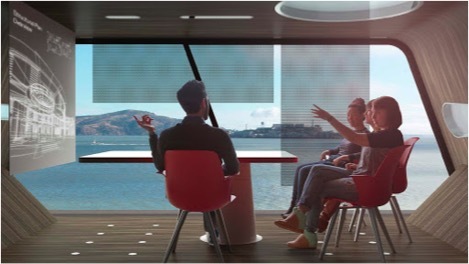
Mobile offices don’t need to be fancy, they only need to be functional!
Going Driverless
Driverless technology will invariably open the door to a whole new era of non-commuting vehicles, and one of the earliest examples we’ll see will be the driverless mobile office.
If you can imagine having an “office” pull up in your driveway, with dimmable windows, projectors, sound systems, 5G-enabled, with flexible, reconfigurable furniture that is perfect for both working alone and hosting meetings, you’ll get the picture.
Executives only need wireless access and the entire day can be managed from their mobile office, picking up people for each new meeting, and dropping them off before the next meeting begins.
Rather than working from an isolated home or a single office, mobile offices will add exotic new dimensions to every workday. But they can be far more than just an office.
A mobile office can also be working laboratories, tattoo parlors, manufacturing operation, arbitration court, zoning resolution station, police command center, mobile ER, fertility clinic, or pawn shop. Some will be owned by government agencies, some by businesses, but others will be part of a fleet and leased on a per-use basis.
Most importantly, these vehicles can operate as moving billboards, wrapped in branding slogans, with marketing messages emblazoned on every available surface.

In the not-too-distant future, driverless mobile offices will be common in most cities!
Final Thoughts
If you’re considering setting up a driveable mobile office, you’re not alone. But having the perfect office to fit your needs may be challenging.
Offices designed for a podcaster, videographer, graphic artist, programmer, script writer, jewelry maker, and movie editor will all require different toolsets.
In general, remote offices need a well-designed desk, good chair, great computer, ergonomic layout, solid internet connection, privacy, backup storage, and excellent lighting. You might also want to include extra video cameras, microphones, switchers, and backup plans for when things go wrong because things will always go wrong.
As the world emerges from the coronavirus, one nation after another will rise out of their collective cabin-fever. With lingering fears about social distancing and a possible return of the virus during flu season, travelers will most likely focus on drivable options.
Many places are already documenting an increase in camping and outdoor activities in areas where the current coronavirus hit earlier than the U.S., namely in Japan and Korea, where families are pitching tents rather than staying in hotels.
As air travel limps back into operation and most public transportation systems around the world are operating on drastically reduced schedules, people are re-imagining new ways to travel in a post-pandemic world.
Road trips are poised to make a resurgence as travelers shy away from international destinations requiring long flights and walking through crowded airports. They’re looking to travel and enjoy all the wonders of the world in ways that they feel are safe and comfortable.
For these reasons, we are witnessing a powerful new trend where the idea of working from a drivable office takes center stage.
Translate This Page
Select LanguageAfrikaansAlbanianAmharicArabicArmenianAzerbaijaniBasqueBelarusianBengaliBosnianBulgarianCatalanCebuanoChichewaChinese (Simplified)Chinese (Traditional)CorsicanCroatianCzechDanishDutchEnglishEsperantoEstonianFilipinoFinnishFrenchFrisianGalicianGeorgianGermanGreekGujaratiHaitian CreoleHausaHawaiianHebrewHindiHmongHungarianIcelandicIgboIndonesianIrishItalianJapaneseJavaneseKannadaKazakhKhmerKoreanKurdish (Kurmanji)KyrgyzLaoLatinLatvianLithuanianLuxembourgishMacedonianMalagasyMalayMalayalamMalteseMaoriMarathiMongolianMyanmar (Burmese)NepaliNorwegianPashtoPersianPolishPortuguesePunjabiRomanianRussianSamoanScottish GaelicSerbianSesothoShonaSindhiSinhalaSlovakSlovenianSomaliSpanishSudaneseSwahiliSwedishTajikTamilTeluguThaiTurkishUkrainianUrduUzbekVietnameseWelshXhosaYiddishYorubaZulu
#goog-gt-tt {display:none !important;}
.goog-te-banner-frame {display:none !important;}
.goog-te-menu-value:hover {text-decoration:none !important;}
.goog-text-highlight {background-color:transparent !important;box-shadow:none !important;}
body {top:0 !important;}
#google_translate_element2 {display:none!important;}
Search for:
Recent Posts
The Drivable Office: RVs, Motorcoaches, 5th Wheels, and Campers Become the Remote Office of the Future.
During periods of great chaos, comes great opportunities!
Facebook’s New Supreme Court: One Step Closer to Becoming a Virtual Country
Categories
Artificial Intelligence
Business Trends
Future of Agriculture
Future of Banking
Future of Education
Future of Healthcare
Future of Transportation
Future of Work
Future Scenarios
Future Trends
Futurist Thomas Frey Insights
Global Trends
Predictions
Social Trends
Technology Trends
Speaking TopicsFuture of Healthcare – “Is Death our only Option?
Future of AI
Future of Industries
By Futurist Thomas Frey, author of 'Epiphany Z – 8 Radical Visions Transforming Your Future'
The post The Drivable Office: RVs, Motorcoaches, 5th Wheels, and Campers Become the Remote Office of the Future. appeared first on Futurist Speaker.
May 28, 2020
During periods of great chaos, comes great opportunities!
During periods of great chaos, comes great opportunities!

Is this the time you’ve been waiting for to start a business?
It’s as if the Yahtzee game of life was just thoroughly shaken up, and an entirely new set of rules was dumped onto the table for us to deal with.
As we stare at this new rule set, yes we can spend our time complaining about it, or we can seize this golden opportunity, reinvent business, and run with it. After all, calamity is a great way to inspire creativity.
The only problem, opportunities are hard to spot, especially in today’s environment. It looks different, feels different, and may come wrapped in a legacy of shattered hopes and dreams.
Pre covid success stories will seem vastly different than the ones that follow. Think of this as the end of business as we know it and the beginning of something else.
Suddenly the sharing economy is bad. Stadiums are bad. In-person events, airports, crowded expos, parades, professional sports, movies, and comedy clubs have all been touched by the social distancing wand of disapproval.
Every post covid success story will come from those who managed to cut through the fog of uncertainty, make the right decisions, and build a durable strategy that can survive the tumultuous times ahead.
So where should you look?
One way is to look for good entry points in emerging new industries like delivery bots, e-learning, blockchain, VR conferences, synthetic biology, 5G apps, AI robotics, and quantum computing.
Another is to look for new trends in old industries like online marketplaces, digital payments, electronic health services, ghost kitchens, reshoring supply chains, online grocery stores, 3D printing, and last mile distribution centers.
Entrepreneurs building new businesses need to understand how the pandemic is shifting behavior and adapt to that change. History has shown that the best companies and the best founders come out of a crisis like this.
Forming the Mindset of an Entrepreneur
The pandemic and looming economic recession do make for a more challenging environment, so it’s especially important to consider what products and services are in demand right now, like food delivery, fitness, financial services, pharmaceutical, and e-commerce start-ups.
Once you develop a great, timely, and relevant idea, consider the following questions:
Who are your customers? In addition to deciding whether your product or service is targeted to consumers or businesses, ask yourself, “What sort of customer will want this, and is this the type of person I will enjoy working with?”
Where do those customers spend their time? Immerse yourself into the social media platforms or online forums where your future customers are so you can gain a better understanding of their wants and needs.
What are the best possible products for your customers? With a good understanding of who your customers are and what they need, you can fine-tune the product or service you intend to offer. That includes honing in on your pricing, defining what makes you different, and developing a unique selling proposition like a guarantee, bonus, premium, or exclusive deals to entice new customers.
Iterate and test, rinse and repeat, will be the guiding principles for startups.
1. Reshoring Operations
Reverse globalization trends are already emerging as companies seeking supply chain resiliency are starting to move manufacturing closer to the consumer and creating redundancy in manufacturing and distribution operations. This trend will pick up steam as leaders ensure that their organizations are never caught off guard like this again.
2. Cybersecurity
Working from home and an increased dependence on internet connectivity are creating a perfect storm for cybersecurity issues. We’re seeing a growing need for improvement, both for our systems and to protect the personnel that could fall victim to phishing scams and other social engineering attacks. But the increased awareness of these attacks could be a boon to cybersecurity solutions providers.
3. AI Facial Diagnostics
Facial recognition tech is already being used as a tool in the fight against COVID-19. In China, companies like Hanwang Technology have rolled out apps that can recognize faces, even if the person is wearing a surgical mask. By employing temperature sensors these systems can also flag citizens with an elevated body temperature in a crowd since having a fever is one symptom of COVID-19. With additional tweaking, potential carriers of the coronavirus can be flagged and identified even in public spaces.
4. Electronic Health Services
Up to this point, telemedicine has not been the success story many were hoping for. Health-related services such as monitoring, advice and education between doctors and patients online over a secure connection, promised to be the forefront of the future of medicine. The overarching goal was to make state-of-the-art healthcare more accessible without waiting for hours at the doctor’s office. However, since only a handful of countries and regions have adopted telemedicine, this could easily become a golden opportunity for the right entrepreneurs.
5. Automation
Robotics will see an acceleration due to COVID-19 as companies look to implement more automation into their operations. New supply chains will emphasize local manufacturing, reshoring, and more lights-out productivity. This all requires new forms of robotics. Tech companies are being encouraged to rapidly adopt new tools and quickly iterate on their products and processes to bolster their manufacturing and logistics. Companies are turning to early stage startups for answers, and this will become more common as businesses struggle to stay ahead of the curve.
6. Funeral Industry
The entire funeral industry has moved to more of a “cremate and wait” approach to dealing with deaths during Covid-19. For those wanting to wait for a casket/cemetery burial, being able to find refrigerated storage for bodies has become particularly challenging. Virtual funerals are now being produced with mixed reviews. While funerals have been integral to the overall grieving process, families and friends of the deceased have had to make do. For all these reasons, the funeral industry has become a prime candidate for disruption.
7. Buying Businesses Out of Bankruptcy
Over the coming months many businesses will use the coronavirus as an opportune time to throw in the towel. Some will do it out of necessity, others are simply tired of the daily grind, and still more will reach their end due to a variety of circumstances. A few will become available through bankruptcy while others will show up on other posting sites. But rest assured, there will be tons of businesses for sale. The primary challenge will be for you to assess the true value of the business and turn it into an ongoing profit center.
8. Retail
Retail comes in many forms ranging from online shopping, to mobile businesses, custom design shops, ghost storefronts, and traditional bricks and mortar. Whatever form the seller may take, our appetite for buying things has not gone away. Entrepreneurs trying to build a retail business will have to understand how the pandemic is going to shift user behavior in the future and adapt.
9. Healthcare
Healthcare is transitioning from an industry driven by pharmaceuticals to an industry driven by data. A digital twin is a virtual representation of a real-life physical product, building, or person. It can take the form of a chair, desk, lamp, house, or even your next-door neighbor. With enough sensors, any item that exists in the physical world can be replicated with a digital twin. So how long will it be before doctors can monitor some’s health remotely through their digital twin? This example is just one of many opportunities in our future healthcare industry.
10. Assisted Living Centers
Retirement villages, including walled, gated, and separate senior living enclaves have had their day. Eight in ten senior living executives report that residents are moving out faster than new ones are moving in. The inability of family members to visit residents during a lock-down over the past few months, coupled with high costs at a time of widespread economic distress make this a perfect storm for disruption. Some of these short-term challenges will fade over time, but many will not.
11. Freelancers
The coronavirus pandemic is thrusting our work-life into the spotlight, revealing some of the fundamental problems that define work for the 57 million Americans, or 35% of the country’s workforce that make their living by being self-employed. Freelancers contribute $1 trillion annually to the GDP, and they operate largely without benefits, meaning no sick leave, no unemployment, and no paid time off. As the pandemic progresses, it’s becoming clear that demand for freelance workers, whether they’re writers, performers, ride-share drivers, or hospitality workers, is increasing. Self-employment could easily become a safer option than full-time jobs in the future.
12. Portable Charging Units
The world’s electric-car infrastructure is growing by leaps and bounds. But there are still gaps – places without chargers that could be served if EV charging was portable, flexible, and put on wheels. Colorado-based Lightning Systems today became one of the latest companies to introduce a mobile DC fast charger for electric vehicles. As electric cars become increasingly common, the demand for battery failure solutions in odd locations will become far more common.

It’s important to keep your peripheral vision intact while scanning the opportunity landscape.
Final Thoughts
It’s important to keep your peripheral vision intact while you’re scanning the opportunity landscape, because most that appear will look nothing like a possible candidate when you first see them.
Make no mistake, right now is a great time to start a business, because there’s a tremendous opportunity to provide new versions of products and services that people want and need.
The pandemic has accelerated the pace of digitalization. Prime candidates to focus on are businesses that can be improved by making either a structural change or where a change that was already anticipated has just kicked it into another gear.
One important step is to test your product or service with prospective customers. Given some of the uncertainties now, it’s critical to start with a minimal budget to minimize the downside.
You will want to test it out on a small group first before you invest a lot of money into it. Iterate and test, rinse and repeat, will be the guiding principles for startups. Once proven, you can pour a lot of gasoline on the fire and scale it as quickly as you need to.
Be patient, be persistent, innovate, and realize that nothing happens overnight.
As always, please feel free to weigh in and let us know what you think.
Translate This Page
Select LanguageAfrikaansAlbanianAmharicArabicArmenianAzerbaijaniBasqueBelarusianBengaliBosnianBulgarianCatalanCebuanoChichewaChinese (Simplified)Chinese (Traditional)CorsicanCroatianCzechDanishDutchEnglishEsperantoEstonianFilipinoFinnishFrenchFrisianGalicianGeorgianGermanGreekGujaratiHaitian CreoleHausaHawaiianHebrewHindiHmongHungarianIcelandicIgboIndonesianIrishItalianJapaneseJavaneseKannadaKazakhKhmerKoreanKurdish (Kurmanji)KyrgyzLaoLatinLatvianLithuanianLuxembourgishMacedonianMalagasyMalayMalayalamMalteseMaoriMarathiMongolianMyanmar (Burmese)NepaliNorwegianPashtoPersianPolishPortuguesePunjabiRomanianRussianSamoanScottish GaelicSerbianSesothoShonaSindhiSinhalaSlovakSlovenianSomaliSpanishSudaneseSwahiliSwedishTajikTamilTeluguThaiTurkishUkrainianUrduUzbekVietnameseWelshXhosaYiddishYorubaZulu
#goog-gt-tt {display:none !important;}
.goog-te-banner-frame {display:none !important;}
.goog-te-menu-value:hover {text-decoration:none !important;}
.goog-text-highlight {background-color:transparent !important;box-shadow:none !important;}
body {top:0 !important;}
#google_translate_element2 {display:none!important;}
Search for:
Recent Posts
During periods of great chaos, comes great opportunities!
Facebook’s New Supreme Court: One Step Closer to Becoming a Virtual Country
All the Wrong Incentives! A complex coronavirus made worse with bad incentives!
Categories
Artificial Intelligence
Business Trends
Future of Agriculture
Future of Banking
Future of Education
Future of Healthcare
Future of Transportation
Future of Work
Future Scenarios
Future Trends
Futurist Thomas Frey Insights
Global Trends
Predictions
Social Trends
Technology Trends
Speaking TopicsFuture of Healthcare – “Is Death our only Option?
Future of AI
Future of Industries
By Futurist Thomas Frey, author of 'Epiphany Z – 8 Radical Visions Transforming Your Future'
The post During periods of great chaos, comes great opportunities! appeared first on Futurist Speaker.
May 14, 2020
Facebook’s New Supreme Court: One Step Closer to Becoming a Virtual Country
Facebook’s New Supreme Court: One Step Closer to Becoming a Virtual Country
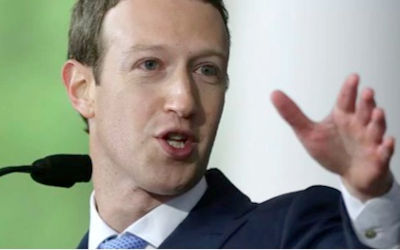
Facebook’s new “Supreme Court” will help deflect criticism as user friction grows!
Facebook’s announcement of their new “Supreme Court,” an announcement that was triggered by the coronavirus, represents a massive turning point in human history. While this may not be their goal, it looks like they’re on the verge of creating their own virtual country.Before jumping to the conclusion that this is “good” or “bad,” my take is that a virtual country is inevitable.
If Facebook were a country, its 2 billion users would make it the largest country in the world. Its $600 billion market cap makes it one of the most valuable companies in the world, and by far the most influential news organization on planet earth.
In late 2018, Facebook CEO Mark Zuckerberg announced plans to create an independent oversight board that could overrule Facebook’s content moderation guidelines, and even overrule Zuckerberg himself.
With a growing number of fake news tools, political divides, and super influencers, Facebook found itself being used to propagate misinformation, spread half-truths, persuade, brainwash, and incite action among increasingly larger groups of impressionable followers.
Unlike a traditional phone line, Facebook is a one-to-many platform. A simple video can go from zero to 10 million views in less than a day.
But Facebook is much more than a conduit for information. It’s a brand, status symbol, a form of entertainment, town-hall meeting, and in many ways, a stamp of approval.
It’s new “Supreme Court” represents a new kind of global authority, much needed in resolving cultural, political, and global conflicts. At the same time, it will operate much like an official policy-making branch of government.
The board is independent from Facebook, but Facebook is funding the board’s operations to the tune of $130 million per year.
If users believe their content was removed from the service unfairly or without cause, they can appeal to this independent board directly. If it decides to reverse Facebook’s decision, that decision “will be binding,” Zuckerberg said, “even if I or anyone at Facebook disagrees with it.”
This naturally takes the pressure off Zuckerberg because he and his staff will no longer be held accountable for any perceived biases in Facebook’s policy.
Members of Facebook’s Supreme Court
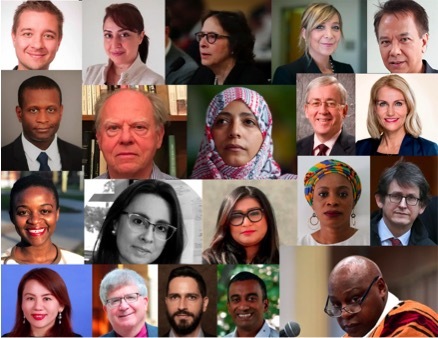
The initial slate for the Supreme Court is filled with a mix of journalists, judges, digital rights activists and former government advisers from around the globe. Evenly split between men and women, varying political agendas, races, and geography, members appear to represent a broad spectrum of interests.
Here is a list of the first 20 Board Members, which will grow to 40 over time.
Tawakkol Karman – First Arab woman to win a Nobel Prize, Co-Founder of Women Journalists Without Chains
Maina Kiai – Kenyan lawyer and Director of the Human Rights Watch Global Alliances and Partnerships
Evelyn Aswad – Professor and Chair, University of Oklahoma College of Law
Endy Bayuni – Executive Director of the International Association of Religion Journalists and Board Member for The Jakarta Post
Pamela Karlan – Professor at Stanford Law School
Nighat Dad – Founder of the Digital Rights Foundation in Pakistan and South Asia
Emi Palmor – Advocate and Lecturer, Interdisciplinary Center Herzliya, Israel
John Samples – VP at the Cato Institute
Catalina Botero-Marino – Dean, Law School at Universidad de Los Andes in Colombia
Michael McConnell – Professor and Director of the Constitutional Law Center, Stanford Law School
Afia Asantewaa Asare-Kyei – Program Manager, Open Society Initiative for West Africa
Ronaldo Lemos – Professor, Rio de Janeiro State University’s Law School in Brazil
András Sajó – Founding Dean of Legal Studies, Central European University in Hungary
Sudhir Krishnaswamy – Vice Chancellor and Professor of Law, National Law School of India University
Katherine Chen – Professor, National Chengchi University in Taiwan
Helle Thorning-Schmidt – Former Prime Minister, Denmark
Nicolas Suzor – Professor, School of Law at Queensland University of Technology in Australia
Julie Owono – Executive Director, Internet Sans Frontières (Internet Without Borders) in France
Alan Rusbridger – Principal at Lady Margaret Hall, and former Editor-in-Chief of The Guardian
Jamal Greene – Professor, Columbia Law School
Former Danish prime minister Helle Thorning-Schmidt, Michael McConnell, Jamal Greene, and Catalina Botero-Marino will co-chair the Board.
So far there are no details about how often these groups will meet, whether it’s in person or virtual, overall size of their caseload, or the most urgent matters at hand.
Each Board Member will have their own staff along with their own areas of responsibility.
According to Facebook’s press release, they will focus on the most challenging content issues for Facebook, including areas such as hate speech, harassment, and protecting people’s safety and privacy. It will make final and binding decisions on whether specific content should be allowed or removed from Facebook and Instagram (which Facebook owns.)
Establishing a Credible Presence
Back in 2015, I first discussed the idea of “fractal organizations,” which represent a narrow spectrum of global authority managed by a board of directors comprised of directors from each member state. Here’s what I imagined:
“Since technology is exceeding governments’ ability to manage it, new global systems in the form of fractal organizations will emerge as a possible solution. Each fractal would be highly automated, and comes with its own management structure.”
“I think of them as fractals because each represents a tiny bit of order in an ocean of chaos. If fractals catch on, we will also see other new patterns of governance emerge. Fractal Organizations will be positioned at the intersection of national and global governance.”
Facebook has been well aware of the enormity of its growing problem. “One of the most painful lessons I’ve learned,” CEO Mark Zuckerberg wrote in late 2018, “is that when you connect two billion people, you will see all the beauty and ugliness of humanity.”
This Board will give it a huge amount of credibility, deflecting much of today’s criticism, allowing both Zuckerberg and Chief Operating Office, Sheryl Sandberg, to focus more on the business side of the equation.
That said, they’ve only begun to peel back the layers of possibility here. One step at a time, I’m convinced Facebook will evolve into something resembling a virtual country, and the world will be much better off because of it.
These are the initial 20 members of Facebook’s Supreme Court.

How can “Facebook Laws” coexist with the laws of other countries?
Understanding Virtual Countries
Perhaps the simplest definition of a virtual country is one without land and borders. The country, or land, on which members of a virtual country reside will be referred to as a host country.
The Internet has created a vast number of borderless economies, and each are confusing issues of power and control, and even the sovereignty of nations. We are entering a new era of public power and control. The true power that is beginning to emerge is more Technocratic, meaning that we are beginning to reorganize the world around the technical imperatives of global competitiveness and economic efficiencies.
In the past we have associated the concept of country with attributes like geographical boundaries, common people, common language, common government, national currency, its own set of laws and regulations, and a series of systems that tie the country into a functional entity.
But not all nations have their own land. Throughout history there are many examples of people in exile or nationalities with a strong heritage and a differentiated culture that exist as a people within one or several countries.
The concept of a virtual country brings into questions some of the traditional notions about what creates the cohesion or loyalty within a group of people. One of the key functions is the ability to resolve conflict and that’s exactly what Facebook is creating.
Can Today’s Nation-State Co-Exist with a Virtual Country?
Countries today are described as nation-states. The concept of a nation-state took root in the little remembered Treaty of Westphalia that was signed in 1648 AD. The Treaty sorted out some of the land issues in Europe and opened the doors for religious freedom by creating some levels of separation between church and state. But a very significant part of this Treaty involved the recognition of one country’s ability to sign a treaty with another country. This became the operational ground rule for all major countries – self-defined relationships with other countries.
Traditionally, governments that operate as a nation-state provide a protective bubble over their people, giving them systems and structures within their borders to live and operate businesses. But several technology trends, such as borderless economies, are beginning to complicate traditional government control over their own citizens.
As a first step, if Facebook bought an island and moved the company headquarters to neutral ground, it would feel less subject to the whims of other countries. Naturally this will raise many more questions:
What services can Facebook provide that traditional countries can’t?
Why would the move to a virtual country be superior to operating as a multinational corporation?
Should Facebook have the right to form treaties with other countries?
Will the move to a virtual country make it more resilient and adaptable to change?
How can Facebook create a relationship with members that is the equivalent of citizenship?
As a “Facebook Citizen,” what rights, liberties, freedoms, and protection should you come to expect?
How can “Facebook Laws” coexist with the laws of other countries?
Does Facebook have the resourcefulness and staying power to make any of this viable?
Can Facebook make the Transition to a Virtual Country?
At the end of WW1, USA President Woodrow Wilson promoted the concept of “self-determination”, a powerful idea in the 19th century, particularly for Europe. The message from President Wilson on Jan 8, 1918 stated:
“…every peace-loving nation which, like our own, wishes to live its own life, determine its own institutions, be assured of justice and fair dealing by the other peoples of the world as against force and selfish aggression. All the peoples of the world are in effect partners in this interest, and for our own part we see very clearly that unless justice is done to others it will not be done to us.”
Stepping through a logical transition from Facebook as a business to Facebook as a country, it might begin with turning over corporate policy decisions into a democratic process. Since user data is already leveraged to determine most of their business decisions, formalizing their data collecting into more of a voting process would help cement the relationship with their “citizens.”

The process would begin with formalizing a constitution, or statement of purpose, outlining their mission and goals both for themselves, their people, and ongoing role and commitment to planet earth. Once that’s created, they would form a transition team to help manage each stage of development and serve as a sounding board for objections, pushback, and criticism.
After the Supreme Court, the next agency would be a ‘foreign ministry” office to manage their relationship with other countries.
Facebook is already imposing an “eyeball tax” on all their users. Additional fee structures may be imposed over time. Keep in mind, people are always free to leave if they don’t like it.
If Facebook proceeds to introduce their own Libra cryptocurrency, will that enable them to create their own online banking system as well? Will Facebook citizens be able to take out a house loan or business loan through the Bank of Facebook?
With the amount of data flowing through their platform, Facebook already has the ability to make risk assessments that may be far more accurate than traditional credit bureaus.
Final Thoughts
Facebook will continue to evolve with or without making the transition to a virtual country.
That said, existing governments do not like the idea of having their citizens under someone else’s control. It creates the potential for developing an enemy army within the confines of its own territory, with the potential for disrupting domestic peace and tranquility.
However, all nations have “outsiders” existing within the confines of their own borders. Whether or not the person is a citizen of a virtual country is of little consequence to the host nation provided the person abides by the laws and pays all their taxes.
But one of the big attractions of joining a virtual country will be the ability to operate outside of the bounds of your existing country. The idea of being able to say “these laws don’t apply to me” is a huge incentive for some people. And that is where the security issues become a massive concern. Forging an equitable rule of law among all people in a country is one of the founding principles of democracy.
For this reason, virtual countries will, by necessity, have to guarantee non-interference in the laws of the host nation. They will also have to guarantee that all of their citizens will abide by the laws, and be subject to any legal or judicial system serving to enforce compliance.
To be sure, the creation of Virtual Countries will be fraught with many problems. Recognition of new countries is discretionary and highly political. New Nation-States must be recognized implicitly or explicitly by other nation-states.
In order to guarantee international security and avoid conflicts, an International Organization, such as the United Nations, will need to exercise some controls.
Competing for citizens is not a concept that will be easily accepted by existing countries. The United Nations will invariably play a significant role in the formation of virtual countries. But it will be the “will” of the constituency that will determine a virtual country’s viability.
Is this a path Facebook can or should go down?
I’d love to hear your thoughts. When will the value of virtual relationships begin to equal that of physical relationships? Is this inevitable?
Translate This Page
Select LanguageAfrikaansAlbanianAmharicArabicArmenianAzerbaijaniBasqueBelarusianBengaliBosnianBulgarianCatalanCebuanoChichewaChinese (Simplified)Chinese (Traditional)CorsicanCroatianCzechDanishDutchEnglishEsperantoEstonianFilipinoFinnishFrenchFrisianGalicianGeorgianGermanGreekGujaratiHaitian CreoleHausaHawaiianHebrewHindiHmongHungarianIcelandicIgboIndonesianIrishItalianJapaneseJavaneseKannadaKazakhKhmerKoreanKurdish (Kurmanji)KyrgyzLaoLatinLatvianLithuanianLuxembourgishMacedonianMalagasyMalayMalayalamMalteseMaoriMarathiMongolianMyanmar (Burmese)NepaliNorwegianPashtoPersianPolishPortuguesePunjabiRomanianRussianSamoanScottish GaelicSerbianSesothoShonaSindhiSinhalaSlovakSlovenianSomaliSpanishSudaneseSwahiliSwedishTajikTamilTeluguThaiTurkishUkrainianUrduUzbekVietnameseWelshXhosaYiddishYorubaZulu
#goog-gt-tt {display:none !important;}
.goog-te-banner-frame {display:none !important;}
.goog-te-menu-value:hover {text-decoration:none !important;}
.goog-text-highlight {background-color:transparent !important;box-shadow:none !important;}
body {top:0 !important;}
#google_translate_element2 {display:none!important;}
Search for:
Recent Posts
Facebook’s New Supreme Court: One Step Closer to Becoming a Virtual Country
All the Wrong Incentives! A complex coronavirus made worse with bad incentives!
Contact Phobia – The growing fear of human touch and our shift towards a contactless world
Categories
Artificial Intelligence
Business Trends
Future of Agriculture
Future of Banking
Future of Education
Future of Healthcare
Future of Transportation
Future of Work
Future Scenarios
Future Trends
Futurist Thomas Frey Insights
Global Trends
Predictions
Social Trends
Technology Trends
Speaking TopicsFuture of Healthcare – “Is Death our only Option?
Future of AI
Future of Industries
By Futurist Thomas Frey, author of 'Epiphany Z – 8 Radical Visions Transforming Your Future'
The post Facebook’s New Supreme Court: One Step Closer to Becoming a Virtual Country appeared first on Futurist Speaker.
May 7, 2020
All the Wrong Incentives! A complex coronavirus made worse with bad incentives!
All the Wrong Incentives! A complex coronavirus made worse with bad incentives!

Science behind “dangling carrots,” which is always about the money, shows it rarely works as planned!
If you’re having a hard time getting an accurate picture of what’s going on with the coronavirus, you’re not alone. In a world that has become obsessed with the latest news, testing numbers, trends, and death tolls, it doesn’t help having behind-the-scenes incentives that are guaranteed to give you a false read on what’s actually going on.The science of incentives has been hotly debated for centuries, primarily because we all know incentives work, but often not in the way they were intended to.
One story that illustrates the problem took place years ago when W. Edwards Deming made a visit to a shoe factory, and the plant manager proudly reported that he had sent one of his quality inspectors home for a week without pay. Inspectors were paid weekly according to the number of shoes they inspected.
When an inspector found a defect in a pair of shoes, they personally had to repair it before they could go on to inspect the next pair of shoes. So, the more defects they found, the fewer shoes got inspected, and the lower their weekly paycheck.
The plant manager said he had discovered one particular inspector gaming the system. He quickly figured out which production workers produced the fewest defects and focused his time just on them. For this reason, the inspector needed to be reprimanded, and was sent home for a week without pay.
Dr. Deming told the plant manager that he was the one that should have been sent home since he created the system. It was the incentives that drove the behavior, and the plant manager didn’t realize that he had created the circumstances that led to those results.
Throughout history business managers, politicians, and system designers have focused on architecting the right incentives. However, everything we thought we knew about incentives has been changing, and many of the ones we have today have been created by new kids on the block like tech companies, health insurance rules, retirement plans, investment advisors, and unemployment systems just to name a few.
In general, the best way to understand future trends is to study the incentives. Human behavior is often driven by a particular set of incentives hiding in the background. But you’ll see in a few moments why it’s so difficult to track incentives during the coronavirus era!
Riddled with bad incentives
As we went through the process of closing down businesses, parks, and restaurants, countless millions lost their jobs, and with it, we lost our sense of purpose. The goals that seemed so important last year suddenly became meaningless.
That’s when panic set in and the first visible signs of the pandemic were empty store shelves, empty streets, and a conspicuous sense of desperation.
We quickly dipped into survival mode.
The survivalist mindset is the most rudimentary level of thinking on Maslow’s hierarchy of need. Step one was hoarding – hoarding food, hoarding cash, and hoarding any supplies that made life doable.
Armored cars filled with cash made extremely large bank deliveries to calm the fears of panicked customers. Supply chains were slower to adapt, but were soon revamped to compensate for shortages.
Panic buying was replaced with binging – binge-watching television, binge-cooking, binge-eating, binge-playing video games, and binge-calling to fill our growing social void.
Now, with the reopening of society just a dangling carrot away, our full attention is once again switching to what comes next. And it’s during this time that the black fog of uncertainty starts to lift as we reset our passions, goals, and desires on high beam to decide the next logical move.
As we look around, we begin to realize how messed up our sense of reality is. While we were distracted, trying to survive quarantine, many new incentives were put into place, causing people to respond in a whole new way.

It’s not possible to have this many top-down decisions without a huge number of unintended consequences!
Problem #1: Paying more money to hospitals for COVID-19 deaths
Incentive: Medical systems do get paid more for Medicare patients diagnosed with COVID-19. Even if it’s only presumed they have COVID-19, without having an actual lab test confirming anything, they get paid more.
If it’s a straightforward, garden-variety pneumonia that a person is admitted to the hospital for, the payment is $5,000. But if it’s COVID-19 pneumonia, then it’s $13,000, and if that COVID-19 pneumonia patient ends up on a ventilator, it goes up to $39,000.
This higher allocation of funds was part of the CARES Act which included a Medicare 20% add-on to its regular payment for COVID-19 patients.
Unintended Results: Skewed data is always a problem. All of the numbers we’re looking at to decide how risky it is to be around others has been artificially inflated by medical groups trying to make extra money.
Problem #2: Pay-per-click ads driving sensationalized headlines and news hysteria
Incentive: Any news site that derives its revenue from pay-per-click ads has a vested interest in posting headlines and topics that garner the most attention. Many even go through a series of A-B testing to see which headline attracts the most attention. Fear is a great motivator and any article that scares readers will invariably generate more money.
Unintended Results: Heightened levels of fear, anxiety, and depression lead to greater levels of drinking, spousal abuse, child abuse, and suicide. While elevated levels of hysteria may earn more money, the psychological toll it takes on the rest of society will be several thousand times more expensive.
Problem #3: Paying people more to stay unemployed
Incentive: Entire new classes of people are being encouraged to file for unemployment, receive an additional $600 per week for 2.5 months, and stay on unemployment for up to a full year.
Unintended Results: Many now make more money on unemployment and have no incentive to return to work. At the same time, many companies are looking at this as an opportunity to clean house. Older workers, minorities, vocal and activist employees are most at risk here. We will be witnessing the greatest job transition in all history.
Problem #4: First-come-first-serve stimulus money
Incentive: Tremendous amounts of money were put into play with the CARES Act, but when everyone found out there wouldn’t be enough to go around, panic set in.
Unintended Results: The mad rush to apply for loans and stimulus money has been overwhelming, using dated systems that were never designed to handle this much volume. Extended response times and too few contact numbers has many people spooked. Small business owners are waiting in limbo to decide if they should close down altogether.
Problem #5: SBA programs creating an unwritten hierarchy of need
Incentive: Fast loans, minimal interest, with super low barrier-to-entry seemed like a dream come true for most small businesses. But now reality has set in.
Unintended Results: Recipients of the SBA loans are overwhelmed by the 19-page document full of onerous restrictions that make the accompanying loans or grants painful to manage. Many will choose to close rather than have the SBA looking over their shoulder. We will witness one of the largest closure of businesses in all history.
Problem #6: Public companies getting publicly outed
Incentive: All small businesses, both public and private, were encouraged to apply for fast and easy low interest loans and stimulus money.
Unintended Results: Since public companies are required to report on what they’re doing, public companies became the media whipping boys for perceived abuses to the programs. At the same time, private companies stayed hidden in the background. Once again, being a public company has lost much of its appeal, so don’t expect new IPOs anytime soon.
Problem #7: The political blame-game turns the whole country into a circus
Incentive: Everything about a pandemic makes it the perfect kind of crisis to blame on other countries, other cultures, and other political parties.
Unintended Results: Spin doctors are working overtime to cast aspersions on political opponents. There is a high likelihood national, cultural, and racial discrimination will manifests itself in increased trade wars and increased tensions globally.
Final Thoughts
As it turns out, McAllen, Texas is one of the most expensive health-care markets in the US. Medicare spends nearly double the national average on people in McAllen and twice what they spent in El Paso County, Texas, even though they have nearly the same demographics.
The cost difference stems from overuse of medicine and procedures. For example, Medicare found that patients in McAllen received 20% more abdominal ultrasounds, 30% more bone-density studies, 60% more stress tests with echocardiography, 200% more nerve-conduction studies to diagnose carpal-tunnel syndrome, and 550% more urine flow studies to diagnose prostate problems.

What incentives are guiding your healthcare provider decisions?
The research went on to show significantly more gallbladder operations, knee replacements, breast biopsies, and bladder scopes, as well as 200%-300% more pacemakers, implantable defibrillators, cardiac-bypass operations, carotid endarterectomies, and coronary-artery stents. They also found five times as many home-nurse visits.
The lesson here is that “more care is generally not better care,” because the outcomes showed no significant difference between McAllen and El Paso.
The researcher in this study identified three types of physicians.
Those who are oblivious to the financial implications of their decisions.
Those who think of the money as a means of improving what they do.
Those who see their practice primarily as a revenue stream. They instruct their secretary to have patients who call with follow-up questions to schedule an appointment, because insurers don’t pay for phone calls, only office visits.
There is a widely held perception today that healthcare companies are just in it for the money. While that may be true in many cases, Mayo is doing just the opposite.
Mayo Clinic, which is among the highest-quality, lowest-cost healthcare systems in the country, figured out how to solve this problem decades ago.
The executive team at Mayo recognized that it needed to eliminate financial barriers, so they pooled all the money doctors and the hospital received and began paying everyone a salary. By doing this, the doctors’ goal in patient care couldn’t be tied to increasing their income.
Mayo promoted leaders who focused first on what was best for patients, and then on how to make this approach financially possible. The core tenet of Mayo Clinic is ‘The needs of the patient come first.’
They didn’t worry whether it was inconvenient for the doctors, or their revenues. To this end, doctors, nurses, and even the janitors, sit together in weekly meetings to work on ideas for making their service and care better, not to get more money out of their patients.
Part of the reasons people are so critical of the U.S. healthcare system is because they have no idea what incentives are being used to guide behavior in the background.
For this reason, it looks like we might be on the verge of a new transparency trend in the healthcare industry where people are given a clear understanding of costs before any charges are incurred.
If you have additional thoughts, ideas, or comments, please feel free to add to the conversation.
Translate This Page
Select LanguageAfrikaansAlbanianAmharicArabicArmenianAzerbaijaniBasqueBelarusianBengaliBosnianBulgarianCatalanCebuanoChichewaChinese (Simplified)Chinese (Traditional)CorsicanCroatianCzechDanishDutchEnglishEsperantoEstonianFilipinoFinnishFrenchFrisianGalicianGeorgianGermanGreekGujaratiHaitian CreoleHausaHawaiianHebrewHindiHmongHungarianIcelandicIgboIndonesianIrishItalianJapaneseJavaneseKannadaKazakhKhmerKoreanKurdish (Kurmanji)KyrgyzLaoLatinLatvianLithuanianLuxembourgishMacedonianMalagasyMalayMalayalamMalteseMaoriMarathiMongolianMyanmar (Burmese)NepaliNorwegianPashtoPersianPolishPortuguesePunjabiRomanianRussianSamoanScottish GaelicSerbianSesothoShonaSindhiSinhalaSlovakSlovenianSomaliSpanishSudaneseSwahiliSwedishTajikTamilTeluguThaiTurkishUkrainianUrduUzbekVietnameseWelshXhosaYiddishYorubaZulu
#goog-gt-tt {display:none !important;}
.goog-te-banner-frame {display:none !important;}
.goog-te-menu-value:hover {text-decoration:none !important;}
.goog-text-highlight {background-color:transparent !important;box-shadow:none !important;}
body {top:0 !important;}
#google_translate_element2 {display:none!important;}
Search for:
Recent Posts
All the Wrong Incentives! A complex coronavirus made worse with bad incentives!
Contact Phobia – The growing fear of human touch and our shift towards a contactless world
Never Again! 10 Future Inventions designed to identify, manage, and crush future pandemics.
Categories
Artificial Intelligence
Business Trends
Future of Agriculture
Future of Banking
Future of Education
Future of Healthcare
Future of Transportation
Future of Work
Future Scenarios
Future Trends
Futurist Thomas Frey Insights
Global Trends
Predictions
Social Trends
Technology Trends
Speaking TopicsFuture of Healthcare – “Is Death our only Option?
Future of AI
Future of Industries
By Futurist Thomas Frey, author of 'Epiphany Z – 8 Radical Visions Transforming Your Future'
The post All the Wrong Incentives! A complex coronavirus made worse with bad incentives! appeared first on Futurist Speaker.
April 30, 2020
Contact Phobia – The growing fear of human touch and our shift towards a contactless world
Contact Phobia – The growing fear of human touch and our shift towards a contactless world
 Over the past couple weeks we’ve been beat over the head with phrases like social distancing, wash your hands, shelter at home, wear your mask, and disinfect everything. These messages have left us with an overarching fear of touching…. virtually anything.
In fact, my wife now has a set routine for every delivery, grocery store pickup, or any outside surface we come into contact with – she disinfects everything. We have unleashed our “inner germ-a-phobe” and the value of the human touch has sunk to less than zero. Touching things is bad, and our new “contact phobia” will manifest itself in unusual ways.
Much of this will play out in the way we send and receive packages in the future.
In 2015, I was asked to keynote the Annual Turkish Postal Symposium in Antalya, Turkey, an event focused on the future of the postal industry, where thought leaders from around the world gathered to discuss next-generation postal systems.
I focused my talk around a central question – “How long will it be before we can mail a package and have it travel to a city on the other side of the world without ever being touched by human hands?”
The example I used was a package traveling from Istanbul to San Francisco, arriving without human contact.
While it seemed like more of a science fiction vision of the future at the time, it has become all too real today.
Thinking through the path of automation, and especially now, I find this to be a logical transition in the future. Once we set a package into motion, it will essentially guide itself to its final destination by way of a completely automated global distribution network.
 The changing psychology of human nature
The threat of contagion has twisted our psychological responses to ordinary interactions, leading us to behave in unexpected ways.
Rarely has the threat of disease occupied so much of our thinking.
For weeks, almost every newspaper has posted front-page stories about the coronavirus pandemic. At the same time, every radio and TV show has back-to-back coverage on the growing number of cases and death toll. And depending on whom you follow on social media, frightening statistics coupled with gallows humor becomes the topic of every conversation.
This constant bombardment by the media has resulted in heightened levels of anxiety, massively influencing our own mental health. But it goes far deeper than that.
It’s leaving psychological imprints so deep that many of us have become “super judgy,” critical of anyone who doesn’t subscribe to our own personal rules of compliance. As we search for ways to survive, we become more tribalistic and less accepting of any foibles or proclivities.
Our moral judgment has moved to the extremes as we become harsher in our social attitudes, and more traditionalist when considering issues such as immigration, sexual freedom, and equality. These daily reminders of disease do indeed sway our political leanings.
Ten Scary Trends being created by “Contact Phobia”
Recent studies have shown that when we fear a virus or pandemic, we tend to be more critical of others. This comes into play when we hear an employee badmouthing his or her company, or when we see someone disrespect an authoritative figure such as a boss or judge.
Naturally, incidents like these have nothing to do with the spread of the disease, but by dissing conventional thinking, people give off signals that they’re willing to break other more relevant rules that are needed to keep the disease at bay.
Our fear of illness is also physiologically expensive. These changing attitudes that stem from our fear of the human touch, will cause a number of ominous and risky shifts in global behavior.
Keep in mind, any number of changing variables can alter these trends, but based on our current temperaments, these become a logical direction for our future.
1. Shrinking world view
A growing concern of contagions will lead us to ‘gain control’ and become more conformist and less accepting of attitudes outside the norm. Our ethical judgements become more rigid and our political, religious, and sexual attitudes more conservative.
2. Protectionism
Our behavioral immune system operates on a ‘better safe than sorry’ logic, altering our moral decision-making and political opinions on issues that have nothing to do with the current threat.
3. De-globalization
The post-pandemic world will be marked by tighter restrictions on the movement of goods, services, capital, labor, technology, data, and information.
4. Growing anti-immigration sentiments
Besides making us more critical of the people within our own social groups, the threat of disease is also leading us to be more distrustful of strangers.
5. Fear of trying something new
Those who worry about illness tend to prefer “conventional” or “traditional” individuals, and less likely to feel an affinity towards “creative” or “artistic” people.
6. Longer-term personal relationships
In a recent study, a reminder to wash hands led participants to be more judgmental of unconventional mannerisms and sexual behaviors. By extension, adventuresome lifestyles are out and marriage will suddenly be back in vogue.
7. Longer-term business relationships
In general, we become more conformist and respectful of convention when we feel the threat of a disease, and less likely to do business with someone we don’t know.
8. Democracy backlash
Government becomes the new whipping boy. Economic weakness, mass unemployment, and rising inequality will lead to blaming foreigners, openness, and elected officials for the crisis. Blue-collar workers and broader segments of the middle class will become more susceptible to populist rhetoric, particularly proposals to restrict migration and trade.
9. Growing risk of deflation
As the recession deepens, a lower demand for goods will mean unused machines, factories, and over capacity. Mass unemployment will drive a price collapse in commodities such as oil and industrial metals, making deflationary debt a strong likelihood, increasing the risk of insolvency.
10. Demographic time bomb
With much more public spending being allocated to health systems, a universal health care approach becomes a necessity, not a luxury. But since most developed countries are having fewer kids and increased lifespans, funding these programs will make the rapidly accumulating debts from today’s unfunded health-care and social-security systems appear even more ominous.
Mailing a package in 2030
It’s hard to imagine so many things being affected by the human touch, but that’s exactly what’s happening. And the leading barometer of change will be the way we send and receive deliveries.
So what will it be like to mail a letter or package ten years from now?
As I envision the process, the person sending an item will simply place it outside their front door, and take a photo of it with a special shipping app on their phone. This will start the process, detailing the package size, dimensions, and GPS coordinates, and the sender will add particulars such as destination, level of urgency and weight category (i.e. under 10 lbs). Within minutes, a robotic pickup service will arrive, retrieve the package, and load it onto a drone delivery vehicle.
While the sender will know the approximate price when they put it into the app, they will get exact pricing once the package is picked up, along with tracking details, and exact time of delivery.
Since packages come in a variety of shapes and sizes, it’s reasonable to assume limits on the size and the weight, both on the high end as well as the low end. As example, a package the size of a grain of salt or as light as a helium balloon will need to be in a larger package. On the larger end of the spectrum, mailing items like furniture, exercise equipment, or motorcycles will require a different kind of delivery service altogether.
In addition to size and weight issues will be a series of legal requirements for shipping restricted items like alcohol, pharmaceuticals, cannabis, live animals, biohazard materials, or products with special handling requirements like fragile glass, frozen food, or sensitive instruments. Establishing limits, rules, and standards will be part of the overarching strategy needed to develop this emerging global system.
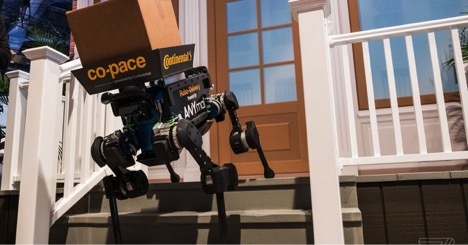
ANYmal is a delivery bot designed to work with virtually every kind of pickup and delivery!
Package pickup
Today’s delivery systems place a heavy emphasis on using a standardized shipping label for every package, however the label itself could be produced by the delivery service and coded onto the package once it’s been picked up. In some cases, it may be beneficial to work with specialty sensor labels to track the condition of sensitive contents in real time.
Retrieving a package from someone’s front door presents a huge number of engineering challenges.
First, the robot will have to travel to and from where the package is. Obstacles could include stairs, trees, broken sidewalks, no sidewalk, dogs, cats, squirrels, snakes, rain, hail, snow, children, rocks, and mud to name just a few.
The package could be square, round, triangle, rectangle, or an odd shape that is hard to describe, but it shouldn’t matter. Once picked up, every package will be rewrapped in an ultra-thin shipping material that is waterproof and virus-proof.
Robotic retrieval bots will be trained to compensate for fences, gates, security guards, locked doors, motion detectors, nosey neighbors, piles of leaves, or overgrown lawns.
Naturally, timing will be an issue. Food deliveries will demand immediate attention, but for everything else, a package left outside for 2 minutes will generally be fine, but one left exposed to the elements for 30-60 minutes could have any number of things go wrong. For this reason, the relatively simple task of retrieving a package can be riddled with complexity.
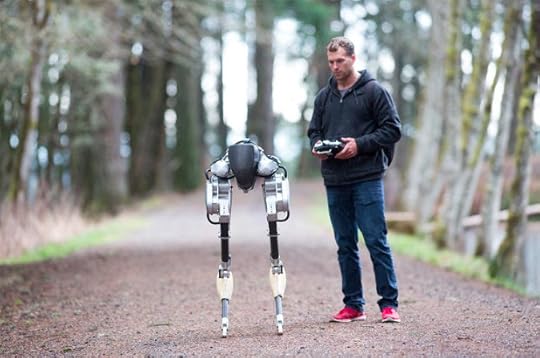
Bots that pickup from a home are not the same as ones that take packages across country borders!
The missing pieces
Naturally there are many missing pieces to the fully automated global system that will eventually be created.
Smart Deliver Boxes
A huge opportunity awaiting the first person to create a globally accepted, robo-dockable mailbox and universally protective package-wrap.
1. Universal Mailing Labels
Labels will monitor both the package’s location and the condition of its content.
2. Robotic Customs Agents
There will always be a need to inspect and monitor package contents to prevent the distribution of illegal items.
3. Trained Human Operators
As a system designed “by humans for humans,” there will still need to be a number of skilled human operators to monitor operations and step in whenever something goes wrong.
The list above is intended to highlight a few opportunities, but admittedly glosses over many of the details and intricacies involved in developing a complete global system. Over time the need for boxes and packaging will decline and disappear altogether as super smart systems know how to deal with every object on an individual basis.

Are we heading towards a touchless world? Does that scare you?
Final Thoughts
In a recent webinar on the future of the airline industry, one corporate exec said they were trying to create a touchless experience from the curb to the gate.
While it’s hard to imagine a touchless airport experience, it’s equally as hard imagining going to touchless grocery stores, touchless fitness centers, touchless dentists, touchless chiropractors, touchless nursing homes, and touchless daycare centers.
Arising from the middle of all this contact phobia will be a growing number of counter-activists thumbing their nose at touchless-advocates, demanding the right to return to a human-centered existence.
After all, researchers have demonstrated countless times that the human touch contains several health benefits for our physiological and psychological well being.
Hugging induces oxytocin, the “bonding hormone,” that’s renowned for reducing stress, lowering cortisol levels and increasing our sense of trust and security. According to researchers at the University of North Carolina, women who receive more hugs from their partners have lower heart rates, blood pressure, and higher levels of oxytocin.
The human touch in all its forms, hugging, hand holding, cuddling, and simply caressing a forehead, has been shown to be super beneficial, health-wise, physically and emotionally.
Ironically, the same kind of human touch that may have triggered the coronavirus in the first place, may be exactly what gives us back enough control of our lives to end it.
If you have additional thoughts, ideas, or comments, please feel free to add to the conversation.
Translate This Page
Select LanguageAfrikaansAlbanianAmharicArabicArmenianAzerbaijaniBasqueBelarusianBengaliBosnianBulgarianCatalanCebuanoChichewaChinese (Simplified)Chinese (Traditional)CorsicanCroatianCzechDanishDutchEnglishEsperantoEstonianFilipinoFinnishFrenchFrisianGalicianGeorgianGermanGreekGujaratiHaitian CreoleHausaHawaiianHebrewHindiHmongHungarianIcelandicIgboIndonesianIrishItalianJapaneseJavaneseKannadaKazakhKhmerKoreanKurdish (Kurmanji)KyrgyzLaoLatinLatvianLithuanianLuxembourgishMacedonianMalagasyMalayMalayalamMalteseMaoriMarathiMongolianMyanmar (Burmese)NepaliNorwegianPashtoPersianPolishPortuguesePunjabiRomanianRussianSamoanScottish GaelicSerbianSesothoShonaSindhiSinhalaSlovakSlovenianSomaliSpanishSudaneseSwahiliSwedishTajikTamilTeluguThaiTurkishUkrainianUrduUzbekVietnameseWelshXhosaYiddishYorubaZulu
#goog-gt-tt {display:none !important;}
.goog-te-banner-frame {display:none !important;}
.goog-te-menu-value:hover {text-decoration:none !important;}
.goog-text-highlight {background-color:transparent !important;box-shadow:none !important;}
body {top:0 !important;}
#google_translate_element2 {display:none!important;}
Search for:
Recent Posts
Contact Phobia – The growing fear of human touch and our shift towards a contactless world
Never Again! 10 Future Inventions designed to identify, manage, and crush future pandemics.
How the coronavirus will trigger a massive new underground economy
Categories
Artificial Intelligence
Business Trends
Future of Agriculture
Future of Banking
Future of Education
Future of Healthcare
Future of Transportation
Future of Work
Future Scenarios
Future Trends
Futurist Thomas Frey Insights
Global Trends
Predictions
Social Trends
Technology Trends
Speaking TopicsFuture of Healthcare – “Is Death our only Option?
Future of AI
Future of Industries
By Futurist Thomas Frey, author of 'Epiphany Z – 8 Radical Visions Transforming Your Future'
The post Contact Phobia – The growing fear of human touch and our shift towards a contactless world appeared first on Futurist Speaker.
April 23, 2020
Never Again! 10 Future Inventions designed to identify, manage, and crush future pandemics.
We’re about to enter the most innovative period of all human history!
Most of the biggest advances in human health have happened outside the hospital.For example, the number one advance in all history has been the filtering of water supplies. Water tech is a complicated topic because only 2% of the planet’s water is drinkable “fresh” water. And since only about 25% of that is actually accessible, the entire human race has survived on 0.05% of all of the world’s water. Even today, the filtering of water continues to be an ongoing challenge.
Other non-medical advances to health include the invention of toilets, pasteurization, auto safety improvements, anti-smoking campaigns, desalinization, precision agriculture, air conditioning, 3D printing, and data analytics.
Those innovations all took place in parallel with well-know medical advances like anesthesia, blood transfusions, insulin, CPR, organ transplants, pacemakers, bypass surgery, radiology, and vaccines.
It’s because of our distorted view of the medical industry’s role in these advances that we naturally turn to doctors and scientists to find answers for a pandemic like COVID-19. However, finding a vaccine is only one of dozens of possible solutions, most of which will stem from radical different approaches.
Here are ten alternative tech strategies that could be equally or more effective than a vaccine.
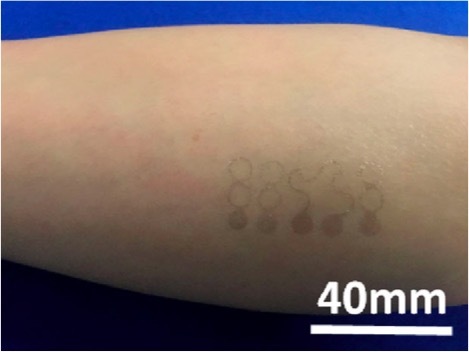
University of Texas researchers have developed ultra-thin graphene sensors similar to digital tattoos.
1. Digital Tattoo for Monitoring Blood
A graphene health sensor applied to the skin, like a digital tattoo, could be used to take real-time measurements and do analytical assessments of a person’s blood. A couple years ago at the International Electron Devices Meeting in San Francisco a graphene tattoo, similar to this, was demonstrated. It was being billed as the thinnest epidermal electronics ever made, and was used to measure electrical signals from the heart, muscles, and brain, as well as skin temperature and hydration.
Graphene electrodes are ideal because they can pick up changes in resistance caused by a person’s own micro-electrical activity under their skin. Since the healthcare industry is heavily invested in selling tests, a graphene tattoo that can track and analyze a person’s blood, spewing hyper-individualized analytics 24-7, will be a huge game changer both for the healthcare industry and in the war against future pandemics.
2. Odorometer for Monitoring Smells
In 2004, two Americans, Dr. Richard Axel and Linda B. Buck, were awarded the Nobel Prize in medicine for discovering how people can recognize and remember an estimated 10,000 different smells, ranging from smelly garbage to expensive perfume.
Their breakthrough stemmed from a 1991 discovery of a family of genes devoted to producing different odor-sensing proteins, called receptors, in the nose. Since then science has progressed, and our ability to develop super-sensitive sensors that can “smell” a disease is now within grasp!
Still, receptor patterning has a ways to go before we’re ready to develop a definitive periodic table of elements for the nose.
3. Skin Coatings
Early on in the filming of Star Trek Next Generation, Brent Spiner, the actor who played the sentient android Lieutenant Commander Data was growing tired of applying his makeup every day. So he asked Gene Roddenberry, “Don’t you think that by this time in history, they would’ve figured out how to make skin look like skin?”
Roddenberry replied, “What makes you think that what you have isn’t better than skin?”
Underlying Spiner’s question was the assumption that humans have already achieved the ultimate form, but have we?
Isn’t it reasonable to think about reengineering human skin, by creating a coating or new levels of resilience that will make us virus-proof? Are we only a layer of skin away from solving this problem?
4. UV Light Disinfectant
UV light is nature’s disinfectant, but can it kill coronavirus? If we look at previous viruses, such as SARS and MERS, studies show that UV light effectively inactivated the viruses. So it’s not unreasonable to think that it would have a similar effect on COVID-19.
But on the down side, ultraviolet radiation can also damage human DNA, causing health problems such as skin cancer or cataracts in the eyes. For this reason, it could be used to disinfect an empty restaurant, hotel room, or airplane, but much more work is needed when it comes to disinfecting people.
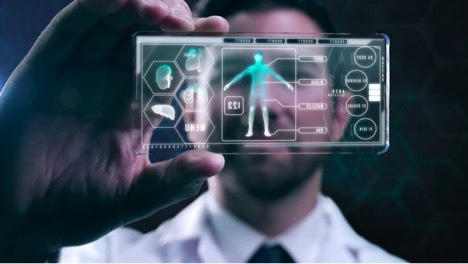
Many new forms of health scanners will spring to life in the coming years!
5. Super High Resolution Infrared Scanners
Many years ago I spent time working with infrared sensors, and since then I’ve often wondered if it would be possible to monitor people from a distance by tracking their personal heat signatures. As this technology moves up the exponential growth curve of precision and data specificity, what inevitably becomes possible is our ability to monitor a person’s health from a distance.
Having a device that could scan the temperature of the entire human body in real-time, both internally and externally, at 1 millimeter resolution would give us enormous amounts of data for spotting virtually any kind of underlying health issues, including viruses.
6. Super High Speed Wifi to Every Square Inch of the Planet
For those wanting to leverage the power of data to solve the coronavirus, our sixth generation of Wi-Fi – Wi-Fi 6 – provides more speed, lower latency, and increased device density. The fifth generation of wireless, or 5G, is the latest cellular technology, engineered to increase the speed and capacity of wireless networks.
Both 5G and Wi-Fi 6 bring the promise of dramatically better tools for managing a contagious disease. For those working from home, they provide higher data rates to support new applications and increases in network capacity with the ability to connect more devices.
All this means more data, more places, simultaneously. And for researchers hoping to crack the covid-code through pattern recognition, AI analytics engines today are able to accomplish a thousand times the output of those working 30 years ago.
7. Self-Disinfecting House
The self-cleaning house has been the dream of housewives and househusbands since the dawn of time. It is finally within reach as smart home technology, combined with the Internet of Things, begins to invade our lives.
Applying this in a far more specific way, it’s easy to imagine a house that can scan itself both internally and externally, monitoring for any potential virus infestations, and deploying robots to disinfect the hotspots seems entirely doable.
We may even start adding disinfection stations at the entrances to buildings, stadiums, and concert venues.
8. Search Engines for the Physical World
Online search technology has framed much of our thinking around our ability to find things. In general, if it’s not digital and online, it’s not findable.
In the future, drones and sensors will replace much of the work of today’s web crawlers when it comes to defining our searchable universe. Search technology will soon become far more sophisticated as we will be able to search for attributes like smells, tastes, harmonic vibration, textures, specific gravity, levels of reflectivity, and barometric pressures. More specifically, they’ll be able to search for attributes specifically associated with a particular virus or disease.
9. Neurohacking
The goal of neurohackers is to solve biological problems by “hacking the brain.” In the past they’ve attempted to help people improve reflexes, learn faster, or treat psychological disorders.
While past efforts have focused on the use of chemical supplements to increase brain function, a new generation of neurohackers have started experimenting with complex medical devices that can be implanted and used to treat illnesses. Some of the primary objectives are to coax the body into healing itself by amping up secretion from targeted glands, revitalizing the immune system, and building resistance to disease by augmenting the body’s own defense mechanisms. Neurohacking has particularly strong potential for solving the self-awareness equation inside a pandemic.
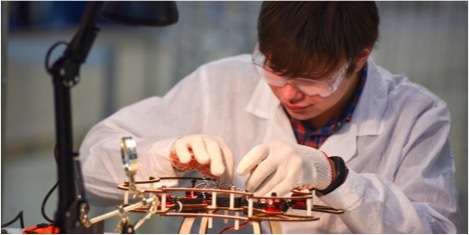
An entire new breed of inventors are working overtime to solve the coronavirus and future pandemics!
10. Digital Twin Technology
A digital twin is a virtual representation of a real-life physical product, building, or person. It can take the form of a chair, desk, lamp, house, or even your next-door neighbor. Any item that exists in the physical world can be replicated as a digital twin.
For anyone managing a business, digital twins offer unique insights into how products or processes are operating in real time, even from a remote location.
Yes, the concept of digital twins has been around for a while, with consulting groups like Gartner hailing it as a game-changing technology, but businesses have been slow to embrace it because it’s still rather complicated to implement.
To scan and monitor the health of an individual will require next generation levels of intricacy. As we step from detail and accuracy to micro-detail and micro-accuracy, these super elaborate 3D models will enable us to visualize how our physical bodies are performing and changing every nanosecond. If our metabolism changes, we can instantly tell what went wrong. More important, we can begin to anticipate problems and devise preemptive strategies to circumvent diseases before they occur.
Final Thoughts
Anti-pandemic tech will be springing to life in far more interesting ways than the few possibilities I’ve mentioned here.
Instead of using mapping apps to tell you about traffic jams and how to get to a favorite restaurant or retail business, we will shift towards using big data, machine learning, and crowdsourcing to facilitate social distancing and crowd-manage large gatherings. The goal will be to minimize crowds, using real-time data from smartphones, wearable devices, and vehicles.
With huge numbers of people working from home, our typical 9-5 workdays are likely to shift toward more flexible work schedules, with a significant portion of the workforce expected to become “night people” for those who prefer to rest during the daytime while others are working.
For most businesses, we will move away from having standard business hours.
Most will switch to 24/7 business operations. This will include companies that traditionally did not operate this way, such as for supermarkets, takeout food businesses, centralized food distribution, and preparation centers.
All of these will require enabling technologies for supply chain and logistics management to serve a population that will always be awake and in need of goods and services any time of the day. Keep in mind, low-traffic night-deliveries can be far more efficient than fighting daytime traffic.
Your future is all about you, and how you’ll fit into this continually evolving idea-scape. I’m sure I’ve missed many of the technologies you may be interested in, but the discussion is only getting started. If you have additional thoughts, ideas, or comments, please feel free to add to the conversation as every new pixel on the masterpiece of life will help us build a better future.
Translate This Page
Select LanguageAfrikaansAlbanianAmharicArabicArmenianAzerbaijaniBasqueBelarusianBengaliBosnianBulgarianCatalanCebuanoChichewaChinese (Simplified)Chinese (Traditional)CorsicanCroatianCzechDanishDutchEnglishEsperantoEstonianFilipinoFinnishFrenchFrisianGalicianGeorgianGermanGreekGujaratiHaitian CreoleHausaHawaiianHebrewHindiHmongHungarianIcelandicIgboIndonesianIrishItalianJapaneseJavaneseKannadaKazakhKhmerKoreanKurdish (Kurmanji)KyrgyzLaoLatinLatvianLithuanianLuxembourgishMacedonianMalagasyMalayMalayalamMalteseMaoriMarathiMongolianMyanmar (Burmese)NepaliNorwegianPashtoPersianPolishPortuguesePunjabiRomanianRussianSamoanScottish GaelicSerbianSesothoShonaSindhiSinhalaSlovakSlovenianSomaliSpanishSudaneseSwahiliSwedishTajikTamilTeluguThaiTurkishUkrainianUrduUzbekVietnameseWelshXhosaYiddishYorubaZulu
#goog-gt-tt {display:none !important;}
.goog-te-banner-frame {display:none !important;}
.goog-te-menu-value:hover {text-decoration:none !important;}
.goog-text-highlight {background-color:transparent !important;box-shadow:none !important;}
body {top:0 !important;}
#google_translate_element2 {display:none!important;}
Search for:
Recent Posts
Never Again! 10 Future Inventions designed to identify, manage, and crush future pandemics.
How the coronavirus will trigger a massive new underground economy
Finding the Opportunities and Filling the Void
Categories
Artificial Intelligence
Business Trends
Future of Agriculture
Future of Banking
Future of Education
Future of Healthcare
Future of Transportation
Future of Work
Future Scenarios
Future Trends
Futurist Thomas Frey Insights
Global Trends
Predictions
Social Trends
Technology Trends
Speaking TopicsFuture of Healthcare – “Is Death our only Option?
Future of AI
Future of Industries
By Futurist Thomas Frey, author of 'Epiphany Z – 8 Radical Visions Transforming Your Future'
The post Never Again! 10 Future Inventions designed to identify, manage, and crush future pandemics. appeared first on Futurist Speaker.
April 16, 2020
How the coronavirus will trigger a massive new underground economy
How the coronavirus will trigger a massive new underground economy

The primary trigger for underground economies will be the inequitable distribution of bailout money!
How long can you survive when your money runs out?
This is an important question today because many are seeing their remaining reserves dwindle and disappear altogether.
In general, it’s impossible to have this many top-down decisions without creating a massive number of unintended consequences.
One logical consequence will be an underground economy so people can still survive when their bank accounts hits zero.
When desperation sets in, all bets are off. Normal rules of decorum and civility get tossed out the window as survival instincts take over and food, water, shelter, and safety become a top priority.
We’ve become very dependent upon a monetary system that, for many of us, is no longer functional. The government’s intended safety net is riddled with holes.
Many of our traditional revenue streams have been abruptly changed, postponed, reduced, or halted completely. At the same time, governments around the world are scrambling to fill the gaps. But this is an imperfect world, filled with imperfect governments, resulting in gaping holes in what they intended to have happen.
When people get desperate, they’ll do whatever it takes to survive. This includes necessities like putting food on the table, finding places to live, clean water to drink, beds to sleep in, and solutions for a multitude of other problems that crop up. With an unprecedented number of changes happening all at once, the sheer volume of problems will often seem overwhelming.
For these reasons, our traditional set of rules and order used to guide our actions instantly gets grayed out in our minds as we’re reduced to primal instincts for survival.
The Unemployment Trigger
A few days ago, several friends informed me that the unemployment they recently applied for, would stay in effect until March-April of next year. This naturally raised several issues as virtually everyone will want to preserve this income stream for the full duration.
While an unemployment check will pay some of the bills, it generally won’t cover a lifestyle many have become accustomed to. So unless a particularly good job comes along, most will be looking for ways to supplement it.
Part time gigs like delivery jobs and ride sharing will help, but most will be able to leverage their skills in different ways as contractors, freelancers, and off-books labor.
Still some will choose to push the envelope, and for those truly motivated, far more money can be made in the shadow economies of the hacker world.
Underground Economies do not happen by Accident
Underground economies have traditionally shown up as a result of imperfections in an economic system or inadequacies in economic policy. While many complex factors come into play, typical causes are excessive tax burdens, government over-regulation, and poor performance by government agencies such as tax, judiciary, police, and other authorities.
In the coronavirus era, the trigger for underground economies will be the inequitable distribution of bailout money.

Never underestimate the power of devious minds!
Any entrepreneur that either gets funding or misses out will be challenging the status quo. Those with funding will attempt to leverage it far beyond anything they did in the past, and those who do not will be forced to go underground.
In general, people who feel disenfranchised or let down by “the system” become far more likely to lash out. When someone has too much time on their hands, and feels like they’ve been screwed, devious minds often percolate to the surface.
At the same time, our toolset for exploiting an underground economy has been growing exponentially. I’ll warn you in advance, there is plenty of technical jargon associated with shadow or hacker economies, yet each of these tools are only a YouTube video away from being skilled in using them
Underground Economy – Level One
We’re all aware of deals today that rarely get reported as income. In the overall scheme of things, this kind of activity has only amounted to a rounding error of significance. However, it won’t take much to move small-scale activities into much larger operations.
Barter
For the trading of goods and services, several barter apps already exist, many with significant networks already in place.
Online Marketplaces
For those selling on Amazon, eBay, Etsy, and thousands more, it will only take minor changes to shift from a traditional above-board business to one with significant off-book income.
Cash and Cash Alternatives
Working with under-the-table payments of cash, money orders, bonds, gift cards, prepaid credit cards, and other non-traditional forms of payment.
Crypto Transfers
Our rapidly advancing crypto world, with thousands of currencies each with their own advantages and disadvantages. Every breed of crypto offers its own degree of anonymity. As expected, crypto exchanges are experiencing a massive surge in new users as bailout packages flood the traditional exchanges with new money.
Underground Economy – Level Two
Level two takes us deep into the hacker underworld, where risks appear relatively low and new tools are being developed on a daily basis.
Database Breaches
Cyber attacks often start by hacking a database full of credentials. This gives them access to a network, and the ability to sell credentials on various dark web forums. Through a series of privilege escalation hacks, they can start reading business emails, send ransomware demands, and stage other types of attacks.
Instant Shell Corps
A shell corporation is a company with no office and no employees. They typically have a bank account, passive investments, or serve as the registered owner of assets. Shell corps are a common tool to mask who the true owners actually are, and used to launder money through currency exchanges.
Keyloggers
A keylogger is a type of monitoring software or hardware designed to record what you write. It can either be a program on your computer or a small device connected to your PC and keyboard, but its purpose is to keep track of everything you’ve been typing.
Banking Injects
Banking injects are widely published, popular, and powerful tools for performing fraud. They often involve fake overlays that are used with banking trojans to inject code that collects sensitive information before redirecting the user to a legitimate website.
Exploit Kits
Exploit kits are automated programs used by attackers to exploit known vulnerabilities. They can be used to secretly launch attacks while victims are browsing the web, with the goal being to download and execute some type of malware.
Spam and Phishing
These types of attacks generally involve email campaigns to gain access to hundreds of thousands of victims for the purpose of deploying malware or to gain further access into a network.
Credential Stuffing
This is where hackers take a massive trove of usernames and passwords, often from a corporate megabreach, and try to “stuff” those credentials into the login page for other companies. Since people often reuse the same username and password across multiple sites, hackers can often use one piece of credential info to unlock multiple accounts.
Loaders and Crypters
Hackers will also apply “loaders and crypters” to elude detection by antivirus software, and then download and execute one or more malicious programs, such as malware.
Sniffers
In an underground economy, sniffers refer to a type of malware written in JavaScript designed to infiltrate and steal card-not-present (CNP) data from the checkout pages of e-commerce websites.
Automated Marketplaces
If the goal is to monetize the data that hackers have acquired, there are tons of online credit card shops and marketplaces. Yes, there is a huge market for the buying and selling of banking credentials, cell phone accounts, online store accounts, dating accounts, and even digital fingerprints of compromised systems, all in an attempt to facilitate further breaches.
Underground Economy – Level Three
If we combine everything above with news manipulation techniques like misrepresented experts, data distortions, twisting facts, false claims, and deceptive headlines, we have a true recipe for disaster. This will become the proving ground for next generation puppet-masters.
Fake News and Fake Cover ups
On top of all the other hacker tools and techniques, people will figure out how to exploit the use of fake news, fake people, and fake reality to cover their trail and cast blame on innocent parties simply to make them look bad. As always, our biggest danger comes when these tools find their way into the hands of devious people.
My guess is that literally millions of cons are already in play and we won’t hear about them until several people and companies have lost their life savings.
Even more perplexing will be those who are operating in the grey areas of the law, using just enough fake-ness and fuzziness and staying somewhat legal.

Could some form of universal basic income be a solution?
Final Thoughts
Wherever we draw the line separating the legal from the illegal, there’s money to be made on both sides of the line.
Please understand that I’m not advocating doing anything illegal. But we need to acknowledge the likelihood of these possibilities.
One thing that could prevent many from going down this path is some form of guaranteed minimum income.
Will the prospects of a full year of unemployment, that may be extended even longer, set the stage for a “guaranteed minimum income” program? If all adults were given a survivable income of $2,000-$2,500 a month, no questions asked, how would that change society?
The Spanish government is working to roll out a universal basic income (UBI) as soon as possible, as part of a battery of actions aimed at countering the impact of the coronavirus pandemic.
But the government’s broader ambition is that basic income becomes an instrument that stays forever, that becomes a structural instrument, a permanent instrument of change.
Spain is dealing with the second worst coronavirus outbreak in Europe, and the pandemic has pushed the government to order a state of emergency, which has put the country in lockdown and driven the economy to a stand-still. The government has announced a barrage of policies to assist self-employed workers and companies, mainly small and medium-sized, but has also said that more measures will be required.
As always, I’d love to hear your thoughts so feel free to weigh in if you have opinions on this topic.
Translate This Page
Select LanguageAfrikaansAlbanianAmharicArabicArmenianAzerbaijaniBasqueBelarusianBengaliBosnianBulgarianCatalanCebuanoChichewaChinese (Simplified)Chinese (Traditional)CorsicanCroatianCzechDanishDutchEnglishEsperantoEstonianFilipinoFinnishFrenchFrisianGalicianGeorgianGermanGreekGujaratiHaitian CreoleHausaHawaiianHebrewHindiHmongHungarianIcelandicIgboIndonesianIrishItalianJapaneseJavaneseKannadaKazakhKhmerKoreanKurdish (Kurmanji)KyrgyzLaoLatinLatvianLithuanianLuxembourgishMacedonianMalagasyMalayMalayalamMalteseMaoriMarathiMongolianMyanmar (Burmese)NepaliNorwegianPashtoPersianPolishPortuguesePunjabiRomanianRussianSamoanScottish GaelicSerbianSesothoShonaSindhiSinhalaSlovakSlovenianSomaliSpanishSudaneseSwahiliSwedishTajikTamilTeluguThaiTurkishUkrainianUrduUzbekVietnameseWelshXhosaYiddishYorubaZulu
#goog-gt-tt {display:none !important;}
.goog-te-banner-frame {display:none !important;}
.goog-te-menu-value:hover {text-decoration:none !important;}
.goog-text-highlight {background-color:transparent !important;box-shadow:none !important;}
body {top:0 !important;}
#google_translate_element2 {display:none!important;}
Search for:
Recent Posts
How the coronavirus will trigger a massive new underground economy
Finding the Opportunities and Filling the Void
Foresight Journaling – Unlocking the secret truths to your hidden future!
Categories
Artificial Intelligence
Business Trends
Future of Agriculture
Future of Banking
Future of Education
Future of Healthcare
Future of Transportation
Future of Work
Future Scenarios
Future Trends
Futurist Thomas Frey Insights
Global Trends
Predictions
Social Trends
Technology Trends
Speaking TopicsFuture of Healthcare – “Is Death our only Option?
Future of AI
Future of Industries
By Futurist Thomas Frey, author of 'Epiphany Z – 8 Radical Visions Transforming Your Future'
The post How the coronavirus will trigger a massive new underground economy appeared first on Futurist Speaker.
April 9, 2020
Finding the Opportunities and Filling the Void
While it’s easy to focus on the negative, the true opportunities lie in the positive side of life!
While it’s easy to focus on the negative, the true opportunities lie in the positive side of life!While it’s easy to focus on the negative, the true opportunities lie in the positive side of life! What things did you do last summer that you can’t do today?
For most, summer was filled with outdoor activities like going to sporting events, concerts, swimming, parades, festivals, and farmers markets.
Those things won’t be happening this year.
The same goes for all of our nightlife activities like dancing, fireworks displays, nightclubs, family gatherings, going shopping, and dining out.
Virtually every activity that we’ve come to enjoy over our entire lifetime has come to an abrupt stop, and business as usual is no longer business as usual.
So what is it that will fill the void?
We can only watch so much television. Our backyard barbecues lose their appeal when they happen every night. And everything we had planned for summer vacations has been delayed until next year.
While a few things can be delayed, others cannot.
Many churches have begun hosting drive-up church services with pastors, priests, and ministers speaking to the crowds through FM signals going directly to the car radio.
Restaurants in Michigan are experimenting with drive-up fish fry events for Lent.
It will be interesting to see how the Republicans and Democrats manage to host their big election-year conventions in advance of the Presidential Election.
Those of you who still have a job consider yourself either lucky or trapped, or both. Even the work-from-home crowds are hugely distracted by stress and anxiety of their surrounding communities.
For this reason, we’re seeing some great opportunities emerging from the woodwork for people who have the talent and creativity to sync up with the mindset of those needing a lifeline. If we were to make a list of all these opportunities, it would include substitutes for:
Sporting events – baseball, football, soccer, golf, basketball void
Entertainment, movie theater, gambling, trampoline park,
Shopping, farmers market, garage sale, lemonade stand void
Nightclub, dance club, casino, theater void
Concerts, rockfests, musicals, live performance void
Waterpark, playground, miniature golf, carnival, and swimming void
Convention, meeting, grand opening, expo, open house, events void
Parade, festival, street performer, magician, comedian void
Innovative people are now staring at a blank canvas trying to imagine ways to solve a pent up demand for finding new ways to interact with others.
So what does that look like? We’re part of a very creative culture so some of our future thinking involves questions like:
Instead of car racing, will people become more interested in drone racing?
Instead of boxing matches, will we see a surge in popularity of robot boxing?
Instead of video games, will people start playing conspiracy theory games?
Instead of fantasy football, will people start playing fantasy politics?
One fascinating example is the Getty Image Art Challenge, which sprung to life when the Getty Museum created a competition where people browse its online collection and recreate famous images, but with a modern day twist!

Joseph Ducreux, “Self-Portrait, Yawning” (1783), Recreation by Paul Morris
with British redcoat and twisty towel (courtesy the J. Paul Getty Museum)
8 Opportunities to Reinvent our World during the Coronavirus
We’re already seeing examples of virtual birthday parties, virtual funerals, virtual dinner parties, virtual workouts, and virtual happy hours. But each of these are but a stepping stone to what comes next.
1. Drive-Up Events
“Storytelling After Dark” would involve a simple stage, maybe in a shopping center parking lot, with a dramatic reading, comedy show, or theatrical performance, telling ghost stories, melodramatic mysteries, or historical tales to entertain crowds in a new and unusual ways, all transmitted through the FM radio on people’s cars. These could be sponsored by local businesses, libraries, or a city.
A variation might be “drive-up concerts.” With all of the musicians out of work, this becomes an interesting option for them. Once again, these events could be sponsored by neighboring brewpubs, restaurants, cannabis dispensaries, and retail shops. Phone numbers would be posted up front or handed out for people to order. Those attending could listen through open windows, FM radio, and even some strategically placed outside seating.
2. Competitions
When the whole world goes back to normal, many businesses will push hard to regain their customer base. For this reason, finding sponsoring companies willing to offer promotional items as prize packages could be relatively easy. Future events such as gambling weekends, train trips, cruise get-aways, and flight packages are just a few of many possible options. For this reason we will see a wide variety of new competitions ranging from treehouse designs, to pranks, situational photo contests, one-minute comedies, home office design, plant wall design, blank-wall painting, mowed-lawn-messaging, and, of course, a drone-spying competition, just to name a few. The range of these competitions is only limited by our imagination.
3. Parades
The idea of a megaphone parade is rather interesting. With no one on the streets, only people waving from doors and windows, a megaphone parade would involve an endless line of people in cars saying crazy things from their megaphones. Perhaps a variation of this idea would include a kid-and-puppy parade, kazoo-band parade, flashlight parade, or a scarecrow parade.
4. Reinventing Business
For those paying close attention to the changing nuances of human behavior, this is a perfect time to launch a new business. Virtual startup teams are now able to loop in all the top talent from other ventures, most of whom have been recently sidelined or laid off as the dangling carrot of stimulus money makes its way through the pipeline. This is a rare moment in time to think deeply about business models that have the potential to redefine life on planet earth.
5. Reinventing Funerals – The funeral industry has not been one to instantly jump on the latest craze and experiment. However, with bodies stacking up in makeshift facilities everywhere, and virtually no one interested in traveling cross-country to attend a wake or funeral, we have an instant need for something new. The traditional grieving process has always involved crying, hugging, and human-to-human contact. So is there a way to duplicate this outlet for highly emotional feelings virtually? Keep in mind, it’s not just people dying from COVID-19. It is also people dying of heart attacks, cancer, liver failure, car accidents, domestic violence, gang wars, malaria, suicide, and every other cause imaginable. There’s a huge opportunity waiting for the person who can come up with a good solution.
6. Reinventing Childcare
Until now, most parents have acclimated to their own version of work-life-parenting balance. For many, being thrust back into the role of full-time parenting, coupled with homeschooling, lingering work obligations, phone-calls, Zoom meetings, grocery shopping, paying bills, filing for unemployment, and dealing with heightened levels of media hysteria has most young parent teetering very close to the breaking point. At the same time, virtually every one of them feels they have their hands tied as traditional daycare, babysitters, and grandparent options have disappeared. This is the perfect time for some ingenious person to reinvent child care altogether.
7. Learning New Skills
We’re shifting into an entirely new gear. Society is changing faster today than ever before in history. Once business returns to our next iteration of “normal,” we will find ourselves struggling to keep up. At the moment, it is up to us individually to decide what new skills will make us the most adaptable, resourceful, resilient, and marketable in the future. While others are sleeping in late, playing video games, and binge-watching movies, aggressive people everywhere are choosing this time to leapfrog ahead and become a whole new version of themselves.
8. Storytelling in the Post-Corona Era
Pay close attention. Our definition of heroes, success, and achievement is changing. So are our thoughts on villains, virtue, passion, and our quest for accomplishment. We’re desperately seeking new forms of leadership, decision-making, ways of setting priorities, and ways of getting things done. Our global consciousness has changed, and this is the perfect time for a new breed of storytellers to pave the way. We no longer feel comfortable with our old sense of morality, purpose, pursuits, and relationships. And it will be our next generation of storytellers who guide us towards our next-gen humans and next-gen human nature.

What stories will we tell to describe the coronavirus era?
Final Thoughts
We live in great fear of the unseeable, unknowable, unmanageable forces of nature.
As a futurist, I’ve spent considerable time thinking about wild card scenarios and all the ways things can go wrong. And yes, the possibility of a global pandemic was certainly on the list.
But the piece that everyone missed was the unusual ruleset that came with this pandemic.
The way a disease is transmitted is hugely important, because there are literally millions of variables that come into play. Is it a sexually transmitted disease? Does it hide out in hair follicles? How does heat, light, and water affect it? How long will it live in our sewer systems? Will it pass from mother to unborn child?
At the same time, there are also millions of possible solutions that need to be considered. Can it survive under water, in ice, acid, mold, or underground? Is it affected by radiation, beams, waves, high frequency and high intensity of sounds,
How many deaths are considered an acceptable loss? Much of the thinking surrounding the actions has to do with the idea of bearable death-rates. How much is a human life worth? When does the death rate from economic loss start to exceed the death rate of the pandemic?
We are a long way from having all the answers. For this reason, I’ve created a new subscription service called “Foresight Journaling – Unlocking the secret truths to your hidden future!” to help you take control of your life during these uncertain times.
As always, please let me know your thoughts.
Translate This Page
Select LanguageAfrikaansAlbanianAmharicArabicArmenianAzerbaijaniBasqueBelarusianBengaliBosnianBulgarianCatalanCebuanoChichewaChinese (Simplified)Chinese (Traditional)CorsicanCroatianCzechDanishDutchEnglishEsperantoEstonianFilipinoFinnishFrenchFrisianGalicianGeorgianGermanGreekGujaratiHaitian CreoleHausaHawaiianHebrewHindiHmongHungarianIcelandicIgboIndonesianIrishItalianJapaneseJavaneseKannadaKazakhKhmerKoreanKurdish (Kurmanji)KyrgyzLaoLatinLatvianLithuanianLuxembourgishMacedonianMalagasyMalayMalayalamMalteseMaoriMarathiMongolianMyanmar (Burmese)NepaliNorwegianPashtoPersianPolishPortuguesePunjabiRomanianRussianSamoanScottish GaelicSerbianSesothoShonaSindhiSinhalaSlovakSlovenianSomaliSpanishSudaneseSwahiliSwedishTajikTamilTeluguThaiTurkishUkrainianUrduUzbekVietnameseWelshXhosaYiddishYorubaZulu
#goog-gt-tt {display:none !important;}
.goog-te-banner-frame {display:none !important;}
.goog-te-menu-value:hover {text-decoration:none !important;}
.goog-text-highlight {background-color:transparent !important;box-shadow:none !important;}
body {top:0 !important;}
#google_translate_element2 {display:none!important;}
Search for:
Recent Posts
Finding the Opportunities and Filling the Void
Foresight Journaling – Unlocking the secret truths to your hidden future!
How the Coronavirus has Altered the Course of Human History
Categories
Artificial Intelligence
Business Trends
Future of Agriculture
Future of Banking
Future of Education
Future of Healthcare
Future of Transportation
Future of Work
Future Scenarios
Future Trends
Futurist Thomas Frey Insights
Global Trends
Predictions
Social Trends
Technology Trends
Speaking TopicsFuture of Healthcare – “Is Death our only Option?
Future of AI
Future of Industries
By Futurist Thomas Frey, author of 'Epiphany Z – 8 Radical Visions Transforming Your Future'
The post Finding the Opportunities and Filling the Void appeared first on Futurist Speaker.
April 2, 2020
Foresight Journaling – Unlocking the secret truths to your hidden future!
Foresight Journaling – Unlocking the secret truths to your hidden future!
 Let’s start by asking, “What if we had a better way of finding answers to our most pressing personal issues?”
Each of us are challenged with a unique set of problems, circumstances, challenges, and opportunities, and let’s be honest, we’re not good at making decisions.
Very few of us feel like great decision-makers and yet, that’s exactly what we spend most of our days doing.
Should I buy a house, sell a house, find a new job, stay where I’m at, go out to eat, cook at home, drive across town, or stay where I am? If we have children, or myriad of other variables, the complexities of our decisions skyrocket.
Our ability to take control of our own destiny is directly tied to the confidence we have in making our own decisions and that’s where Foresight Journaling comes in.
Everyday we wake up to an entirely new set of issues, confrontations, confusion, interruptions, panic, hope, and opportunities. Sometimes even our finest moments of serendipity seem to be laced with chaos. This is especially true after the COVID-19 pandemic with each of us searching furiously to find something solid to hang onto.
We all go through life-changing experiences differently, but for every problem we face, there is an equal and opposite life-changing opportunity waiting to be discovered.
Your ability to both discover and leverage those opportunities is tied directly to the way we frame our thinking.
Foresight Journaling is a contemplative thought process that allows us to find the answers we’re looking for and take control of our destiny. And we do it using a process known as “contemplative inquiry”, which is a powerful tool for reprogramming our inner vision.
For this reason we have launched a Foresight Journaling Newsletter which will show up in your inbox once a week for only $9.98 per month.
Here’s how it works!
With “contemplative inquiry”, you relax your body, calm your emotions, and quiet your mind, so you can begin to master the fine art of leveraging your own intuitive wisdom.
Every week I’ll pose a series of provocative questions, and it’ll be up to you to struggle your way through them to find the answer. Keep in mind, there is great power in the struggle.
Every contemplative inquiry question is designed to help you dig deeper, to find the untouched regions of your being, and unlock the secret truths.
Start by finding a quiet place and learn to clear away both your internal and external distractions. You’ll need to be in a high-energy state, fully hydrated, listening to the right kind of music at the right volume. Some experts say it works best if the music is a repetitive type such as techno, classical, new age, or trance.
During this process, nothing is straightforward. There are no one-size-fits-all formulas, no repeatable processes, and no certainty about what you think you know, until you know it.
For some it will make sense right away, but for others, it’ll be as chaotic as it sounds. You will find exceptions to every rule, new ways of defining every situation, and countless new perspectives to uncover on the path to finding your answers.
I encourage you to take notes, jot down ideas, phrases, quotes, and make list upon list until you feel comfortable with all the options you need to explore. The universe is not linear and neither is your mind, so feel free to let your randomness, spontaneity, and impulsive whims help guide your thinking.
Every week we’ll send you a new set of five questions. At first glance they may not appear to be the most pertinent questions of the day, but rest assured they are all critical pieces of a much larger mind map for triggering the inner you.
Each set of five questions are intended to be a week’s worth of contemplation, probing, musing, deliberation, brooding, deep thinking, and reflection. One question will lead to another, and another, until a light bulb turns on in your head. If the light bulb doesn’t turn on, you’re not done.
You will not be graded on whether your answers are right or wrong. This is YOUR process, YOUR answers, and YOUR seismic breakthroughs!
If you stall out, take a break and come back later. But never, never, never give up. Your future self is counting on you!
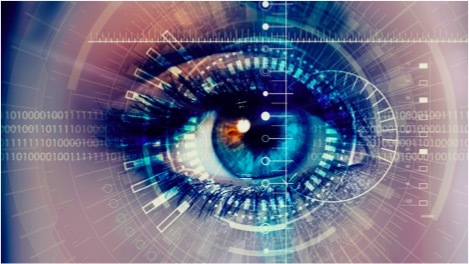
Guided by Our Inner Vision of the Future
With every presentation I do, I give a brief overview of how the future gets formed.
I describe it like this. “People make decisions today based on their understanding of what the future holds. So if we change someone’s vision of the future, we change the way they make decisions today.”
My role as a futurist is to change people’s vision of the future.
The internal steering wheel that our subconscious relies on to guide us through our daily life is our “inner vision of the future.”
Tucked away, deep in our cranial cavities, is a personal vision of what the future holds. While we’re not conscious of its role or how it works, our inner vision oversees every action we take today.
If we come across a new way of looking at the future, we have to check in with our inner vision first. It’s our official roadmap for the future. If something does sync up, we will begin a point by point comparison of how the new perspective is different from the “official version.” When something doesn’t mesh, we think through every discrepancy and start the process of reprogramming our inner vision.
‘Contemplative Inquiry’ and our ‘Inner Vision’
To better understand the dynamics, our inner vision represents our comfort zone. And we tend to be very protective of what we think we know.
Contemplative inquiry is a process for piercing the comfort zone and forcing us to rethink, reexamine, and reevaluate. Our inner vision needs far more adjusting than we think it does.
Yes, we have control over our own decisions, but we go through a series of internal processes before they get “blessed” by our inner vision. Ironically, even our decision to change our inner vision has to be approved by our inner vision.
We have many tools for managing our inner vision like increasing our exposure to information, changing our focus, our perspective, or changing our event horizon. But the most effective tool of all is contemplative inquiry.
It not only gives us the answers we need, but it also has a way of validating our thinking!
Few people understand the human-to-future interface!
The Human-to-Future Interface
The three items that the human body comes into contact with most in life are the beds that we sleep in, the chairs that we sit in, and the shoes that we walk in. These are the primary friction points that we know all too well.
However the overarching, all-consuming interface that few people consider is our human-to-future interface. Since we will all be spending the rest of our lives in the future, we really should learn more about how we’re making the transition from the here-and-now to what-comes-next.
Just as a fish has no way of understanding the concept of water, we are immersed in wave upon wave of an ever-changing future, silently slipping through our reality lens like the hands of time.
The needs of “now,” are different from the needs of “then,” and even though we take these imperceptible changes for granted, every future has a way of altering the demands that will be placed on us, as we go about our daily living.
We all intuitively know that today will be different than yesterday, and that tomorrow will also hold a few surprises. But few scientists, if any, have actually tried to examine the effect these micro-forces of change have on us individually as they wash relentlessly over us.
Even the slightest bump, noise, smell, or thought can alter what comes next. With most of these changes, we’re not even aware they’re happening.
Final Thoughts
How many times have you heard someone say they are “looking for a sign?” Perhaps you’ve said it yourself.
But what exactly constitutes a “sign” and how is one sign more significant than another? Sometimes we will describe our “sign” as an article we’ve read, a video clip we’ve seen, image on a wall, or conversation with a friend.
In reality, the “signs” we’ve imagined operate more as a triggering mechanism alerting us to the fact that something important just happened. In each of these situations, a momentary thought becomes a “sign” because it distinctly resonates with our inner vision.
The signs we’re all looking for are being guided by our inner vision.
Translate This Page
Select LanguageAfrikaansAlbanianAmharicArabicArmenianAzerbaijaniBasqueBelarusianBengaliBosnianBulgarianCatalanCebuanoChichewaChinese (Simplified)Chinese (Traditional)CorsicanCroatianCzechDanishDutchEnglishEsperantoEstonianFilipinoFinnishFrenchFrisianGalicianGeorgianGermanGreekGujaratiHaitian CreoleHausaHawaiianHebrewHindiHmongHungarianIcelandicIgboIndonesianIrishItalianJapaneseJavaneseKannadaKazakhKhmerKoreanKurdish (Kurmanji)KyrgyzLaoLatinLatvianLithuanianLuxembourgishMacedonianMalagasyMalayMalayalamMalteseMaoriMarathiMongolianMyanmar (Burmese)NepaliNorwegianPashtoPersianPolishPortuguesePunjabiRomanianRussianSamoanScottish GaelicSerbianSesothoShonaSindhiSinhalaSlovakSlovenianSomaliSpanishSudaneseSwahiliSwedishTajikTamilTeluguThaiTurkishUkrainianUrduUzbekVietnameseWelshXhosaYiddishYorubaZulu
#goog-gt-tt {display:none !important;}
.goog-te-banner-frame {display:none !important;}
.goog-te-menu-value:hover {text-decoration:none !important;}
.goog-text-highlight {background-color:transparent !important;box-shadow:none !important;}
body {top:0 !important;}
#google_translate_element2 {display:none!important;}
Search for:
Recent Posts
Foresight Journaling – Unlocking the secret truths to your hidden future!
How the Coronavirus has Altered the Course of Human History
19 Startling Covid Trends and 19 Golden Covid Opportunities Emerging from the Chaos
Categories
Artificial Intelligence
Business Trends
Future of Agriculture
Future of Banking
Future of Education
Future of Healthcare
Future of Transportation
Future of Work
Future Scenarios
Future Trends
Futurist Thomas Frey Insights
Global Trends
Predictions
Social Trends
Technology Trends
Speaking TopicsFuture of Healthcare – “Is Death our only Option?
Future of AI
Future of Industries
By Futurist Thomas Frey, author of 'Epiphany Z – 8 Radical Visions Transforming Your Future'
The post Foresight Journaling – Unlocking the secret truths to your hidden future! appeared first on Futurist Speaker.
Thomas Frey's Blog

- Thomas Frey's profile
- 2 followers

