
Thomas Frey's Blog, page 21
August 20, 2020
Is Moore’s Law for Mad Science Inevitable?
Is Moore’s Law for Mad Science Inevitable?
 In 1996, Artificial Intelligence (AI) theorist Eliezer Yudkowsky wrote: “Our sole responsibility is to produce something smarter than we are; any problems beyond that are not ours to solve.”
Nearly 20 years later Yudkowsky seemed to have something to say about people at the other end of the intelligence spectrum. In what he coined Moore’s Law for Mad Science, Yudkowsky stated that, “Every 18 months, the minimum IQ necessary to destroy the world drops by one point.”
Just taking a moment to give credit where credit is due, this “Law” (more of a prediction or estimation) was no doubt suggested in tongue-in-cheek deference to Gordon Moore, co-founder of Intel Corporation. Moore predicted in 1965 that the number of transistors per silicon chip would double every year, an assertion known as Moore’s Law. That prediction was still on track up until 2019 when it finally came to an end.
But with Yudkowsky, was his “Moore’s Law” a reconsideration of the optimism and positivity implied in his earlier statement? Should we seriously consider placing limits on self-learning technologies as Elon Musk has warned? At what point do AI and system intelligence become a danger because human intelligence has not advanced enough to cope with it?
Another trend that ties into Yudkowsky’s Mad Science law is the fact that, over time, we’re putting more and more information, and therefore more power, into the hands of individuals. Should we try to place limits around the distribution of information that could prove dangerous?
Thanks to the Internet, all kinds of sensitive information is available, and not just to scientists.
With a little bit of digging, complex and dangerous information is not only available, it’s dumbed down for the rest of us, like me and you, as well as the anarchist who lives down the road, and the delusional schizophrenic working in their garage laboratory-workshop. After all, mad science information is for mad scientists, right?

So, yes, we need to be vigilant. We need to be aware that there are countless, remarkably detailed “how-to” articles available deep online about how to cause chaos or trigger widespread death.
But do we really have the ability to destroy the world? Releasing a more viral version of COVID-19 may be one approach. We’ve already seen some very entertaining television shows and movies have been built around foiling plots to destroy all or parts of the world.
What about nuclear weapons? We seem still to be in a kind of Cold War environment where wars between superpowers are fought regionally, often by proxies, using conventional weapons and armory. Outright utilization of nuclear mega-weapons by one of the superpowers would certainly trigger mutually assured destruction on a widespread or, yes, possibly global scale.
Our biggest concern, though, shouldn’t be that a rogue nation will choose to act, but that a rogue actor will be able to gain access to them, or reframe access to them through a sophisticated ransom scenario.
While the age of heavy military guns and hardware is ending, a new age of bio, cyber, and propaganda wars is just beginning. The concept of imminent risk and menacing danger is being reframed around non-intuitive, non-visible, and non-obvious threats related to the infrastructure and systems all around us.
Power grids, air traffic control systems, Internet misinformation and rumors, as well as medical labs all have technology-based points of entry.
As these systems become automated and smarter, as per Yudkowsky first statement, often weak links are discovered by hackers (granted, they’re smart people) and shared with others who don’t need to figure things out for themselves, leading to Yudkowsky second statement, by simply following the devious instructions they find online.
Yudkowsky is clearly someone that will make you think! That said, I would tie his two statements together into, “Our sole responsibility is to produce something smarter than we are, but let’s make sure the keys are locked away from those without a legitimate need to know.”
Otherwise yes, it will eventually become rather simple to destroy the world.
Translate This Page
Select LanguageAfrikaansAlbanianAmharicArabicArmenianAzerbaijaniBasqueBelarusianBengaliBosnianBulgarianCatalanCebuanoChichewaChinese (Simplified)Chinese (Traditional)CorsicanCroatianCzechDanishDutchEnglishEsperantoEstonianFilipinoFinnishFrenchFrisianGalicianGeorgianGermanGreekGujaratiHaitian CreoleHausaHawaiianHebrewHindiHmongHungarianIcelandicIgboIndonesianIrishItalianJapaneseJavaneseKannadaKazakhKhmerKoreanKurdish (Kurmanji)KyrgyzLaoLatinLatvianLithuanianLuxembourgishMacedonianMalagasyMalayMalayalamMalteseMaoriMarathiMongolianMyanmar (Burmese)NepaliNorwegianPashtoPersianPolishPortuguesePunjabiRomanianRussianSamoanScottish GaelicSerbianSesothoShonaSindhiSinhalaSlovakSlovenianSomaliSpanishSudaneseSwahiliSwedishTajikTamilTeluguThaiTurkishUkrainianUrduUzbekVietnameseWelshXhosaYiddishYorubaZulu
#goog-gt-tt {display:none !important;}
.goog-te-banner-frame {display:none !important;}
.goog-te-menu-value:hover {text-decoration:none !important;}
.goog-text-highlight {background-color:transparent !important;box-shadow:none !important;}
body {top:0 !important;}
#google_translate_element2 {display:none!important;}
Search for:
Recent Posts
Is Moore’s Law for Mad Science Inevitable?
On the Shoulders of Giants: Retro art and imagining future transportation
Future of Hollywood: Post-COVID Storytelling
Categories
Artificial Intelligence
Business Trends
Future of Agriculture
Future of Banking
Future of Education
Future of Healthcare
Future of Transportation
Future of Work
Future Scenarios
Future Trends
Futurist Thomas Frey Insights
Global Trends
Predictions
Social Trends
Technology Trends
Speaking TopicsFuture of Healthcare – “Is Death our only Option?
Future of AI
Future of Industries
By Futurist Thomas Frey, author of 'Epiphany Z – 8 Radical Visions Transforming Your Future'
The post Is Moore’s Law for Mad Science Inevitable? appeared first on Futurist Speaker.


August 13, 2020
On the Shoulders of Giants: Retro art and imagining future transportation
As a futurist, I’ve become enamored with past visionaries and their gift for imagining the future. While some of their retro-futuristic visions may seem poorly conceived or even laughable, each of them had a gift for opening the door of possibilities into the magical world ahead.
One thing I hope we all share, though, is an imagination and a curiosity about the future. Instead of limiting our focus on the present, I trust there’s a little futurist in all of us as we try to visualize the technology advances that future generations will find commonplace.
I really enjoy seeing those online posts where, for example, Millennials try to explain to Gen Z’ers how different life was “when I was your age.” That’s especially true with technology. The 1980s and 1990s versions of video games, computers, recording devices, music media, and so on, seem ancient today – similar to how young people would view a Victrola!
A friend at Budget Direct shared some insights, as a fun way of looking back on what our parents and grandparents considered “futuristic” modes of transportation.
As part of the project, they commissioned drawings of what these vehicles would look like today. (If you’re like me, you were drawing these kinds of cars in the back of your spiral notebook during middle school Algebra class instead of solving for “x”!)
No doubt these 20th Century futurists with a passion for transportation technology and design hoped their dream vehicles would be on the market within their generation. That hasn’t been the case, but if you look at the original and re-created images, I think you’ll see some things that are very familiar.
Let’s have some fun taking a futuristic look at the past!

This proposed “Super-Cycle,” sketched in the 1930s, would reach speeds of 300 m.p.h. according to its now unknown designer. As of today, one motorcycle model reportedly has broken the 300 m.p.h. barrier, but it looks far more like a traditional motorcycle than the Super-Cycle.

If you check out that original design in the link, the Super-Cycle doesn’t look much safer than today’s high-performance bikes, even with its vaunted “headrest over the windshield” feature. The fact that the test driver in the drawing appears to be protected only by a 1930s-era leather football helmet probably adds to that perception.
Let’s hope that inside this re-imagined Super-Cycle, there’s a bit more protection!
Gil Spear was a well-regarded car designer for Chrysler, but his design (below) for a 1941 model never came to fruition.

Gil clearly spent most of his time thinking about the front ends of his cars – grill design was his forte. The back end in this sketch almost seems like an afterthought. This two-seat coup certainly conjured up visions of a spaceship on wheels, an image that’s maybe subliminally re-enforced when his car is placed in an airport setting.
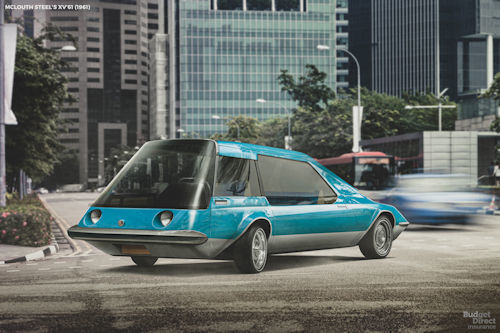
This 1961 concept car was designed by Syd Mead for the McLouth Steel Corporation in Detroit, which was dabbling in auto production at the time. You may have heard of Syd in conjunction with his work designing the cycles in TRON movies.
Translate This Page
Select LanguageAfrikaansAlbanianAmharicArabicArmenianAzerbaijaniBasqueBelarusianBengaliBosnianBulgarianCatalanCebuanoChichewaChinese (Simplified)Chinese (Traditional)CorsicanCroatianCzechDanishDutchEnglishEsperantoEstonianFilipinoFinnishFrenchFrisianGalicianGeorgianGermanGreekGujaratiHaitian CreoleHausaHawaiianHebrewHindiHmongHungarianIcelandicIgboIndonesianIrishItalianJapaneseJavaneseKannadaKazakhKhmerKoreanKurdish (Kurmanji)KyrgyzLaoLatinLatvianLithuanianLuxembourgishMacedonianMalagasyMalayMalayalamMalteseMaoriMarathiMongolianMyanmar (Burmese)NepaliNorwegianPashtoPersianPolishPortuguesePunjabiRomanianRussianSamoanScottish GaelicSerbianSesothoShonaSindhiSinhalaSlovakSlovenianSomaliSpanishSudaneseSwahiliSwedishTajikTamilTeluguThaiTurkishUkrainianUrduUzbekVietnameseWelshXhosaYiddishYorubaZulu
#goog-gt-tt {display:none !important;}
.goog-te-banner-frame {display:none !important;}
.goog-te-menu-value:hover {text-decoration:none !important;}
.goog-text-highlight {background-color:transparent !important;box-shadow:none !important;}
body {top:0 !important;}
#google_translate_element2 {display:none!important;}
Search for:
Recent Posts
On the Shoulders of Giants: Retro art and imagining future transportation
Future of Hollywood: Post-COVID Storytelling
Is it Possible to Pandemic Proof Our World?
Categories
Artificial Intelligence
Business Trends
Future of Agriculture
Future of Banking
Future of Education
Future of Healthcare
Future of Transportation
Future of Work
Future Scenarios
Future Trends
Futurist Thomas Frey Insights
Global Trends
Predictions
Social Trends
Technology Trends
Speaking TopicsFuture of Healthcare – “Is Death our only Option?
Future of AI
Future of Industries
I like this design because it seems that the car would look just as good (and maybe less bus-like), driving in reverse, bringing to fruition my idea from long ago of having dual direction cars with swivel seats.
Plus, it has kind of a Jetsons’ look to it don’t you think?
The Singoletta (Singlet) was ideated by Sci-Fi author Franco Bandini in the early 1960s. An electric motor, easy parking – the Singoletta seems like a very plausible solution for today’s urban gridlock. This is the 1962 conceptual rendering of the Singoletta from the noted Italian Domenica del Corriere weekly newspaper, now out of print.
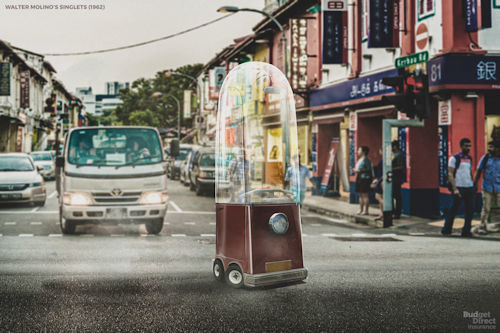
As the Journal of Classic Cars article points out, the Singoletta is essentially a canopy over a Segway!
There’s not much protection for the driver that I can tell (lots of glass to boot), but if everyone stays at or below the 40 km/hr estimated top speed (and if it’s used in this kind of congestion), how much harm could there be?
The New Urban Car, designed by Ken Purdy in the 1970s and drawn by Syd Mead, looks really, really familiar.
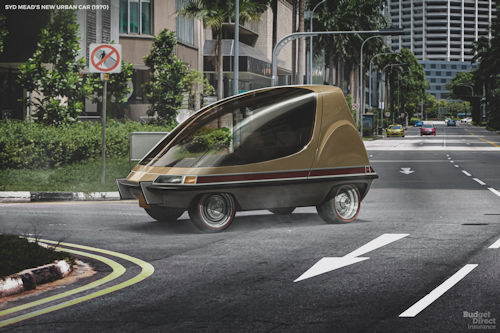
It’s DeLorean-esque in that the door (a single one) opens up. It’s hinged at the front bumper, a really futuristic look, but not too practical for rainy days.
Last of course, we need to address the hover car issue that’s been a staple of imagination and sci-fi for some time. Some people are eager to jump right from four-wheels on the ground to widespread personal flight vehicles. But for intra-city driving, with no 3-dimensional road systems, I think we need to take it a step at a time and set our sights on hovering for the time being!
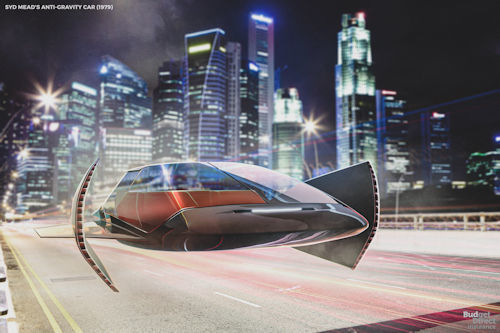
Again, working on behalf of the steel industry, Syd Mead put pen to paper to come up with a futuristic Anti-Gravity Car similar to the one here that’s based on his earlier designs.
How close are we to having hover cars on and over the road? Well, we have hoverboards and hover boats. The technology is there. Ford introduced its Levacar prototype in 1959. At this time, Volkswagen and Tesla seem to be in the driver’s seat in developing and marketing hover cars. None of the prototypes I’ve seen, though, come with the very distinctive TIE-Fighter-style side wings in Syd’s visionary plans!
As a final thought, keep in mind, all of the images of the future we’re creating today will look just as dated fifty years from now.
[Acknowledgment: Information for this blog came from the excellent article “Visions of an automotive future that hasn’t come to fruition,” which includes images commissioned by insurance company Budget Direct. All photos in this blog are reproduced from that article, which appeared in the Journal of Classic Cars on August 7, 2020.]
By Futurist Thomas Frey, author of 'Epiphany Z – 8 Radical Visions Transforming Your Future'
The post On the Shoulders of Giants: Retro art and imagining future transportation appeared first on Futurist Speaker.
August 6, 2020
Future of Hollywood: Post-COVID Storytelling
Future of Hollywood: Post-COVID Storytelling
 The COVID-19 pandemic has put pop culture on hold. What we’re facing is not just a summer without popcorn blockbusters, but a fall television season with many series put on hold in mid-stream (nearly literally) and an Oscar season devoid of contenders for those coveted golden statuettes. This production lull is exhausting all our entertainment content inventories and it could take years to recover.
And once TV and film production does begin to fill the pipeline again, we’ll see different kinds of content because the world will be different. Because, well, 2020 has been a different kind of year!
Film production considerations
TV and film production closed down quickly in mid-March due to state and local government mandates and the impracticality of social distancing on set. After all, who wants to see their favorite actors wearing masks or blowing kisses?
Post-production work was able to continue of course, but to what end? Movie theaters were shuttered and quickly became nothing more than anchors threatening to sink suburban malls.
Production companies faced the option of delaying releases for as long as a year or biting the bullet and sending their work directly to streaming services. Both happened. As a result of locked theaters, Netflix has millions of new subscribers.
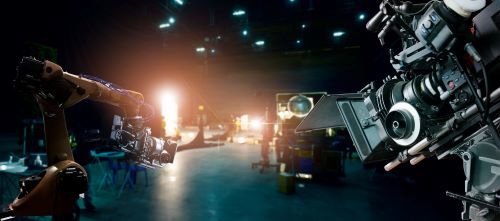
At this time, production has begun again with many safety precautions in place. Experts say that for the foreseeable future there will be smaller crews on sets, fewer shooting locations, fewer cast member extras, and more reliance on virtual effects.
A new era for making movies
But what’s really interesting to me is not how or when TV shows or movies will once again be made and released, it’s the kind of content and themes we’ll see. Will our experience with COVID-19 change content? Yes, but probably not in the ways you’re thinking.
Have you noticed how jarring it is these days to see a pre-2020 filmed scene with a crowded bar, a packed arena, or close-talking groups of people? That’s because it doesn’t reflect the reality of our life at this moment in time. But when we finally get the all-clear to shed our masks, and when social distancing is once again by choice and not necessity, those kinds of scenes on film won’t seem odd anymore.
Film reflects everyday life, and our life will not always be about avoiding respiratory droplets or worrying about invisible aerosol particles. Accordingly, the only masks we’ll see on the big screen will be in scenes with doctors, caregivers, or bank robbers.
Our shared COVID experience, though, should and will change movie content in a much more fundamental way. When we come out on the other side of this pandemic, we’re going to have to reflect on what we went through and what it all means. Movies and shows can help with that internalization process. For people all over the planet, the COVID crisis has been a deeply personal experience, and we’ll be looking to storytellers to help guide our thinking and even help us formulate some newly calibrated life priorities.
A new era for content
Of course, COVID isn’t the only challenge we’ve been confronting as a society in the last few months.
We’ve seen the emergence of a new level of social consciousness on matters related to diversity and equality. In light of that, have you noticed how many episodes of our favorite television series or movies now feature cringe-worthy scenes or plots with noticeable stereotyping?
Moving forward, movie and television show themes, plots, portrayed relationships, and dialog will be forever changed, reflecting a new awareness of racial and gender equality and related sensitivities. The general public will be super-attuned to these themes, so filmmakers and script writers will need to be very careful to stay on the right side of the shifting boundaries related to these social issues.
Would these areas of social conscientiousness have emerged as strongly had we not been in a COVID-induced state of vulnerability? That’s for others to decide. I would simply say that our global consciousness changed in 2020 and this is the perfect time for a new breed of storytellers to pave the way in healing our psyches and even helping us understand some new social norms.

Pay Attention, Hollywood!
The old ways of thinking in Hollywood just won’t cut it anymore. We’re in a new age, and script writers will need to take heed. Our definitions of heroes, success, and achievement are changing. So are our thoughts on villains, fairness, virtue, passion, and our quest for accomplishment.
If film and television producers don’t realize this and if they fail to seize the opportunity to give us what we need and want, they too risk becoming irrelevant in the post-COVID world.
Translate This Page
Select LanguageAfrikaansAlbanianAmharicArabicArmenianAzerbaijaniBasqueBelarusianBengaliBosnianBulgarianCatalanCebuanoChichewaChinese (Simplified)Chinese (Traditional)CorsicanCroatianCzechDanishDutchEnglishEsperantoEstonianFilipinoFinnishFrenchFrisianGalicianGeorgianGermanGreekGujaratiHaitian CreoleHausaHawaiianHebrewHindiHmongHungarianIcelandicIgboIndonesianIrishItalianJapaneseJavaneseKannadaKazakhKhmerKoreanKurdish (Kurmanji)KyrgyzLaoLatinLatvianLithuanianLuxembourgishMacedonianMalagasyMalayMalayalamMalteseMaoriMarathiMongolianMyanmar (Burmese)NepaliNorwegianPashtoPersianPolishPortuguesePunjabiRomanianRussianSamoanScottish GaelicSerbianSesothoShonaSindhiSinhalaSlovakSlovenianSomaliSpanishSudaneseSwahiliSwedishTajikTamilTeluguThaiTurkishUkrainianUrduUzbekVietnameseWelshXhosaYiddishYorubaZulu
#goog-gt-tt {display:none !important;}
.goog-te-banner-frame {display:none !important;}
.goog-te-menu-value:hover {text-decoration:none !important;}
.goog-text-highlight {background-color:transparent !important;box-shadow:none !important;}
body {top:0 !important;}
#google_translate_element2 {display:none!important;}
Search for:
Recent Posts
Future of Hollywood: Post-COVID Storytelling
Is it Possible to Pandemic Proof Our World?
Is this the end of the shopping mall?
Categories
Artificial Intelligence
Business Trends
Future of Agriculture
Future of Banking
Future of Education
Future of Healthcare
Future of Transportation
Future of Work
Future Scenarios
Future Trends
Futurist Thomas Frey Insights
Global Trends
Predictions
Social Trends
Technology Trends
Speaking TopicsFuture of Healthcare – “Is Death our only Option?
Future of AI
Future of Industries
By Futurist Thomas Frey, author of 'Epiphany Z – 8 Radical Visions Transforming Your Future'
The post Future of Hollywood: Post-COVID Storytelling appeared first on Futurist Speaker.
July 30, 2020
Is it Possible to Pandemic Proof Our World?
Is it Possible to Pandemic Proof Our World?
 Given the source of COVID-19 and recent similar viral outbreaks, there’s no reason to think that another one won’t happen again – and sooner rather than later.
Are we willing to do and spend what’s necessary to prevent another pandemic? From the data I’ve seen, it seems like the cost of critical preventive activities is far less than the costs we’ve already incurred, and will continue to incur, since COVID-19 has reached pandemic status.
Viruses vs. Pandemics
It’s important to differentiate between preventing viruses and preventing pandemics. Webster defines a pandemic as an “outbreak of a disease that occurs over a wide geographic area and affects an exceptionally high proportion of the population.”
So, when the first cases of this latest virus were reported in China was it a pandemic? No, this was simply another new virus that had made its way from wild mammals to the human race.
In the following weeks, though, the COVID-19 virus wasn’t contained. And as it spread to other cities, regions, and continents, with a rising number of fatalities, COVID-19 crossed that admittedly fuzzy threshold to the point where it could legitimately be considered a “pandemic.”
Preventing/Minimizing viruses
There are hundreds of species of bats and they continue to carry a wide variety of constantly evolving coronavirus variants. Some of the viruses prove to be relatively harmless when passed to humans. Others are incredibly contagious and deadly.
Nipah, HIV/AIDS, SARS, MERS, Ebola, Zika, and now SARS-CoV-2 (the virus that causes COVID-19) … it’s very likely that each of these was caused initially by animal-to-human contact. Unusually it stems from bats but sometimes other animals, such as pigs or camels serve as a middle mammal in the exchange.
To minimize the emergence of another new and deadly virus that can lead to pandemics, we, and this is a global “we” – including governments at the highest and lowest levels, can create systems to minimize the instances of these exchanges by:
Eliminating the wildlife markets that exist in some countries and cultures
Not only reducing deforestation, but increasing forestation to restore buffer zones between the habitats of wild animals and domestic livestock
Think what you will about the United Nations, the World Health Organization, and other regional or global collectives of national, sovereign governments, but these kinds of collectives are exactly what’s required to coordinate any kind of global efforts to accomplish this. There can be no weak links among nations because viruses cross borders with ease.

Manage the Meat?
But beyond minimizing the emergence of new viruses at their source, what about protecting our food supply? We should at least consider these steps as well:
Prohibit the sale of raw meat that hasn’t been irradiated, cleansed with UV lighting, or undergone similar measures.
Transition to lab grown meat, also called “clean meats” or “cultured meats“.
Continue to develop and promote plant-based meat substitutes
Stop eating meat altogether
These all make sense in theory, and they may be beneficial in their own right. But the fact is that pandemic viruses have never started with hundreds of people eating virus-laden meat. Pandemics all begin with one person.
Once that animal to human threshold is crossed in one person (Patient Zero), no amount of meat irradiation or vegetarianism will stop the virus. From that point on, it’s passed through normal, person-to-person interaction – sharing space, breathing air, or coming into contact with bodily fluid, as in the case of Ebola and HIV/AIDS.
So, we need to go back to that fundamental point: minimizing new viruses means reducing the likelihood of these initial interactions and infections ever taking place. That said, I don’t think it’s possible to prevent another viral outbreak, but we certainly can prevent another pandemic.
Pandemic-Proofing
Okay, so maybe we’ll always have some periodic emergence of localized, horrible viruses. How do we keep them from spreading? How do we “pandemic-proof” the world?
We’ve learned a lot in the last six months, lessons we seem to learn about every century or so, about how to slow a virus and contain its spread. Medical science has a lot to say about how to prevent a virus from becoming a pandemic. Trace the contacts of infected people. Quarantine suspected or actual cases. Dutifully wash hands and surfaces. Wear masks. Limit public gatherings. Socially distance.
We’ve also been reminded that healthcare workers need to have quick access to certain equipment and supplies, especially personal protection equipment (PPE), ventilators, and other medical necessities.
Additionally, in a recent article, William A. Haseltine, formerly of the Harvard Medical School and School of Public Health, points out that antiviral drugs (as opposed to vaccines) can control a coronavirus by binding and blocking the enzymes that most of them need in order to grow. Those enzymes are similar across all coronaviruses. He suggests that it’s not only advisable but very possible to stockpile combinations of these drugs under the BioShield program adopted after 9/11 that’s intended to prevent “new and emerging biological threats.”
Cost-Benefit Analysis
Yes, all of this costs money – from reversing deforestation, to educating people about consumption of exotic animals, to stockpiling drugs, to maintaining a significant cache of healthcare worker PPE and citizen masks. There’s no definitive figure that captures all of these, but let’s at least start with:
Conservation International’s estimate that we need to make an investment of between $22.3 billion and $30.1 billion per year (globally) to address deforestation and to minimize the spread of viruses from wild mammals to humans. They compare that figure to the $10-20 trillion that COVID-19 has cost the global economy in 2020 alone.
Researchers at Princeton University offer an even more compelling case for these expenditures. They estimate that the global price tag to regulate the wildlife trade, maintain adequate disease surveillance, and reduce deforestation in critical areas (all at a total cost of $260 billion over 10 years) is a little more than two percent of the estimated global economic cost of COVID-19 over time.
These are very rough estimates of course but if we compare a few billion to the trillions we’re currently spending, plus the magnitude of benefits to humanity makes these programs seem like a pretty solid investment!
Our goal needs to be to not only pandemic-proof our world, but to pandemic-proof our future!
Translate This Page
Select LanguageAfrikaansAlbanianAmharicArabicArmenianAzerbaijaniBasqueBelarusianBengaliBosnianBulgarianCatalanCebuanoChichewaChinese (Simplified)Chinese (Traditional)CorsicanCroatianCzechDanishDutchEnglishEsperantoEstonianFilipinoFinnishFrenchFrisianGalicianGeorgianGermanGreekGujaratiHaitian CreoleHausaHawaiianHebrewHindiHmongHungarianIcelandicIgboIndonesianIrishItalianJapaneseJavaneseKannadaKazakhKhmerKoreanKurdish (Kurmanji)KyrgyzLaoLatinLatvianLithuanianLuxembourgishMacedonianMalagasyMalayMalayalamMalteseMaoriMarathiMongolianMyanmar (Burmese)NepaliNorwegianPashtoPersianPolishPortuguesePunjabiRomanianRussianSamoanScottish GaelicSerbianSesothoShonaSindhiSinhalaSlovakSlovenianSomaliSpanishSudaneseSwahiliSwedishTajikTamilTeluguThaiTurkishUkrainianUrduUzbekVietnameseWelshXhosaYiddishYorubaZulu
#goog-gt-tt {display:none !important;}
.goog-te-banner-frame {display:none !important;}
.goog-te-menu-value:hover {text-decoration:none !important;}
.goog-text-highlight {background-color:transparent !important;box-shadow:none !important;}
body {top:0 !important;}
#google_translate_element2 {display:none!important;}
Search for:
Recent Posts
Is it Possible to Pandemic Proof Our World?
Is this the end of the shopping mall?
Can Social Media Survive? Is it Worth Saving?
Categories
Artificial Intelligence
Business Trends
Future of Agriculture
Future of Banking
Future of Education
Future of Healthcare
Future of Transportation
Future of Work
Future Scenarios
Future Trends
Futurist Thomas Frey Insights
Global Trends
Predictions
Social Trends
Technology Trends
Speaking TopicsFuture of Healthcare – “Is Death our only Option?
Future of AI
Future of Industries
By Futurist Thomas Frey, author of 'Epiphany Z – 8 Radical Visions Transforming Your Future'
The post Is it Possible to Pandemic Proof Our World? appeared first on Futurist Speaker.
July 23, 2020
Is this the end of the shopping mall?
Is this the end of the shopping mall?

Has the coronavirus sounded the closing bell for shopping malls?
Huge shopping markets like the Grand Bazaar in Istanbul were around as early as 1455. Some of the Middle Eastern Souks have been in existence even longer.
A Slice of Americana
By comparison, we in North American are relative newcomers to the shopping mall concept. Our malls started popping up in the suburbs in the late 1950s, most of them seemingly with a similar design and shopper experience formula: Build anchor stores, maybe make one of them a movie theater, connect them with rows of specialty shops, and drop a fast-food court somewhere in the middle.
Malls quickly evolved into an important anchor in our communities, a social gathering place for young people, filled with the latest fashions, entertainment, and friends. They were “cool” destinations for teens to hang out and pretend they were older than they were, and maybe even a starting point for work with a minimum wage job.
Ah yes, I remember those days well!
When Competition Began
Retail is a tricky business. The first shot across the bow came from standalone, big-box stores and discount mass merchandisers.
1962 was a big year for retail in the U.S. with the launch of the very first K-Mart, Walmart, and Target stores. While their focus was primarily on competing with the likes of Sears, Macy’s, JCPenny, and Montgomery Wards, it also began to affect mall traffic.
Later a variety of competitors chipped away at the mall business model even more with the likes of Costco, Kohl’s, Nordstroms, Staples, and Best Buy. With every new store opening, consumers were drawn to the newer brighter shinier objects.
Later came the Dollar Stores wave with and discounters like Big Lots, Tuesday Morning, and At Home.
Then, in the past decade, online shopping dealt a massive blow to mall retailers and, by extension, the malls themselves. It’s not surprising that mall visits declined by 50% between 2010-2013, with further declines reported each successive year.
The Outlook is Mixed
Are indoor malls done for? At the very least, when we add COVID-19 realities into the mix, it almost certainly is the end of malls as we know them today.
However, in the past decade we’ve seen some micro-innovations in malls that could provide a clue about larger trends in the works:
Some stores are serving as showrooms (think Apple stores) where products are stored in back or ordered onsite through kiosks.
More space is being taken by providers of immersive experiences – gyms, laser tag emporiums, organized play spaces, build a bear, or throw a clay pot.
Malls are offering upgraded food options, including higher-end restaurants at entrance points.
Occasionally, space is being offered for public service purposes such as library branches, DMV offices, police substations, and post office branches.
Some east coast malls have added eclectic areas for collaborative offices and coworking suites.
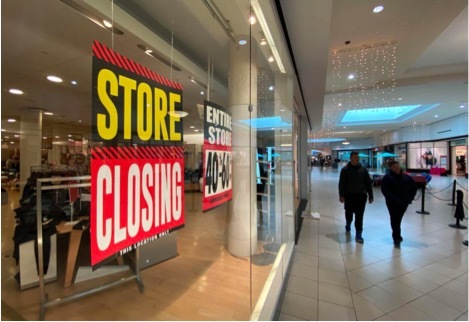
Will customers still be attracted to malls when there are hundreds of new options?
These changes were all underway well before 2020. COVID can probably be considered the third major disruptor for malls in their brief North American history. Mall owners today are struggling to survive, to the point where some are leasing portions of their parking lots for drive-in theaters or outdoor concert venues
Can these property owners hold on long enough to come out on the other side of the pandemic? A definitive COVID-19 “All Clear” simply can’t come soon enough to bring shoppers back in time to save most of these malls. But some higher-end Class A mall properties are likely to receive more grace from their lenders and will have the opportunity to compete in what will become the “new normal for malls.”
Malls as Communities
While the big trend is towards making malls community hubs, the coronavirus has put a damper on any gatherings of people. Over time, the pre-COVID trends will accelerate, and Class A malls will continue to innovate. They’ll devote even more space to:
Showrooms or fulfillment centers for digitally native brands.
Immersive experience venues.
Public services.
Consumer healthcare services (dentist, optical, rapid clinics, etc.).
Private personal services (realtors, attorneys, accountants, etc.).
Co-working space – entire wings or floors or even former anchor store space.
Community events and even religious services. (Theaters have been marketing their unused Sunday morning space to small churches for several years.)

Malls of the Future – Mobile and Driverless
We sketched out our first scenario for driverless mobile mall shops, it started with rural communities. In most small towns the customer base is far too small to warrant a full-time presence and permanent location. But a one-day-a-week storefront in five or six communities might be the perfect market size.
For this reason, it’s not a stretch to envision a new form of shopping center catering to mobile businesses. With a stationary common area at its core, the mobile mall will be a central gathering place where a variety of businesses can quickly “plug-in” and set up shop.
RVs, trucks, vans, and other large vehicles can be converted into traveling dental offices, tax preparation centers, chiropractic clinics, and retail storefronts. As they pull into place, merchandise and service areas will expand into the common area creating an “open bazaar” feel for the shoppers.
In this kind of setting, malls will increasingly become one-stop destinations, not just for all your shopping needs but for a growing number of your daily living needs.
Most of the traveling storefronts will be one or two-person businesses, nomadically traveling from city to city on their daily business adventure. Others will work a regular circuit, showing up on the same day each week, building a loyal customer base.
The most exciting part of driverless mobile businesses plugging into a mall setting is that every customer visit will be a unique and different experience. Even old-timers like me can get excited about this concept.
When you combine shopping, working, eating, self-care, professional services, events, and religious services, the mobile storefronts inside malls of the future start to sound like my kind of live, work, and play community. All that’s lacking is residential space, and that will surely follow!
Translate This Page
Select LanguageAfrikaansAlbanianAmharicArabicArmenianAzerbaijaniBasqueBelarusianBengaliBosnianBulgarianCatalanCebuanoChichewaChinese (Simplified)Chinese (Traditional)CorsicanCroatianCzechDanishDutchEnglishEsperantoEstonianFilipinoFinnishFrenchFrisianGalicianGeorgianGermanGreekGujaratiHaitian CreoleHausaHawaiianHebrewHindiHmongHungarianIcelandicIgboIndonesianIrishItalianJapaneseJavaneseKannadaKazakhKhmerKoreanKurdish (Kurmanji)KyrgyzLaoLatinLatvianLithuanianLuxembourgishMacedonianMalagasyMalayMalayalamMalteseMaoriMarathiMongolianMyanmar (Burmese)NepaliNorwegianPashtoPersianPolishPortuguesePunjabiRomanianRussianSamoanScottish GaelicSerbianSesothoShonaSindhiSinhalaSlovakSlovenianSomaliSpanishSudaneseSwahiliSwedishTajikTamilTeluguThaiTurkishUkrainianUrduUzbekVietnameseWelshXhosaYiddishYorubaZulu
#goog-gt-tt {display:none !important;}
.goog-te-banner-frame {display:none !important;}
.goog-te-menu-value:hover {text-decoration:none !important;}
.goog-text-highlight {background-color:transparent !important;box-shadow:none !important;}
body {top:0 !important;}
#google_translate_element2 {display:none!important;}
Search for:
Recent Posts
Is this the end of the shopping mall?
Can Social Media Survive? Is it Worth Saving?
The Future of Non-Lethal “Weapons”
Categories
Artificial Intelligence
Business Trends
Future of Agriculture
Future of Banking
Future of Education
Future of Healthcare
Future of Transportation
Future of Work
Future Scenarios
Future Trends
Futurist Thomas Frey Insights
Global Trends
Predictions
Social Trends
Technology Trends
Speaking TopicsFuture of Healthcare – “Is Death our only Option?
Future of AI
Future of Industries
By Futurist Thomas Frey, author of 'Epiphany Z – 8 Radical Visions Transforming Your Future'
The post Is this the end of the shopping mall? appeared first on Futurist Speaker.
July 16, 2020
Can Social Media Survive? Is it Worth Saving?
Can Social Media Survive? Is it Worth Saving?
 Among most of my futurist friends, it’s common thinking that most future wars will be started as cyberwars.
As we discuss this type of scenario, they begin as a series of attacks on critical infrastructure, with one country being severely undermined by state-sponsored terrorists, or a rogue band of hackers. Malicious computer code inserted into a critical system related to transportation, finance, health, or utilities, for example, can bring a nation to its knees, or even turn these systems into weapons – crashing planes, blowing up nuclear plants, releasing contagions … no doubt you’ve seen the same movies I have.
Now let’s imagine another kind of cyber war – an extension of the propaganda wars of the past. Not Hanoi Hanna or Tokyo Rose, but lies and misinformation spread on mainstream social media sites, maybe even seemingly by famous people. This isn’t farfetched, of course, and it’s happened already, usually on a smaller scale. We’ve all seen these messages – “Ignore that post, I’ve been hacked.” Or, “Don’t respond to a friend request from me, my account has been hacked.”
Add to this plot our mainstream media’s proclivity to use social media as a news source, and our disinformation pipeline can be amplified a hundred-fold before it’s proven false or bogus. Once it’s out there, like the evil genie, it becomes impossible to put back into the bottle.
As we’re seeing these days, people eagerly accept, believe, and share any “news item” they see that supports their viewpoint. It doesn’t take much to polarize a nation when people stop learning and choose just to “accept.”
This opens the door for foreign agents to sow discord, polarization, division, and humiliation through social media. But who needs a foreign agent to do that these days!
Let’s take things a step further. What if the Facebook, Twitter, or Instagram account of a world leader, a nation’s president for the sake of argument, is hacked? In the ten minutes before the account can be locked down, slanderous or even extremely dangerous information is presented as fact. “Prime Minister X is a predator.” “We’re sending troops to the Y country border for an imminent invasion.” “We will seek to assassinate the evil leader of country Z.” Can you imagine the international reaction and the national security/military Code Reds that would be triggered?
Is it possible that our next war could be triggered by fake news on Facebook? Keep in mind, virtually every past war has resulted from a massive communications problem, and in our world today, a little misinformation can go a long way since 1.62 billion users visit Facebook daily and most of them like to share.
Little by little, Facebook is being dominated by toxic advocates. If you unfriend the polarizing people, then you’re not left with much. If we add enough filters to manage our feed, we might get the message, “Sorry, I can’t find anything else you might want to see!”
Final Thoughts
In my mind, the biggest danger Facebook and similar sites pose is not the pre-emptive nuclear war resulting from a hacked presidential post, but how they’re dividing us and polarizing society.
Yes, virtually every technology, even those created with the best of intentions, can be used to the detriment of society. And now we can add Facebook and Twitter to that list.
Social media, as it is being pressured by its boycotting advertisers, has found itself being pushed towards an impossibly high standard.
Facebook and Twitter now have the mandate to become their own arbitrators of not only what’s true and what’s not, but also what’s demeaning, inflammatory, bullying, and mean-spirited. And they’re attempting to do so in a way that’s okay with every country, culture, religion, ethnic group, and language. In short, it’s simply not possible.
My prediction is that once we’ve seen that they’ve passed their peak, perhaps only a few months away, social media will get replaced with what comes next, something edgier and more disturbing, but a platform that insulates and removes itself from our most egregious human behavior.
Translate This Page
Select LanguageAfrikaansAlbanianAmharicArabicArmenianAzerbaijaniBasqueBelarusianBengaliBosnianBulgarianCatalanCebuanoChichewaChinese (Simplified)Chinese (Traditional)CorsicanCroatianCzechDanishDutchEnglishEsperantoEstonianFilipinoFinnishFrenchFrisianGalicianGeorgianGermanGreekGujaratiHaitian CreoleHausaHawaiianHebrewHindiHmongHungarianIcelandicIgboIndonesianIrishItalianJapaneseJavaneseKannadaKazakhKhmerKoreanKurdish (Kurmanji)KyrgyzLaoLatinLatvianLithuanianLuxembourgishMacedonianMalagasyMalayMalayalamMalteseMaoriMarathiMongolianMyanmar (Burmese)NepaliNorwegianPashtoPersianPolishPortuguesePunjabiRomanianRussianSamoanScottish GaelicSerbianSesothoShonaSindhiSinhalaSlovakSlovenianSomaliSpanishSudaneseSwahiliSwedishTajikTamilTeluguThaiTurkishUkrainianUrduUzbekVietnameseWelshXhosaYiddishYorubaZulu
#goog-gt-tt {display:none !important;}
.goog-te-banner-frame {display:none !important;}
.goog-te-menu-value:hover {text-decoration:none !important;}
.goog-text-highlight {background-color:transparent !important;box-shadow:none !important;}
body {top:0 !important;}
#google_translate_element2 {display:none!important;}
Search for:
Recent Posts
Can Social Media Survive? Is it Worth Saving?
The Future of Non-Lethal “Weapons”
Foresight Journaling: We Can Help You Unlock the Secret Truths to your Hidden Vision
Categories
Artificial Intelligence
Business Trends
Future of Agriculture
Future of Banking
Future of Education
Future of Healthcare
Future of Transportation
Future of Work
Future Scenarios
Future Trends
Futurist Thomas Frey Insights
Global Trends
Predictions
Social Trends
Technology Trends
Speaking TopicsFuture of Healthcare – “Is Death our only Option?
Future of AI
Future of Industries
By Futurist Thomas Frey, author of 'Epiphany Z – 8 Radical Visions Transforming Your Future'
The post Can Social Media Survive? Is it Worth Saving? appeared first on Futurist Speaker.
July 9, 2020
The Future of Non-Lethal “Weapons”
 The first time I watched Star Trek and heard Captain Kirk calmly instruct the crew to – “Set your phasers to stun” – I wondered just how many more settings those weapons actually had. Was it just a simple two-position switch with “kill” or “stun,” or were there additional settings that were less than lethal?
For this reason, I came up with 10 other settings that could be employed to handle the situation:
Stun-P (with pain)
Stun-NP (no pain)
Giggle (incapacitate through uncontrollable laughter)
Amnesia (forget what they’re doing)
Slo-Mo (move in slow motion)
Freeze (not move at all)
Seizure (fire all muscles at once)
Overwhelming Guilt (immobilized by contemplative self-loathing)
Overwhelming Pity (extreme empathy and understanding), and
Distraction (instant squirrel)
Whether you’re a Trekkie, a Trekker, or just a person with an imagination, I’m sure you can come up with a few more options.
These days, though, we’ve been reminded that some policing tools are out of sync with certain policing situations. Lethal bullets are a last resort, of course, but even tasers, rubber bullets, pepper spray, water cannons, and pepper balls can escalate a situation and cause injuries or even accidental deaths. There’s a time and place for each of these, I’d say, but we also need to expand our thinking.
What we need, maybe, is a non-confrontational weapon-tool that simply immobilizes a person and doesn’t escalate the situation – a temporary “off-switch” for their brain, something that allows an offender to be safely removed from the situation. I’d be willing to bet our military is looking into this!
But let’s think bigger (and more seriously) still.
When law enforcement can only rely on weapons to stop illegal behavior, the fall-out and consequences can expand. When it comes to guns and less lethal weapons, the finality of death and the potential escalation should and do give police officers pause before they employ them.
There’s a similar debate when it comes to international relations. Very often we see bad actor nations and international groups seizing territories, enslaving people, killing those with different ideologies, and taking other aggressive domestic or international steps. If our only strategy is to stop them with military force, we risk igniting the kind of conflict and casualties no one wants. So, enlightened nations hold their fire, if not their tongues, and these leaders or rogue groups become emboldened to take incrementally aggressive steps.
As a result, and somewhat ironically, powerful and honorable nations are too often powerless to stop bad actor nations if all they have at their disposal are weapons. Former U.S. Secretary of Defense Robert Gates addressed this situation in his recent book, Exercise of Power. He points out that nations must rely more on things like diplomacy, economic instruments, communication, technological advantages, and other tools to influence the actions of malevolent international powers. That’s because all too often military force is not an option – it’s the kind of all-or-nothing response no one wishes to unleash except in the most compelling cases. And since we can’t put all our eggs into the basket of military force, we also need to put in the hard work necessary to develop other tools of influence.
See the similarity?
When it comes to limiting or pre-empting certain illegal domestic behavior, we shouldn’t always rely on law enforcement solutions that can escalate the situation. We need to put in the hard work to develop certain other tools and strategies. We also need to be able to set the phaser to “good jobs,” “access to education,” “equal economic opportunity,” and “fair economic competition.”
Translate This Page
Select LanguageAfrikaansAlbanianAmharicArabicArmenianAzerbaijaniBasqueBelarusianBengaliBosnianBulgarianCatalanCebuanoChichewaChinese (Simplified)Chinese (Traditional)CorsicanCroatianCzechDanishDutchEnglishEsperantoEstonianFilipinoFinnishFrenchFrisianGalicianGeorgianGermanGreekGujaratiHaitian CreoleHausaHawaiianHebrewHindiHmongHungarianIcelandicIgboIndonesianIrishItalianJapaneseJavaneseKannadaKazakhKhmerKoreanKurdish (Kurmanji)KyrgyzLaoLatinLatvianLithuanianLuxembourgishMacedonianMalagasyMalayMalayalamMalteseMaoriMarathiMongolianMyanmar (Burmese)NepaliNorwegianPashtoPersianPolishPortuguesePunjabiRomanianRussianSamoanScottish GaelicSerbianSesothoShonaSindhiSinhalaSlovakSlovenianSomaliSpanishSudaneseSwahiliSwedishTajikTamilTeluguThaiTurkishUkrainianUrduUzbekVietnameseWelshXhosaYiddishYorubaZulu
#goog-gt-tt {display:none !important;}
.goog-te-banner-frame {display:none !important;}
.goog-te-menu-value:hover {text-decoration:none !important;}
.goog-text-highlight {background-color:transparent !important;box-shadow:none !important;}
body {top:0 !important;}
#google_translate_element2 {display:none!important;}
Search for:
Recent Posts
The Future of Non-Lethal “Weapons”
Foresight Journaling: We Can Help You Unlock the Secret Truths to your Hidden Vision
Should we have the right to be invisible?
Categories
Artificial Intelligence
Business Trends
Future of Agriculture
Future of Banking
Future of Education
Future of Healthcare
Future of Transportation
Future of Work
Future Scenarios
Future Trends
Futurist Thomas Frey Insights
Global Trends
Predictions
Social Trends
Technology Trends
Speaking TopicsFuture of Healthcare – “Is Death our only Option?
Future of AI
Future of Industries
By Futurist Thomas Frey, author of 'Epiphany Z – 8 Radical Visions Transforming Your Future'
The post The Future of Non-Lethal “Weapons” appeared first on Futurist Speaker.
July 2, 2020
Foresight Journaling: We Can Help You Unlock the Secret Truths to your Hidden Vision
Foresight Journaling: We Can Help You Unlock the Secret Truths to your Hidden Vision
Decisions, Decisions
 Each of us is faced with a unique set of problems, circumstances, challenges and opportunities, and let’s be honest, we’re not too good at making decisions about them. Very few of us feel like great decision makers, and yet that’s exactly what we spend most of our time doing – making or contemplating decisions!
Should I buy a house, sell a house, find a new job, stay where I’m at, go out to eat, cook at home, drive across town, or stay where I am? Add life variables like children, financial stress, illness, wealth, or a myriad of other circumstances, and the complexities of our decisions skyrocket.
We all approach life-changing experiences differently, but, ideally, we should have the mindset that for every problem we face, there is an equal and opposite life-changing opportunity waiting to be discovered. Our ability to discover and leverage those opportunities is tied directly to the way we frame our thinking.
Our decisions shape our future. But conversely, and circuitously, we make decisions today based on our understanding of what the future holds – imperfect information at best. So, what if we could change our vision of the future, get past inactivity biases and preconceived notions, for example, to improve the decisions we make?
That’s my role as a futurist: To change a person’s vision of the future. Much of that happens by tapping into fresh insights and information we uncover inside ourselves. In a moment, I’ll introduce a technique to help do exactly that. We’re not quite there yet, though!
Subscribe Today!

We’re Guided by Our Inner Vision of the Future
Your inner vision of your future is the internal steering wheel that your subconscious relies on to guide you through your daily life. It’s on automatic pilot – even though you’re not always conscious of its role or how it works, your inner vision is overseeing many actions and decisions every day. That’s not always bad, but it can be limiting.
Here’s how your inner vision evolves. If you come across a new way of looking at the future, you’ll instinctively compare it with your current inner vision of the future. If there’s a discrepancy between the new insight and the current roadmap, you’ll begin a point-by-point comparison of how the new perspective is different from the official version. If the new information is credible, you’ll start the process of reprogramming certain aspects of your inner vision for the future.
This is a process we all need to encourage – it’s how we grow wiser and, yes, make better decisions. It’s a process that’s nurtured by Foresight Journaling.
Foresight Journaling – A Tool to Open Your Mind to a New Future
Every day, we wake up to an entirely new set of issues, confrontations, confusion, interruptions, panic, hope, and opportunities. Sometimes even our finest successes are tinged with chaos. During challenging times, like during the COVID-19 pandemic, most of us are searching furiously to find something solid to hang onto.
Foresight Journaling is a contemplative exercise that allows us to find the answers we’re looking for and take control of our destiny. It’s based on a process called contemplative inquiry, a powerful tool for reprogramming the inner vision. With contemplative inquiry, you relax your body, calm your emotions, and quiet your mind, so you can begin to master the fine art of leveraging your own intuitive wisdom.
Our weekly Foresight Journaling Newsletter will help support this process.
Every week I’ll pose a series of five provocative questions, and it’ll be up to you to struggle your way through them to find the answers!
Keep in mind, the struggle will be the source of your growth – the expanded access to the insights and truths within you. The Foresight Journaling Newsletter is an investment in your future for only $9.98USD per month.
Start Your Journaling Today!
The Foresight Journaling Process
Each contemplative inquiry question is designed to help you dig deeper, to find the untouched regions of your being, and unlock the secret truths.
Start by finding a quiet place. Clear away both internal and external distractions. You’ll need to be in a high-energy state, fully hydrated, listening to the right kind of music at the right volume. Some experts say this technique works best if the music is a repetitive type such as techno, classical, new age, or trance.
During this process, nothing is straightforward. There are no one-size-fits-all formulas, no repeatable processes, and no certainty about what you think you know … until you know it.
For some, the exercise will make sense right away. For others, it’ll be as chaotic as it sounds. You’ll discover exceptions to every rule, new ways of defining every situation, and countless new perspectives as you try to determine the answer.
I encourage you to take notes and jot down ideas, phrases, and quotes. Make list upon list until you feel comfortable with all the options you need to explore. The universe isn’t linear, and neither is your mind, so feel free to let your randomness, spontaneity, and impulsive whims guide your thinking.
At first glance the questions may not appear to relate to the most pertinent matters of the day, but rest assured there’s an important method to the randomness. Each exercise will push you to engage with your larger mind map, and that’s the key to triggering the inner you.
Each set of five questions provides a week’s worth of contemplation, probing, musing, deliberation, brooding, deep thinking, and reflection. One question will lead to another, and another, until a light bulb turns on in your head. If the light bulb doesn’t turn on, you’re not done.
You won’t be graded on whether your answers are right or wrong. This is your process, and these are your answers that will lead to your seismic breakthroughs! If you stall out, take a break and come back later. But never, never, never give up. Your future self is counting on you!
A Final Thought on Contemplative Inquiry – It’s Time to Get Uncomfortable
Our inner vision represents our comfort zone. We all tend to be very protective of what we think we know. Engaging in Contemplative Inquiry will pierce your comfort zone and force you to rethink, reexamine, and reevaluate. Your inner vision needs far more adjusting than you may think, but when you approach the process purposefully, through Foresight Journaling for example, you can literally change your future for the best!
Translate This Page
Select LanguageAfrikaansAlbanianAmharicArabicArmenianAzerbaijaniBasqueBelarusianBengaliBosnianBulgarianCatalanCebuanoChichewaChinese (Simplified)Chinese (Traditional)CorsicanCroatianCzechDanishDutchEnglishEsperantoEstonianFilipinoFinnishFrenchFrisianGalicianGeorgianGermanGreekGujaratiHaitian CreoleHausaHawaiianHebrewHindiHmongHungarianIcelandicIgboIndonesianIrishItalianJapaneseJavaneseKannadaKazakhKhmerKoreanKurdish (Kurmanji)KyrgyzLaoLatinLatvianLithuanianLuxembourgishMacedonianMalagasyMalayMalayalamMalteseMaoriMarathiMongolianMyanmar (Burmese)NepaliNorwegianPashtoPersianPolishPortuguesePunjabiRomanianRussianSamoanScottish GaelicSerbianSesothoShonaSindhiSinhalaSlovakSlovenianSomaliSpanishSudaneseSwahiliSwedishTajikTamilTeluguThaiTurkishUkrainianUrduUzbekVietnameseWelshXhosaYiddishYorubaZulu
#goog-gt-tt {display:none !important;}
.goog-te-banner-frame {display:none !important;}
.goog-te-menu-value:hover {text-decoration:none !important;}
.goog-text-highlight {background-color:transparent !important;box-shadow:none !important;}
body {top:0 !important;}
#google_translate_element2 {display:none!important;}
Search for:
Recent Posts
Foresight Journaling: We Can Help You Unlock the Secret Truths to your Hidden Vision
Should we have the right to be invisible?
In Search of a Social Media Truth Meter
Categories
Artificial Intelligence
Business Trends
Future of Agriculture
Future of Banking
Future of Education
Future of Healthcare
Future of Transportation
Future of Work
Future Scenarios
Future Trends
Futurist Thomas Frey Insights
Global Trends
Predictions
Social Trends
Technology Trends
Speaking TopicsFuture of Healthcare – “Is Death our only Option?
Future of AI
Future of Industries
By Futurist Thomas Frey, author of 'Epiphany Z – 8 Radical Visions Transforming Your Future'
The post Foresight Journaling: We Can Help You Unlock the Secret Truths to your Hidden Vision appeared first on Futurist Speaker.
June 25, 2020
Should we have the right to be invisible?
Should we have the right to be invisible?
 We’re hearing a lot about “the right to be forgotten,” as the European Union is taking the lead in adopting policies that allow a person to request their personal information be removed from the Internet or other information databases. Significantly, this issue is also called “the right to erasure,” since it doesn’t prevent the initial posting – it calls for a reactive step: removing the information after it’s out there.
A related erasure-type issue, and one that’s a little harder to get your hands around, is the expectation of “the right to be invisible” – in other words, the right to ensure that your image isn’t stored or shared without your consent.
The very first photograph was taken in 1826, the view from the photographer’s window in France. No people are visible from what I can see on that fairly blurry shot, so personal privacy was safe, at least for the very brief time being. It wasn’t long, though, till group and individual portraits were all the rage.
How many times will your picture be taken today?
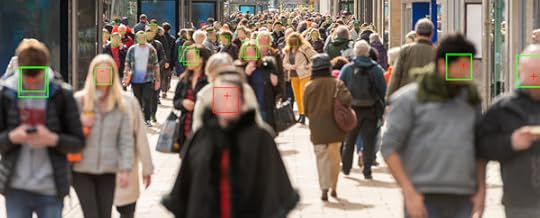
This year we’ll take more than 1.4 trillion pictures according to some estimates. And that doesn’t include passive, automated pictures ranging from street-level building security cameras to doorbell cameras, which is part of the challenge with asserting the right to be invisible. Passive cameras record what they see. Period. If you go outside, you will eventually be captured digitally. That picture of you taken at a random moment in time may sit someplace for a while or forever. No human being may ever see it unless they have a reason to look.
Can technology support the right to be invisible? Is it possible to demand your image be deleted if you don’t even know it’s been captured? Can security cameras be programmed to blur out the image of someone who has received permission to be invisible? I wouldn’t bet against very smart people figuring out these kinds of challenges. But there are bigger issues here. Who serves as the judge to allow you to opt out of today’s ubiquitous image capturing? Will it be like TSA pre-check programs, except those who pass a background check not only get through security quicker but the cameras around the world are turned off for them?
How far is too far?
We’re all aware of some compelling advantages to extensive image capturing. We’ll soon be able to monitor people’s health and safety with drones. We can prove guilt or innocence at a crime scene thanks to the bystander cameras, officer body cameras and traffic/street level cameras. We can pick up the trail of missing children (and shake our heads at porch pirates) thanks to doorbell cameras.
Then of course there’s the arguments against invisibility. Some folks have things to hide that we all need to know about. There’s a reason bank robbers wear masks. In fact, that’s why some people tell me they don’t care about being caught on tape: “I’m not doing anything wrong, so I don’t care.” By implication, though, they’re saying that those who want to be invisible do have something to hide. That’s not fair. Do privacy advocates need to justify their position? Is their concern, or even paranoia, about who’s sifting through the footage a good enough reason to insist on being invisible?
Technology constraints aside, should we have the right to insist on invisibility? Maybe COVID has solved this problem for those who don’t want to be seen. Just keep wearing your mask outdoors. After all, even my phone doesn’t recognize me now!
I am sure there’s something I haven’t included here, so please share your thoughts with me!
Translate This Page
Select LanguageAfrikaansAlbanianAmharicArabicArmenianAzerbaijaniBasqueBelarusianBengaliBosnianBulgarianCatalanCebuanoChichewaChinese (Simplified)Chinese (Traditional)CorsicanCroatianCzechDanishDutchEnglishEsperantoEstonianFilipinoFinnishFrenchFrisianGalicianGeorgianGermanGreekGujaratiHaitian CreoleHausaHawaiianHebrewHindiHmongHungarianIcelandicIgboIndonesianIrishItalianJapaneseJavaneseKannadaKazakhKhmerKoreanKurdish (Kurmanji)KyrgyzLaoLatinLatvianLithuanianLuxembourgishMacedonianMalagasyMalayMalayalamMalteseMaoriMarathiMongolianMyanmar (Burmese)NepaliNorwegianPashtoPersianPolishPortuguesePunjabiRomanianRussianSamoanScottish GaelicSerbianSesothoShonaSindhiSinhalaSlovakSlovenianSomaliSpanishSudaneseSwahiliSwedishTajikTamilTeluguThaiTurkishUkrainianUrduUzbekVietnameseWelshXhosaYiddishYorubaZulu
#goog-gt-tt {display:none !important;}
.goog-te-banner-frame {display:none !important;}
.goog-te-menu-value:hover {text-decoration:none !important;}
.goog-text-highlight {background-color:transparent !important;box-shadow:none !important;}
body {top:0 !important;}
#google_translate_element2 {display:none!important;}
Search for:
Recent Posts
Should we have the right to be invisible?
In Search of a Social Media Truth Meter
Four “Impossible” Situations, Four Solutions, and Ten Predictions for the Future
Categories
Artificial Intelligence
Business Trends
Future of Agriculture
Future of Banking
Future of Education
Future of Healthcare
Future of Transportation
Future of Work
Future Scenarios
Future Trends
Futurist Thomas Frey Insights
Global Trends
Predictions
Social Trends
Technology Trends
Speaking TopicsFuture of Healthcare – “Is Death our only Option?
Future of AI
Future of Industries
By Futurist Thomas Frey, author of 'Epiphany Z – 8 Radical Visions Transforming Your Future'
The post Should we have the right to be invisible? appeared first on Futurist Speaker.
June 16, 2020
In Search of a Social Media Truth Meter
 Like me, you’ve probably seen news items, blog posts, and web pages that are cringe worthy for a number of reasons – including their lack of truthfulness. If we hold a “truth meter” next to every college course, Wikipedia article, or television newscast, how many of them would pass that test? Yes, truth is more important than ever since we’re consuming so much news and information online and unverified.
But “truth” is a tricky thing.
Truth is in the eye of the beholder
Except for the most basic statements, many “facts” are anything but provable or definitive. Often, their accuracy depends on the personal opinion of each reader, which, in turn, is informed by their education, status, culture, location (e.g., country of residence), upbringing, gender, race, and other factors.
Our individual perceptions of truth are also influenced by what we expect or want the truth to be. Does a narrative fit our preconceived notions? Does it validate a trend or cause that’s important to us? If so, we’re more likely to view it as true … and share it widely.
Truth can be deceptive – words matter
“Experts say the colonization of Mars could begin by 2040.”
Could that statement be considered factual? Well, using the word “could” certainly gives the writer some leeway. And you can find a person (and call them an “expert”) who will espouse pretty much anything you want to promote – including readership.
On its face, though, I’d say that that statement is not un-factual, but it certainly can be a misleading headline when our tendency as readers and social media consumers is to:
Discount the fine print (words like “could”).
Assign relatively equal credibility to anyone claiming to be an expert.
Thus, determining “truth” requires careful consideration of the statement and the source. (One must also decide if truth is the only standard that should be used when administering social media content. Well-intentioned censorship is a topic for another day.)
Social media administration
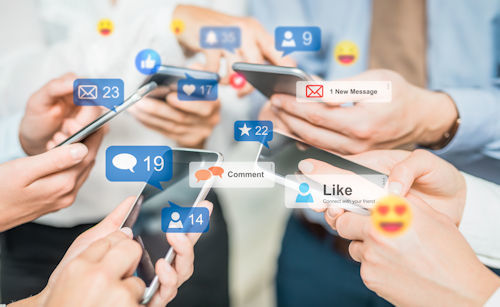
Social media companies like Facebook and Twitter have decided to become their own arbitrators of what’s true and what’s not, promising to remove lies and liars. But doing so in a way that takes into account every country, culture, religion, and language is simply not possible – from a logistical standpoint if nothing else. All that these companies can do, in my opinion, is remove the most egregious falsehoods, leaving in place many potentially possibly deceptive gray area posts for readers to weigh for themselves.
It’s important to keep in mind how most people use social media – especially Facebook and Twitter. First there’s commercial promotion (“Try our new menu”), entertainment (videos from Bob Dylan’s newest album), and personal life sharing (“Yay, Dwayne finally graduated from high school!”).
Then there’s the potentially darker side of social media: advocating positions and policies (and/or criticizing those of others) based on supposed sources or statements of truth.
Who’s to judge?
No doubt, posts of this type are the ones Facebook and Twitter will and should focus on. But as long as humans are making the decisions, there will be content curation biases similar to the personal biases noted (what do we want to be true, for example) plus perhaps a tendency to avoid controversial posts lest they upset a majority of readers, advertisers, or policymakers. Monitoring social media with this kind of objectivity is a tall order for a human being, but with the right training and guidance, maybe it’s possible these human editors can protect truth or move us in that direction.
What about automating the content monitoring process using artificial intelligence (AI) to separate fact from fiction? Someone will need to program the algorithms of course, and if that can be done objectively and thoroughly, this could conceivably work too – at least as well today’s automated spellcheck and grammar programs that don’t always get it right.
No doubt social media companies are using AI to some extent and will likely take bigger steps in that direction. It’s an interesting experiment in allowing machines to control societal discourse. What possibly could go wrong with that!
As always, if there is a point I missed, I’d love to hear your thoughts.
Translate This Page
Select LanguageAfrikaansAlbanianAmharicArabicArmenianAzerbaijaniBasqueBelarusianBengaliBosnianBulgarianCatalanCebuanoChichewaChinese (Simplified)Chinese (Traditional)CorsicanCroatianCzechDanishDutchEnglishEsperantoEstonianFilipinoFinnishFrenchFrisianGalicianGeorgianGermanGreekGujaratiHaitian CreoleHausaHawaiianHebrewHindiHmongHungarianIcelandicIgboIndonesianIrishItalianJapaneseJavaneseKannadaKazakhKhmerKoreanKurdish (Kurmanji)KyrgyzLaoLatinLatvianLithuanianLuxembourgishMacedonianMalagasyMalayMalayalamMalteseMaoriMarathiMongolianMyanmar (Burmese)NepaliNorwegianPashtoPersianPolishPortuguesePunjabiRomanianRussianSamoanScottish GaelicSerbianSesothoShonaSindhiSinhalaSlovakSlovenianSomaliSpanishSudaneseSwahiliSwedishTajikTamilTeluguThaiTurkishUkrainianUrduUzbekVietnameseWelshXhosaYiddishYorubaZulu
#goog-gt-tt {display:none !important;}
.goog-te-banner-frame {display:none !important;}
.goog-te-menu-value:hover {text-decoration:none !important;}
.goog-text-highlight {background-color:transparent !important;box-shadow:none !important;}
body {top:0 !important;}
#google_translate_element2 {display:none!important;}
Search for:
Recent Posts
In Search of a Social Media Truth Meter
Four “Impossible” Situations, Four Solutions, and Ten Predictions for the Future
The Drivable Office: RVs, Motorcoaches, 5th Wheels, and Campers Become the Remote Office of the Future.
Categories
Artificial Intelligence
Business Trends
Future of Agriculture
Future of Banking
Future of Education
Future of Healthcare
Future of Transportation
Future of Work
Future Scenarios
Future Trends
Futurist Thomas Frey Insights
Global Trends
Predictions
Social Trends
Technology Trends
Speaking TopicsFuture of Healthcare – “Is Death our only Option?
Future of AI
Future of Industries
By Futurist Thomas Frey, author of 'Epiphany Z – 8 Radical Visions Transforming Your Future'
The post In Search of a Social Media Truth Meter appeared first on Futurist Speaker.
Thomas Frey's Blog

- Thomas Frey's profile
- 2 followers

