
Thomas Frey's Blog, page 53
December 31, 2011
Year in Review: Top 10 Articles on FuturistSpeaker.com

The sixth law of the future states, "The "unknowability" of the future is what gives us our drive and motivation."
The fact that the future is unknowable is a good thing. Our involvement in the game of life is based on our notion that we as individuals can make a difference. If we somehow remove the mystery of what results our actions will have, we also dismantle our individual drives and motivations for moving forward.
There is a whole lot that we don't know about the year ahead. Yes, it will be messy. Important people will die. We will not cure cancer, just yet. And we won't find a solution for war. But there is great value in the struggle. Our greatest achievements will come from these struggles.
We can learn much about where we've come from, and for this reason I'd like to give you a quick overview of the top articles in 2011 on FuturistSpeaker.com, based on popularity. They touch on jobs, education, crime, food supplies, and most importantly, the future. Join me as we take a look at the future through the eyes of the past.

10.) Four Fundamental Myths Derailing Academic Change
When we think about Benjamin Franklin, we instantly think of the author, scientist, inventor, diplomat who signed the U.S. Declaration of Independence and has his face on the one-hundred dollar bill. Ben Franklin was a truly remarkable person, yet he had less than two years of formal education.
I recently came across a study that examined the lives of 755 famous people who either dropped out of grade school or high school. The list included 25 billionaires, 8 U.S. Presidents, 10 Nobel Prize winners, 8 Olympic medal winners, 63 Oscar winners, 55 best-selling authors, and 31 who had been Knighted.
With names like Thomas Edison, Andrew Carnegie, Richard Branson, Henry Ford, Walt Disney, Will Rogers, and Joseph Pulitzer, being an academic failure still left you in the company of some incredible luminaries.
Going one step further, adding the names of well-known college dropouts to the list, names like Steve Jobs, Frank Lloyd Wright, Bill Gates, Buckminster Fuller, Larry Ellison, Howard Hughes, Michael Dell, Ted Turner, Paul Allen, Mark Zuckerberg, and virtually every famous actor, actress, and director in Hollywood, and the dropout list becomes a venerable Who's Who of American culture.
So what are we missing here? On one hand we are being told that the path to success is through academia. Yet, we have literally thousands of examples of wealthy, successful, business leaders, industry icons, and some of our greatest heroes that took a different route. Continue reading here.
.
.

9.) Why Industries Collapse
It was roughly two years ago, October 15, 2009, when I got a call from a desperate lady, panicking, as she asked for my help.
Being a futurist, I don't get many calls from people who urgently need my help. Futurists are rarely first responders.
As she described the situation, telling how a young boy's life was at stake, and the situation was far too complicated for normal emergency rescue crews, she somehow thought of the DaVinci Institute.
"You work with some of the brightest minds in the world and this situation is going to require a very ingenious solution." Her voice was dripping with trepidation and fear.
Moments after receiving her call, I turned on the television because the problem she described was quickly unfolding across the nation, gaining national attention, as a six-year old boy named Falcon had somehow gotten trapped inside a small weather balloon that was flying over the Midwest. Yes, this was the legendary balloon-boy incident, gripping the nation in panic and fear until the entire hoax started unraveling.
At the DaVinci Institute, we often tackle complex problems to find solutions. But in today's world, one of the biggest problems threatening society today is complexity itself. Here's why. Continue reading here.
.
.

8.) Hoping the Crime Rate Goes Up
How many laws are governing you at this very moment?
Driving across America we find ourselves constantly driving through invisible barriers where new laws come into play and old ones fade away. We have no clue as to what laws they are, or even how many, but these laws have the potential to ruin our lives.
In a country that claims to be the land of the free, the number of people under the control of the U.S. corrections system has exploded over the last 25 years to more than 7.3 million, or 1 in every 31 U.S. adults, according to a report by the Pew Center on the States. The actual number of people behind bars rose to 2.3 million, nearly five times more than the world's average.
But true criminals are not the problem.
Headlines in the New York Times have repeatedly showed us the irony of our current dilemma – "Crime Keeps on Falling, But Prisons Keep on Filling," "Prison Population Growing Although Crime Rate Drops," "Number in Prison Grows Despite Crime Reduction," and "More Inmates, Despite Slight Drop in Crime."
Logically then, if crime keeps falling, we simply won't be able to build prisons fast enough.
We can only hope that real crime goes up so our criminal justice system will have real criminals to go after. Continue reading here.
.
.

7.) Introducing the Eight Grand Challenges for Humanity
On Sunday I gave the closing keynote at the World Future Society's "WorldFuture 2011″ event in Vancouver, BC. It was an energized crowd of inspired thinkers from around the globe, and I felt quite honored to be part of this event.
As I took the stage, my goal was to introduce the crowd to a series of Eight Grand Challenges, incentivized competitions designed to push humanity to another level.
But as with many crowds, there was a formidable issue in the minds of attendees, a hurdle of acceptance before these challenges would be deemed cause-worthy.
At issue was our obsession with solving all of today's problems before we dare think about advancing humanity. How can we possibly justify advancing humanity when the money would be far better spent solving today's massive problems?
Answering this objection first, was critically important, so here is the way I presented it.
If we only focus on solving today's problems, we become trapped in the past. Every solution leads to another set of problems. Much like the whack-a-mole game at video arcades, as one problem gets pounded down, another pokes its ugly head out.
The only real way out is to advance civilization. By advancing civilization we change the nature of the problems we're dealing with, and that is exactly what the Eight Grand Challenges have been designed to do. Continue reading here.
.
.

6.) The Coming Collapse of Bitcoin?
In 2008 the entire world was beginning to panic as our global financial systems teetered ever so close to total meltdown. Major banks were either failing or near failure, and the entire house of cards seemed to be one 10-of-Clubs away from becoming a meaningless flat stack in the middle of the table.
There was a growing distrust of banks, Wall Street, and our entire monetary system. We had allowed the wrong powerbrokers to gain control and business and industry were collapsing all around us. Visions of the Great Depression and its soup lines were haunting us, like a reoccurring nightmare, causing us to rethink our every move.
Many ideas were percolating in the background, but for one, the timing was perfect. Indeed, it is during the worst of times that we, as humans, often do our best work.
So it was in this collapsing chaos where people were grasping desperately for even the slightest ray of hope when on November 1st in 2008 a mysterious paper appeared on an obscure cryptography listserv describing details for a new digital currency called bitcoin.
It was from this seemingly innocent birthing chamber that this piece of monetary-replacement technology would begin its three-year rollercoaster journey, a journey with great lessons for our future. Continue reading here.
.
.

5.) Eight Critical Skills for the Future
On Monday evening I presented my thoughts on the "Future of Mobile Apps & Peripherals" at our monthly Night with a Futurist event. My talk was followed by a fascinating panel discussion with three of the industry's brightest minds – Michael Sitarzewski, Lisa Calkins, and Gary Moskoff with Karl Dakin moderating the discussion.
Several people left this event saying their heads were ready to explode with all the fascinating new ground we covered, and I credit these four with helping us push the envelope on this topic.
At one point the conversation turned to social networking services like Facebook, Twitter, Foursquare, Yelp, and Buzz that encourage users to log in and share their location. This feature is packaged as a fun way to find friends and stay social. But there is a downside.
Michael Sitarzewski was quick to point out a new site called 'Please Rob Me' that aims to make online tell-alls aware of the potential downside to public location-sharing.
'Please Rob Me' aggregates and streams location check-ins into a list of "all those empty homes out there," and describes the recently-shared locations as "new opportunities."
While this seems comical on one level, the dangers are quite obvious, and even more apparent is our poor understanding of the demands being placed on us individually, and the skills we will need to function in this unchartered new territory.
With this in mind, I've put together a list of the eight critical skills that we will need in the future that are not being taught in school today. Continue reading here.
.
.
4.) 12 Laws of the Future
For several decades now I have been contemplating our relationship with the future.
Many of my colleagues think of me as that crazy guy who assigns human attributes to this thing we call the future.
On occasion you can hear me uttering phrases like, "I know it's going to be a great day because the future is clearly happy with me today." Or, "no, that's not a good idea because the future is probably going to push it off a cliff."
At one point I even tried to convince my wife that the future wanted me to buy a new car, but she wasn't buying it.
So why is it so important to study the future? For starters, we all have a vested interest in it. We will all be living in the future. Continue reading here.
.
.
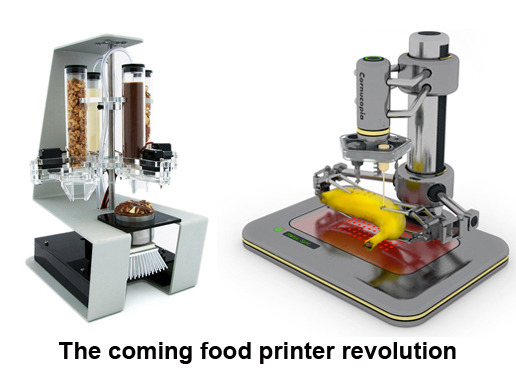
3.) The Coming Food Printer Revolution
Would you buy a product that was advertised as "Naturally grown, completely organic, printed food?"
Anyone who has an apple tree growing in their yard knows how difficult it is to grow one that is worthy of eating straight off the tree. Most have bruises, wormholes, or bird damage that leaves most apples somewhat marginalized. They may be perfectly good on the inside, yet they don't look very good.
As we shop for apples in the grocery store, we find ourselves looking for the "perfect apple." Only a small percentage of apples grown on the farm are worthy of making it into the major leagues of food – the fresh produce section of our grocery stores.
But what if we could take all of those bruised and damaged apples and turn them all into "perfect apples" – perfect size, perfect color, perfect crunch when we bite into them, and the perfect sweet juicy flavor and aroma that makes our mouth water every time we think about them.
This is the promise of food printer technology as we move from simply printing ink on paper, to 3D printing of parts and objects, to next generation food printers.
These aren't the artificial food devices that science fiction movies have been promising. Instead, they are devices with the very real potential for turning real apples into perfect apples. But this is only scratching the surface. Continue reading here.
.
.

Great lies continue to be propagated
2.) Eight False Promises of the Internet
In early 2003 I had a conversation with Dee Hock, founder and former CEO of VISA. At the time we were interested in hiring him to be the keynote speaker at our upcoming Future of Money Summit, an event that would take place in November of that year.
Ten years earlier, in March of 1993, Hock gave a dinner speech at the Santa Fe Institute where he described his unusual organizational theories in managing VISA, describing them as "chaordic" a term that roughly translates into "ordered chaos."
In 1996 he formed the Chaordic Alliance, later renamed the Chaordic Commons, for the purpose of furthering his notions that businesses can run more effectively when they are based on a "vital set of living beliefs" distributed through an organization, essentially replacing top-down command and control.
As we talked, his powers of persuasion were quite evident as he artfully described his "chaordic" theories, and by the end of the conversation I was a true believer, wanting to become a disciple of this new business gospel.
But as with many things that sound too good to be true the first time you hear them, Hock's "chaodic" theories that somehow worked within VISA, proved non-reproducible in other settings, and have now largely been abandoned after numerous attempts to implement them in other companies.
As we enter the 2nd decade of the new millennium we find ourselves in a similar quandary trying to separate the fallacies from the promises of what works and what doesn't on the Internet. With that in mind I've put together a list of eight of the founding theories of the Internet that have proved similarly deceptive. Continue reading here.
.
.

1.) 55 Jobs of the Future
One of my primary complaints with higher education is that they tend to prepare students for jobs of the past. The way a Midwesterner would phrase it, "they are constantly shooting behind the duck."
Similarly, whenever a column is written about the best paying jobs of the future, jobs like civil engineers, registered nurses, and computer system analysts, they are all jobs that currently exist today.
Yes, many of these jobs will still exist in the future, but every one of them will morph and change as technology and communication systems make their impact.
As an example, technology research firm IDC predicts the amount of data businesses will have access to will grow 50-fold over the next decade. As data becomes cheaper, faster, and more pervasive, the nature of our work begins to change as well.
The first wave of baby boomers has now turned 65. As this generation grays, their needs will change. Their growing numbers and increasing medical needs will require a different kind of health care professionals to take care of them.
As a rule of thumb, 60% of the jobs 10 years from now haven't been invented yet. With that in mind, I've decided to pull together a list of 55 jobs that will be in high demand in the future. Continue reading here.
..
Final Thoughts
We are in for a very exciting year ahead. It's a year where many competing trends will collide, and through those collisions we will see new pathways emerge.
At the same time, many new trends are forming, some with enough steam to form entirely new movements, others that will run their course and splinter into other emerging ways of doing business.
The "new normal" is quickly becoming the "nothing normal," and our daily routines, the things we use to maintain our own sanity, will need to morph and change if we hope to stay competitive in the emerging job market and even stay current in our own social circles.
The year ahead will be a wild ride. Let's take that ride together.
Author of "Communicating with the Future" – the book that changes everything
.
.



December 30, 2011
Flooring the Customer: Retail 2.0, The Rebirth is Coming
"High expectations are the key to everything" – - Sam Walton
On a recent shopping trip, I went to three separate stores and had difficulty finding what I was looking for. On each of these occasions I talked with a staff person and they told me about an option that either wasn't apparent to most customers, or that I hadn't considered.
Yes, the online retail business is stealing a growing percentage of market share, but people-to-people interaction still matters. The problem is that it's mattering less, and pricing competition is making the people-to-people option a luxury.
Our mobile devices are freeing the retail experience from the confines of the physical storefronts and traditional online locations, allowing shopping to take place virtually anywhere.
In the emerging customer-centric approach to retail, retailers will need to come up with new ways to engage their customers and find ways to lower barriers to purchase. Most importantly, retailers must be prepared to make a sale whenever and wherever a customer is ready. Here are a few thoughts on how they can make that happen.
Retails Downhill Slide
Recently Sears announced the closure of 120 of its Sears and Kmart stores. This was one of a number of similar announcements during the past year as online retailers become much more skilled at stealing market share.
The 2011 list of store closings is a very long list that includes the following:
405 – Blockbuster
633 – Borders
200 – GameStop
189 – Gap
160 – f.y.e.
117 – Anchor Blue
117 – Foot Locker
100 – Talbot's
71 – A.J. Wright
69 – Metropark
63 – Friendly's
60 – Rite Aid
52 – Destination Maternity
50 – Abercrombie & Fitch
50 – Hot Topic
45 – Big Lots
45 – Family Dollar
43 – Select Comfort
43 – Sonic Drive-In
35 – Denny's
32 – Great Atlantic and Pacific Tea Company, Inc. (SuperFresh, Pathmark Super Market)
30 – Ultimate Electronics
28 – Dominos
25 – Superfresh (Great Atlantic & Pacific Tea Company)
20 – Lowe's
Many, many more
Store closings hurt local communities in a number of ways, primarily with the blighted look of empty storefronts and plummeting sales tax receipts. But a dead Main Street adds to it a sense of declining options, fewer ways to meet the neighbors, and a growing detachment from that all-important sense of community.
Many of the empty storefronts still have large retailers paying the rent in the background, so property owners have little incentive to find a new tenant until the lease finally runs out. It also leaves owners with a delusional view of the property's true value.
When it comes to sales tax, the system is severely broke, giving preferential treatment to online sales. It can be reinvented, and the issues surrounding sales tax are solvable, but they need to be dealt with on a national level and this is not likely to make it onto any of the dockets in a presidential election year. One approach for solving this issue can be found here.
With declining sales tax receipts, local communities have very few options for engineering their own solutions.
For these reasons, combined with increased competition from the online sector, tradition retail is not likely to recover – ever.
However, every problem creates an opportunity, and the stage has now been set for a new era of retail, what I call Retail 2.0.
Flooring the Customer
People love to shop at places that are new and different. They love to be surprised by their experience, and they are willing to pay for those surprises.
Gone are the days where stores could simply warehouse products for consumer to buy. Retailers need to provide customers with a feeling of excitement and exclusivity; in short, they need to be floored by their experience.
Traditional shopping centers have become stagnant. Sure, some of the displays change along with the merchandise, and occasionally a store is replaced by another store, but the pace of life today is much faster than the glacial speed that transforms the fashion racks at Macy's.
We don't remember an evolution. We only remember a revolution.
Inside this ocean of lackluster thinking lies a few shining examples of what the next generation of retail will look like. Retail 2.0 will form around phrases like "experiential entertainment," "active engagement," and "interaction with experts."
Here are 9 different examples of how this grand experiment is beginning to unfold:

Apple Stores, where people go for answers
1.) Experts Shops – People love to talk to the experts and find answers for those nagging questions that create a cloud of uncertainty around most consumer products. The Apple Stores are a perfect example of an "experts shop" because each of their employees is a true expert on the products they sell. While Apple uses several other elements to attract and engage buyers, the expert-to-consumer relationship is a key feature.
Other companies like Amazon and Google are looking to replicate the Apple experience, but they will have an uphill battle. Unless something major changes, Google will ultimately fail with their retail experiment because they have no respect for two-way communications. If you've ever tried to contact Google to get an answer to a problem you'll know what I mean. In the end, retail is all about two-way communications.
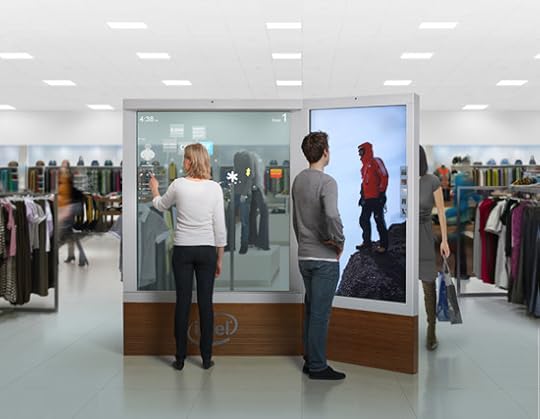
Intel's "3D Magic Mirror" – a gesture-controlled parametric body model display
2.) 3D Mirror Tech Shops – Imagine walking up to a mirror and visually "trying on" 120 different outfits in 15 minutes to find the perfect wardrobe combination to match your personality and the image you're hoping to portray. Intel is currently experimenting with 3D Mirror technology where an avatar that closely resembles a customer, and move with their movements, can be clothed and re-clothed numerous times as customers search for their perfect outfit. While this technology is still in its infancy, look for some version to make its way into most clothing stores within a decade.

Example of Cornell University's Body Scan Technology
3. Body Scanner Tech Shops – The key to a perfect fit is clothing that has been custom tailored to your exact specifications, and what better way to achieve that than to have your body scanned and your dimensions fed into some sort of clothing printer.
Leading the charge is Brooks Brothers, a company that already uses body scanners seamlessly. They offer mass-customized suits at their New York City retail store using a 3D body scanner to collect customer measurements. Style, fabrics, and design features are selected from a computer screen in consultation with a trained sales professional, who facilitates the discussion of fit preferences, such as loose or form-fitted clothing. Brooks Brothers uses a proprietary custom pattern-making system to create an individual pattern based on the body measurements. The garment is manufactured remotely and shipped to the store where a single fitting ensures customer satisfaction. Scan data and patterns for each customer are stored for future orders.
Further research is being conducted at Cornell University. Clothing printers are still a ways off.
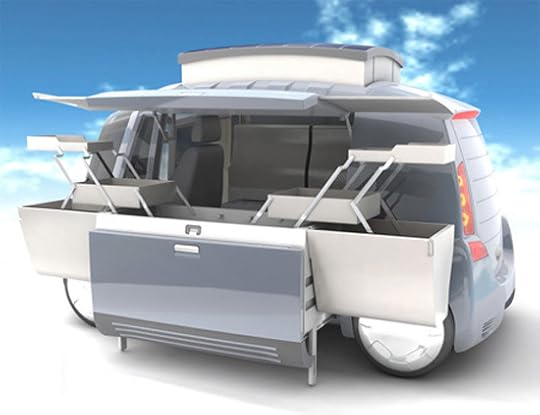
MERM – Mobile Electric Retail Minivan
4.) Mobile Shops – Rather than having customers come to you, move your store to the customers.
One example, MERM (Modular Electronic Retail Minivan), shown above, creates a mobile retail market wherever people are gathered – at sporting events, theater, concerts, parades, or even busy street corners.
When MERM is in driving mode, all the inner space is used for storing inventory. When it's switched to retail booth mode, the shelves can be easily unfolded for display outside the car, making adequate space for the vendor to stand inside. This feature minimizes the size of the car and thus reduces its energy consumption. Also, the compact size enables the user to drive in narrow urban streets.
Instead of opening a retail store and trying to get customers to walk in the front door, mobile retail has the flexibility to find the markets, anytime day or night.
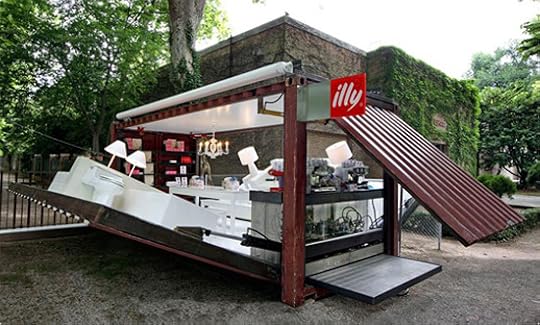
Pop-Up Shop by illy
5.) Pop-Up Shops – If new products come and go, why can't the stores that display them do the same?
Pop-Up Shops, in their current iteration, have a tendency to pop up unannounced, quickly draw in the crowds, and then disappear or morph into something else, adding to retail the fresh feel, exclusivity and surprise that galleries, theaters and Cirque du Soleil-adepts have been using for years.
Look for many new variations on this concept. Much like mobile retail, Pop-Up Shops can easily move to where the customers are.
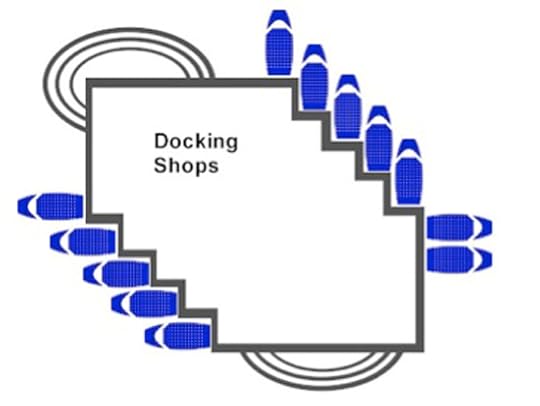
Conceptual layout for Docking Shops
6.) Docking Shops – The idea of Docking Shops were first envisioned for rural communities where the customer base is too low to warrant a permanent location. But a one-day-a-week storefront in five or six communities might be a perfect arrangement.
For this reason, I'm predicting a new form of shopping center will spring to life – Docking Shops. With a stationary common area at its core, the Docking Shops will be the central gathering place where multiple businesses can "plug-in" and set up shop.
RVs, trucks, vans, and other large vehicles will be converted into traveling dental offices, tax preparation centers, chiropractic clinics, and mobile retail storefronts. As they "dock" with the Docking Shops, merchandise and service areas will expand into the common area creating an "open bizarre" feel for the shopping experience.
Most of the traveling storefronts will be one or two person businesses, nomadically traveling from city to city on their business adventure. Others will work a regular circuit, showing up on the same day each week, building a loyal customer base.
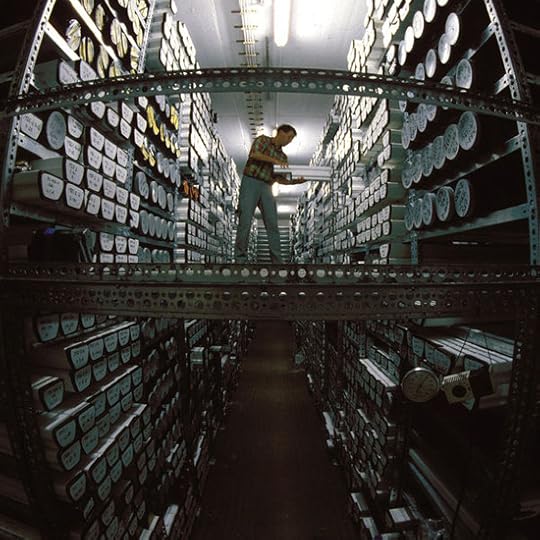
What was the brand and style of shoes you bought last time?
Who has that information?
7.) Complementary Digital Curation – Information about your brand preferences, past purchases, sizes, shapes, colors, and overall shopping habits is a double-edged sword. For privacy advocates, any storehouse of personal data is a recipe for future disasters. But for those looking to improve speed, convenience, and their overall shopping experience, digital curation has the potential to offer an unparalleled shopping experience.
Customers can volunteer for this experience, and retailers would love to have them, but the current privacy-transparency battleground has created too many unknowns for this to be used to its fullest. That will change in the future as the rules get defined.

Cooking Demonstration
8.) No-Inventory Demo Shops – One of the major expenses in traditional retail have been maintaining inventories and shelf space. Look for a new breed of retails shops that carry no inventory, only product demonstration stations with the ability to order on the spot (and receive a discount).
While most people think in terms of cooking demos with chef's talking about the food and cookware that they're using, the Demo Shops will extend to everything from athletic equipment, to toys, to hardware, to appliances, and much more.
Most will be pay-to-play product placement stations with experts on hand to answer questions. Look for tech companies like Apple, Amazon, Google and Microsoft to pave the way for these kinds of storefronts.
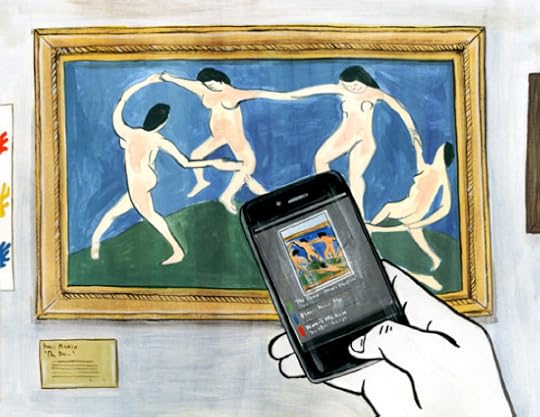
Using smartphone cameras to turn the world around us into our marketplace
9.) Google Goggles Retail – Still in early testing, Google Goggles is an experimental technology that will enable our smartphones to 1.) identify a product, 2.) find the entity selling it, 3.) make the purchase, and 4.) have it delivered – any product, any where, any time.
This technology has the potential to turn the world around us into our marketplace. If we can see it, we may be able to buy it and have it delivered to our home.
So rather than traditional storefronts, some retailers may hire models to walk up and down the street, trying to get people to "click" on them and buy their clothing or whatever they're selling.
Final Thoughts
When it comes to retail, consumers are in control. They decide what to buy, where to buy, when to buy, and how much they're willing to pay.
In a connected world, where information is fluid and transparent, retailers must become actively engaged in the global conversation. If not, their customers will begin the conversations without them.
Physical stores still provide the best way to create a high-value relationship with customers and build a branded experience.
Bricks and mortar stores are not going away any time soon, but the value they add to their communities and the variety of products they offer will remain in transition for the foreseeable future.
Author of "Communicating with the Future" – the book that changes everything
December 22, 2011
28 Major Trends for 2012 and Beyond – Part 2

Understanding trends is more of an art form than an exact science. But for those who can read the tealeaves, and make bold moves, leveraging trends can give them a serious competitive advantage.
As an example, LinkedIn just posted its annual list of top buzzwords, the ones most commonly used on their members' professional profiles. The top word people in the U.S. use to describe themselves on LinkedIn is "Creative." Last year "Creative" didn't even make it into the top ten, where "Extensive Experience" topped the list.
And it's not just the U.S. This was the most used word in Britain, Canada, Netherlands, and Germany. So what business decisions will you make that tie into people's recast dreams of being "creative?"
Obviously, trends don't happen in one-year cycles. They are constantly evolving, and all of the content below is, in one way or another, already happening. Last week we began our journey with trends 1-14 of the "28 Major Trends," and this week we will finish it. Here are trends 15 – 28.
15.) Exploding Smartphone Industry – With a global population exceeding 7 billion people, we have seen the mobile phone industry mushroom to include over 5 billion members. Smartphones remain a small subset, owned by around 10% of all those with mobile phones. But not for much longer. We are about to see virtually all communication devices replaced with smartphones over the coming decade.
Leading the charge is Google with over 700,000 Android devices being activated daily. Over the past year, Google activated more than 255 million devices compared to 105 million Apple activations. Admittedly this isn't a true apples-to-apples comparison (no pun intended) because Google doesn't make their own phones and Apple does.
As smartphones and other devices evolve in this exploding market, look for a near-term push into near-field communications, 4G, and flexible bendable devices.
Critical to the growth of this mobile device market is the global supply of rare earth metals, which China currently controls 95% of known reserves. Looking out for its own self-interests, Chinas has been ratcheting down exports of these metals by 12% per year for the past 5 years. Their reluctance to export enough to meet global demand has touched off a world-wide hunt for new sources with promising finds being uncovered in Canada, Argentina, South Korea, and California. Look for several new mines to come online in coming years and China's stranglehold on the industry to plummet.
16.) Hyper-Local Urban Farming Going Underground – A few years ago, a study by the Leopold Center for Sustainable Agriculture at Iowa State University reported that between 1980 and 2001, the distance food traveled from farm-to-table increased 25%, ranging from 1,500 to 3,000 miles. Since then we have seen a strong push to localize and even hyper-localize the growing of food supplies.
The drive to make all food supplies local has touched off a number of battles to rewrite municipal codes to accommodate everything from rooftop gardens, to backyard cows and chickens, to aquaponic and aquaculture projects, to experimental vertical farms. The next shift with see crops grown underground.
Dutch-based PlantLab recently announced it has figured out how to triple plant yield in a sunless, rainless environment housed in their underground research facilities. PlantLab uses artificial light and only 10% of the water typically needed. Using the correct spectrum from their LED lighting system has increased photosynthesis efficiency to 12-15% percent from sunlight's 9% range.
By keeping the plants in a contained environment, PlantLab can also recycle evaporated water, which helps them grow crops using just one-tenth the water needed in traditional greenhouses. As an addition bonus, pesticides are no longer necessary. Production facilities can be built almost anywhere – from the deserts of Sahara to the icy plains of the Artic.
17.) The Gamification of Business – Currently a huge buzzword in techy circles, gamification is moving mainstream. Simply defined, gamification involves applying game techniques such as leveling, rewards and competition, to any human experience.
Many limit their thinking about gamification to mobile apps but it has far broader implications. Imbedded game features such as leaderboards, achievements, and skill-based learning are becoming common in day-to-day business processes, driving adoption, performance and engagement.
One recent example is the Nike campaign to gamify the process of personal training. People who visit the site, enter details of their running times and the routes they were on, and compete for prizes with others around the world.
Another example is the geo-location service Foursquare provides which encourages people to use its check-in technology by giving them an incentive, when they checked in to a certain venue. Many restaurants have picked up on this and offer free cupcakes or desserts to customers who talk about their experience on Foursquare and other social networks.
It's all about adding fun to the daily tedium of living. Look for gamification to start making major inroads into college offerings as well as non-traditional K-12 educational programs.
18.) Going Cashless – Signs of our emerging cashless society has been popping-up in small doses since 2005. And while 2012 may not be the year that consumers instantly go cashless, it will be the year that major players like Google and MasterCard roll out their cashless initiatives around the world.
For consumers, the initial attraction will be convenience, but eventually mobile payments will create an entirely new data-driven eco-system of rewards, purchase history, daily-deals and more. Key to this movement will be Near Field Communication (NFC), a technology that allows for encrypted data to be exchanged between two devices in close proximity ("near field") to each other.
Here are a few of the changes happening in this market over the past few months:
In October 2011, the Google Wallet, a free, NFC-enabled mobile payment system became operational at select retailers across the US. Licensing MasterCard's PayPass technology, shoppers simply tap their mobile device on special terminals at points-of-sale to pay instantly.
In June 2011, PayPal demonstrated its own mobile payment app for Android devices.
Twitter founder Jack Dorsey's latest venture, Square, is an electronic payments service which enables users to accept credit card payments by using a portable card-reader device that plugs in to iPhone, iPad or Android devices. Both the Square card-reader and app are free, although there is a 2.75% charge for each payment made. In November 2011, Richard Branson and Visa became investors in Square.
In June 2011, Sweedish-based iZettle was launched to enable consumers to accept anywhere-anytime credit card payments. The iZettle app works with iPhones and iPads. Bills can also be paid or money transferred using this service.
Google CEO Larry Page sees himself as the next great visionary, following in the footsteps of Steve Jobs, Nikola Tesla, and Thomas Edison, as he attempts to rewrite the rules for major industries by pushing initiatives like driverless vehicles, wireless power, and a cashless society. With our hero-based culture, look for Larry Page to emerge as the heart and soul of the movement to turn virtually every electronic device into a payment device.
19.) Ending the Dream of Home Ownership – If you had to choose between starting your own company, traveling around the world, or owning your own home, which would you choose?
Attitudes among Gen X and Gen Y are increasingly shifting towards creating a full life experience rather than settling down and building a nest egg.
Home ownership in the U.S. dropped to 66.9% last year from a high of 70% in 2005, and some are forecasting it will drop as low as 62%, a level not seen since the Census began tracking this data in 1963, as the hurdles to owning a home increase.
Naturally, this begs the question: Is a 62% home ownership rate so bad? It's still far higher than in most European countries. And, more importantly, why is it assumed we need to own our own homes?
Trillions of dollars have been spent propping up the American Dream of owning our own home. But the dream is shifting, so look for Congress to quit spending money on it. Instead, look for new experimental approached for redefining the relationship between people and the places they're living in. The stage has been set, it only a matter of time before a new paradigm unfolds.
20.) Accomplishment-Based Education - Writing a book, receiving a patent, or starting a business are all symbols of achievement in today's world. But being the author of a book that sells 10,000 copies, or inventing a product that 100,000 people buy, or building a business that grosses over $1 million in annual sales are all significant accomplishments that are far more meaningful than their symbolic starting points.
Much of what happens in today's colleges and universities is based on "symbols of achievement," not actual accomplishments.
Students that enter a classroom will typically find themselves immersed in an academic competition, a competition that pits students against each other to produce results that best match the teacher's expectations. Only rarely will the work product of a student in a classroom rise to any notable level of significance. Completing a class is nothing more than a symbol of achievement.
Look for this to change quickly as the tools for creating and managing "accomplishments" remotely become more pervasive. More details here.
21.) Driverless Cars and Autonomous Vehicles – The next revolution in transportation will be here soon, and it won't be streetcars, monorails, Segway's, or electric vehicles. It will be self-driving cars, and the adoption of this technology will change virtually everything in the field of transportation planning.
The idea of jumping into a vehicle and having it shuttle you to your destination without anyone "driving" it may sound like pure fantasy to some, but it's far closer than most of us think.
Google's self-driving car project has already racked up over 200,000 driverless miles on highways. Google reports these cars have required intervention by a human co-pilot only about once every 1,000 miles and the goal is to reduce this rate to once in 1,000,000 miles.
In 2010 VisLab ran VIAC (VisLab Intercontinental Autonomous Challenge), a 13,000 km test run of autonomous vehicles. In this competition, 4 driverless electric vans successfully drove from Italy to China, arriving at the Shanghai Expo on October 28, 2010. This was the first intercontinental trip ever completed by an autonomous vehicle.
Many car companies including General Motors, Volkswagen, Audi, BMW, and Volvo have begun early testing of driverless car systems.
General Motors has stated that they will have a driverless model ready for final testing by 2015, going on sale officially in 2018.
Even though car companies are making plans for the transition, planning departments are not. Most local and regional transportation departments are working with models that assume 20 years from now transportation systems will be basically the same, with only slight variations around the edges.
Driverless cars will be far safer. Human-based foibles like speeding, inattention, inexperience, impairment and fatigue all contribute to road accidents. Driverless cars will remove the human variable from the system. Along with fewer accidents will come the eventual elimination of traffic cops, traffic courts, stoplights, and parking lots.
Look for rapid advancement in this area and for Google to make a play to design an Android-like operating system for all driverless cars.
22.) The Drone Side of Life - Sometime over the coming months you can expect to see a version of the following help wanted ad:
"Help Wanted: Full-time aerial drone pilots needed to help manager our growing fleet of surveillance, delivery, and communication drones. We are also looking for drone repair techs, drone dispatchers, and drone salesmen."
In 2010 the U.S. Military spent $4.5 billion on drones, increasing to $4.8 billion in 2011.
With this kind of focused spending, military drone technology has improved dramatically over the past decade. But as a technology, future drones will go well beyond military uses. The stage is being set for thousands of everyday uses in business and industry all over the world.
With basic drone hardware being matched up with smartphones, and the bottom-up design capabilities of app developers around the world, drones will quickly move from the realm of personal toys to functional necessities that we interact with on a daily basis.
For those of you looking to switch careers, the drone marketplace will create one of the hot new industries of the future. More details here.
23.) The Coming Transparency Wars – Can you feel the layers being lifted? Transparency is entering our lives in unusual ways and much like having individual veils lifted from a multi-veiled garment; we are now able to see the world around us with far greater clarity.
Recently, several misguided thinkers have proposed the notion that the more transparent our society becomes, the better off we'll be. Using the logic that a self-watching society will be a safer one, they advocate for radical transparency. This is simply not true. And the privacy advocates will not let it happen.
The greatest danger of too much transparency is that we will become consumed by watching each other, and somewhere along the way, we will lose sight of the big picture. Each day will be filled with constant drama as we exhaust ourselves trying to right every wrong, and solve every problem.
We are all terminally human and have very limited ability to improve who we are simply because someone else may be watching. However, drawing the correct dividing line between privacy and transparency will not come easy. This will continue to be a volatile battleground for many years to come. More details here and here.
24.) Dismantling the Justice System - In a country that claims to be the land of the free, the number of people under the control of the U.S. corrections system has exploded over the last 25 years to more than 7.3 million, or 1 in every 31 U.S. adults, according to a report by the Pew Center on the States. The actual number of people behind bars rose to 2.3 million, nearly five times more than the world's average.
A new study by the University of North Carolina now shows a shocking 30% of all young people get arrested at least once by age 23.
People who enter prison cannot lead productive lives. Removing too many from wage-earning positions, turning them into wards of the state, is a recipe for economic disaster.
We are seeing some experimentation and improvements around the edges but so far nothing major. Even with its massive inertia to maintain the status quo, public tolerance has reached its limit for this kind of needless expenditure and constant friction between the government and its citizens.
Look for this to become one of the long-term movements splintering away from the Occupy Wall Street crowd. Ironically, the biggest changes in this area will happen when driverless cars start eliminating the need for street cops. More details here.
25.) Going Waitless – In our highly competitive business and social environments, we have a need to be active and engaged at all times. And waiting in line, for virtually anything, becomes irritating.
For this reason, Los Angeles-based QLess Inc. has devised a text-messaging service to help eliminate the wait.
The department of motor vehicles seems to be the epitome of mind-numbingly long wait times and Johnson County, Kansas was one of the first to implement QLess to alerts customers when it was their turn.
With this type of service, people don't have to be present as the grueling minutes click away. Many customers now go grocery shopping, while waiting in a virtual line, or come in closer to their estimated appointment time.
Since implementing the system three years ago, customers no longer camp out on the floor and spend far less time complaining.
Look for wait-less systems to spring to life in doctor offices, auto service shops, pharmacies, Disneyland, and virtually every place in society where the wait needs to dissipate.
26.) Power of 10 Interface - The distance between information and our brain is getting shorter.
Twenty years ago if you had access to a large information base, such as the Library of Congress, and someone asked you a series of questions, your task would have been to pour through the racks of books to come up with the answers. The time involved could have easily have been 10 hours per question.
Today, if we are faced with uncovering answers from a digital Library of Congress, using keyboards and computer screens, the time-to-answer process can easily be reduced to as little as 10 minutes.
The next iteration of our information-to-brain interface will give us the power to find answers in as little as 10 seconds. Look for major advancements in "smart contacts" in the coming months to help close the gap towards the 10-second goal. More details here.
27.) Emergence of Food Printers - 3D printing is a form of object creation technology where the shape of the objects are formed through a process of building up layers of material until all of the details are in place – a relatively slow process often requiring hours to complete.
Three-dimensional printing makes it as cheap to create single items as it is to produce thousands of items and thus undermines traditional economies of scale. It may have as profound an impact on the world as the coming of the factory did during the Henry Ford era.
Marcelo Coelho and Amit Zoran, a couple ingenious minds at MIT working on the Cornucopias Project, have created a very visual way for us to imagine next generation food that will come from similar 3D printers. Each of their designs proposes an advanced way of mixing ingredients, forming new compounds, and building a layer-by-layer aesthetically pleasing menu item with perfect texture and shape.
Look for continuing progress in the area of 3D food printers, even though the Jetson's style food synthesizers may still be a few years off. More details here.
28.) The Self-Health Movement – No one cares more about your health than you do. So it was only a matter of time until someone invented the self-diagnostic tools, self-monitoring devices, and self-analysis systems to put "self" into the center of the healthcare equation.
Apple's App Store currently offers 9,000 mobile health apps, along with 1,500 cardio fitness apps, over 1,300 diet apps, more than 1,000 stress and relaxation apps, and over 650 women's health apps.
But apps are only part of the equation. Peripheral devices are setting the stage for the true self-revolution:
All Apples stores now carry the Withings' Blood Pressure Monitor, a peripheral device that plugs into the iPad, iPhone or iPod Touch and takes the user's blood pressure. Data can be sent directly to a doctor or saved (confidentially) to the cloud.
Lifelens has created a smartphone app to diagnose malaria. The app can magnify a drop of blood (captured via a simple finger prick) and identify whether malarial parasites are present.
In October 2011, Ford demonstrated three SYNC apps offering in-car health monitoring for drivers to track chronic conditions such as diabetes, asthma and hay fever.
Also in October 2011, AT&T announced it will begin selling clothes embedded with health monitors, able to track the wearer's vital signs – heart rate and body temperature – and upload them to a dedicated website.
The X Prize Foundation is co-sponsoring a $10 million prize for the best mobile device allowing consumers to diagnose their own diseases.
Every new peripheral device will create a market for hundreds of new apps, and we haven't even scratched the surface of what will seem like a massive influx of brilliant new peripherals over the coming months. Healthcare industry execs should be nervous.
Final Thoughts
I will end with a few comments about the new systems that will be needed to tie all of these trends together.
We are currently out of balance between backward-looking problem-solving and forward-looking accomplishments. Forward accomplishments help erase past problems. They solve problems in a different way. We need more forward-looking accomplishments, and our greatest undertakings in the future will come in this area.
This need for future accomplishments will also dictate a need for new and better systems to regulate, manage, and leverage the activities surrounding them. These systems will need to be global in nature, and over time, a few will emerge to challenge the power of nations. National systems are already putting the brakes on emerging global systems, but it will only serve as a short-term delay of the inevitable.
The era of global systems is coming very soon.
See "28 Major Trends for 2012 and Beyond – Part 1"
Author of "Communicating with the Future" – the book that changes everything
.
.
December 16, 2011
28 Major Trends for 2012 and Beyond – Part 1

We are in for a very exciting year ahead. 2012 is a year where many competing trends will collide, and through those collisions we will see new pathways emerge.
At the same time, many new trends are forming, some with enough steam to form entirely new movements, others that will run their course and splinter into other emerging ways of doing business.
The "new normal" is quickly becoming the "nothing normal," and our daily routines, the things we use to maintain our own sanity, will need to morph and change if we hope to stay competitive in the emerging job market and even stay current in our own social circles.
With this in mine, I'd like to take you on a journey into some of the trends I'll be watching in 2012 as the tectonic plates of change inch their way into new positions. Here is the first half of the 28 major trends to watch in 2012 and beyond.
1.) Retail 2.0 – People still like getting out of the house and being around other people, but the retail world hasn't quite figured out what people are looking for. New ways of thinking about Retail 2.0 will form around phrases like "experiential entertainment," "active engagement," and "interaction with experts."
Some of the major expenses involved in traditional retail have been maintaining inventories and shelf space. Look for a new breed of retails shops that carry no inventory, only product demonstration stations with the ability to order on the spot (and receive a discount). Most will be pay-to-play product placement stations with experts on hand to answer questions. Tech companies like Apple, Amazon, Google and Microsoft will be paving the way for these kinds of storefronts. I'll be writing more on this topic in the weeks ahead. Other thoughts on this topic here.
2.) Crowdfunding – Even though some sites like Kickstarter and Quirky have been getting traction in this space, Congress' recent effort to pass official Crowdfunding legislation will unleash an entirely new Pandora's box full of options for entrepreneurs hoping to launch their latest ventures. Many startups are waiting on the sidelines for this new option to kick in, so look for a surge of activity to take place as an entirely new finance industry begins to take shape.
3.) The Persistent "Big Lie" Opportunity – Throughout history we have seen any number of cultural truisms spring to life that were simply not true. If something is repeated enough times, society will begin to believe it. With our ability to post and repost a novel concept, new cultural memes can be formed virtually over night. Yet at the same time, our attempts to debunk any myth with over a million mentions online often runs into a murky wall of ambivalence. For this reason, even though they have been scientifically disproven, "big lies" such as these will persist:
"In the future everyone will have their fifteen minutes of fame"
"You only use 10% of your brain"
"The Internet is making us dumber"
"The more you sweat, the more calories you burn"
"Listening to classical music turns babies into geniuses"
"Alcohol kills brain cells"
"Being skinny means you're fit and healthy
"Your IQ is fixed and stays the same throughout your life
If you thought some of the statements above were true, you're not alone. Many of us still do even though they have been proven false. Look for a new breed of services to appear that will offer solutions for globally debunking the persistent "big lies."
4.) Emerging Data Marketplace – The data that you currently own can become far more valuable when you mix it with other data. As an example, if you add weather conditions to your customer data, chances are you will find some connection between weather patterns and your customers' purchasing habits.
Acquiring datasets such as these is presently very time consuming, expensive, and generally a pain to do. Look for emerging big data marketplaces, such as Microsoft's Azure, that will come complete with directories of the available datasets, along with counselors who can help coach you through the maze.
5.) Smartphone Peripherals – The whole mobile apps revolution began in March of 2008 when Steve Jobs announced the software developer's kit for the Apple iPhone. When Apple's App Store officially opened on July 11, 2008, there were a whopping 552 apps to choose from. Over 60 million apps were downloaded within the first 3 days and tech companies around the world began to sense a market shift, and we now have well over a million apps to choose from.
While apps have been getting tons of attention, the piece getting very little is the exploding field of smartphone peripherals that extend our current communication systems far beyond simple person-to-person communications. Virtual every object we come into contact with has the potential for being controlled by our smartphone, and interface designers are working overtime to make this happen.
Look for literally thousands of new peripheral devices to hit the market over the coming year or two. More details here.
6.) The Coming Age of Micro-Incomers – Twitch.tv, or "Twitch," as it's called by founder Justin Kan, was built as a way to make professional video gamers more mainstream. It has a partner program similar to YouTube, where the most popular gamers can make money by running commercials during their live streams. Yes, people can actually make money by playing games.
While most of them will not make full-time incomes, they will find it relatively easy to become part of the emerging "micro-incomer" crowd. Here are a few other ways people can make partial and even full-time incomes online:
Sell stuff on eBay or Craig's List
Sell photos to stock photo sites
Amazon's Mechanical Turk
Transcribing audio files
Become a virtual assistant
Interview people and sell the interview
Enter online competitions
Write articles on eHow.com
None of these are get-rich-quick schemes, but they can make all the difference between getting by and being destitute. Look for training centers to emerge with a "micro-incomers" kind of focus.
7.) Data Visualization Trends – "I remember seeing a terrific video on wireless power but cannot seem to find it no matter what I do." Mental faux pax like this are all too common.
For most of us, it's very difficult to image what information looks like, and when we save a file somewhere, its very often very difficult for us to find it again. Data visualization has been a problem plaguing the online world for years and will become even more pronounced as we move further into the cloud.
Data visualization provides tools for two primary functions – explanation and exploration. While business people might think of visualization as the end result, scientists also using forms of visualization to formulate questions, and for discovering new features of a dataset. More importantly, our ability to find and work with data needs to be so easy that average everyday people can work with it. Look for a few critical new offerings in this area to revolutionize how we store and retrieve the information that will operate and manage our future selves.
8.) Regionalization of the Internet – In the 1990s the Internet was greeted as the New New Thing: It would erase national borders, give rise to communal societies that invented their own rules, and undermine the power of governments. But not so fast!
Even though the Internet began as a utopian dream of a unified world without government intervention, today's Internet is moving towards the opposite end of the spectrum. In many cases, Internet companies not only welcome governmental restrictions; they are being used as agents of government policy.
The future Internet will see a move towards even more border sensitivity, with hyper-location based services to both improve relevancy of the user experience, and also put themselves in good standing for regional business and government contracts. More details here.
9.) The End of an Era – Faster than Ever – When Dell announced it would no longer be selling netbook computers, it foretold the end of an era. The cute little laptops surged in popularity and came crashing back to earth in a timeframe best measured in months, not decades. Tablet computers, starting with the Apple iPad, made them instantly obsolete.
Our increased awareness of what's hot and what's not gives us instant ability to turn our backs on "the old" and to begin embracing "the new." When Netflix announce they were changing their business model, they instantly got the cold shoulder and had to reverse course. RIM's Blackberries, once the hottest product in the connected business marketplace, got blindsided by the iPhone and Android and has been plummeting ever since.
The speed with which new companies can emerge, is also the speed with which they can become dismantled. Today's hotness can become tomorrow's coldness in a matter of months. So take a close look at the top 100 emerging new companies and know that less than 20% will still be around five years from now. (By the way, I just made that statistic up. Soon to be another one of the Big Lies.)
10.) Poor Lifestyles Hurting Long-term Health – In the past three or so decades, women have increased their calorie intake by 22% and men by 10%, with carbohydrates and sugar-sweetened beverages being major sources of the unnecessary calories.
The inevitable result is that more than two-thirds of U.S. adults and about one-third of children are over the ideal body weight, with the extra layers of fat putting a major strain on people's hearts. The trend is particularly concerning in children. Today, about 20% of U.S. kids are obese, compared with just 4% thirty years ago.
Neither adults nor children are exercising enough and about 21% of men and 18% of women still smoke. About 20% of high school students also have taken up the smoking habit. This means that 94% of U.S. adults, and that's almost everyone, have heightened risk factors for heart disease, diabetes, cancer, and Alzheimer's.
However, as always, every problem creates an opportunity, and every one of the identifiable risk factors will become a focal point of activity until each of the problems has become a thing of the past.
11.) Reversing the Obesity Trends – New research documents a 5.5% drop in the number of obese kids in K-8 classes in New York City's public schools from 2006-2007 to 2010-1011.
It's no secret that reversing the childhood obesity epidemic in the U.S. will require a long-term effort. Since 1970, the rate of childhood obesity in the U.S. has tripled. There have been hints that these rates were leveling off in New York City in recent years, but the new study reports an actual decrease. The bad part is that no one knows exactly why it's happening.
Look for a trend where researchers flock to every new community that shows progress, to uncover the clues. Also look for the answers to be different than what "the experts" have been telling us in the past.
12.) Fast-Niche Online Universities – We are seeing more and more niche professions without a clear path for getting there. At least not through any traditional University programs. These include everything from social networking experts, to product evangelists, to drone operators, to business colony managers.
Through projects like Khan Academy, MIT OpenCourseWare, and iTunesU, the Internet has made it easier for anyone to be a student. Now it's also making it easier for anyone to become a teacher. Several platforms have launched within the last couple years that democratize teaching.
Online universities such as Udemy, Learnable, Tildee, Skillshare, and Sophia are beginning to capture market share. Look for large associations and businesses, as the early adopters, to start creating their own path-to-profession courseware to fill the demand for rebooting skills in a short timeframe.
13.) Teaching Entrepreneurship and the Rise of the Accelerator – Can you teach entrepreneurship? People like Eric Ries, author of "The Lean Startup," think so. He also thinks that entrepreneurship must be taught to far more people if the American economy is to successfully pivot towards a post-manufacturing era.
But as people who have started a business know, is very difficult to teach the emotional side of business, and startups invariably become extremely emotional at one time or another. And the only good counseling for a person going through the trials of getting a business off the ground are other well-seasoned entrepreneurs. That's why accelerators like Techstars and Y-Combinator have been gaining so much attention.
With their rapid incubation processes, Techstars and Y-Combinator have quickly becoming a natural farm club for VCs in the high tech arena. Look for a variety of other vertical niche accelerators, in fields like healthcare, education, finance, and other sectors, to materialize.
14.) Information Doesn't Want to be Free – In 1984 at a Hackers Conference, Silicon Valley futurist Stuart Brand was the first to use the phrase "Information wants to be free" in response to a point made by Apple co-founder Steve Wozniak but continued, "On the other hand, information wants to be expensive, because it's so valuable. The right information in the right place just changes your life."
John Perry Barlow, lyricist for the Grateful Dead, keyed in on the first half of the phrase, "Information wants to be free" in a keynote speech at an Open Source Internet Symposium in 1992. This set the stage for an entirely new era of free-thinking "free" advocates. This became another one of society's "big lies."
There is always a cost to "free." While it may not extract a payment from your bank account, there is always a "time" cost involved. Without some amount of friction, the volume of information you have to sift through skyrockets and even with good search technology, your time-costs climb dramatically.
The days of "free" thinking are numbered. Look for this mindset to shift over the coming years. More details here.
Next
Continue to "28 Major Trends in 2012 and Beyond – Part 2."
Author of "Communicating with the Future" – the book that changes everything
.
Thomas Frey's Blog

- Thomas Frey's profile
- 2 followers

