
Thomas Frey's Blog, page 12
May 17, 2022
The Future of Crypto Ecosystems and their Mainnets

“These are the times that try men’s souls!” Over the past few days, I’ve heard several people use this Thomas Paine quote!
A crash in cryptocurrency prices has wiped away countless billions in value over the past few days as the price of Bitcoin plunged to its lowest point since 2020. While the crypto markets had been experiencing considerable volatility over the past few months, it all came to a head this week, all triggered by the crash of the Terra stablecoin, and the cryptocurrency, Luna, that it is linked to. Terra failed to maintain its dollar peg which, in turn, triggered a collapse in Luna’s price, causing the entire crypto ecosystem to take a nosedive.
Rest assured, cryptocurrencies are not going away, but this market readjustment is causing people to reevaluate why they’re important, and part of this rethinking involves the strategies behind their mainnets.
What is a Mainnet?Every cryptocurrency needs a blockchain network in order to function … but not all cryptocurrencies have their own blockchains.
Digital currencies that maintain their own unique blockchain network, referred to as a mainnet, are more likely to be the ones that last into the future, providing unique value and service.
Why is a Dedicated Mainnet Important for a Cryptocurrency?Many factors can help determine whether a cryptocurrency might be valuable and worthwhile in the long run. Visibility, wallet accessibility, acceptance, market cap, circulating supply, community size, team experience, and the management team’s commitment to making ongoing upgrades or revisions are all important things to consider when looking at the ongoing viability of a cryptocurrency.
And so is the uniqueness of the coin – the protocols, tokenomics, and business strategy behind it that make the transactions faster and less costly and that provide special functionality. Related to this is the blockchain’s reliability and security.
These features are best proven in the context of a rigorous testing environment. The gold standard for this is the testing that happens in a safe “testnet” setting within another existing mainnet.
Governing Structures for MainnetsSince Mainnets operate outside the boundary of a single country, and outside the purview of any existing authority, it has become customary to establish a non-profit Foundation as the governing entity to both help develop strategies and manage the inner workings of the Mainnet.
Since blockchains are a relatively new technology, we still haven’t seen the full extent of their capabilities, and these capabilities will continue to grow as we incorporate more tools, precision, scalability, and extensibility into the mainnets.
 The Birth and Emergence of New Utility Tokens
At any given time, there are over 20,000 developers working on cryptocurrency platforms.
Most new cryptocurrencies are developed on top of another existing mainnet, in a safe “testnet” environment. The testnet development is walled off from the active functions running on that mainnet by use of a unique genesis block – the first block on the testnet’s blockchain – to avoid disruptions or worse of that mainnet if issues occur during this testing phase. Testnets are commonly used for new blockchain testing as well as smart contracts, NFTs, DAOs, DeFi, DEXs, dApps, and other features.
In the case of blockchain development, developers typically choose a mainnet “host” for their testnet activity that’s similar in function and design to its own project. Mainnets like Ethereum and Polkadot are the most popular networks for testnet activity, while Terra, Solana, and NEAR have shown the most recent growth in that area.
As developers evaluate and refine the features and functions of their testnets, they use fake crypto coinage with no value to simulate transactions.
When testing is complete, and the testnet’s features have proved to live up to the functionality promised in the developer’s white paper, the project team can transition their testnet platform and launch its own mainnet, often with published code.
Its status as a mainnet provides an added level of proof that the blockchain project is functional and ready for participation. As time goes on, developer teams will continue to refine their mainnet, an indication of a vibrant and possibly more future-proof cryptocurrency.
Implications for Quality and LongevityThis testnet-to-mainnet process is thorough, but investors who get involved early in a cryptocurrency blockchain development often do so at greater risk. Functionality promises found in a white paper can seem exciting and groundbreaking, but until the blockchain successfully emerges from the “sandbox” testing environment, nothing is certain.
However, once their mainnets are released at the conclusion of this testing process, developers are essentially stating that now their blockchain can be trusted – they’ve tested it in realistic conditions and refined it within that space before releasing it.
The Maturing of the Crypto IndustryAs I stated earlier, cryptocurrency is the logical next stage of development for currency and mediums of exchange around the world.
Because crypto represents the privatization of currency, it will often struggle to compete with traditional government-backed currencies used in everyday kinds of commerce – there is no FDIC, no safety nets, and no Federal Reserve Bank to plug the leaks. So no, it’s not easy to transition a nation’s economy from a national currency to a cryptocurrency, and having a few hiccups along the way should naturally be expected.
At the heart of this revolution are the mainnet’s blockchain engines that are forging new inroads into business and industry. Thought leaders are beginning to realize that blockchains cannot succeed over the long run simply by imitating others.
For this reason, it’s the operation of mainnets that’s separating the crypto-men from the crypto-boys.
And if worse comes worse, and by some stretch of the imagination the entire crypto industry were to collapse, it would collapse forward. Just as the dot com world survived the brutal Y2K implosion of 2000, the crypto implosion of 2022 could become the launching pad for our golden future over the years ahead.
Translate This PageSelect LanguageAfrikaansAlbanianAmharicArabicArmenianAzerbaijaniBasqueBelarusianBengaliBosnianBulgarianCatalanCebuanoChichewaChinese (Simplified)Chinese (Traditional)CorsicanCroatianCzechDanishDutchEnglishEsperantoEstonianFilipinoFinnishFrenchFrisianGalicianGeorgianGermanGreekGujaratiHaitian CreoleHausaHawaiianHebrewHindiHmongHungarianIcelandicIgboIndonesianIrishItalianJapaneseJavaneseKannadaKazakhKhmerKoreanKurdish (Kurmanji)KyrgyzLaoLatinLatvianLithuanianLuxembourgishMacedonianMalagasyMalayMalayalamMalteseMaoriMarathiMongolianMyanmar (Burmese)NepaliNorwegianPashtoPersianPolishPortuguesePunjabiRomanianRussianSamoanScottish GaelicSerbianSesothoShonaSindhiSinhalaSlovakSlovenianSomaliSpanishSudaneseSwahiliSwedishTajikTamilTeluguThaiTurkishUkrainianUrduUzbekVietnameseWelshXhosaYiddishYorubaZulu
#goog-gt-tt {display:none !important;}
.goog-te-banner-frame {display:none !important;}
.goog-te-menu-value:hover {text-decoration:none !important;}
.goog-text-highlight {background-color:transparent !important;box-shadow:none !important;}
body {top:0 !important;}
#google_translate_element2 {display:none!important;}
function googleTranslateElementInit2() {new google.translate.TranslateElement({pageLanguage: 'en',autoDisplay: false}, 'google_translate_element2');}
function GTranslateGetCurrentLang() {var keyValue = document['cookie'].match('(^|;) ?googtrans=([^;]*)(;|$)');return keyValue ? keyValue[2].split('/')[2] : null;}
function GTranslateFireEvent(element,event){try{if(document.createEventObject){var evt=document.createEventObject();element.fireEvent('on'+event,evt)}else{var evt=document.createEvent('HTMLEvents');evt.initEvent(event,true,true);element.dispatchEvent(evt)}}catch(e){}}
function doGTranslate(lang_pair){if(lang_pair.value)lang_pair=lang_pair.value;if(lang_pair=='')return;var lang=lang_pair.split('|')[1];if(GTranslateGetCurrentLang() == null && lang == lang_pair.split('|')[0])return;var teCombo;var sel=document.getElementsByTagName('select');for(var i=0;i<sel.length;i++)if(/goog-te-combo/.test(sel[i].className)){teCombo=sel[i];break;}if(document.getElementById('google_translate_element2')==null||document.getElementById('google_translate_element2').innerHTML.length==0||teCombo.length==0||teCombo.innerHTML.length==0){setTimeout(function(){doGTranslate(lang_pair)},500)}else{teCombo.value=lang;GTranslateFireEvent(teCombo,'change');GTranslateFireEvent(teCombo,'change')}}
Search for: Recent Posts The Future of Crypto Ecosystems and their Mainnets Drone Delivery: A Massive Huge Industry Coming Soon to a Doorstep Near You Creating a Code of Ethics for Artificial Intelligence Categories Artificial Intelligence Business Trends Future of Agriculture Future of Banking Future of Education Future of Healthcare Future of Transportation Future of Work Future Scenarios Future Trends Futurist Thomas Frey Insights Global Trends Predictions Social Trends Technology Trends Speaking TopicsFuture of Healthcare – “Is Death our only Option?Future of AIFuture of Industries

The post The Future of Crypto Ecosystems and their Mainnets appeared first on Futurist Speaker.


May 11, 2022
Drone Delivery: A Massive Huge Industry Coming Soon to a Doorstep Near You

The path to the future is really many paths, each moving in fits and starts with rapid progress along some and unexpected but ultimately explainable delays along with others.
In 2015 I looked in detail at the progress of the drone delivery business. That column, titled “37 Critical Problems that need to be Solved for Drone Delivery to become Viable,” goes A-Z with all the logistical challenges that will likely be encountered and will need to be addressed in the context of a residential drone-powered delivery.
We can cross some of those challenges off the list – especially those related to the battery technology of the drones themselves.
Although I didn’t put a date on the ultimate point when drone deliveries would be widely implemented, I’ll admit I was overly optimistic about that timeframe. I’m not the only one, though. Thanks to early hype from Amazon and others nearly a decade ago, we were led to believe this was just around the corner. It wasn’t, but a lot can happen in eight years.
So now, it would appear, we’re almost there. The concept has been proven and in 4-6 years, a majority of people in the U.S. will be able to receive drone deliveries of food, medication, and relatively light packages. This same transition, however, will be even quicker and more comprehensive in China and other APAC countries.
Don’t Let Perfection be the Enemy of Progress“When” is an important and fun question to consider, but first let’s ask a more serious one.
Does every logistical, ethical, and safety contingency situation need to be addressed and resolved in advance before we begin widely deploying these groundbreaking technologies?
There’s no right answer, but I can’t help but think about the introduction of cars in the early years of the 20th century. Gottlieb Daimler, Karl Benz, and others were instrumental in designing and prototyping automobile technology in the decades prior to that. Henry Ford made his own improvements and, maybe even more important, developed the assembly line process for mass-producing his car and bringing automobility to the general public.
However, an observer back in 1906 could have written a similar article to my drone delivery piece, but with a twist. They might have echoed today’s “solve everything first” mindset by saying we needed to address safety, logistical, and infrastructure challenges before cars should be introduced to the masses. Logically things like road, traffic safety codes, fuel stations, airbags, driver training, driver’s licensing, and insurance, should be in place prior to selling cars.
Instead, the Model T was literally rolled out first, and these other things evolved quickly or in subsequent years and decades. When the need became apparent, the challenges were met.
That’s the path to the future. Sometimes we need to rely on human ingenuity, and just let things work themselves out as we go.
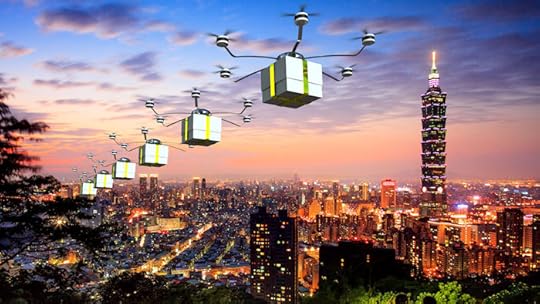 Some Hurdles Cleared, Others to Come
But back to delivery drones. Except for important safety protocols and licensing standards, many of the logistical matters related to drone delivery should be left to the market and the innovators. How will we deliver to high-rises? Someone will figure it out. What about rural delivery? Technology and warehousing will address much of that. Chalk that up to the “messy early years,” that I described seven years ago.
Let’s just get more delivery drones safely into the air! I say “more” because they’re already out there.
The good news is that the FAA seems to be willing to get out of the way of the industry and let this happen for the most part, again after putting a few safety guardrails in place.
That’s why we’re finally on the cusp of widespread implementation of this service category – and just in time given the shortage of labor and the explosion of the online economy.
Will We Even Know the Date When it Happens?Like many breakthroughs, there won’t be a red-letter day where the switch is thrown, and delivery drones flood the skies. We’ll begin seeing them more and more until we don’t really notice them at all.
A colleague of mine was visiting friends in a Seattle suburb recently and told me he saw one of Amazon Prime’s Scout robots rolling down the sidewalk making a last-mile delivery. Needless to say, he noticed it, but the locals he was with seemed to take it in stride. In fact, many companies are deploying delivery robots in certain areas to deliver groceries, prepared food, and light packages.
We’ve reached the tipping point for delivery robots, and delivery drones aren’t far behind.
Although they’re not routine or widespread, commercial drone deliveries are happening – mostly launched as pilot projects and publicity demonstrations or for emergency medical deliveries.
Wings, an Alphabet company, was set to begin drone-based delivery services last month in select Dallas-Fort Worth suburbs after successful experiences in test markets in Australia. Alphabet’s Wing is now delivering via drone for Walgreens in those Texas locations with plans to work with other healthcare providers and retailers.
Interestingly, and as an aside, Alphabet’s Wing drones don’t land at their destination – they drop their cargo from 20 feet or so with a tether line. Once it reaches the ground, the container is automatically unhooked.
Can Drone Delivery Be Profitable?Drones won’t be widespread until the path to profits is clear. It’s hard to define where “pilots” end and “regular service” begins for most drone-based packages and food delivery. We can be sure though, that it will quickly become the norm right around the time that there are sufficient efficiencies in the technology and demand for the service to send the profit projections in the right direction.
We’re on that path now, and we have plenty of proof-of-concept examples, thanks to the pilot programs. The vehicle technology is good and it’s only going to get better. There are tens of thousands of documented successful deliveries, primarily in non-U.S. markets.
In addition to vehicle enhancements that will add energy efficiencies and reduce capital costs, we’ll have continued breakthroughs in systems and processes, such as the ability to make multiple stops and deliveries on a single trip.
One evolution that’s lacking, which accounts for the bulk of my 4-6-year estimate, is the lack of certainty around local regulatory authorizations – it will likely be a city-by-city approval process for every company and its technology.
And then there’s the demand side. The pandemic propelled the market for home deliveries in general to levels that would have otherwise taken decades to reach – if even then. This demand will need to remain high if the delivery drone sector is going to be sustainable and profitable.
The news is encouraging there, too. One consumer survey indicates that consumer demand for home delivery will likely continue to drift up even as pandemic restrictions are lifted.
For many, home delivery clearly is a convenience worth paying for. That particular survey showed, though, that the reliability of current systems has a long way to go in the eyes of the home consumer. That means delivery drones will need to make the case – and prove it very quickly – that they’re a reliable and predictable delivery solution. In other words, they’ll need to do better than Grubhub, Uber Eats, and Instacart.
The Markets Seem to Back Delivery DronesMaybe the best indicator of the potential for drone delivery might be the willingness of investors to back these ventures and companies.
Market analysts are generally bullish on this sector, with some, for example, citing the possibility of automated fulfillment centers with a nearly literal beehive of activity as orders are filled by robots and delivered by drones.
There are numerous analyses, such as this one from Data Bridge Market Research, that indicate the growth rate in drone package delivery will be well into the double digits from now and into the foreseeable future.
So don’t be disheartened. Drone deliveries will soon be coming to your doorstep. This time I’m positive.
Translate This PageSelect LanguageAfrikaansAlbanianAmharicArabicArmenianAzerbaijaniBasqueBelarusianBengaliBosnianBulgarianCatalanCebuanoChichewaChinese (Simplified)Chinese (Traditional)CorsicanCroatianCzechDanishDutchEnglishEsperantoEstonianFilipinoFinnishFrenchFrisianGalicianGeorgianGermanGreekGujaratiHaitian CreoleHausaHawaiianHebrewHindiHmongHungarianIcelandicIgboIndonesianIrishItalianJapaneseJavaneseKannadaKazakhKhmerKoreanKurdish (Kurmanji)KyrgyzLaoLatinLatvianLithuanianLuxembourgishMacedonianMalagasyMalayMalayalamMalteseMaoriMarathiMongolianMyanmar (Burmese)NepaliNorwegianPashtoPersianPolishPortuguesePunjabiRomanianRussianSamoanScottish GaelicSerbianSesothoShonaSindhiSinhalaSlovakSlovenianSomaliSpanishSudaneseSwahiliSwedishTajikTamilTeluguThaiTurkishUkrainianUrduUzbekVietnameseWelshXhosaYiddishYorubaZulu
#goog-gt-tt {display:none !important;}
.goog-te-banner-frame {display:none !important;}
.goog-te-menu-value:hover {text-decoration:none !important;}
.goog-text-highlight {background-color:transparent !important;box-shadow:none !important;}
body {top:0 !important;}
#google_translate_element2 {display:none!important;}
function googleTranslateElementInit2() {new google.translate.TranslateElement({pageLanguage: 'en',autoDisplay: false}, 'google_translate_element2');}
function GTranslateGetCurrentLang() {var keyValue = document['cookie'].match('(^|;) ?googtrans=([^;]*)(;|$)');return keyValue ? keyValue[2].split('/')[2] : null;}
function GTranslateFireEvent(element,event){try{if(document.createEventObject){var evt=document.createEventObject();element.fireEvent('on'+event,evt)}else{var evt=document.createEvent('HTMLEvents');evt.initEvent(event,true,true);element.dispatchEvent(evt)}}catch(e){}}
function doGTranslate(lang_pair){if(lang_pair.value)lang_pair=lang_pair.value;if(lang_pair=='')return;var lang=lang_pair.split('|')[1];if(GTranslateGetCurrentLang() == null && lang == lang_pair.split('|')[0])return;var teCombo;var sel=document.getElementsByTagName('select');for(var i=0;i<sel.length;i++)if(/goog-te-combo/.test(sel[i].className)){teCombo=sel[i];break;}if(document.getElementById('google_translate_element2')==null||document.getElementById('google_translate_element2').innerHTML.length==0||teCombo.length==0||teCombo.innerHTML.length==0){setTimeout(function(){doGTranslate(lang_pair)},500)}else{teCombo.value=lang;GTranslateFireEvent(teCombo,'change');GTranslateFireEvent(teCombo,'change')}}
Search for: Recent Posts Drone Delivery: A Massive Huge Industry Coming Soon to a Doorstep Near You Creating a Code of Ethics for Artificial Intelligence How Many of Today’s Cryptocurrencies Will Still Exist in 2040? Categories Artificial Intelligence Business Trends Future of Agriculture Future of Banking Future of Education Future of Healthcare Future of Transportation Future of Work Future Scenarios Future Trends Futurist Thomas Frey Insights Global Trends Predictions Social Trends Technology Trends Speaking TopicsFuture of Healthcare – “Is Death our only Option?Future of AIFuture of Industries
The post Drone Delivery: A Massive Huge Industry Coming Soon to a Doorstep Near You appeared first on Futurist Speaker.
May 4, 2022
Creating a Code of Ethics for Artificial Intelligence
For more than 50 years, scientists, philosophers, and mathematicians have been exploring and perfecting advances in artificial intelligence (AI) while the average person was in the dark about the details and actual capabilities during this time. It wasn’t until IBM’s Deep Blue computer defeated world chess champion Garry Kasparov in 1997 that we could begin to relate to this incredible new branch of science.
The next generation experienced a similar moment 18 years later when IBM’s Watson defeated two Jeopardy champions.
And now, a decade further still, AI is all around us.
Most of us can’t even distinguish applications of AI from “normal” life. AI powers our social media and news feeds. It’s given us speech and biometric recognition along with verbal computer communication. Language-based interfaces answer our questions and give us directions to where we’re going.
Simply put, but amazing to consider, AI simulates and mimics human thought processes and actions to perform tasks, forming conclusions in a way that a human might.
So when it comes to machines that think and act like a person … what could go wrong with that?
We naturally don’t trust things we don’t understand. And if we can’t understand things like AI fully, we want to be sure that someone we trust is watching out for our best interests. We don’t have that kind of oversight at the moment, but we’re quickly going to need it.
Bad Data and Bad ActorsWhy do we need AI regulation?
Many ethical issues arising from AI are due to poorly formed or inadequate inputs such as the data and the basis of knowledge the AI program is provided to work with. Bad data gives bad results, and biased data, that doesn’t actually reflect a real-world situation, will trigger biased machine learning and, therefore, flawed results. Policies or actions based on those results move us backwards, not forwards.
There are also occasions for humans to use AI technology in a more nefarious, possibly criminal way. AI can be used to manipulate, trick, and distort, but one person’s manipulation may also be another person’s “persuasion.” And pre-judging – in targeted advertising, for example – isn’t too different from “customizing.” It’s all a matter of degrees and intent. We know inappropriate AI-driven activity when we see it, but bright lines are often hard to define.
Underlying Standards for AI EthicsResponsible AI that safely serves humankind (and not just the manipulators, tricksters, and distorters) will need to:
ExplainabilityBe based on standards of transparency and “explainability,” meaning a common understanding of the input, processing, and output of the AI function. This entails having common, agreed-upon language and definitions as well as measures of success and error. It means there are no black boxes with results or processes that can’t be rationally explained.
StandardsBe based on standards that weigh both the benefits and the risks of AI. This requires stepping back within the research and design phase to consider the harm or downsides that might occur due to missteps in the development of the system or exploitation of the system when it’s released. At the development stage, there’s a tendency to over-promote the positives and downplay concerns, a tendency known as “ethics washing.” Equally concerning is the inclination to ignore the downsides of AI “for now,” while offering assurances that these issues will be addressed as they arise.
SafeguardsMaintain guardrails, safety standards, and protocols to govern high-risk functions of AI, such as voice and facial recognition or social bots. The AI behind deepfakes is a prime example, this amazing technology can be used for legitimate reasons such as movie special effects. Or it can be used for nefarious purposes to misinform, deceive, misrepresent, and much worse. Bots are another example. Appropriately used as digital assistants or as web crawlers to sort and rank information, social bots, on the other hand, can be intentionally used to distort online discussions and spread falsehoods.
Human-in-the-LoopEnsure there’s always a human in the loop to train, tune, and test AI algorithms to ensure those first three criteria are met. In other words, AI should not be completely overseeing AI development.
Using these standards as guiding posts, AI regulation will need to quickly get into the weeds. We shouldn’t try to create broad enforceable standards that try to address every conceivable application. Instead, we should focus on use cases regarding specific tools, such as facial recognition and business sectors, such as the use of AI in banking or national defense.
Creating an AI Police ForceWho is it that should put these policies in place and enforce them? This is a huge question with no easy answers.
We can’t completely count on legislative bodies to codify and regulate these standards. Policymaking is slow, subject to special interest manipulation, and, yes, even political. These government bodies always seem to address last-generation challenges even as iterative new problems replace the old ones.
Plus, the standards need to be global, which is an even more challenging policy arena. Governments at every level have a measure of independence from industry, which is important to foster trust but makes them less attuned to the urgencies of today.
To be certain, government bodies haven’t exactly been on the sidelines. Nations (e.g., the U.S. and China) and blocs of nations (e.g., the EU) have issued frameworks for oversight and regulation of AI. It’s at least a start.
More likely the policies will be set by regulation, with knowledgeable input from industry tempered by informed regulatory staff who can put that input into context.
As this evolves, though, we’ll need to put the onus on tech companies themselves to establish internal standards and work collectively to develop industry-wide standards. These can serve as points of information and even boundary lines for establishing regulations.
[image error] What Else Needs to Happen?To be certain, I’m a big fan of AI. Our future will be driven by AI technology that can discern, understand, learn, and act far quicker and more reliably than we can. It will give us additional capabilities and we’ll all be better for it.
But in order to enhance trust and in order to keep AI in its proper place, in addition to regulatory safeguards, all of us will need to recognize AI for what it is and what it isn’t. AI involves machine learning and other processes that might be flawed if that learning comes from the processing of incomplete or biased data.
Ninety-nine times out of 100 your map application will get you to your destination. But don’t bet your life on it because there will still be times when it sends you to a dead-end or a road closure. AI programs might be able to predict an election outcome with a level of certainty, but they may still have their own “Dewey Defeats Truman” moments, perhaps because in those political contexts it relies on polling data from people who increasingly hate to be polled.
We’ll also need to develop our own levels of healthy skepticism – to not always believe what we see and read in social media, for example. That will be a major challenge as more and more curated content is AI-distributed, and bot-driven, in a way that reinforces our predilections, to begin with.
For better and worse, AI mimics human thought processes. The cycle of incomplete data inputs, leading to faulty learning, resulting in bad decisions is true with humans as well.
We aspire to live in a world far better than what we have today, and AI is a key piece of the equation for getting us there.
Translate This PageSelect LanguageAfrikaansAlbanianAmharicArabicArmenianAzerbaijaniBasqueBelarusianBengaliBosnianBulgarianCatalanCebuanoChichewaChinese (Simplified)Chinese (Traditional)CorsicanCroatianCzechDanishDutchEnglishEsperantoEstonianFilipinoFinnishFrenchFrisianGalicianGeorgianGermanGreekGujaratiHaitian CreoleHausaHawaiianHebrewHindiHmongHungarianIcelandicIgboIndonesianIrishItalianJapaneseJavaneseKannadaKazakhKhmerKoreanKurdish (Kurmanji)KyrgyzLaoLatinLatvianLithuanianLuxembourgishMacedonianMalagasyMalayMalayalamMalteseMaoriMarathiMongolianMyanmar (Burmese)NepaliNorwegianPashtoPersianPolishPortuguesePunjabiRomanianRussianSamoanScottish GaelicSerbianSesothoShonaSindhiSinhalaSlovakSlovenianSomaliSpanishSudaneseSwahiliSwedishTajikTamilTeluguThaiTurkishUkrainianUrduUzbekVietnameseWelshXhosaYiddishYorubaZulu
#goog-gt-tt {display:none !important;}
.goog-te-banner-frame {display:none !important;}
.goog-te-menu-value:hover {text-decoration:none !important;}
.goog-text-highlight {background-color:transparent !important;box-shadow:none !important;}
body {top:0 !important;}
#google_translate_element2 {display:none!important;}
function googleTranslateElementInit2() {new google.translate.TranslateElement({pageLanguage: 'en',autoDisplay: false}, 'google_translate_element2');}
function GTranslateGetCurrentLang() {var keyValue = document['cookie'].match('(^|;) ?googtrans=([^;]*)(;|$)');return keyValue ? keyValue[2].split('/')[2] : null;}
function GTranslateFireEvent(element,event){try{if(document.createEventObject){var evt=document.createEventObject();element.fireEvent('on'+event,evt)}else{var evt=document.createEvent('HTMLEvents');evt.initEvent(event,true,true);element.dispatchEvent(evt)}}catch(e){}}
function doGTranslate(lang_pair){if(lang_pair.value)lang_pair=lang_pair.value;if(lang_pair=='')return;var lang=lang_pair.split('|')[1];if(GTranslateGetCurrentLang() == null && lang == lang_pair.split('|')[0])return;var teCombo;var sel=document.getElementsByTagName('select');for(var i=0;i<sel.length;i++)if(/goog-te-combo/.test(sel[i].className)){teCombo=sel[i];break;}if(document.getElementById('google_translate_element2')==null||document.getElementById('google_translate_element2').innerHTML.length==0||teCombo.length==0||teCombo.innerHTML.length==0){setTimeout(function(){doGTranslate(lang_pair)},500)}else{teCombo.value=lang;GTranslateFireEvent(teCombo,'change');GTranslateFireEvent(teCombo,'change')}}
Search for: Recent Posts Creating a Code of Ethics for Artificial Intelligence How Many of Today’s Cryptocurrencies Will Still Exist in 2040? Nine Ways Autonomous Transportation will Impact Real Estate Categories Artificial Intelligence Business Trends Future of Agriculture Future of Banking Future of Education Future of Healthcare Future of Transportation Future of Work Future Scenarios Future Trends Futurist Thomas Frey Insights Global Trends Predictions Social Trends Technology Trends Speaking TopicsFuture of Healthcare – “Is Death our only Option?Future of AIFuture of Industries
The post Creating a Code of Ethics for Artificial Intelligence appeared first on Futurist Speaker.
April 27, 2022
How Many of Today’s Cryptocurrencies Will Still Exist in 2040?

A few days ago, I was listening to episode 597 of the Bad Crypto Podcast and it was rather insightful listening to how Joel Comm and his co-host Travis Wright randomly picked cryptocurrencies from listings on CoinGecko and evaluated them on the spot using a variety of techniques and standards.
With just a cursory glance at key data points, they assessed the cryptocurrency’s market cap, years in business, professionalism of the website, underlying business model, blockchain capabilities, leadership team, major engagers, and historic fluctuation. It’s a lot of data, and once combined, can tell a pretty good story about the coin’s past and future.
The last I checked there were 13,660 different coins listed on CoinGecko, and from a newbie’s perspective it’s incredibly challenging to weed through the hype and make sense out of everything that’s taking place.
Before I continue, let me make it clear; nothing in this article is to be taken as financial advice. I am simply stating my observations and experiences. Past performance is not a guarantee of future return, nor is it indicative of future performance. Investing involves risk and the investment will fluctuate over time, and you may gain or lose money. As with all financial decisions, you should consult a licensed professional.
What’s Different About Crypto?Cryptocurrency is the next evolution of currency and mediums of exchange in our world. We’ve already progressed from barter systems to tradeable certificates of value, to printed notes, to currency that’s based on the full faith and credit of governments, and to electronic manifestations of these notes and currencies.
What’s different about cryptocurrencies of course is they represent the privatization of currency, and thus they often struggle to compete with traditional government-backed currency in the everyday kinds of commerce. It’s not easy to transition a global or even a nation-state’s economy and commerce from a traditional national or regional currency to cryptocurrency, which has been very apparent in El Salvador.
That’s why cryptocurrencies still only fill a relatively tiny niche. But still only being a tiny niche is because of many more things than just that. They are still too geeky, too complicated, too hackable, too confusing, and too risky for the average person on the street. In short, they’re not user-friendly.
From a usability standpoint, cash is easy to understand. The denominations are clearly printed on the bills, it’s widely accepted, you don’t need a device like a phone or a computer to work with it, and even a third-grader can understand the basic elements of a transaction. But the crypto universe has a long way to go to make its coins and tokens as stupidly simple as cash.
For example, most first-time users have conventional payment systems in mind when making a transaction, similar to online banking. They instantly assume transactions have fixed fees, are reversible, and can easily be canceled, none of which are true in reality.
Most are confused about the terminology and the fundamental building blocks of crypto, including blockchain, public-key cryptography, recovery mechanisms, how to perform a transaction, and even the role of a wallet.
So far, crypto has managed to carve out a niche as an alternative investment asset. They can also be used for metaverse-based commerce (e.g., for NFTs), smart contracts, and DeFi engagement. Some retailers in the physical world are willing to accept them, but usually, as a way to enhance their brand or to entice a specific customer demographic. Outside of the metaverse, our economies still need both options.
 Why So Many?We’re still in the early days of cryptocurrency, and there’s a lot of weeding out that will happen. Cryptocurrencies are plentiful because they’re new, trendy, easy to create, and relatively unregulated – especially at the global level. It’s also important to note that there are many different categories or types of cryptocurrencies. For example, some are intended to serve as a global currency for mainstream transactions and investments. Within that category, we also have stablecoins, cryptocurrencies that are tied to a fixed asset (like a national currency or a commodity), which theoretically protects them and their holders from extreme price fluctuations. Other cryptocurrencies are “project tokens” tied to specific DeFi platforms to provide ownership stakes and as a tool for governance within those spaces. Still, others are considered “meme coins,” designed and marketed as trendy, serving primarily as speculative investments.Moving forward, all of these types of cryptocurrencies will continue to be offered, but many individual ones will fail, putting a damper on the impulse to start new ones. How to ChooseHere are some of the common approaches people will use to evaluate a cryptocurrency, regardless of the category:Check the market listing and review data points such as Project Ranking, Market Cap, Price History, Trading Volume, Liquidity, Circulation Supply, Total Supply, Today’s Price.Visit the Website for information about who’s on the Team (founders, executives, developers, partners, advisors), Roadmap, Vision, Investors, and Tokenomics. Assess the cryptocurrency’s White Paper and review its information related to Objectives, Details on open-source code, Target Demographic, Roadmap, Tokenomics, and Distribution Scheme.Review the cryptocurrency’s social media profiles and commentary (especially on Twitter, Telegram, Reddit, and LinkedIn) to get a feel for the experience.Understand the utility and use case.Check for scam alerts.Assess the competing cryptocurrencies in that space.Learning from HistoryIn fact, roughly 1,000 cryptocurrencies have failed or were ended by their owners, including OneCoin, BitConnect, GetGems, SpaceBIT, and The DAO. Why did they fail? Some were publicity stunts. Others were the victim of unregulated, Wild West markets at their worst, with massive fluctuations that caused investors to lose confidence. Others were mismanaged, and still, others were done in by hacker thieves. The breathtaking fluctuations in the significant global cryptocurrencies seem to be getting more under control and are less concerning to investors. But some experts say that a broader economic crash, possibly due to geopolitical events, could bring many more of them down. At this time, 75 cryptocurrencies are worth more than $1 billion. How Many Cryptocurrencies Do We Need?In the future, we’ll need as many types of cryptocurrencies as it takes to satisfy all the purposes for cryptocurrencies, and we’re still a long way from all of the potential uses. For example, some cryptos may carve out a unique niche for specialty insurance, financing land on Mars, or funding eldercare, medical tourism, childcare, or barter networks.Additionally, we should expect limited-time business-specific cryptos to fund startups during their initial growth phases.We will also see a number of cryptocurrencies that will both complement and replace national currencies. These will be designed to support specific geographical constituencies. Token-based cryptocurrencies will continue to be developed to match metaverse and other DeFi experiences, the number of which will naturally consolidate over time reflecting normal market forces. There will always be room for meme-type, hyper-speculative cryptocurrencies offered in an appropriately regulated environment. To the extent that stablecoins are tied to a national hard currency, they’ll be offered primarily as investment options. Those that are based on a global commodity, for example, gold or possibly a globally accepted national currency like the Euro or U.S. Dollar, might serve as a (not “the”) global currency. And in the last category, the truly global cryptocurrencies are used for investment and for international commerce. In all likelihood, we’ll see just 3-4 win out in the end. Keep in mind, that today’s use of widely accepted credit cards emerged in the 1950s, and today consumers and market forces have caused us to settle on just a handful of companies – Visa, Mastercard, Discover, AmEx, etc. The same will happen with global transactional cryptocurrency options. The strongest global cryptocurrencies will squeeze out the rest as merchants choose which ones to accept. Translate This Page
Select LanguageAfrikaansAlbanianAmharicArabicArmenianAzerbaijaniBasqueBelarusianBengaliBosnianBulgarianCatalanCebuanoChichewaChinese (Simplified)Chinese (Traditional)CorsicanCroatianCzechDanishDutchEnglishEsperantoEstonianFilipinoFinnishFrenchFrisianGalicianGeorgianGermanGreekGujaratiHaitian CreoleHausaHawaiianHebrewHindiHmongHungarianIcelandicIgboIndonesianIrishItalianJapaneseJavaneseKannadaKazakhKhmerKoreanKurdish (Kurmanji)KyrgyzLaoLatinLatvianLithuanianLuxembourgishMacedonianMalagasyMalayMalayalamMalteseMaoriMarathiMongolianMyanmar (Burmese)NepaliNorwegianPashtoPersianPolishPortuguesePunjabiRomanianRussianSamoanScottish GaelicSerbianSesothoShonaSindhiSinhalaSlovakSlovenianSomaliSpanishSudaneseSwahiliSwedishTajikTamilTeluguThaiTurkishUkrainianUrduUzbekVietnameseWelshXhosaYiddishYorubaZulu
#goog-gt-tt {display:none !important;}
.goog-te-banner-frame {display:none !important;}
.goog-te-menu-value:hover {text-decoration:none !important;}
.goog-text-highlight {background-color:transparent !important;box-shadow:none !important;}
body {top:0 !important;}
#google_translate_element2 {display:none!important;}
function googleTranslateElementInit2() {new google.translate.TranslateElement({pageLanguage: 'en',autoDisplay: false}, 'google_translate_element2');}
function GTranslateGetCurrentLang() {var keyValue = document['cookie'].match('(^|;) ?googtrans=([^;]*)(;|$)');return keyValue ? keyValue[2].split('/')[2] : null;}
function GTranslateFireEvent(element,event){try{if(document.createEventObject){var evt=document.createEventObject();element.fireEvent('on'+event,evt)}else{var evt=document.createEvent('HTMLEvents');evt.initEvent(event,true,true);element.dispatchEvent(evt)}}catch(e){}}
function doGTranslate(lang_pair){if(lang_pair.value)lang_pair=lang_pair.value;if(lang_pair=='')return;var lang=lang_pair.split('|')[1];if(GTranslateGetCurrentLang() == null && lang == lang_pair.split('|')[0])return;var teCombo;var sel=document.getElementsByTagName('select');for(var i=0;i<sel.length;i++)if(/goog-te-combo/.test(sel[i].className)){teCombo=sel[i];break;}if(document.getElementById('google_translate_element2')==null||document.getElementById('google_translate_element2').innerHTML.length==0||teCombo.length==0||teCombo.innerHTML.length==0){setTimeout(function(){doGTranslate(lang_pair)},500)}else{teCombo.value=lang;GTranslateFireEvent(teCombo,'change');GTranslateFireEvent(teCombo,'change')}}
Search for: Recent Posts How Many of Today’s Cryptocurrencies Will Still Exist in 2040? Nine Ways Autonomous Transportation will Impact Real Estate Inventing the College Equivalency Scale Categories Artificial Intelligence Business Trends Future of Agriculture Future of Banking Future of Education Future of Healthcare Future of Transportation Future of Work Future Scenarios Future Trends Futurist Thomas Frey Insights Global Trends Predictions Social Trends Technology Trends Speaking TopicsFuture of Healthcare – “Is Death our only Option?Future of AIFuture of Industries
The post How Many of Today’s Cryptocurrencies Will Still Exist in 2040? appeared first on Futurist Speaker.
April 20, 2022
Nine Ways Autonomous Transportation will Impact Real Estate

It won’t be long until we see major breakthroughs in the number of autonomous vehicles (AVs) on our roadways – both for on-demand passenger travel as well as for product delivery. AV technology is improving quickly, and it appears that the bigger inhibitor to more widespread use is the uncomfortable, vulnerable feeling of being driven by a pilotless machine.
Fortunately, AV safety evaluations seem to be held to a standard of zero incidents and accidents when the alternative for human-operated vehicles “allows” for thousands of accidents and fatalities due to human error, distraction, impairment, and more. In fact, 94% of serious vehicle crashes are caused by human error.
I haven’t seen the final numbers yet for 2021, but traffic fatalities were on track last year to exceed 40,000 in the U.S., which would be the highest level in many years. We’re moving in the wrong direction on that front.
But yet, when there’s an autonomous vehicle-related accident or even an unfortunate fatality, suddenly AV technology is once again suspect in the eyes of regulators, the media, and the public. Far more often than not, accidents involving AVs are not the vehicle’s fault.
Keep in mind, that air travel is still the safest form of transportation.
Eventually, though, we’ll all become far more confident in these vehicles, just as we did with the airlines, and move past that unreasonable threshold of perfect AV safety in all circumstances. We’ll embrace this opportunity for a significant improvement in road safety overall, and as more AVs fill our roadways, society’s focus on car ownership will shift even further to an AV-enhanced, shared car lifestyle.
When we reach that tipping point in the U.S., there will be far-ranging changes in many areas of our lives, including one area few people have given much thought to – the real estate industry.
Nine Forms of ImpactHere are a few thoughts on how autonomous transportation will impact the residential and commercial real estate industry in the future. Undoubtedly there will be more in the future.
1. Property Values Adjacent to RoadsCurrently, residential property values plummet as the location gets closer and closer to major roads and especially interstates. The roar of trucks and gas guzzlers is too much for most people to live with or alongside. But AVs are electric, and electric is quiet. As gas and diesel-powered vehicles dwindle, more people will be fine with living closer to highways. Developers will recognize the opportunity and build far more communities in the current high noise zones adjacent to highways.
2. Garage-less HomesAs people shift to an AV car-sharing lifestyle, they’ll have less need for garages. Some people will turn their garages into spare bedrooms, offices, Airbnb rentals, workshops, or massive storage spaces. New homes won’t be designed around garages, as so many are today – and street views of homes will be all the better for it! In fact, new home footprints will be smaller, and most houses will fit comfortably on smaller plots.
 3. Portico Circular Driveways
While we won’t need garages, we will need driveways – most likely a functional circular driveway with the front door at the midpoint under a weather-shielding portico. Home properties will be landscaped in this way so that shared AVs can proceed to the doorway, load and unload passengers, and then continue to the street.
4. Standardized Delivery BoxesThis small but important home feature will accommodate and secure the increasing number of deliveries we receive and the many more that will be delivered soon by AV-delivery vehicles. A number of key retailers will collaborate to develop a standardized delivery box, similar to a mailbox but larger, to accommodate a variety of autonomous delivery service providers so they can securely deposit packages and other items at the home. Existing homes will be retrofitted with this feature, and it will be standard in all new homes. Some new homes may even be designed with a delivery dock or a one-way delivery door into the house.
5. Reduced Emphasis on ProximitySince automated, shared driving and delivery from point A to point B will involve far less human involvement, home buyers will think less about “Location, Location, Location” and more about “Time, Time, Time.” Consideration about distances to shops and amenities will be overtaken by how we utilize our time along the way. Autonomous vehicles with built-in games and other forms of entertainment will be in huge demand to distract us from the time and distance we’re traveling.
6. Parking Lots will DisappearSome of the space currently reserved for parking will be used as a staging area for shared AVs. Space devoted to massive surface parking areas and standalone parking garages will be put to better use for parks and new developments. New urban office buildings will need only one level for personal and shared AVs rather than the multi-level parking garages we see today.
7. Car Sales and Maintenance Moves to B2BCurrently, over 10% of retail space is dedicated to the auto industry – from showrooms and brake shops to car washes and gas stations. But as AV fleet ownership consolidates, there will be fewer and fewer customer-facing car businesses. Fleet owners will purchase their autonomous vehicles in bulk, directly from manufacturers and there will be little need for the multitude of new and used car lots we see today. Similarly, auto repair will shift from consumer-focused to in-house maintenance shops by fleet-owning companies. This all means that a lot of valuable land will be available to repurpose for commercial/residential development, entertainment, and recreation.
8. Redesign of Entry-Exit for Public SpacesSimilar to how new home landscaping will accommodate circular driveways, the street-facing layout of public buildings will be designed to resemble a hotel-like, off-street, drive-up/drop-off configuration. Automated systems will manage the flow of AVs coming and going from all high traffic arrival-departure areas.
9. City ExpansionAs more people move into cities, cities themself will begin to grow their footprint exponentially, as people pay less and less attention to proximity to goods, culture, and services. Since AVs reduce human involvement and traffic congestion, people will feel liberated to venture further from core city centers to the wide-open spaces of suburbia and beyond.
However, as I mentioned earlier, travel time and how engaged we are along the way, not distance, will be our primary concern when choosing a location. The shared AV option will be affected by the time it takes to free up an AV to travel to the rider’s destination and bring them back again. Since it’s currently more challenging to get a Lyft or Uber ride in the suburbs than in the central city, it will be interesting to see how autonomous vehicles change our urban vs. rural perceptions.
We should remember, too, that shared AVs will not be our only source of transportation. Mass transit AV buses and subways will still be an important element and option. However, these networks will become far less convenient and less cost-differentiated over time and may disappear altogether.
Shared AV-based transportation will be a boon to our cities and society overall. They will not only increase safety but also reduce congestion thanks to improved, sensor-enhanced traffic flow. And maybe just as important, but less obvious, our new lifestyles shaped around convenient shared AV access will allow us to make far better use of valuable land in our cities and suburbs.
Translate This PageSelect LanguageAfrikaansAlbanianAmharicArabicArmenianAzerbaijaniBasqueBelarusianBengaliBosnianBulgarianCatalanCebuanoChichewaChinese (Simplified)Chinese (Traditional)CorsicanCroatianCzechDanishDutchEnglishEsperantoEstonianFilipinoFinnishFrenchFrisianGalicianGeorgianGermanGreekGujaratiHaitian CreoleHausaHawaiianHebrewHindiHmongHungarianIcelandicIgboIndonesianIrishItalianJapaneseJavaneseKannadaKazakhKhmerKoreanKurdish (Kurmanji)KyrgyzLaoLatinLatvianLithuanianLuxembourgishMacedonianMalagasyMalayMalayalamMalteseMaoriMarathiMongolianMyanmar (Burmese)NepaliNorwegianPashtoPersianPolishPortuguesePunjabiRomanianRussianSamoanScottish GaelicSerbianSesothoShonaSindhiSinhalaSlovakSlovenianSomaliSpanishSudaneseSwahiliSwedishTajikTamilTeluguThaiTurkishUkrainianUrduUzbekVietnameseWelshXhosaYiddishYorubaZulu
#goog-gt-tt {display:none !important;}
.goog-te-banner-frame {display:none !important;}
.goog-te-menu-value:hover {text-decoration:none !important;}
.goog-text-highlight {background-color:transparent !important;box-shadow:none !important;}
body {top:0 !important;}
#google_translate_element2 {display:none!important;}
function googleTranslateElementInit2() {new google.translate.TranslateElement({pageLanguage: 'en',autoDisplay: false}, 'google_translate_element2');}
function GTranslateGetCurrentLang() {var keyValue = document['cookie'].match('(^|;) ?googtrans=([^;]*)(;|$)');return keyValue ? keyValue[2].split('/')[2] : null;}
function GTranslateFireEvent(element,event){try{if(document.createEventObject){var evt=document.createEventObject();element.fireEvent('on'+event,evt)}else{var evt=document.createEvent('HTMLEvents');evt.initEvent(event,true,true);element.dispatchEvent(evt)}}catch(e){}}
function doGTranslate(lang_pair){if(lang_pair.value)lang_pair=lang_pair.value;if(lang_pair=='')return;var lang=lang_pair.split('|')[1];if(GTranslateGetCurrentLang() == null && lang == lang_pair.split('|')[0])return;var teCombo;var sel=document.getElementsByTagName('select');for(var i=0;i<sel.length;i++)if(/goog-te-combo/.test(sel[i].className)){teCombo=sel[i];break;}if(document.getElementById('google_translate_element2')==null||document.getElementById('google_translate_element2').innerHTML.length==0||teCombo.length==0||teCombo.innerHTML.length==0){setTimeout(function(){doGTranslate(lang_pair)},500)}else{teCombo.value=lang;GTranslateFireEvent(teCombo,'change');GTranslateFireEvent(teCombo,'change')}}
Search for: Recent Posts Nine Ways Autonomous Transportation will Impact Real Estate Inventing the College Equivalency Scale Democracy Vs. Autocracy: What does the Future Hold? Categories Artificial Intelligence Business Trends Future of Agriculture Future of Banking Future of Education Future of Healthcare Future of Transportation Future of Work Future Scenarios Future Trends Futurist Thomas Frey Insights Global Trends Predictions Social Trends Technology Trends Speaking TopicsFuture of Healthcare – “Is Death our only Option?Future of AIFuture of Industries
The post Nine Ways Autonomous Transportation will Impact Real Estate appeared first on Futurist Speaker.
April 13, 2022
Inventing the College Equivalency Scale

There are many ways to absorb the information required to earn the equivalent of a college degree, but it’s only possible to get official college credentials by attending an official institution of higher education.
The average annual cost of undergraduate tuition and fees at a public college is $11,000 for in-state students and $28,000 for those from out of state. The corresponding cost at a private college is $38,000. Naturally, the pedigree schools come with much higher price tags, and in many cases, room and board will more than double that amount.
Over the years I’ve written numerous columns on everything from micro-colleges, to micro-credits, to certifications. But it appears we’re now at a critical juncture or turning point in the future of higher education. Any person or institution that comes up with a better way to prepare people for careers, either within a college environment or outside of it, will be a hero to many. And the first step toward making a disruptive shift like this will be the creation of a college equivalency scale.
Non-College LearningAccording to ZenithOptimedia, Americans spent 495 minutes per day consuming information in 2021. That works out to 8 hours and 15 minutes every day, seven days a week.
On average, we subscribe to 12 paid media subscriptions and spend huge amounts of time watching television, reading books, listening to podcasts, and absorbing digital content. And none of this day-to-day “learning” is credentialed in any way.
While someone who reads 3-4 books, listens to 10 podcasts and watches 8 TED Talks every week may be far more knowledgeable about certain topics than a recent college graduate, we currently have no way of assessing the value of this kind of learning.
That’s where a college equivalency scale and the use of AI assessment bots come into play.
Education vs. Proficiency vs. Situational AwarenessEveryone knows that in the majority of undergraduate degree areas, students graduate with core skills and rudimentary knowledge in their chosen field. Their most valuable training and proficiency-building come after that, in the “real world,” with on-the-job training, along with the development of softer skills like adaptability, communications, and situational awareness.
Today we have an inefficient two-step process for developing workers: first, college curriculum-based education, followed second by proficiency training and a more informal building of situational awareness.
It’s a cliché, but in many fields, it’s probably true that on the first day on the job, the seasoned boss will tell the fresh-faced recent grad to forget everything they learned in college … “I’ll tell you how it’s really done.”
For example, someone who is a recently graduated journalism major may be very “educated,” but 99% of them are not qualified or have enough situational awareness to write lead stories for the Wall Street Journal until they’re seasoned and receive additional training.
In so many ways, traditional education is an easy first step. Situational awareness takes time and broad-spectrum learning. So why should we leave it up to colleges and universities to be the only means to bestow that initial, core, entry-level education? After all, people today can gain that knowledge base through audiobooks, YouTube, magazines, one-on-one conversations, and even on-the-job training.
We have information flowing continuously from thousands of different sources and it’s preposterous of us to think that only credentialed skills have any value.
The Precedent – GEDs, Apprenticeships, and “Testing Out”In fact, we already have a number of well-accepted non-tradition paths for evaluating a person’s proficiency.
GEDsAt the high school level, we have General Education Development (GED®) certifications – a high-school equivalency diploma that confirms that a student has mastered basic math, reading, social studies, and writing skills. The program is offered through a non-profit organization, the American Council on Education, which also provides training courses to prepare people for the four GED tests covering those core areas.
ApprenticeshipsAnd then there are the high school-level apprenticeship programs that prepare inexperienced young people for certifications in a trade specialty. To the extent these apprenticeships are combined with targeted classroom training, apprenticeships merge the education and proficiency steps so that the student-worker is productive more quickly than someone who sequentially goes through traditional education processes.
CertificationsSince tech companies are becoming increasingly ambivalent to academic credentials, colleges are now offering Certifications that allow a student to immediately focus on specialized, marketable skill development. In a way, it’s moving the proficiency training stage into the education environment – a more efficient and faster process to deliver employees who can contribute on Day One.
Testing-OutFinally, there’s already a process called “credits by examination,” in which participating colleges allow students to test out of usually entry-level classes by passing a proficiency test administered by one of several nationally-recognized organizations. These programs could seemingly be expanded to offer a “degree by examination.”
However, we’re only scratching the surface of what’s possible when we step outside of the box of traditional academia.
 Four Key Components of a College Equivalency Scale
The global education system of the future will be very different from our existing school systems today. Here are some of the attributes and performance characteristics that I’m thinking will likely be incorporated into the design of this operating system.
1. Micro Credits for Assessing Micro AccomplishmentsAs a working formula, one Micro-Credit will be the equivalent of one-hundredth of a traditional college semester credit. Or, stated another way, 100 Micro Credits will equal one traditional college semester credit.
It’s very seldom that learning happens in large chunks, and by reducing the size of credentialing units we create a much more granular means for assessing accomplishments.
Since most people still believe that higher education must take place in a college, and only educators can create new courses, we have placed a very constrictive valve on the inflow of new education options.
The notion that higher education can take place only in a college is similar to the notion that purchasing a product can only take place when you see it on a store shelf. Removing the college constraints to learning is similar to removing the shelf space constraints in the marketplace.
That’s why a well-accepted equivalency scale will not only open the doors to super learning processes based on microcredits but also new forms of hyper-individualized learning.
2. Our Need for Hyper-Individualized LearningOur need for hyper-individualized learning is driven by several factors including our time, our personality, and an overwhelming need to feel unique in a world of nearly 8 billion people wanting many of the same things.
Our self-directed learning systems of the future will be driven by personal interests, a hyper-individualized sense of purpose, and a set of milestones to help define the progress. Unlike traditional institutions that only credential a narrow spectrum of their own in-house courses, our next-gen education systems will test, assess, and grant micro credits for virtually all topics, subjects, and forms of learning that align with the user’s interests.
3. Universal AcceptanceUnlike the rigid acceptance policies used by elite colleges and universities today, our next-gen education system will need to be capable of working with the full spectrum of prospective users.
It will need to be simultaneously language agnostic, culturally agnostic, location agnostic, and even be capable of engaging illiterate, non-technical, and non-social people who tend to be left out of today’s educational systems.
4. Equivalency ScaleAs the final piece of this next-gen education system, we will need to establish a universally accepted equivalency scale based on micro-credits. The equivalency scale will be based on an additive barometer of lifetime achievement and will show users when a person’s credits and micro-credits add up to the equivalency of a bachelor, master, and Ph.D.
The Equivalency Scale will then add hundreds of levels beyond Ph.D., onto the accomplishment scale.
I often joke that the top level of the equivalency scale may be a Category-Five Ninja Black-Belt Ph.D. that only three people in the world will ever achieve.
Final ThoughtsIf done correctly, these four components will set the stage for a future learning system with the potential to unleash the human spirit in ways we’ve never imagined. Learning curves will become radically shorter. Switching professions will become radically quicker. And our ability to take on massively huge projects will become radically more doable.
I have nothing against colleges. They represent one strategy for obtaining and then proving basic educational attainment. And, of course, they help young people learn and practice interpersonal, teamwork, and professional skills in a relatively protected environment.
But we need more choices and options to shorten the career training cycle. Given the cost of education, the inefficiency of spending four years in order to be semi-prepared to work, and the level of debt today’s students saddle themselves with, alternative options will emerge in the future, and we’re already seeing lots of effort moving us into this direction.
Sign up now to receive Newsletters and Emails from Thomas Frey .et_bloom .et_bloom_optin_2 .et_bloom_form_content { background-color: #b32828 !important; } .et_bloom .et_bloom_optin_2 .et_bloom_form_container .et_bloom_form_header { background-color: #ffffff !important; } .et_bloom .et_bloom_optin_2 .et_bloom_form_content button { background-color: #ffffff !important; } .et_bloom .et_bloom_optin_2 .et_bloom_form_content .et_bloom_fields i { color: #ffffff !important; } .et_bloom .et_bloom_optin_2 .et_bloom_form_content .et_bloom_custom_field_radio i:before { background: #ffffff !important; } .et_bloom .et_bloom_optin_2 .et_bloom_form_content button { background-color: #ffffff !important; } .et_bloom .et_bloom_optin_2 .et_bloom_form_container h2, .et_bloom .et_bloom_optin_2 .et_bloom_form_container h2 span, .et_bloom .et_bloom_optin_2 .et_bloom_form_container h2 strong { font-family: "Open Sans", Helvetica, Arial, Lucida, sans-serif; }.et_bloom .et_bloom_optin_2 .et_bloom_form_container p, .et_bloom .et_bloom_optin_2 .et_bloom_form_container p span, .et_bloom .et_bloom_optin_2 .et_bloom_form_container p strong, .et_bloom .et_bloom_optin_2 .et_bloom_form_container form input, .et_bloom .et_bloom_optin_2 .et_bloom_form_container form button span { font-family: "Open Sans", Helvetica, Arial, Lucida, sans-serif; }SUBSCRIBE! You have Successfully Subscribed! Translate This Page
Select LanguageAfrikaansAlbanianAmharicArabicArmenianAzerbaijaniBasqueBelarusianBengaliBosnianBulgarianCatalanCebuanoChichewaChinese (Simplified)Chinese (Traditional)CorsicanCroatianCzechDanishDutchEnglishEsperantoEstonianFilipinoFinnishFrenchFrisianGalicianGeorgianGermanGreekGujaratiHaitian CreoleHausaHawaiianHebrewHindiHmongHungarianIcelandicIgboIndonesianIrishItalianJapaneseJavaneseKannadaKazakhKhmerKoreanKurdish (Kurmanji)KyrgyzLaoLatinLatvianLithuanianLuxembourgishMacedonianMalagasyMalayMalayalamMalteseMaoriMarathiMongolianMyanmar (Burmese)NepaliNorwegianPashtoPersianPolishPortuguesePunjabiRomanianRussianSamoanScottish GaelicSerbianSesothoShonaSindhiSinhalaSlovakSlovenianSomaliSpanishSudaneseSwahiliSwedishTajikTamilTeluguThaiTurkishUkrainianUrduUzbekVietnameseWelshXhosaYiddishYorubaZulu
#goog-gt-tt {display:none !important;}
.goog-te-banner-frame {display:none !important;}
.goog-te-menu-value:hover {text-decoration:none !important;}
.goog-text-highlight {background-color:transparent !important;box-shadow:none !important;}
body {top:0 !important;}
#google_translate_element2 {display:none!important;}
function googleTranslateElementInit2() {new google.translate.TranslateElement({pageLanguage: 'en',autoDisplay: false}, 'google_translate_element2');}
function GTranslateGetCurrentLang() {var keyValue = document['cookie'].match('(^|;) ?googtrans=([^;]*)(;|$)');return keyValue ? keyValue[2].split('/')[2] : null;}
function GTranslateFireEvent(element,event){try{if(document.createEventObject){var evt=document.createEventObject();element.fireEvent('on'+event,evt)}else{var evt=document.createEvent('HTMLEvents');evt.initEvent(event,true,true);element.dispatchEvent(evt)}}catch(e){}}
function doGTranslate(lang_pair){if(lang_pair.value)lang_pair=lang_pair.value;if(lang_pair=='')return;var lang=lang_pair.split('|')[1];if(GTranslateGetCurrentLang() == null && lang == lang_pair.split('|')[0])return;var teCombo;var sel=document.getElementsByTagName('select');for(var i=0;i<sel.length;i++)if(/goog-te-combo/.test(sel[i].className)){teCombo=sel[i];break;}if(document.getElementById('google_translate_element2')==null||document.getElementById('google_translate_element2').innerHTML.length==0||teCombo.length==0||teCombo.innerHTML.length==0){setTimeout(function(){doGTranslate(lang_pair)},500)}else{teCombo.value=lang;GTranslateFireEvent(teCombo,'change');GTranslateFireEvent(teCombo,'change')}}
Search for: Recent Posts Inventing the College Equivalency Scale Democracy Vs. Autocracy: What does the Future Hold? Creating New Countries in the Future will be Challenging at Best Categories Artificial Intelligence Business Trends Future of Agriculture Future of Banking Future of Education Future of Healthcare Future of Transportation Future of Work Future Scenarios Future Trends Futurist Thomas Frey Insights Global Trends Predictions Social Trends Technology Trends Speaking TopicsFuture of Healthcare – “Is Death our only Option?Future of AIFuture of Industries
The post Inventing the College Equivalency Scale appeared first on Futurist Speaker.
April 6, 2022
Democracy Vs. Autocracy: What does the Future Hold?

The war in Ukraine hasn’t concluded as of this writing, and victory for either side has yet to be determined. But regardless of how this tragedy turns out, to the surprise of many people worldwide, the bulk of Russia’s ground-based military was stopped in its tracks.
Who would have thought the people and army of this small democratic-leaning nation could stand in the way of the vaunted army of an authoritarian regime like Russia?
It’s easy to assume that a totalitarian government can accomplish whatever it wants, given the nearly absolute power maintained by its singular leader and surrounding advisors. After all, these leaders have the benefit of:
No viable opposing political parties.No legitimate debate on options within the executive branch.No, truly independent, empowered, non-executive branches of government.In contrast, democratic governments are messy and inefficient. Their executive leaders face:
Competing political factions and intense politicking.Aggressive media watchdogs.Free speech and enough diverse media and communication channels to meet and reinforce the mindset of any citizen.Checks and balances between branches of governments and levels of governments (e.g., state vs. federal).One would wonder how anything of substance ever gets done in a democratic, representative government in the normal course of business.
Shades of GrayWith the caveat that there are many kinds of democracy (direct, representative, etc.) and variations with regard to autocratic systems, the two approaches lie on opposite ends of a governance spectrum.
In 2020, The Democracy Index, sponsored and compiled by the Economist Intelligence Unit, graded 167 countries based on 60 different indicators, assigning each one a ranking between 1 (strongly authoritarian) and 10 (strongly democratic).
The top five scores went to Norway, Iceland, Sweden, New Zealand, and Finland. Many Western European countries ranked quite high with 8’s and 9’s.
The U.S. had a score of 7.92, ranking 22nd in the world, which placed it in the second-highest tier, labeled as a “Flawed Democracy.” At the other extreme, 57 countries found themselves in the bottom tier, “Authoritarian Regime,” anchored by North Korea, with a score of 1.08. China was 17th from the bottom with a score of 2.27, and Russia was 44th from the bottom scoring 3.31.
One can quibble with the criteria and relative scoring, but the principle is certainly true that there’s a continuum, a democracy scale when it comes to democracy and authoritarianism.
Moving the Needle on the Democracy ScaleIt’s human nature to want what you can’t have – that’s true for people in authoritarian countries as well as in democratic countries. It’s just that in the two situations, the goals and dreams are quite different. The collective effort to attain those goals and dreams ultimately propels countries to move along that democracy scale.
The movements stem from citizen exposure to ideas and an empowerment to express those ideas – in all types of countries. As I’ll explain further below, the enhancement of those communication opportunities can have a different and even opposite effect when it comes to moving the needle, depending on whether the country is a 7.92 (U.S.) or a 2.27 (Russia) on the democracy scale.
In autocratic countries, citizens increasingly want more choices in their lives along with access to economic and cultural pleasures. Dictators used to be able to keep this in check with a “What they don’t know, they won’t know they want…” approach. These citizens increasingly want a real say in government policies at all levels and the right to express those viewpoints. And as they strive for better lives and access to governance, they’re moving their countries UP the democracy scale. Greater access to a variety of communication technologies, including social media, is helping to make that happen.
In democratic countries, citizens, for the most part, already have the freedom to make choices regarding lifestyles. They enjoy representative-democratic governments that funnel their views up and into the decision-making system. With those fundamental rights in hand, what do these people want more of these days? They want “Their Side” to win and their policies to prevail. As they strive for this dominance, they’re moving their countries DOWN the democracy scale toward a more autocratic, less tolerant situation. Greater access to a variety of communication technologies, including social media, is helping to make that happen.
 The Efficiencies of Autocracies
Human rights, civil liberties, and free and fair election concerns aside, as a futurist, it’s hard not to notice that some of the most significant manifestations of the future are appearing in authoritarian countries like China.
For example, since 2008, China has built roughly 40,000 kilometers of high-speed rail, connecting cities across the country. By 2035, the network will extend to 70,000 kilometers. Not content with that, the country is already preparing to transition to magnetic levitation (maglev) trains.
By comparison, initial high-speed rail bonding for a Los Angeles to San Francisco line was approved by California voters in 2008. We may see 107 miles of that completed by 2030, with neither end touching one of those ultimate terminus cities.
We all know from history that dictators know how to make the trains run on time. And for some people, that’s good enough. But that number is dwindling, as we’ll describe below.
The Achilles Heel(s) of AutocraciesThe popular conception that communist/socialist autocracies always lead to squalor and a subsistence standard of life has been disabused somewhat by China. That country’s goal of “common prosperity” – essentially promoting high-performing industries, accompanied by a system to equalize wealth and standing through redistribution and coercion – has generated a decent standard of living for many citizens. But a slightly enlightened autocracy is still an autocracy, and it is destined to be undermined by the same primary natural forces.
The first is poor decision-making. Russia’s recent military fiasco seems to be evidence of insular decision-making by elites striving to maintain their position by not offering unpopular viewpoints. I see the same danger for China when approved videos show 100% of the National People’s Congress members applauding rhythmically when President Xi Jinping approaches the dais to address that body. Absolute power distorts decision-making absolutely and similar videos from North Korea.
The second threat to autocracies is the underlying natural hunger for humans to make the most of their time on earth and be free to pursue their best possible outcome in terms of success and happiness. As David Brooks pointed out recently, “Autocracies restrict freedom for the sake of order.” This leads to a brain drain as talent tends to migrate from authoritarian countries to democratic ones, a dynamic that dooms the former in the long run.
At the same time, the U.S. has demonstrated an overly aggressive assault on crime, asserting criminal justice control over the largest percentage of society in all history. This once again demonstrates that democracies may be better but are far from perfect.
And third, autocracies will ultimately decline because of the increasing presence of open, world-wide communications. Voice of America and others, along with social media, will inevitably pierce whatever bubbles autocratic governments try to maintain to keep their citizens compliant and undistracted. More on this below.
Democracy and Social MediaCommunication technology is one of the most fundamental influencers in our lives these days. With its power for good and bad, what’s the logical future endgame for governments? Again, where you end up depends on where you start.
Despite autocratic government censorship efforts, citizens of authoritarian countries will find ways to learn the truth about their governments’ actions and how much better their lives could be. Social media will be key, just as it was in the wide dissemination of concerns about the dictatorial abuses of autocratic governments in the Middle East and Northern Africa during the Arab Spring popular revolts in 2011.
In some countries, these social-media-driven uprisings ultimately led to greater democracy. In others, the effort couldn’t be sustained and may have caused even more repression. But in the long run, even these “victorious” autocrats have been put on notice that the ice under their feet is just a little bit thinner.

The long-term impact of social media is less clear in democratic countries, where social media is making speech “cheap.” Social media bypasses established institutions that tend to moderate and referee debate. Unmediated opinions don’t need to be based on reasoning, logic, or facts. “Experts” are crowned based on readership and their number of followers, not necessarily their experience or credentials. Facts are in the eye of the beholder.
And when cheap speech undermines the pillars that democracy rests on – for example, open and fair elections, an individual’s rights to pursue wealth and happiness, freedom of expression, and losers’ consent for the winner to govern – a country can drop down a point or two in the democracy scale.
In the short term, too many citizens of democratic countries will continue to tune in only to the social media forums and echo chambers that reinforce and prove Their Side. But as those settings become more and more outrageously divisive, people will begin to tune out – either from boredom or a recognition of the irrationality of the messaging and their tiredness of the situation.
In retrospect, covid was a huge anomaly, forcing us all through a period of intense introspection, and most people were less than ok with their assessment. This resulted in a series of anger-frustration-and-denial moments that may have long-term implications!
It’s still too early to tell if the cacophony of cheap speech noise will cancel out, and people will drift back toward the center, closer to realizing that it’s okay to have divergent opinions.
Democracy in the MetaverseThe metaverse offers the opportunity of creating a democracy as we’ve never seen before. After all, it’s founded on two very democratic institutions – the internet (access to all) and blockchain (transparency and a single source of truth).
In its purest form, democracy calls for consent (i.e., a vote) of the people on every policy and leadership issue. That’s proven unworkable in the physical world and will probably be in the metaverse as well. But metaverse elections regarding major issues and leadership spots will be simple, easy, and unchallengeable.
Yet, it‘s still too early to tell if there will be just one metaverse of 10,000 competing metaverses. And while I hold little hope for any kind of utopia, there may indeed be better ways of resolving conflict, and that alone could be a major accomplishment!
Translate This PageSelect LanguageAfrikaansAlbanianAmharicArabicArmenianAzerbaijaniBasqueBelarusianBengaliBosnianBulgarianCatalanCebuanoChichewaChinese (Simplified)Chinese (Traditional)CorsicanCroatianCzechDanishDutchEnglishEsperantoEstonianFilipinoFinnishFrenchFrisianGalicianGeorgianGermanGreekGujaratiHaitian CreoleHausaHawaiianHebrewHindiHmongHungarianIcelandicIgboIndonesianIrishItalianJapaneseJavaneseKannadaKazakhKhmerKoreanKurdish (Kurmanji)KyrgyzLaoLatinLatvianLithuanianLuxembourgishMacedonianMalagasyMalayMalayalamMalteseMaoriMarathiMongolianMyanmar (Burmese)NepaliNorwegianPashtoPersianPolishPortuguesePunjabiRomanianRussianSamoanScottish GaelicSerbianSesothoShonaSindhiSinhalaSlovakSlovenianSomaliSpanishSudaneseSwahiliSwedishTajikTamilTeluguThaiTurkishUkrainianUrduUzbekVietnameseWelshXhosaYiddishYorubaZulu
#goog-gt-tt {display:none !important;}
.goog-te-banner-frame {display:none !important;}
.goog-te-menu-value:hover {text-decoration:none !important;}
.goog-text-highlight {background-color:transparent !important;box-shadow:none !important;}
body {top:0 !important;}
#google_translate_element2 {display:none!important;}
function googleTranslateElementInit2() {new google.translate.TranslateElement({pageLanguage: 'en',autoDisplay: false}, 'google_translate_element2');}
function GTranslateGetCurrentLang() {var keyValue = document['cookie'].match('(^|;) ?googtrans=([^;]*)(;|$)');return keyValue ? keyValue[2].split('/')[2] : null;}
function GTranslateFireEvent(element,event){try{if(document.createEventObject){var evt=document.createEventObject();element.fireEvent('on'+event,evt)}else{var evt=document.createEvent('HTMLEvents');evt.initEvent(event,true,true);element.dispatchEvent(evt)}}catch(e){}}
function doGTranslate(lang_pair){if(lang_pair.value)lang_pair=lang_pair.value;if(lang_pair=='')return;var lang=lang_pair.split('|')[1];if(GTranslateGetCurrentLang() == null && lang == lang_pair.split('|')[0])return;var teCombo;var sel=document.getElementsByTagName('select');for(var i=0;i<sel.length;i++)if(/goog-te-combo/.test(sel[i].className)){teCombo=sel[i];break;}if(document.getElementById('google_translate_element2')==null||document.getElementById('google_translate_element2').innerHTML.length==0||teCombo.length==0||teCombo.innerHTML.length==0){setTimeout(function(){doGTranslate(lang_pair)},500)}else{teCombo.value=lang;GTranslateFireEvent(teCombo,'change');GTranslateFireEvent(teCombo,'change')}}
Search for: Recent Posts Democracy Vs. Autocracy: What does the Future Hold? Creating New Countries in the Future will be Challenging at Best How much will my metaverse real estate be worth ten years from now? Categories Artificial Intelligence Business Trends Future of Agriculture Future of Banking Future of Education Future of Healthcare Future of Transportation Future of Work Future Scenarios Future Trends Futurist Thomas Frey Insights Global Trends Predictions Social Trends Technology Trends Speaking TopicsFuture of Healthcare – “Is Death our only Option?Future of AIFuture of Industries
The post Democracy Vs. Autocracy: What does the Future Hold? appeared first on Futurist Speaker.
March 30, 2022
Creating New Countries in the Future will be Challenging at Best

Would the world be better off with relatively more countries or relatively fewer countries? Are the countries we see across the world meeting the needs of the world and their citizens? Should we celebrate or be concerned about the formation of new countries?
Most people will likely go along with the argument that creating new countries gives us the power to experiment and try new things. Traditional countries seem stagnant, mired in problems, with aging systems that don’t work well in modern society.
But on the other hand, stability can be a positive thing, and they can certainly evolve without starting completely from scratch.
What Exactly is a Country?It’s generally accepted that a “country” must have:
Defined boundariesA system of governanceA permanent populationI would add two more to the list:
An agreed-upon medium of exchange or commerceThe ability to legitimately engage with other nationsWith that in mind, let’s explore some of the ways countries may evolve in the future.
Size Matters – The Private Sector ParallelInterestingly we have the same “more vs. fewer” debate with regard to publicly held companies. We seem to go through alternating periods of corporate conglomerations and spinoffs, celebrating the efficiencies gained in the first model and the greater likelihood of innovation, specialization, and profitability with the second.
The parallels don’t stop there. Large conglomerates are unlikely to be snapped up by a competitor. But smaller companies might be at the mercy of a hostile takeover. The same is arguably true for countries.
On the individual level, a worker’s position might be safer and more secure in a large corporation compared to a smaller spin-off company or a startup. People living in some of the former Soviet Republics can certainly relate to this comparison.
Yet, land on earth is very limited. Is it even reasonable to consider the formation of new countries?
Where do New Countries Come From?Since nearly all the walkable space on Earth has been claimed as part of a country (with some possible exceptions described below), country formation as far as landmass for the most part is a zero-sum game. There are no new places to plant a flag. That will ultimately happen on planets other than Earth, though for now the UN Moon Agreement prohibits national colonization there.
But here on Earth, new countries are either re-invented or rebranded from established lands, carved out from established countries, or less commonly, the result of a merger of established countries.
Re-Branded CountriesNot to be confused with the formation of “new countries,” we’ll continue to see nations filing some informational paperwork with the United Nations and changing their names. This might be a tweak that’s significant just to them, such as adding the phrase “Republic of…” or changing the name altogether.
Many times, these changes aren’t due to newly derived independence or a substantially re-formed government; they’re from what I would call “re-branding,” driven by political change, ethnic pride, or a new national identity that seeks to separate itself from the vestiges of a former outside, often Anglo, dominance.
MicronationsWhen it comes to the formation of new countries on new lands, I’ve written and lectured in the past about micronations, formed on manmade islands, or natural ones that are too small for the host nation to have much interest in.
In theory, these lands can be transformed into a new country, meeting many if not all of the five characteristics. In some cases, however, these are more akin to a tourism gimmick like this one, or an effort to foster a utopian society for a handful of true believers. The Principality of New Utopia, a monarchy established on an island off the Cayman Islands in the Caribbean, is perhaps the most well-known in this category.
Generally, though, micronations aren’t large enough to be socio-economic players on the world stage, which is the 5th criterion, and the residents and their leaders like it like that. Increasingly, though, there’s a place for these micronations in the metaverse as we will discuss below.
 New Real-Nation – Split-Offs
In contrast, the founding of a truly new country with significant territory and population, whether it gains its independence from another country by force or mutual agreement, is a significant worldwide, historical event.
The emergence of the United States of America is one example of course, and more recently the Soviet Republics emerged as a set of new nations subsequent to the breakup of the USSR in 1991.
Other new countries in the last century according to Wikipedia include:
South Sudan — split from Sudan in 2011.Kosovo (partially recognized) — seceded from Serbia in 2008, not yet fully recognized by United Nations.Montenegro — separated from Serbia in 2006.East Timor — gained independence from Indonesia in 1975.Serbia — separated from Montenegro in 2000.Palau — graduated from a U.N. Trust program in 1994.In the future, we’ll see more and more of these new nations when boundaries imposed by past military victors or other outsiders and map makers are exposed as artificially combining peoples, cultures, and even landmasses that would not otherwise be lumped together.
New Real-Nation – MergersWill the reverse happen as well? Will nations in the future absorb others, either voluntarily or otherwise? Germany is a good example of this relatively uncommon phenomenon with the reunification of East and West Germany in 1991.
Many who live in South Korea are hoping for a similar reunification with North Korea.
I’ve also predicted that we’ll be transitioning from national systems to global systems. This has been happening, but at a slower rate than I originally anticipated. I still hold to that trend in the long view, although my column next week will explore the evolution of democratic visa à vis authoritarian national governance models.
In many cases, country combinations or mergers will come to pass in a way that initially looks like a union of countries (e.g., the European Union). Over time, the nations will cede more and more functions of a sovereign nation to the union, reducing them to the kind of relatively weaker “state” status. This tendency is apparent at the moment as countries work together within groups like NATO and the European Union to address the Russian invasion of Ukraine.
Interestingly, the widespread opposition and sanctions we’ve seen opposing that invasion is an indication that country combinations and unions are increasingly less likely to happen by force.
What About Antarctica?In spite of those who insist Antarctica is independent and a continent, not a country, it actually already fits the definition of a country. There are established boundaries and a system of government. It will likely host permanent residents in the near future, with those permanently stationed in its settlements. We already have treaties and agreements in place between nations and those who are governing Antarctica.
Since 1959 the area has in fact been governed by the Antarctic Treaty System, which is managed by a Secretariat structure based in Argentina. Twenty-nine of the 54 signatory countries to the treaty have voting rights about what happens there, including some countries that have tried to lay claim to portions of the land.
It’s probably a topic for a separate column someday, but as rising temperatures make it more accessible and inhabitable, the scientific research activity already underway there will be joined by mineral exploration and extraction which will invariably lead to inter-nation disputes.
Ultimately, with the assistance of the United Nations or another arbiter, the land in Antarctica will be divided among two or more major powers.
 Metaverse Countries
Finally, I’d be remiss if I didn’t once again discuss the concept of new countries in the metaverse. These will be legitimate countries in nearly every sense of the definition – defined boundaries, (increasingly) permanent residents, a system of governance, and a cryptocurrency. I see no reason these countries won’t be able to enter into a variety of agreements with other metaverse countries.
For some people on Earth, these metaverse countries will be a respite from the tyrannical situations in their own countries. In fact, many metaverse countries will market themselves in this way to recruit citizens.
In other cases, the metaverse countries will be a way to bring together people from different real-world countries who share a common heritage or fundamental beliefs, à la the micronation concept.
That’s a critical piece of the equation that can be applied to real-world countries as well. A commonality of purpose, high-level fundamental beliefs (e.g., freedom, diversity, fairness) not only can help define a new country, but it should also be something citizens strive for in every existing country as well.
In ConclusionThere will be many attempts to launch new countries in the future, but be wary of these attempts. Virtually none of the efforts will be recognized by the UN. There is no such thing as a utopia, and any effort to create a country solely as a tax haven will fail. Any new country needs a purpose, and the purpose cannot singularly be about saving money.
The unification of a people as in Korea is a good overarching purpose. And so is the management of a global system, such as a global privacy policy, global intellectual property, banking, human rights, or ethics. Each of these will need to be managed from a neutral country, and this could be an opportunity to create an instantly recognized micronation, and give it a fighting chance. But it will still be challenging at best.
Translate This PageSelect LanguageAfrikaansAlbanianAmharicArabicArmenianAzerbaijaniBasqueBelarusianBengaliBosnianBulgarianCatalanCebuanoChichewaChinese (Simplified)Chinese (Traditional)CorsicanCroatianCzechDanishDutchEnglishEsperantoEstonianFilipinoFinnishFrenchFrisianGalicianGeorgianGermanGreekGujaratiHaitian CreoleHausaHawaiianHebrewHindiHmongHungarianIcelandicIgboIndonesianIrishItalianJapaneseJavaneseKannadaKazakhKhmerKoreanKurdish (Kurmanji)KyrgyzLaoLatinLatvianLithuanianLuxembourgishMacedonianMalagasyMalayMalayalamMalteseMaoriMarathiMongolianMyanmar (Burmese)NepaliNorwegianPashtoPersianPolishPortuguesePunjabiRomanianRussianSamoanScottish GaelicSerbianSesothoShonaSindhiSinhalaSlovakSlovenianSomaliSpanishSudaneseSwahiliSwedishTajikTamilTeluguThaiTurkishUkrainianUrduUzbekVietnameseWelshXhosaYiddishYorubaZulu
#goog-gt-tt {display:none !important;}
.goog-te-banner-frame {display:none !important;}
.goog-te-menu-value:hover {text-decoration:none !important;}
.goog-text-highlight {background-color:transparent !important;box-shadow:none !important;}
body {top:0 !important;}
#google_translate_element2 {display:none!important;}
function googleTranslateElementInit2() {new google.translate.TranslateElement({pageLanguage: 'en',autoDisplay: false}, 'google_translate_element2');}
function GTranslateGetCurrentLang() {var keyValue = document['cookie'].match('(^|;) ?googtrans=([^;]*)(;|$)');return keyValue ? keyValue[2].split('/')[2] : null;}
function GTranslateFireEvent(element,event){try{if(document.createEventObject){var evt=document.createEventObject();element.fireEvent('on'+event,evt)}else{var evt=document.createEvent('HTMLEvents');evt.initEvent(event,true,true);element.dispatchEvent(evt)}}catch(e){}}
function doGTranslate(lang_pair){if(lang_pair.value)lang_pair=lang_pair.value;if(lang_pair=='')return;var lang=lang_pair.split('|')[1];if(GTranslateGetCurrentLang() == null && lang == lang_pair.split('|')[0])return;var teCombo;var sel=document.getElementsByTagName('select');for(var i=0;i<sel.length;i++)if(/goog-te-combo/.test(sel[i].className)){teCombo=sel[i];break;}if(document.getElementById('google_translate_element2')==null||document.getElementById('google_translate_element2').innerHTML.length==0||teCombo.length==0||teCombo.innerHTML.length==0){setTimeout(function(){doGTranslate(lang_pair)},500)}else{teCombo.value=lang;GTranslateFireEvent(teCombo,'change');GTranslateFireEvent(teCombo,'change')}}
Search for: Recent Posts Creating New Countries in the Future will be Challenging at Best How much will my metaverse real estate be worth ten years from now? How to Run a Cooking School in the Metaverse Categories Artificial Intelligence Business Trends Future of Agriculture Future of Banking Future of Education Future of Healthcare Future of Transportation Future of Work Future Scenarios Future Trends Futurist Thomas Frey Insights Global Trends Predictions Social Trends Technology Trends Speaking TopicsFuture of Healthcare – “Is Death our only Option?Future of AIFuture of Industries
The post Creating New Countries in the Future will be Challenging at Best appeared first on Futurist Speaker.
March 23, 2022
How much will my metaverse real estate be worth ten years from now?

We’re starting to see metaverse real estate companies and developers coming out of the meta-woodwork, but everyone seems to have that lingering question in the back of their mind: Is this a good investment? And how much will it be worth ten years from now?
Before we get to those questions, let’s learn a little more about this buying opportunity.
Where is the Property?Since there’s no single, unifying metaverse yet, there are multiple parallel virtual worlds, each with their own NFT parcels of land under development and ready for sale. The Sandbox and Decentraland are the primary two at this time. In these spaces and others, investment firms are buying up chunks of property and parceling it out for residential or commercial development. Transactions, of course, are made using the preferred cryptocurrency of that platform.
The real estate markets in these worlds function pretty much the same as in the physical world. Space can be owner-occupied or leased. Owners can improve their parcel with structures and features. We have zoning (and presumably neighborhood associations), along with retailer covenants and restrictions.
Metaverse real estate is currently a rich person’s game, but increasingly developers will democratize the movement and cater to average folks by offering micro-parcels because they need shoppers and concertgoers to hang out in this world.
The EconomicsHere’s where things get sticky though. As one metaverse expert points out, the issue of scarcity doesn’t exist when it comes to land on the metaverse. Virtual worlds can be unlimited in size, Louis B. Rosenberg explains, since the world can be expanded and have multiple layers – that means potentially multiple buildings on the same plot of land with different owners.
As any Econ 101 student knows, price is set by supply and demand, so how can a metaverse property price be established when supply is unlimited?
How is Meta Land Valued?In spite of those shaky economics, metaverse parcel purchases totaled roughly $500 million in 2021, and some say that amount will double in 2022. I think it will triple at least, given that new platforms keep popping up and celebrities are helping fuel the craze.
Supply and demand aside, it’s commonly accepted that real estate value – including the land and structural improvements – is a function of location, size, and utility/usability.
The first two seem applicable in the metaverse, although old habits are hard to break when it comes to location. Living next to a celebrity or a high-rent shopping district will strictly be for bragging rights since getting to the shopping center from any location in the metaverse takes the same amount of time.
And while it’s tempting to say that utility won’t be an important pricing factor since we won’t actually be visiting it in person, our avatars will be plodding around in virtual homes and hosting virtual dinner parties. And our avatars will want to shop at only the trendiest virtual shopping areas and attend shows at breathtaking virtual venues.
Thus, property values in the metaverse will reflect all three of those pricing elements, plus one additional one. Just like in the physical world, and maybe even more so in the metaverse, re-salability will be critical. Property turnover will likely be faster and more frequent in the metaverse since deeds are recorded in the blockchain as NFTs and quite easy to transfer.
So, while we will see metaverse real estate agents, we probably won’t see title companies.
 The BIG RISK
Market fluctuations in the metaverse are to be expected, just as with cryptocurrencies and nearly any other asset. But the biggest risk with metaverse real estate is that the specific platform you’ve invested in fails completely.
After all, I see us eventually zeroing on one capital-M Metaverse. Right now, though, there are many, and even if we settle on two or three, that still means more will go by the wayside than will survive. These platforms will go blank along with all the property and assets.
Even in the worst real estate cycles in the physical world, it’s hard to imagine a parcel of property that loses all of its value forever. The equivalent situation would be if a beachfront property sunk into the permanent ocean bed or if the Earth were destroyed along with all possible investors.
Who’s Going to Buy?I can see four types of people who will buy a parcel of property in the metaverse, whether for residential or commercial development.
AdvocatesThese are the true believers in the metaverse who are ready to build their personal space or their company because it’s where they want to be, and it’s where they believe most everyone else will be too. They live through their avatars and want them to be comfortable and successful.
MarketersThese brand owners want to market and sell their NFTs and other virtual goods or services. They also see the opportunity to strategically place their ads on the sides of buildings and popup billboards.
HobbyistsJust like gaming is an addictive element of the metaverse, so too will be real estate investing. Buying, swapping, improving, bragging, one-upping … to these metaverse real estate enthusiasts, it’s a game of its own kind.
SpeculatorsI divide this group into three subgroups. The first is the cynical devotees of the “greater fool theory,” which holds that an investor is willing to pay “X” for an item as long as they’re convinced they’ll be able to sell it for “X+1” to the next person. Second, speculators also include less nefarious long-term investors looking for an alternative bull market option. Finally, other speculators are “fix and flippers” who are skilled at purchasing properties, furbishing them inside and out, and then reselling them to advocates, marketers, and hobbyists who aren’t quite as adept in this space and want a move-in ready property.
Final WordI’m a futurist, not an investment coach. So please don’t take investment advice from me. Period.
Having said that, and again speaking as a futurist, we’re nearing a tipping point. I think there’s a very good chance the metaverse will be around for a long time and that over time, it will mimic nearly all the good and bad elements of our physical world.
That’s true for real estate in the metaverse too. There will be fluctuations and even bubbles. Ten years from now, any investor’s property might be worth 0 or else 100X what they bought it for. You might be the former, you might be the latter.
New metaverse platforms will emerge and many more will die away, along with all of their meta mansions, shopping centers, and convention centers. But the metaverse real estate market overall will consolidate and survive over time and property owners can too if they can avoid all those nasty pitfalls along the way.
Translate This PageSelect LanguageAfrikaansAlbanianAmharicArabicArmenianAzerbaijaniBasqueBelarusianBengaliBosnianBulgarianCatalanCebuanoChichewaChinese (Simplified)Chinese (Traditional)CorsicanCroatianCzechDanishDutchEnglishEsperantoEstonianFilipinoFinnishFrenchFrisianGalicianGeorgianGermanGreekGujaratiHaitian CreoleHausaHawaiianHebrewHindiHmongHungarianIcelandicIgboIndonesianIrishItalianJapaneseJavaneseKannadaKazakhKhmerKoreanKurdish (Kurmanji)KyrgyzLaoLatinLatvianLithuanianLuxembourgishMacedonianMalagasyMalayMalayalamMalteseMaoriMarathiMongolianMyanmar (Burmese)NepaliNorwegianPashtoPersianPolishPortuguesePunjabiRomanianRussianSamoanScottish GaelicSerbianSesothoShonaSindhiSinhalaSlovakSlovenianSomaliSpanishSudaneseSwahiliSwedishTajikTamilTeluguThaiTurkishUkrainianUrduUzbekVietnameseWelshXhosaYiddishYorubaZulu
#goog-gt-tt {display:none !important;}
.goog-te-banner-frame {display:none !important;}
.goog-te-menu-value:hover {text-decoration:none !important;}
.goog-text-highlight {background-color:transparent !important;box-shadow:none !important;}
body {top:0 !important;}
#google_translate_element2 {display:none!important;}
function googleTranslateElementInit2() {new google.translate.TranslateElement({pageLanguage: 'en',autoDisplay: false}, 'google_translate_element2');}
function GTranslateGetCurrentLang() {var keyValue = document['cookie'].match('(^|;) ?googtrans=([^;]*)(;|$)');return keyValue ? keyValue[2].split('/')[2] : null;}
function GTranslateFireEvent(element,event){try{if(document.createEventObject){var evt=document.createEventObject();element.fireEvent('on'+event,evt)}else{var evt=document.createEvent('HTMLEvents');evt.initEvent(event,true,true);element.dispatchEvent(evt)}}catch(e){}}
function doGTranslate(lang_pair){if(lang_pair.value)lang_pair=lang_pair.value;if(lang_pair=='')return;var lang=lang_pair.split('|')[1];if(GTranslateGetCurrentLang() == null && lang == lang_pair.split('|')[0])return;var teCombo;var sel=document.getElementsByTagName('select');for(var i=0;i<sel.length;i++)if(/goog-te-combo/.test(sel[i].className)){teCombo=sel[i];break;}if(document.getElementById('google_translate_element2')==null||document.getElementById('google_translate_element2').innerHTML.length==0||teCombo.length==0||teCombo.innerHTML.length==0){setTimeout(function(){doGTranslate(lang_pair)},500)}else{teCombo.value=lang;GTranslateFireEvent(teCombo,'change');GTranslateFireEvent(teCombo,'change')}}
Search for: Recent Posts How much will my metaverse real estate be worth ten years from now? How to Run a Cooking School in the Metaverse Are We Alone? The Fallacies and Misguided Thinking behind the Drake Equation Categories Artificial Intelligence Business Trends Future of Agriculture Future of Banking Future of Education Future of Healthcare Future of Transportation Future of Work Future Scenarios Future Trends Futurist Thomas Frey Insights Global Trends Predictions Social Trends Technology Trends Speaking TopicsFuture of Healthcare – “Is Death our only Option?Future of AIFuture of Industries
The post How much will my metaverse real estate be worth ten years from now? appeared first on Futurist Speaker.
March 16, 2022
How to Run a Cooking School in the Metaverse

While it’s already possible to run a virtual reality (VR) cooking school in the metaverse, one that demonstrates a three-dimensional Julia Child approach to preparing food, there are several emerging technologies that will add entirely new sensory experiences. These cutting-edge advances will not only redefine our online experience but will also pave the way for everything from virtual wine tasting, to online Costco food samples, to virtual chili cookoffs.
People in the future metaverse will indeed be able to taste, smell, touch, chew, and experience food and beverages. And the best part will be zero calories from the virtual food.
But will our avatars be okay drinking alcohol or using cannabis without their desired side effects? Most probably won’t, as evidenced by the current market share for non-alcoholic beverages. However, we’ll likely develop VR technology that will simulate those sensations as well – like relaxation and reduced inhibitions to name just two.
After all, the purpose and value of the metaverse is to recreate and duplicate as many aspects of physical life as possible. To do that, we’ll need to be able to experience the metaverse with every one of our five primary senses in the same way we engage with everything we come across in the physical world.
In fact, the metaverse cooking school may be one of the more ambitious tests of this parallel world, given that fine cuisine relies on two of the most discerning and individualized senses: taste and smell. These two exceptionally sensitive senses often work together. While I’m told it’s a myth that you can’t taste food while you plug your nose, just consider the health condition called anosmia, the simultaneous loss of taste and smell that’s one of the better-known symptoms of COVID.
How Do We Experience the Metaverse?As we plan for the cooking school, though, it’s important to understand both the difference and the linkage between VR and the metaverse. Both are progressing side by side and it’s no wonder we equate the experiences.
Does gaming on your VR Oculus headset place you in the metaverse? It’s a matter of semantics. Some would call this “a metaverse,” others call it a pretty neat alternate sensory experience. Both can be right.
In my studies and analyses, I tend to focus on “the Web 3 metaverse,” the single, under-development, unifying, parallel-life, alternate universe that extends beyond any single gaming environment to replicate and create new and better human institutions, businesses, and experiences. It’s substantially more than a game.
But whether you’re gaming, setting up a cooking school, or buying virtual real estate (and be sure to see my blog next week on the latter), for the time being, these will require specialized VR sensory equipment to engage in the experience.
 Progress in VR Sensory Experiences
In the earliest manifestations of VR, the tools accounted for two of the five major senses – sight and sound. The experience in both is getting better all the time with each breakthrough.
Next came haptic suits and gloves to virtually mimic touch, skin, and body sensations. In other words, you’ll feel getting punched or having a zombie tap you on the shoulder. That’s three of the five basic human senses down … and two to go.
Smell and Taste – The Last Major VR Sensory FrontierUnderstandably, recreating the senses of taste and smell in VR and ultimately the metaverse has been trickier. But we’re seeing breakthroughs in that regard as well and we’ll be in the metaverse cooking school before you know it!
Of the two, recreating the sense of smell might be easier. New technology has been introduced that will not only offer that olfactory sensation but also integrate it with VR sight and haptic touch experiences as well. You’ll see a virtual orange on the tree, pluck it off, and smell it. So far so good, but not good enough.
Taste is probably the trickiest sense to capture virtually. We’re seeing some breakthroughs here, too, though. In one manifestation, there’s the emergence of gadgets that trick the taste receptors on your tongue to convince you that a real chunk of algae tastes like a virtual medium-rare piece of filet or a bite of pound cake. Here’s a report on what this dining experience is like.
Other promising VR tasting technologies are exploring ways to electronically simulate jaw muscle activity to reproduce the sense of chewing. Clearly, there’s a way to go yet in the taste department, including the ability to remember the taste of an orange so you can anticipate the experience and trigger saliva glands. Equally important will be the ability to imagine and virtually predict sensory taste outcomes – how the egg would taste with a dash of salt, for example.
Once we’re able to use our virtual sense of taste in this way, we’ll be ready to have a true experience in cooking school that goes beyond mixing ingredients according to a formula.
Final Thoughts on VR and the MetaverseWith those five virtual senses in hand, so to speak, we’ll count on creative geniuses to artificially create some additional virtual reality sensory experiences, for example, hunger, balance, pain sensation, temperature sensitivity, and more.
And finally, to completely experience the metaverse with all of our senses, will we need to suit up with helmets, haptic suits, taste-bud stimulators, and the like? Yes, until someone finds a way to hardwire our brains with all of this capability so we can simply switch it on and off and make the trip unencumbered.
Translate This PageSelect LanguageAfrikaansAlbanianAmharicArabicArmenianAzerbaijaniBasqueBelarusianBengaliBosnianBulgarianCatalanCebuanoChichewaChinese (Simplified)Chinese (Traditional)CorsicanCroatianCzechDanishDutchEnglishEsperantoEstonianFilipinoFinnishFrenchFrisianGalicianGeorgianGermanGreekGujaratiHaitian CreoleHausaHawaiianHebrewHindiHmongHungarianIcelandicIgboIndonesianIrishItalianJapaneseJavaneseKannadaKazakhKhmerKoreanKurdish (Kurmanji)KyrgyzLaoLatinLatvianLithuanianLuxembourgishMacedonianMalagasyMalayMalayalamMalteseMaoriMarathiMongolianMyanmar (Burmese)NepaliNorwegianPashtoPersianPolishPortuguesePunjabiRomanianRussianSamoanScottish GaelicSerbianSesothoShonaSindhiSinhalaSlovakSlovenianSomaliSpanishSudaneseSwahiliSwedishTajikTamilTeluguThaiTurkishUkrainianUrduUzbekVietnameseWelshXhosaYiddishYorubaZulu
#goog-gt-tt {display:none !important;}
.goog-te-banner-frame {display:none !important;}
.goog-te-menu-value:hover {text-decoration:none !important;}
.goog-text-highlight {background-color:transparent !important;box-shadow:none !important;}
body {top:0 !important;}
#google_translate_element2 {display:none!important;}
function googleTranslateElementInit2() {new google.translate.TranslateElement({pageLanguage: 'en',autoDisplay: false}, 'google_translate_element2');}
function GTranslateGetCurrentLang() {var keyValue = document['cookie'].match('(^|;) ?googtrans=([^;]*)(;|$)');return keyValue ? keyValue[2].split('/')[2] : null;}
function GTranslateFireEvent(element,event){try{if(document.createEventObject){var evt=document.createEventObject();element.fireEvent('on'+event,evt)}else{var evt=document.createEvent('HTMLEvents');evt.initEvent(event,true,true);element.dispatchEvent(evt)}}catch(e){}}
function doGTranslate(lang_pair){if(lang_pair.value)lang_pair=lang_pair.value;if(lang_pair=='')return;var lang=lang_pair.split('|')[1];if(GTranslateGetCurrentLang() == null && lang == lang_pair.split('|')[0])return;var teCombo;var sel=document.getElementsByTagName('select');for(var i=0;i<sel.length;i++)if(/goog-te-combo/.test(sel[i].className)){teCombo=sel[i];break;}if(document.getElementById('google_translate_element2')==null||document.getElementById('google_translate_element2').innerHTML.length==0||teCombo.length==0||teCombo.innerHTML.length==0){setTimeout(function(){doGTranslate(lang_pair)},500)}else{teCombo.value=lang;GTranslateFireEvent(teCombo,'change');GTranslateFireEvent(teCombo,'change')}}
Search for: Recent Posts How to Run a Cooking School in the Metaverse Are We Alone? The Fallacies and Misguided Thinking behind the Drake Equation When the Dark Web meets the Metaverse Categories Artificial Intelligence Business Trends Future of Agriculture Future of Banking Future of Education Future of Healthcare Future of Transportation Future of Work Future Scenarios Future Trends Futurist Thomas Frey Insights Global Trends Predictions Social Trends Technology Trends Speaking TopicsFuture of Healthcare – “Is Death our only Option?Future of AIFuture of Industries
The post How to Run a Cooking School in the Metaverse appeared first on Futurist Speaker.
Thomas Frey's Blog

- Thomas Frey's profile
- 2 followers

