Allison Gilbert's Blog, page 8
January 24, 2018
Joyce Maynard on Losing Her Husband and How Grief Has Made Her More Resilient
New York Times bestselling author Joyce Maynard lost her husband in 2013. Their love affair was rapturous. Yet shortly after their one-year wedding anniversary, Jim was diagnosed with pancreatic cancer. He died 19 months later.
Joyce captures this emotional upheaval in her latest book, The Best of Us, a work she dove into the night Jim died. In our interview, Joyce reveals how she celebrates and honors Jim’s memory and how grief has made her more resilient. I’m honored Joyce took the time to speak with me while on her nationwide book tour.
For more on The Best of Us (and wonderful photos of Joyce and Jim), watch this video.
Allison: What one memento reminds you most of your husband, Jim?
Joyce: Jim’s black fedora hat. The night he died we had gone to Bob Dylan concert in Berkeley. It took him quite a long time to get ready because he was so ill and weak but he really wanted to go. I had gotten the tickets for his birthday. He managed to look very sharp. He wore his black jeans and his black shirt and his black hat. Jim was always a snappy dresser, quite debonair. When we got home, I set Jim’s black hat on the banister as we made our way upstairs to our bed. He would not come down the stairs again. And that’s where his hat sits, and that’s where it will stay forever.
Allison: Is there anything you do outside of holidays and anniversaries to keep your husband’s memory alive?
Joyce: I didn’t write when Jim was sick, but he knew I was going to write a book about him and us one day. The night he died I began writing The Best of Us. It’s a love story. It’s about finding meaning in what happened. When the active sharing of the book is over, I will move on with my life. I do not believe in living my life as a memorial to my lost partner. I will go and do new things. And that’s how I’ll celebrate him. He wanted me to have a full life. I’ll have one hand in the sorrow pocket and joy in the other. The joy pocket will always be deeper.
Allison: The loss of a loved one can sometimes feel isolating. Have you had to address this experience, and what lessons did you learn as a result?
Joyce: Yes, for sure. We didn’t have children, and while my friends loved Jim, we didn’t have a lot of time to know each other’s worlds. So what I missed is a lot of opportunity to share the loss with others. The way I’m doing that now is by telling our story.
Allison: Being proactive about celebrating loved ones drives resilience and happiness. Have you found this to be the case?
Joyce: I’ve had a lot of losses and I’ve gotten pretty good at survival. I can take grief and use it. I don’t allow it to crush me. I want it to nourish me. Grief has made me more resilient.
Allison: Loss is a great teacher. In what way have you derived greater joy and meaning from life following loss?
Joyce: Grief can make people bitter, but it can also make individuals more compassionate. I understand illness better now. I’ve been a very lucky person with my own health and before Jim died I didn’t have a lot of patience. If people walked too slowly because something was wrong with them, I got impatient. Now I’m aware and walk more slowly. I’ve had to learn that. I now know when a friend of mine has illness not to take their hardship lightly.
In some ways, I’m also more joyful now. I don’t go through life as a brokenhearted woman. I’ve always been a pretty happy person, and that may be more true now because I realize how precious life is. My goal is never to avoid pain. My goal is to experience life. I miss how completely we lived, how we breathed in every moment. I recognize we can’t live that way all the time, but I hold on to that incredible feeling.


January 16, 2018
The Most Important New Year’s Resolution You Can Make
One New Year’s resolution often overlooked is making the commitment to keep our loved one’s memory alive. Being proactive is critical. Taking steps to remember builds our capacity for happiness. Loss is out of our control. Knowing we have the ability to ensure our family and friends won’t be forgotten restores some of the power we need for joy and healing.
To start 2018, here are three easy, no-cost ideas from my book, Passed and Present, to help you remember, connect, share, and embrace memories of your loved one:
1. Say Their Name Out Loud – How we talk about loved ones plays a critical role in the way we and others remember them. The more we share our memories, the more our recollections have the capacity to bring us joy. Preparing simple foods that prompt conversation is a great way to begin. A sentimental cookie recipe works just fine! The point is to lower the bar and embrace even the smallest tidbits of opportunity.
2. Celebrate Their Words – Buy a small notebook, one you can carry with you wherever you go. Jot down your loved one’s funny or poignant sayings as soon as they come to you. Consider ways you can make some of these words or phrases an indelible part of your home. Paint a little sign using those words and display it on a bookshelf. Stencil a word or saying directly on a wall.
3. Keep Doing It – What activities did you and your loved one do together? Did you enjoy hiking, cooking, skating, or visiting museums? Don’t also grieve the hobbies you and your loved one shared. Keep doing them. Try to feel your loved one with you.
And there’s always the opportunity to perpetuate your loved one’s passions. Was there a cause that brought meaning to his or her life? Volunteering is a powerful way to bring you closer to the family and friends you never want to forget.
Illustration by Jennifer Orkin Lewis

December 12, 2017
Rachel Thomas, President of LeanIn.Org and OptionB.Org, Discusses Sheryl Sandberg, Helping Grieving Friends During the Holidays, and #OptionBThere
What an honor it is for me to feature this conversation with Rachel Thomas, President of LeanIn.Org and OptionB.Org. Rachel works side by side with Facebook COO Sheryl Sandberg on these two groundbreaking, sweeping initiatives. Ever since I heard about OptionB (the online community) and Option B (the book, co-written by Sandberg with bestselling author and psychologist Adam Grant), I’ve been awestruck by Sandberg’s indefatigable commitment to empower and lift individuals up. In particular, I’m deeply moved by her readiness to harness personal loss (her husband died suddenly while they were on vacation in 2015) into a global movement helping those who are grieving and suffering other forms of life-altering adversity. I’m proud to have written this piece for the launch of OptionB, as well as this post on my blog.
OptionB.org has just launched a new initiative, #OptionBThere. The program is the first of its kind. The goal of #OptionBThere is to help individuals be there for friends and family facing setbacks of any kind this holiday season. Rachel says the program has helped her personally.
“I’ve felt trapped by fear, a real concern that I’ve offered support the wrong way,” she admits. “Getting this campaign off the ground has been a real eye opener for me. Even if my words are clumsy, I realize now I don’t have to be perfect. I feel freer to offer support because I don’t worry about getting it wrong. I just have to acknowledge what would otherwise be the elephant in the room.”
I’m so thrilled Rachel joined me for this Q & A on my grief & resilience blog. Oh, and did I mention we went to Georgetown University together?!
Allison: Your work as president of LeanIn.Org and OptionB.Org just expanded with another meaningful and empowering initiative. Tell me about the new campaign, #OptionBThere.
Rachel: What we’ve learned is that creating substantive opportunities for people to give and receive social support after a loss or during an illness is crucial. It makes the recipient of that compassion feel stronger and less alone, and it brings those who offer comfort an incredible sense of joy and purpose.
Allison: Why launch this campaign now?
Rachel: Holidays can be tough. They can be a particularly difficult time for anyone facing adversity of any kind. The most important action we can take is simply showing up for our friends and family who are suffering — to engage, to truly be there, front and center. It’s often hard to know what to do or say, so too often we don’t do or say anything. That silence can be painful.
Allison: You published a revealing post on your LinkedIn page, confessing to having frequently let those closest to you down. You wrote: “When bad things happen to people, even to people I love dearly, I realize I often say and do too little. I’ve always assumed people don’t want to be pushed to talk about what they’re feeling, as if somehow not mentioning it will make it go away.“ How can we do better?
Rachel: People who are suffering don’t forget something terrible has happened to them. When we ignore their pain, we just end up unintentionally dismissing the people we love. In Option B, the book Sheryl Sandberg and Adam Grant wrote together, Sheryl discusses the isolation she felt after losing her husband Dave. Even those who work with her every day didn’t know how to respond. That sense of isolation only added to her grief. It turns out saying something, actually almost anything, is better than saying nothing at all.
Allison: So, what tools does #OptionBThere offer?
Rachel: The holidays can frequently be hard to navigate in traditional ways so there are suggestions for what to say and what to do when the usual holiday greetings don’t feel quite right. We’ve also teamed up with artist Emily McDowell who designed very special, digital holiday greeting cards. These cards can be shared across social media and through email. Each one acknowledges how loved ones might really be feeling this time of year, instead of ignoring those emotions or pushing them aside. #OptionBThere also offer atypical, meaningful gift ideas. These presents are especially thoughtful and represent additional opportunities to show friends you care. (For even more suggestions, check out “5 Meaningful Gifts for $100 or Less” on my grief & resilience blog.)
http://allisongilbert.com/wp-content/uploads/2017/12/OptionB_HighlightReel_990.mp4
Allison: I love what you’ve said, that helping others helps the givers not just the receivers. I agree! Can you explain this a little more?
Rachel: In my work with OptionB.Org, I’ve learned a lot by spending time with Joe Primo, who runs Good Grief, an organization offering free support to families after the death of a parent or sibling. In his view, grief is good for us because it allows us to feel joy more intensely. This kind of sadness, he says, also helps us evolve and grow.
In Option B (the book), Sheryl and Adam also talk about post-traumatic growth, the idea that we can bounce forward after devastating setbacks and find more meaning and happiness in our lives. I will go even further: I think supporting people who are suffering can help us actually find meaning and joy. It can lead to deeper relationships and help us see the good in our lives in higher relief.
Allison: Do you have any plans to create OptionB in person communities similar to Lean In Circles?
Rachel: No, the Option B community will remain a digital support platform.
Allison: In my book, Passed and Present and in an author talk I gave at Google, I reveal the most critical factors for moving forward after loss: It’s being proactive about remembering and taking concrete steps to keep our loved one’s memory alive. What do you consider the most important action individuals can take to help friends and family who are grieving this holiday season?
Rachel: Do something. Say something. The people we love need to hear from us. They benefit from the same type of proactivity you describe. We can make an enormous difference to our friends and family just by showing up.

December 4, 2017
Celebrating the Holidays with a Very Special Keepsake
My aunt died not too long after my mother passed away. Dying relatively young (my mother was 56; Ronnie was 60), neither woman had the chance to meet her grandchildren. It’s a loss my cousin’s children (pictured above with their dad as well) won’t fully appreciate until they’re older and begin to ask questions about their Grandma Ronnie.
This holiday I’m going to celebrate my aunt’s memory by helping my niece and nephew slowly get to know their maternal grandmother. I’ve decided to surprise my cousin with a very special and meaningful gift. (Do me a favor? Don’t send her this post!)
Legacy Republic, where I work as Executive Family & Memories Editor, has created the below keepsake for me. The charm features a picture of my aunt taken at my cousin’s wedding. I think my cousin will enjoy wearing it, keeping her mother close to her heart. But she may choose not to wear it at all. Instead, my cousin may wrap the chain and charm around the handlebars of her stroller or perhaps the base of a lamp in her living room. Any way she enjoys it, one upside is certain: the charm will spark conversations about Ronnie, and opportunities to gradually, and age-appropriately, share stories about her, too.
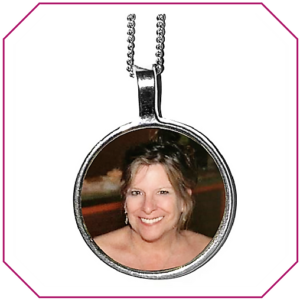
Legacy Republic is busy creating photo charms and other customized photo gifts for the holidays. The deadline to send along a photo to ensure on-time Christmas delivery is this Tuesday, December 5th. View Legacy Republic’s many other wonderful present ideas here.

5 Meaningful Gifts for $100 or Less
This post was created in partnership with NFDA.
Giving gifts to help friends remember loved ones is especially thoughtful. Far from being an unwelcome reminder of loss (during the holidays it’s likely to be top of mind anyway), offering presents that acknowledges their grief demonstrates incredible kindness and compassion. It shows you recognize the period between Thanksgiving and New Year’s Day can be especially difficult.
So what kinds of gifts are most meaningful? Here are five ideas, all $100 or less:
1. Create a Memory Garden
 Help your friend start a Memory Garden in honor of their loved one. First, buy packets of seeds. Flowers, plants, and herbs all work. Second, place the envelopes inside a wicker basket, adding several “Love Rocks” to make the presentation even more special.
“Love Rocks” are easy and inexpensive to make. All you have to do is take a piece of fabric and cut it into the shape of a heart. Next, glue the fabric heart onto a smooth stone with craft adhesive. If the stones are likely to be used outdoors, make sure to use acrylic sealer. Make the entire project even more poignant by using cloth that once belonged to their loved one – strips of fabric taken from a favorite shirt, pair of jeans, even a necktie. For more ideas on using flowers to strengthen memories of loved ones, please read these posts. I also write about the concept in, Passed and Present: Keeping Memories of Loved Ones Alive.
2. Preserve Their Handwriting

Locate a handwritten recipe or letter written by your friend’s loved one. Get it framed or transfer the image onto a piece of pottery. You can find lovely options at Prairie Hills Pottery. The accompanying photograph is the plate Prairie Hills made for me by using my grandmother’s “famous” coffee cake recipe. I adore it!
Preserving handwriting is a nod to a loved one’s enduring legacy. The additional upside of designing a decorative piece is that it doubles as a great conversation starter. Whenever company visits, your friend will have the opportunity to talk about his or her loved one and say their name out loud.
3. Embrace the Present
We honor loved ones by talking about them. We also pay tribute by celebrating the loving relationships that remain.
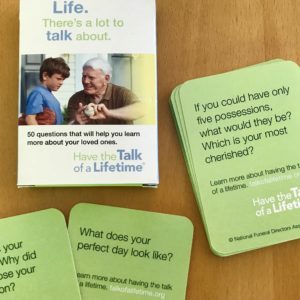
One great way to embrace family and friends after a significant loss is to use the National Funeral Directors Association and Funeral and Memorial Information Council’s Have the Talk of a Lifetime Conversation Cards. There are 50 cards to a deck and each one is printed with a different question. Questions like: Who has been the most influential person in your life? For what are you most grateful? The cards facilitate meaningful discussions and create unrivaled opportunities for sharing stories.
The best part?! Thanks to the Funeral Service Foundation, the Have the Talk of a Lifetime Conversation Cards are FREE. The deck makes a perfect stocking stuffer or small holiday gift. Request your free deck of cards here.
4. Preserve & Share Memories

Loss can be overwhelming… so is deciding what to do with all those VHS tapes, slides, film reels, scrapbooks, and photo albums. Help your friend remember and celebrate their loved one by preserving and sharing their memories.
Legacy Republic has created several Memory Makeover Kits to make digitizing media as simple as possible. The “Shoebox Kit” is $100 and holds up to four items, including videotapes, film reels, slides, photos, and negatives. All your friend has to do is put the items in one of Legacy Republic’s packing boxes and ship it off to one of its Memory Factories. In just a few weeks, your friend will be able to access their memories on a secure online account and order beautiful, decorative keepsakes for their home.
For more on Legacy Republic and how photographs fuel happiness and healing, read these blogs.
5. Make Sculptures from Meaningful Objects

If your friend’s loved one adored painting, gardening, or cooking, take one of their old paintbrushes, gardening tools, or kitchen gadgets and transform it into a permanent sculpture. The design process is straightforward: an artist drills a hole into the bottom of the object and then a steel rod with an attached base is screwed into place. One sculpture works well. A cluster makes a statement.
Create a custom gift by visiting 106 Vintage Co. on Facebook: https://www.facebook.com/106vintageco.
Make gift-giving this holiday season an opportunity to support friends and family members who are grieving. Acknowledge their losses. Invite them to share their memories. They will feel loved, understood, and validated. And of all the gifts you can give them, that may be the greatest one of all.

November 15, 2017
Julia Scheeres on the Loss of Her Brother and the Healing Power of One Very Special Stuffed Animal
November 18 marks the anniversary of the Jonestown Massacre. In 1978, Jim Jones orchestrated the deaths of more than 900 people, all Americans. The individuals who built Jonestown, the Peoples Temple settlement in Guyana, went to South America in search of a better life. But over time they were held against their will as Jones urged them to commit “revolutionary suicide.” He denied them access to the outside world and eventually, food, sleep, and any dream of escape.
The tragedy was first considered a mass suicide. But author Julia Scheeres, in her gripping book, A Thousand Lives, reports that the children living in Jonestown were given no choice and that many adults felt pressured to take their own lives and didn’t do so voluntarily.
Julia came to this book from a rather unique vantage point. When she and her adopted brother, David, were teenagers, they were sent to a Christian boarding school. In Jesus Land, her memoir about the experience, Julia recounts the abuse they suffered in the name of religion.
A few years after Julia and her brother were released from the school, David was killed in a car accident. Her journey finding resilience after this unimaginable loss is illuminating and inspiring. I’m so honored Julia joined me for this Q &A on my grief and resilience blog.
Allison: What one memento reminds you most of your brother?
Julia: David’s first stuffed animal, a Snoopy. David didn’t leave much behind – he was only 20 when he died. I remember playing “animal hospital” with our stuffies when we were in grade school, so seeing Snoopy still “sparks joy” in me.
Allison: Where do you keep David’s Snoopy?
Julia: My younger daughter sleeps with it every night. She eschews dozens of other stuffies to snuggle with this old, hard, beat-up Snoopy. It’s falling apart at the seams and I’ve tried to patch it with new fur, but it’s starting to look a little Frankenstein-esque. I really need to find a place that refurbishes stuffed animals – if I can convince her to let go of it for a few days. But I’d rather Snoopy be loved than packed away in our dark attic – that thought just makes me sad.
Allison: The loss of a loved one can sometimes feel isolating. Have you had to address this experience, and what lessons did you learn as a result?
Julia: Yes. I was 20 when David died. (He was African American and adopted at 3; I was only four months older). I was a sophomore in college. Suddenly I couldn’t relate to the concerns of my classmates – dating, parties, boys, etc. I remember barely speaking for several months afterward and developing severe heartburn and migraines. I felt like an old woman at 20, full of physical and psychic pains. I spent a lot of time alone, in the local library, avoiding people. I drank too much peach schnapps (this was the 80s!) and listened to a lot of The Smiths and Joy Division in dark rooms.
I wish I’d seen a therapist soon after he died. But therapy wasn’t really an accepted mode of dealing with emotions in the conservative Christian household I grew up in. You were either supposed to “suck it up” or pray to God for relief. Neither worked.
Immortalizing David in a book – my memoir, Jesus Land – was the most helpful way to deal with my grief. Bringing him to life on the page – with all his dreams, hardships and hopes – was deeply satisfying.
Allison: What is the most satisfying way you’ve developed for keeping David’s memory alive?
Julia: I named my second child after him. David’s birthday was June 2, 1967. Davia Joy’s birthday is June 3, 2009. We talk about David a lot. She wishes she could have met him, of course. She’s proud of her name because she knows how close I was to him. I love saying her name because it’s as if I were saying his name. They share a nickname even: “Dave.”
Allison: Loss is a great teacher. In what way have you derived greater joy and meaning from life following David’s death?
Julia: I’ve realized that time is our precious asset in life. Forget money or fame. When we die, what matters most is our connection to the people we love. My husband and I are lucky to have jobs where we’re able to spend a lot of time with our kids. (He’s an academic, I’m a freelance writer). I want our children to have a deep well of happy memories to draw from as they get older. I think that’s an important foundation for a stable life – that sense of unconditional love and security that your parents give you as a child. I didn’t have that.

October 23, 2017
Making and Sharing Halloween Memories
Yup, that’s me. A little devil. This photo brings back joyful memories of Halloweens past. I’ve tried to make October 31 equally special for my kids. Part of this effort was taking them to a jaw-dropping event when they were small (they’re teenagers now and generally prep themselves for the big day). Recently, my best friend from high school visited me with her two young sons. Their stay was the perfect excuse to revisit this enormous, one-of-a-kind Halloween extravaganza.
I took them to The Great Jack O’Lantern Blaze, New York area’s most innovative Halloween event. At night, visitors snake their way through a display of 7,000 illuminated jack-o’-lanterns – all hand-carved and fashioned into massive, elaborate designs. Some of our favorites included an enormous T-Rex, a train engine, and a giant spider web. The event goes through Thanksgiving.

Photo © Jennifer Mitchell

Photo by Tom Nycz
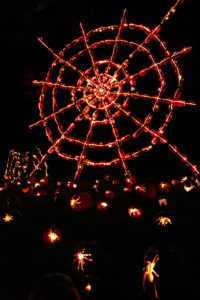
Photo by Angie Gaul
This kind of creativity reminds me of a Halloween project I did with my grandmother’s ceramic figurines. After she died, I decided to give them a holiday goth makeover. You can read about this fun and meaningful endeavor in my post, “Making Meaningful Halloween Decorations.”
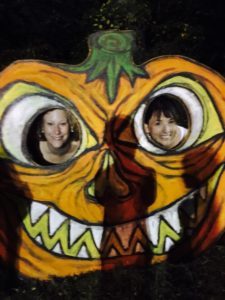 For Tracy and me, visiting this year’s Blaze added wonderful memories to the stockpile we already have. And it was so much more. The evening also provided a welcome moment for me to reminisce about Trick-or-Treating when I was small, remember my parents, and savor memories of my children when they were, at one time, mesmerized by the Blaze, too.

October 6, 2017
Make This Thanksgiving the Best, Most Meaningful Yet
This post was created in partnership with NFDA.
A funeral director once told me the number one regret he hears at memorial services. It wasn’t, as I expected, that individuals wished they’d spent more time with loved ones – having one more birthday dinner or going to one last baseball game. The leading cause of remorse was all the questions they never asked, the conversations they pushed off because they believed there’d always be time.
This revelation struck me and changed how I approach family gatherings, in particular Thanksgiving. When my family gathers around the dinner table, before we take a bite to eat, we take the time to talk. Starting with my father-in-law and going around the table one at a time, each person shares a personal story that fills him or her with gratitude. I tend to hear more about my family from these precious moments than I do at other times during the year. I think this is because we eagerly embrace this annual opportunity to truly listen and learn.
This year, I’m adding a twist. I’m going to bring a deck of cards with me — the Have the Talk of a Lifetime Conversation Cards.
The National Funeral Directors Association teamed up with the Funeral Service Foundation to create the cards, each printed with a different question, to cultivate meaningful family conversations. Topics range from lighthearted to serious and are designed to prompt both short and long responses. The 50-card deck includes questions like: How did you meet your spouse or significant other? If you could travel back in time, to what era would you go? Who has been the most influential person in your life? The cards are free and you can order yours here.
To honor loved ones who’ve passed away, I recommend reading Passed and Present: Keeping Memories of Loved Ones Alive, the book I wrote about remembering and celebrating the family and friends we never want to forget.
Below are a few ideas you can start planning right now to ensure loved ones remain close this Thanksgiving despite their absence:
1. Make Cooking a Game
Serving that sentimental Thanksgiving dish is great, but if you want to increase the chances family and friends will remember why it’s important to you, include them in its creation. Have a few hours to work with? Bring children with you to the grocery store and launch a scavenger hunt. Ask them to find all the ingredients you’ll need to make “Grandma’s Famous Apple Pie.” I recognize it’s nearly always easier to forgo this kind of help, but if you’re open to the assistance, you’ll create a bonus pocket of time to discuss why that apple pie really matters.
2. Play Sentimental Music
My father died when he was 63. He absolutely adored jazz composer and bassist Charles Mingus. When my family gathers, his music tops my playlist.
3. Set a Loving Mood
In addition to flowers and candles, use framed photographs to enhance your holiday table. And if you have old 35mm slides, consider punching a hole in the corner of each one, stringing a piece of ribbon through the opening, and using them as charms to identify wine and cocktail glasses.
One final and important note about using NFDA’s Have the Talk of a Lifetime Conversation Cards: You’ll likely get the best results if you let your family know your plan in advance. New traditions often need explanation, even those that are simple and lots of fun.

September 25, 2017
Dani Shapiro on Loss, Religion, and Honoring Her Father Through Writing
As I sit down to write this blog, it’s odd for me to admit that I don’t remember when I met Dani Shapiro. I just know I’ve admired her work for a very long time. Her writing is provocative and elegant. There are few authors I admire more.
Dani is the bestselling author of numerous books, including Still Writing, Devotion, and Slow Motion. She’s been a guest on Oprah Winfrey’s Super Soul Sunday. Her most recent book, Hourglass: Time, Memory, Marriage, has received significant attention and praise. Cheryl Strayed has said she was “absorbed by Hourglass and consoled by it too.” I’m honored Dani joined me for this discussion on my grief and resilience blog.
Allison: Your father passed away more than two decades ago. How has that loss influenced your life until now?
Dani: My father died suddenly more than half my life ago — when I was 23 — and many of the most meaningful parts of my adult life have been enriched and formed by that early loss, no matter how I wish it had been otherwise.
Allison: Do you have mementos that remind you of your dad? Where do you keep them?
Dani: He was a religious man, and I have kept his tallis and tefillin in their blue velvet embroidered pouch near me. I don’t keep it in public, as he would never have kept it in the open or displayed it, but rather it is on a shelf in my closet where I see it every day.
Allison: Have you ever shared these significant heirlooms in any way?
Dani: At my son’s bar mitzvah, he wore my father’s tallis. It’s the tradition for the 13 year old at his bar mitzvah to be given a tallis. I passed my dad’s on to Jacob on that day, and to see my then-small boy wrapped in the enormous shawl, yellowed with time, was incredibly meaningful and moving. In the Jewish faith there is a Hebrew expression — l’dor vador — which means, from generation to generation. This was a physical and symbolic enactment of that.
Allison: The loss of a loved one can sometimes feel isolating. Did you experience this with the loss of your father, and what lessons did you learn as a result?
Dani: Because I was so young when my dad died, I did feel very isolated in my grief, because most of my friends hadn’t been through such an experience and didn’t know what to do or how to be. I did have one friend who had lost her mom, and she rode with me to the cemetery, and stayed close to my side in the weeks and months after, checking in. I’ll never forget that. I kept a journal at the time, as had always been my practice, and to see, now, the way I felt I should be “getting over it” just months after the loss, I feel such sorry and compassion for my younger self. I wish I could tell her that grief and mourning takes its own route, and its own time.
Allison: Loss is a great teacher. In what way have you derived greater joy and meaning from life following the loss of your father? Has it fueled creativity or driven you to a new purpose?
Dani: My father’s death made me a writer. Perhaps I would have become a writer anyway, but I don’t know if I would have had the drive, the courage, the awareness of life’s fragility, and honestly, the power of the grief driving me, and the desire to put language to it. Nine books and all these years later, I’m aware that much of my work has been an elegy, a way of honoring him. When my memoir Devotion came out, my dad’s sister, who was in her late eighties, called me weeping: It’s like a Kaddish for your father, she said. Kaddish is the prayer of remembrance. It was the most beautiful thing she possibly could have said.

August 30, 2017
How to Help A Friend Who’s Lost a Loved One
A few years ago, a writer I’ve long admired published a book I recommend every chance I get. How to be a Friend to a Friend Who’s Sick, an important and relatable work by Letty Cottin Pogrebin, explores this essential yet often overlooked landscape with tenderness and humor. It reads like a guidebook, providing a helpful roadmap whenever individuals are called upon to lend support to a friend in crisis.
I wrote Passed and Present: Keeping Memories of Loved Ones Alive to enhance the capacity of readers to remember and celebrate the family and friends they never want to forget. But men and women across the globe have told me the book also makes a great gift – they give it to friends who are helping their friends navigate the pain of loss.
Like Pogrebin, I recognize most friends want to be useful when needed but frequently find it difficult to know what to say or how to act.
Here are two opportunities for helping a friend who’s lost someone he or she dearly loved. You can find 85 creative and inspiring ideas in Passed and Present.
Share a Story
Bring loved ones up in conversation. Doing so is unlikely to make your friend feel worse. Indeed, by never talking about the person who died you’re unintentionally denying your friend opportunities to keep their loved one’s memory alive.
Facebook COO Sheryl Sandberg and Wharton professor Adam Grant make a convincing case in their book, Option B: Facing Adversity, Building Resilience, and Finding Joy, that giving voice to traumatic events helps people feel less alone and more understood by others.
Use Technology
Put tech to work. Using your smartphone, set a calendar reminder for the dates most likely to be difficult for your friend – a loved one’s birthday, the anniversary of their death. This small step will remind you to send a supportive text or make a loving phone call on the days your friend may need you most.
Pogrebin has defined kindness as empathy plus action. In an interview with the Chicago Tribune she summed up her point of view this way:
“If you are capable of truly feeling another person’s suffering and if you’ve made an effort to diminish or alleviate it, that person is going to experience your behavior as kindness — and in some small way it’s going to enhance their life and make them feel a little better. As far as I’m concerned, during stressful, painful times, what we most need from our friends — and anyone who crosses our path — is kindness.”