Allison Gilbert's Blog, page 11
November 30, 2016
Ann Hood Talks About Grief and Resilience
I first became aware of award-winning author Ann Hood after reading her deeply stirring book, Comfort: A Journey Through Grief, a memoir about losing her 5-year-old daughter Grace to a severe form of strep. My interest in her work only grew when I pored over her novel, The Knitting Circle, a work that cuts through many themes including “loss, hope, love, knitting, friendship, and the power of stories in our lives.”
Ann’s latest work, The Book That Matters Most, is a must-read. The story centers on a book club, but the novel is also about the accidental death of the protagonist’s sister and her mother’s suicide one year later. I could not put this book down.
Ann and I met at Spoken Interludes, a literary salon where celebrated and emerging writers read their work and answer questions from a large and enthusiastic audience. If you’ve never been to one of these events, I highly recommend carving out the time, if at all possible. Below, Ann and I talk about grief and resilience. We also discuss how music (the Beatles) and food (plain pasta with butter) have brought her unexpected joy.
Allison: Is there anything you do outside the holidays and anniversaries to keep Grace’s memory alive?
Ann: Beatles music was a passion and love that Grace and I shared. When she first died I couldn’t bear to hear a Beatles song. That’s kind of a hard thing to avoid. But hearing one without her was almost more than I could bear. However, over time, the Beatles have come to comfort me again, and now when I hear a Beatles song, I can see Grace smiling, I can see her frowning, and she trying to understand the meaning behind the song. I can also hear her laughing because she knew and collected all the stories about how the Beatles came to write their music. Recently, I dug out my old albums, and bought a turntable, and was horrified to learn that most of my Beatles albums had somehow disappeared. A good friend, when hearing about that, surprised me by replacing all of them. So now late in the afternoon I pick up my knitting and put on a Beatles album and think about Grace.
Allison: What one memento reminds you most of Grace?
Ann: Grace’s backpack. She came home from school, from kindergarten, her giant purple leopard backpack dragging behind her. She collected small items from our travels to hang from it. And it contains the schoolwork she had done that day, all the things that were in progress, the night we took her to the hospital and never brought her home.
Allison: How do food, recipes, and cooking factor into the way you celebrate her memory?
Ann: Just a few days ago it was what would have been Grace’s 20th birthday. We celebrated it the way we did every year when she was alive and after she died: plain pasta shells with butter, with a side of sliced cucumbers. Although this meal does not reflect that I’m actually a very good cook and Grace was actually an adventurous eater, it was her comfort food. And now it comforts us.
Allison: What do you know now about keeping Grace’s memory alive that you didn’t know when she died?
Ann: So many people urged me to put things of hers away, dismantle her room, kind of hide her away. I just couldn’t do it. I needed pictures and mementos of her around me. So I resisted that advice, and I am so glad I did. I was holding onto certain things instinctively, but that instinct was right. Now when I talk to someone who’s lost a loved one I urge them to keep special things around them. I recently moved after a divorce, and when I unpacked boxes that had been put far back in my closet, I found the shirt I was wearing the night Grace died covered in her blood, her brush with her fine blonde hair strands still on it. At first I was puzzled, and then it came back to me how right after she died the nurse in the hospital told me to never wash that shirt and to keep it forever. I cannot begin to tell you how glad I am that I took her advice.
photo credit: Catherine Sebastian


November 15, 2016
O, The Oprah Magazine: Why Looking at a Photo Can Ease Loneliness and Grief
 In the photograph, my mother and I are sitting on the stone lip of a large circular fountain in Paris. Shoulder to shoulder, we’re leaning into each other, fingers interlaced, my head tilted toward her cheek. It’s Saturday, August 31, 1985, and I’m 15 years old. We are in the Tuileries Garden, giddy tourists on a mother-daughter adventure that began just that morning when we landed in France from New York.
Studying the photo now, I see not just that moment, but so many other joyous times I shared with my mother: horseback riding in Central Park, the raucous annual holiday parties she hosted. Continue Reading

Arianna Huffington Helps Me Launch New Q & A Series
I’m thrilled to announce a new Q & A feature on my blog, a series of interviews with luminaries around the world. And I’m overjoyed to reveal my first conversation is with the incomparable Arianna Huffington!
The focus of every discussion will be grief and resilience. I’ve always been fascinated by the many ways loss can fuel enormous change and personal growth. My interest soared even more when I was named a contributor to the November issue of O, the Oprah Magazine and wrote an essay about the power of nostalgia to transform lives. If you’re curious about this topic, you can read about The Reflection Effect here.
Arianna and I met five years ago in the hair and make-up room at CNN. We were getting ready to appear on different shows and we briefly talked about my new book at the time, Parentless Parents: How the Loss of Our Mothers and Fathers Impacts the Way We Raise Our Children. My memory of that discussion is generally a blur. I mostly recall being in awe of her. Her work founding The Huffington Post had always inspired me, but it was her outsize warmth and generosity to everyone around her that afternoon, including me, that sparked my deepest admiration. And now, with the launch of her latest endeavor, Thrive Global, just a few weeks away, I am once again amazed by her singular kindness.
I’m so grateful that even with her new company’s November 30th start, Arianna took the time to reflect on the uplifting and empowering lessons revealed in my latest book, Passed and Present: Keeping Memories of Loved Ones Alive. Indeed, there’s a connection between the lessons in Passed and Present and the mission of Thrive Global. Loss is part of life, but it’s how we choose to harness these setbacks that can reduce burnout, spark creativity and productivity, and improve our health at home and in the office. Growth and resilience are driven by these unexpected factors.
Here’s my full interview with Arianna Huffington.
Allison: Loss is a great teacher. In what way have you derived greater joy and meaning from life following loss?
Arianna: There’s nothing like loss to help you put your own life – especially disappointments, failures and setbacks – in perspective. And this is one of my mother’s legacies that I particularly try to honor. She had a gift for finding beauty in the moment. And her conception of beauty was very much tied to the way she experienced time. After she died, I realized that she and I had an unspoken deal: hers would be the rhythm of a timeless world, a child’s rhythm; mine was the rhythm of the modern world. While I had the sense every time I looked at my watch that it was later than I thought, she lived in a world where there were no impersonal encounters, where a trip to the farmer’s market happily filled half a day, where there was always enough time for wonder at how lovely the rosemary looked next to the lavender. In fact, going through the market with her was like walking through the Louvre with an art connoisseur — except that you could touch and smell these still lifes.
Because however blessed our lives, we have, if we’re lucky, about 30,000 days to play the game of life. And that’s not morbid. In fact, it’s wisdom that will put all the inevitable failures and rejections and disappointments and heartbreaks into perspective. Because as a great Onion headline summed it up, “World Death Rate Holding Steady at 100 Percent.” So let’s stop sweeping it under the rug. That’s a modern impulse. Ancient Romans would carve “MM,” Memento Mori (Remember Death), on statues and trees — to put every victory and every defeat into its proper perspective.
Allison: Being proactive about remembering loved ones makes you happier. Have you found this to be the case?
Arianna: Absolutely. It’s why I am constantly invoking my mother, both privately and publicly, from quoting her (“Don’t miss the moment” was her favorite saying) to dedicating my book, Thrive, to her
Allison: What one memento reminds you most of your mother?
Arianna: A photo of my mother and me taken at my wedding rehearsal. The way she looks at me in this photo so perfectly captures the sense of unconditional loving she gave me all my life. Even as I was going for my dreams, I knew that if I failed she wouldn’t love me any less. And that made me less afraid to fail.
Allison: Where do you keep this photo?
Arianna: I’ve hung this photo on a wall in the foyer of my apartment among my other most treasured family photos, including many of my daughters through the years.
Allison: What is the most satisfying way you’ve developed for keeping your mother’s memory alive?
Arianna: There are many ways, but what stands out is keeping my mother’s memory alive through food – especially bringing people together for conversation around a meal. My mother was always cooking, as she believed that if you didn’t eat something every twenty minutes, something terrible would happen to you!

November 3, 2016
Preparing Your Best Holiday Playlist Ever, and a Secret About My Family
Now is the perfect time to create your best holiday playlist ever, songs to accompany all your upcoming dinners and celebrations. “Music is one of the strongest tethers we have to the past,” Kenneth Bilby, a former director at the Center for Black Music Research at Columbia College Chicago in Chicago, tells me. “It’s a critically important carrier of memory.” It’s with this notion in mind that I’m revealing a story about my family I’ve never shared. I hope you find it helpful as you plan your holiday playlist.
My uncle dictated a note to me one day before he died. The intention was for me to type it up and email it his closest friends and family after he passed away. And I did. It was one of the most important and joyful notes I’ve ever written. Richard was my dad’s younger brother and he’d been sick for a while. He was 70 and my father had been dead more than a decade by the time I became Richard’s primary caretaker.
Richie, as our family called him, went to the Peabody Conservatory at The Johns Hopkins University and was a great lover of music throughout his life. He founded Grenadilla, a music label, and his company produced acclaimed discographies and was nominated for a Grammy Award in 1978 in the category of Best Arrangement for Voices. He also performed a clarinet recital at Carnegie Hall, the event so large in his memory he often told my brother and me it was the happiest moment of his life.
The note was my idea. Sitting at his bedside, feeding him cherry Jell-O and urging him to take even a sip of water, I asked my uncle for a list of his favorite pieces of music. I thought I’d benefit — indeed all his family and friends could benefit — from his deep reservoir of knowledge.
And I knew we’d feel closer to Richie after he died if we could enjoy these songs and arrangements knowing he once took pleasure in them, too. This year, three years after my uncle’s death, I pass along his expertly curated list to you:
“Some of My Favorite Listening” by Richard Allen Gilbert
Artie Shaw — Begin the Beguine
Mozart — Sinfonia Concertante for Violin/Viola
Mozart — Piano Concerto #21
Mozart and Brahms — Clarinet Quintet
Bach — Brandenburg Concerto
Beethoven — Violin Concerto
Samuel Barber — Adagio for Strings
Hoagy Carmichael — The Nearness of You
Joaquin Rodrigo — Concierto De Aranjuez
Stan Getz — Focus (entire album)
John Lennon – Imagine
Brahms — Piano Concerto #2
Musicals — Fiddler on the Roof, Sound of Music, West Side Story
This playlist brings back wonderful memories of my uncle and me. You can read more in Passed and Present: Keeping Memories of Loved Ones Alive (Forget Me Nots #56 and #84), where I talk more to the importance of music in remembering. What music did your loved one enjoy most? Make a playlist and then consider sharing it. A commemorative playlist happens to make an especially thoughtful holiday gift.

October 13, 2016
Making Meaningful Halloween Decorations
After my grandfather died, my grandmother took a ceramics class. She got out of it exactly what she needed — distraction, friendship, and a sense that she could be happy and engaged once again. Grandma made more than a dozen pieces, and not too long ago, I did something I thought I’d never do: I gave them a creepy Halloween makeover.
My inspiration came from Blair Stocker’s handsome how-to guide, Wise Craft: Turning Thrift Store Finds, Fabric Scraps, and Natural Objects into Stuff You Love. In Forget Me Not #74, from my book, Passed and Present: Keeping Memories of Loved Ones Alive, I reveal Stocker’s Sinister Ceramics concept: coating figurines such as cats, birds, and owls in black spray paint and sticking red jewels on the eyes. (I think Hummels work well, too, as they can be made to look especially creepy.)
I adore this project because it gives new life to old objects while simultaneously provoking conversation about the objects’ origins. Giving my grandmother’s ceramics a goth makeover provided a chance to talk about her with my children. Every figurine is proof of her resilience and grit, and every October I tell my children why their great grandmother made them, hoping to engrain in them the very attributes I admired so much in her.
For a while, I wondered what my grandmother would think of her ceramics’ new, decidedly dark look. Would she be offended? I truly don’t think so. I like to imagine she’d be gratified I found a way to share a part of her life she was proud of, too.

September 19, 2016
Surprising Fall Opportunity
One of the most uplifting gifts I’ve ever heard of giving someone in a time of loss is a wicker basket full of daffodil bulbs. The idea is for the recipient to plant one bulb for every year the loved one lived. Daffodils are the perfect flower for such a happiness-inducing project: as perennials, they’ll come back spring after spring—and they’re virtually indestructible. And, the best time of year to plant daffodils is the fall!
In my book, Passed and Present: Keeping Memories of Loved Ones Alive, Forget-Me-Not #46, I introduce Becky Heath, along with her husband Brent. Together, they run Brent and Becky’s, a family-owned daffodil farm and distribution center in Gloucester, Virginia (www.brentandbeckysbulbs.com). Becky offers the following advice for success:
First, choose a sunny spot.
Autumn is the best time to plant daffodils because the bulbs prefer cool soil. If you’re in a southern climate, stick with planting jonquils or tazettas, as these daffodils are better suited for warmer temperatures.
Plant each bulb at a depth of three times their height, spacing them three times their width apart.
This is a great activity to involve friends, family, and neighbors. Not only will you benefit from the extra hands, you’ll be able to use the time to invite conversation and share stories about your loved one.

July 28, 2016
The Healing Power of Retracing Your Steps
Have you ever heard “These Foolish Things”? The song recounts a long list of sights, sounds, and objects that conjure up memories of loved ones. Take a listen here. With a nod to this popular standard, go back to that restaurant you enjoyed together. Return to the hotel. And if, for you, this idea involves getting into nature, consider the enormous emotional benefits I write about in Passed and Present that stem from being outdoors (Forget Me Not #85).
According to a study published in Proceedings of the National Academy of Sciences, individuals who spe nd time in green, natural spaces focus less attention on negative aspects of their lives and open themselves up to the kind of thinking that brings them joy – including happy memories of loved ones. Gretchen Daily, coauthor of the study, told me: “Never before have people been so detached from nature. There is growing evidence, however, that reintroducing nature to people who are deprived of it can improve mood. Many individuals feel better in a natural setting, perhaps because it helps them let go of pain.”
Creating just this kind of positive space for remembering is the backbone of every Forget Me Not in Passed and Present. It’s also the springboard that enables us to celebrate loved ones who have passed while enthusiastically, unreservedly, and joyously embracing our present.

July 16, 2016
Tips for Repurposing Tablecloths, Linen Napkins, and Other Atypical Fabrics
My dad always wore neckties to work, so after he passed away, I hired The Gazebo to turn them into a quilt. The quilt brings back lots of happy memories, recollections I can now share with my children who never got to know their grandfather. You can see a picture of this beautiful quilt here. But discovering opportunities for upcycling other types of fabric is often more challenging. What to do with table linens, kitchen towels, aprons, and placemats?
In my book, Passed and Present: Keeping Memories of Loved Ones Alive, Forget Me Not #10 reveals several ways to repurpose fabric not usual considered for memorial projects. Nancy Roy, owner of Totes with Tales (www.toteswithtales.com), uses virtually any kind of fabric to create one-of-a-kind bags customers can use every day.
Roy uses bandanas, cloth napkins, and towels to create imaginative and practical bags. She also transforms placemats into wine carriers. And did you see the yellow and green bag in the photo above? It’s made out of sheets and a comforter. While not fabric, I also happen to love Roy’s most inspired idea – using shower curtains to make diaper bags.
Bags, of course, are not the only upcycling option. Be creative! Consider making throw pillows, bean bags, and teddy bears. You can also use pieces of fabric to make doll outfits, infant onesies, and plush Christmas ornaments. If you’re handy, you can do these projects on your own. If you’re not (like me!), you can work with Roy or a local seamstress or tailor.
Have you repurposed your loved one’s clothing? I’d like to hear about it! Better yet, post a picture on my Facebook page, https://www.facebook.com/agilbertwriter/.
If, after reading this post, you’d enjoy learning more ways to give cherished fabric new life, please email me at allisongilbert@allisongilbert.com and write “Fabric Ideas” in the subject line. I’ll be happy to send you additional suggestions.

June 29, 2016
Commemorative Travel: The Latest Trend In Vacation Planning
What do you call a trip that speaks to the desire to celebrate the memory of loved ones in the company of others who are drawn to do the same? I call it Commemorative Travel.
Previously on my blog, I revealed five destinations around the world where travelers can spend time away from home remembering and honoring the family and friends they never want to forget. Just as we build trips around caring for endangered animals, jumping out of airplanes, and building schools in developing countries, Commemorative Travel is another kind of specialized adventure. This type of vacation allows us to design itineraries to strengthen our connections to the past.
In Passed and Present, I reveal a number of Forget Me Nots that can deepen our connections to loved ones through travel. In fact, I write an entire chapter of travel ideas! Below are several destinations, and if you’d like even more, please email me at allisongilbert@allisongilbert.com. Please write “More Travel Ideas” in the subject line. OK, let’s share some of these opportunities.
 Camino de Santiago: The Camino is a spiritual and physical journey that winds through Spain and a small section of France. There are many routes one can take – the longest taking 30-40 days, covering about 500 miles. Time on the Camino is transformative: allowing uninterrupted time to reinvest in the relationship you’ve lost. It’s a pilgrimage in every sense of the word – a chance for private reflection, prayer, meeting fellow travelers, and developing new, meaningful friendships.
If international travel isn’t what you have in mind, there are a number of ways to celebrate your loved one’s memory closer to home. Here are three places to go that I think are amazing:
 The RiSE Festival puts on lantern release events every year in the Mojave Desert, Nevada. Every participant receives a paper lantern on which they can write a message to a loved one. Then, in unison, thousands of people release their lanterns into the night sky, creating a twinkling and deeply stirring moment of communal solace and reflection. RiSE organizers say they use only biodegradable lanterns and conduct a miles-wide 72-hour clean up following the event to recover them.
 The Morikami Museum and Japanese Gardens puts on a Japanese Obon-inspired Lantern Festival every fall on its beautifully manicured grounds in Delray Beach, Florida. Here, in addition to a magnificent paper lantern ceremony that takes place on its lake, there’s also the opportunity to purchase tanzaku, colorful strips of paper used for writing messages to loved ones. During Obon, it’s believed the spirits of the dead return home and are guided back to the afterlife when the celebration ends by flames and smoke. Because of this tradition, guests who have lost loved ones within the last year are invited to place handwritten notes into a large boat which is then set on fire during the ceremony, the smoke symbolically transporting their loved ones to the next world for the first time.

Lantern Floating Hawaii is an annual event that takes place on Memorial Day on the island of Oahu. According to organizers, it’s a chance for anyone who has ever lost a loved one to “be surrounded by the love, understanding, and support of others – even strangers.” On the morning of the ceremony, participants collect materials to assemble a lantern in the Lantern Request Tent. Each lantern has three sides for writing messages of remembrance. Each family personally places their lantern into the water during the service. Because the observance takes place at night, the water gradually transforms into a sparkling and bobbing oasis of memories.
Vacations are perfect times to honor, celebrate, and remember loved ones. We are generally more relaxed and open to new and meaningful experiences. The trick is aligning our intentions with the right destination.

June 16, 2016
Celebrating Dads Gone Too Soon on Father’s Day
After my father died, my stepmother longed for a quiet place outdoors to think about my dad. Cheryl’s ideal spot ended up being a secluded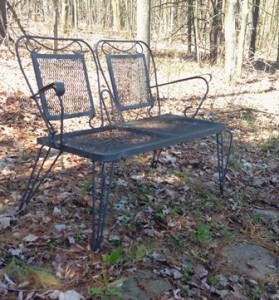 spot right in her backyard. She cleared out a few weeds, bought an iron bench at a garage sale, and that was about it. A refuge was born. You can read more about this idea and many others in Passed and Present: Keeping Memories of Loved Ones Alive.
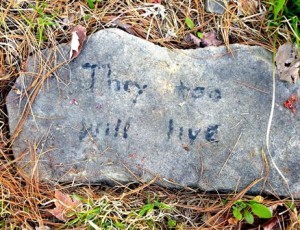
My favorite part of Cheryl’s retreat is the path she made to get there. She gathered a large number of medium-sized stones and carefully positioned them one after the other until a line of rocks stretched from the side of the house to the bench.
And then, over the course of several visits, she asked my children and my brother’s children to help her paint each stone with a different stanza from We Remember Them, a poem by Rabbis Sylvan Kamens and Jack Riemer. Here’s how the poem begins, adapted below:
At the rising sun a nd at its going down
We remember them.
At the blowing of the wind and in the chill of winter
We remember them.
At the opening of the buds and in the rebirth of spring
We remember them.
At the shining of the sun and in the warmth of summer
We remember them.
At the rustling of the leaves and in the beauty of the autumn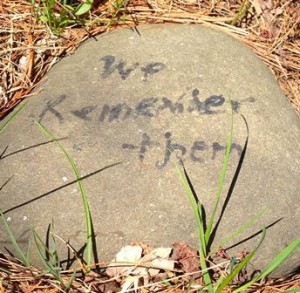
We remember them.
At the beginning of the year and at its ends
We remember them.
As long as we live, they too will live;
for they are now a part of us,
as we remember them.
Building an outdoor refuge doesn’t require a lot of effort or space. You can use a chair instead of a bench or simply spread a blanket on the ground. There’s no obligation to mark a trail. The goal is simply giving yourself the time and a location to be alone with your thoughts.
And for that reason, it’s essential to recognize that a sanctuary doesn’t even have to exist outdoors—you can assign refuge status to any spot you dedicate for reflection, even your sofa—as long as it offers you a quiet place to remember.