Willie Handler's Blog, page 9
November 23, 2021
The Painful Existence of a Toronto Maple Leaf Fan

When I was a boy, the Toronto Maple Leafs were an important part of my life. I knew every player’s stats, bio and background. When they won the Stanley Cup in 1967, the schools were closed early to attend the victory parade. I was there hours before. It was their 4th Cup in 6 years. I thought they good times would never end. But it did. 54 years have passed, and they haven’t returned to the Cup finals let alone winning Lord Stanley’s fabled trophy.
The franchise is over 100 years old having been established in 1917. Conn Smythe purchased the team in 1927 and it was a dominant franchise is the original NHL six-team league that didn’t expand until 1967. By then the Leafs had won 13 Stanley Cup championships. But in 1961, Conn Smythe decided to cash out and sold the team to a partnership of sone Stafford Smythe, John Bassett and Harold Ballard. By 1971, Ballard was the sole owner after Bassett sold out after a dispute and Stafford Smythe had passed away. That’s when the franchise went into a death spiral that it has never fully recovered despite new owners and a parade of general managers, coaches, failed saviours, bad trades, and horrible draft picks. There have been seasons that have look promising that ended in failure and frustration. It’s been hard on Leafs fans. Meanwhile the owners rake in the money with season after season of sell outs along with the highest ticket prices in the NHl.
I’ve compiled a list of the worst moments in the franchise’s history.
ROGER NEILSON AND THE PAPER BAG
In 1978-79, Neilson’s second behind Toronto’s bench, Ballard fired his head coach after a bad stretch of games. However, he was unable to find a new coach in time to get behind the bench for Toronto’s next game, so he re-hired Neilson. Trying to take advantage of the publicity, Ballard wanted Neilson to return with a bag over his head as The Mystery Coach. Neilson refused. He didn’t last the rest of the season anyway.
DARRYL SITTLER RIPS THE “C” OFF HIS JERSEY
In the 1979-80 owner Harold Ballard had brought Punch Imlach back as general manager, his third go-around with the team, and he immediately went to war on his players, more notably his star player Darryl Sittler. Since Imlach couldn’t get rid of Sittler due to the captain’s no-trade clause, he instead traded Sittler’s friend Lanny McDonald. In response, Sittler took scissors to his jersey and cut the ‘C’ right out. Citing the stand-off with his GM, Sittler resigned the captaincy.
WAYNE GRETZKY, AND THE HIGH STICK THAT WASN’T CALLED
It’s the play that has made Kerry Fraser an embedded piece of Leafs Lore. In 1993 we nearly got a Leafs-Canadiens Stanley Cup Final, which of course under the modern league alignment can never happen. With Doug Gilmour, Wendel Clark, Dave Andreychuk, Glenn Anderson, etc., the Leafs had one hurdle between them and their first Cup final appearance since 1967: Gretzky’s Los Angeles Kings.
With the Leafs leading the series 3-2 and Game 6 tied in overtime, Gretzky high-sticked Leafs captain Doug Gilmour, which went uncalled by referee Fraser. Toronto should have been put on the man advantage and a goal would have clinched a berth in the final. Instead, the unpenalized Gretzky scored the game-winning goal shortly after. Los Angeles went on to win Game 7 in Toronto 5-4…Gretzky scored three times and added an assist.
THE CANUCKS, AND ANOTHER BLOWN OPPORTUNITY
The Leafs had another golden opportunity to reach the Stanley Cup Final in 1994. Toronto finished third in the Western Conference with 98 points but didn’t face either of the conference’s top two seeds because both Detroit and Calgary were upset in the first round. In the conference final, Toronto faced the seventh-seeded Vancouver Canucks, who Toronto accumulated 13 more points than in the regular season. Toronto won Game 1 in overtime but scored just three goals over the next three games to fall behind the Canucks 3-1 in the series. In Game 5, Toronto took a 3-0 lead and seemed poised to head home for the last two games of the series. The Leafs being cursed and all, they coughed up the lead and lost 4-3 in overtime. The team wouldn’t win a playoff series for another five years.
THE DEVILS, AND THE PUTRID OFFENCE
The Leafs won their division with a 100-point season in 1999-2000, and after getting past Ottawa in the Battle of Ontario in Round 1, they faced the Dead Puck Devils, a defensively stout team with one of the all-time greatest goalies in Martin Brodeur behind it all. It was a close series, with four of the first five games being decided by one goal. But Toronto had managed just 21, 20, 23, 22 and 25 shots against Brodeur in the first five games, but were still in it, down 3-2 in the series heading back to New Jersey. Game 6 is where it all fell apart though, and it really distinguished how far apart these teams actually were. Toronto was embarrassed and put only six shots on goal all game, ultimately falling 3-0.
THE 18-WHEELER
On Feb. 1, 2012, things weren’t so bad for the Leafs. Their 28-20-6 record was good enough for sixth place in the Eastern Conference and, unlike all the teams chasing them, they had a positive goal differential.
But, of course, it didn’t finish so smoothly. Toronto won just once over its next 11 games. The bad stretch pushed the Leafs all the way to 12th in the conference. Head coach Ron Wilson was fired, and then-GM Brian Burke uttered these now-famous words, which you’ll commonly see referred to in Leaf Land in nervous.
“I’ve never had a team fall off a cliff like this before, I’ve had dips, slumps, rough patches, but this is akin to an 18-wheeler going right off a cliff, I don’t know what happened.”
4-1 LEAD AGAINST THE BRUINS
After missing the playoffs for several years, in 2013, the Maple Leafs were back and up against the Boston Bruins. The Leafs had a 4-1 lead in Game 7 with five minutes to go. After a nine-year post-season hiatus, it looked like Toronto was set for a playoff run. The fans in Boston were streaming into the exists.
But then, an epic collapse. The Bruins scored three goals in quick succession to tie the game 4-4. The game went to overtime, and Boston centre Patrice Bergeron, who had the game-tying goal, scored 6:05 into OT to leave the Leafs and their fans stunned.
TIM LEIWEKE PLANNING THE PARADE
When the Leafs brought in Tim Leiweke as the new CEO of MLSE, he came with bold ideas of where to take the company and he had special plans for the Maple Leafs. Just a couple months after blowing that 4-1 lead mentioned above, Leiweke mentioned that he already had a parade route planned out for when the team did win the Stanley Cup. Leiweke had great success leading the Los Angeles Kings to Stanley Cup glory, so he came in full of confidence. And while he should be considered a success overall in his time with MLSE, he, obviously, wasn’t able to get that Cup. The parade route is something that just shouldn’t be mentioned with the Leaf fans, not even as a joke.
IT HAPPENS AGAIN AGAINST THE CANADIENS
It happened again. The Maple Leafs run roughshod in the Canadian Division formed during the Covid-shortened 2021 season. It was their best chance at a Stanley Cup in decades. After a 3-1 series lead and all the momentum to boot, the Toronto Maple Leafs’ path to a deep playoff run never seemed so clear. But Toronto’s history repeated itself in a cruel manner as they dropped three consecutive games to the bottom-ranked Montreal Canadiens to bow out of the opening round of the 2021 playoffs. It was the Habs who seemingly figured out how to stop Toronto’s potent offense dead in its tracks in a 3-1 victory on Monday to take Game 7.
SEX ABUSE
The worst event Maple Leaf history emerged in 1997, when it was learned that some employees of the Maple Leaf Gardens had sexually abused young boys in the 1970s and 1980s. Martin Kruze was the first victim to come forward. His story of abuses beginning in 1975 prompted dozens of other victims to come forward. In October 1997, Gordon Stuckless pleaded guilty to sexually abusing 24 boys dating back to 1969 and was sentenced to a jail term of two years less a day. Three days later, Kruze committed suicide. In 1999, former usher John Paul Roby was convicted of sexually molesting 26 boys and one girl. He was subsequently declared a dangerous offender and could have been kept in prison for the rest of his life. Roby died in Kingston Penitentiary from an apparent heart attack in 2001. In 2002, former Gardens security guard Dennis Morin was found guilty of sexual assault, indecent assault and gross indecency for incidents involving teenage boys.


November 10, 2021
How Do You Know When Your Book Is Finished?
At some point, every author has grappled with the question of how to know when you’re done writing your work-in-progress. From obsessing over the last few lines to getting lost in endless revisions, it’s hard to know if the latest draft of your manuscript is final.
For example, here are the last few names of drafts for one of my books.
RoadAhead_final
RoadAhead_final_final
RoadAhead_final_final_edits
RoadAhead_final_final_edits_ARC
So, I decided to make of list of things to help me stop the endless cycle of editing and finally declare victory.
1. Listen to your subconscious
When you’re no longer thinking about that story day and night, you’re likely done. You may be pushing that shopping cart down the aisle at the grocery store and while scanning the boxes of pasta, do you lose your train of thought and start thinking about your manuscript? Or does your subconscious begin to ruminate about your next story? If it’s the latter, maybe it’s a sign that your book is finished?
2. You’ve had enough
Have you ever said to yourself, that I can’t look at this manuscript anymore? Maybe you feel editing is making it worse not better. I’ve been there. It may be time to call it a wrap before you end up making it worse.
3. Edits have become miniscule
After round after round of edits, your manuscript will reach the point where further edits are pointless. For some writers the editing process is a manifestation of their insecurities. While the manuscript still needs edits, it’s not ready to show the world. It’s time to let go. If you need help to get you there, show it to critique partners who can be honest about whether your book is finished.
4. You’re not setting deadlines
Art doesn’t always observe the concrete deadlines we might like to impose upon it. If it says it wants more time than you had planned to give it, you’re usually better off listening to it. However, there comes a time when deadlines can be useful in moving a stubborn story to the finished line. Set a time limit for your story.
5 Learn to let go
I’ve held a printed copy of a released novel and discovered a missing comma or a minor typo. My first reaction is why didn’t I do another round of edits. It’s inevitable that this will happen to you one day. Best seller novels lso have typos. You do the best editing job you can and then just let your baby go so she can stand on her own two feet.
October 26, 2021
Why Writers Need Websites
Many writers spend more time on social media than blogging (including me) and that’s too bad. A website/blog is an opportunity to show off your writing and engage with clients and readers in a way that is often not possible on social media. I sat down and came up with 10 reasons why writers should have an active website/blog.
1. You want to look professional
You need to start a website before you are published. Whether you’re querying a manuscript or trying to find freelance work, agents, publishers, agents will want to check you out. The first place they will go to is a website/blog. There you can have a proper bio, testimonials, etc. Also, having a sharp looking website suggests that you are up-to-date with technology. The earlier you set up a website, the better it will be at promoting you as a writer.
2. Websites help readers find you and your books
It’s great that you’re on Facebook, Twitter, Instagram, and TikTok, but social media is not a substitute for a website. It’s your ultimate marketing tool, yet many writers spend much more of their time on social media than on their website. When potential readers and clients Google you, then expect to find your website. They will eventually check your social media accounts but social media cannot possible tell them as much about you as a proper website.
3. Websites with blogs demonstrate your writing ability
Website hosting platforms like WordPress (which is what I use) allow you to incorporate a blog into your website. This is a great opportunity to post short stories, excerpts from books, video clips, etc. Use it to market yourself. But you need to update your site on a regular basis. Having an out-of-date blog and website is as bad as not having one at all.
4. Websites with blogs keep you writing
It takes me about 2 years to get a book written and published. In between I want to keep readers and followers engaged. It takes just hours or several days to write a blog post. I like being able to put aside my manuscript and work on something different like a blog post or newsletter article. Even my newsletter links people back to my website.
5. Websites can assist in producing additional income
If you have a side gig as an editor, writing coach, or cover designer, your website/blog is the platform for finding clients. People looking at your books on your site might be interested in your other services and vice versa.
6. Websites can be used to make special announcements
Are you planning a book launch? How about a book signing appearance? Are you planning on running a sale? You should be using your website to promote these events. You should be using your website/blog as your writing ”home base.” But keep in mind, your website can’t be too self-serving. You need to make sure you have content that will bring people back to your site.
7. Website can be used to facilitate networking
As a writer, you need to be out there meeting and connecting with people whether it’s readers, clients, industry professionals, or other writers. Since many writers are introverts, networking online is often much more in their comfort zone. Your website/blog can facilitate that process.
8. Website should be part of your marketing strategy
Whether you go the traditional publishing route or decide to self publish, you’ll be doing marketing. Even large publishers expect you to do a lot of your own marketing and will want to see that you have an online presence. It’s even more important that you have an online presence should you choose to self publish. Readers need to be able to connect with you.
9. Websites assist in developing an email list
When it’s time to get word out that you’ve published a new book, it really helps if you have a mechanism to get the word out to potential readers. So, using your website to build an email list of people interested in your work is important. It doesn’t matter if you have a static website or a blog with regular posts, include a form to collect emails of people who want to stay connected to you. It helps to provide something in return for signing up. I provide a free ebook.
10. A blog on your website will help your search rankings
If you maintain a website and blog that is updated regularly, search results will place you higher. Google algorithms rank websites with lots of content and regularly updates higher. That’s important if you are a freelance writer or editor. If people use editor or freelance writer as their keyword search, you want you website to appear as high as possible.
October 1, 2021
One of My Most Embarrassing Experiences Growing Up
While working on my memoir, this was an experience I recalled. It was my first year of junior high school (middle school) and we had just moved into the area over the summer. I began the school year at Ledbury Park knowing no one. I was awkward and a year younger than the other students because I had skipped a grade several years earlier. The experience was intimidating. Walking the halls to class, I would see the vice-principal pulling male students aside if their hair was too long and female students if their skirts were too short. The Beatles and mod styles may have been popular in mid-sixties society but not at Ledbury Park. In grade 7, we had music classes, and I was placed in a vocal class rather than assigned an instrument. I have no idea why other than maybe I was a late enrolment to the school and that’s all that was available to me. I cannot sing. It’s fine if I’m alone in the car or the shower, but my voice was not made to be heard by others. We would sing pieces in class, and everyone would break out laughing the moment I opened my mouth. It was one of those embarrassing moments you never forget. After three classes, the teacher informed me that I had a spare for the rest of the year and no longer needed to attend class. What she likely meant to say was that I was no longer welcome to class. It was humiliating. I spent each music class in the library working on homework. I received a B grade for my futile effort at singing. It was an humiliating experience.
September 16, 2021
Beware of the Vanity Press
This past week I received a publishing offer from a NYC publisher that I had queried in March. I have already signed a publishing deal with another indie publisher, but I was curious and reviewed the offer. It seemed like any other contract I’ve been sent until I got to clause 15.
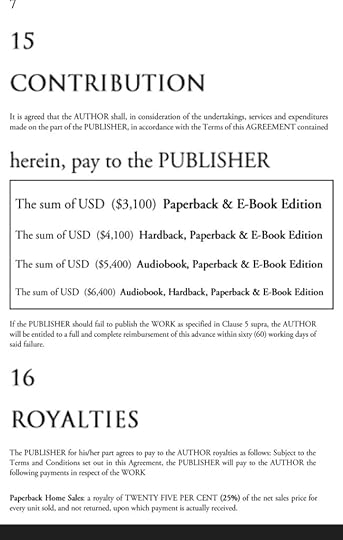
The publisher was asking me to contribute between $3,100 and $6,400 USD towards the publication of my novel. The covering letter stated that these were discounted amounts because of the pandemic. In other words, I was going to cover the full costs of publishing my book and share profits with them. Whether or not I already had a publishing agreement, this offer had to be rejected.
This type of publisher is described as the vanity press. This is really nothing more than a scam. I know of cases where money was paid and the publisher never releases the book. An author should never have to cover the costs of publishing their books unless they choose to self publish. Let me review the types of legitimate publishing routes.
Traditional publishersIndependent publishersSelf-publishingTraditional Publishers
This option is straightforward. I wish I could say it was easy, but it’s not. Traditional publishers use literary agents to screen manuscripts. You could say literary agents are the gatekeepers to the publishing industry. You can’t approach a traditional publisher directly if you aren’t represented by an agent. So, the first step is finding an agent willing to represent you and get you a publishing contract.
That’s the hard part. An agent will only take on a limited number of clients, and there are thousands and thousands of writers looking to be published. Agents are familiar with what publishing houses are looking for. In a nutshell, agents and publishers looking for books that will be enough of a commercial success to offset the time and money they will need to put into a book. I don’t have to tell you what that means. Just look at the books released by the major publishers and you will quickly figure out what they’re looking for. They also deem a debut author to be more of a risk since they have no track record of success.
If the traditional publishing route is what you are truly want, then you need to begin the querying process. It involves searching for literary agencies and finding agents that are interested in books similar to yours. Some agents are so busy that they will not accept any submissions. They might be open to queries for only a few months each year. Each agency has different submission guidelines. You need to review them carefully. If you don’t follow their guidelines, they might use it as a reason for rejecting your submission. All agents will require a query. You might be asked to for a synopsis and a sample which might be anywhere between five pages and fifty pages. Here is a previous post on what to put in a query letter and synopsis.
Then you wait.
Each agency will let you know how long it will take to get back to you. It might be as long as twelve weeks. Some agents will respond very quickly. Many agencies have a policy where they will not get back to you unless they are interested in your manuscript. I am currently querying a manuscript. I’ve sent out 145 queries and received about 35 responses – all rejections. So, for the majority of queries I will just have to assume at some point that they are not interested. It can be a demoralizing process.
Should you receive a positive response, you will be asked to provide more of the manuscript or even the full manuscript, so be sure you’ve finished it before querying. If the agent wants to represent you, they will pitch your book to editors at the various publishers based on what the companies are looking for. The agent might first ask for another round of edits to polish your manuscript further.
Once they are ready to pitch your book, you wait some more. Get the picture. This is a long and drawn-out process. Even when your book is accepted for publishing, there is more waiting. Publishing is like an assembly line. Your book has to wait in line as they prepare the manuscripts that they’ve previously accepted for publication. So, from the time you begin to query until the release date, two or three years can pass.
What are the advantages to traditional publishing?
The prestige of being part of a well-recognized publisher.The support of a design, editing, and marketing team.Production costs are covered by the publisher.They have strong relationship with book sellers.What are also disadvantages that you should know about?
As mentioned, it’s a long, drawn-out process and is often not successful.To gain access to a publisher’s connections and services, you give up a lot of creative control.These will be a lot of pressure on you because of the money that a publisher invests into your book.Royalties are between 5% and 15%Books tend to be priced higher because the publisher takes a big cut of sales.Independent and hybrid publishers
Let’s be honest, some very good books are passed over by agents. They are not just evaluating whether your book will be a commercial success but whether the author will be a success. Do you have an established platform? Do you do public speaking which can be used to promote your book? What can the author bring to the table to ensure commercial success? That’s the reality of publishing.
Fortunately, a new breed of publishers has developed over time. They are referred to independent publishers or, in some cases, hybrid publishers. They are small presses that will accept books that traditional publishers are not interested in. The indies are often small teams of editors and publishing staff. They will not provide the level of services that the big guys provide but they will provide editing, cover design, book formatting, and copyright registration. They can get your book onto websites like Amazon, Kobo and Barnes & Noble, but they can’t get your book into bookstores. They do not have advertising budgets, so much of the marketing will be on your shoulders. You need to be able to sell in the online world. Do not confuse the vanity press with independent publishing.
Querying an independent publisher is simple. They will often ask for a query letter and a partial or full manuscript. When they get back to you, it will either be a yes or a no. This eliminates the middleman (the agent) and you get your book published quicker. When I published with an independent, it was a little over a year from the time I sent my query until the release of my novel. I selected my book cover, and other than cleaning up the manuscript, they asked for no content changes.
What are the advantages of an independent publisher?
You much more control over content and design.The publisher provides design and editing support.Production costs are covered by the publisher.Your book will be released sooner than with a traditional publisher.What are also disadvantages that you should know about?
Your publisher has no access to bookstores, so your sales will be through online sales, book signing, and other book events.You need to have some marketing savvy and cover most of the marketing costs.Royalties are better than through traditional publishers but only between 15% and 25%.You will need to price books high enough to allow the publisher to recoup their costs and make a profit.It’s more difficult to reach reader solely online.Self-Publishing
Self-publishing is the process of undertaking all responsibilities related to publishing a book. If you decide to self-publish, you’ll be in charge of edits, cover design, formatting, and releasing and marketing your book.
The internet and online sales have been a godsend for authors. You don’t have to wait years, hoping to be published. Instead, you can bypass the publishing industry and do it yourself. This isn’t the route for losers. There are successful authors who choose this option because they are able to exploit all the advantages of self-publishing.
Of course, being in charge doesn’t mean you have to do all of this yourself. You can hire an editor, a cover designer, etc. to help you out. However, you will have to arrange and pay for these services out of your own pocket. This can cost up to $2,000 depending on how much you contract out to others. I want a polished and professional looking book, so I pay for editing, cover design and book layout. There are a lot of excellent and inexpensive freelancers out there. Many are also self-published authors who have developed these skills. You may be good at these things and don’t need to pay for others to do it for you.
You are able to maintain ownership of your book’s rights and royalties when you self-publish, which is exactly why so many people take this route. I’m not going to cover the entire process in this post, but I will be covering how to get out a book on your own in a future post. The beauty of self-publishing is that once your book is completed, you can get it published in no time at all. You decide on the price and you only share with the online sellers you select. You can get a supply of paperback or hardcover books printed to sell to friends or at book events and keep all the profits.
What are the advantages of self-publishing?
It’s guaranteed that your book gets published.You control everything including cover design, price, and release date.Your royalties on ebooks can be as high as 70% and 50% for printed books.What are also disadvantages that you should know about?
You will still have no access to bookstores, so your sales will be through online sales, book signing, and other book events.Unless you plan on doing your own editing, cover design, and book formatting, you will need to pay someone to do these things.You need to develop marketing savvy and cover all marketing costs.It’s more difficult to reach readers solely online.Bottom line
The good news is that you have options. Each option is quite different and needs to match up with the books you write, your entrepreneurial skills, and your expectations. There are many successful authors that fall into each of these options. Some people start off self-publishing and move to traditional publishing while others have moved the other direction. Whatever you choose good luck!
August 8, 2021
Selling Books on a Shoestring Budget
I’ve heard so many authors complain that what they hate the most about the publishing process isn’t querying or editing, it’s marketing. And no wonder. Marketing requires a completely different set of skills and has nothing to do with your ability as an author.
If you are an author signed by a large traditional publisher, congratulations. Your publisher will be directly involved in marketing your book. But if you are an indie author, you’re largely on your own. I’ve tried many different strategies for marketing my books. What I found is that the cost of marketing can often exceed any profits I can earn. In other words, I lost money. Let me run through the different marketing tools. But first a disclaimer. I am not a marketing pro. You may have more success with strategies that didn’t work for me.
Social MediaYou probably have noticed some authors follow tens of thousands of people on social media. They generally have an equal number following them. These authors will post multiple ads each week or even each day on their social media feed promoting their books. I’m sure you’ve seen the ads. If you follow enough of these authors, your social media feed will be clogged with their promotions. If you unfollow them, you will quickly be unfollowed as well. They aren’t interested in connecting. Just in promotions.
This form of marketing is inexpensive but requires you to build a significant list of followers. It’s also ineffective for several reasons. A lot of those followers may not be readers. If they are readers, they might not be interested in your genre. As well, if they are being bombarded with book promos, they will eventually scroll right by the ads.
I’m not against using social media. I sell some books this way. It just shouldn’t be the only marketing tool you use.
2. Paid Social Media Ads
I’ve tried purchasing ads on Facebook and Amazon. I’ve also tried promoting through vendors who will send out promos for you on their social media accounts for a fee. I have never broken even on any of these approaches. I’m not saying they won’t work for you. Ads are expensive and if your profit margin on books is low, it’s hard to make money. This approach makes for sense when you are selling services valued at several hundred dollars as opposed to the cost of a book. As a result, you need high volumes to break even.
3. In-Person Events
I love attending in-person events where you can interact with readers. This includes book signings in stores and malls, book fairs, flea markets, and farmers’ markets. I might sell anywhere between 5 to 20 books in a day depending on the size of the crowd. Your cost is the price of a table or stall. It’s often possible to share tables with other authors to reduce the cost. Bookstores will generally just take a commission on each book sold. For in-person events, you will need to invest in book displays and banners. These events are time consuming and there are only a limited number of these opportunities each year. During covid lockdowns, the only opportunities available have been virtual events, which are not nearly as effective. In September 2020, I sold 1 book at a virtual event. I sold 16 books at the same event in 2019 the last year it was in-person.
4. Online Influencers
Why not use others to promote your books. There are three types of online influencers: podcast interviewers, YouTube reviewers and bloggers who review books. The catch is that you want to find influencers with large followings. Otherwise, they aren’t much of an influencer.
Book reviewers are great, but the most desirable influencers are podcasters. A podcast allows you to speak directly to potential readers. You will be able to talk about yourself, your books, and your writing process. Typically, you will be able to do a reading. Podcasts are available on iTunes, Spotify, and several other services.
The trick is persuading a reviewer or podcaster to feature your book. I email podcasters providing information about myself, what’s unique about my book (the hook), and how I can entertain their audience. It’s much like a query letter. Remember, they get a lot more requests than they can handle, so you need to do your homework.
The best part about online influencers is that it’s FREE!
5. BookBub
BookBub is basically an email service. Readers can sign up for a series of emails that alerts them to quality ebooks at deeply discounted prices. It’s inexpensive for authors relative to Facebook or Amazon ads. It can’t be used to sell paperback or hardcover books. Because the ads direct potential buyers to Amazon, it gives you a lot of visibility.
The company sends out emails to thousands of readers each day. BookBub’s email lists are huge. The cost of havimg BookBub include one of your books price varies depending on the price of your book and which newsletter you want to be featured in. They’re willing to consider permanently free books, but in general, they’re looking for book deals that are deeply discounted.
BookBub wants to give their readers the best deals, so try to offer your book free (if it’s the first in the series) or for $0.99. They usually won’t feature anything above $2.99, and they’re unlikely to feature your book at that price if it’s always priced there. You decide on how much to budget each day and that will determine how many people your ad will reach and which types of readers to send the ads to.
Similar to social media ads, BookBub will provide you with metrics on how many people see your ad (impressions), how many people click on your ad, and cost per click and 1,000 impressions. You can play around with your ads, budgets, and demographics to maximize your sales. BookBub will only show your ad to a reader 4 times. Change or pause your ads after 7-10 days if it doesn’t perform well. You want to have a click rate of 2%. That means for every 100 impressions, two people click on your ad. You want to see 1 sale for every 10-20 clicks.
6. Build an Email List
What I’m currently working on is building an email list. I send out a monthly newsletter to connect with my subscribers and provide incentives to remain on the list. The idea is that when my next book is released, I will have a list of subscribers who I can promote my book to.
So, what do you need to do to build a list? Well, you will need to have a regular newsletter with new issues released every 2-4 weeks. Less frequent and subscribers will forget about you. You will need a platform on which to produce your newsletters and collect emails. There are many platforms, and each has its advantages and disadvantages. Costs and functionality will vary. I am using MailChimp because it’s free until you reach a certain size. Once you exceed that threshold, it becomes costly.
The most important piece is what is called a content magnet. You need to provide readers with something that they will want to have in exchange for their email. I wrote a prequel to my second book and designed attractive cover (it’s part of the hook), which I provide for free for those who sign up for my newsletter. It doesn’t have to be a book. But it needs to be something that will get people to provide their email. A free chapter from a book will not work. But the first book in a series would be great.
I use Bookfunnel to assist in attracting new subscribers to my newsletter. It’s a hosting service for ebooks. There are other similar providers. For a low cost, I set up a landing page for each of my books including the free one. Then I sign up for sales promos and newsletter builders each month. I include links for each promo I sign up for each month in my newsletter. A promo may have 100 or more ebooks for people to buy or download for free. The link takes you to a page with all the books included in the promo. If a person clicks on your book, your landing page will pop up. If it’s a sales promo your landing page will take them to your Amazon (or another bookseller) page. If it’s a newsletter building promo, they can exchange their email for the free download.
I’ve built up an email list of over 800 in less than a year. Some people will unsubscribe once they have your freebie. My experience is that only 15% have been unsubscribing. My goal is to reach a couple of thousand subscribers and if 15-20% buy my next book, that’s a good number of sales.
There are lots of inexpensive ways to sell your books. You should adopt several strategies to maximize your sales. But all these marketing tools eat up your time. Time you could be writing. But if your goal is also to sell books once they’re published, then you need to fit this in.
July 28, 2021
Beeker and Seepa v. Jehovah Witness
“Kids!” shouts Seepa. “How many instances have I told you to keep that covered by the tarp?’
Two little reddish Martian kids with tuffs of orange hair scurry from under the tarp and up the stairs of the back porch.
“Sorry, mama,” one of the two sheepishly blurts out.
“We don’t need our inquisitive Earthling neighbours to see our space vehicle,” Seepa with a frosty tone. As she steps inside, voice rings out from down the hall.
“What was that commotion about?”
“Bleeker, our offspring have been playing with the space vehicle again,” she says with a sigh. “I wish you would store it somewhere inaccessible.”
“Be reasonable. Where would you have me store it? On the roof of our dwelling?”
“At least the offspring couldn’t access it.”
“True. But our Earthling landlord would be displeased if the roof was to become damaged.”
The doorbell rings and the two Martians look at each other. “I wonder who that might be?” says Bleeker.
“Are you going to respond?” asks Seepa. “I am expecting an Earthling wig from Amazon.”
“I don’t see the necessity of a wig. You have such lovely orange hair,” he says while waddling toward the front door. When he swings the door open, he finds a well-dressed man and woman standing on their welcome mat with some literature in their hands. The man is older with salt and pepper hair. The woman is conservatively dressed in long sleeves and dress below her knees.
“Hello, do you have a few minutes so we could talk to you about Jesus?” asks the man.
Bleeker turns and shouts down the hall to his partner, “Are we aware of a Jesus being?”
Seepa shuffles to the door, “I believe he attends our offspring’s school.”
“Oh, good,” says the woman. “Glad to hear that the school discusses Jesus with the students.”
‘A man will leave his father and his mother and will stick to his wife, and the two will be one flesh,” states the man. “Therefore, what God has yoked together, let no man put apart.”
“Did you write those words?” asks Bleeker.
“No,” says the woman. “Those are the words of God.”
“Can I ask you something?” asks Seepa, staring at the woman’s head.
“Yes.”
“Are you wearing an Amazon wig?”
“No. It’s my real hair.”
“I assumed you were Amazon with the wig I’ve purchased.”
“Are you familiar with the bible?” asks the man.
Bleeker turns to his partner. “Do we know any being named Bible?”
She shakes her head.
“I’m not referring to a person but the holy book.”
“It appears you aren’t too convinced,” Bleeker says chuckling.
“You would imagine if a being was knocking on doors, that being would know what they wanted to communicate about,” adds Seepa.
“You don’t understand,” says the woman. “We came here to talk about the bible.”
“We told you we are not aware of a being with that name,” says Bleeker.
“Maybe you should post a notice around the neighbourhood, suggests Seepa. “Someone might know this Bible being you are searching for.”
The man pulls a book from a briefcase and holds it up. “This is the Bible. Would you us to leave you a copy? After you read it, we could come back to discuss it.”
“Do you belong to one of those book clubs we’ve heard about?” asks Seepa. “Our research suggests they’re some type of cult.”
The woman becomes visibly upset. “We aren’t in a cult. We’re Jehovah Witness.”
The two Martians look at each with puzzled looks.
“That’s a religion,” adds the man.
“Umm,” mumbles Bleeker. “We are Satanist.”
The two strangers quickly retreat from the door and head down the street. After closing the door, Seepa questions her partner, “What’s a Satanist?”
“I don’t really know. I think they are like attorneys. I just know they certainly do upset beings.”
June 27, 2021
Are You a Writer or Author?
Every notice how writer and author are used interchangeable? I know I do it all the time. But are they really the same? As I began to think about the two, I tried to make a distinction. I looked up the definitions.
Writer:
a person engaged in writing books, articles, stories, etc., especially as an occupation or profession; an author or journalist. a clerk, scribe, or the like. a person who commits his or her thoughts, ideas, etc., to writing.Author:
a person who writes a novel, poem, essay, etc.; the composer of a literary work, as distinguished from a compiler, translator, editor, or copyist.the literary production or productions of a writer.the maker of anything; creator; originator.These definitions seem to support the notion that writer and author are interchangeable words. But here is why that’s often the case. Every author is also a writer. But I don’t think that every writer is an author. I’m using my own case as an example. For many years I was paid to write government documents. I wrote reports, speeches, brochures, consultation papers, and briefing notes. In many cases I was instructed on what to write. Sometimes I summarized submissions to the government or research. But nothing I did was creative or original. I was definitely not an author.
In 2016 I published by first novel, The Road Ahead. This was an original piece of fiction. At that point I crossed the line from being a writer to also being an author. Neither is more prestigious or accomplished that the other. There are just subtle difference.
A writer is service-oriented while an author is self-oriented. In fact, I still function in both roles. I write reports for clients while working on novels.
In the end if you want to be a writer, then you have to write. And if you want to be an author, then you also have to write.
So, just write and don’t worry about the distinction.
June 23, 2021
Dear Author – No Thanks

I’m writing this post for all the writers who have ever gone through the querying process, who are currently querying a book, and who will be querying sometime in the future. I feel for you. My last count had me at 167 queries, 48 rejections received, and 0 requests for a partial or full manuscript. Many more queries have “expired,” which is what I call it when the timeframe for responding suggested in an agency’s website has passed.
I’m not here to rip into literary agents. They are inundated with query letters and need to work through them in an efficient manner. Still, the querying process can tear your heart apart, one rejection at a time. This has nothing to do with being an egotist or narcissist. When you put your soul into a manuscript that took you fourteen months to write, this become personal. Yes, everyone tells you not to take it personally. But how can you not? Sure I understand that publishing is a business and agents are looking for projects that will sell. I just wish there was a better way of doing this.
There are two ways in which your rejection is delivered. Some choose not to communicate at all. That’s right. They tell you in advance that they are too busy to find the time to communicate a rejection. So, if you haven’t heard back from them in 12 weeks or so, well try to put two and two together. I looked at the numbers and this is what I found. I received 4 rejections on the same day I sent them and 20 rejections were received within a week of sending them out. So, thank you for not keeping me hanging. The average response time was about 20 days. But I have yet to hear from 119 and I don’t expect to hear back from most of them. There are always strange outliers. For example, I received a rejection for a previous query 13 months after sending it out. Why bother responding?
Don’t expect any feedback included in your rejections. They are almost always a standard response. “This is not for me.” The only response I received that actually provided a reason for rejecting my query was that the story was too dark. It would be nice to know that story is good but not very marketable. Or that what you sent was weak and needs more work. But agents don’t see this as their role.
But to help others I’ve compiled a possible list of reasons why an agent might have rejected your query. You will need to decide which may apply to you.
You queried the wrong agent. Many agents provide a wish list of the types of manuscripts they are looking for. You’re going to get rejected if your manuscript isn’t a great fit.Your query is weak. If you don’t provide the information or material they ask for or what you send doesn’t wow them, you’ll be rejected. There may be typos and grammatical errors, which will not reflect well on the author.The genre or story doesn’t appear to be marketable enough. Publishers need strong sales to recoup the money the put into a book. The agent wasn’t inspired. If the first 5 or 10 pages of your manuscript doesn’t excite them, they may feel it’s not worth reading more.Your manuscript is good but not quite good enough. Have you ever watched American Idol and thought a contestant was good but they are rejected by the judges? Agents are only going to accept the best. Sometimes it’s as simple as an agent has too much going on at the moment and you get rejected regardless of how much promise your query showed. If that’s the case, you don’t want an overwhelmed agent anyway.When do you call it quits? You need to decide what your threshold is with respect to number of queries and time frame. I intentionally aimed high so that I wouldn’t have regrets down the road. I might wait a little longer to see if I receive any additional feedback but I won’t be sending out any more queries.
And what are your options if you can’t find an agent. Self-publishing is something many writers consider. In some cases, it’s their first options. For more on self-publishing, check out my previous post on the topic.
May 19, 2021
How To Self-Publish Your Novel

Until recently, there was just one route to getting published – you had to find an agent that liked your book and who would be able to sell it to a publisher. The process could take months or years. Many writers would give up in frustration. But now there are more options (see my previous posts on publishing).
The only other alternative to traditional publishing was “vanity publishing.” The vanity press will publish anything for a price. Writers can pay several thousand dollars to get their work published. A word of caution, I know of at least one author who was ripped off by a vanity publisher. Some are what you might call sleazy. The vanity press still exists, but emerging technologies have provided writers with new options.
The emergence of print-on-demand (POD) revolutionized publishing. You could produce single copies and small l print runs which allowed the indie publishing industry to flourish. And the internet made it possible to sell books directly to readers without needing to convince bookstores to stock your books. This provided writers with the ability to self-publish. This was nothing short of a revolution!
What are the advantages of self-publishing?
It’s guaranteed that your book gets published.You don’t need to waste time looking for an agent or publisher.You control everything including book length, cover design, price, and release date.You don’t have to share profits with others.Your royalties on ebooks can be as high as 70% and 50% for printed books.What are also disadvantages that you should know about?
You will still have no access to bookstores, so your sales will be through online sales, book signing, and other book events.Unless you plan on doing your own editing, cover design, and book formatting, you will need to pay someone to do these things.You need to develop marketing savvy and cover all marketing costs.It’s more difficult to reach readers solely online.Publishing an ebook is actually simple. This is partly why self-published books have a poor image. But to do it well and make your book look professional requires some work. These are the steps to releasing a professional looking novel. You will notice that at each step there are things you must do. Self-publishing doesn’t mean doing every step yourself. There are a lot of people who can provide good quality and inexpensive help. If you are too busy or not confident that you have the skills, it is possible to pay others to complete them for you. It doesn’t have to cost an arm and a leg, but you need to have the resources to hire freelancers.
Step #1 – Finish Your Book
Yes, this is an obvious step. But many new writers become too worried about the next steps before they even finish their book. When is your manuscript finished? Essentially when you are satisfied with the quality of your writing. I would suggest having different sets of eyes to review your story. Many writers make use of writing friends to review and critique your manuscript. I have a post on how to get the most out of beta readers. You may want to go further than this and hire a professional editor. I’ve also written a post on editing. Not only does your story need to be polished but error-free. Getting multiple people to proofread is an excellent idea.
Step #2 – Front and Back Cover Content
Once your book is completed, as in critiqued, edited, and proofread, it’s time to work on your cover design, title page, author’s bio, acknowledgements, and back cover blurb. Here is a quick description of each piece.
Front Cover – You need to have a professional looking cover that will be attractive to potential readers. If the cover is substandard, it won’t matter how good your novel is. It needs to be in a jpg format and high resolution. You can purchase reasonable priced images for the cover from several sources. I’ve used Shuttlestock in the past. If you hire a graphic artist to design an original cover for you, it will cost more. But if you can’t design a great looking cover on your own, then you need to pay someone. The truth is that readers often choose a book by its cover.Title Page – This is the first page of your novel and includes the book title, author’s name, publisher’s name. If you plan on signing paperback copies at events, you will be using the title page for this.Dedication – The next (odd-numbered) page is typically where you will have your dedication.Copyright – The standard copyright page (again on an odd-numbered page) comes next, which includes in addition to copyright information, credit for the cover design, as well as the books ISBN (covered in Step #5).Acknowledgements – This is your opportunity to thank those who supported you through the writing process. It can go in the front or back of your book. I prefer the back because it’s not really a selling feature.About the Author – I always have this as the last page of the book. I include a bio and a photo. You can include your social media contacts and website/blog. If you have other books, you might include info about them.Back Cover – A back cover is typically used to provide a summary of the novel. This is similar to the summary you might include in a query letter. It’s important to hook in readers. Many purchasing decisions are made based on your cover design and back cover summary. I spend hours trying to get it right. Online sellers like Amazon will also use the back cover blurb as the description of your novel on their site. Should you be selling paperbacks, you will need to design a back cover and spine along with your front cover.Step #3 Formatting
If you are absolutely satisfied that you have a typo-free and grammatically correct manuscript, then you are ready to format your novel. If you plan on releasing both an e-book and paperback version, you will have to format it twice.
To create an e-book, you need to convert your document into epub or mobi format. If you are a Scrivener user, the software will export it into either format. There are many other platforms that can be used. Some are free but they aren’t always easy to use.
Then you want to format your paperback. Formatting an e-book doesn’t involve making every page look perfect because the page layout is determined by the e-reader being used by the person who has downloaded your book. With a paperback, every page must be reviewed to ensure there are no problems. That is why formatting the paperback is considerably more work. If a setting is changed, it can snowball and effect the rest of the document. To do it correctly, you need a good professional desktop publishing software.
Some writers already have the software and experience to format their books. I’m not one of them. It makes more sense for me to pay someone who has both the experience and software. Prices vary so shop around. The price is partly determined by the length of your book because formatting involves reviewing each page for formatting glitches, So, obviously the longer the book, the longer this will take.
Step #4 – Final Proofread
This is your last chance to review your proofs. Not only to catch typos and other errors, but now to catch any formatting errors, including improper page breaks, text where the fonts change, proper page numbering and headers, etc.
Step #5 – Acquiring ISBNs
International Standard Book Number or ISBN is a 13-digit product identifier used by publishers, booksellers, libraries, internet retailers and other supply chain participants for ordering, listing, sales records and stock control purposes. The ISBN identifies the registrant as well as the specific title, edition and format. I’ve provided this as a separate step because you can’t publish your book without an ISBN. In fact, you need a separate ISBN for each format (e-book, paperback, hardcover, audiobook) and each edition. If you take down your book from sales platforms to make changes to it, you will likely need new ISBNs. You need to provide your ISBNs to upload your books onto sales platforms.
There are many agencies that you can purchase an ISBN from including Amazon through KDP. If you’re Canadian, it’s free. You can register your books with Library and Archives Canada who will assign you numbers. I include the ISBNs on my copyright page and indicate with format each number has been registered to.
Step #6 – Upload to Sales Platforms
This is the end of the road. Some sales platforms will only accommodate e-books while others will allow you to sell paperback and hardcover books as well. You may have also set up your website for book sales. The process for uploading e-book and other formats is different, which is why you had to design covers and format the interior layouts separately. There are many sales platforms to consider including KDP (Amazon), Kobo, Nookpress and Smashwords.
Many authors have a love/hate relationship with Amazon. I get this, but how can you ignore the world’s biggest bookseller? Despite the negative you hear about them I really believe you really need to sell on this platform.
Amazon offers two methods of e-book distribution – Kindle Direct Publishing (KDP) and KDP Select. Kindle Select gives you access to a variety marketing tools, higher royalties and Amazon’s Kindle Unlimited program. Kindle Unlimited is a subscription services in which readers pay a month fee to borrow books to read. The author earns royalties based on the number of pages read. However, KDDP Selects requires you to give Amazon exclusive rights to your e-books. That means you can’t distribute digitally on any other platform including your own website. KDP Select does not cover physical copies of your book.
Your book has been uploaded, all that’s left is marketing. I’m going to leave that for a future post. Good luck publishing.