Willie Handler's Blog, page 6
January 27, 2023
Can Another Holocaust Happen?

Today is International Holocaust Remembrance Day and I thought it would be appropriate to reflect on one of the darkest stains in the history of mankind.
The industrial murder that eventually became known as the Holocaust took place was the end of a long process which began in the 1930s. It began in as stereotypes, misinformation and propaganda. That is why today’s Jews are sensitive to Jewish tropes and stereotypes that are freely circulated. Things like Jews control things like the media and the banking system. But at the time, no could predict what this would lead to.
The next stage included legal exclusions and dehumanizing. Jews were excluded from teaching in universities, being judges, participating in sports, and working in hospital. Jews were stripped of legal rights. The propaganda became more vicious in order to cast Jews as subhuman. This opened the door to escalating violence and forced labour. Even at this stage, most Jews could foresee what was to come because attacks on the Jewish community have taken place throughout our history.
The final stage was genocide with the establishment of killing centres at Sobibor, Belzec, and Treblinka. Additional killing factories were added to Auschwitz-Birkenau, Majdanek, and Chelmno. The murder of millions of people is not a simple task. It involved hundreds of trains, the construction of camps with gas chambers and crematoriums, the assignment of troops to guard the camps, and the cooperation of businesses and civilians. The killing of Jews and other undesirables was given substantial priority, considering it was drawing resources away from the war effort. As the war in Europe was ending, and Germans realized they would soon be defeated, the killings continued at a more rapid pace.
Someone recently asked me when and how did anti-Semitism originate? That’s a difficult question to answer. I can only point to historical events in our past. The Assyrians conquered the Kingdom of Israel in the eighth century B.C. and deported the Jewish population to Khorasan. Ten of the twelve Tribes of Israel are considered lost.
In the First Crusade, Jewish communities along the Rhine and the Danube were destroyed. In the Second Crusade, the Jews in France were subject to frequent massacres. King Edward I of England expelled all Jews from England in 1290. Ferdinand II and Isabella I expelled Jews from Spain in 1492.
When the Black Death epidemics devastated Europe in the mid-fourteenth century, Jews became the scapegoats. Rumors spread that Jews caused the disease by deliberately poisoning wells. Hundreds of Jewish communities were destroyed by violence in the Black Death persecutions.
Catherine the Great of Russia restricted Jews to the western parts of the empire by means of deportation, beginning in 1791. In America, Jews were expelled by Ulysses S. Grant from Tennessee, Mississippi, and Kentucky in 1862. Pogroms in the Russian Empire in the late nineteenth century and early twentieth century led to around 2.5 million Jews emigrating from eastern Europe, mostly to the United States. While in Canada, outbreaks of violence against Jews and Jewish property culminated in August 1933 with the Christie Pits riots: six hours of violence between Jewish and Christian youths in Toronto. Attacks and threats against to Jewish community occur globally at an alarming rate.
“Never again” is a slogan which is associated with the Holocaust. The phrase may originate from a 1927 poem by Yitzhak Lamdan which stated, “Never again shall Masada fall!” In fact, genocide has continued to take place since the end of the Holocaust.
The Bangladesh genocide began on March 26, 1971, when the Pakistan government dominated by West Pakistan began a military crackdown on East Pakistan (now Bangladesh) to suppress Bengali calls for self-determination. During the nine-month-long Bangladesh Liberation War, members of the Pakistan Armed Forces and supporting pro-Pakistani Islamist militias killed between 300,000 and 3,000,000 people and raped between 200,000 and 400,000 Bengali women, in a systematic campaign of genocidal rape. The Government of Bangladesh states 3,000,000 people were killed during the genocide, making it the largest genocide since the Holocaust.
Cambodian genocide was the systematic persecution and killing of Cambodians by the Khmer Rouge. Their objective was to force Cambodia towards an entirely self-sufficient agrarian socialist society. It resulted in the deaths of 1.5 to 2 million people from 1975 to 1979, nearly a quarter of Cambodia’s 1975 population. The Khmer Rouge emptied the cities and forced Cambodians to relocate to labor camps in the countryside, where mass executions, forced labor, physical abuse, malnutrition, and disease were rampant. They targeted previous political leadership, business leaders, journalists, students, doctors, lawyers, and anyone considered an intellectual. When I visited Cambodia in 2018, our tour guide described how his father was targeted because he was a schoolteacher.
Rising nationalism from the numerous ethnic groups in Yugoslavia led to its breakup in 1990 and inter-ethnic conflicts. The Srebrenica massacre was considered genocide as result of the ethnic cleansing campaign in areas controlled by the Bosnian Serb Army during the Bosnian War of 1992–1995. The events in Srebrenica in 1995 included the killing of over 8,000 Bosnian Muslim men and boys, as well as the mass expulsion of another 25,000 to 30,000 Bosnian Muslim civilians. The ethnic cleansing campaign included extermination, unlawful confinement, mass rape, sexual assault, torture, plunder and destruction of private and public property, and inhumane treatment of civilians.
The Bosnian Serb Army was involved in a second genocide during the siege of Sarajevo. The siege was a prolonged blockade of Sarajevo, the capital of Bosnia and Herzegovina, during the Bosnian War. When Bosnia and Herzegovina declared independence from Yugoslavia after the 1992 Bosnian independence referendum, the Bosnian Serbs – whose strategic goal was to create a new Bosnian Serb state – encircled Sarajevo. The city was besieged from April 5, 1992, to February 29,1996 (1,425 days). It lasted three times longer than the Battle of Stalingrad and more than a year longer than the siege of Leningrad. A total of 13,952 people were killed during the siege, including 5,434 civilians.
The Rwandan genocide occurred between April 7, and July 15, 1994, during the Rwandan Civil War. During this period of around 100 days, members of the Tutsi minority ethnic group, as well as some moderate Hutu and Twa, were killed by armed militias. The most widely accepted estimates are around 500,000 to 662,000 Tutsi deaths. The scale and brutality of the genocide was shocking, but no country intervened. Most of the victims were killed in their own villages or towns, often by their neighbors and fellow villagers. Victims were attacked with machetes and rifles. An estimated 250,000 to 500,000 women raped during the genocide.
Genocide has been conducted against the against Uyghurs and other ethnic and religious minorities by the Chinese government, the Yazidis in northern Iraq by the Islamic State, the Muslim Rohingya people by the Burmese military, and the ethnic Darfuri people in Western Sudan.
Can it happen again? I ask myself repeatedly this same question: could we have another Holocaust? Maybe the right question is, why can’t the Holocaust happen again? Primo Levy said, “It happened so it can happen again.”
Whether another Holocaust can take place isn’t the issue. What we need to ask ourselves is whether things are much different than they were in Weimar Germany. When democracy erodes, it opens the door to anti-Semitism and other forms of racial hatred. The Holocaust happened because past societies failed to educate its citizens on the importance of democracy, or on how the world stands idle whenever persecution takes place. Just look at the fate of the Rohingya, the Uyghurs, and Afghan women. Elie Wiesel pointed out that although the Holocaust was a uniquely Jewish event, its implications are universal. The Jewish people will always be defined in part by Auschwitz. But that memory should not be used to foment hate, but instead to prompt compassion, civility, and action. It should also not be used as a moral shield.


January 21, 2023
The Darwin System: Decision-Making at Its Best
I’m sure I walked out of the minister’s boardroom with a scowl on my face. People were clearly trying to avoid me. Some pretended to look the other way as if they hadn’t noticed me walk by.
You probably want to know what I was all in knots about. In our weekly update on progress in staging the 2024 Pan Am Games, Minister Donaldson, God bless him, had suggested that people wanting to attend the opening ceremonies should be selected randomly rather than on a first-come basis. That would have been good to know two years ago or even last year but the Games are just months away. What am I going to do?
When I get back to the office, I pick up the phone to call our IT director. “Danny, how are you? It’s your pal Brian!”
There was a long and painful pause. “What do you want?”
“I just got back from a minister’s update meeting and he thought it would be great idea to randomly choose people to attend the opening ceremonies. Everyone at the update meeting was totally behind the idea so I thought you guys in IT could write a little program to makes it happen.”
“You tell the minster he’s nuts. It will take eighteen months to write the program, load the data and test it. Maybe we can cut some corners but twelve months is the absolute limit.”
” Gee thanks. Do you have any suggestions? I’m in a real pickle here.”
“Yeah, get yourself a monkey to pull names, maybe one of those hot shot kids working in the minister’s office.”
Then I heard the line go dead. I began to slip into depression. Danny could be so abrasive but he was right about this stupid timeline. I began to spin stories in my mind for the minister when I remembered the news story about Darwin the IKEA monkey. He was living in a primate sanctuary just outside the city. Maybe Danny’s suggestion had some merit. After all, radio stations have used zoo primates to make football game picks for NFL pools. Why not Pan Am tickets? I asked my assistant to set up a call with the director of the primate sanctuary which took place the following morning. With a little arm-twisting and a promise to mention the sanctuary in press releases, the sanctuary director agreed to make Darwin available to our team.
The next week my team drove up to Sutherland, where the primate sanctuary is located, to implement our random selection process. Darwin was brought into a large room with handlers and my staff. The ticket requests were in boxes on one side of the room. Darwin selected a card from one of the boxes and brings it over to our table. One of my staff took the information from the card and put into a spreadsheet. One of the primate handlers gave Darwin a treat. This process continued through the day and over the next week with two other monkeys to back up Darwin when he fatigued until all 17,980 tickets available through the lottery system were accounted for. When we were done I thanked the sanctuary staff and headed back to wilds of Queens Park.
The following week was another minister’s update meeting. When the agenda got to the opening ceremonies the minister looked my way. I responded as if it was a command performance which in my mind it was. “Minister I am pleased to report that in the past month we had a new system designed to randomly select people from the pool of applicants to purchase tickets for the Pan Am Games opening ceremonies. We have dubbed it the Darwin System in recognition of the innovative algorithm designed to make the selections. On this flash drive that I have in my hand are the names and contact information for those people. With your permission Minister, we will begin the process of contacting those lucky people and issue a press release to alert the media.”
“Well I’m pleased to hear that you were able to pull this off so quickly. In particular, after you made such a fuss about timelines at the last update meeting. I’ve always believed that those IT people are all smoke and mirrors. Put their feet to the fire and they will miraculously create new systems in a matter of months if not weeks. I want a directive going out stating that the timeline for all new information systems from now on will be three months. Great job Brian!”
December 25, 2022
My Favourite Tweets in 2022
My wife has agreed to go camping so I’ll be booking a room at the 5-star resort near the camp grounds
I’m so hungry I could eat my mother in law’s cooking.
Have you ever met someone that you instantly knew you would want to spend the rest of your life avoiding?
I’m just becoming accustomed to standing naked in front of a full-length mirror which allows me to better come to terms with my imperfections. It’s not an easy thing to do though, and I feel the mall security staff could be more supportive.
Last night we watched a news program where a woman kills her husband. I noticed my wife was taking notes. Should I be worried?
A moose, a beaver and a loud goose walk into a bar.
There’s no punchline. That’s just a typical night in Canada.
Stop being angry at procrastinators. We didn’t do anything.
My Jewish mom: Sigh
Me: What’s wrong mom?
Mom: You look so good in a surgical mask.
Me: So, what’s with the sigh?
Mom: I’m just imagining how much better you would look if you were a doctor wearing the mask.
I was stopped at a red light when this nice lady leaned into my open window to tell me she’ll do anything for $50. So guess who’s getting his deck sanded and stained?
If Putin makes a speech in the forest and there’s no one else there, is he still lying?
You know what? Just fuck it. Fuck everything.
– me as a Life Coach
There are a few people I can think of who should use Gorilla Glue as a lip gloss.
Remember the 80s, when you could hide an alien in your room for 3 days before mom found out.
My wife hadn’t ordered anything from Amazon in 8 days and they had one of their drivers come to the house to do a wellness check.
To the people who send “get well” messages after I post selfies, that’s just how I always look.
Have you ever noticed that when you tell someone to calm down, it has the opposite effect? So I tell them they’re not showing enough rage.
That knife I carry is not for protection. It’s in case I come across cake.
My wife began talking to a house plant but it died. Now I’m concerned about my well being.
One of the things I’ve learned in life is not to comment on people’s mustaches. The women in particular become hostile.
I entered my symptoms into WebMD and it said I died in the War of 1812.
I don’t quite understand why my wife gave me monogrammed pyjamas with the initials DNR.
I said for better or for worse, for richer, for poorer, in sickness and in health, to love and to cherish; until death do us part. But I never entioned sharing this pint of ice cream.
I didn’t have a drink for 7 years. 7 whole years! Then my dad gave me a sip of beer on my 8th birthday.
At a restaurant I ordered an impossible burger and it turned out to be possible. Now I’m so confused.
1960: Call me.
1980: Leave me a message.
2000: Just text me. 2020:
Please don’t call or text me.
Yesterday we had no internet, phone and phone service. It wasn’t so bad and I talked to a lovely woman that I noticed in the family room. She seemed nice.
Last month I received a book royalty payment and the bank called to ask me about an unusual transaction.
I’m always mixing metaphors but that’s the way the cookie bounces.
My wife is always wearing my t-shirts and hoodies. I don’t care. But the one time I borrow a dress of hers, we have to have a “serious” talk.
At the Covid test center I was asked if I experienced a sudden loss of taste. I said, I’ve always dressed like this.
The first rule of OCD Club is to make sure all the rules have the same number of words.
Voicemail: You have a dentist appointment tomorrow
Text message: You have a dentist appointment tomorrow
Email: You have a dentist appointment tomorrow
My dead mom during a séance: You have a dentist appointment tomorrow
My wife has informed me that I can no longer answer my phone with “what the fuck do you want?”
1990: The internet will put all of human knowledge at our fingertips, ushering in a new age of enlightenment. Today: People think the Earth is flat, there’s a 5G chip in Covid vaccines, Prince Phillip is a vampire.
November 26, 2022
The Egg Cream: A New York Jewish Icon
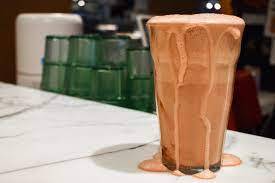
I have a curiosity and passion for iconic Jewish foods. I’ve previously blogged about New York and Montreal bagel, Toronto blueberry buns, and chocolate babka. The egg cream is another iconic creation from New York.
For those not familiar with this drink, there is no egg or cream in it. It’s sometime called a chocolate soda, a combination of seltzer water, cold whole milk, and Fox’s U-Bet chocolate syrup. A proper egg cream does not have Hershey’s or Nestle chocolate syrup. I was first introduced to the egg cream while at grad school in Philadelphia. On a long weekend, I went to New York classmate who asked if I’d ever had an authentic New York egg cream. I didn’t even know what it was. She took me to this shop in Queens and I was handed a chocolate soda with a foamy head. It had a consistency much lighter and velvety than a milkshake. I was hooked.
According to most historians, the egg cream was allegedly created in the early 1900s by a Jewish candy shop owner, Louis Auster, who came to America and opened a candy store in Brooklyn, New York. It is reported that 3,000 egg creams a day were sold until the day the store closed. When Auster refused to sell the rights to the drink to an ice cream chain, a company executive called him an anti-Semitic slur and he vowed to take the formula to his grave. Without Auster’s special syrup, other soda fountains relied on a Brooklyn original: Fox’s U-bet chocolate syrup,
Fox’s U-Bet chocolate syrup was produced by a Jewish man, Herman Fox, in his Brooklyn tenement home at the beginning of the 20th century. Fox was a gambler who lost his money in a Texas oil well investment, but turned things around when he struck gold with his syrup. While his money stayed in Texas, the Texan term “you bet it’s good” became part of his syrup’s name.
In the New York tenements, Jews dominated the seltzer trade, and Jews loved to drink it. Seltzer was a pareve (neither meat or dairy) beverage beloved by Jews, observant and assimilated alike. It was a welcome digestive aid to the heavy Eastern European fare people ate in delis. Auster’s egg cream was an inexpensive concoction that competed with fancier drinks served in upscale neighbourhoods.
As for the name, there are various theories on its origin. Some felt the egg cream name was pure marketing to make it sound fancy or rich. One explanation claims that egg is a corruption of the Yiddish echt (genuine or real), making an egg cream a “good cream”. Another explanation comes from reports that it grew out of a request for chocolat et crème from someone who had tried a similar drink in Paris. His heavy accent altered the name into something like “egg cream,” which then developed into the current term.
The egg cream has lost some of its charm over the years and not commonly found throughout New York. But the drink has a small loyal following. Some shops make variations such as vanilla or orange flavoured. But purest want to see it made like the original egg cream by Louis Auster.

HOW TO MAKE AN EGG CREAM
1. Choose The Correct GlassBegin by choosing the correct glass. It should hold approximately 12 ounces of liquid, be tall enough to showcase the beautiful chocolate foam you are about to create, and wide enough to allow you to properly mix the drink with a spoon. A wide highball glass will work well.
2. Pour The MilkOnce you have selected your glass, add in the milk. However tall your glass is, you want to fill it a little less than a quarter of the way with milk (so, ideally around two to three ounces). Use whole milk for the creamiest, richest egg cream but feel free to use almond milk or oat milk for a dairy-free egg cream.
3. Add The Chocolate SyrupNext, add about an inch of chocolate syrup to the bottom of the glass. Now, it’s totally acceptable to first add the chocolate to the glass, then pour the milk. Just don’t mix the milk and chocolate together yet. That would be a mistake. Let them go their separate ways for now. Do you have to use Fox’s U-bet chocolate syrup? No. Fox’s U-bet chocolate syrup is iconic and the syrup most associated with the classic egg cream. A bottle costs $6 in New York, and I saw it selling on Amazon for a ridiculous $30. So go with the Hershey’s. There’s something else should know about Fox’s U-bet chocolate syrup. The original syrup was made with sugar, and the current version is made with corn syrup, which means it’s the same as every other chocolate syrup.
4. Add The Seltzer And Stir Very AggressivelyWhen you have your milk and chocolate syrup ready in the glass, select a long spoon to stir with and an unopened bottle or can of seltzer. It is of the utmost importance that the seltzer be fresh and unopened. It needs to be as ferociously bubbly as possible to make an excellent egg cream. Pour the freshly opened seltzer in an aggressive way: The seltzer should come crashing down into the glass, a disruptive force not unlike the jet of a soda fountain. Stop pouring the seltzer as the liquid approaches the top of the glass. Ignore any spillage and start stirring the drink right away. Move the spoon in a quick up-and-down motion, rather than a swirling, spinning stir. Chopping up and down with the spoon will help develop a nice, thick head of foam on the drink, which is essential. When the chocolate syrup has been thoroughly mixed, take a look at your foam. If it is white, turn it brown and chocolaty by taking some liquid from the bottom of the egg cream glass, and folding it over the top of the foam. Do this until the foam turns brown, and is nice and chocolaty. Then enjoy!
November 25, 2022
My Incredible Trip to the Galapagos Archipelago
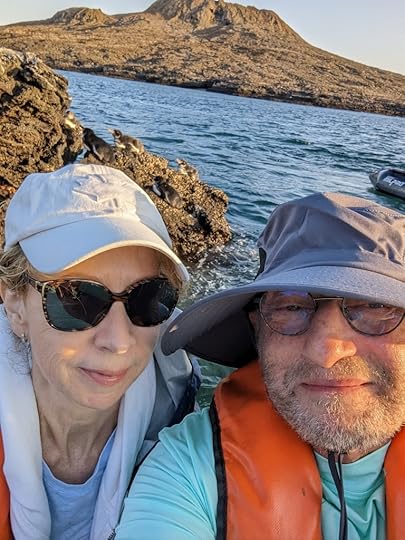
The Galapagos Islands area situated in the Pacific Ocean about 1,000 km from the Ecuadorian coast. This archipelago and its immense marine reserve is known as the unique ‘living museum and showcase of evolution’. The archipelago is composed of 127 islands, islets and rocks, of which 19 are large and only 4 are inhabited. 97% of the land mass is a National Park. Human settlements are restricted to the remaining 3% in specifically zoned rural and urban areas on four islands (a fifth island only has an airport, tourism dock, fuel containment, and military facilities). Access to the uninhabited islands are strictly controlled with carefully planned tourist itineraries limiting visitation. On some of the islands our group was split up so we weren’t all ashore at the same time.
Its geographical location at the confluence of three ocean currents makes it one of the richest marine ecosystems in the world. Ongoing seismic and volcanic activity reflects the processes that formed the islands. These processes, together with the extreme isolation of the islands, led to the development of unusual plant and animal life – such as marine iguanas, flightless cormorants, giant tortoises, huge cacti, endemic trees and the many different subspecies of mockingbirds and finches – all of which inspired Charles Darwin’s theory of evolution by natural selection following his visit in 1835.
Our trip was organized jointly by National Geographic and Lindblad Expeditions. I can’t say whether they are the best group to use for visiting the Galapagos but I can say this was the best trip I’ve even been on. The group was small and cozy with 84 guests on the ship – 80 Americans and 4 Canadians.
Day 1/2 – San Cristobal Island
It takes 3 flights and 1 1/2 days to reach the Galapagos from Toronto. When you step off that plane you immediately get a blast of fresh air. Pollution isn’t a thing on the archipelago. We landed on San Cristobal with its own one strip airport. We were bussed to the waterfront and loaded onto zodiacs. These would be our primary transportation for the next week. Humans and nature live side-by-side on the islands without fear of each other. That was immediately evident as there were numerous sea lions on the rocky shore and dock. I spotted one asleep under a bench on the dock as I boarded a zodiac.
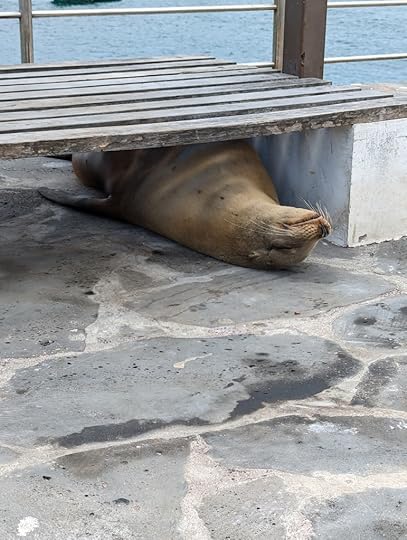
Napping sea lions would be a common sight on most islands. I expected hot weather since the Galapagos is on the equator but the currents from the south kept the temperatures moderate. Most days in was low to mid 70s. The rest of the day was for unpacking and orientation. The fun stuff would start the next day.
Day 3 – Espanola Island
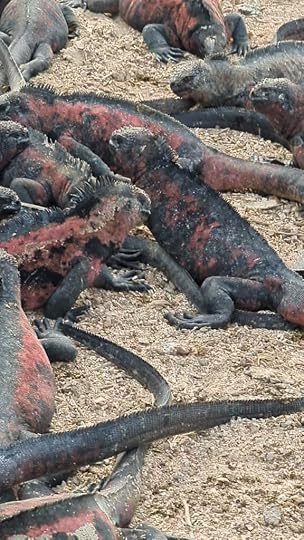
Espanola is the oldest island at around 3.5 million years, and the southernmost in the group. Due to its remote location, Española has a large number of endemic species. It has its own species of lava lizard and mockingbird. Espanola’s marine iguanas have a distinctive red coloration between the breeding season. Espanola is the only place where the waved albatross nests. We were able to see all of these species when we landed on the island.
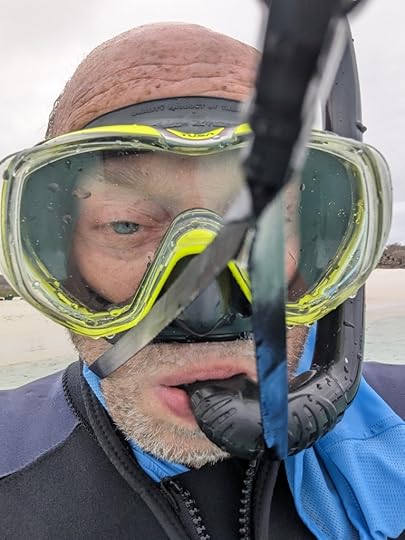
I tried a little snorkelling. First from the beach and then off a tiny island a hundred metres from the shore. Although a good number of people brought cameras, many just had their phones.
There was photography experts on the expedition to provide advice. I had a waterproof case for my phone, so I could take it into the water. That turned out to be a big fail. The phone worked fine at first but the touchscreen is heat sensitive, and when my fingers got cold, the screen stopped responding. I did get a faint shot of a ray close to the bottom.
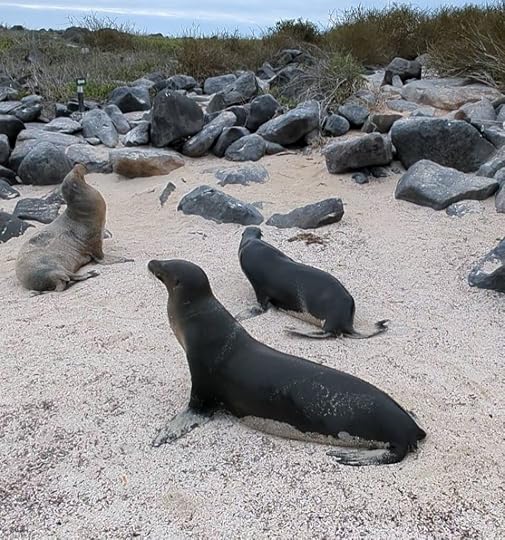
In the afternoon, we landed on another part of the island for a hike where the albatross nests were located. There is a professional naturalist that accompanied us on every excursion. Mary Anne had broken a big toe a month before, so we decided the terrain on this hike would be too rocky for her. So, we opted for a shorter hike. We saw plenty of the island’s unique lava lizards and mockingbirds. In a cove was a large group of sea lions. In the water was a large male barking orders at the group the entire time we were there. I presume he was the alpha male and he was quite loud. Females were on the shore feeding babies that were as young as two weeks. At this point we could see what a special place this was.
Day 4 – Floreana Island
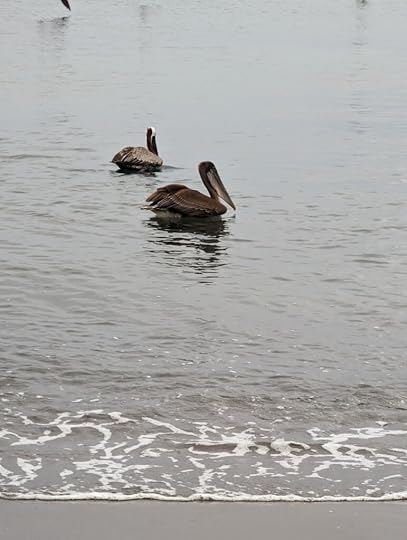
Flamingos and green sea turtles nest (December to May) are featured on this island. On each island, the landings were quite different with some involving dry landings while others were wet. Floreana Island required a wet landing on a beach, and we brought along wet sandals that would also be suitable for hiking.
The hiking trails have been marked by Park Service employees but many were rocky with steep grades. Going off the trails are illegal as we are required to minimize the impact on the ecosystem. The area had been experiencing a drought, and most trees and shrubs had no leaves other than cacti and plants close to the shore that can survive on salt water.
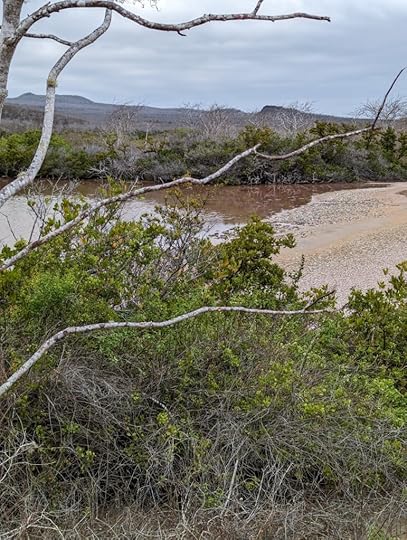
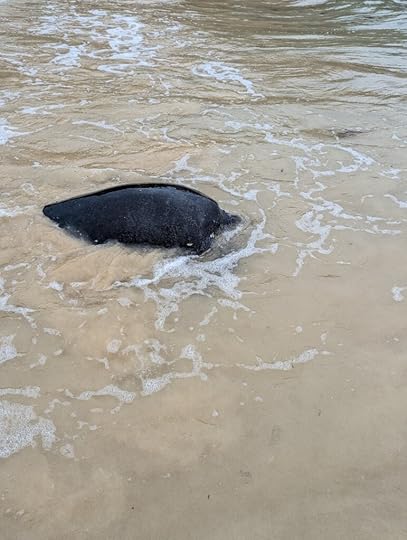
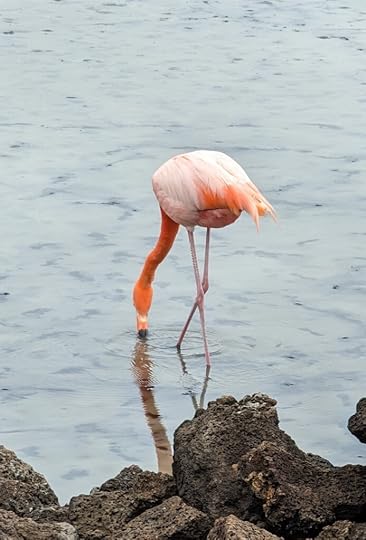
We came across several sea turtles in the shallow sea water, but the ponds had dried up and the flamingos had relocated. Fortunately, we ran into a couple of flamingos two days later.
At Post Office Bay, where 19th-century whalers kept a wooden barrel that served as a post office, mail could be picked up and delivered to its destinations. Surprisingly the mailbox and its honor system are still in use today. Nowadays the postcards and letters are generally left and delivered by hopeful tourists, but many still seem to make it to their destination.
Day 5 – Santa Cruz Island
We landed in Puerto Aryoa on the island of Santa Cruz to board buses that took us to the highlands. Santa Cruz hosts the largest human population in the archipelago. Our first stop was the Charles Darwin Research Station and the headquarters of the Galápagos National Park Service. The GNPS and CDRS operate a tortoise breeding centre here, where young, and mostly saddleback tortoises are hatched, reared, and prepared to be reintroduced to their natural habitat.
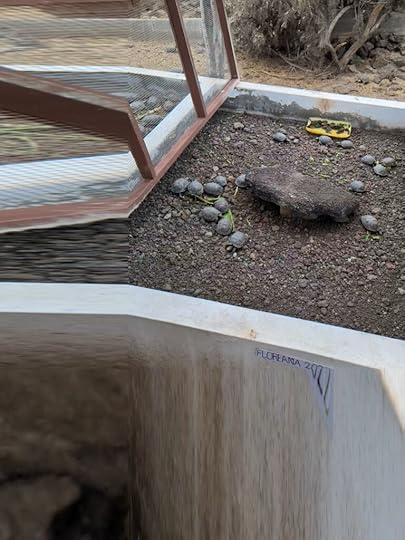
It struck me that the tortoise heads reminded me of Stephen Spielberg’s E.T.
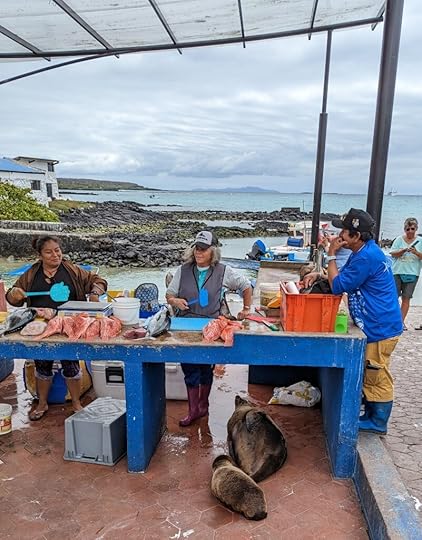
We stopped in a town for some snacks and I noticed a fishmonger that was surrounded by scavenger birds and sea lions. Two sea lions were directly under the table with their mouths open, waiting for something to fall. Reminded me of a dog waiting under a child’s highchair knowing something was eventually coming his way.
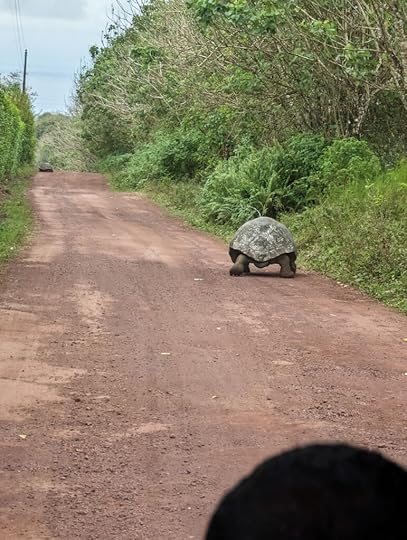
The Highlands of Santa Cruz have plush flora and a large tortoise population. Our bus driver had to gingerly drive around huge dome tortoises that took up parts of the roadway.
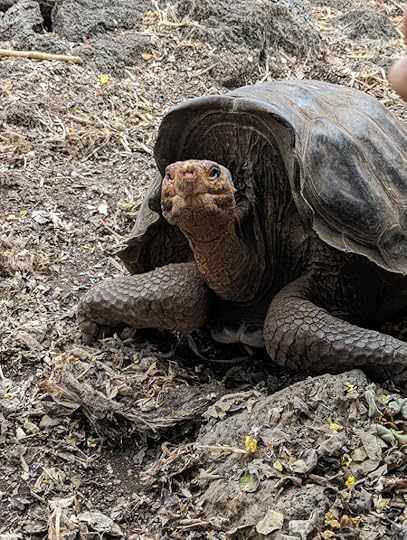
Some of the tortoises were 100 years old. There animals are filthy and their droppings were everywhere. We were given rubber boots to wear otherwise I would have burned my sneakers.
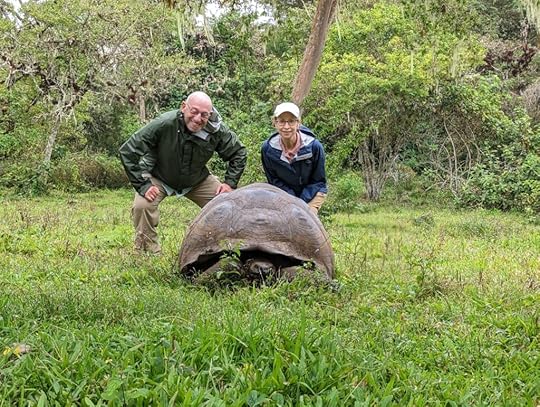
Day 6 – Santa Cruz Island
We traveled to the north shore of the island and hiked in the morning.
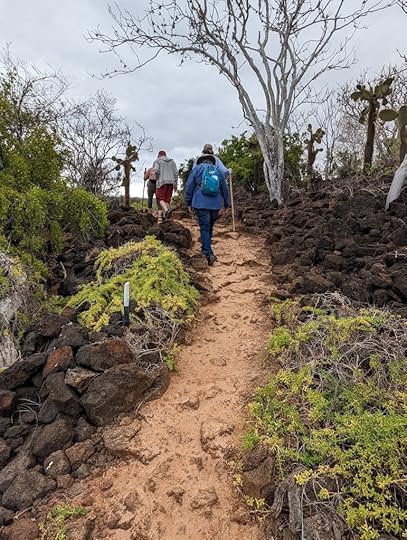
Cerro Dragon is known for its flamingo lagoon, and along the trail we did find land iguanas foraging.
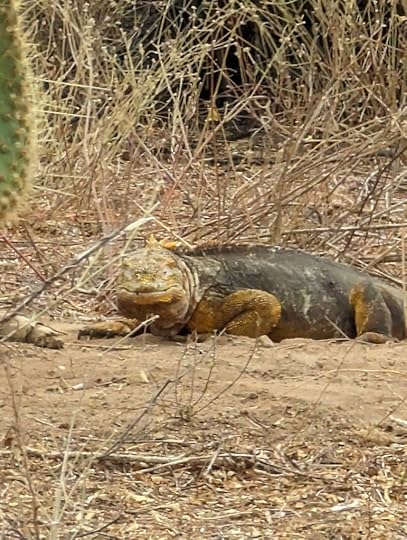
It was dry and hot with cacti constituting much of the vegetation. The island has feral pigs and goats. We also spotted a small group of goats in the brush. The distinctive colouring of the flamingos comes from their shrimp diet.
In the afternoon we went kayaking in Black Turtle Cove which is surrounded by mangroves and loaded with sea turtles, rays and small sharks. Now, Mary Anne has never been in a kayak. She agreed to let me sit in the stern but she treated the front seat like the passenger seat of my car. She couldn’t resist giving me direction and telling me how to steer the kayak. Some things never change!

Day 7 – Bartolome Island/Santiago Island
We had an extremely early start to the day. Well I did, Mary Anne decided to sleep instead. We left the ship at 6:15 and landed in a small bay, opposite Pinnacle Rock. Pinnacle Rock is a volcanic cone, formed when magma was expelled from an underwater volcano; the sea cooled the hot lava, which then exploded, only to come together and form this huge rock made up of many thin layers of basalt.
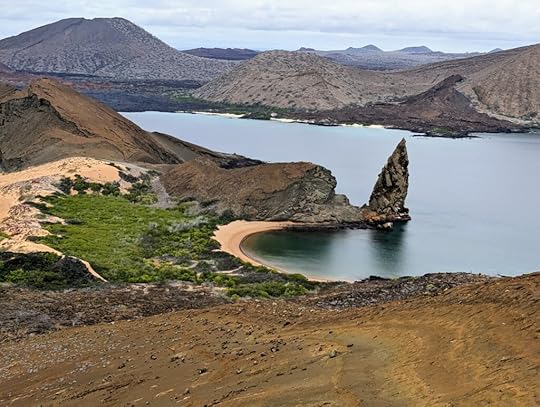
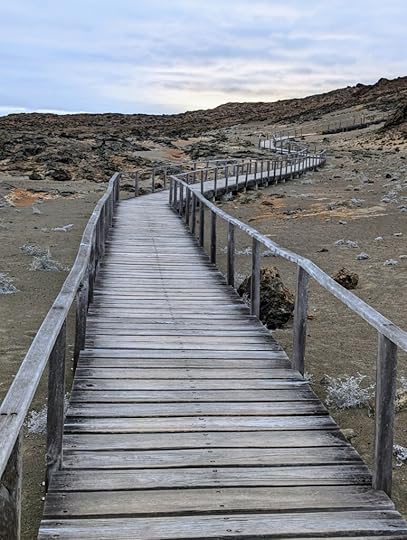
We climbed a 600-metre trail to the 114-metre summit. The climb includes a wooden staircase constructed by the Park Service to protect the island from erosion.
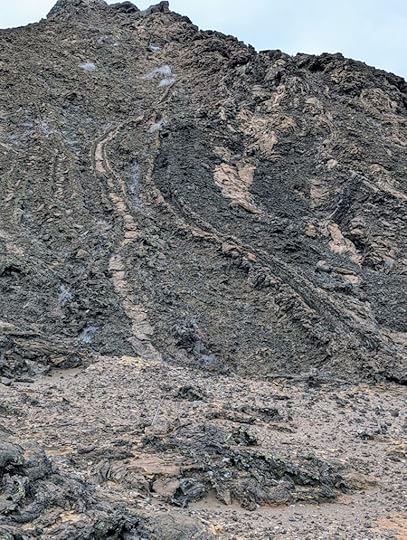
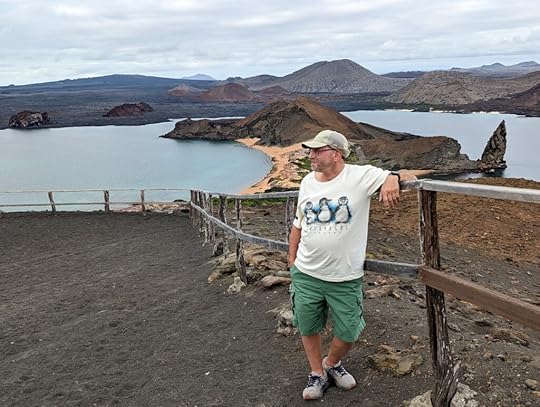
The summit provides spectacular views of Pinnacle Rock, the immense black lava flows at Sullivan Bay and the rest of Santiago Island, and Daphne Major and Minor. Along the way, various volcanic formations including spatter and tuff cones and lava flows were visible.
It was worth the early start and the sore knees. The fresh breeze and unpolluted air blowing in your face was invigorating. As we boarded the zodiacs to return to the ship, several Galapagos penguins were swimming in the bay, likely searching for food.
Later in the morning, I was relaxing in my cabin when the Expedition Leader announced on the public address system that there was a school of dolphins spotted on our starboard. I looked out my window and saw several dozen dolphins playing in the water. She then announced that anyone who wanted to catch a closer look should head to the back of the ship because they were sending out the zodiacs. I grabbed my life vest and phone and ran down to the loading docks. It turned out to be a spontaneous excursion and thrilling. The playful dolphins chased our zodiac, jumping out of the water to do somersaults.
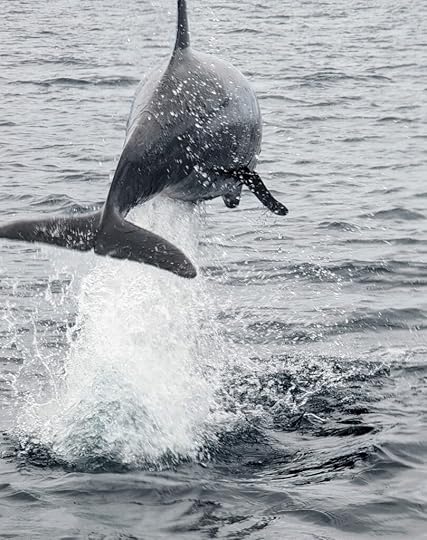
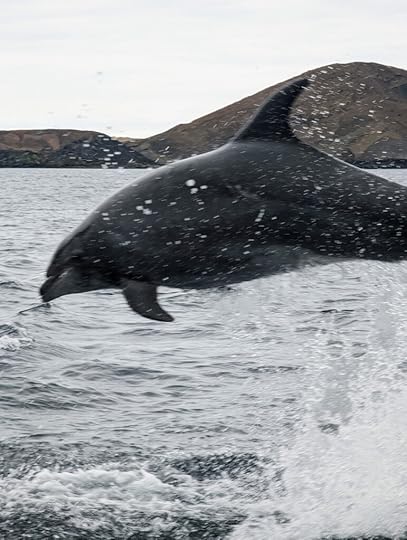
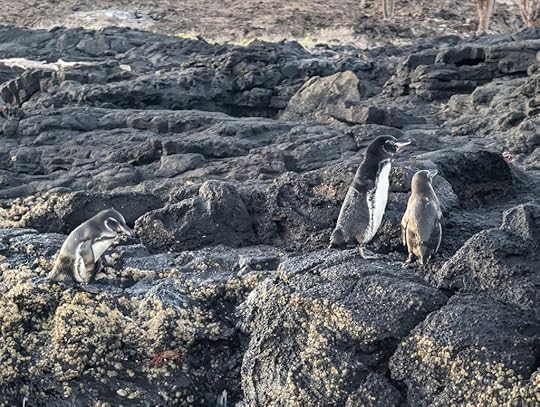
It was an incredible show and so glad I had passed up snorkelling in the bay. Later in the day we returned to the zodiacs to cruise along the shore of Sombrero Chino which is a small island off of Santiago Island in search of penguins. We eventually came across a small group relaxing on the rocks. These species were quite different than those we saw in Antarctica and the Falkland Islands in 2020. It’s surprising to discover penguins so close to the equator but they were there.
Day 8 – Genovesa Island
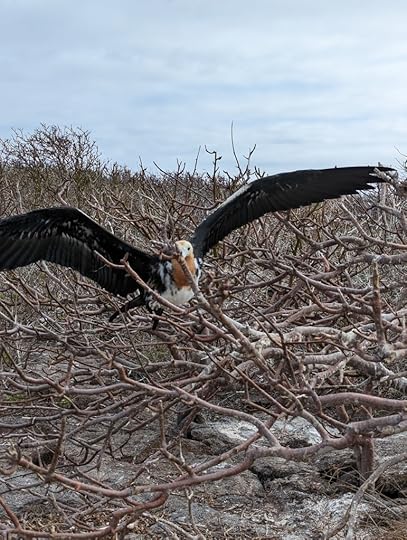
This island is appropriately nicknamed “the bird island” which is clearly justified. There were limits on the number of people who could come ashore so we were split into two groups First we went to Darwin Bay, home to frigatebirds and swallow-tailed gulls.
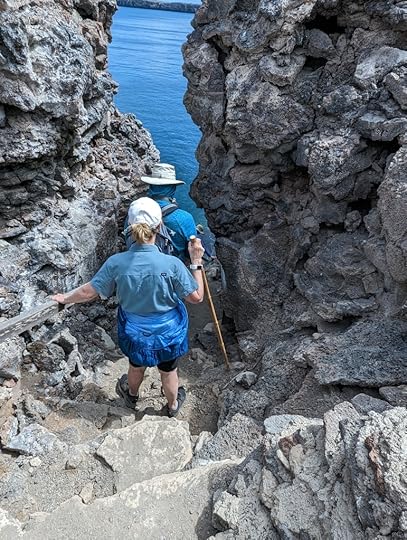
Afterwards we flipped locations and went to Prince Philip’s Steps. That was the more treacherous landing of the entire week. Those steps were a steep rock formation that took you to a plateau that was 30 metres above the shoreline.
Red-footed boobies, lava gulls, owls, and red-footed boobies.
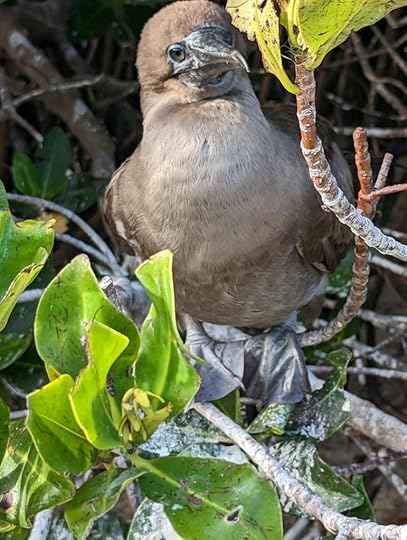
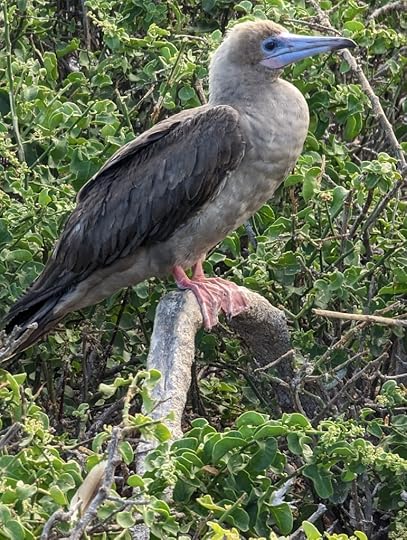
There many nesting and infant birds lying out in the sun. These birds have no predators on the island and are not at all frightened by humans.
Day 9/10 – Baltra Island
With their typical efficiency, the crew had us fed and off the ship by 8:00, bussing us to the airport on Baltra Island. That was the start of two days of travel which ended close to midnight the following day. I was amazed by what I saw but this is not everyone’s cup of tea. A look forward to our next adventure.
November 6, 2022
The Future of Twitter Under Musk
In the 10 days since Elon Muck took over Twitter, there has been a tremendous amount of angst, rumours, speculation. Little is known about his plans for the platform other than his sometimes bizarre tweets and interviews. Musk loves being provocative so it’s difficult to know what the future really holds for the app. I don’t agree with some of the things he says but I am in a wait and see mode.
He has talked about opening the app to people with extreme views. Well, they have always been on Twitter. Appropriate content moderation continue, at least, for the time being. He has talked about charging $8 per month for a verified account. He has mentioned providing additional features to make it more attractive to have a verified account. But he has alluded to a lower level of service for free accounts, whatever that mean. These ideas can work against each other. His borrowing costs used to purchase the app will be about $1 billion. Advertising revenue is slightly more than half of that. He is aware that measures that lose users will downgrade advertising revenue. It will be a difficult balance.
I’ve seen many people announce that they are leaving Twitter. Frankly, people have threatened to leave Twitter shortly after Frank Dorsey sent the first tweet in 2006. Typically, they return. I have no plans to leave unless it no longer are tenable for me. I’ve not noticed anything different but if course it’s early in the Musk era. I am an active Twitter user, but I try to also restrict my use. My tweets fall mostly in these four categories:
Info about my books and writingHumorous tweetsConnecting with other writers and authorsHolocaust awareness and defending against anti-SemitismI only engage in people I know. I have no interest in verbal battles with trolls. There are many people on Twitter who are rude and insensitive. Unfortunately there are people who do not understand that many of my tweets are satirical. I tolerate these people to some extent but those who cross a line are blocked with no explanation. I don’t believe I own them one. My DMs are only open to people I follow and I’m selective on who I follow. About 90% are also writers.
Not only have I found friends through Twitter but also beta readers, editors, graphic artists, cover designer, and book designers. I’ve also found many readers. These things are not going to be easily replaced.
Here is an example of my social media analytics:
FOLLOWERS
Twitter – 17,114Facebook – 422Instagram – 506Tiktok – 218It doesn’t take a genius to figure out which platform I get the most interaction and impressions. Shifting my time to another platform is going to significantly impact for quite some time. It took me about five years to build my Twitter numbers. It won’t take me nearly as long the next time. But it’s not going to happen overnight. In a typical month, I’ll create 1,700 tweets (less than 5 a day), have 45,000 profile visits, and 750,000 tweet impressions. I am in no hurry to give that up..
As I’ve mentioned already, I have not noticed anything different. I plan to stick around until it no longer makes sense to be on Twitter. However, I will be paying more attention to Instagram as a contingency. If I leave, I’ll first have a transition plan.
November 3, 2022
The Story Behind Deep Into The Weeds
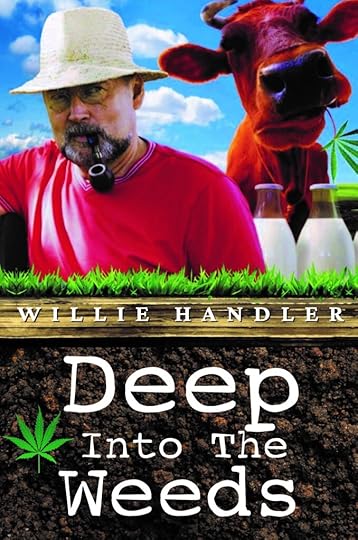
Preston McPherson thought he could save his troubled Canadian dairy farm by growing marijuana, but his problems were only just beginning. With the help of his brother-in-law and local police sergeant, Ferg, he signs an agreement with a cannabis distributor, Green Fields, but money is still tight. When a greenhouse break-in sends Preston deeper into the red, Ferg– not exactly a model cop–comes up with a scheme to sell marijuana illegally to a Michigan drug dealer.
As time goes on, Preston sets up a secret grow-op on his farm, launders the proceeds, and becomes involved in robbery and even murder. At the same time, he needs to bluff his way through government inspections, deal with a local group of women bible-thumpers who are picketing his farm, address the growing demands from the Michigan gangster, and stay one step ahead of the persistent small-town cop who insists on investigating all the strange things going on in town. If any of them catch up with him, Preston risks losing his farm, going to jail, or floating at the bottom of a lake with cement shoes.
Why did you decide to write a black comedy/crime thriller?
After taking a stab at world building in Loved Mars Hated The Food, I decided to write something dark. I enjoyed the character arc that I developed for Dix Jenner. This time around I wanted to develop one that went in the opposite direction – a person who starts off good and loses his way. I originally had been thinking about a story centred around a British dairy farmer dealing with the fallout from Brexit. Instead, I decided to have the story based in Canada dealing with both free trade between Canada and the United States and the recent legalization of recreational marijuana.
What were your inspirations for this story?
I’m a big fan Breaking Bad. I was intrigued by the character of arc of Walter White who started off a meek high school teacher that evolved into a cold blooded drug dealer. I tried to develop the same type of arc for Preston McPherson. As well, I love the Coen Brothers, and one of their best films is Fargo. In the film, the main character, Jerry Lundegaard, is desperate to keep his head above water and enlists the aid of criminals to get some quick cash. Things quickly snowballed for him. I also loved the quirkiness of Fargo and tried to bring some of that into my novel.
You seem to have borrowed from several sources. Any others that you can share?
The story is very much character driven so I spent a lot of time on making an interesting cast of characters. Even Bess the cow is inspired by Arnold Ziffel in the Green Acres TV series. I wanted to go with a farm animal who was also a beloved family member although Bess didn’t develop a human-like lifestyle as was the case with Arnold. Mum is a large source of humour in the story. I envisioned her to be a little old lady who seemed to be always carrying a shotgun. Much like Grannie in The Beverley Hillbillies. The other side characters, including Fergus Becker, the mayor and his wife, and the drug dealer, Ramone, are partly stereotypes with some meat to them. I really enjoyed creating all these wonderful characters.
The book contains a lot of info about dairy and marijuana farming. How did you research these businesses?
I learned that one of my close friend’s has a cousin that operates a dairy farm about an hour outside of Toronto. I arranged a visit and spent an hour learning about how a dairy farm operates, taking pages of notes. In fact, one of the book’s reviewers commented that he was raised on a dairy farm and found the description to be accurate. I take that as a compliment. I tried to arrange to visit a cannabis farm but they operators are quite proprietary and don’t like visitors. I learned that one of Canada’s larger producers, Tweed, owns a plant in Smith Falls, which is outside of Ottawa, Canada. At one time, the plant was a Hershey’s chocolate factory. They have a visitors’ centre and provides tours. You don’t get to walk into their growing rooms but you can view the rooms from above through glass viewing stations. There was enough information available to serve my purposes.
So, there really is a Delhi in Ontario?
Yes. As I did in my first novel, The Road Ahead, I like to use real places in my books. Many of the local readers relate to places that they’ve been to. Even the scene in the Detroit BBQ restaurant is based on a real place in that city. But there is no cannabis company called Green Fields.
What’s up next for you?
I’ve been working on a memoir for the past two years. It is really part memoir and part an investigative book. It describes my parents’ story and how I slowly and meticulously uncover what happened to them. I am sure I’ve uncovered details my own parents weren’t fully aware of. I am hoping to wrap this up soon. After that, I want to go back to writing a fiction book.
September 20, 2022
The Story Behind Loved Mars Hated The Food
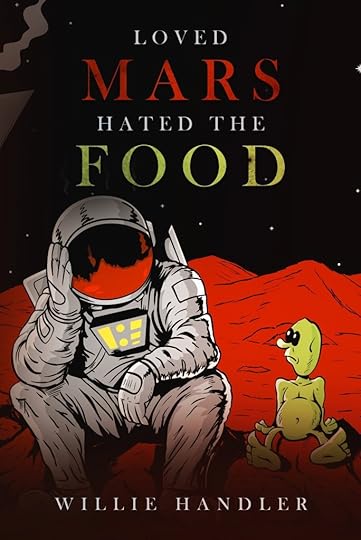
After releasing my first book The Road Ahead, a political satire, many were surprised that my next book was a science fiction story. Loved Mars Hated The Food is a story about Dix Jenner, a self-proclaimed slacker, who is the first chef to live-and maybe die-on Mars. After an explosion kills his colony companions and leaves him with nothing but his spacesuit, his time on Mars is about to expire. But before that happens, he is rescued by two friendly Martians. He also attracts the attention of the corrupt and narcissistic Martian Grand Leader Cheyhto.
Why did you decide to write a science fiction story?
I wanted to do something completely different for my second book. In my youth, I had read a lot of science fiction book, so it was a genre that I was familiar with. But to be honest, I didn’t stray to far from my roots. Loved Mars is not just a science fiction story but also a satire. It pokes fun at pop culture, sports, government, race theory.
I wasn’t originally thinking that my second novel would be science fiction. The idea to write the book originated in a writing course I took with Terry Fallis at the University of Toronto. Each week we would write a short story in class based on the style of humour that was covered in class. For the class on physical comedy, I wrote a story about the first Starbucks on Mars. After the class, Terry approached me and suggested that the story could be the basis of a novel. That got my brain working. The short story that I wrote for the class became a scene in Loved Mars.
What inspirations did you use to create this book?
I really enjoyed Andy Weir’s book The Martian. I wanted to do something similar but with humour and much more world-building. I even borrowed the potato subplot from Weir but made it more of a source of humour. I also used an old TV sitcom My Favorite Martian as inspiration. In the TV show, a human-looking Martian crash lands on Earth. He is taken in by Tim who explains to everyone that his new border is his “Uncle Martin”. I switched things around and had Martians take in the human and explain that it was a cousin with a medical condition. In the TV show, the nosy landlady Mrs. Brown becomes a love interest for Uncle Martin just as the next-door neighbour Plinka becomes Dix’s love interest. The story also pays homage to some great science fiction books including Stranger in a Strange Land and Hitchhiker’s Guide to the Galaxy.
Why did you decide to make you protagonist a chef?
I tried to think of the most absurd background for an astronaut and thought a chef would be perfect. It created many humourous scenes where the food preferences of Dix and his hosts collide. The only time they agree is in the case of coffee, but the Martian reaction to caffeine is much different to what humans’ experience. I even went as far as to include recipes for every dish referenced in the book. Food preferences is the ultimate human experience. I don’t care for Indian curry, but I love Thai curry. The hate/love for pineapple on pizza. Who makes the best burger? People will debate food forever, which explains the title of the book.
Where did the sling league come from?
Sports is part of our society, and each culture or region has their favourite sport. I decided to apply that to Mars and create a uniquely Martian sports league. As part of my world-building exercise, the behaviour of the Martian and the treatment of the athletes are not what you would expect on Earth. It’s more like the Roman gladiators. It’s also an opportunity to satirize sports by using a spectator who is a complete outsider.
The sling players are part of your Martian class system?
Yes. This was rather overt attempt to comment on the unfairness of discrimination based on race, colour or class. Loved Mars in a funny fantasy but it’s also a commentary on the social and political worlds that we live in. So often the privileged class exploit others to maintain their position. We don’t often see it ourselves, but an outsider will spot it right away. And systemic discrimination is a subtle way to maintain the status quo. In Loved Mars, the privileged class have red pigmentation and the underclass is blue. Dix did not start off as someone who cares about social justice but over time he becomes “woke” to the unfairness of Martian society.
What can you tell us about your choice of antagonist?
Well Cheyhto is pronounced Cheeto, which most people recognize as a popular orange snack food. It was also an early nickname for Donald Trump because of his orange hair. Cheyhto is an authoritarian and narcissist. He has a bad temper and a mean streak. One of his favourite activities is tanning on the surface of Mars which gives him a strange orange pigmentation. I thought that he would be a perfect foil for the wise-cracking protagonist. For a short time, the two characters actually reach an understanding.
What is your favourite part of the book?
I love the sling matches. If someone would make a film out of the book, those scenes would be so much fun to watch. I also love the Martian’s love for and reaction to espresso. As an espresso drinker, these scenes still make me snicker.
Can we expect more sci-fi out of you in the future?
I have been asked many times to do a sequel to Loved Mars. But I have so many stories in my head that I can’t see myself returning to Mars with Dix and his Martian friends. But you never know.
August 24, 2022
My Impressions of Modern Poland
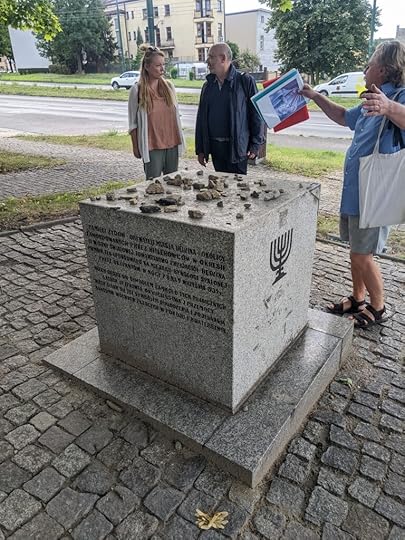 Memorial constructed at the site of the former Bedzin synagogue
Hitler almost succeeded in making Poland judenfrei. The Germans murdered ninety percent of Polish Jews. Most of the survivors chose not to return. They really had nothing to return to. My father harshly criticized Poles for their anti-Semitism. His anger reflected Poland in the 1930s. As I journeyed further into my family’s history, I became more interested in finding out what was Poland is like today. I signed up for a genealogy tour of Poland including the area where my father once lived.
The POLIN Museum of the History of Polish Jews in Warsaw lists over 1400 shtetls in Poland. Shtetls were small market towns that shared a unique socio-cultural community pattern during the 19th and early 20th centuries. Yiddish was the spoken language. They began as private towns and the non-Jewish population grew around them. This describes the communities that my family came from.
Those villages and small towns dotted the Polish landscape. Each shtetl had a market in the town center, at least one synagogue, and other Jewish institutions such as a Hebrew School. There were about 1,200 Jewish cemeteries In Poland at the start of the war.
During the Second World War, the Germans systematically removed the Jews from these communities. Some of the villages no longer exist because there were so few residents that remained. Most villages are still there, but without Jewish residents.
I visited several towns and villages. A few synagogues still stand, some of them crumbling from neglect and disuse, others preserved and restored to their former dignity but not necessarily a place of worship. The synagogue in Jaworzno was reconstructed after the war and is now a pub. A café operates in the former Chevra Tehilim synagogue in Krakow’s Kazimierz quarters. The Pinczow synagogue is one of the oldest in Poland having been built during the Renaissance in 1594. It was used for storage until 1970 when the Regional Museum in Pinczow restored it and is now part of the museum. Often the reason that some synagogues survived is that they were used for storage or as a horse stable by the German during the war.
Occasionally, outside the borders of a village, there would be a small Jewish cemetery, with weeds and vegetation climbing up the shattered gravestones. That was the case in Wislica, where my father was born. There was no trace of my ancestors’ graves who had lived in the village for 200 years. The gravestone fragments found in the Pinczow Jewish cemetery were moved to the synagogue and used to build a memorial. I felt like I was visiting relics of a lost ancient civilization. The pulsing Jewish world that was here, the small shops and stalls, the bustle of people, carts, horses, the sounds of Yiddish are no more.
There are between ten and twenty thousand members of the Jewish community in Poland. It’s difficult to come up with a number because many Poles are unaware of their Jewish heritage. Under Communism, many hid their Jewish roots, and their descendants are now just becoming aware that they have some Jewish ancestry. There are four active synagogues in Warsaw. We were introduced to the rabbi of the Nozyk Synagogue. There are another three in Krakow and perhaps twenty more across the country. A Jewish Community Center is now active in Krakow. Polish Jews are using genealogy services to trace their Jewish roots.
The cultural revival isn’t limited to the Jewish community. I met numerous Poles who specialized in Jewish studies in university and now are working as historians, genealogists, and tour guides. They are more knowledgeable about Judaism than many of my Jewish friends. Several are able to read Hebrew. We just missed by a few weeks, the world’s largest Jewish cultural festival which is held each summer in Krakow’s old Jewish quarters and organized by non-Jewish Poles. Poles fill the Auschwitz-Burkineau State Museum each week. The Kazimierz quarters has Jewish-themed restaurants catering to non-Jewish diners. In 2005, the POLIN Museum of the History of Polish Jews opened its door. It’s a first-class cultural institution presenting the 1,000 years of Jewish life in Poland. People I encountered treated as very well. When the topic of my memoir came up, some offered to help me with the research.
It was all very nice to see but one can’t ignore that Jews were now just part of Polish history and barely visible in Polish society. Whether you visited a former shtetl or a large city, I didn’t hear anyone say a bad word about Jews. But they also don’t encounter very many Jews. There was a woman in Pinzcow with the same last name as my father’s first wife, Estera Sledzik who also lived in Pinczow. I asked the woman from the local museum who was showing us around whether it was possible to contact this woman. I was told she refuses to talk about her past. It seems she has kept her Jewish ancestry a secret from others in the town. This suggests that there might still be a stigma associated with Jews.
The Poles were warm and friendly, but I still had an uneasiness. Throughout history, anti-Semitism will sometimes disappear, but it will always return to the surface. Poland will be no exception.
July 28, 2022
Jerry Seinfeld: “You Can’t Beat a Babka”
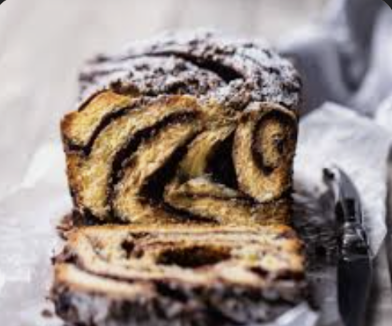
I’ve previously written about bagels and Toronto blueberry buns so I had to mention the babka. Part bread, part cake, and totally delicious: babka is among the most iconic Jewish sweets and a common fixture at the dessert table of religious celebrations.
For millions of people, the Jewish babka was introduced into the American consciousness by Jerry Seinfeld. In his 1994 episode “The Dinner Party”, Jerry and Elaine are invited to a dinner party and plan to a chocolate babka on the way there. While they are waiting to be served, another couple buys the last one. They pair eventually spot another babka with cinnamon, calling it the “lesser babka”.
The name babka evolved from Baba, which means Grandma in several Eastern European languages, including Yiddish. Babka is a diminutive of baba, meaning “little grandma”.
Culinary historians credit Polish cooks with its creation and in the late 19th century a wave of emigrants from that and other central European countries brought babka with them to North America, where it became a staple ware in Jewish bakeries. There is some dispute over the origin and some credit Czech Jews while others say it came from Germany. In its most traditional form, babka is made by twisting a yeast-based dough swathed in different fillings around itself into a tortuous loaf that is baked at medium heat for around an hour. The top of the babka may be dusted with streusel or seeds and warm syrup sometimes serves as a final garnish.
It was in North America where chocolate was added to the traditional babka. Now you can find babkas with not just chocolate (and cinnamon) but also sweet cheese, Nutella, poppyseeds or raisins.