Patrik Edblad's Blog, page 15
March 1, 2019
Multiplying by Zero: How to Avoid Crucial Mistakes in Life

In 1986, college basketball prodigy Leonard “Len” Bias was selected as the second overall pick in the NBA Draft by the Boston Celtics. It seemed like he had everything needed to become one of the best basketball players in the world.
He was 6 ft 9 in (2.06 m), incredibly skillful, and amazingly athletic.He lived in Maryland, a city that reveres basketball, and had great support from his parents.He had a proven track record, getting two Atlantic Coast Conference Player of the Year awards, and named into two All-America teams.
There was just one problem. Bias had developed a cocaine habit. And two days after he was picked in NBA draft, he passed away from an overdose. Today, many sportswriters consider Bias to be the greatest basketball player who never played professionally.
What the tragic story of Len Bias illustrates so well is a simple rule we all learn in math class: Anything times zero is always zero. It doesn’t matter what the other numbers are — if you multiply them by zero, the answer will inevitably also be zero.
1 x 0 = 0
128 x 16 x 0 = 0
1,577,404 x 99,503 x 6.76 x 0 = 0
Len Bias had incredibly high “numbers” in terms of talent, support, and track record. But in the end, none of that mattered. Because as soon as he added the “zero” of his cocaine addiction to the equation, the end result was zero.
That’s the profound insight behind this simple mathematical fact: All of your talent and hard work can be entirely eradicated by just one weak link the chain. Let’s have a look at some examples:
You can have everything working for you in your career — a great education, an excellent resume, and an impressive background — but none of that matters if you can’t deal with other people.Your company might seem impressive — big-name investors, large offices, fancy systems, tons of employees, and a great product or service — but it’ll still struggle to be profitable if your customer service is terrible.You can get every productivity tool on the market — fancy apps for project management, communication, time-tracking, note-making, and email management — but that won’t help you if you’re constantly distracted by e-mail and social media.You can have plenty of healthy habits — get regular exercise, eat healthy, and meditate every morning — but if you’re not sleeping sufficiently, you’ll still have an increased risk of cancer, heart attack, and Alzheimer’s disease.You can be an excellent partner in pretty much every aspect — a great listener, accepting, supportive, and fun to be with — but your relationship can still fall apart if you spend too much time at work.
So, no matter what you want to accomplish, examine the most critical factors in getting there. Tease out and strengthen the weakest part of the chain. That way, you’ll ensure all your hard work isn’t for nothing.
The post Multiplying by Zero: How to Avoid Crucial Mistakes in Life appeared first on Selfication.


February 22, 2019
Bayesian Thinking: How to Improve Your Understanding of the World

Thomas Bayes was an 18th-century English statistician, philosopher, and minister. His most famous work was “An Essay towards Solving a Problem in the Doctrine of Chances,” which he never published himself. Instead, it was introduced to the Royal Society two years after his death by his friend Richard Price.
The essay contained the seeds of what today is called Bayes Theorem, which “describes the probability of an event, based on prior knowledge of conditions that might be related to the event.”
If you’re not into math — don’t worry. You don’t have to understand exactly how probability calculations work to benefit from Bayesian thinking. You just have to grasp the intuitions behind the math, which is pretty easy to do. Consider, for example, the following news headline:
“Violent Crime Doubles”
If you read that in your local newspaper, you might get worried that your chances of being assaulted have increased dramatically. But is that really true? To find out, we’ll use Bayesian thinking to put this new piece of information into the context of your prior knowledge.
Let’s say that violent crime in your city has been steadily declining for decades. You know that the risk of being assaulted last year was 1 in 10,000. Since then, according to the newsletter article, violent crime has doubled. That means the risk of assault is now 2 in 10,000. In other words, the risk of getting assaulted is no longer 0.01%, but 0.02%.
So, the headline actually shouldn’t make you too worried. Sure, the probability of getting assaulted has increased. It has indeed doubled. But it’s still very unlikely to happen. And that’s difficult to discern unless you factor in prior information about the situation.
This example illustrates the big idea behind Bayes Theorem; that we should continuously update our probability estimates as we come across new information. And that’s very different from how we typically approach the world. Usually, we tend to either dismiss new evidence or embrace it as though nothing else matters.
As an example of that, let’s say that you consider yourself a good driver. But then, one day, you get into a car accident. In that situation, most people will either protect their belief (“It was the other guy’s fault”) or replace it altogether (“I guess I’m a terrible driver”).
By instead using Bayesian thinking, you look at the situation in the context of your prior experience. Sure, the car accident is evidence against your theory that you’re a good driver. But that doesn’t mean you have to stubbornly protect or immediately replace that belief. It just means you should be a little less confident that it’s correct.
Instead of being 100% or 0% sure that your theory is correct, you assign it a more reasonable probability. If you’ve been driving for 10 years without any prior accidents, perhaps you can be 90% sure that you’re a good driver. With that estimate in mind, you don’t have to avoid driving, but you might want to be a little more cautious than you previously were.
Reasoning this way makes you much more aware that your beliefs are greyscale rather than black-and-white. It allows you to continually update the level of confidence in your own theories about the world. And that helps you make more accurate predictions, improve your decisions, and get better outcomes.
I’m 99% sure of it. 
February 15, 2019
Inversion: How to Avoid Being Stupid

During his career, the German mathematician Carl Jacobi made important contributions to several scientific fields. In his work, he often solved difficult problems by following his maxim “Man muss immer umkehren,” which loosely translates into “Invert, always invert.”
Jacobi believed that one of the best ways to clarify your thinking is to restate problems in their inverse form. He would write down the opposite of the math problems he was trying to solve and found that the solutions often came more easily to him.
While Jacobi mainly applied inversion to mathematics, it’s an equally powerful approach in other areas. No matter what problems you’re trying to solve, it can help you uncover errors and roadblocks that aren’t readily apparent.
The way to use inversion is to think about things backward instead of forward. Rather than asking how to do something, you ask how not to do it. Let’s have a look at some examples of what those questions might look like.
Career
What kind of work feels uninteresting and meaningless to me?What doesn’t match my unique strengths?What industries have low or decreasing demand?
Business
What would alienate our core customer?How can we become less innovative?How can we create a negative company culture?
Productivity
How can I waste more time on distractions?How can I reliably shatter my focus every day?How can I reduce the energy I bring to my work?
Health
How can I decrease the quality and quantity of my sleep?What foods can I eat more of to lower my energy and increase the risk of disease?How can I make sure I move less every day?
Relationships
What makes a bad friend?How can I be a terrible leader?How can I ruin my marriage?
If you’re like most people, you rarely ask yourself questions like these. For most of us, inversion is highly counterintuitive. Thinking backward is not something that comes naturally to us.
But it’s very much worth learning because it helps improve your understanding of problems. It forces you to step out of your usual way of thinking, consider different perspectives, and come up with new solutions.
While inverting problems won’t always solve them, it will help you avoid trouble. When you know what you don’t want, you can take steps to make sure those things don’t happen. And that will move you closer to the solution.
So, whenever the best path forward isn’t clear — flip the problem on its head. Instead of trying the find the right path to take, make sure you know which ones to avoid.
Keep in mind: “Invert, always invert.”
Spend less time trying to be smart, and more time trying to avoid being stupid. Avoiding mistakes is much easier than seeking excellence — and it’s usually a much better way to solve your problems.
The post Inversion: How to Avoid Being Stupid appeared first on Selfication.
December 27, 2018
This is How to Make 2019 Your Best Year Ever
Legendary psychologist Abraham Maslow once said: “What human beings can be, they must be.”
He wasn’t talking about a mere wish or desire. No, according to Maslow, you have a deep need to express your latent abilities and live your full potential:
“If you deliberately plan on being less than you are capable of being, then I warn you that you’ll be unhappy for the rest of your life.” (1)
Feelings like anxiety, regret, and boredom live in the gap between who you are capable of being, and who you are actually being.
In this article, I’m going to share my seven favorite strategies for closing that gap, so you can feel great, perform at the top of your ability, and make 2019 your best year ever.
To make it as easy as possible for you to implement everything we’ll cover, I’ve put together a companion resource:
Click here download your free copy of The 2019 Personal Mastery Workbook.
Then, let’s get started, shall we? 
November 28, 2018
This is How to Program Yourself for Success
Do you know the feeling?
You’ve set your goals. You know what you should do to achieve them. But for some reason, you can’t get yourself to do what needs to get done.
If you know what that’s like, you’re not alone. Humans have struggled with this problem for centuries.
In fact, philosophers all the way back to Plato even have their word for it.
The called it “akrasia,” and it can be defined as “a lack of self-control or the state of acting against one’s better judgment.” 1
But just because the issue is timeless, that doesn’t mean it’s hopeless.
It turns out that this ancient problem has a modern solution, and that solution is:
Algorithms
Professor Yuval Noah Harari is a historian, philosopher, and best-selling author. In his book, Homo Deus2, he writes:
Algorithm’ is arguably the single most important concept in our world. If we want to understand our life and our future, we should make every effort to understand what an algorithm is, and how algorithms are connected with emotions.
An algorithm is “a process or set of rules to be followed in calculations or other problem-solving operations, especially by a computer.” 3
Have you ever wondered how a Tesla can drive itself? The answer is algorithms — millions of them.
But there are also more relatable, everyday occurrences of algorithms. Each time you bake a cake, for example, the recipe you use is an algorithm.
And, as psychologists have found, you can also use algorithms to program yourself for success.
If-Then Planning
Psychology professor Peter Gollwitzer focuses his research on how goals and plans affect cognitions, emotions, and behaviors.
He has created a strategy called “if-then planning.” 4 To use it, all you have to do is fill out this simple formula:
If [situation] – Then I will [behavior].
The beauty of if-then planning is that it forces you to turn vague intentions into clear algorithms.
“I want to eat healthier” becomes “If I’m buying lunch, then I will order a salad.”
It sounds ridiculously simple, but don’t let that fool you. More than 200 scientific studies show that if-then planners are about 300% more likely to achieve their goals.
The reason it works so exceptionally well, according to psychologist Heidi Grant Halvorson, is that 5:
Contingencies are built into our neurological wiring. Humans are very good at encoding information in “If X, then Y” terms, and using those connections (often unconsciously) to guide their behavior.
In other words: Much like computers, our minds respond very well to algorithms.
Program Yourself for Success
I warmly encourage you to try this right now: Think about the goals you want to achieve, and then write down the specific if-then plans that will get you there. Here are some examples:
“I want to be healthier.”
If I’m at work, then I’ll take the stairs.
If it’s my afternoon break, then I’ll have a fruit.
If it’s 8 pm, then I’ll run my “power down” ritual and get ready for bed.
“I want to be more productive.”
If I arrive at work, then I’ll do two hours of deep work.
If it’s before noon, then I’ll have my email turned off.
If it’s ten minutes left of my workday, then I’ll organize my to-do list for tomorrow.
“I want to improve my relationships.”
If I finish my morning cup of coffee, then I’ll meditate for ten minutes.
If I come home from work, then I’ll share the best thing that happened to me that day.
If someone talks, then I’ll let them finish before I speak.
Instead of relying on vague intentions, purposely install the daily habits that will lead you to your goals. Think of yourself as a robot and the if-then plans as the algorithms you use to program yourself.
It sounds silly, I know, but it works extremely well.
October 5, 2018
This is How to Be Happy & Productive with “Flow Habits”
A while back, I watched Joe Rogan interview mixed martial arts instructor Firas Zahabi1.
When discussing how to work out smarter2, Zahabi said something that I found interesting.
He’s a big believer in never being sore. Whenever you’ve worked out, you should wake up the next day feeling good.
It doesn’t matter what your fitness level is. Even if it’s your first day in the gym, you shouldn’t feel any pain.
When Rogan asks him how that would be possible, Zahabi explained it like this:
“Consistency Over Intensity”
Let’s say you can do a maximum of ten pull-ups. Does that mean you should try to do ten when you work out?
According to Zahabi, the answer is no. Instead, you should aim for five. Why? Well, let’s consider these two options:
You hit your max every time you go to the gym. Working out that way, you’ll get sore, and you’ll have to rest. You might be able to do pull-ups twice a week for a total of 20 reps.
You hit half of your max every time you go to the gym. Working out that way, you won’t get sore, and you won’t have to rest. You’ll be able to do pull-ups every day of the week for a total of 35 reps.
As you can see, option two leads two almost twice the training volume. Over the course of a year, that will have a dramatic effect on your results. But that’s not the only benefit of choosing consistency over intensity. It also helps you…
Get in the Zone
According to Zahabi, working out should be fun and addictive. That’s the only way to make yourself do a lot of it.
To make that point, he refers to psychologist Mihaly Csikszentmihalyi’s research on “flow”3:
“A state in which people are so involved in an activity that nothing else seems to matter; the experience is so enjoyable that people will continue to do it even at great cost, for the sheer sake of doing it.”
If something is too hard, you’ll feel anxious. If something is too easy, you’ll get bored. But if something is in that sweet spot where your skills match the challenge, you’ll find it enjoyable:
Research shows that people tend to be happiest and most productive when they’re in flow. But we rarely set ourselves up to experience it consistently.
The gym is an excellent example of that. Most people drive themselves into anxiety every time they go there. They push themselves to exhaustion and come to associate training with pain.
Zahabi’s advice is to optimize your training for flow. Work out in a way that is neither too hard nor too easy. That way, the exercise will be so much fun that you’ll naturally want to come back to it.
Flow Habits
I’ve thought a lot about the concept of flow recently, and I’ve realized that it’s a very useful framework, not just for exercise, but for any kind of recurring behavior.
We all have a tendency to set overoptimistic goals, and we can mitigate that by creating what I like to call “flow habits.”
A flow habit is a behavior designed to optimize for flow. Most of the time that means reducing the challenge to avoid anxiety. And the way to do that is to start small. Here are a couple of examples:
If you want to meditate regularly, start with just two minutes.
If you want to read more books, begin with only two pages a day.
If you want to floss, start with flossing just one tooth every night.
The idea, just like in the gym, is to focus on consistency over intensity. Instead of big efforts, you go for small wins. That way, you’ll create sustainable habits that will grow naturally over time.
Thank You for Reading!
I hope you’re excited to create your own flow habits. If so, I highly recommend you use a habit calendar to track them:
 You can download a free habit calendar here and read step-by-step instructions for how to use it here.
Let’s get in the zone! It will make everything easier, and a lot more fun!
September 5, 2018
This is How to Optimize Your Life with a Habit Calendar
Did you know that one of the easiest ways to change your behavior is to simply measure it?
Yup.
Research shows that merely asking people to track what they do immediately and significantly improves their performance in that area.
For example, studies have shown that people who track their steps with a pedometer increase their physical activity by 27%.1
What gets measured, gets improved.
And in this article, I’d like to share my favorite tool for taking advantage of that.
The Habit Calendar
A habit calendar is exactly what it sounds like — a calendar for tracking your habits:
(Click here to download the habit calendar for free.)
Here’s how it works:
Write down the habits you want to track in the top row.
Check off each habit as you complete them every day.
Celebrate each small success. You rock!
August 6, 2018
Limited Time Offer: Get The Self-Discipline Blueprint for just $2.49!
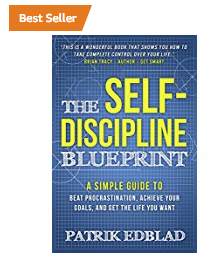 Right now, Amazon is running a Kindle promotion for my latest book, The Self-Discipline Blueprint.
So, if you want a complete step-by-step guide to achieve anything you set your mind to, don’t wait:
—> Get The-Self-Discipline Blueprint Now!
This offer expires August 31st, 2018.
Happy reading!

The post Limited Time Offer: Get The Self-Discipline Blueprint for just $2.49! appeared first on Selfication.
February 12, 2018
The Self-Discipline Blueprint
Last week, I launched my new book, The Self-Discipline Blueprint.
It was a lot of work but it was well worth the effort because the response has been incredible.
In just one week, the book:
Has sold well over 1 000 copies.
Is the #1 best seller in several Amazon categories.
Has 26 reviews, with a 4.9 out of 5 stars average.
How awesome is that? 
February 6, 2018
The Self-Discipline Blueprint is a Best Seller!
Wow! It’s only been 24 hours since I launched The Self-Discipline Blueprint, and it’s already sold almost 500 copies!
As a result, it’s #1 in several categories on Amazon. Here’s one of them:
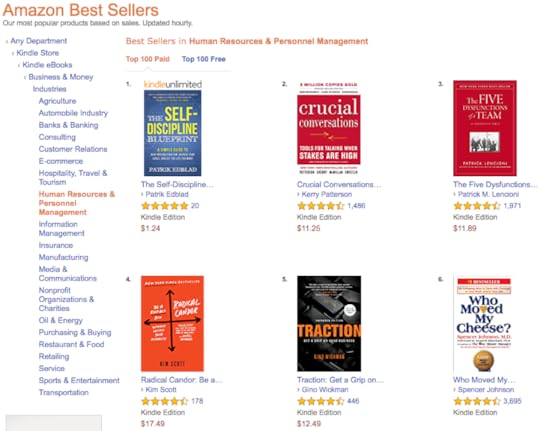
It’s super-exciting to see my book ahead of so many fantastic titles!
If you haven’t yet picked up your copy, you can do so clicking the link below:
Thanks for reading and supporting my work!