Patrik Edblad's Blog, page 11
December 12, 2019
Habit Tracking: How to Make Progress Toward Your Goals
Are you familiar with comedian Jerry Seinfeld’s “Don’t break the chain” strategy? If not, I’ll quickly share the story about it.
Years ago, when Seinfeld was still a new television show, a young comedian named Brad Isaac was starting out on the comedy circuit.
One night, the story goes, Isaac happened to be in the same club as Seinfeld. And in an interview on Lifehacker, Isaac shared what happened when he met Seinfeld backstage and asked if he had any advice for a young comic.
Here’s how Isaac described his interaction with Seinfeld:
“He said the way to be a better comic was to create better jokes and the way to create better jokes was to write every day. He told me to get a big wall calendar that has a whole year on one page and hang it on a prominent wall. The next step was to get a big red magic marker. He said for each day that I do my task of writing, I get to put a big red X over that day. After a few days you’ll have a chain. Just keep at it and the chain will grow longer every day. You’ll like seeing that chain, especially when you get a few weeks under your belt. Your only job is to not break the chain.”
An Unexpected Twist
If you’ve already heard about “Jerry Seinfeld’s productivity secret”1, that’s no surprise. It’s been references to time and time again in articles, magazines, and books.
But according to Jerry Seinfeld himself, he didn’t come up with this strategy. In an “Ask Me Anything” session on Reddit, he commented2:
“This is hilarious to me, that somehow I am getting credit for making an X on a calendar with the Seinfeld productivity program. It’s the dumbest non-idea that was not mine, but somehow I’m getting credit for it.”
I find it funny that Seinfeld’s productivity secret apparently had nothing to do with Jerry Seinfeld. But I don’t agree that it’s a “stupid non-idea”. In fact, I think it’s quite the opposite.
Measuring your behavior is one of the easiest ways to change it. Research shows that merely asking people to track what they do immediately and significantly improves their performance in that area.
For instance, studies show that people who use pedometers will increase their physical activity by 27%, and result in them walking at least one extra mile per day on average3.
Habit Tracking
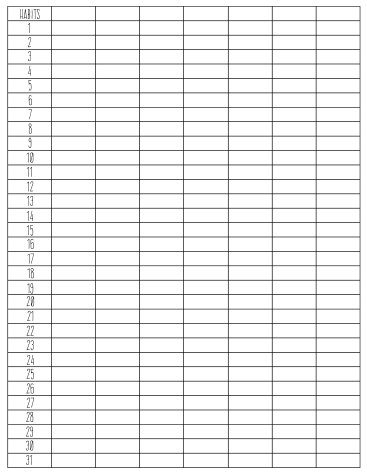
What gets measured gets improved. And the “Don’t break the chain strategy” provides a simple and effective way to measure what you do. So, any time you’re creating a new habit, I highly recommend tracking your progress in a habit calendar:
(Click here to download a free habit calendar.)
Write the habits you want to track in the top row and put the calendar on a wall where you’ll see it often. Then check off each habit after you’ve completed it.
That way, you’ll create a visual representation of your progress that can work as a powerful motivator. And, perhaps more important, you’ll collect valuable data that you can use to analyze your results and improve your approach.
Footnotes
Jerry Seinfeld’s Productivity Secret
Jerry Seinfeld here. I will give you an answer.
Pedometers Help People Count Steps to Get Healthy
Thank you, Sarah Moore, for creating the habit calendar in this article.
The post Habit Tracking: How to Make Progress Toward Your Goals appeared first on Patrik Edblad.


December 6, 2019
Intermittent Reinforcement: How to Get Addicted to Good Habits
Burrhus Frederic “B.F.” Skinner was a professor of psychology at Harvard University from 1958 to 1974. He is considered a pioneer of modern behaviorism and one of the most influential psychologists of the 20th century1.
One of Skinner’s most important inventions was the “Skinner box”; a device used to study the effects of reinforcers on lab animals. The rat in the box had to figure out a task (like pulling a lever) that would give it a reward (like food)2.
This automated system allowed Skinner and thousands of his successors to study behavior in a controlled setting. And years of research into reinforcement have found that consistency and timing play vital roles in shaping new behaviors.
Continuous vs Intermittent Reinforcement
The best way to learn a new behavior is through continuous reinforcement, in which the behavior is reinforced every time it occurs.
Meanwhile, the best way to strengthen an already established behavior is through intermittent reinforcement, in which the behavior is reinforced only some of the time.
Imagine, for instance, that you want to teach a dog how to sit. Initially, the best strategy is to reward every successful attempt. If you don’t, the dog might interpret the lack of reward as a sign of incorrect behavior.
But later on, when the dog knows how to sit, it’s a better strategy to reward it only some of time. By making the rewards unpredictable, you’ll make the behavior even stronger.
How so? When you reward a behavior only some of the time, you add the word “maybe” into the equation. And, in the words of neuroscientist Robert Sapolsky3, “Maybe is addictive like nothing else out there”.
Uncertainty Boosts Dopamine
In last weeks article, we learned that dopamine is released in anticipation of a reward:
Interestingly, if you add uncertainty to that same reward, those dopamine levels will shoot through the roof:

The higher the level of unpredictability of a reward, the more dopamine will come pouring into the brain.
So, if you’ve ever wondered why people in places like Las Vegas spend hours and hours playing casino games where they are extremely unlikely to win, this is the answer.
Casino games are carefully engineered according to intermittent reinforcement schedules that make them incredibly addictive.
Much like a rat pressing a lever in a Skinner box, a human playing a slot machine experiences a powerful surge of dopamine that makes it very difficult to stop.
The Habit Reward Lottery
Whenever you want to create a new habit, you can use these insights to your advantage through a strategy I like to call the “habit reward lottery”. It’s a fun and simple way to get yourself hooked on the behaviors you want.
The way it works is that you set up a lottery with prices that align with your objectives. Let’s say, for example, that you want to become a good runner. In that case, your prices might look something like this:
Water bottle
Pedometer
Heart rate monitor
Running shoes
Entry to marathon (Jackpot!)
Once you’ve established your prices, you write them down on winning tickets and mix them with a bunch of blank tickets. Then, each time you’ve completed your habit, you reward yourself with a ticket.
Whether or not your ticket is a winner, you can be sure that your dopamine levels will spike. And that, in and of itself, will make the habit much stronger.
Footnotes
B. F. Skinner
Operant Conditioning Chamber
Dopamine Jackpot! Sapolsky on the Science of Pleasure
The post Intermittent Reinforcement: How to Get Addicted to Good Habits appeared first on Patrik Edblad.
November 28, 2019
Reinforcement: How to Make Your Habits Stick
Whenever you’ve completed a good habit, it’s vital that you allow yourself to feel good about it. The reward at the end of the behavior is what will make you want to do it again in the future.
To understand why that is, we need to take a look inside the brain. Every behavior involves multiple brain regions and neurochemicals, but the neurotransmitter dopamine plays an especially important part.
Many people think dopamine is released when the brain gets a reward, but that’s actually not quite accurate. Dopamine is not released during a reward, but in anticipation of a reward 1.
If you, for example, bite into your favorite piece of chocolate, you won’t have a spike in dopamine. In fact, you’ll have very little of it. The dopamine is released long before that — when you spot the chocolate in the store:
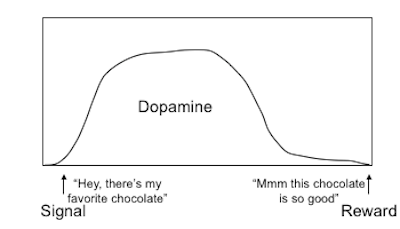
In the words of neuroscientist Robert Sapolsky: “Dopamine is not about pleasure, it’s about the anticipation of pleasure. It’s about the pursuit of happiness rather than happiness itself.”
Dopamine Drives Behavior
The vital importance of dopamine became apparent in 1954 when neuroscientists James Olds and Peter Milner published a seminal paper uncovering the reward system of the brain2.
In one of their experiments, they implanted electrodes in the brains of rats and blocked the release of dopamine. Soon, the rats lost all will to live. They wouldn’t eat. They wouldn’t have sex. They didn’t want to do anything. And within a few days, they died from thirst.
When other researchers have reversed this process and flooded brains with dopamine, animals have executed behaviors at incredible speed. In one study, researchers gave mice a hit of dopamine every time they poked their nose in a box. Within minutes, the mice were poking their nose into the box eight hundred times per hour3.
The takeaway? Dopamine is vital for eliciting goal-directed behavior. Low levels of dopamine will lead to weak habits, and high levels of dopamine will lead to strong habits.
Deliberate Reinforcement
In a perfect world, the reward for a good habit would be the habit itself. But, as you’ve probably noticed, that’s not how it works. In the beginning, there’s usually nothing inherently rewarding about it.
The first couple of times you go to the gym, there won’t be any noticeable difference in your physique. It will probably take months before you start getting fitter. And it’s usually not until then that it gets easier to exercise for its own sake.
So, in the beginning, you need to engineer your own dopamine spikes while the long-term rewards accumulate in the background. And the best way to do that is to use what psychologists call reinforcement; using immediate rewards to strengthen behaviors.
Reinforcement can take many forms, but the simplest and most effective I’ve found is behavior expert BJ Fogg’s “celebration” technique4. As the name suggests, all you have to do is celebrate each time you’ve completed your habit. For example:
Do a fist pump
Tell yourself, “That’s like me!”
Put on a big smile
It might sound silly, but it works remarkably well. By deliberately self-generating positive emotions, your brain will pay attention. It will come to associate your routine with feeling good. And soon, it will start releasing dopamine each time it anticipates your habit.
So, find a way to celebrate that makes you feel successful, empowered, and happy. Then use it every time you’ve completed your habit. The stronger the emotion you generate, the faster your habit will form.
Footnotes
Dopamine Jackpot! Sapolsky on the Science of Pleasure
Positive Reinforcement Produced by Electrical Stimulation of Septal Area and Other Regions of Rat Brain
Serotonergic Versus Nonserotonergic Dorsal Raphe Projection Neurons: Differential Participation in Reward Circuitry
Rewire Your Brain
The post Reinforcement: How to Make Your Habits Stick appeared first on Patrik Edblad.
November 21, 2019
Social Influence: How to Easily Build Good Habits
Human beings are herd animals. For most of our evolutionary history, our ancestors lived together in tribes.
The group provided safety, access to resources, and mating opportunities. Getting excluded from the tribe, on the other hand, was a death sentence.
We have survived and thrived through collaboration with other people. Because of that, one of the core human drives is to belong.
We have a deep need to fit in, to bond with others, and to feel accepted by the people around us. And those ancient preferences still influence us in a big way.
The Power of Social Influence
From an early age, we conform to the attitudes, feelings, and actions of those around us. Our family and friends, our school, our local community, and society all shape the person we become.
Each of these groups provide the standards and expectations that we live by. These social norms are kind of like invisible rules that form our identity, guide our behavior, and affect our outcomes.
Imagine, for example, that you’re a student struggling with poor grades. The intuitive solution to that problem is to study harder.
But research suggests that a better strategy is to simply pick a smart roommate. In his book, The Happiness Advantage, researcher Shawn Achor writes1:
One study of Dartmouth College students by economist Bruce Sacerdote illustrates how powerful this influence is. He found that when students with low grade-point averages simply began rooming with higher-scoring students, their grade-point averages increased. These students, according to the researchers, “appeared to infect each other with good and bad study habits—such that a roommate with a high grade-point average would drag upward the G.P.A. of his lower-scoring roommate.”
Behavior is Contagious
And study habits are of course just one area where our social circles influences us. Other fascinating research shows that:
If your neighbour gets a new car, you’re significantly more likely to buy a new car2.
If your colleagues are often late for work, you’ll be much more inclined to come in late, too3.
If you’re a woman and your coworker recently had a child, you’re more likely to get pregnant4.
If your friends, siblings, or coworkers get a divorce, you’re more likely to get divorced as well5.
If you have a friend who becomes obese, your risk of also becoming obese increases by 57 percent—even if your friend lives hundreds of miles away6!
I could go on and on with examples, but I’m sure you get the point: The people around you deeply influence the person you become.
Over time, the way they do things become the way you do things.
Leverage Social Influence
Whenever you set out to create a new habit, make sure to establish positive social influence around it.
Let’s say, for instance, that you want to exercise regularly. You’ll be much more likely to make that happen if you team up with a workout partner, hire a personal trainer or get a group training membership.
Surround yourself with the right people, and your behavior will naturally adapt to theirs.
Footnotes
The Happiness Advantage: The Seven Principles of Positive Psychology That Fuel Success and Performance at Work by Shawn Achor
The Effects of Lottery Prizes on Winners and their Neighbors: Evidence from the Dutch Postcode Lottery
Employee Lateness Behavior: The Role of Lateness Climate and Individual Lateness Attitude
Businesses, Buddies and Babies: Social Ties and Fertility at Work
Breaking Up is Hard to Do, Unless Everyone Else is Doing it Too: Social Network Effects on Divorce in a Longitudinal Sample
The Spread of Obesity in a Large Social Network over 32 Years
The post Social Influence: How to Easily Build Good Habits appeared first on Patrik Edblad.
November 14, 2019
Commitment Devices: The Best Way to Stick to Your Habits
If you have a hard time sticking to your goals, you’re in good company. It’s a problem people have been struggling with all throughout history.
In fact, philosophers all the way back Plato even have their own term for it. They call it “akrasia,”1 and it encompasses procrastination, poor self-control, lack of follow-through, and any kind of addictive behavior.
The reason we have this problem is what behavioral economists call time inconsistency, and it’s nicely illustrated in a study on grocery-buying habits2: When people buy groceries online for delivery tomorrow, they buy a lot more ice cream and a lot fewer vegetables compared to when they’re ordering for next week.
Short-term pleasures like having an ice-cream are immediate and tangible. Conversely, long-term benefits like those of eating vegetables are far away and abstract.
That imbalance makes our preferences inconsistent over time. It’s why we tend to choose short-term pleasures now and postpone long-term benefits for the future.
Beating Akrasia

All throughout history, people have a tried a lot of creative strategies to overcome akrasia, stick with their intentions, and achieve their goals.
The most classic example is probably Odysseus having his body tied to the mast of the ship so he could listen to the Siren’s song without getting lured into jumping overboard.
Another one is Spanish conqueror Hernán Cortés bold move to destroy his ships behind him to remove the possibility of retreat.
And a more recent, quite funny, example comes from entrepreneur Maneesh Sethi who hired a girl to slap him in the face each time she caught him wasting time at his computer.
Behavioral economists refer to strategies like these as…
Commitment Devices
A commitment device3 is a way of proactively locking yourself into a desired course of action. It’s something you put in place now to avoid akrasia later. Here are some more examples:
Get a long-term gym memberships instead of one-day passes.
Cut up your credit cards to avoid mindless spending.
Leave your laptop at the office so you can’t keep working at home.
Buy junk food or candy in small packages rather than large ones.
Get rid of all alcohol in your house to prevent drinking.
These days, there are also a lot of digital commitment devices you can use to avoid akrasia online. Examples include:
News Feed Eradicator for Facebook, a Chrome extension that replaces your Facebook news feed with an inspiring quote.
Freedom, a service that lets you block apps and websites so you can stay focused and productive.
SelfControl, an app for Mac that lets you block your access to sites and mail servers for a set amount of time.
Moment, an app that tracks how much you use your phone and helps you create daily usage limits.
Forest, an app that “plants” a digital tree which grows while you stay away from your phone and dies if you leave the app.
What’s Your Commitment Device?
As you can see, there are many ways that you can use commitment devices to your advantage. So, take some time to think about how you can bind yourself to your intentions. Find the right commitment devices, and you’ll be way more likely to make your habits stick.
Footnotes
Akrasia
I’ll Have the Ice Cream Soon and the Vegetables Later: A Study of Online Grocery Purchases and Order Lead Time
Bestiary of Behavioral Economics/Commitment Devices
The post Commitment Devices: The Best Way to Stick to Your Habits appeared first on Patrik Edblad.
November 8, 2019
Flow: How to Create Habits the Fun & Easy Way
In an interview on The Joe Rogan Experience1, mixed martial arts instructor Firas Zahabi explained that he’s a big believer in never being sore.
Whenever you’ve worked out, you should wake up the next day feeling good. It doesn’t matter what your fitness level is.
Even if it was your first day ever in a gym, you shouldn’t feel any pain.
When Rogan asked him how that would be possible, Zahabi explained it like this:
“Consistency Over Intensity”
Let’s say you can do a maximum of ten pull-ups. Does that mean you should try to do ten when you work out?
According to Zahabi, the answer is no. Instead, you should do five. Why? Well, consider these two scenarios:
You hit your max every time you go to the gym. Working out that way, you’ll get sore, and you’ll have to rest. You might be able to do pull-ups twice a week for a total of 20 reps.
You hit half of your max every time you go to the gym. Working out that way, you won’t get sore, and you won’t have to rest. You’ll be able to do pull-ups every day of the week for a total of 35 reps.
As you can see, option two leads to almost twice the training volume compared to option one. Over the course of a year, that will have a dramatic effect on your results.
Get in the Zone
According to Zahabi, working out needs to be fun and addictive. That’s the only way to make yourself do a lot of it.
To make that point, he refers to psychologist Mihaly Csikszentmihalyi’s research on “flow”:2
A state in which people are so involved in an activity that nothing else seems to matter; the experience is so enjoyable that people will continue to do it even at great cost, for the sheer sake of doing it.
If something is too hard, you’ll feel anxious. If something is too easy, you’ll get bored.
But if something is in that sweet spot where your skills match the challenge, you’ll find it enjoyable:

Research shows that people tend to be happiest and most productive when they’re in flow. But we rarely set ourselves up to experience it consistently.
The gym is an excellent example of that. Most people drive themselves into anxiety every time they go there. They push themselves to exhaustion and come to associate exercise with pain.
Zahabi’s advice is to instead optimize your training for flow. Work out in a way that is neither too hard nor too easy. That way, the exercise will be so much fun that you’ll naturally want to come back to it.
Optimize for Flow
This advice is applicable not just for exercise habits, but all kinds of recurring behaviors. In fact, anytime you want to create a lasting habit, it’s good practice to optimize it for flow.
Almost always, that means reducing the effort to avoid anxiety. And the way to do that is to start small. Here are a couple of examples:
If you want to meditate regularly, start with just two minutes.
If you want to read more books, aim for only two pages a day.
If you want to floss, begin with flossing just one tooth every night.
The idea, just like in the gym, is to operate within the flow channel. Instead of intensity, you go for consistency. Instead of big efforts, you go for small wins. And that way, you’ll create sustainable habits that grow naturally over time.
Footnotes
Joe Rogan – How To Workout Smarter
Flow: The Psychology of Optimal Experience by Mihaly Csikszentmihalyi
The post Flow: How to Create Habits the Fun & Easy Way appeared first on Patrik Edblad.
October 31, 2019
Environment Design: How to Create Habits the Easy Way
We often assume that we do what we do because of who we are. But the truth is a lot of what we do is the result of where we are.
To illustrate that point, we’ll turn to a fascinating graph from an organ donation statistics study by researchers Eric Johnson and Daniel Goldstein1.
To Donate or Not to Donate…

This graph shows the percentage of people across a number of European countries who are willing to donate their organs after they die.
As you can see, there’s a huge difference between the countries on the left and the ones on the right. Why do you think that is?
At first glance, you might assume some major underlying factor like culture or religion caused these results, but at a closer look, that doesn’t hold up.
Denmark and Sweden, the Netherlands and Belgium, Austria and Germany—these are all countries with similar cultures and religious beliefs.
Still, their organ donation percentages are wildly different. So, what’s going on here?
The Default Effect
It’s actually quite simple. What explains the differences between the countries is the design of the form related to organ donations in each region.
In the countries where the form has an “opt-in” design (i.e., “Check this box if you want to donate your organs”), people tend not to check the box.
And in the countries where the form has an “opt-out” design (i.e., “Check this box if you don’t want to donate your organs”), people also tend not to check the box.
No matter which one of these forms people are presented with, an overwhelming majority of them will choose to stay with what they already have.
In psychology, this tendency is called the default effect2, and it influences us all the time as we go about our daily business. For instance:
If you have cookies on your kitchen counter, you’re likely to eat them.
If you have credits cards in your wallet, you’re likely to spend money.
If you have games on your phone, you’re like to play them.
In many ways, you shape your environment, and then your environment shapes your behavior. So, with that in mind, what does your default setup look like? What cues are you surrounded with? Do they support or sabotage your desired habits?
Environment Design
At any given moment, the default effect is either working for you or against you. So, you need to shape your environment to support the behaviors you want and discourage the behaviors you don’t want. For example:
If you want to sleep better, ban all screens from your bedroom and put a great fiction book next to your bed.
If you want to eat less, store away big plates and put salad plates in their place.
If you want to be more present, remove unnecessary apps and notifications from your phone.
Make your desired habits very easy to do and undesired habits very hard to do. That way, you’ll turn to the right habits by default.
Footnotes
Medicine. Do Defaults Save Lives?
Default Effect
The post Environment Design: How to Create Habits the Easy Way appeared first on Patrik Edblad.
October 25, 2019
Habit Stacking: How to Create Powerful Daily Routines
In his autobiography, No Limits, swimmer Michael Phelps describes entering the 400-meter individual medley final at the 2008 Olympic Games in Beijing1:
After we walked out to behind the blocks, I did what I always do there. I stretched my legs on the blocks, two different stretches, one a straight-leg stretch, the other with a bent knee, left leg first. I took the right headphone out. Once they called my name, I took the left headphone out, the parka off.
Continuing his pre-race routine, he made sure that the block was dry before stepping onto it. Once up there, he did his usual double arm swing, slapping his back. Then we waited for the beep, dove into the water, and started swimming.
4:03.84 later, Phelps had won the race and broken his own world record by nearly two seconds. Over the course of the Beijing Olympic Games, he went on to win a total of eight gold medals — the most first place finishes at any single Olympic Games in history.
Michael Phelps retired as the most decorated Olympian of all time2 with 28 medals, and also holds the record for Olympic gold medals with a total of 23.
The Power of Habit Stacking
Throughout his remarkable career, Phelps relied heavily on specific routines to consistently perform at his very best. His pre-race routine was carefully designed to help him be calm and focused before the race. And if you look into it closely, you’ll see that it’s basically a series of if-then plans following each other:
→ If I stand behind the blocks – Then I will stretch my left leg
→ If I’ve stretched my left leg – Then I will stretch my right leg
→ If I’ve stretched my right leg – Then I will take my right headphone out
→ If they call my name – Then I will take the left headphone out and the parka off
→ If I’ve removed my headphones and parka – Then I will make sure the block is dry
… And so on, until the moment Phelps hit the water. This strategy of grouping a sequence of behaviors together into a routine is called habit stacking.
If-Then, If-Then, If-Then…
Habit stacking is a simple and effective strategy you can use anytime you want to establish several small behaviors. To use it, all you have to do is follow this formula:
After [Habit 1], I will [Habit 2] → After [Habit 2], I will [Habit 3], etc.
The beauty of habit stacking is that it turns individual tasks into a single action, where each habit acts as a cue for the next. And you don’t have to be a professional athlete to benefit from this approach. To give you a more relatable example, here’s the habit stack for my morning routine:
10-minute meditation → 10 minutes of reading → Light workout → Basic stretching → Two hours of focused writing
If I just sit down on my meditation pillow, that will initiate the rest of the morning routine. And once I’ve done my morning routine, the rest of the day tends to be productive.
How about you? What small behaviors could you turn into a habit stack? What routine could you put in place to achieve your goals?
Footnotes
No Limits: The Will to Succeed by Michael Phelps & Alan Abrahamson
List of Multiple Olympic Medalists
The post Habit Stacking: How to Create Powerful Daily Routines appeared first on Patrik Edblad.
October 18, 2019
If-Then Planning: How to Make Good Habits Stick
In his book Homo Deus, historian Yuval Noah Harari writes1:
‘Algorithm’ is arguably the single most important concept in our world. If we want to understand our life and our future, we should make every effort to understand what an algorithm is, and how algorithms are connected with emotions.
So, what is an algorithm? The dictionary defines it as “a process or set of rules to be followed in calculations or other problem-solving operations, especially by a computer.”
If you’ve ever wondered how a Tesla can drive itself, the answer is algorithms—millions of them. But there are also more relatable everyday occurrences of algorithms. Each time you bake a cake, for example, the recipe you use is an algorithm.
Habit Algorithms
Interestingly psychologists have found that you can also use algorithms to improve radically improve your habits. Psychology professor Peter Gollwitzer refers to this strategy as if-then planning2. To use it, all you have to do is fill out this formula:
If [situation] – Then I will [habit].
The beauty of if-then planning is that it forces you to turn vague intentions into specific actions.
“I want to eat healthier,” becomes “If I’m buying lunch, then I will order a salad.”
It’s a simple yet extremely powerful strategy. Over 200 scientific studies show that if-then planners are about 300 percent more likely to achieve their goals.
The Power of If-Then Planning
The reason if-then planning so exceptionally well, according to psychologist Heidi Grant, is that3:
“Contingencies are built into our neurological wiring. Humans are very good at encoding information in ‘If X, then Y’ terms, and using those connections (often unconsciously) to guide their behavior.”
In other words: much like computers, our minds respond very well to algorithms.
If-then plans allow you to act the way you want without thinking, and that saves a lot of mental energy.
Instead of hesitating and deliberating, you just execute the algorithm whenever the situation arises.
Create Your Own If-Then Plans
Rather than relying on vague intentions, purposely install the specific responses that will lead you to your goals. Let’s have a look at some examples:
“I want to move more.” → If I’m at work, then I will take the stairs.
“I want to sleep better.” → If it’s after noon, then I will have water instead of coffee.
“I want to be more productive.” → If I arrive at the office, then I will do two hours of deep work.
“I want to improve my relationships.” → If I come home from work, then I will share the best thing that happened to me that day.
“I want to be happier” → If I wake up in the morning, then I will think about one thing I’m grateful for.
Think of yourself as a robot and the if-then plans as the algorithms you use to program yourself. It sounds silly, I know, but it’s a remarkably effective way to make good habits stick.
Footnotes
Homo Deus: A History of Tomorrow by Yuval Noah Harari, page 83
Implementation Intentions and Effective Goal Pursuit
Get Your Team to Do What It Says It’s Going to Do
The post If-Then Planning: How to Make Good Habits Stick appeared first on Patrik Edblad.
October 11, 2019
The Rider and the Elephant: How to Get Motivated
Psychologists know that there are two systems in our brains; the rational system and the emotional system. In his book, The Happiness Hypothesis, psychologist Jonathan Haidt provides a great analogy for these two systems. He says to imagine your brain as a human rider on top of an elephant1.
The rider represents the neocortex of the brain. This is the rational part of us that plans out where we want to go.
The elephant represents the limbic system of the brain. This is the emotional part of us that provides power for our journey.
These two parts need different things to do what they do. The rider needs good instructions to guide the elephant in the right direction. The elephant needs motivation to carry the rider in the right direction.
The Rider and the Elephant

As you can see, there’s a glaring problem with this arrangement. If the huge elephant has a different opinion about the tiny rider about where to go, guess who will have the final say?
The rider can try to convince, drag, or push the elephant all he wants. But if the elephant has a different destination in mind, that’s inevitably where they’ll end up.
I’ve covered how to provide the rider with the instructions he needs in other articles on habits. But before you get to that, you need to motivate the elephant to carry the rider in the right direction. And the way to do that is to get crystal clear on why the changes you want to make are important to you.
To paraphrase the philosopher Friedrich Nietzsche, he who has a strong enough why can bear almost any how. If you gather a set of strong enough reasons to change, you can trust the elephant to stay on track and carry the rider where he wants to go.
So, before you set out to change your habits, take a moment and ask yourself: In what ways will my life be better if I create the behavior change I want?
What Are the Pros?
Identify at least three compelling reasons. Write them down and then vividly imagine what experiencing these benefits would be like. For example:
I’d wake up full of energy.
I’d be focused and productive at work.
I’d be more present and loving with my family and friends.
Next, invert the question, and ask yourself: In what ways will my life be worse if I don’t create the behavior change I want?
What Are the Cons?
Identify at least three aversive reasons. Again, write them down and then vividly imagine what experiencing these things would be like. For example:
I’d feel tired and depressed.
I’d be stressed and unproductive at work.
I’d be distanced and cranky with my family and friends.
By contrasting these potential futures, you’ll clarify your motivation. You’ll create an emotional connection to the end goal. And that will align the power of the elephant with the plans of the rider.
Footnotes
The Happiness Hypothesis: Finding Modern Truth in Ancient Wisdom by Jonathan Haidt
Image courtesy of jyeltherealart.
The post The Rider and the Elephant: How to Get Motivated appeared first on Patrik Edblad.