Patrik Edblad's Blog, page 19
October 25, 2016
This is How to Stop Sucking at Your Habits
In 1995, film studio Pixar released Toy Story — the first-ever computer-animated feature film.
Since then, the studio has produced 16 more movies, including titles like A Bug’s Life, Monsters Inc., Finding Nemo, The Incredibles, Cars, Ratatouille, and WALL-E.
This list of blockbusters has earned Pixar sixteen Academy Awards, seven Golden Globe Awards, eleven Grammy Awards and a bunch of other awards and acknowledgments.1
There is a lot we can learn from how they go about creating their exceptional movies.
From Suck to Unsuck
It’s tempting to think brilliant companies like Pixar always know exactly what to do next.
Presumably, their workflow looks something like this:
One of their genius employees comes up with a brilliant idea.
The genius employee explains the brilliant idea to the rest of the uber-talented team.
The uber-talented team executes flawlessly to turn the genius employee’s brilliant idea into an amazing blockbuster movie.
But in reality, that’s not at all how it works.
The truth is that each of Pixar’s movies goes through a process of relentless iteration before it’s finished.
Sure, an initial idea gets the project moving, but it will change many times before the film is released.
In fact, Pixar assumes that the first versions of their movies are going to suck.
And as a result, they are willing to tweak everything about it until it doesn’t anymore.
Their process is all about going from suck to unsuck.
A Mountain of Storyboards
For each movie that they create, Pixar uses thousands of ‘storyboards.’
These are hand-drawn comic book versions of the film that contains ideas for the characters and actions they take in each scene.
The people working on the project come up with a huge number of these ideas, most of which are never used in the final product.
And the number of storyboards they use increases for each successful movie they release. So far, they’ve created:
27,565 storyboards for A Bug’s Life
43,536 for Finding Nemo
69,562 for Ratatouille
98,173 for WALL-E.
Clearly, Pixar has no intention of slowing down their iterations.
And neither should you.
How Good Intentions Fizzle Out
We all seem to have this tendency to think that somehow our new habit will work out pretty much exactly they way we imagine.
If we just come up with a solid enough plan, we should be able to follow through without major problems.
And that might be the case for a week or two. But then it turns out that our plan has a hole or two (or a hundred).
Perhaps we notice that we don’t have enough energy to show up at the gym after work consistently. Or that the book we planned to read is boring. Or that there just isn’t enough time to prepare the healthy food we’ve been planning.
And so our good intentions fizzle out, and we quit.
Always Be Creating Storyboards
If you can relate to this, the problem isn’t that you’re lazy or lack willpower.
The problem is that you rely too much on the first version of your plan.
You heavily overestimate your ability to predict every obstacle that will show up in your way.
As a result, each time your run into a setback, you’ll perceive it as a failure and get discouraged.
And here’s why Pixar’s approach is so powerful.
Instead of thinking of your first plan as your definitive strategy, it becomes your first shitty first draft.
You’ll work under the assumption that it’s going to have plenty of holes.
And this approach allows you to face setbacks without getting discouraged.
You know that your plan is a work in progress so every time you run into an obstacle, you simply create a new ‘storyboard.’
How to Stop Sucking At Your Habits
If you struggle with creating and sustaining healthy habits, you need to change your mindset about it.
Just because you’ve failed a lot in the past, that doesn’t mean you’re a failure. It just means you’ve created a lot of storyboards.
And that’s a good thing because it means you have a lot of insights into what haven’t worked in the past.
Now all you have to do is create a new storyboard and try again. If that doesn’t work, you create a new one and try again. And again. And again.
Constantly refine your habit by using strategies like creating a trigger, rewarding small wins, raising the stakes, shaping your environment, and using accountability.
Conduct a weekly review to track your progress and readjust your approach.
Build Your Own Mountain of Storyboards
Pixar was willing to make 98,173 storyboards to create WALL-E. And they’ll continue to make even more for their future films.
They don’t waste their time worrying about setbacks. And neither should you.
The question isn’t if you have what it takes.
The question is how many storyboards are you willing to create?
As long as you do not stop, you are succeeding.
What storyboard will you create next?
Sources
Pixar
The post This is How to Stop Sucking at Your Habits appeared first on Selfication.


October 18, 2016
This is the Most Fun Way to Get Started With a New Habit
Do you know the feeling?
You’re super-excited about a big change you want to create in your life.
But after struggling with it for a few weeks (or even just days), it all becomes a grind.
What was supposed to be an exciting opportunity to grow has quickly become a source of dread, frustration, and self-doubt.
Why can’t I ever stick to my goals? Why do I always do this? What’s wrong with me?
And then you quit. Again and again… and again. Each time feeling a little more discouraged than the last.
But getting started with a new habit doesn’t have to be this hard. In fact, it can be quite easy (and even a lot of fun).
The Problem With Difficult Goals
The biggest mistake people make when they get started with a new habit is that they aim for a goal that is too hard.
We tend to want results immediately and, as a result, we end up asking too much of ourselves too soon.
It doesn’t matter if we haven’t been exercising much the last couple of months. We still expect to hit the gym four times a week (starting Monday).
And while audacious goals can be inspiring they can also become a huge roadblock in the beginning.
I suggest we take another approach.
Let’s Play Dominoes!
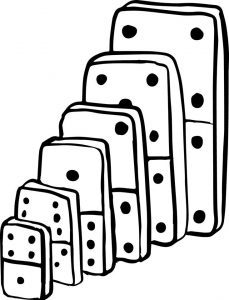
Did you know that a domino can knock over another domino that’s about 1.5 times larger than itself? 1
The domino effect is powerful. But the only way to get it moving is to start with a domino that’s small enough that we can actually knock it over.
What we usually do is start at the other end. We walk right past the small dominoes and start wrestling the biggest one right away.
And when the damn thing doesn’t budge, we get discouraged (or maybe even injured or burned out) and quit.
In my experience, it’s a much better approach to start with a domino that’s so small it’s nearly effortless to knock down.
Line Up Your Tiny Dominoes
Here are some examples of what your smallest dominoes could look like:
Meditate for just one minute.
Add one vegetable to just one of your meals.
Do two pushups every day.
Read one page in your book every night.
Remove just one piece of clutter from your home every day.
Once you’ve got these tiny pieces in place, focus all your energy on becoming a master domino player.
All you need to worry about is showing up and knocking down your tiny dominoes. Every single day.
If you can do that, you’ll eventually knock down the biggest domino at the end of the row.
And it will most likely happen much faster than you think.
Small Dominoes Creates Big Momentum
The reason this approach is so effective is that it allows you to make progress without depleting your willpower muscle.
Instead of getting stuck and frustrated, you get to experience a series of small wins.
Each domino you knock over proves that you are in charge of your behavior and that you can create the change you want in your life.
From this empowered state, it gets much easier to stick to your habits long enough that they become a natural part of what you do every day.
And once you’re in that place, it’s only a matter of time before you start knocking over your biggest dominoes.
Shall we play? 
October 11, 2016
This is How to Use Accountability to Be Awesome (Join the Selfication Facebook Group)
In the 1920’s, psychologist and industrial researcher Elton Mayo ran a series of experiments at the Hawthorne Works near Chicago.
The purpose of his studies was to determine whether the light exposure in the building affected the productivity of the workers.
At first, Mayo seemed to be on to something as the workers did indeed increase their output when he turned the lights up.
But then he noticed something peculiar. The output of the laborers also increased when he turned the lights down.
In fact, it didn’t matter what kind of change he made to the facilities. As long as he did something, the worker’s productivity would spike.
Mayo had just discovered what would later be dubbed…
The Hawthorne Effect
This term was coined in 1958 by researcher Henry A. Landsberger after analyzing the work of Mayo.
The Hawthorne Effect is “a type of reactivity in which individuals modify or improve an aspect of their behavior in response to their awareness of being observed.” 1
If you’re a researcher, it doesn’t matter if you change the lights, move the workstations, clean up the facilities, or do something else entirely.
As long as the subjects are aware that you’re paying attention to what they do, they will probably change their behavior no matter what you do.
This finding was so influential it became one of the foundations in the field of social science known as Industrial Psychology.
The Power of Being Observed
You’ve probably experienced the Hawthorne Effect many times throughout your life, for example:
As a kid, knowing that your parents were watching you.
In school, knowing that your teachers were expecting certain results.
At your job, knowing that your boss was waiting for your report.
In practice, knowing that your coach and teammates were expecting you to do the drills.
So, you know how powerful it can be to have someone hold you accountable.
Still, most of us rarely use this to our advantage when it comes to our personal goals.
How to Use Accountability to Be the Best Version of Yourself

It’s much easier to show up and do the work if you know someone else is expecting you to.
That’s why teaming up with an accountability partner is such a powerful strategy.
A great accountability partner will:
Hold you accountable (duh) to your goals by checking in with you regularly to see if you’re sticking to your plan.
Root for you and remind you to celebrate your small wins.
Offer new perspectives and ideas on how to overcome challenges.
Help establish and hold you to consequences if you slack off.
Get a serious Hawthorne Effect going.
(Of course, you would do the same thing for the other person.)
So, how do you go about finding a great accountability partner?
Introducing: The Selfication Facebook Group
A lot of readers have been asking me about how to surround yourself with the right people.
How are you supposed to do this if you don’t know any growth-oriented people?
After giving this questions some thought I realized the answer was right under my nose.
The Selfication community is now thousands of people strong.
And all of us are eager to become remarkable and help others do the same.
We just need a place to connect.
And that’s why I’ve just now opened the doors to The Official Selfication Facebook Group
I warmly encourage you to drop by and share what you’re working toward with the community.
With a little luck, you might just find an accountability partner who will make all the difference in getting there.
“Alone we can do so little; together we can do so much.”
― Helen Keller
Visit The The Official Selfication Facebook Group!
Footnotes
Hawthorne effect
Runner image courtesy of Joel Lindmark (Society6).
Selfication image courtesy of Sarah Moore.
The post This is How to Use Accountability to Be Awesome (Join the Selfication Facebook Group) appeared first on Selfication.
October 4, 2016
A Powerful Hack to Become Who You Want to Be, Backed by Research
In 1971, psychologist Philip Zimbardo and a team of researchers conducted a study to examine the effects of becoming a prisoner or prison guard 1.
Zimbardo wanted to know if the brutality reported among American prison guards was due to their personalities or if it had more to do with the jail environment.
To do that, he and his team built a mock prison in the basement of the Stanford University psychology building and recruited 21 college students.
These participants were split up into two groups consisting of 10 prisoners and 11 guards.
Zimbardo reasoned that if the subjects turned out to behave non-aggressively, this would indicate that real life prison brutality had to do with sadistic personalities of the guards.
If the participants behaved aggressively, this would support the idea that brutality has more to do with the prison environment.
The First Day of the Experiment
As the experiment began, everything was designed to be as lifelike as possible. The “prisoners” were treated like real criminals.
Without warning, they were arrested in their homes and taken to the police station. They were photographed, fingerprinted and ‘booked.’
They were then blindfolded and taken to the mock prison at Stanford. At arrival, the prisoners were stripped naked, deloused, and had all their personal possessions taken from them.
From this point forward, they were only allowed to wear prison clothes and refer to themselves and fellow prisoners by the ID number on their clothes.
Meanwhile, the subjects who had been selected as guards were dressed in uniforms, sunglasses, a whistle around their neck, and a baton.
The guards were instructed to do “whatever they thought was necessary to maintain law and order in the prison and to command the respect of the prisoners.” No violence was permitted.
Zimbardo himself took the role of the prison warden.
The Experiment Gets Out of Hand
If you’ve heard about the Stanford Prison experiment 1 or seen the movie based on it 2 you know that it didn’t end well.
After only two days, the prisoners tore off their ID numbers and barricaded themselves inside their cells by putting their beds against the doors.
The guards retaliated by shooting fire extinguisher to force the prisoners to open the doors.
Then they broke into the cells, stripped the prisoners naked, and removed their beds.
After this incident, the harassments escalated as the guards started intimidating the prisoners.
“It’s terrible what you are doing to these boys!”
36 hours into the experiment, one of the prisoners had to be released because of “uncontrollable screaming, crying, and anger.”
After few more days, three other participants were removed from the experiment as they were showing “disturbing signs of emotional disorders.”
When psychologist Christina Maslach was brought into the prison to conduct interviews with the participants, she strongly objected to the experiment.
She screamed at Zimbardo: “It’s terrible what you are doing to these boys!”
Maslach was the first person, out of more than 50 outsiders who had seen the prison, to question its morality.
The experiment was meant to last two weeks but was terminated on day 6.
Zimbardo later reflected: “It wasn’t until much later that I realized how far into my prison role I was at that point — that I was thinking like a prison superintendent rather than a research psychologist“.3
Change Your Clothes, Change Your Behavior
I write a lot about how easily we are influenced by our surroundings.
Your environment plays a huge role in your behavior and your social circles determine what’s normal for you.
The Stanford Prison Experiment shows that even the clothes you wear can be a big driver of behavior.
A fascinating (but a lot less dramatic) study on this topic divided people into two groups:
Group A wore their normal clothes.
Group B wore their normal clothes and lab coats.
When these groups did tests of mental agility, the group wearing lab coats made about half as many mistakes as the other group.
In a similar experiment where both groups wore lab coats:
Group A was told they were wearing painter’s smocks.
Group B was told they were wearing doctor’s coats.
In this study, the group wearing doctor’s coats scored significantly higher on brain games compared to the painter’s clothes group.
Researchers call this weird phenomenon ‘enclothed cognition’4.
The Curios Effects of Enclothed Cognition
Enclothed Cognition is defined as “the systematic influence that clothes have on the wearer’s psychological processes.”
Scientists believe that enclothed cognition occurs because of the symbolic meaning of the clothes as well as the physical experience of wearing them.
Dress as a prisoner, and you’ll become submissive. Dress like a prison guard, and you’ll become assertive and aggressive.
Put on a painter’s smock, and you’ll become more artistic. Wear a doctor’s coat, and it will make you more careful and attentive (which helps you score better on brain games).
Whatever you wear, you’ll start to embody the attributes you associate with that type of clothing.
And this translates into actual changes in your behavior and performance.
Become Who You Want to Be by Changing Your Clothes
Who do you want to become? What skills do you want to develop? What qualities would you like to possess?
No matter what your answers are, there’s no reason to wait until you’ve “arrived” to start dressing like the person you want to be.
Instead, find the people who embody the skills and qualities you want right now and literally walk a mile in their shoes.
(Well, not their shoes. And not exactly one mile. I wouldn’t want to set in motion a wave of shoe stealing mile-walkers. But I’m pretty sure you get the idea.)
What I’m getting to is this: Dress like the person you want to become and your behaviors will naturally follow.
Obviously, the clothes you wear won’t magically create the skills and traits you want. But they will prime your brain to be more disciplined in developing them.
So, let’s get dressed for success!5
“You must be the person you have never had the courage to be. Gradually, you will discover that you are that person, but until you can see this clearly, you must pretend and invent.”
– Paulo Coelho
Sources
Stanford Prison Experiment
The Stanford Prison Experiment Movie
Stanford Prison Experiment — Escape
Enclothed Cognition
You might want to blast this classic by Swedish pop legends Roxette while getting dressed.
The post A Powerful Hack to Become Who You Want to Be, Backed by Research appeared first on Selfication.
September 27, 2016
This is the Best Way to Realize Your Full Potential, Backed by Research
 Swimmer Michael Phelps is a living legend.
He’s the most decorated Olympian athlete of all time with a total of 28 medals, and also holds the record for Olympic gold medals 1.
In his book, No Limits: The Will to Succeed 2, Phelps tells a story about when he was training as a little kid.
His coach, Bob Bowman, would push Phelps until he was completely exhausted and then give him a new series of exercises to do.
When little Michael looked at his coach with wide eyes exclaiming “I can’t!”, Bowman gave him some of the most important advice of his life.
“There’s a Big Difference Between I Can’t And I Won’t”
Bowman explained: “Can’t — that’s a tough word. Let’s preserve our power and quit throwing around can’t when we really mean won’t.”
There’s a lot of wisdom in this advice. To realize your full potential, you have to remove the boundaries you’ve put up for yourself.
If Phelps had continue to think in terms of “I can’t” instead of “I won’t”, he would’ve had a completely different mindset.
And if he still got to publish a book, a more accurate title would’ve been something like “Some Limits: The Will to Be Okay”. Not a very compelling title.
Still, most of us live our lives like it’s this book we have been reading.
The Science of Mindsets
Within research, a “mindset” is defined as “a mental frame or lens that selectively organizes and encodes information, thereby orienting an individual toward a unique way of understanding an experience and guiding one toward corresponding actions and responses”. 3
In other words, your mindsets are the lenses through which you perceive the world.
These lenses are colored by your beliefs and attitudes and they help determine your response in any given situation.
And these mindsets have some fascinating implications. For example, research has shown that:
Students who believe they can change their intelligence through hard work do better academically compared to students who believe their intelligence is a fixed trait 4.
Merely believing that your work provides a good amount of exercise is enough to lose weight, drop BMI and decrease blood pressure 5.
Your beliefs about how much calories a drink contains affect how much hunger hormone is released in your body after drinking it 6.
If you believe stress is harmful, you’ll experience more stress than people who don’t 3.
Mindsets even affect your life expectancy. This is because people with a negative aging mindset are less likely to proactively engage in healthy behaviors such as eating healthy, exercising and visiting the doctor 7.
“It’s not what happens to you, but how you react to it that matters.”
— Epictetus (Tweet that)
Your Mindsets Determine Your Outcomes
As we go through life, we pick up beliefs that help us navigate the world. And as the research above suggests, these beliefs have very real consequences for our psychology, physiology, behavior, and performance.
One mindset can flood your system with stress hormones and make you anxious. Another can boost your testosterone levels and make you feel confident.
It’s up to you to choose which one of these responses we want. And this is why I suggest the following:
Believe what is helpful to believe.
Don’t believe something just because your thoughts are telling you something. Your mind is nothing more than a suggestion box.
It’s up to you to choose what to believe, so why not pick the most empowering beliefs you can possibly find?
Between stimulus and response there is a space. In that space is our power to choose our response. In our response lies our growth and our freedom.
— Viktor Frankl (Tweet that)
5 Ways to Change Your Lenses & Realize Your Full Potential
Here are the most powerful ways I’ve come across for changing your lenses:
1. Put your thoughts in perspective. Realize that you are not your thoughts. You are the one that’s observing your thoughts. Whenever a limiting belief shows up, listen to it but don’t necessarily believe it. A thought is not an accurate representation of reality, it’s just a thought. So treat it accordingly.
2. Use empowering language. Ban victim speech from your vocabulary. Instead of saying “I can’t”, say “I won’t”. Instead of “I have to”, say “I’m going to”. Instead of “I don’t know”, say “I’ll figure it out”. Pay attention to the language you use and get rid of any phrases that imply helplessness.
3. Change your feelings. Copy the body language of the person you want to become. Strike a powerful posture and smile. Doing this for just a couple of minutes will make you feel less stressed and more in charge 8.
4. Surround yourself with the right people. The people around us have a huge influence on how we feel 9, what goals we pursue 10, and even on our BMI 11. You become the average of the five people you spend the most time with, so choose your social circles wisely.
5. Take control of your behavior. Run daily habits that help you realize your full potential. Build your fundamentals. Master your craft. Fill your mind with ideas from great books. Journal about what you learn. And focus on the process rather than your results.
How to Realize Your Full Potential, In Summary
To realize your full potential, you need to remove the barriers you’ve put up for yourself. There’s a big difference between “I can’t” and I “won’t”.
A mindset is “a mental frame or lens that selectively organizes and encodes information, thereby orienting an individual toward a unique way of understanding an experience and guiding one toward corresponding actions and responses“.
These lenses affect your psychology, physiology, behavior, and performance. So, choose ones that are helpful.
To change your lenses — put your thoughts in perspective, use empowering language, change your feelings, surround yourself with the right people, and take control of your behavior.
“The real voyage of discovery consists not in seeking new landscapes, but in having new eyes.”
— Marcel Proust (Tweet that)
Sources
Michael Phelps
No Limits: The Will to Succeed
Rethinking Stress: The Role of Mindsets in Determining the Stress Response
Implicit Theories of Intelligence Predict Achievement Across an Adolescent Transition: A Longitudinal Study and an Intervention
Mind-Set Matters: Exercise and the Placebo Effect
Mind Over Milkshakes: Mindsets, Not Just Nutrients, Determine Ghrelin Response
Longevity Increased by Positive Self-Perceptions of Aging
Power Posing: Brief Nonverbal Displays Affect Neuroendocrine Levels and Risk Tolerance
Emotional Contagion
Goal Contagion: Perceiving Is for Pursuing
The Spread of Obesity in a Large Social Network over 32 Years
The post This is the Best Way to Realize Your Full Potential, Backed by Research appeared first on Selfication.
September 20, 2016
This is the 1 Thing Successful People Do Differently
In the late 1960’s and early 1970’s, psychologist Walter Mischel explored the self-control in children with a simple but effective test (1).
He and his researchers began their experiments by presenting a preschooler with a plate of treats such as marshmallows.
The child was then told that the researcher had to leave the room for a couple of minutes. Before they left, they gave the child the two options:
”If you wait until I come back you’ll get two marshmallows. If you can’t wait, you can ring a bell and I will come back immediately, but then can only have the marshmallow in front of you”.
Mischel’s ‘marshmallow test’ laid the groundwork for the modern study of self-control and it has been replicated many times over.
And the results are always fascinating.
What Marshmallows Can Teach Us About Success
The purpose of the experiment wasn’t to study the children’s strategies to resist the marshmallow. Although it does provide some pretty great entertainment.
September 13, 2016
This is How to Be a Remarkable Person
J.J. Watt is an American football player who plays for the Houston Texans in the NFL (1).
During his first five seasons, he received the AP NFL Defensive Player of the Year Award three times (2).
By NFL standards, he was performing way better than he was getting paid.
When a journalist asked Watt about this, he replied (3):
I can’t worry about it out here. All I can do is practice football. I think no matter what job you do – I don’t care what job it is – you want to outperform your contract.
You should want people to think you’re underpaid because of how hard you work, because of how well you do your job, because of how you go about your business.
That’s just personal pride, and that’s the way I was raised, and that’s the way my parents taught me: If they give you $2 worth of wage, give them $3 worth of work.
Outperform Your Contract

Most people let their contracts determine their performance. They read the terms and do what they’re supposed to do. No more, no less.
Other people do as little as possible to get by. They make sure they never do more than what they’re paid to do. For these people, their contract becomes the upper limit of their performance.
For extraordinary people, however, their contract terms represent the absolute minimum amount of effort required. These people are always working to outperform their contracts.
And if you want to be a remarkable person, you should too. Why? Because to be remarkable, you have to be, well, REMARK-ABLE.
In other words, your performance has to be so good that others start making remarks about it (4).
You have to be so good they can’t ignore you.
So, how do you do that?
Make Arete Your Guiding Principle
Arete is an ancient Greek word that means “excellence of any kind” (5). The arete of something is the highest quality state it can reach.
Making arete your guiding principle means that you focus on the quality in everything you do.
Instead of worrying about how something will make you feel, you strive to do it to the very best of your abilities.
In every moment, you strive to live up to your full potential. You make excellence your ultimate goal.
You replace the question “How do I feel about this?” with “What would the highest version of me do in this situation?”.
Then you go out and do what the highest version of yourself would have done.
And the more you put arete into practice, the more you’ll start to embody it.
Living With Arete
Of course, this isn’t easy. Just because you’ve read this article doesn’t mean you’re going to live in a constant state of excellence. No one does.
And that’s not the point. What’s important is the subtle mindset shift it creates.
Once you’ve decided to make arete your guiding principle, it doesn’t matter if you stray off course.
Because every moment brings a new opportunity to realign with the highest version of yourself.
If you find yourself in a situation where you didn’t perform as well as you would’ve liked, this is a perfect opportunity to get back into arete.
Keep on asking yourself what the highest version of yourself would do right now. Then do it. Again and again. Even if you just screwed up. Especially when you just screwed up.
How I Try to Be a Remarkable Person
I realize that this arete talk is quite abstract. So, let me share a few practical ways that I’ve been trying to incorporate the principle of arete into what I do. Here’s how I try to outperform my contracts:
As a writer.
I try to make each one of my articles as good as I possibly can. To do that, I regularly educate myself in the craft of writing by taking courses and reading books.
I also spend at least two hours every day writing. As a result, people have found my articles remarkable enough to share them.
That has led to features on some of the most popular publications in the world.
As a blogger.
If you join my newsletter, you’ll get my best articles sent directly to your inbox. You’ll also get access to a dedicated members’ section, full of gifts. Everything for free.
And when a reader reaches out, I always answer and try to be as helpful as possible.
That makes the newsletter so remarkable that my readers invite their friends, which gets my work in front of more people.
As a coach.
When working with a client, I always try to exceed their expectations by being remarkably helpful and by giving away free copies of books and courses.
This makes the coaching experience so remarkable that clients leave glowing reviews which encourage other people to sign up for coaching with me.
Outperform the Contracts in All Areas of Your Life
Of course, arete isn’t just about becoming a remarkable person at work. It’s about bringing your A-game to everything that you do:
Get an extra rep in at the gym.
Surprise your significant other with a gift for no reason.
Read one more extra page in your book.
Sit one more minute in meditation.
Choose a healthy snack.
And so on.
Always keep coming back to the question “What would the highest version of me do in this situation?”. Then do it.
This way, you’ll consistently stretch yourself to the edge of your abilities and outperform all your contracts.
Not because of what you’ll get from it, but for what it will make of you.
That’s how to be a remarkable person.
Sources
J. J. Watt
J.J. Watt wins Defensive Player of the Year award
J.J. Watt wants to remain a Texan, but he’s frustrated by talks
Seth Godin: How to Be Truly Remarkable
Arete (moral virtue)
Image courtesy of Joel Lindmark (Society6).
The post This is How to Be a Remarkable Person appeared first on Selfication.
September 6, 2016
This is How to Be Comfortable Being Uncomfortable
(In case you’re not into sports) Muhammad Ali was a heavyweight champion and Olympic gold medalist boxer.
He is widely regarded as one of the most significant and celebrated athletes of the 20th century (1).
Ever since the beginning of his career, Ali was known as a controversial and inspiring guy, both inside and outside of the ring.
When Newsweek did an interview with him (2) and asked about his training regimen, Ali described the relationship to his practice like this:
I hated every minute of it. But I said to myself, ‘Suffer now, and live the rest of your life as a champion.’
Being Comfortable Being Uncomfortable
Ali’s way of thinking echoes the attitude of anyone who has become legendary within their field.
If you study the greatest artists, academics, and athletes of all time, they all have one thing in common.
They all put in a remarkable amount of hours of hard work into honing their skills before reaching a level of mastery.
Mozart needed at least ten years before he produced something that became popular.
Elon Musk read two books per day as a teenager. He also studied at both the University of Pennsylvania and Stanford before becoming one of the wealthiest entrepreneurs in the world.
John Hanke spent 20 years creating Pokémon Go before it got 10 million+ downloads in the first week.
Somehow, top level performers find a way to always get the work done. What they happen to feel like on any given day has nothing to do with it. They do their job anyway.
If they experience resistance, it doesn’t matter because they are comfortable being uncomfortable.
And this is what allows them to be so consistent that greatness follows as a natural byproduct of their efforts.
Because when you are always showing up, no matter what, day after day, week after week, month after month, year after year, amazing results will inevitably follow.
Writing Through Resistance
I’m definitely no Mozart, Musk, or Hanke. Hell, I’m not even a particularly good writer (yet). But I do a decent job at modeling what great people has done in the past.
And since I started writing consistently, I’ve been featured on some of the most popular online publications in the world.
I’ve connected with readers telling me that my articles are helping them change their lives. I’ve seen close to 3,000 people sign up to my newsletter.
And more than 25,000 unique visitors find their way to my blog every week.
To me, this is absolutely amazing. I never thought so many people would be interested in what I had to say.
The first few years I hit published the only people reading were my closest family.
It wasn’t until I made a deliberate effort to write every day and publish every week that things began to take off.
And none of this had been possible if I hadn’t learned…
How to Be Comfortable Being Uncomfortable
Each time I sit down to write, I experience some level of resistance. Some days, it’s just a minor discomfort. Other days, it’s complete chaos.
The research takes forever, I can’t seem to articulate the simplest of ideas, and my brain keeps turning its attention to anything it can think of except the article in front of me.
My writing is slow. And I’m terribly bored.
A year ago, one of these sessions always got the best of me. So, I waited for inspiration to write.
And as a result, I made little to no progress and was very inconsistent.
These days, I always keep on writing until I hit my word count for the day.
It doesn’t matter how I happen to feel about it.
The discomfort that used to be a signal that I should quit has become a trigger for…
Mental Resistance Training
Most of us tend to view adversity as an obstacle preventing us from achieving our goals and finding happiness.
But we don’t have to. If we want, we can choose to flip this view by realizing that there is no better opportunity to practice mental toughness than during times of hardship.
Just like Muhammad Ali spent countless hours suffering in practice, we can use mental resistance to strengthen our resilience and resolve.
Each time you find yourself struggling with resistance to a task, you can decide that you just stepped into…
Your Mental Gym
This is where you do your mental resistance training. Here’s how:
Start small. This will ensure you get out of your head and get started. For me, this meant writing just 100 words (or even less) every weekday.
Continuously increase your efforts. If you want to get better at something, you have to keep raising the bar to a level you’re not already used to. I’ve kept on adding to my daily word count goal, and now I’m consistently writing 1,000+ words per day.
Be mindful of resistance. Each time resistance shows up, welcome it! Be with your thoughts and feelings. Let they do what they came to do. Then take action anyway.
Measure your progress. Let go of the results you’re after, and focus on the process. On any given day, I try to forget about my long-term writing goals and instead just concentrate on reaching my writing goal. A habit tracker like Coach.me is very helpful for tracking your progress and competing with yourself.
Schedule a weekly review. Take 10-15 minutes every week to review your progress. If it hasn’t been what you were hoping for, consider this valuable data. Reflect on what went wrong and adjust your efforts accordingly the next week.
Celebrate your small wins. Research has shown that celebrating your progress is crucial to your long-term success. This is because each time you celebrate a small win, it reinforces your good behavior. So, if you’ve made some good progress on your goal, reward yourself! If you want some ideas for how to do this, check out my article on how to create a ‘token economy.‘
How to Be Comfortable Being Uncomfortable, In Summary:
To be great, you need to invest a remarkable amount of time into your craft.
That time investment requires consistency.
If you’re going to be consistent, you have to be comfortable being uncomfortable.
You can develop the required mental toughness by viewing hardship as mental resistance training.
To get the most out of your mental resistance training: start small, increase your efforts, be mindful of resistance, measure your progress, conduct a weekly review, and celebrate small wins.
What goals have you been putting off because it made you uncomfortable? Let this become your mental resistance gym. Then pick up the weights.
Greatness requires suffering. So let’s get comfortable being uncomfortable.
“Suffer now, and live the rest of your life as a champion.” — Muhammad Ali (Tweet that)
Sources
Muhammad Ali
Newsweek, volume 92.
The post This is How to Be Comfortable Being Uncomfortable appeared first on Selfication.
August 30, 2016
This is The Best Way to Easily Improve Your Life, Backed by Research
Research suggests that more than 40 percent of the actions we take each day are habitual (1).
That means that almost that half the time you’re doing something, it’s not because you decided to do it.
You’re doing it simply because you’ve done it so many times in the past that the behavior has become automatic.
The best way to easily improve your life is to learn how to change these habits.
Because when you do that, you can make them work for you every day. And you won’t even have to think about them.
A good habit moves you closer to your goals. A bad habit does the opposite.
When you know how to change your habits effectively, you can create more good habits and eliminate more bad habits.
And then you can consistently move closer to your goals by default every single day.
How neat is that? Let’s look at how habits work.
The Habit Loop
According to researchers at MIT (2), all habits consist of three parts:
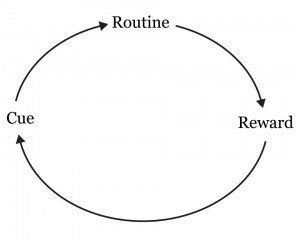
The cue. This is the trigger that starts your habit. Example: You get an email notification.
The routine. The habit that follows the cue. Example: You open the email.
The reward. The benefit you gain from doing the habit. Example: You get to know what the email is about.
If you perceive the reward as positive, you’ll want to repeat the loop again the next time the cue shows up. Repeat this sequence enough times and you’ll create a habit.
Thinking about your habits in this framework is very helpful because it helps you see what initiates the behavior, what the behavior is, and the reward you get from it.
This is very powerful because by breaking your habits down into these parts, you can start manipulating them to get them to work for you.
Substitution Habits
You’ve probably noticed that habits are hard to break. It’s a much more effective approach to replace them.
For example, if you smoke when you get stressed, it’s usually a pretty bad idea to just stop smoking. Instead, you should come up with a different way to deal with the stress and insert that behavior into the loop.
If your old habit loop looked like this:
Cue: Stress –> Routine: Smoking –> Reward: Calm
… Your new one might look like this:
Cue: Stress –> Routine: Going for a walk –> Reward: Calm
Your cue and reward stay the same. All you change is the routine.
Obviously, quitting smoking isn’t as easy as just going for a walk. But if you experiment with different substitution habits (while using other aids at the same time) you’ll increase your chances of success.
Enroll in Toilet University
 There are plenty of ways you can make positive changes in your behavior by using substitution habits.
And they don’t have to be huge to have a significant, positive impact on your life.
One of the funniest examples I’ve come across is MJ DeMarco’s “Toilet University” habit. In his book, The Millionaire Fastlane (3), he writes:
“Never throne without reading something of educational value.”
If you spend 15 minutes on the toilet every day reading on your phone, that translates into 90+ hours every year.
How much could you learn in that amount of time if you watched videos from Big Think, ASAP Science or The School of Life every time you ‘throned’?
Or read excellent blogs or book summaries about your area of expertise?
Talk about giving a shit about your education! (Sorry, I couldn’t help myself.)
Substitution Habit Examples
Here are a few more ideas for how you can use substitution habits to easily improve your life:
Waking up — Instead of falling back to sleep, use your snoozing time to think about three things you’re grateful for.
Relaxing — Instead of watching TV shows, read a great book.
Standing in line / Stuck in traffic — Instead of restlessly waiting, use this time to practice some mindfulness.
Walking / Running — Instead of just moving from point A to point B, listen to an educational podcast.
Housekeeping — Combine doing the laundry, dishwashing, and cleaning with an audiobook.
Taking a break — Instead of reading celebrity gossip, relax your mind with five minutes of meditation.
Snacking — Throw away your unhealthy snacks and prepare healthy alternatives.
Walk in the door rule — No matter what your day has been like, always talk about the best thing that happened first (4).
Going up — Always choose the stairs rather than the elevator.
Getting into to bed at night — Turn off your phone and write in your journal.
By themselves, small changes like these won’t make much of difference. But if you systematically start adding one after another, together they can create massive change.
That’s because substitution habits are simple enough to help you just get started.
And when you get started, you start building momentum.
And once you’ve got momentum, it’s only a matter of time before your efforts start compounding on themselves and create positive ripple effects across all areas of your life.
It All Starts With One Tiny Habit
If you like the idea of substitution habits, I encourage you to try one out right now. The time to take action is when the inspiration is high.
Within the next 10 minutes, take these steps:
Pick ONE substitution habit. If you try making several changes at once, they’ll all likely fail. Don’t overwhelm yourself. Use the list above for inspiration and decide on one change you’re going to make.
Create an “implementation intention”. Frame your goal in an IF –> THEN statement. The ‘If’ should represent your cue, and the ‘Then’ is your habit. For example: IF I sit down on the living room couch, THEN I’ll read my book.
Pick a reward. Celebrating small successes is a powerful way to reinforce good habits. A tiny reward can get you addicted to your new behavior. An excellent way to do this is to check off your habit in a habit tracker. My favorite is Coach.me.
Manipulate your environment. Change the “activation energy” of your habits. Make your substitution habit as easy as possible to do and the old habit as hard possible to do. For example, put a great book right next to your couch and put the TV remote in another room.
Rehearse the new habit. By practicing the substitution habit a couple of times, you’ll be much more likely to remember it. You can do this in the environment where the habit will take place, or in your imagination.
Schedule a weekly review. Take 15 minutes every week to review the progress in your habit tracker. Did you complete your habit every day? If not, ask yourself what got in the way. Then adjust your approach for the following week. There are no failures, just valuable data.
Once you’ve completed these five steps, it’s all about showing up and doing the habit every day. Know that there likely will be some resistance in the beginning, but that it will get easier over time.
The Best Way to Easily Improve Your Life, In Summary:
The best way to easily improve your life is to change your habits.
The habit loop consists of three parts: a cue, a routine, and a reward.
By breaking your habits down into these parts, you can manipulate them to work for you.
You can use substitution habits to replace negative or neutral habits with more empowering ones.
Substitution habits help you get started, build momentum, and create positive ripple effects across all areas of your life.
To get started, pick ONE habit, create an implementation intention, choose a reward, manipulate your environment, rehearse the new habit, and schedule a weekly review.
Make one small empowering change today. When that habit is in place, make a new one. And then another.
With time, you’ll start feeling and acting like a completely different person. And before you know, your life has changed for good.
“We first make our habits, and then our habits make us.” – John Dryden (Tweet that)
Sources
Habits—A Repeat Performance
The Power of Habit: Why We Do What We Do in Life and Business
The Millionaire Fastlane: Crack the Code to Wealth and Live Rich for a Lifetime!
Leave Problems at the Office with the “Walk in the Door” Rule
The post This is The Best Way to Easily Improve Your Life, Backed by Research appeared first on Selfication.
August 23, 2016
The Simple Habit That Will Make You Happy, Backed by Research
In his book, Peace is Every Step (1), the Buddhist monk, author and peace activist Thích Nhất Hạnh writes:
When I see someone smile, I know immediately that he or she is dwelling in awareness.
This half-smile, how many artists have labored to bring it to the lips of countless statues and paintings?
I am sure the same smile must have been on the faces of the sculptors and painters as they worked.
Can you imagine an angry painter giving birth to such a smile?
Mona Lisa’s smile is light, just a hint of a smile.
Yet even a smile like that is enough to relax all the muscles in our face, to banish all worries and fatigue.
A tiny bud of a smile on our lips nourishes awareness and calms us miraculously. It returns us to the peace we thought we had lost.
The Science of Smiles

We all know that when we feel happy, we tend to smile. But did you know that this works the other way around, too?
Just like Hạnh suggests, a gentle smile seems to have the power to “banish all worries and fatigue.”
When we smile, it causes us to feel happy.
Within the science community, this idea dates all the way back to Charles Darwin. He was one of the first to suggest that physiological changes caused by an emotion had a direct impact ON, rather than being just the consequence OF that emotion (2).
In modern science, this idea is called “The Facial Feedback Hypothesis,” and states that:
“Facial expressions are not only the results of our emotions but are also capable of influencing our emotions. In other words, the act of smiling can itself actually make you feel happier.” (3)
The Benefits of Smiling
According to behavior change expert Mark Stibich, research has shown smiling can (4):
Make you more attractive to others. People who smile draws us in.
Relieve stress. Smiling can reduce stress even if you don’t feel like smiling or even KNOW that you are smiling.
Elevate your mood. A smile can trigger the release of mood-boosting neurotransmitters like dopamine and serotonin.
Elevate the moods of others. Since we tend to mimic the facial expressions of those around us, your smile can make the people around you happier, too.
Boost our immune system. The act of smiling relaxes you, which helps your immune system to function more efficiently.
Lower blood pressure. When you smile, there is a measurable reduction in your blood pressure.
Make you feel good. Smiling is a natural anti-depressant. Studies have shown that smiling releases endorphins, natural pain killers, and serotonin that makes you feel good.
So, you don’t need a “reason” to smile. The smile itself is reason enough.
Smile Therapy
With all these benefits in mind, we should aim to smile more often in our lives.
I suggest we set up our daily smile therapy using exercises like:
The Wake Up Smile — When your alarm goes off in the morning, spend a couple of minutes smiling. Be grateful for the fact that you get to spend another day in this world.
The Meditation Smile — Every time you sit down to meditate, do it with a light smile on your lips.
The Morning Walk Smile — When you head out the door in the morning, meet the world with a smile. Spend a couple of minutes walking and counting the blessings in your life.
The Greeting Smile — When you’re about to meet a friend, take a minute to reflect on how happy you are to have this person in your life. Then greet him or her with a contagious smile.
The Telephone Smile — Each time your telephone rings, pause for a couple of seconds and smile. The conversation will be much better for it.
The “Walk In The Door” Smile — No matter what your day has been like, greet your family/friends/cat with a smile when you come home. Make a point out of always telling them about the best thing that happened that day as soon as you walk in the door (5). This will start you evening off on a positive note.
The Goodnight Smile — Spend the last minutes of your day smiling. Think about what went well that day and why. Drift off to sleep with a smile on your face.
These are just some examples, of course. Hopefully, they’ll inspire you to create your own smile therapy exercises.
Let’s get our Mona Lisa on!