Patrik Edblad's Blog, page 20
August 16, 2016
This is How to Consistently Make Progress on Your Goals
Jack Nicklaus is widely regarded as the greatest golf player of all time.
During his career, he racked up 18 major championships, 19 second places, and 9 third places over a period of 25 years (1).
When asked what makes a golf player great, Nicklaus gave a fascinating answer:
“I have always felt that the mettle of a player is not how well he’s playing when he’s playing well, but how well he scores and plays when he’s playing poorly.” (2)
No matter what your goals are, this is a key idea to keep in mind. Let me explain why.
The Importance of Playing Poorly Well
We all know what it’s like to work on our goals when we’re feeling inspired. And it’s pretty awesome.
Without much effort, we find ourselves doing the required work day after day.
There’s a feeling of effortlessness as our burning motivation carries us through each task.
Unfortunately, we’re all also very familiar with what happens when that initial inspiration goes away.
Suddenly, we have to muster up a ton of willpower to get anything done.
What previously came together pretty much all by itself now requires a ton of discipline.
It’s in these moments that it’s crucial we learn how to play poorly well.
The Power of Momentum
The team at Coach.me (where I’m one of the coaches) build all their coaching training around one core principle — momentum (3).
The reason for this is that when a client is sitting on their couch doing nothing, it can be very hard to spark a change.
But when someone is actively moving toward a goal, suddenly there are thousands of opportunities to do it.
With consistent action comes greater confidence and optimism. You can measure what’s working and make continual refinements. And you have constant opportunities to celebrate small wins to reinforce good habits.
Momentum is a super important principle in behavior change. And it’s also one of the most overlooked.
Momentum First, Results Second
We tend to think about our habits in a vacuum: “If I skip the gym today, it won’t make much of a difference in my long-term results.”
And although this is true, we’re forgetting about the importance of momentum.
If you skip one day, you might as well skip two. If one day off doesn’t affect your results, two won’t either.
Once you’ve skipped two days, you might as well skip the entire week. It still won’t affect the results much, and you’ll get a fresh start on Monday, right?
Well, not really. With all of your momentum gone, it will be much harder to get back into your routine.
It might take you weeks, months, or even years to get going again.
And this is why, on any given day, it’s not your results that are important.
What’s important is that you keep your momentum going.
Keep Big Mo Happy
Author Darren Hardy refers to momentum as his friend “Big Mo”:
“You can’t see or feel Mo, but you know when you’ve got it. You can’t count on Mo showing up to every occasion, but when it does – WOW! Big Mo can catapult you into the stratosphere of success. And once you’ve got Mo on your side, there’s almost no way anyone can catch you!” (4)
In my experience, it only takes a couple of missed occasions to scare off this precious friend.
If you miss one day, Mo gets cranky. If you miss two days, he’s packing his bags. If you miss three, he leaves and won’t return for a LONG time.
So, how do you develop the consistency to always have Big Mo by your side?
You learn how to play well when you’re playing poorly.
Minimum Daily Quotas
We all have days when we’re not on top of our game. And it’s crucial for our success to be prepared for these occasions.
The most effective strategy I’ve come across for playing well when I’m playing poorly is minimum daily quotas.
Whenever I find myself particularly tired and uninspired, I forget about the results. And instead, I focus on getting the absolute minimum done so I can keep Big Mo happy.
Instead of writing 1,000 words, I write 100.
Instead of going to gym, I go for a run or a brisk walk.
Instead of meditating for 10 minutes, I sit for 2 minutes.
I find a way to do something, no matter how small, to move me closer to my goal.
By doing this, I ensure I make some progress every day and keep myself from having to start over without Mo.
And as a very nice bonus, once I hit my minimum daily quota, more often than not, I’ll find that I’ll WANT to keep going.
Almost always, getting started is the hardest part. So by aiming for a smaller goal than usual, you can often “trick” yourself into what becomes a great performance.
And that’s a very powerful tactic for playing poorly well.
How to Consistently Make Progress on Your Goals, In Summary
You never know when inspiration will go away. Therefore, you need to know how to play poorly well.
Momentum is a super important principle in behavior change.
On any given day, your results aren’t nearly as important as keeping Big Mo happy.
If you miss one day, Mo gets cranky. If you miss two days, he packs his bags. If you miss three, he’ll leave and not come back for a long time.
When you’re not at the top of your game, use daily minimum quotas to keep Mo happy.
By aiming for a smaller goal, you can often “trick” yourself into what becomes a great performance.
It’s okay to have days when you’re not on top of your game. We all have them. What’s important is that you still show up every single day and make some sort of progress.
Play poorly well and keep your momentum going. If you can do this, the results you want will show up as a natural side effect of your consistent efforts.
“It does not matter how slowly you go as long as you do not stop.” – Confucius
Sources
Jack Nicklaus
The Secret of Golf: The Story of Tom Watson and Jack Nicklaus
Momentum Methodology for Accountability Coaches
Darren Hardy
The post This is How to Consistently Make Progress on Your Goals appeared first on Selfication.


August 11, 2016
This is How to Get Really Good at What You Do
I wrote my first article ever in April of 2013.
When I published it, I had three readers; my mom, my brother, and my girlfriend.
Back then, I couldn’t even imagine that my writing would someday get featured by some of the most popular publications in the world.
I mean, why would it? English isn’t my native language, and I’d had almost no experience with writing.
Fast forward three years and huge publications like The Daily Muse and Lifehacker have used my articles.
And 2,500+ awesome readers have joined my newsletter.
How did this happen?
Mastering the Fundamentals
I’m well aware that I’m not the greatest writer in the world. Far from it.
But I think I’ve built enough expertise to have something helpful to say about how to develop it.
And, as I’ve done many times before, I’ll be emphasizing the importance of mastering the fundamentals.
As I see it, there are two types of fundamentals:
Universal fundamentals — These are the keystone habits every human needs to feel great and perform at their very best.
Individual fundamentals — These are the specific areas you need to work on consistently to become a master at your craft.
Let’s look closely at both of them.
Universal Fundamentals
The Spartans had a Warrior Creed I try to live my life by. It said: “He who sweats more in training bleeds less in war.”
It doesn’t matter whether you’re a Spartan warrior (although, that would be pretty badass), a writer, a painter, a teacher, a construction worker, or something else entirely.
No matter what you do, you need to prepare yourself like an athlete.
If you want to become so good they can’t ignore you; you have to arrange your days in a way that you feel great and consistently perform at your very best.
There are four fundamental keystone habits for doing this.
The benefits of each one of them are so powerful that scientists often refer to them as natural ‘magic pills’.
Master them all at once and you’ll naturally slip into peak performance.
These habits are:
Eating healthy.
Exercise.
Sleep.
Meditation.
(To learn more about these universal fundamentals, and how to make them a natural part of your life, click here.)
Individual Fundamentals
Warren Buffett is considered one of the most successful investors in the world and consistently ranks among the world’s wealthiest people (1).
In his 1996 Shareholder Letter (2), he wrote:
What an investor needs is the ability to correctly evaluate selected businesses. Note that word “selected”: You don’t have to be an expert on every company, or even many. You only have to be able to evaluate companies within your circle of competence. The size of that circle is not very important; knowing its boundaries, however, is vital.
No matter what you’re trying to get really good at, the ‘circle of competence’ concept is very useful.
By answering the question: “What will my circle of competence be?”, you’ll know your boundaries.
You’ll understand where to focus your efforts and, perhaps even more importantly, where to stop wasting your time.
My individual fundamentals are:
Teaching — Writing, coaching & (at some point) speaking.
Learning — Habits, behavior change & how to live.
Promoting — Get my work in front of as many people as possible.
As long as I’m spending the bulk of my time within these areas, I know I’m on the right track.
Each day that I learn something, teach something, and promote what I teach, is a day well spent because my circle of competence has gotten stronger.
But I’m using my individual fundamentals as an example, of course. Your list will likely be very different from mine.
What’s important is that you take the time to uncover them. Because once you do, you’ll be able to focus your energy consistently within your unique circle of competence.
And that way, you’ll consistently get better and better at your craft.
Focus on Your Fundamentals by Default
I sort everything in my daily schedule into buckets related to my fundamentals.
If something doesn’t fit into one of them, I always ask myself an extra time if it’s something I should be doing.
Most likely, it’ not, and I delete it so I can put as much time as possible back into my fundamentals instead.
By doing this, I arrange my days so that I naturally turn my attention to what’s most important by default.
Does this guarantee that I always get the most out of my days? No, but it makes it far more likely.
Brick by brick, I keep building my fundament until it’s strong enough to support my dreams.
And this is how I’ve made the successes I’ve had so far possible.
How to Get Really Good at What You Do, In Summary:

To get really good at what you do, you need to master the fundamentals.
There are two types of fundamentals; universal and individual.
The universal fundamentals are eating healthy, sleep, exercise, and meditation.
Your individual fundamentals are in your circle of competence.
To consistently practice your fundamentals, schedule them, so they become what you do by default every day.
Now, I do realize that you may not have a 100 percent control over your schedule. If that’s the case, simply do what you can with what you have.
Figure out how to make a little time for your fundamentals each day.
Forget about the results you want, and instead start obsessing about showing up and laying at least one brick every day.
If you can do that, the results you want will inevitably show up as a side-effect of your consistent efforts. And probably much sooner than you think.
“Don’t judge each day by the harvest you reap but by the seeds that you plant.” – Robert Louis Stevenson
Sources
Warren Buffett
Warren Buffett’s 1996 Shareholder Letter
Thank you
Joel Lindmark (Society6), for creating the image in this article.
The post This is How to Get Really Good at What You Do appeared first on Selfication.
August 2, 2016
This is How to Figure Out What to Do With Your Life
A reader recently reached out to me and asked:
Hi Patrik,
It would be identifying my own passion. How do I figure out what is that thing that would really make my life meaningful or pursuing that gives me a sense of fulfillment? I would really like to hear your views or personal experience on that subject.
Thanks,
Goutham
This is an important question that a lot of people struggle with, so I thought I’d share my thoughts in this article.
The Passion Hypothesis
In his excellent book, So Good They Can’t Ignore You: Why Skills Trump Passion in the Quest for Work You Love (1), author Cal Newport explains what he calls “The Passion Hypothesis”:
(…) to refer to the popular belief that the way to end up loving your career is to first figure out what you’re passionate about, and then pursue it (a strategy often summarized with the pithy phrase, “follow your passion.”)
The more I studied this hypothesis, the more I noticed its danger. This idea convinces people that there’s a magic “right” job waiting for them, and that if they find it, they’ll immediately recognize that this is the work they were meant to do.
The problem, of course, is when they fail to find this certainty, bad things follow, such as chronic job-hopping and crippling self-doubt.
If you’ve been stuck looking for your passion a long time, you can probably relate to all the confusion, overwhelm, and frustration it brings with it. But if the passion hypothesis isn’t helpful, what are you supposed to do instead?
Newport suggests you forget about finding your passion and instead start working on becoming so good they can’t ignore you.
The Craftsman Mindset
Instead of relying on the passion hypothesis, you should develop a “craftsman mindset”. Newport writes:
In a 2007 episode of the Charlie Rose show, Rose was interviewing the actor and comedian Steve Martin about his memoir Born Standing Up (2). They talked about the realities of Martin’s rise. In the last five minutes of the interview, Rose asks Martin his advice for aspiring performers.
“Nobody ever takes note of [my advice], because it’s not the answer they wanted to hear,” Martin said. “What they want to hear is ‘Here’s how you get an agent, here’s how you write a script,’ . . . but I always say, ‘Be so good they can’t ignore you.’ ”
In response to Rose’s trademark ambiguous grunt, Martin defended his advice: “If somebody’s thinking, ‘How can I be really good?’ people are going to come to you.”
This is exactly the philosophy that catapulted Martin into stardom. He was only twenty years old when he decided to innovate his act into something too good to be ignored.
“Comedy at the time was all setup and punch line . . . the clichéd nightclub comedian, rat-a-tat-tat,” Martin explained to Rose. He thought it could be something more sophisticated. It took Martin, by his own estimation, ten years for his new act to cohere, but when it did, he became a monster success. (…)
If you’re not focusing on becoming so good they can’t ignore you, you’re going to be left behind. This clarity is refreshing. It tells you to stop worrying about what your job offers you, and instead worry about what you’re offering the world.
This mindset–which I call the craftsman mindset-allows you to sidestep the anxious questions generated by the passion hypothesis—”Who am I?”, “What do I truly love?”—and instead put your head down and focus on becoming valuable. (1)
The Passion Hypothesis vs. The Craftsman Mindset
I love this piece of advice because it aligns perfectly with my experience.
Whenever I’ve tried to think my way to my passion, I’ve always ended up stuck and confused. The times I’ve made progress is when I’ve focused in on one thing and developed enough expertise that people naturally wanted my help.
And ironically, this is where passion has shown up. Because when you get so good at something that you are making a difference in people’s lives, you can’t help but feel it.
So, don’t worry about how to find your passion. Instead, focus on becoming so good they can’t ignore you.
In other words, don’t ask what the world can do for you, but what you can do for the world. This way, you’ll be in a much more empowered position to find meaningful work.
How to Get Started
At this point, you may be thinking something like “OK, I get it. That all sounds good. But I still don’t have a clue where to get started! I mean, WHAT should I get so good at that they can’t ignore me?!”
So, let’s have a look at how you can set yourself up in the best way possible to offer your unique strengths to the world.
The most useful advice I’ve come across for doing this comes from the book Good to Great: Why Some Companies Make the Leap… and Others Don’t (3). In it, the author, Jim Collins, describes a framework called:
The Hedgehog Concept
This concept is based on an ancient Greek parable that states: “The fox knows many things, but the hedgehog knows one big thing.”
In the parable, the fox tries every strategy it can think of to catch the hedgehog. But no matter how much sneaking, pouncing, racing, and playing dead it tries, the result is always the same. The hedgehog curls up into a ball, and the fox gets his nose full of spines.
The moral of the story is that it’s much more powerful to know how to do one thing perfectly, than doing a lot of things decently.
You can find your hedgehog, your ONE thing, by making three separate assessments:
What you like to do.
What you’re good at.
What the world will pay you for.
Your hedgehog sits pretty where all these areas overlap:
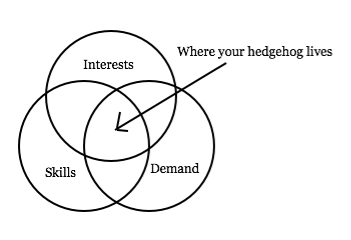
Let’s take a look at each of these areas separately:
What Your Interests Are
According to Collins, if you are going to do great work, you need to have a passion for it. In this article, I’ve toned the first circle down from passions to interests to help you avoid overwhelm. In my opinion, an interest is enough since it can blossom into a passion if you get really, really good at it.
To figure out what belongs in this circle, you can ask yourself questions like:
What did I spend time doing as a kid?
What activities absorbs me so much that I forget to eat and sleep?
If money wasn’t an issue, what would I spend my time doing?
What You’re Good At
Next, you need to consider what strengths and skills you currently possess. This can be a bit tricky since they’re usually so natural to you that you don’t even consider it a strength or skill. Here are some helpful exercises:
Take a personality test. For example, the Myers-Briggs or Big Five.
Take a character strengths test. For example, the VIA survey.
E-mail the people closest to you. Ask them what they consider your biggest strengths and skills to be, and why.
Ask yourself what people tend to ask you for advice about.
What the World Will Pay You For
Finally, you need to combine what you love to do, and what you’re good at with the needs of the world. Ask yourself:
How can my unique interests and strengths can be used in the marketplace?
What jobs does best match my interests and strengths?
What problems can I solve that people are willing to pay for?
Finding Your Hedgehog
Note that having only two of the areas overlapping is a problem:
If you combine interests and skills, but there’s no demand what you have is most likely a hobby.
If you combine interests and demand but have no matching skills or strengths, it’ll probably be hard to get so good they can’t ignore you.
If you combine skills and demand but have no interest, you’ll probably end up with a job you don’t like and risk getting burned out.
Finding your hedgehog usually requires some pretty hard work and deep reflection. But when you find it, you have a very powerful position to start working on getting so good that they can’t ignore you.
And when you do that, when you start to work consistently toward getting better at what you do every day, it’s only a matter of time before you find meaningful and fulfilling work.
And that’s a pretty damn beautiful place to be.
How to Figure Out What to Do With Your Life, In Summary:
The Passion Hypothesis (find your passion and pursue it) is flawed advice that leads to overwhelm, confusion, and frustration.
The Craftsman Mindset (get so good they can’t ignore you) helps you sidestep these obstacles by focusing on becoming valuable.
Therefore: Don’t ask yourself what the world can do for you. Ask yourself what you can do for the world.
The Hedgehog Concept can help you figure out the ONE thing you should offer to the world.
Your hedgehog lives where your interests and skills overlap with what the world is willing to pay for.
If this article has got you thinking, it’s time to get out your journal and get to work. The world is waiting for you to offer your unique strengths to it. How will you become so good we can’t ignore you?
Sources
So Good They Can’t Ignore You: Why Skills Trump Passion in the Quest for Work You Love
Born Standing Up: A Comic’s Life
Good to Great: Why Some Companies Make the Leap… and Others Don’t
Thank you
Goutham, for the excellent question that inspired this article.
If you have a question you’d like me to answer, drop me a message. I look forward to hearing from you!
The post This is How to Figure Out What to Do With Your Life appeared first on Selfication.
July 26, 2016
This is How to Get Better at What You Do, Every Single Day
I talk a lot about the importance of starting small when you’re just getting started with a new habit.
And this is indeed an important and very powerful strategy for establishing a new behavior.
Starting small allows you to get out of your head and start building the momentum necessary to make the habit stick.
But once your new behavior is a reliable part of your daily routine, it’s equally important to increase your efforts to get better at what you do.
The Process of Supercompensation
In sports science theory, there is a fundamental principle of athletic training known as “supercompensation” (how’s that for a badass word?).
This concept refers to “the post-training period during which the trained function/parameter has a higher performance capacity than it did prior to the training period”. (1)
The idea is that since the human body is an adjustable organism, it will not only recover from the exercise. It will also adapt to the new strain placed on it and get a little bit stronger than it was before:
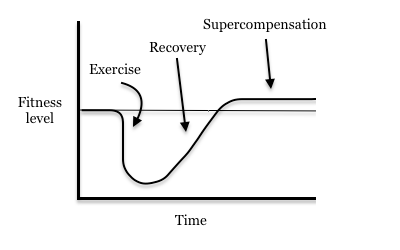
But the thing is, supercompensation will only occur if you increase your efforts to a level that is higher than your body is already used to.
And this is, unfortunately, where a lot of people get it wrong. According to sports scientist, the most common mistake regular exercisers make is doing the same workout over and over again.
When you do that, there’s no new level of strain for your body to adapt to and because of that, no supercompensation will occur:
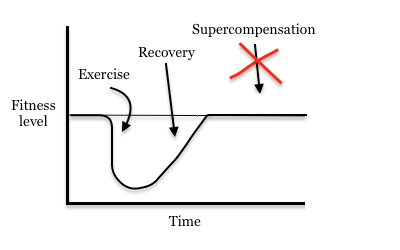
Albert Einstein once said that “the definition of insanity is doing the same thing over and over again, but expecting different results.” (2)
So, if you want your fitness level to improve, you can’t settle for running the same trail at the same intensity week in and week out. That would be NUTS. Hey, it was Einstein who said it (2). Not me.
For supercompensation to occur, you need to consistently push yourself to run a little bit faster or longer than what you’re already used to.
How to Get Better at What You Do, Every Single Day
And the concept of supercompensation isn’t just helpful for fitness. In fact, it’s a very useful concept for any positive change you’re trying to create:
Want to be more mindful? Add one minute to your meditation habit every month.
Want to sleep better? Make one small improvement to your bedroom every week.
Want to clean up your diet? Remove one type of unhealthy food from your diet every week.
Want to become a prolific writer? Add 100 words to your daily writing goal every month.
You get the idea. Once your habit is up and running, don’t settle for putting in the same amount of effort every day. If you do, your growth will quickly plateau.
Instead, always look for ways to raise the bar just a little bit and push yourself to get better at what you do.
If you can do that, your consistent, tiny improvements will lead to massive results over time.
Let’s get our supercompensation on! Where will you get started?
Sources
Supercompensation
Although Albert Einstein is widely credited for saying this, there’s actually no evidence that supports it. I say, let’s let him have it.

July 19, 2016
This is How to Overcome Perfection: The Power of “The Shitty First Draft”
In her excellent book, Bird by Bird: Some Instructions on Writing and Life (1), author Anne Lamott writes:
“(…) Shitty first drafts. All good writers write them. This is how they end up with good second drafts and terrific third drafts.
People tend to look at successful writers who are getting their books published and maybe even doing well financially and think that they sit down at their desks every morning feeling like a million dollars, feeling great about who they are and how much talent they have and what a great story they have to tell; that they take in a few deep breaths, push back their sleeves, roll their necks a few times to get all the cricks out, and dive in, typing fully formed passages as fast as a court reporter.
But this is just the fantasy of the uninitiated. I know some very great writers, writers you love who write beautifully and have made a great deal of money, and not one of them sits down routinely feeling wildly enthusiastic and confident. Not one of them writes elegant first drafts. (…)”
The Power of Shitty First Drafts

I’ve found this idea of shitty first drafts very helpful in my writing. Before I started writing shitty first drafts, I’d waste tons of time and effort crafting the next sentence in my text. And when I’d finally move forward in the text, I’d often end up scrapping the sentence anyway since it didn’t fit well in the context of the paragraph.
As a result, more often that I’d like, my total word count would add up to a grand total of zero (or even -200 or so, if I felt the need to edit some words from the day before). As you can imagine, this was not a very exciting nor motivating way to work.
Allowing myself to write shitty first drafts helped me get rid of this problem. And as a result, I’m now able to write 1,000+ words every day.
How to Overcome Perfection in All Areas of Life
I have been thinking a lot about the shitty first draft concept lately, and I’m convinced it’s not only helpful for writers.
No matter what you’re trying to achieve, you need to consistently put in the effort to get there.
You need to learn how to just get started. Again and again and again.
Because it’s only when you get out of your head and start taking action that you’ll start building the necessary momentum to reach your goal.
Want to be more mindful? Have a shitty meditation session. Don’t worry about if you’re doing it right or if your mind is going bananas. Just sit down and focus on your breath for a few minutes.
Want to save money? Put a shitty amount in a savings account. Even if it feels like an insignificant sum of money, make the deposit anyway.
Want to eat healthily? Make one shitty dietary change. Forget about finding the perfect balance of carbs, fats, and proteins. Just add one vegetable to one of your meals.
Want to have great relationships? Pick up the phone and make one shitty phone call. Forget about what’s been said or done in the past. Just make the call.
Want to get fit? Have a shitty workout session. Forget about figuring out the perfect training program. Just go to the gym and get your reps in.

You get the idea. Instead of overwhelming yourself with the high-level stuff, just do one shitty thing, and do it NOW.
The reason this idea is so powerful is that it allows you to lower your expectations so you can stop thinking and start doing. And nothing cures perfectionism like good ol’ action-taking.
“Shitty First Drafts Lead to Terrific Third Drafts”
The real power in the shitty first draft mindset comes from executing on it consistently. That’s because when you start racking up shitty actions on a daily basis, you allow the compound effect to get to work. And once you’ve got some serious momentum going it will be harder to stop than to keep going.
With enough repetition, your efforts will start feeling a lot less shitty. In fact, they’ll start feeling perfectly fine. In some cases, even pretty good. And when this starts happening, you’ll naturally develop the sense of competence necessary to get really, really good at what you do.
And from this point forward, it’s only a matter of time before you reach your goal.
But always remember that it all starts with that shitty first draft. So, whenever you start feeling overwhelmed, forget about the results and focus on the process instead.
If your mind starts telling you that what you’re doing isn’t good enough, remember that this is the shitty first draft. It’s SUPPOSED to be bad. And know that the quality will come later, but only if you focus on the quantity first.
Now, figure out what shitty little action you could take right now and go do it. Your future self will be grateful you did.
Source
Bird by Bird: Some Instructions on Writing and Life by Anne Lamott
Thank you
Joel Lindmark (Society 6), for creating the images in this article.
The post This is How to Overcome Perfection: The Power of “The Shitty First Draft” appeared first on Selfication.
July 12, 2016
This is the #1 Way to Become Who You Want to Be
Imagine sitting down at a table in a small room with seven other people.
You’re all about to participate in a psychology experiment concerning people’s visual judgments.
The experimenter places two cards in front of you. The card on the left contains one vertical line. The card to the right has three lines of varying length.
The whole group is now asked, one at a time, to choose which of the three lines on the right card that matches the length of the left card. This task is repeated several times with different cards.
Everything is going smoothly. But then, all of a sudden, the entire group unanimously choose what is clearly the wrong line before it’s your turn.
The experimenter turns to you. What would you say?
The Science of Conformity

As is often the case with psychology experiments, the experimenter has played a little trick on you.
In reality, you’re the only participant. All the other people at the table are actors who have been carefully instructed to give the wrong answer simultaneously to some of the cards.
It’s not your visual judgment, but your level of conformity to the rest of the group that’s being tested.
This clever study design is one of the most famous ones in psychology and was initially conducted by Salomon Asch (1). And the results he got were remarkable.
On average, about 33 percent of the participants who were placed in this situation conformed to the clearly incorrect majority. Over 12 attempts, about 75 percent conformed at least once (!).
In the control group, where there was no pressure to conform, less than 1 percent of participants gave the wrong answer.
How We Adapt to the People Around Us
Human beings are social creatures. Our need for belonging is very strong. Apparently, so much so that we prefer giving an answer that is clearly wrong as long as it makes us feel part of the group.
This tendency to adapt to the people around us has some serious practical implications for our lives. One study, for example, showed that if your friend becomes obese, your risk of obesity increases with 57 percent (2).
Social scientists are well aware of how much we affect each other. They know that humans have a strong tendency to adopt the same goals (3) and even the same feelings (4) as the people around them.
In other words, it’s been well documented that:
If you hang out with people who are pessimistic and lazy, you’re likely to feel as negative and perform as poorly as they do.
If you surround yourself with enthusiastic and hard-working people, those are the feelings and attitudes you’ll adopt instead.
The People Around You Determine What’s Normal
A couple of months ago, I was regularly writing 1,000 words per day. I felt like I was stretching myself and considered dropping back to 500 words per day. Then my accountability coach Nik told me that he was writing SEVERAL thousand words every day for his 4 Minute Books site (which is awesome, by the way).
Suddenly, my 1,000 words a day goal didn’t feel like such a stretch anymore. And instead of lowering it, I found ways to increase it. By just telling me about his goals, Nik had successfully raised the bar for what was normal for me. If I didn’t have him in my corner, I would’ve lowered my goal instead.
And this kind of influence affects us all the time in every area of our lives. If the people around us have high standards, we’ll naturally adjust our own to match theirs. Unfortunately, if they have very low standards, that’s the way we’ll tend to gravitate instead.
How to Become Who You Want to Be
And this is why it’s so important to have the right people in your corner. If you want to realize all your potential, you need to surround yourself with individuals who are already at the level you want to be at (or who are at least enthusiastically pursuing the same goals as you are). Here are some ideas:
Start a mastermind group. Put together a group of 3-5 people with similar goals. Meet up in person or online for an hour once a week to give each other feedback and encouragement.
Get an accountability partner. Team up with one person and talk regularly about a specific goal you’re both pursuing.
Read great blogs. No matter what you’re trying to get better at, chances are there is plenty of blogs on the topic. Collect your favorite writers in a Feedly account and let their goals and attitudes rub off on you every day.
Go to meetups. Find or start a meetup group on Meetup.com.
Get a coach. If you’re up for it, I’d love to work with you!

July 5, 2016
This is the Best Way to Change Your Habits
We often assume that we do what we do because of who we are.
But the truth is, a lot of what we do is the result of where we are.
A fascinating study by researchers Eric Johnson and Daniel Goldstein (1) beautifully illustrates this point.
What they did was investigate the answers people gave to the following question:
Would You Like to Be an Organ Donor?
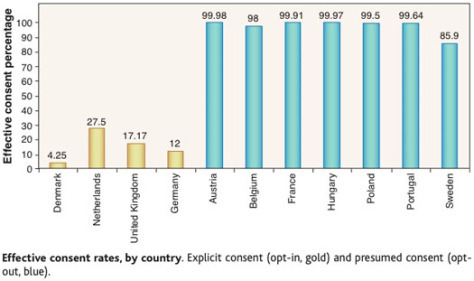
This graph (2) shows the percentage of people, across a number of European countries, who are willing do donate their organs after they pass away.
Notice the HUGE difference between the countries on the left and the countries on the right. How can this be?
At a first glance, you may think some high-level reason like culture or religion probably caused these results, but at a closer look, this doesn’t make sense.
Denmark and Sweden, The Netherlands and Belgium, Austria and Germany — these are all countries with similar cultures and religious beliefs. Still, their organ donations percentages are very different. How could this be?
The Default Effect
 As it turns out, what explains these differences is the design of the form related to organ donations in each region.
In the countries where the form has an ‘opt-in’ design (check this box if you WANT to donate your organs), people tend not to check the box.
In countries where the form has an ‘opt-out’ design (check this box if you DON’T want to donate your organs), people ALSO tend not to check the box.
No matter which one of these form designs people are presented with, an overwhelming majority of them will choose to stay with what they already have.
In psychology, this tendency is known as “The Default Effect” (3) and it shows up all the time in our lives.
What Are Your Default Options?
 We rarely pay attention to this, but the default options we’re surrounded with every day have a huge effect on our behavior:
If we have cookies on the table, we’re likely to eat them.
If we have a remote control on the living room table, we’re likely to turn on the TV.
If we sleep with our phone next to our bed, we’re likely to pick it up first thing in the morning.
In many ways, we shape our environment and then our environment shapes us.
With that in mind, what does YOUR default design look like?
How well does it reflect the goals you want to achieve? The habits you want to adopt? The person you want to become?
Change Your Habits by Tweaking Your Default Design
Whenever you’re trying to change your habits, start with your default design. Ask yourself if your environment is supporting or sabotaging the behaviors you’re trying to create. Then tweak it to get the Default Effect to work for you every day. Here are some examples:
Want to learn more? Replace entertainment with educational apps in your phone.
Want to be more productive? Use digital commitment devices like StickK, Freedom, and SelfControl.
Want to sleep better? Ban all screens from your bedroom and place a great book next to your bed.
Want to finish more books? Remove entertainment podcasts from your phone and install an audiobook app.
Want to eat less? Get smaller plates. Seriously, it works (4).
In other words, shape your environment in such a way that you turn to your desired habit by every day by default.
This is easier said than done, of course. And if you’re anything like me, you’ll find yourself reverting to your unhelpful behaviors from time to time (my e-mail apps have a tendency to get mysteriously reinstalled now and again).
But if you keep being mindful of your default design, and keep adjusting it every time you fall back, you’ll gradually get better at changing your habits.
Sources
Defaults and Donation Decisions
3 main lessons of Psychology
Default effect
From mindless eating to mindlessly eating better
Thanks to
Joel Lindmark ( Society 6 ), for creating the images in this article.
The post This is the Best Way to Change Your Habits appeared first on Selfication.
June 28, 2016
This is the Fastest Way to Improve Your Life
Vince Lombardi is considered by many to be one of the best and most successful coaches in the history of professional football.
During the 1960’s, he led his team, the Green Bay Packers, to three straight and five total NFL Championships in seven years.
During this time, his team also won the first two Super Bowls following the 1966 and 1967 NFL seasons. Today, Lombardi is part of the Pro Football Hall of Fame, and the Super Bowl’s trophy is named in his honor (1).
Those are some pretty outstanding achievements. So, what was it that made this coach one of the greatest of all time?
A Ruthless Focus on the Fundamentals
In his book, When Pride Still Mattered: A Life Of Vince Lombardi (2), author David Maraniss describes what happened when Lombardi walked into his team’s training camp in the summer of 1961:
He took nothing for granted. He began a tradition of starting from scratch, assuming that the players were blank slates who carried over no knowledge from the year before… He began with the most elemental statement of all. “Gentlemen,” he said, holding a pigskin in his right hand, “this is a football.”
This is a football. Imagine being told that as a professional football player. You might just think that this guy is nuts. Yet, this methodical focus on the fundamentals was the start of Lombardi’s streak as one of the greatest football coaches in history.
And he’s not alone. A ruthless focus on the fundamentals has been a recurring theme of many successful coaches. Basketball legend John Wooden, for example, even taught his players how to put on their socks and tie their shoes (3). How’s that for fundamentals?
The Power of Keystone Habits
It’s very easy to forget about the basics. Still, mastering them is and has always been the fastest way to improve your life.
This is because when you’ve got your fundamentals down, it tends to create a positive ripple effect across all areas of your life.
Author and habit expert, Charles Duhigg, refers to these behaviors as ‘keystone habits’ (4).
For me, exercise has always been a huge keystone habit. Whenever I work out regularly, I tend to eat better, sleep better, feel better, be way more productive and so on. Conversely, whenever I’m missing workouts, all these other areas tend to take a hit as well.
If you think about it for a minute, I’m sure you’ll identify at least one habit that tends to work the same way for you. And if not, I’ve listed out four keystone habits below that you might want to experiment with.
How to Improve Your Life: The Principles
Now, just because you identify a possible keystone habit, that doesn’t mean it’ll be easy to stick to. If it were, it would probably already be part of your life. That’s why, before we get to the list of habits, I highly recommend you keep these principles in mind when implementing them:
One change only. That’s all you need. If you execute well on one keystone habit, the rest will likely fall into place by themselves.
Make it so small you can’t say no. When you’re starting out, always aim for a goal that is so small that it requires no willpower at all.
Use a trigger. Anchor your new habit to a behavior that is already a natural part of your daily routine. For example, exercise (new habit) right after breakfast (old habit).
Track your efforts. Use an app like Coach.me or Beeminder to keep track of your efforts. This will help build momentum and motivation.
Review your progress. A weekly review is an excellent way to do this. If your habit fails, figure out why, and improve your method. Or try another keystone habit.
Sound good? Let’s get to it!
4 Fundamental Keystone Habits
1. Eating healthy. It’s easy to forget about this, but the food we eat heavily influences how we feel and perform every day. As I write about in The Science of Willpower, the Glycemic Index (GI) (5) is a great resource for choosing what to eat. Low-GI foods associated with decreased risk for disease (cardiovascular disease, type 2 diabetes, metabolic syndrome, stroke, depression and more) and it also helps strengthen your self-control (6). So, add a vegetable to one of your meals. Eat a healthy snack in the afternoon. Pick one high-GI food and cut it out. Keep making a tiny dietary tweak like this every week and you’ll be surprised at how quickly your diet (and your tastebuds) changes.
2. Exercise. We all know physical activity is essential to our health and well-being. What’s perhaps more surprising is that neuroscientists have found that it’s also crucial for the brain’s ability to learn (7). So, if you want to be at your best — physically as well as mentally — exercise needs to be a regular part of what you do. Establish an exercise routine where you start too light, make tiny gains every week, and refuse to miss workouts.
3. Sleep. This is perhaps the most overlooked keystone habit there is. If you want to be healthy and perform well, proper sleep is an absolute necessity. Start prioritizing your sleep by setting clear rules for your evenings. Set an alarm in the evening to remind yourself to turn off all your screens at least one hour before bedtime. Spend this last hour winding down (reading, meditating, journaling, or something else you find relaxing). Turn your bedroom into a haven for sleep by making it slightly cool and as dark as you can to help your body relax deeply.
4. Meditation. This simple practice is a very powerful way to reduce stress and anxiety, increase creativity, sharpen mental focus, strengthen social relationships and much, MUCH more (8). I find myself recommending regular meditation to clients all the time. Take a couple of minutes each day to sit in silence and focus on your breath. When you find yourself lost in thought, gently and non-judgmentally return your attention to the flow of the breath. Repeat this process until the time is up.
Sum Up
If you want to be great, focus ruthlessly on the fundamentals.
Keystone habits are behaviors that tend to create positive ripple effects across all areas of your life.
Stick to the principles: One change at a time, make it so small you can’t say no, use a trigger, track your efforts & review your progress.
The four fundamental keystone habits are; Eat, Move, Sleep & Meditate.
Let’s get back to the basics!
“Success is neither magical nor mysterious. Success is the natural consequence of consistently applying the basic fundamentals.” — Jim Rohn
Special Offer: Get My Popular Plan for Free (Value $9,99)
If you’d like some personal attention in establishing your keystone habit, I have a special offer for you. If you sign up for coaching with me right now, I’ll give you a free lifetime membership to my popular plan The Science of Habits: 14 Days to Change That Sticks. To claim your free spot, follow these simple steps:
Go to my Coach.me coaching profile by clicking here.
Select the habit you’d like to be coached in and click “Start Free Trial”.
Use the promo code “PATRIKWEEK” to get the first week for free. That’s right, a free week AND a free plan to help you make your keystone habit stick once and for all!
June 21, 2016
This is the Fastest Way to Relieve Stress: 3 Research-Backed Secrets
Imagine that you’re participating in a study that has been carefully designed to stress you out.
As you enter the laboratory, you’re told that you have to give a five-minute improvised speech on your personal weaknesses to a panel of expert evaluators that will be sitting right in front of you.
To make sure you really feel the pressure, there will be bright lights and a camera in your face.
On top of that, the evaluators have been trained to give you discouraging, non-verbal feedback.
When the five minutes are up, it’s time for part two of the experiment, which is a math test. You’re now asked to count backward from 996 in increments of 7 while an evaluator deliberately harasses you for going too slow.
How much of a wreck would you be during this experience? If you’re like most people, you’d be stressed out of your mind. And that’s why stress researchers enjoy tormenting their subject with this test so much (1).
The Fight-or-Flight Response
When you’re put into a stressful situation like this, your body initiates what’s known as the fight-or-flight response. This reaction is an evolutionary adaptation that we’ve inherited from our ancestors, and it hasn’t changed much since our caveman days.
As a result, whenever we perceive a stressful stimulus, whether it be a sabre-toothed tiger or a panel of grumpy-looking “evaluators,” our body will launch the same biological reaction. Stress hormones start flooding the body and causes among many other things (2):
Increased heart rate.
Restricted digestion.
Dilated pupils.
Tunnel vision.
Increased blood flow to the muscles.
Faster blood clotting functioning to prevent excessive blood loss.
Increased muscle tension for extra speed and strength.
These would be some pretty fantastic adjustments if you were about to fight a massive prehistoric cat. But when you’re trying to make a good impression on a panel of judges? Not so much.
So, what can we do relieve stress in these situations? Here are three very helpful strategies backed by research:
1. Cognitive reappraisal
This is a fancy term that simply means changing the way you interpret certain things. When most people feel stressed, they tend to interpret it in negative ways. And this is definitely understandable, especially considering the bad rep stress has.
But while it is true that stress can have some pretty nasty negative effects, it is also true that it has lots of positive effects, as well.
Studies have, for example, shown that stress can increase the brain’s ability to process information (3) and that the hormones released during the fight-or-flight response can help improve memory and concentration in cognitive tasks (4).
What’s particularly interesting about this is that what you decide to focus on — the negative or positive sides of stress — will heavily influence how you perceive it and, in turn, how you perform (5).
Physiologically, anxiety and excitement are very similar, which means a lot of it comes down to how you decide to interpret the arousal you’re experiencing.
So, the next time you’re feeling stressed out, choose to interpret this as a feeling of excitement rather than anxiety. Your body isn’t having a nervous breakdown; it’s preparing itself for a top level performance.
Welcome the physical arousal. It would be much worse if you felt nothing because then your body wouldn’t be preparing at all.
2. Power posing
Have you ever noticed how you tend to close up and make yourself small in stressful situations?
This behavior is not unique to humans. You can see it everywhere in the animal kingdom. Dominant animals take up a lot of space while low power animals make themselves smaller.
And what’s fascinating about body language is that it works both ways. Research has shown that just as certain feelings makes us exhibit certain postures, these postures also make us feel in certain ways.
If you, for example, forced yourself to smile by biting a pencil, it would make you feel happier. This is known as the Facial Feedback Hypothesis (6).
Research by Amy Cuddy and her colleagues (7) has shown that you can use this to your advantage. By deliberately changing your body language from submissive to dominant, you can change the way you feel.
You do this by using what the researchers call ‘power posing,’ which is a very simple and straightforward technique.
All you need to do is take up space. Instead of making yourself small you deliberately spread out and exude confidence (even if you don’t feel it).
Doing this for just a couple of minutes will significantly increase your testosterone (”the dominance hormone”) while decreasing your levels of cortisol (”the stress hormone”), turning these hormone levels to those of powerful and effective leaders (8).
3. Deep breathing
Another great way to balance out the chemicals that flood your body during the fight-or-flight response is to induce what mind/body medicine Professor Herbert Benson refers to as the ‘relaxation response’ (9). An effective way to do this is to practice deep breathing (10):
Sit comfortably with your back straight. Put one hand on your chest and the other on your stomach.
Breathe in through your nose. The hand on your stomach should rise. The hand on your chest should move very little.
Exhale through your mouth, pushing out as much air as you can while contracting your abdominal muscles. The hand on your stomach should move in as you exhale, but your other hand should move very little.
Continue to breathe in through your nose and out through your mouth. Try to inhale enough so that your lower abdomen rises and falls. Count slowly as you exhale.
A couple of minutes of deep, proper breathing is all you need to elicit the relaxation response and help your body alleviate acute stress.
How to Relieve Stress, In Summary:
The next time you find yourself in a stressful situation, you can cool off by using the following techniques:
Change your thoughts. View the stressful feelings as excitement rather than anxiety.
Change your body language. Take up a lot of space and exude confidence.
Change your breathing. If your stress feels overwhelming, practice deep breathing for a couple of minutes.
These quick and simple strategies can make all the difference in how you feel and perform under pressure.
Footnotes
This is known as the “Trier Social Stress Test.”
Fight-or-flight response
On time distortion under stress
Enhanced Human Memory Consolidation With Post-Learning Stress: Interaction With the Degree of Arousal at Encoding
Mind over matter: reappraising arousal improves cardiovascular and cognitive responses to stress.
Nonverbal behavior and the theory of emotion: the facial feedback hypothesis.
Power Posing: Brief Nonverbal Displays Affect Neuroendocrine Levels and Risk Tolerance
Amy Cuddy — Your body language shapes who you are
The power of the relaxation response
Relaxation Techniques for Stress Relief
The post This is the Fastest Way to Relieve Stress: 3 Research-Backed Secrets appeared first on Selfication.
June 15, 2016
How to Practice Gratitude: 4 Secrets Backed by Research
Louis CK is one of my favorite comedians. In one of his bits, he talks about how air travelers have lost perspective on how amazing commercial flight actually is. Imitating a moaning passenger, he whines:
“I had to sit on the runway for 40 minutes.”
Then, he counters:
“Oh my god, really? What happened then, did you fly through the air like a bird, incredibly? Did you soar into the clouds, impossibly? Did you partake in the miracle of human flight and then land softly on giant tires that you couldn’t even conceive how they f**king put air in them?…You’re sitting in a chair in the sky. You’re like a Greek myth right now.” (1)
It’s All About Perspective
The fact that humans can fly is amazing. And so is pretty much everything else. I mean, have you ever considered what a miracle your existence is? Let’s look at some numbers. According to Dr. Ali Binazir’s calculations (2), the probability of you even existing at all (taking into account each of your ancestors reproducing successfully, your parents finding each other, the right sperm meeting the right egg, and so on) is about as likely as if:
“2 million people got together – about the population of San Diego – each to play a game of dice with TRILLION-sided dice. They each roll the dice, and they all come up the exact same number – say, 550,343,279,001.”
That’s pretty damn near impossible, and yet here you are. And if you’re like me, you routinely take this unfathomable miracle for granted. You might even complain about it from time to time.
So, why do we do that? Why can’t we appreciate our lives as the miracle it really is, and in the words of Louis CK, constantly yell “WIIIIIIIIIII!!!” every time we’re on a flight?
The Negativity Bias