Patrik Edblad's Blog, page 16
January 29, 2018
The Self-Discipline Blueprint is Launching on Monday!
Woho! After a lot of hard work, my new book, The Self-Discipline Blueprint, is finally finished.
I’m really proud of the final product, and I’ve received some fantastic feedback from reviewers and fellow authors.
Even the great Brian Tracy called it:
“A wonderful book that shows you how to take complete control over your life.”
I mean, how’s that for a quote to put on the cover? 


September 5, 2017
A Quick Update
Hey there,
I hope you’ve had a great summer!
This is a quick note to let you know that I’m about to wrap up the third and final draft of my next book, The Self Discipline Blueprint. I’m excited to send the manuscript to my editor and get it ready for launch!
If you struggle with procrastination, I think you’ll enjoy this one. You can get a FREE copy of the finished version if you sign up for my street team here. All I ask in return is that you leave a review on Amazon once I’ve published it.
As always, thanks for reading and supporting my work!
Now, I’ll return to my man cave and get the manuscript finished.
August 1, 2017
I’m Taking August Off From Blogging
This is a quick note to let you know I’m taking August off from writing articles.
The reason is I want to free up more time to finish my next book, The Self-Discipline Blueprint.
In the meantime, you’re more than welcome to check out the Selfication archives.
Enjoy the rest of the summer, and I’ll see you soon!
July 25, 2017
This is How to Stop Putting Things Off
Do you know the feeling?
You have a big goal you’re trying to achieve but, for some reason, you just can’t get yourself to take action.
Maybe you’re getting disappointed looks from the people who depend on you — or from the person you see in the mirror.
Perhaps you’re tired of you ever-expanding to do-list, the clutter that’s filling your house, or a passion project you never seem to get off the ground.
If so, you’re not alone. Some research suggests that one-fifth of adults and half of all students procrastinate 1.
And along with it comes decreased performance, worsened mental and physical health, and increased stress, anxiety, and guilt2.
Yuck.
Luckily, there’s a simple tool you can use to stop procrastinating, build a strong sense of motivation, and start getting things done.
The Procrastination Equation
Piers Steel is one of the world’s leading researchers in the science of motivation and procrastination.
In his book, The Procrastination Equation3, he outlines a formula that makes it super easy to understand why we put things off:
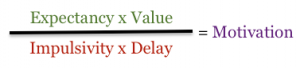
Steel put together the procrastination equation after analyzing hundreds of studies on motivation. In his own words, it is: ”inspired by the common elements that determine when we procrastinate and crafted together from the most deeply researched elements of social sciences’ strongest motivation theories. The Procrastination Equation accounts for every major finding for procrastination.”
It’s a bit abstract when you first see it, so let’s unpack it a bit.
If you’re not a math wizard, the first thing you need to notice is that if you want a big Motivation, you have to have a big numerator (above the line), and small denominator (below the line).
In other words, you want to have a high Expectancy and Value, and a low Impulsivity and Delay. So what do those words mean?
Expectancy
Do you expect to achieve your goal? If you’re going to have a strong motivation, you have to be confident that you make it happen.
If the expectancy is low, you can increase it by starting small and then increase the effort as your momentum grows.
Value
Do you value the outcome you’re going after? If you don’t, you’re going to have a tough time doing the work necessary to get there.
If the value is low, you can turn it up by aligning it with your ”why.” Establish your personal vision, and consistently remind yourself about how your daily work moves you closer to it.
Impulsivity
Does your impulsivity steal your focus away from the work that has to be done? Are you constantly interrupted by push notifications and email alerts?
If the impulsivity is high, you can decrease it by removing distractions and optimizing your environment for deep work.
Delay
Does your goal allow you to delay your efforts? In other words, is your deadline far away in the future? If so, you’re likely to put it off.
If the delay is high, you can turn it down by chunking it up. Create daily, weekly, and monthly targets to give you a consistent boost of small wins.
How to Stop Putting Things Off, Quick Summary
Whenever you feel unmotivated, use the Procrastination Equation.
Find ways to make the numerator as big as possible. Make sure you expect to achieve the goal, and that doing it is truly important to you.
Then, find ways to make the denominator as small as possible. Remove distractions from your environment and reduce the time to your deadlines.
To make it as easy as possible for you, I’ve created a Procrastination Equation Cheat Sheet you can print out and put to use whenever your motivation is waning.
Join my newsletter NOW to grab your cheat sheet!
Don’t procrastinate on this. 
July 18, 2017
This is How to Be Charismatic: 3 Secrets From Research
Have you ever someone who can light up a room with their mere presence?
You know, that kind of person who can step into a room and attract, charm, and influence everyone around them?
These people have that alluring and elusive quality called “charisma.”
And, even though you might think that’s something they’re born with, researchers have found that it’s actually a learnable skill.
The Charisma Myth
In her book, The Charisma Myth: How Anyone Can Master the Art and Science of Personal Magnetism (1), leadership expert Olivia Fox Cabane writes:
“Consciously or not, charismatic individuals choose specific behaviors that make other people feel a certain way. These behaviors can be learned and perfected by anyone. In fact, in controlled laboratory experiments, researchers were able to raise and lower people’s levels of charisma as if they were turning a dial. Contrary to commonly held charisma myths you don’t have to be naturally outgoing, you don’t have to be physically attractive, and you won’t have to change your personality. No matter where you’re starting from, you can significantly increase your personal charisma and reap the rewards both in business and in daily life.”
Contrary to common beliefs, charisma doesn’t require you to be physically attractive, extroverted, or have a certain type of personality.
All you need is a specific set of skills that, with enough practice, anyone can master. According to Fox Cabane, charisma depends on three core behaviors: presence, power, and warmth. Let’s have a closer look at them individually:
Presence
If you want to be charismatic, you have to be present with other people. Tuning out, thinking about other stuff, or glancing at your phone won’t cut it. Charismatic people are 100% present. Are you? If so, you’re probably way ahead of everyone else:
“The good news is that even a minor increase in your capacity for presence can have a major effect on those around you. Because so few of us are ever fully present, if you can manage even a few moments of full presence from time to time, you’ll make quite an impact.”
In a world full of distractions, you can set yourself apart and boost your charisma a LOT simply by offering others your full attention.
So, put your technology in silent mode, get it out of sight, and look other people in the eye. It will make a huge difference in how others perceive you.
Power
Power is all about whether you are perceived as having the ability to affect the world:
“Being seen as powerful means being perceived as able to affect the world around us, whether through influence on or authority over others, large amounts of money, expertise, intelligence, sheer physical strength, or high social status. We look for clues of power in someone’s appearance, in others’ reaction to this person, and, most of all, in the person’s body language.”
The simplest and most effective way to tune up your power is to take charge of your body language. Fox Cabane suggests you do that by practicing visualization.
Close your eyes, relax, and vividly imagine an occasion where you felt especially triumphant. Hear the sounds in the room. See the people congratulating you. And let the feelings of pride, confidence, and enthusiasm fill your being.
Visualize a “power moment,” and your body language will follow.
Warmth
Finally, the people around you need to feel that you’ll use your presence and power to their benefit:
“Warmth, simply put, is goodwill toward others. Warmth tells us whether or not people will want to use whatever power they have in our favor. Being seen as warm means being perceived as any of the following: benevolent, altruistic, caring, or willing to impact our world in a positive way.”
To express warmth, you need to show compassion and be a good listener. A lot of people think charisma is about being a great talker, but you can increase your personal magnetism even more by being a good listener.
People are used to being talked to, but it’s much rarer to be heard. So, let go of your need to be interesting, and instead be interested.
Let the conversation be about the other person. Put yourself in their shoes. Show genuine empathy and gratitude for what they share with you.
If you can make other people feel that you’re really TRULY listening, they’ll perceive you as highly charismatic. And you don’t have to say a word to convince them you are.
How to Be Charismatic, In Summary
Every interaction with other people is an opportunity to practice your personal magnetism. So, when you’re about to step into a social situation, remember “P.P.W.”:
1. Presence — Remove all possible distractions and look the other people in the eye.
2. Power — Visualize a triumphant situation and bring that body language to this situation.
3. Warmth — Let go of your need to be interesting, and instead be interested.
Practice these behaviors every chance you get and, before you know it, YOU will be the person lighting up the room.
July 11, 2017
This is How to Get Out of Your Comfort Zones: “Bring it ON!”
Do you remember the last time you had to step out of one of your comfort zones?
How did it make you feel?
Was your heart pounding in your chest? Your palms sweaty? Your mouth dry?
Stepping out of your comfort zones is, by definition, uncomfortable.
And it’s also one of the most important things you have to do.
Luckily, there’s a powerful strategy that makes it much easier.
Your Potential Exists Outside Your Comfort Zones
Most people hate the feeling of discomfort so they do pretty much anything they can to avoid having to step out of their comfort zones.
They rationalize all kinds of excuses to get themselves out of challenging situations.
And while that is a pretty great way to alleviate immediate stress, it’s also a terrible way to realize your potential.
That’s a huge problem because, as Abraham Maslow put it: “If you deliberately plan on being less than you are capable of being, then I warn you that you’ll be unhappy for the rest of your life.”
If you want to live a fulfilling and happy life, you have to become the very best version of yourself.
And that requires you to step out of your comfort zone routinely. Why? Because that’s where every single great thing you’re capable of exists.
A fulfilling life is an uncomfortable life. To be happy, you need to get comfortable being uncomfortable.
Reverse Your Desire
Each time you get out of your comfort zone your going to experience a delightful cocktail of stress, fear, anxiety, pain, and doubt.
I say delightful not because I’m being sarcastic, but because that’s the attitude you need to bring to these challenges.
In their book, The Tools1, psychotherapists Phil Stutz and Barry Michels refers to it as ”reversal of desire”; instead of avoiding pain, you learn to love it.
Within psychology, this technique is called ”cognitive reappraisal2,” which means that you reinterpret the meaning of an emotional stimulus.
So, in other words, when you start to feel your heart pounding, palms getting sweaty, and your mouth drying up, you don’t perceive that as reasons to run and hide.
You instead choose to see these moments as the gifts they truly are — opportunities to step into your full potential!
How to Get Out of Your Comfort Zones: ”BRING IT ON!”
This all might seem easier said than done. And it is. That’s why you have to practice it. Again, and again, and again.
The only way to get comfortable being uncomfortable is to desensitize to it. For each uncomfortable situation you put yourself through, you’ll notice that it gets just a little bit easier next time.
And luckily, Stutz and Michels describes a tool that makes the whole process easier.
The strategy is simple. The next time you start feeling even an inkling of fear, doubt, anxiety, etc., SCREAM to yourself ”BRING IT ON!!!”
Then continue the chant by yelling ”I LOVE PAIN!! PAIN SETS ME FREE!!”
I’ll admit it sounds a little nuts, but it’s true. Pain is the doorway to your ultimate potential.
So, step through it right now.
BRING IT ON!!
July 4, 2017
This is How to Be Content: Live With “Arete”
These last couple of weeks, I’ve written a lot about how to feel fulfilled and happy.
According to the ancient philosophers, the way to go about that is to live in harmony with your Daimōn — the inner soul and guiding spirit that exists inside of you.
Abraham Maslow emphasized the importance of ”self-actualization” — your need to express your latent abilities and live your full potential.
But how, exactly, do you do those things? How do you follow the instructions of your Daimōn and become all that you can be?
Well, the ancient Greeks had a word for that, too.
“Arete”
Arete is an ancient Greek word that means “excellence of any kind” 1. The arete of something is the highest quality state it can reach.
Striving for arete means that you focus on the quality in everything you do.
Instead of worrying about how something will make you feel, you strive to do it to the very best of your abilities.
You replace the question “How do I feel about this?” with “What would the highest version of me do in this situation?”.
Then you go out and do what the highest version of yourself would have done.
And the more you put arete into practice, the more you’ll start to embody it.
”Sweep the Floor”
Living with arete is one of those things that take a minute to understand and a lifetime to master.
It’s an ideal you strive for, moment to moment. In his book, Ego Is the Enemy2, Ryan Holiday writes:
“My friend the philosopher and martial artist Daniele Bolelli once gave me a helpful metaphor. He explained that training was like sweeping the floor. Just because we’ve done it once, doesn’t mean the floor is clean forever. Every day the dust comes back. (…) You must sweep the floor every minute of every day. And then sweep again.”
That’s a great metaphor for living with arete. The dust collects quickly. So you must sweep your floor every minute of your life. And then sweep some more.
How to Be Content
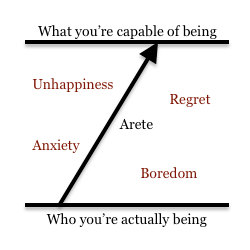 If at any given moment there’s a gap between who you are capable of being, and who you are actually being, you will inevitably experience some level of discontent.
Because it’s in that space feelings like unhappiness, regret, anxiety, and boredom exists.
So, whenever you’re at a choice point, think arete.
Ask yourself what the very best version of you would do right now.
Then get out your broom and start sweeping.
Express all that you can be, and there will be no place for discontentment.
Footnotes
Arete (moral virtue)
Ego is the Enemy by Ryan Holiday
Thanks to Brian Johnson for inspiring this article.
The post This is How to Be Content: Live With “Arete” appeared first on Selfication.
June 27, 2017
This is How to Be a Force for Good in the World
Imagine having a challenging workout at the gym.
You’re extremely tired and about to give up.
But then, you see someone next to you who is fighting their way through the pain.
So, you decide to join in and keep pushing.
Without knowing it, the other person nudged you into their direction.
And you do the same thing for the people around you all the time.
Actions Are Infectious
Human beings are social creatures that are constantly influencing each other. Our attitudes, feelings, and actions spread like viruses throughout our networks. In his book, Connected1, sociologist Nicholas Christakis writes:
Across many different kinds of behavior: voting, cooperation, smoking, weight loss and weight gain, happiness, cooperative behavior, public health behaviors, we and others have been able to show that people are very meaningfully affected by the behaviors of other people to whom they’re connected.
And here’s the kicker: they are also affected by the behaviors of people to whom they’re not directly connected. When your friend’s friends quit smoking or your friend’s friends friend become nicer and more cooperative, this ripples through the network and affects you.
Similarly, when you make a positive change in your life, when you start running for example, or you participate in our democracy and you vote, it ripples outward from you and can affect dozens, hundreds, perhaps even thousands of other people.
How crazy is that? Each positive action you take has the potential of inspiring countless others to do the same. Not only your family and friends but the people they know. And then the people they know. And on and on it goes.
Always remember that everything you do is contagious. It will infect people you’ll never even meet. So, to be a force for good, the best thing you can do is…
Spread Positive “Viruses”
The greatest gift you can give the world is to lead by example; to show up at your very best and go after your goals with inspiring persistence. Because when you do that, you’ll motivate others to do the same. Here are the best ways I’ve come across to spread positive good “viruses” into the world:
Use empowering language. Ban victim speech from your vocabulary. Instead of saying “I can’t,” say “I won’t.” Instead of “I have to,” say “I’m going to.” Instead of “I don’t know,” say “I’ll figure it out.” Pay attention to the language you use and get rid of any phrases that foster helplessness.
Master your feelings. Express the body language of the person you want to be. Strike a powerful posture and smile. Doing that for just a couple of minutes will make you feel less stressed and more in charge.
Build great habits. Run daily routines that help you realize your full potential. Build your fundamentals. Master your craft. Fill your mind with ideas from great books. Journal about what you learn. And focus on the process rather than your results.
Be an instrument of service. Don’t ask what the world has to offer you, but instead what you have to offer the world. Forget about what others can do for you, and instead approach new people thinking to yourself: ”How can I help this person?”
Outperform your contracts. Whatever you’ve committed to doing, always do a little bit more. Exceed the expectations others. And exceed the expectations you have for yourself. Always strive to be remarkable in your efforts.
Forgive yourself fast. When you have a setback, practice self-compassion. Treat yourself like you would a good friend. Then, get back on track.
Be a Force for Good in the World
It might seem like a lot of work to show up your very best, but it’s much easier than not doing it.
When you’re spreading positive viruses, that means you’re actualizing your potential, and that’s the only way to experience true fulfillment and lasting happiness.
On top of that, you’re an inspiration to everyone around you.
So, be a force for good in the world. It’s the most rewarding way to approach life.
Plus, you might just change someone’s life.
Footnotes
Connected: How Your Friends’ Friends’ Friends Affect Everything You Feel, Think, and Do by Nicholas Christakis
Thanks to Lewis Howse for inspiring this article.
The post This is How to Be a Force for Good in the World appeared first on Selfication.
June 20, 2017
This is The #1 Way To Be Happy: Make Your “Daimōn” Proud
Take a moment right now to imagine your ideal self.
See that version of yourself sitting right next to you.
Seriously — pause for a moment right now and envision this person as vividly as you can.
Done? Good! You’ve just spent a few seconds with…
Your Daimōn
These days, most people call it your conscience. The Stoic philosophers called it ”the Other.”
Back in the day, another name for it was “Daimōn” — the inner soul and guiding spirit that exists inside of you.
And here’s the thing about your Daimōn — it’s deeply dedicated to its task. It’s constantly watching you and providing directions for the best path forward.
I admit that all sounds a bit hokey, but I bet you have a sense of what I’m talking about.
We all have that inner voice that’s trying to lead the way. But most of us rarely pay attention to it.
The #1 Way To Be Happy
According to the ancient philosophers, your relationship to your Daimōn is THE #1 most important thing in life.
To be happy, they believed you have to live in harmony with this inner soul and guiding spirit.
In fact, their word for happiness was “eudaimōn,” which translates into ”good soul.”
When you focus on making your Daimōn proud, something interesting happens.
All the obstacles that show up in your way cease being problems.
Instead, they present themselves as perfect opportunities to practice your ultimate goal: To be the best version of yourself.
It moves your focus from how you feel, to what you do.
That allows you to consistently step forward into growth, instead of back into safety.
And that, in turn, creates happiness and contentment.
Make Your Daimōn Proud
You know all those cheesy signs and posters that say stuff like ”Happiness is not destination — it’s a way of life”?
Well, there’s a lot of truth to that statement.
You can’t do something now to experience some constant state of happiness later.
Just as every other feeling, happiness is fleeting.
So, the wisest thing you can is to forget about the emotion itself and instead focus solely on making your Daimōn proud.
The Stoic philosopher Epictetus wrote:
“When you go to see some important personage, remember that there is an Other, watching what happens from above and that it is better to please this Other than that man.”
And that advice extends to every situation. Whatever you do, ALWAYS put the opinion of your Daimōn first.
Act to the Best of Your Ability
Here’s an exercise I’ve found very helpful for putting this idea into practice:
Imagine that your Daimōn is the cameraman and the director of your life.
Do your best to follow its instructions. Play your part to the best of your ability.
Focus all your energy on being an excellent actor in whatever scenes it puts you in.
And if you ever find yourself in a situation when your performance wasn’t your best, well, there’s always THIS moment to get right back on track.
Are you ready?
Lights… camera… ACTION!
June 12, 2017
This is How to Feel Fulfilled: Advice From Abraham Maslow
Do you feel like you have more potential than you’re expressing?
Like there’s this gap between who you are and who you could be?
That can be a frustrating place to be.
Luckily, one of the most prominent psychologists of all time studied this exact problem.
And he came up with some pretty fantastic ideas for solving it.
Abraham Maslow & “The Self-Actualizing Individual”
Back in the day, mainstream psychologists like Sigmund Freud and B.F. Skinner focused most of their time on mental illness.
When Abraham Maslow came along, he was one of the first psychologists to instead focus primarily on happiness.
He studied the greatest people of his generation, folks like Eleonore Roosevelt and Albert Einstein, and in the process coined the phrase “the self-actualizing individual.”
Maslow argued that “What human beings can be, they MUST be.”
So, he wasn’t talking about a mere wish or desire. No, according to Maslow, you have a NEED to “self-actualize” — to express your latent abilities and live your full potential.
Just like you lungs need oxygen, your mind needs self-actualization, or it will suffocate.
Deprived of it, you might not gasp for air, but you will experience other painful symptoms like stress, anxiety, or even depression.
What Must YOU Be?
Musicians must make music, artists must paint, poets must write if they are to be ultimately at peace with themselves. What human beings can be, they must be. They must be true to their own nature.
— Abraham Maslow
If you want to feel truly fulfilled, you need to realize your potential.
You have to ask yourself what truly makes you come alive, and then do those things.
If it helps, you can start by reflecting on questions like these (ideally in a journal):
What did I spend time doing as a kid?
What activities absorbs me so much that I forget to eat and sleep?
If money wasn’t an issue, what would I spend my time doing?
Then, it’s all about taking consistent action toward realizing those things.
But don’t feel like you have to make a huge change overnight.
As always, small and consistent steps in the right direction is the best approach. Take the tiny first step and then build the momentum necessary to carry you where you want to be.
Also, note that the self-actualizing process doesn’t necessarily have to be about finding a more meaningful career. It’s an individual process that can just as easily be about becoming a great parent or friend (or something else entirely).
That’s why Maslow asks the question the way he does:
What must YOU be?
Growth or Safety
According to Maslow, you have two options at any given moment. You can either:
Step forward into growth.
Step back into safety.
I like to think of it as a voting game. Every time I take a step forward, I cast a vote for self-actualization. And each time I step back into safety, I cast a vote against it.
Here are some examples:
I wake up in the morning. If I get up immediately, that’s a positive vote. If I snooze, that’s a negative note.
It’s time to hit the gym. If I go there, that’s a positive vote. If I stay at home watching TV, that’s a negative note.
I feel the need to pursue an interest. If I take the first step, that’s a positive note. If I ignore the feeling, that’s a negative note.
These are, of course, just a few possible situations. The truth is, every single moment is a chance to step forward into growth or back into safety.
And here’s why paying attention to your votes is so important: At the end of the day, they will determine how fulfilled you feel.
If your negative votes outweigh your positive by 10,000, you’ll experience some level of stress and boredom. And, as a result, you’ll likely turn to comfort foods, alcohol, TV, or something else that temporarily alleviates those feelings.
But if your positive votes instead outweigh your negative by the same number, you’ll experience happiness and contentment. There won’t be a need for alleviating negative feelings, so you can use that time to take even more action toward self-actualization.
Your positive votes make things spiral upward. And your negative votes make things spiral downward.
So, if you want to feel fulfilled, what you need to do is step forward into growth, instead of back into safety. Again, and again, and again.
How to Feel Fulfilled, In Summary
Here’s what we’ve covered in this article:
According to Abraham Maslow, you have a NEED to “self-actualize.” Otherwise, your mind can’t breathe.
To feel truly fulfilled, you need to realize your potential. You need to find what you’re passionate about and take small steps in that direction.
In any given moment you can step forward into growth or step back into safety. Pay attention to your votes because they will determine how fulfilled you feel.
Positive votes make things spiral upward. Negative votes make things spiral downward.
Now, before we part ways, a friendly warning is in place. Dr. Maslow also said: “If you deliberately plan on being less than you are capable of being, then I warn you that you’ll be unhappy for the rest of your life.”
I mean, yikes!
Luckily, he also encouraged us not to be perfectionists about it: “It seems that the necessary thing to do is not to fear mistakes, to plunge in, to do the best that one can, hoping to learn enough from blunders to correct them eventually.”
So, before you move on to whatever you’re doing next, I encourage you to cast a positive vote right now. Then, as you go about your day, remember that each new situation is a chance for you to step forward into growth.
Make a game out of casting as many positive notes as you can. Before you know it, all those small self-actualization actions will start adding up.
Your mind will get the oxygen it needs, and you’ll feel fulfilled, energized, and excited.
Sound good? Let’s plunge in!