Patrik Edblad's Blog, page 18
January 31, 2017
This is the First Thing You Need to Do to Change Your Life
In the 1960’s, cognitive neuroscientists Michael Gazzaniga and Roger Sperry performed research on split-brain patients1.
These patients had once suffered from extreme and controllable forms of epilepsy.
By disconnecting the two brain halves, it was found that their seizures became less severe2.
But it also made it impossible for the two hemispheres to communicate with each other.
And this condition gave Gazzaniga and Sperry a unique opportunity to examine the functions of each hemisphere.
Split-Brain Experiments
As the researchers began investigating the split-brain patients, they soon found that no information was transferred between their brain halves.
Unsurprisingly, the left hemisphere had no idea what the right one was doing, and vice versa.
Then, in the early 1980’s, Gazzaniga did one more of his signature experiments with split-brain patients. Only this time, he added a little twist.
In one example, he started by flashing a patient with two pictures.
The left hemisphere saw a chicken foot, and the right saw a snow scene.
Thanks to previous research, he knew that the left is where language skills are centered, and the right is holistic and sensual and has no words for what it sees.
Gazzaniga then asked the subject to choose related images for each picture from an array visible to both brain halves.
These were things like a fork, a shovel, a chicken and a toothbrush.
The patient chose a chicken to go with the foot and a shovel to go with the snow.
So far, everything made sense.
Rationalizing After the Fact
Next, Gazzaniga asked the subject why he chose those particular items.
The patient quickly replied: “The chicken goes with the foot.”
The left hemisphere had seen the foot. It also had a good rationale for connecting it with the chicken and words to describe it with.
But his left brain hadn’t seen the picture of the snow, only the shovel.
He had chosen the shovel instinctively with no conscious explanation for it.
When Gazzaniga asked him to explain his choice, the subject searched his left brain for the symbolic representation of the snow and found nothing.
But instead of saying “I don’t know,” he looked down at the picture of the shovel and said: “And you need a shovel to clean out the chicken shed.”3
The Interpreter
The left hemisphere just threw out an explanation of what it could see: the shovel.
In subsequent studies, Gazzaniga and other researchers have found that this pattern is consistent.
The left brain takes the information it gets and tells a story about it to our conscious awareness.
Gazzaniga refers to this system as “The Interpreter”4, and it seems always to want to explain our moods and actions after they’ve occurred.
The reason we can make sense of everything that goes on in our heads is that The Interpreter is providing a never-ending narration about what’s going on.
The Interpreter takes everything we perceive and think about and turns it into a story that makes sense.
The Flawed Brain
We tend to take our thoughts very seriously. If a thought pops up and tells us about what’s going on in a particular situation, we’re likely to consider that thought an objective truth.
But it’s not. It’s just The Interpreter in your left hemisphere putting together yet another narrative to make sense of the world.
And it does so with incomplete information, limited senses, and a ton of cognitive biases that distort the story5.
So, we all have an inaccurate view of what is really going on in any given situation.
That’s just part of the human condition.
(Oh, and if right now you’re thinking this doesn’t apply to you, remember where that thought is coming from. That’s right — your friend, The Interpreter.)
Choosing What to Believe
Accepting that we perceive the world inaccurately can be a tough pill to swallow.
But I actually find it to be quite inspiring.
Because if there’s no way to know for sure what is going on, that means you get to choose what to believe.
And by becoming aware of The Interpreter, you can develop the ability to question the thoughts and narratives in your head.
You can examine your beliefs, remove the ones that aren’t helpful, and put empowering convictions in their place.
That practice can have huge implications for your life.
Your Beliefs Become Your Reality
As I’ve written about before, research has found that:
Students who believe they can change their intelligence through hard work do better academically compared to students who believe their intelligence is a fixed trait6.
Merely believing that your job provides a good amount of exercise is enough to lose weight, drop BMI and decrease blood pressure7.
Your beliefs about how much calories a drink contains affect how much hunger hormone gets released in your body after drinking it8.
If you believe stress is harmful, you’ll experience more stress than people who don’t9.
Mindsets even affect your life expectancy. That is because individuals with a negative aging mindset are less likely to proactively engage in healthy behaviors such as eating healthy, exercising and visiting the doctor10.
One belief can flood your system with stress hormones. Another one can make you feel calm and confident.
A Practical Example
The Father of American psychology, William James11, claimed that: “The greatest weapon against stress is our ability to choose one thought over another.”
Let’s say you’re about to speak in front of a lot of people and you’re feeling nervous.
Your interpreter shows up and says: “Yup, you’re in way over your head this time. You’re going to fail miserably. Everyone is going to see it. And obviously, you’re stressing out about it.”
If you believe that, you’re going to be a mess, and your performance will most likely suffer from it.
But you can also step in and choose another belief: “This is not stress. It’s excitement. And that’s a good thing because it means my body is preparing for a great performance.”
That won’t necessarily make the feeling go away, but you’ll interpret it differently.
And that’s all you have to do to increase your chances of a great performance significantly12.
Change Your Beliefs, Change Your Life
The Stoic philosopher Epictetus once said: “It’s not what happens to you, but how you react to it that matters.”
In light of this research, perhaps we should say: “It’s not what The Interpreter says, but whether you choose to believe it, that matters.”
This simple idea can make a huge difference.
And it goes way beyond stage fright.
If you want, you can use it to examine and change your most deeply held beliefs.
And it all starts with becoming aware of The Interpreter is telling you.
Remind yourself that what it’s telling you is not the truth. It’s just a narration to help you make sense of the world.
And if that particular story isn’t helpful to you, then switch it out.
You get to decide what to believe, so choose wisely.
Footnotes
Split-brain
Epilepsy and the Corpus Callosotomy
How We Learn: The Surprising Truth About When, Where, and Why It Happens by Benedict Carey
Left brain interpreter
List of cognitive biases
Implicit Theories of Intelligence Predict Achievement Across an Adolescent Transition: A Longitudinal Study and an Intervention
Mind-Set Matters: Exercise and the Placebo Effect
Mind Over Milkshakes: Mindsets, Not Just Nutrients, Determine Ghrelin Response
Rethinking Stress: The Role of Mindsets in Determining the Stress Response
Longevity Increased by Positive Self-Perceptions of Aging
William James
Get Excited: Reappraising Pre-Performance Anxiety as Excitement
The post This is the First Thing You Need to Do to Change Your Life appeared first on Selfication.


January 24, 2017
This is How to Motivate Yourself: A Powerful Strategy Backed by Research
You’ve set your audacious goals.
You’ve broken them into smaller milestones and daily actions.
And you’ve even started making some progress.
But then, you seem to hit a wall.
Your initial enthusiasm runs out.
And, as a result, you’re finding it very difficult to show up and do the work every day.
But it doesn’t have to be so hard.
One simple tweak in your strategy can be all that’s needed to keep going.
How the Mind Perceives Losses & Gains
In behavioral economics, there’s a concept know as loss aversion 1.
It refers to people’s tendency to prefer avoiding losses rather than acquiring equivalent gains.
According to the researchers who first demonstrated this idea, Daniel Kahneman and Amos Tversky, losses are twice as powerful, psychologically, as gains.
In other words, losing ten dollars stings twice as much as gaining five dollars feels good.
And that’s just what they’ve stated officially in their research.
Unofficially, they’ve said that it’s really more like five to seven times as much.
They just wrote down two times as much to get fewer arguments.
How Loss Aversion Affects Our Motivation
When we set goals, we tend to focus on the benefits we’ll attain from achieving it.
We’ll imagine getting in shape, more money in our bank account, a new career, and more quality time with our family and friends.
We might even put all of these things on a vision board to remind ourselves of these things every day.
And that’s perfectly fine. But what loss aversion teaches us is that we also need to take into consideration what we’ll lose if we don’t reach our goals.
If a vision board motivates you, an anti-vision board will motivate you two times (but really five to seven times) as much.
How to Motivate Yourself Through Loss Aversion
The next time you’re trying to motivate yourself to achieve a big goal, don’t just focus on the gains.
Pay just as much attention, if not more, to the potential losses. Ask yourself hard questions like:
What do I stand to lose if I don’t reach my goal?
What is the path I’m on costing me every single day?
What will my future look like if I don’t change?
These questions will help you perceive status quo as a loss.
And when that happens, you’ll be much more likely to take action.
Footnote
If you’d like a very practical way to implement this idea, I highly recommend using a tool like Beeminder, StickK, or Pact.
Source
Loss aversion
The post This is How to Motivate Yourself: A Powerful Strategy Backed by Research appeared first on Selfication.
January 17, 2017
This is How to Make 2017 Your Best Year Ever
Nine out of ten people fail at their New Years Resolution every year 1.
Clearly, we’re doing something wrong.
So, in 2017, I suggest we take another approach.
Instead of relying on willpower, let’s focus on the following big ideas for making this our best year ever.
[Note: Make sure to read to the end for a special invitation to my FREE 7-Day Personal Transformation Challenge!]
Aim for Arete
Arete is an ancient Greek word that means “excellence of any kind” 2.
The arete of something is the highest quality state it can reach.
By aiming for arete, you focus on the quality in everything that you do.
Whatever action you’re taking, you strive to do it to the very best of your abilities.
You try to live up to your full potential, moment to moment, with excellence as your ultimate goal.
I admit that sounds a bit grandiose but aiming for arete doesn’t mean you’ll always be perfect.
It just means you have the intention to be the best version of yourself in any given situation.
And that’s a pretty great place to start.
Now, let’s have a look at how to live with arete.
Focus on the Fundamentals
Legendary basketball coach John Wooden taught his players how to put on their socks and tie their shoes 3.
That kind of ruthless focus on the most basic fundamentals has been a recurring team of many successful coaches.
The fundamentals may not be the most exciting thing you do, but they are crucial to your success.
So, in 2017, let’s up our game in the following areas:
Sleep — This is perhaps the biggest health and productivity “secret” out there. Research has shown that if you want to feel great and perform at your very best, sufficient sleep is non-negotiable. Get better sleep this year.
Nutrition — The food you consume becomes the fuel and building blocks of your body. Replace refined carbs with good protein and fat, fruits and vegetables. Eat foods that make you feel good later, not just in the moment.
Movement — Peak performance requires physical activity. Not only because it’s crucial for your health. Research has shown that it’s also essential for your brain’s ability to learn 4. So, give your body the exercise it craves.
Focus — I recommend meditation to pretty much everyone I meet. This practice has so many benefits, it’s ridiculous 5. If you haven’t started meditating yet, now is the time.
Master Your Craft
Now that we’ve covered the fundamentals that apply to everyone, it’s time to look at your personal fundamentals.
I’ll share mine to give you an example. My personal fundamentals are:
Teaching — Writing, coaching & (at some point) speaking.
Learning — Habits, behavior change & how to live.
Promoting — Get my work in front of as many people as possible.
As long as I’m spending my time working in these areas, I know I’m on the right track.
Each day spent learning, teaching, and promoting what I teach, is a day well spent because I’ve strengthened my fundament.
What do you need to do every day to become a master at your craft?
When you take the time to uncover your fundamentals, it becomes much easier to focus your energy in the right places every day.
Manage Your Energy
Most people worry a lot about time management. I’m much more concerned with how I manage my energy 6.
The hours you put in are important. But the amount of energy you bring to each hour is even more important.
That’s why I keep preaching the importance of fundamentals. And it’s also why I recommend planning your days in accordance with your energy levels.
I know from experience that my energy tends to be highest in the early morning and lowest in the afternoon.
So, I do all my writing before lunch.
And, since email tends to be the least draining and most rewarding thing I do, I’ve scheduled it in the late afternoon when my energy is at its lowest.
How will you rearrange your schedule so you take maximum advantage of your energy this year?
Switch Goals for Keystone Habits
In psychology, there’s a concept known as “goal competition.” 7
Goal competition says that one of the biggest obstacles to reaching your goals is the other goals you have.
If you’ve ever tried making a lot of big changes at once, you might relate to this.
Your goals end up competing for your time and attention.
And, as a result, you get overwhelmed and end up with little to no progress at all.
That is why I’m a big fan of building “keystone habits” instead.
A keystone habit is a particular behavior that creates positive ripple effects across all areas of your life.
Here are my keystone habits for 2017:
Squats. By showing up at the gym to do squats, I know I’ll do the other exercises as well. That, in turn, will help with better productivity, sleep, diet and so on.
Deep work. By scheduling deep work every day, I should be able to learn, teach, and promote better material than ever before.
Meditation. If I meditate every day, I’ll be more present, less stressed, and better focused. That will obviously be extremely helpful in everything I do.
What keystone habits will you adopt this year?
Start Ridiculously Small
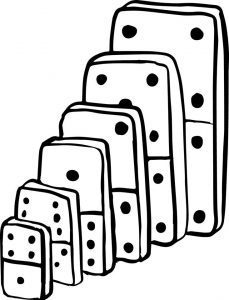 One of the biggest reasons so many people fail at their New Years resolutions is making them too difficult.
We want results fast and, as a result, we ask too much of ourselves too soon.
It doesn’t matter if we haven’t been exercising for the last couple of months.
We still expect to hit the gym bright and early January 1st.
That is an example of what I like to call “starting with the biggest domino first.”
And when that big piece budge, we get discouraged (or maybe even injured) and quit.
In my experience, it’s WAY better to start at the other end.
Knock down a domino that’s so small it’s nearly effortless to knock over.
Do one pushup. Meditate for one minute. Read two pages in a book. Add one vegetable to your meals. Do five minutes of deep work.
Focus on establishing the behavior first, then incrementally increase the effort. Domino by domino.
Shape Your Environment
We tend not to think about it, but our environment has a HUGE effect on our behavior.
If we have snacks on the table, we’re likely to eat them.
If we have a remote control on the living room table, we’re likely to turn on the TV.
If we sleep with our phone next to our bed, we’re liable to pick it up first thing in the morning.
In many ways, we shape our environment and then our environment shapes us.
We can use this to our advantage by manipulating what Psychology professor Mihaly Csikszentmihalyi calls the “activation energy” of our habits.
The bigger the obstacles standing in the way of the behavior, the more activation energy you’ll need to muster up and the less likely you’ll be to do it.
So, what you want to do is:
Decrease the activation energy of your desired habits.
Increase the activation energy of you undesired habits.
For example:
If you want to eat less, store away your big plates and use salad plates instead.
If you want to read more books, put your TV remote control in another room and a book right next to your living room couch.
If you want to write more, have your word processor launch automatically when you start your computer and use an application like StayFocusd to eliminate distractions.
Surround Yourself With Awesome People
Just like the stuff in our environment affects us in a big way, so do the people around us.
As human beings, we are social creatures with a strong tendency to conform to each other.
And that, of course, has huge implications for our lives.
One study, for example, showed that if your friend becomes obese, your risk of obesity increases by 57 percent 8.
The people around us affect what goals we decide to pursue 9 and even what feelings we get to experience 10.
In other words, it’s been well documented that:
If you hang out with people who are pessimistic and lazy, you’re likely to feel as negative and perform as poorly as they do.
If you surround yourself with enthusiastic and hard-working people, those are the feelings and attitudes you’ll adopt instead.
The people around you determine what’s normal so be very selective about the people in your social circles.
Have Fun!
Finally, it’s important to have a playful attitude to all of these ideas.
Taking these things too seriously suck the joy out of them.
And if you don’t enjoy them, you probably won’t act on them.
So, treat all your efforts as exciting experiments where you get to be both the scientist and the subject.
If something doesn’t work out as you planned, that’s fine.
It doesn’t mean you’ve failed. It just means you’ve gathered a new information.
In an experiment, there are no failures. There’s just valuable data.
So, instead of getting discouraged, get curious!
Form a hypothesis about what didn’t work and run another experiment.
Then persistently repeat this approach until you’re happy with the results.
A Special Invitation
If you found this article useful, I highly recommend you join my FREE 7-day Personal Transformation Challenge.
The purpose of this course is to give you everything you need to create massive change in your life and set you up for your best year ever.
We’ll dive deeper into big ideas and hard-hitting, practical strategies for becoming the best version of ourselves.
And to make it as easy as possible for you to implement everything we’ll cover, I’ll send you a complimentary workbook to use throughout the challenge.
Sound good? 
January 10, 2017
My 2016 Annual Review
2016 is over, and we have a new year ahead of us.
At the end of each year, I like to conduct an Annual Review.
That helps me reflect on the last twelve months, celebrate my victories, evaluate my setbacks, and get some public accountability.
My 2016 Annual Review will answer the following three questions:
What went well this year?
What didn’t go so well this year?
What am I working toward?
I hope you’ll find it useful and maybe even inspire you to create an annual review of your own.
Let’s get to it!
1. What went well this year?
Writing
I wrote and published 43 new articles on Selfication. That’s the best output I’ve had in a year so far.
Almost all of these articles got featured in the Medium publications Better Humans & Personal Growth which lead to a lot of extra exposure.
In July, I received an email from the Associate Editor at The Muse, asking me if they could feature my article “Forget About Motivation. Focus On This Instead.”
Since their publication reaches more than 5 million people each month, this was a big opportunity. I promptly answered yes.
The article was renamed to How to Be the Person Who Just Shows Up and Gets Work Done Every Single Day and became so popular that The Muse decided to run it as their featured article of the day on July 26th.
As a result, thousands of people found their way to Selfication and a couple of hundred became new members.
Since then, The Muse has featured several more of my articles. If you want to check them out, you can find them on my author page at The Muse.
Book launch
Another exciting thing that happened in 2016 was self-publishing my first book The Habit Blueprint: 15 Simple Steps to Transform Your Life.
I was debating whether to put this under things that didn’t go so well because I made a lot of mistakes in the process.
But in the end, I decided against it because finishing requires making mistakes. And as I’ll get more into later, finishing is one of the things I want to get better at.
Anyway, writing and self-publishing a book is A LOT of work, but it’s also pretty damn fun and rewarding.
So, if you’re interested in doing that, let me know, and I’ll give you some recommendations on how to get started.
Business growth
Looking back at my 2015 review, one of the biggest milestones last year was reaching 1,000 Selfication members.
This year, Selfication surpassed 4,000 members and the blog now reaches close to 20,000 unique visitors every month.
I’ve also started earning a little bit of income, mostly from:
Freelance writing, both in English and Swedish.
Book sales from The Habit Blueprint .
Affiliate commissions from my recommended resources section.
That is very exciting to me as it’s my dream to write and serve the Selfication community full-time.
So, to everyone who’s helping me move closer to that goal by hiring me, buying my book, or by getting a personal coach or great book through my affiliate links — THANK YOU!
You guys make it possible for me to do what I do.
December 12, 2016
The Top 10 Most Popular Selfication Articles of 2016
Since 2016 is almost over, I thought it would be fun to see which of my articles were most popular this year.
All in all, I hit the publish button 43 times which makes this my best year ever in terms of output.
I’ve listed the most popular ones below.
For the sake of DRAMA, we’ll start with #10.
Happy reading!
December 6, 2016
This is How to Create a New Habit: 5 Secrets From Research
Every year, people set their New Years Resolutions. And every year, about 9 out of 10 fail at achieving them1.
The biggest reason for this is most people never take the time to educate themselves on how human behavior works.
There are tons and tons of diets, exercise programs, productivity tools, personal finance strategies, and time management apps out there, and a lot of them are pretty great.
The problem is that we fail to appreciate the crucial part our behavior plays in actually picking them up and using them.
You can gather all the information in the world, but it won’t create any tangible results in your life unless you consistently take action on what you learn.
That is why understanding how to create a new habit is so important.
Let’s have a look at the most powerful strategies I’ve found for doing that.
1. Start Ridiculously Small
It’s always tempting to try to create a massive change overnight.
You have a big goal in mind, so it makes sense to go after it with a big behavior change.
The problem (as 9 out of 10 people can attest to) is that this approach rarely works.
Going to the gym four days a week when you’re used to zero won’t lead to success — it will lead to burnout or even injury.
So, what you want to do is start small. Really small. Like, ridiculously small.
Instead of 50 pushups, do 5.
Instead of 20 minutes of meditation, do 2.
Instead of saving $100 every month, save $10.
Establish the actual behavior first2. When you’re consistently showing up and doing it, you can start increasing the effort.
2. Get Yourself Hooked
When you’ve invested a lot of time, energy, and resources into something, it gets much harder to quit3.
You can take advantage of this by using what comedian Jerry Seinfeld calls the “Don’t Break the Chain” strategy4.
Get a big wall calendar, put it on a prominent wall in your house, and start putting a big, red X over each day you complete your habit.
That is a brilliant way of creating a physical representation of your efforts.
When you’ve done this for a while, you’ll find yourself pushing through even when it’s hard, just to keep the chain going.
3. Use a Trigger
One of the biggest mistake people make when committing to a new habit is having vague intentions.
“I’ll try to drop by the gym a couple of times after work this week” unfortunately won’t cut it.
Research has shown that if your goal is going to be effective, you need to have very clear intentions about it5.
You have to know exactly when and where you’re going to do what.
Implementation intentions and scheduling are two great strategies for clarifying that.
4. Deliberately Shape Your Environment
Your environment plays a huge role in your behavior6.
If you’ve ever walked into your kitchen, spotted a plate of cookies on the counter, and eaten them just because they were in front of you, you know what I mean.
So, if you want to create change in your behavior, you need to create change in your environment.
Professor of Psychology, Mihaly Csikszentmihalyi, provides an excellent strategy for this7.
What he recommends is that you deliberately change the ”activation energy” of your habits. You can do this by:
Decreasing the activation energy of your desired behaviors.
Increasing the activation energy of your undesired behaviors.
If you, for example, want to read more books but find yourself consistently choosing to watch TV instead, place a great book next to your living room couch. Then put the TV remote in another room (or, if necessary, in the garage).
By tweaking your environment like this, you can nudge yourself to choose the right habits by default.
5. Surround Yourself With the Right People
The people around us also impact our behavior in a big way.
One study found that if you have a friend who becomes obese, your risk of obesity increases by 57 percent — even if your friend lives hundreds of miles away(!!)8.
Other research has shown that we tend to feel like, and adopt the same goals, as the people we spend the most time with9.
So, if you’re serious about creating big change in your life, you need to have the right people in your corner.
If you want to be healthy but all your friends are unhealthy, it’s time to make some new friends.
And if you want to go after big goals but you’re surrounded with pessimists, it’s time to surround yourself with inspiring and uplifting supporters.
Bonus Tip: Adopt a “Scientist & Subject Mindset”
When you set out to create a new habit, see it as an experiment.
Consider yourself both the scientist and the subject10.
This mindset allows you to perceive setbacks as valuable data rather than failures.
If a strategy isn’t working, tweak it until it does.
Let go of the long-term results you’re after and, instead, focus on showing up and doing the habit every single day.
If you can do that, the results you’re after will inevitably show up as a side effect of your efforts.
How to Create a New Habit: A Proven Blueprint
 If you enjoyed this article, I highly recommend you check out my brand new book The Habit Blueprint: 15 Simple Steps to Transform Your Life.
It contains all the strategies you’ll ever need to create and sustain the habits you want in your life.
Everything is laid out in very simple, step-by-step explanations and action steps (as well as a downloadable checklist) you can follow to put any habit you want in place — and to keep it there.
The Habit Blueprint is available for only $0,99 until midnight (EST) on Sunday, December 11th, so grab your copy now and create all the habits you want for the price of a coffee!
Sources
New Years Resolution Statistics.
I learned this from behavior expert BJ Fogg.
This tendency is known as the sunk cost fallacy.
Jerry Seinfeld’s Productivity Secret.
Implementation Intentions.
There is tons of research on this. Here are some examples.
Finding Flow: The Psychology Of Engagement With Everyday Life
by Mihaly Csikszentmihalyi
The spread of obesity in a large social network over 32 years.
This is called emotional contagion and goal contagion.
I learned this idea from Change Anything: The New Science of Personal Success by Kerry Patterson, Joseph Grenny, David Maxfield, Ron McMillan, Al Switzler.
The post This is How to Create a New Habit: 5 Secrets From Research appeared first on Selfication.
November 29, 2016
This is How to Never Fail at Anything Ever Again
In 2004, Gmail was made available to the public for the first time.
The developers knew the service wasn’t perfect, but they still went ahead and released a “beta” version.
That way, they could get valuable feedback from users to make the final product as good as possible.
And there’s nothing surprising about that strategy. A lot of companies use beta testing for their products and services.
What is surprising, however, is that Gmail didn’t officially exit beta status until 2009.
That’s a five-year long beta test!
How NOT to Deal With Failure
Most people tend to beat themselves up pretty bad for the mistakes they make.
Every setback is followed by heavy self-criticism and thoughts like:
“I can’t believe I always do this.”
“I’m so lazy.”
“I don’t have any willpower.”
“I’m such a failure.”
And on the surface, this might seem like a logical thing to do.
After all, if we don’t punish ourselves for straying off course, how will we ever be able to reach our goals?
But the problem with this strategy, of course, is that it doesn’t work.
Beating yourself up doesn’t make you perform better.
It makes you feel terrible. It makes you discouraged. And it ruins your self-confidence.
If anything, harsh self-criticism will make you perform worse than you did before.
So, what should we do instead?
Put Yourself in Permanent Beta Mode
I suggest we learn from the developers at Google and put ourselves in beta mode.
But instead of staying there for five years, let’s stay there for life.
That’s right. Permanent beta mode.1
The beauty of this mindset is that it changes how you deal with setbacks.
Because if you’re in beta mode, missteps are to be expected.
Instead of perceiving them as discouraging failures, they become valuable data for you to use to continually improve your approach.
You don’t expect to be perfect. And that’s a huge relief.
This is How to Never Fail At Anything Ever Again
The next time you find yourself in a situation where you didn’t perform as well as you would have liked:
Remind yourself that you’re in permanent beta mode. You’re an imperfect human so don’t expect perfect results.
Forgive yourself as quickly as possible. Not only will this make you feel better, but you’ll get back on track much faster. If you’re not used to forgiving yourself, try practicing self-compassion.
Ask yourself what you can learn from this new data. What went wrong? And which strategies could you put into place to get better results in the future? If you’re not sure, here are some of my favorites:
Start small.
Do a ‘shitty first draft.’
Use implementation intentions.
Set up commitment devices.
Change your environment.
Celebrate your small wins.
Team up with the right people.
Conduct a weekly review.
Life is an Experiment
Put yourself in permanent beta mode. Treat every setback not as a failure, but as valuable data.
Then revise your approach relentlessly until you find a way that works.
It will make you much more effective. And it will make life a lot more fun. 
November 22, 2016
This is the Best Way to Focus, Backed by Research
I got one of my first fully functioning cell phones back in the early 2000’s.
It was a beautiful piece of technology called the Nokia 32101.
This badass phone had cutting edge features like a built-in antenna, vibrate alert function, and “picture messages” (not to be confused with actual photo messages).
But the best feature of them all was undoubtedly Snake. You know, the game where your job was to maneuver a line that grew in length for every pixel it ate?
What Snake Can Teach Us About Deep Focus
If you’ve ever played this game, you know how hard it is. The longer your snake grows, the more concentration is needed to avoid crashing into yourself and ending the round.
And if you’re interrupted and have to hit pause (for example to check out a cool “picture message”), you’ll be much more likely to fail soon after returning to the game.
As it turns out, this happens to be an excellent example of a psychological effect known as “attention residue”2.
Research has shown that there’s a cognitive cost involved with switching your attention3.
Each time you turn your attention from one task to another, the first task will leave a “residue” that reduces your cognitive performance.
And that’s the case even if the switch is very brief.
So, whenever you’re interrupted from your game of Snake, the interruption will leave a residue that affects your play negatively when you return to it.
Switching Costs at Work
Now, this article isn’t just about how to become a top-level Snake player (although that’s obviously very important, too).
The concept of attention residue is crucial to consider when you approach any kind of work.
Imagine that you’re deeply focused on a work task. Then someone or something interrupts your attention.
You might think that you’ll quickly switch back to the task once you’ve dealt with before the interruption. But, unfortunately, that’s not the case.
Each and every call, message, notification, alarm, and well-meaning colleague that knocks on your door has a switching cost.
And they’ll all leave an attention residue that gets in the way when you return to your work task.
The Myth of Multitasking
Doing a lot of things at once can make you feel highly productive. But in reality, it’s quite the opposite.
The problem with multitasking is that you’re not really doing a lot of things at once.
You’re just switching your attention between tasks in a rapid fashion. And, as we’ve learned, each one of these switches involves a cost that causes you to work slower and less efficiently.
And even if you’re usually single-tasking, it’s important to know that mixing this work with a series of small “just checks” can be just as bad as multitasking.
Every quick check of your phone, email inbox or something else leaves some amount of attention residue that affects your focus negatively.
The Best Way to Focus
The takeaway here is that deep focus requires you to work for long blocks of time without any interruptions. Here are some ideas for how to make that happen:
Plan proactively. Schedule time blocks for deep, undisturbed focus. Plan out exactly what you will be working on and avoid switching tasks until it’s completed.
Remove distractions from your phone. Take a deep dive into your phone settings and relentlessly remove all unnecessary apps and notifications. If you don’t decide your phone’s behavior, it will decide yours.
Remove distractions from your computer. Delete unnecessary icons, apps and programs. Remove all notifications. Have your most important programs launch automatically when you start your computer.
Set up commitment devices. Breaking old habits can be hard. Unless you remove the possibility of doing them, that is. Check out this list of commitment devices and implement the ones you’ll need to stay away from your usual distractions.
Create an interruption-free zone. Let your colleagues, family, and friends know about your deep work blocks of time. Close your office door, set your phone in “do not disturb” mode and put on some ambient music (or something else that helps you get into the zone).
I hope this helps. Now, I’m off to play some Snake. Please, don’t disturb me. 
November 15, 2016
This is How to Overcome Your Fear of Failure
When Pablo Picasso was an old man, he was sitting in a cafe, scribbling on a napkin.
He didn’t know it, but a woman sitting near him was looking on in awe.
A couple of minutes later, Picasso finished his coffee, crumpled up the napkin, and was about to throw it away.
But the woman stopped him and said “Can I have that napkin? I’ll pay you for it.”
“Sure,” said Picasso. “That will be twenty thousand dollars.”
The woman was stunned. “What? It only took you two minutes to draw that”.
“No, ma’am,” Picasso replied. “It took me over 60 years to draw this.”1
Mastery Takes Time
Picasso lived to be 91. When he passed away in 1973, he had amassed a net worth of around $500 million, and his art had become famous all over the world.
His output was exceptionally prolific. The total number of artworks he produced has been estimated at 50,000, comprising a large number of paintings, drawings, sculptures, ceramics, prints, tapestries, and rugs.2
By honing his craft for decades, Picasso eventually reached a point where he could charge twenty thousand dollars for a two-minute napkin scribble. Or, at least, deliver a pretty damn cool one-liner about it.
Anyway, the takeaway here is that mastery takes time. Therefore, we need to be consistent in our practice. And to do that we need to be able to make mistakes without losing momentum or giving up.
To become really good at what you do, you have to be comfortable failing at it.
To become remarkable, you have to be willing to fail more than anyone else around you.
Why Failing is So Scary
When you were a kid, you didn’t think twice about learning to walk.
It didn’t matter what the results happened to be in one single attempt; you just kept on trying no matter what.
You stood up, took a step, fell, hurt yourself, maybe cried for a minute or two, and then tried again.
Giving up never crossed you mind.
At no point did you stop and think “Man, I suck at this. I guess walking isn’t for me.”
Clearly, avoiding failure is something we learn later in life.
Somewhere along the way, most of us become afraid to fail.
We learn that it’s embarrassing to fail and that others might hold it against us or make fun of us for it.
And when that happens, we tend to stick to what we’re already good at.
We Start Failing At Failing
The problem with this, of course, is that it severely limits us.
As soon as we buy into the idea that failing is something to be avoided, every unsuccessful attempt sends the signal that we should stop trying.
And while that reasoning keeps us feeling safe, it also robs us of the opportunity to realize our highest potential.
Because the only way to become great at something is to be willing to fail at it. Over and over again.
Success demands failure. So, we need to take action despite our fear of failure.
How do we do that?
The Sphere of Choice
In Stoic philosophy, there is a concept known as “the sphere of choice.” This idea makes a distinction between:
“Internals” — things we can control. For example, our character, values, and behavior.
“Externals” — things we cannot control. For example, the past, much of the natural world, and the thoughts and behavior of other people.
The Stoic philosopher Epictetus believed that we should focus exclusively on the internals and let go of the externals.
Only when we stop worrying about what is outside our control and instead turn our attention to what is within our control can we have peace of mind.
Let Go of What You Cannot Control
I’ve found the sphere of choice to be very effective for dealing with my fears of failure.
Pretty much every time I sit down and write, a series of fearful (and quite mean) thoughts run through my head. Usually, they go something like this:
“Who do you think you are? Nobody is going to want to read this. Man, your writing is dull. You don’t have anything to say, do you? Let’s throw this article in the trash and go do something else.”
In the past, these thoughts would often get the best of me. But I have since learned that I am not my thoughts — I am the one who hears them.
And since that’s the case, my thoughts belong in the category of external things. I can’t control what thoughts happen to pop into my head at any given moment, and therefore I don’t worry about it.
My writing, on the other hand, belongs in the category of internal things. It’s completely within my control. I can always decide to keep on typing. So, that’s what I do.
No matter what my brain is yelling at me, I just keep on typing away until I’ve met my writing goal for the day.
The Opinions of Others
This is another part of writing that used to be a big problem for me.
If you’ve ever created something and put it out for the world to see, I’m sure you can relate.
Getting good feedback feels quite nice. But getting bad feedback feels downright awful.
If you get 100 positive responses followed by one negative, it’s that last one that’s going to stick in your mind.
So, to get really great at what you do, you simply cannot care what other people think about it.
Remember, the thoughts and behavior of others belong in the external category, and therefore you need to treat them with a healthy dose of indifference.
You’ll never get the approval of everyone, so don’t waste your time trying.
How to Overcome Your Fear of Failure
From now on, whenever you’re experiencing a fear of failure, remember the sphere of choice.
If you find that your concern is about something external, practice letting it go. Remember that it’s a waste of time to worry about things you cannot control.
If the object of your concern is internal, use it as a trigger to take action. Stop thinking and start doing.
Be like a kid who’s learning to walk. Fall without concern about how it looks or what other people think. Then do it again. And again. And again.
Measure your success not by your ability to avoid mistakes, but by your ability to show up and do the work no matter what.
Picasso was willing to create 50,000 artworks to build his legacy. What are you willing to do?
“Every child is an artist. The problem is how to remain an artist once he grows up.”
— Pablo Picasso
Sources
There are plenty of versions of this story. This one is from Mark Manson’s awesome book The Subtle Art of Not Giving a F*ck: A Counterintuitive Approach to Living a Good Life.
Pablo Picasso
The post This is How to Overcome Your Fear of Failure appeared first on Selfication.
November 1, 2016
This is How to Stick to Your Habits, Backed by Research
Last week, I published an article about how to stop sucking at your habits.
In short, it explained how relying too much on your initial plan for your habit is a big mistake.
I got some great feedback on that article and it seems like a lot of people can relate to the problem.
One of the readers who got back to me was Sarah.
She wanted my next article to be about specific ways to tweak your plan to make it easier to stick to your habits.
A great idea! Let’s begin with…
An Analogy of the Mind
Psychologists tell us that there are two systems in our brains — the rational system and the emotional system.
In his awesome book, The Happiness Hypothesis 1, author Jonathan Haidt explains that you can think about these systems as a human rider on top of an elephant.
The rider represents the prefrontal cortex of the brain. This is the rational part of us that plans and problem-solves. The rider is the one making the decisions about where we want to go.
The elephant represents the older parts deep inside the human brain, such as the amygdala. This is emotional side of us. The elephant provides the power for our journey.
Authors Dan and Chip Heath later elaborated on this model in their book, Switch: How to Change When Change is Hard 2. They added a third component to the model which represents the path that the elephant and the rider are traveling. This can be thought of as an environmental part of the analogy.
The Rider, The Elephant & The Path
With all these components in place the complete picture looks something like this:
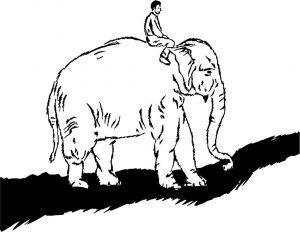
It should be fairly obvious to us what the problem is here. If this huge elephant has a different opinion than the tiny rider about where to go, guess who’s going to get to decide?
The rider can try to convince (or push) the elephant all he wants but in the end it’s the elephant who is going to choose where they go.
This is a big part of why it’s so hard to adopt new habits. We can try to rationalize our way into a particular behavior, but it’s useless if the emotional side of us doesn’t agree.
Another common issue is the path. If the rider and the elephant are going to get your desired destination, you can’t have a bunch of distractions along the road they’re traveling. You need to clear their path.
But I’m getting ahead of myself. Let’s look at all these components individually.
The Rider
The rider may be small compared to the elephant, but he’s pretty damn awesome at planning the route — IF he’s been given a good map to work with.
Most of us give the rider very vague instructions. If you want your rider to lead your elephant effectively, statements like “I’ll exercise sometime this week,” “I’ll call mom when I get a chance,” or “I’ll start eating healthy soon” won’t cut it.
The rider wants specific and measurable targets:
“I’ll exercise at 6 pm on Monday, Wednesday, and Friday at the gym.“
“I’ll call mom from home on Saturday after breakfast.“
“I’ll add one vegetable to each dinner this week.“
In other words, you need to mark down a big fat red X at the exact spot on the map where you want the rider to lead the elephant.
Two effective strategies for doing this are scheduling and implementation intentions.
The Elephant
The elephant doesn’t care much for rational planning. He does what he feels like doing. So, what you need to do is provide the elephant with enough motivation to take the rider in the right direction.
Here are some practical strategies for motivating your elephant:
Start ridiculously small. Let your elephant experience a sense of competence and accomplishment by taking tiny steps in the right direction.
Celebrate small wins. Each time your elephant moves in the right direction, give it an immediate reward.
Create immediate consequences. If your elephant refuses to move, use a stick in the form of a commitment device.
Use accountability. Get a coach or an accountability partner. The elephant will be more motivated if someone else is watching it.
Track your progress. Get your elephant hooked on progress by measuring how many days in a row you’ve completed your habit.
The Path
The path represents the physical environment where the habit takes place. For the rider and elephant to travel smoothly, you need to:
Make the desired path as easy as possible.
Ask yourself how you can alter your environment to make your habit as effortless as possible. You want your elephant to stick to your desired path by default.
For example, if you want to read more books, make sure to always have a great book right next to your living room couch.
Make undesired path as hard as possible.
The elephant is going to be tempted to stray off course onto alternative paths along the way. Especially if they contain some sort of immediate gratification. To avoid this, you need to make these roads as unappealing as possible.
If your elephant typically prefers watching TV instead of reading the book, then put the TV remote in another room. Make the undesired path uncomfortable enough that the elephant stays on the right track.
How to Stick to Your Habits, In Summary
“The Rider, The Elephant, and The Path” is a very useful analogy in behavior change.
The Rider represents the rational part of your mind that plans the journey. He needs specific and measurable targets to guide the elephant. This can be done by using scheduling or implementation intentions.
The Elephant represents the emotional part of your mind that provides the power for the journey. He needs to be motivated to go in the right direction. This can be done by starting small, celebrating small wins, creating immediate consequences, using accountability, and tracking your progress.
The Path represents your environment. To travel effortlessly, the rider and elephant need the desired path to be as easy as possible, and undesired paths to be as hard as possible.
Improve your map. Motivate your elephant. Clear the path. Then get moving. And whenever you get stuck, simply repeat and refine these steps until the rider and the elephant reach their destination.
Oh, and if you have an idea for an article you’d like me to write, I’d love to hear about it.