Patrik Edblad's Blog, page 17
June 6, 2017
This is How to Overcome Procrastination
I love this piece of advice from novelist Raymond Chandler:
“Write or nothing. Two very simple rules, a. you don’t have to write, b. you can’t do anything else.”
As I’m writing my new book, The Self-Discipline Blueprint, I’ve applied that strategy with great results using what author Cal Newport calls The Monk Mode Morning:
“The execution of the monk mode morning is straightforward. Between when you wake up and noon: no meetings, no calls, no texts, no email, no Slack, no Internet. You instead work deeply on something (or some things) that matter.”
Now, I realize not everyone can spend their entire morning in monk mode. If that’s the case for you, I warmly encourage you to try it for just an hour a day.
You’ll probably find that it will have a huge effect on your productivity. And then you’ll naturally be motivated to find ways to extend your time in monk mode.
Here are some practical advice for getting started:
1. Find your space
The first thing you need to do is locate a spot where you’ll put yourself in monk mode every day. That could be a room in your house, your office at work, a space at the library, or someplace else.
The important thing is that you can lock out interruptions. If that means hanging a “Do Not Disturb” sign on the doorknob or letting your cube mates know that your headphones mean you’re unavailable is up to you and your circumstances.
In short — find a space where you’re not tempted by distractions, and distractions have a hard time reaching you.
2. Prepare your stuff
Once you’ve decided where you’ll be spending your time in monk mode, the next step is to prepare everything you might need while you’re there.
That might mean textbooks, other study material, your laptop, snacks, and drinks. By having everything close at hand, you prevent yourself from coming up with excuses for leaving monk mode.
You have everything you need, so there’s no valid reason to get up and do something else.
3. Remove all distractions
Next, you need to search your space for anything that could potentially distract you, and remove it.
If you’re working on a computer, turn off all notifications and close your email program. Use an app like Freedom to restrict Internet access while in monk mode.
If you have your phone with you, set it for “Do Not Disturb” mode or turn it to silent until you’re done.
Remember, you don’t have to work. But you can’t do anything else, either.
4. Let everyone know
Before you launch into monk mode for the first time, make sure to tell the people around you about it.
Explain why it’s important to you, and why you hope to accomplish by doing it.
By setting very clear expectations about when people will have access to you, you’ll most likely find that you won’t be bothered.
5. Celebrate your progress
Finally, I highly recommend you keep track of, and celebrate, your accomplishments in monk mode.
I keep a wall calendar in my space where I put a big X over each day I stick to my monk mode habit.
That small reward at the end of each monk mode morning is enough to keep showing up and doing it. Why? Because at this point I got a long streak going, and I don’t want to break it.
How to Overcome Procrastination, In Summary
Here’s how to put yourself in monk mode:
Find your space. Lock out all interruptions.
Prepare your stuff. Work material, snacks, and drinks.
Remove all distractions. You don’t have to work, but you can’t do anything else, either.
Let everyone know. Tell the people around you about your monk mode times.
Celebrate your progress. Record your successes on a wall calendar — then don’t break the chain!
Thanks for Reading!
If you enjoyed this article, .
Then put yourself in monk mode.
Your most important work deserves it.
Stay awesome,

The post This is How to Overcome Procrastination appeared first on Selfication.


May 2, 2017
I’m Writing My Next Book!
This is a quick note to let you know I’m taking May off from writing articles.
The reason is I want to free up more time to write my new book. (Yay!)
Since The Habit Blueprint has become so popular, I’ve decided to create a series of “blueprint books.”
And the second book in that series will be The Self-Discipline Blueprint.
As the name suggests, it will outline all my favorite strategies for showing up and getting work done every single day.
I’ve chosen that topic because it’s the most requested by my readers and because I believe consistency is the key to success in all areas of life.
If you have an idea for another blueprint book you’d like me to write, please don’t hesitate to get in touch. I’d love to hear what you have in mind.
Now, I’m off to my man cave. Enjoy the spring, and I’ll see you in June. 
April 19, 2017
This is How to Master Your Habits: Secrets From Research
This is my answer to the Quora question “What can I learn/know right now in 10 minutes that will be useful for the rest of my life?”
If you enjoy it, I’d be very grateful if you upvote it so others can find it as well.
Here we go!
Learn How to Master Your Habits
“We are what we repeatedly do. Excellence, then, is not an act, but a habit.”
— Aristotle
Your life today is the result of your habits from the past:
How in shape you are is a result of your habits.
How educated you are is a result of your habits.
How happy you are is a result of your habits.
How much money you have is a result of your habits.
How good your relationships are is a result of your habits.
I could keep going, but I’m sure you get the point. As the late, great Jim Rohn used to say: ”Success is nothing more than a few disciplines, practiced every day. Failure is a nothing more than a few errors, repeated every day.”
So, if you want to lead a successful life, it’s crucial that you learn how to master your habits. Here’s how.
[Note from Patrik: If you find this answer interesting and would like to learn more research-backed strategies for behavior change, check out my FREE resource “Habits: The Definitive Guide to Lasting Change.“]
The Habit Loop
According to researchers at MIT, all habits follow the same neurological loop1:
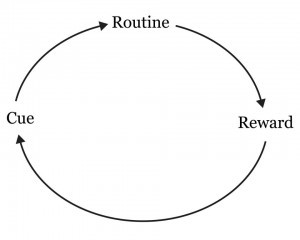
A cue — The trigger that starts your habit. Example: You get an email notification.
A routine — The habit that follows the cue. Example: You open the email.
A reward — The benefit you gain from doing the habit. Example: You get to know what the email is about.
If you perceive the reward as positive, you’ll want to repeat the loop again the next time the cue shows up. If you repeat it enough times, it will become a habit.
The habit loop is a very useful framework because it makes it easy to dismantle your habits and manipulate its different parts.
Let’s go through each of the habit loop parts and look at the most powerful strategies for mastering them.
1. The Cue
Most people have very vague intentions for the habits they want to create.
Unfortunately, as you may have noticed, telling yourself that ”I’ll work out three times this week” rarely works.
And that’s because you haven’t created a proper cue for the behavior.
To build a solid habit, you need to know exactly when and where it will be taking place.
A stupid simple, yet incredibly powerful way of doing that, is to use ”If —> Then” statements2. You do that by completing the following statement:
If [situational cue], Then I will [planned response to the cue].
For example: ”If I’m leaving work on a Monday, Wednesday, or Friday —> Then I will go to the gym.”
Don’t be fooled by the simplicity of this strategy. More than 200 studies have shown that people who use If —> Then planning are about 300 percent more likely than others to reach their goals3.
2. The Routine
When we create new habits, we tend to want big results fast.
And because of that, we try to create big changes.
The problem, of course, is that it rarely works. Instead, what typically happens is that we overwhelm ourselves and quit shortly after we’ve started.
To avoid that trap, you need to make a simple shift in your mindset.
Instead of obsessing over the results, start obsessing over showing up.
Forget about the long-term results, and instead make the habit so ridiculously easy you can’t say no4.
Go for a five-minute walk. Meditate for two minutes. Read one page in a book.
Build motivation and momentum by setting yourself up for, and celebrating, small wins.
Then, when the behavior is well established, you can incrementally increase your efforts.
3. The Reward
To reinforce your habit, you need to reward yourself for doing it.
That can feel a bit awkward, especially in the beginning when the behavior is easy to do.
But the thing is, you aren’t celebrating your results. You’re celebrating your ability to show up.
Stanford psychologist and behavior expert BJ Fogg suggests you think f it this way5:
”The fact that you’re learning to change your behavior is a big deal. Think how rare a skill it is. Think how long behavior change has eluded you. And now you are succeeding.”
Don’t celebrate your five-minute walk. Celebrate that you’ve taken another successful step to improve your life.
Allow yourself to do a quick fist-pump, short victory dance, or exclaim a proud ”yay, me!” each time you complete your habit.
Your brain will associate your habit with your reward. And that, in turn, will make it likelier you’ll keep doing it in the future.
Breaking Bad Habits
The Habit Loop isn’t just helpful for creating good habits. It’s also very useful for getting rid of unwanted behaviors. All you have to do is analyze and manipulate the different parts of the already existing loop. Here’s how.
1. Remove the Cues
First, think about how you can cut out unhelpful cues. For example:
If you smoke when you drink, don’t go to the bar.
If you eat unhealthy snacks when you have them around the house, throw them out.
If you watch too much TV, put the TV remote in another room (or put the TV in the garage).
Try to remove as many triggers as possible from your environment. In psychology, this is referred to as ”stimulus control.” 6
2. Change the Routines
Then, use If —> Then plans to replace unwanted routines. For example:
If I get the urge to smoke –> Then I will play Tetris.
If I feel like eating a snack –> Then I will have a fruit.
If I want to turn on the TV –> Then I will read two pages in a great book.
The key here is to experiment with different routines to find substitutes that work for you.
3. Remove the Rewards
And finally, come up with creative ways to remove the rewards associated with your bad habit.
Let’s say you want to stop drinking alcohol. One way of removing the rewards associated with drinking is to take Antabuse7. That will replace the pleasant short-term effects of alcohol with a reaction that is so unpleasant that you’d rather abstain from drinking.
You can also use services like StickK, Beeminder or Pact to create immediate consequences for giving into your bad habit.
Thanks for Reading!
I hope you found this answer useful. If you did, I’d be very grateful if you upvote it on Quora so others can find it as well.
If you’d like to learn more about behavior change, check out my FREE resource “Habits: The Definite Guide to Lasting Change.”
Good luck mastering your habits!
Stay awesome,

Footnotes
The Power of Habit: Why We Do What We Do in Life and Business by Charles Duhigg
Implementation Intentions
Get Your Team to Do What It Says It’s Going to Do
The Four Habits that Form Habits
Tiny Habits Sandbox
Stimulus control
Antabuse
The post This is How to Master Your Habits: Secrets From Research appeared first on Selfication.
April 11, 2017
Announcing the Winners of Patrik’s B-Day Giveaway 2017!
Drumroll, please!
It’s time to announce the winners of my 2017 B-day Giveaway!
Aaand the Winners Are…
Daniel, Kalli, Brett, Sailesh, Colette, Asif, Jason, Anggun, Josue, and Karl!
Congratulations, guys! You have all won a free lifetime membership to The Science Of Habits: 14 Days To Change That Sticks!
E-mails with promo codes are on their way. Thanks for participating and reading! I hope you’ll enjoy your prize! 
April 2, 2017
March 21, 2017
48 Tiny Habits That Will Make You Awesome
Here’s my answer to the Quora question “What are some good habits to follow?”
If you enjoy it, I’d be very grateful if you upvote it on Quora so others can find it as well.
Oh, and if you’d like a practical, research-backed plan for making any of these habits stick, check out my FREE resource ”Habits: The Definitive Guide to Lasting Change”.
Here we go!
48 Tiny Habits That Will Make You Awesome
Note from Patrik: I don’t expect you to follow all these habits, nor do I do it myself. But hopefully, you’ll find one or two that will enrich your life. If you do that, I consider this article a success.
February 28, 2017
This is How to Do Things You Don’t Want to Do
The common denominator of success — the secret of success of every person who has ever been successful — lies in the fact that they formed the habit of doing things that failures don’t like to do.
— Albert E.N. Grey
No matter what you want to accomplish in life, it’s going to involve discomfort:
A great career or business requires hard work.
A healthy body needs exercise and foods you don’t necessarily like.
Meaningful relationships need vulnerability and compromises.
In fact, anything worthwhile often requires that you do what you don’t want to do.
And that can be hard.
But it doesn’t have to be.
You Are Not Your Thoughts
I used to take my thoughts very seriously. Whenever one of them popped into my head, I’d immediately identify with it and perceive it as the “truth.”
If a thought told me I was tired and bored, I’d immediately look for a way out.
But I’ve since learned that I am not my thoughts and that my mind is nothing more than a suggestion box.
Because of that, I don’t take my thoughts as seriously as I used to.
And that, in turn, has made a huge difference in my subsequent behavior and the results I get.
These days, when my mind tells me I’m restless and should do something else, I simply thank it for the suggestion and then get back to the task at hand.
Stimulus –> Perception –> Response
It’s never the discomfort that stops you; it’s how you perceive the discomfort.
Your beliefs determine your response, and what you choose to believe is within your control.
You can assign whatever meaning you want to discomfort.
I used to believe it was a signal that I should stop.
These days, I believe it’s a signal that I should keep going.
I’ve decided that anytime I feel discomfort, that just means I’ve stepped into my mental gym and that it’s time for my mental resistance training.
Exercise Your Willpower Muscle
Willpower is a lot like muscle power. The more you exercise it, the stronger it will get.
If you practice it for an extended period of time, you can change your behavior around completely.
You’ll be able to do what others dread doing and to stay away from things that others can’t resist doing.
That level of self-control is exactly what’s needed to become a remarkable person and create extraordinary results.
So, how do you get started?
Practice Voluntary Discomfort
He who sweats more in training bleeds less in war.
— Spartan Warrior Creed
The best way to practice mental resistance training is through voluntary hardship. Here are a few examples:
Underdress for cold weather.
Turn off the air conditioning in your house or car.
Take cold showers.
Occasional fasting.
Drink only water.
Sleep without a pillow.
High-intensity exercise.
These are just a few ideas to help you come up with your personal mental resistance training.
The important thing is that you choose one and commit to it.
And just like in a physical gym, you don’t want to use the heaviest weights right away.
There’s no point getting overwhelmed or injured.
So, start small and then get a little bit every day.
If your willpower muscle is weak right now, it’s perfectly fine to start by making your bed each morning. Or reading one page in a book. Or flossing one tooth.
How to Do What You Don’t Want to Do
If you’re thinking to yourself right now; “I’m not the kind of person who practices voluntary discomfort,” be very mindful of the fact that this is the same voice you want to take control over.
Don’t take it as literal truth. Remember — it’s just a suggestion. And it’s entirely within your power what you do with that suggestion.
If you choose to take action despite what your mind is telling you, it holds no power over you.
You can decide to perceive discomfort as mental resistance training from this moment forward.
And each time you push through the resistance, you’ll notice that you’ll get a little bit stronger.
If you stick to the practice consistently, with time, it’ll become second nature to do what you don’t want to do.
You’ll become a relentless action-taker.
And that’s when you can turn your most desired goals into reality.
The post This is How to Do Things You Don’t Want to Do appeared first on Selfication.
February 20, 2017
This is the Most Fun Way to Overcome Cravings
Do you know the feeling?
You’ve been staying away from an unhealthy habit for a while.
And so far, you’ve been doing quite well.
But then, from out of nowhere, overwhelming cravings start setting in.
Suddenly, you feel like you just HAVE TO have that chocolate, fast food, cigarette, or [insert your personal kryptonite here].
These urges can be hard to deal with. But they don’t have to be.
In fact, it can even be a lot of fun.
Want to Overcome Cravings? Play Tetris!
In a recent study1, 119 people had their natural cravings measured.
They were then divided into two groups.
The first group was instructed to play Tetris whenever their cravings set in.
The second group was a control condition that involved waiting for Tetris to load (which it never did).
After just three minutes of playing Tetris, the first group reduced their craving by 24 percent compared to the control condition.
The Tetris players reported less vivid, less frequent, and less intense cravings for typical temptations like alcohol, food, and cigarettes.
How could that be?
Urges Are Like Ocean Waves
When a craving takes hold of you, it feels like it won’t go away unless you give into it.
But in reality, cravings usually only lasts for a few minutes.
Just like ocean waves, they arrive, crest, and then subside.
They start off small and then grow before finally breaking up and dissipating2.
The Tetris strategy works because it provides a distraction to turn to.
Instead of getting caught up in the wave, you just let it run its course without acting on it.
Overcome Cravings With “Mini-Actions”
But what if you don’t like Tetris? No problem. With a little experimentation, you can find an alternative that works for you.
What’s important is that you find some kind of healthy or neutral behavior to engage in when the craving shows up. Here’s how:
Reflect on when your urges occur. When do you typically give into cravings? What usually precedes them? Are there any particular triggers?
Pick a “mini-action.” This is the alternative behavior you’ll turn to when the cravings set in3.
Create an “If –> Then” plan. This is also known as an implementation intention: If I sense a craving coming on –> Then I will [mini-action].
Shape your environment. Make sure that your mini-action is always more readily available than competing behaviors.
Measure your progress. Track how often your cravings appear, how often your mini-action is successful, and how often you give in.
Reflect and readjust. Schedule a 15-minute weekly review to celebrate your small wins and adjust your plan. Experiment with different mini-actions until you find one that works.
A Practical Example
Let’s say you tend to have sugar cravings each day after eating lunch.
You decide that chewing gum will be your mini-action:
If I start craving sugar after lunch –> Then I will have a chewing gum.
You shape your environment by getting chewing gums you like and throwing away your usual sweets.
Each time you feel a craving coming on, you make a note on your phone or in a notebook to keep track of how it went.
Every Sunday morning, you evaluate your efforts. If the chewing gum mini-action seems to work, you keep going. If not, you create a new If –> Then plan for the upcoming week.
You then rinse and repeat that process until you’ve found an approach that works.
Final Words
Between stimulus and response, there is a space. In that space is our power to choose our response. In our response lies our growth and our freedom.
– Viktor Frankl
You can’t control what cravings happen to show up on a given day. But you can control how you respond to them.
The beauty of mini-actions is that they fit neatly into the space between stimulus and response.
A simple If –> Then plan can be enough to interrupt your usual behavior.
And that’s all you need to create massive change in your long-term results.
So, why not give it a try right now?
Oh, and if you have an idea for a mini-action you want to try, we’d love to hear about it in the Selfication Facebook Group.
Now, it’s time for lunch! Where are my chewing gums?
Footnotes
Playing ‘Tetris’ reduces the strength, frequency and vividness of naturally occurring cravings
Urge Surfing
I’m not sure where I first learned about mini-actions, but I believe it was in a James Clear seminar.
The post This is the Most Fun Way to Overcome Cravings appeared first on Selfication.
February 14, 2017
This is How to Stop Dreaming and Start Doing
You’ve heard the same message from an early age.
“Think positive. Be optimistic. Look at the bright side of things.”
It’s repeated over and over again in pop music, political speeches, and commercials.
No matter what you want to achieve, the message is the same:
Focus on your dreams, eliminate negative self-talk, and your wish will inevitably come true.
The problem, unfortunately, is that it doesn’t work.
The Downsides of Positive Thinking
Gabrielle Oettingen is a professor of psychology and the author of Rethinking Positive Thinking: Inside the New Science of Motivation1.
After studying motivation for more than 20 years, she has found that a positive outlook isn’t as great as conventional wisdom tells us.
In fact, dreamers are often non-doers.
Why? Because positive thinking makes you feel good in the moment.
And that pleasure is actually a huge problem because it makes you feel the same sense of accomplishment as you would if you had attained your goal2.
Merely envisioning the success you want saps the energy needed to make it happen in reality(!).
Positive Thinking = Less Effort
Research conducted over the last 20 years has shown that3:
The more positive obese people are when entering a weight reduction program, the less weight they’ll lose.
The more positive University graduates are about entering the job market, the less they’ll earn.
The more positive students are about excelling on a test, the worse they’ll perform.
The more positive people are about retirement, the less they’ll save.
The more positive hip replacement patients are about early recovery, the less well they’ll do as judged by their physical therapist.
The takeaway? Positive thinkers put in less effort and are therefore less successful.
Practical Positive Thinking
So, does this mean that we should become pessimists and dismiss positive thinking altogether?
No and no. Optimists enjoy better health, greater achievement, and longer lives.
But only when they’re using their positivity in a practical way.
Positive thinking is very helpful for sketching out the possibilities you have in your future.
And it’s also useful for implementing these dreams.
But only if you combine your positive thinking with a good sense of reality.
So, how do you go about doing that?
WOOP Your Goals
WOOP is an acronym based on Gabriele Oettingen’s research. It stands for:
Wish
Outcome
Obstacle
Plan
By taking your goals through these steps, you’ll be much more likely to follow through on it.
Oettingen and her colleagues have found that people who use WOOP are more successful in reducing cigarette smoking, eating less unhealthy food, doing more work, fostering healthier relationships, and many other goals3.
Let’s look at each step in more detail. Oh, and let’s pretend you want to eat healthier as a practical example.
1. Wish
Every change starts with a wish. In this first step, ask yourself what you would like to achieve. Make sure that it’s challenging and at the same time feasible.
You want to eat healthier, so you decide only to eat salads for lunch.
2. Outcome
This is where positive thinking comes into play. What are the benefits you’ll experience when you achieve your outcome?
You’ll lose some weight, get healthier, and have more energy.
3. Obstacle
Most people never make it to this step. And that’s a problem because it’s not enough to decide what you want to do and imagine the benefits it will bring. You also have to rub it against reality. What are the specific obstacles that will get in the way when you’re trying to turn your wish into reality?
You’re often offered a desert after lunch.
4. Plan
Finally, you need to put a plan in place for how to deal with each obstacle so you can attain your wish. You do that by creating an “If –> Then” plan for each obstacle using this framework:
If [obstacle] happens, –> Then I will [pre-planned action].
If I’m offered a desert after lunch –> Then I will order a cup of coffee.
How to Stop Dreaming and Start Doing, In Summary:
Positive thinking is great but only if you combine it with a good sense of reality. You can do that by using the WOOP process:
Wish. What do you want to achieve?
Outcome. Use positive thinking to imagine the benefits.
Obstacles. What will get in the way?
Plan. When the obstacle shows up, how will you deal with it? “If _____ happens, Then I will _____.”
Now, I have a challenge for you:
Run your most desired goal through the WOOP process immediately.
If it’s truly important to you, why let it wait?
Take the first tiny step right now and let the compound effect get to work for you.
Let’s stop dreaming and start doing.
Footnotes
Rethinking Positive Thinking: Inside the New Science of Motivation by Gabriele Oettingen
Keep your goals to yourself | Derek Sivers
Rethinking Positive Thinking (Gabriele Oettingen, New York University) | DLDwomen 14
The post This is How to Stop Dreaming and Start Doing appeared first on Selfication.
February 6, 2017
This is How to Grow Your Grit: 5 Secrets From Research
Do you stick to your long-term goals? Or do you constantly get distracted by new ideas and projects?
Do you keep showing up when things get difficult? Or do you procrastinate and give up?
Your answers to these questions are important because they say a lot about the level of success you’re likely to experience in life.
“80% of success is showing up”
That quote belongs to legendary actor, author, filmmaker, comedian, playwright, and musician Woody Allen1.
When giving advice to aspiring writers, he elaborated on his statement this way2:
“My observation was that once a person actually completed a play or a novel he was well on his way to getting it produced or published, as opposed to a vast majority of people who tell me their ambition is to write, but who strike out on the very first level and indeed never write the play or book.”
Some people talk. They are the ones who “strike out” and get stuck.
Other people do. They are the ones who make consistent progress and get real results.
So, what separates these two groups from each other? In one word, the answer is…
Grit
In short, grit is “perseverance and passion for long-term goals.”3
The psychological definition of grit contains two components:
The ability to stick to long-term goals.
The ability to keep going despite adversity.
Angela Duckworth is a professor of psychology and pioneer in grit research.
In study after study, she has found that “where talent counts once, effort counts twice.”4
She explains that finding with this formula:
TALENT x EFFORT = SKILL
SKILL x EFFORT = ACHIEVEMENT
When you apply effort to a talent, you get a skill. And when you apply effort to a skill, you get achievement.
Without effort, your talent is just untapped potential.
And without effort, your skill is just something you could’ve done, but never did.
That is why grit counts twice, and that is why it’s such an important factor.
5 Ways to Grow Your Grit
Grit is the best predictor of success that researchers have found.
It helps kids do better in school, high-school students graduate, university students get higher grades, soldiers follow through on demanding military training, and adults succeed at work and stay in their marriages5.
No matter what long-term goals you’re trying to achieve, you need grit to get there.
And the good news is that you can grow your grit.
By looking at life as a marathon rather than a sprint, and by developing certain factors that are indirectly connected to grit, you can realize your potential. Here’s how:
1. Pursue Your Interests
You’re going to have a hard time sticking to goals that don’t fascinate you.
So, the first step to growing your grit is to find something interesting.
But that doesn’t mean sitting around thinking about what your passion is.
According to Angela Duckworth, it’s much more efficient to get out there and try different things until you’ve found something you’re passionate about.
Once you’ve done that, it’s time to find a role model, mentor or coach to help you improve.
2. Practice, Practice, Practice
Hard work leads to competence, and we’re much more likely to stick with things we’re good at.
The most gritty people always want to improve, no matter what it takes or how good they already are.
So, when you’ve found your interest, put in the work to get a little bit better every day.
Compete with who you were yesterday.
Do a slightly harder workout. Meditate a little longer. Stick with a boring task even though you don’t want to.
Consider these challenges mental resistance training.
3. Connect to a Higher Purpose
People who connect what they do to a higher purpose are grittier.
It’s not enough to have a compelling interest.
You also have to take a step back and understand how what you do contribute to the well-being of others.
That is not only useful for increasing your grit. It also helps you enjoy the task more.
So, reflect on how what you do benefit the people around you.
4. Cultivate Hope
If you want to reach your goals, you first need to believe it’s possible.
Limiting beliefs about your abilities being fixed and unalterable affects your grit negatively.
And they are also plain wrong.
Research has shown that you have the possibility to change your brain and learn new skills throughout your life.
Your brain is “plastic”6, and you can reshape it through effort and experience.
So, go after your goals with the belief that you can improve if you work hard at it.
Because you can.
5. Surround Yourself With Gritty People
The people around you have a huge influence on your thoughts, feelings, and behaviors.
When you spend enough time with a particular group of people the way, they do things become the way you do things.
Their norms and values will rub off on you and become your new standard.
So, one of the most efficient ways to grow your grit is a kind of positive peer pressure.
Surround yourself with gritty people, and it’s only a matter of time before you’re just as gritty yourself.
How to Grow Your Grit, In Summary
Grit is the stubborn refusal to quit. — Jonah Lehrer
Successful people stick with their long-term goals instead of getting distracted, and they keep showing up, even when it’s difficult.
If you lack those abilities, you can grow your grit in these five ways:
Pursue your interests. Find something that fascinates you.
Practice, practice, practice. Get a little bit better every day.
Connect to a higher purpose. Ask yourself how you are helping other people.
Cultivate hope. Remove your inaccurate, limiting beliefs.
Surround yourself with gritty people. Create positive peer pressure.
80% of success is showing up. With that in mind, what will you stop talking about and start doing?
Let us know in the Selfication Facebook Group.
Footnotes
Woody Allen
On Language; The Elision Fields
Grit: Perseverance and Passion for Long-Term Goals
Grit: Passion, Perseverance, and the Science of Success by Angela Duckworth
The grit effect: predicting retention in the military, the workplace, school and marriage
Neuroplasticity
The post This is How to Grow Your Grit: 5 Secrets From Research appeared first on Selfication.