K.E. Garland's Blog, page 9
June 26, 2024


June 23, 2024
Sunday Shorts: Respect Reality
“You just have to respect reality,” he said.
He uttered respect reality as if it was the most natural thing in the world. The words pinged between my hypothalamus, amygdala, and hippocampus, then settled around my limbic cortex, whose function is to process and regulate emotion and memory while also dealing with sexual stimulation and learning.
Respecting reality is one of life’s tests I’ve repeatedly failed. I’ve attained high honors in disassociation and fantasy-world creation. I’ve received A’s in world building, including ignoring family and friends’ traits, re-constructing them in my mind, and interacting with the new and improved fabrication.
So, how do you respect reality? The details are denoted in definitions.
Respect is synonymous with honor and sometimes regard. Respect is akin to admiration and appreciation. We are not inclined to fix, when we respect. Respect doesn’t mean “like.”
Reality is absolute. It is unadulterated. We don’t parse truths when living in reality. “My truth” and “your truth” don’t exist in a space of reality. There is no room for delusions or to be delulu, as the youth say. Reality is the state of things as they actually exist.
The end.
Therefore, when you respect reality, you’ll do as Mama Angelou advised. You’ll take heed “when people show you who they are.” You’ll “believe them.”
Respecting reality offers us a powerful lens. It allows us to make decisions from what is, as opposed to interpreting what we think we see in ourselves or others. It won’t always feel good, and it may not be our preference, but life could be easier if we journey toward respecting reality.
Sunday Shorts is a series that is fewer than 300 words and prompted from a brief interaction or thought I’ve had, while speaking with someone.
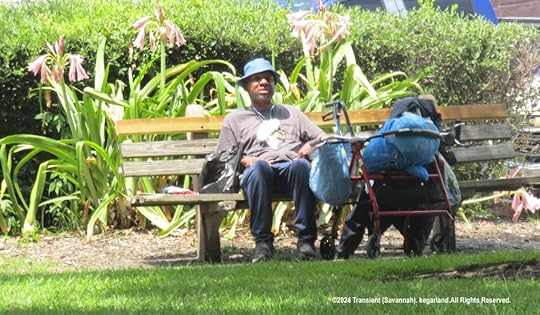
Sunday Shorts: Respect RealityInspiring Image #150: Detroit Mural #2: StevieMonday Notes: In Search of a Salve HYBRID Q&AMonday Notes: Too Much Information in the Information AgeMonday Notes: My Entry into the Adoption CommunityJune 12, 2024
June 10, 2024
Monday Notes: In Search of a Salve HYBRID Q&A
If you’ve read In Search of a Salve, first of all, thank you! Guess what? On July 20th, from 1:00-3:00 p.m. (ET), I’ll be holding a Q&A for anyone who has read the book and has questions. For the in-person option, I’ll be interviewed by a former Jacksonville TV personality, Henny. So, if you live in or near Jacksonville, Florida, please pop in and say, “Hey!” For the virtual option, my friend, Tarcia, and host of the Adoption Journey Podcast, will be fielding and moderating questions/comments. Either way, I hope you’ll consider attending. Here are some details and the link:
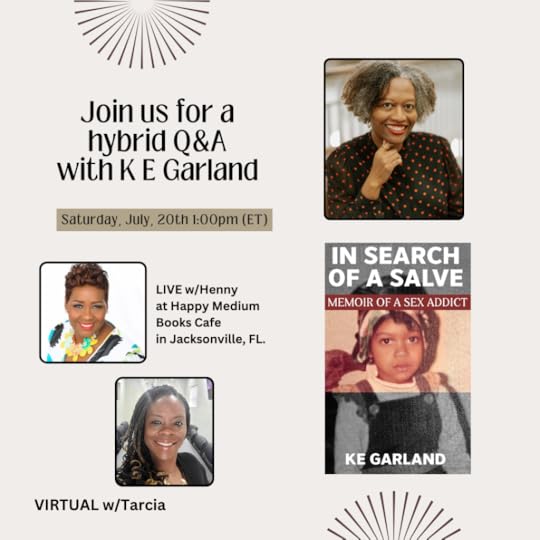 If you’re in Jacksonville, I’ll be in person at Happy Medium Books Cafe. If you’re not in Jacksonville, you’ll be able to
participate virtually
. It’s a FREE event, but, you’ll have to register to attend, whether for in-person or virtual attendance.As a secondary part of the event, I’m raising funds for Family Support Services of Northeast Florida, an organization that helps adoptees and children who live in foster care. To donate, please use the same link.REGISTER HERE! Monday Notes: In Search of a Salve HYBRID Q&AMonday Notes: Too Much Information in the Information AgeMonday Notes: My Entry into the Adoption CommunityIn Search of a Salve: Lori L. Tharps’ ReviewMental Health Matters: Curated Resources for Mental Health Awareness Month
If you’re in Jacksonville, I’ll be in person at Happy Medium Books Cafe. If you’re not in Jacksonville, you’ll be able to
participate virtually
. It’s a FREE event, but, you’ll have to register to attend, whether for in-person or virtual attendance.As a secondary part of the event, I’m raising funds for Family Support Services of Northeast Florida, an organization that helps adoptees and children who live in foster care. To donate, please use the same link.REGISTER HERE! Monday Notes: In Search of a Salve HYBRID Q&AMonday Notes: Too Much Information in the Information AgeMonday Notes: My Entry into the Adoption CommunityIn Search of a Salve: Lori L. Tharps’ ReviewMental Health Matters: Curated Resources for Mental Health Awareness Month
June 3, 2024
Monday Notes: Too Much Information in the Information Age
“Do you remember when your daddy used to make sun tea?” I recently asked my youngest daughter.
“I do,” she said. “But guess what? I read that sun tea is bad for you.”
“Huh?” I asked, skepticism brewing.
“Yeah. Something about the bacteria.”
She was right. Bacteria breed in warm water, and the sun is rarely hotter than 130 degrees, which is ten degrees short of how tea should be brewed. Thus, sun tea is not healthy.
While I like to be as healthy as possible, and I like to read and learn new information, in the 21st century, a deluge of daily facts is beginning to feel daunting.
For example, I recently watched seven parts of a nine-part documentary on health and longevity. One of the main points was about how important the microbiome is. I’m sure you’ve heard by now that our gut health is an integral part of our overall wellbeing. Guess what we should do if we’re concerned about our microbiomes?
Consider a probiotic.Consider a prebiotic.Find a bottle of enzymes.Eat only organic food.Exercise, but not 30 minutes a day for five days as the CDC has suggested, but rather, intermittently, all day long, as much as possible, because that’s what our ancestors did…you know, the ones who hunted and gathered.Make sure your food is non-GMO, which is no easy feat because in the States, those who grow non-GMO food are responsible for labeling their food, not farmers who harm us with genetically modified food.Get a colonoscopy, but don’t wait ‘til you’re 50. Nope. That’s old news. The recommended age is now 45.So, yeah. That’s just one aspect of our physical health. What about mental health? I’m glad you asked.
Recently, I thought it was a great idea to learn more about autism, so I purchased a special edition verywell health magazine. My head swam by page four. Unlike other disorders, this one isn’t as simple to understand. Though there are five characteristics that a person must exhibit, there are other factors, such as if the person is female. An autistic female presents differently than a male one. Also, research has been focused on white males, so there are probably more autistic people in the world than we think.
But that’s not what got me. What stood out was an article about what to call people with autism spectrum disorder (ASD). As a teacher educator, I have been taught and have taught others to use what’s called people-first language. In this case, that means saying: John is a boy with autism. Welp. That is not the case with ASD. Instead, people with this disorder prefer identity-first language. Meaning, you should say: John is an autistic boy.
Oh, and Asperger’s is no longer a diagnosis, partially because Asperger was a Nazi sympathizer who collaborated with a clinic that was known to have killed children with disabilities. Folks formerly diagnosed with Asperger’s are now considered on the ASD spectrum. However, some people who were previously diagnosed with Asperger’s prefer not to be labeled as autistic. They’re fine using Asperger’s to define who they are.
Geez-la-flipping-wheeze!
I’d like to reiterate that I don’t have a problem learning new information. Like Plato, I believe society should be educated if we want an informed citizenry. And in this century, it has never been easier or more important for everyone to be educated about something. Today’s challenge, however, is that there is not only too much information in the information age, but also too much access to “hot-off-the presses” info. What we knew yesterday is not what we’ll know tomorrow.
So, what should we do?
It seems imperative that we not only learn ways to consume information in critical ways, but also that we figure out how to be lifelong learners. Information is constantly changing. It always has and will continue to do so. But now, more than ever, the onus is on the public as opposed to purveyors of information. Now, it’s up to us to determine how and if we will use information in our lives.
Monday Notes: Too Much Information in the Information AgeMonday Notes: My Entry into the Adoption CommunityIn Search of a Salve: Lori L. Tharps’ ReviewMental Health Matters: Curated Resources for Mental Health Awareness MonthMonday Notes: When I Was a Child, I Spake as a ChildMay 27, 2024
Monday Notes: My Entry into the Adoption Community
May 18, 2024, I participated in Fog Lift Chicago. I’ve previously shared about Fog Lift and how the creator, Autumn, is a documentarian, who shares her lived experiences with reckoning with the “primal wound” of adoption. One of the subsequent results of her documentary is an event called Fog Lift, which was created to support adoptees in an experiential, artist kind of way. I also explained that I’d be interviewing Tarcia, a friend of mine about finding her birth father and paternal side of her family. I’ve been to a lot of conferences over the years, and I didn’t think this would be much different.
I was wrong.
The FOG in Fog Lift symbolizes the complicated emotions that adoptees sometimes feel. FOG is an acronym for the fear, obligation, and grief associated with being adopted, interacting with our adoptive families, or reuniting with our birth families. Similar to when I watched Reckoning with the Primal Wound, being in community with other adoptees helped me to feel seen and to face and process the FOG I’d experienced in my own life.
FEARThe first time I searched for my birth mother and my maternal family, I experienced fear of the unknown. Who would these people be? How would they receive me? Did they want to get to know me? These questions and more shaped my concerns. Though my adoptive mother was deceased, I also feared not knowing what “Grandma Hunny,” my adoptive grandmother’s response would be. My anxiety was warranted. My maternal birth family had lived with generations of mental illness and trauma that precluded us from connecting on a deeper level, and “Grandma Hunny” was not pleased or supportive of my search.
OBLIGATIONIt is common for adoptees to feel a sense of obligation to their adoptive families, especially when the common narrative is that our families “saved us.” Consequently, a lot of times, adoptive families feel hurt when adoptees want to do something natural, like locate their birth families or have relationships with their first families. For me, it manifested in my grandmother’s words, your mama said she didn’t want you to know who they were. It was a challenge to traverse these guilt trips because if I searched, then I felt as if I was betraying my adoptive family; if I didn’t search, then I was betraying someone far more important…myself.
GRIEFAdoptees face grief in a myriad of ways. Finding our birth families and learning about our conception stories can trigger grief. Learning about the circumstances surrounding how and why our mothers and fathers relinquished their parental rights can be distressing and overwhelming. Oftentimes, we must trade the unicorn and rainbow stories we’ve developed in our minds for the horrific and traumatic stories of the truth. When I found out who my birth mother was, I simultaneously learned that she’d drowned in Lake Michigan, thus creating twice the sadness; I had to not only put my concocted story to rest, but also accept that I’d never know my mother. Finding my birth father was different, but the result has been similar. Though he is alive, he does not have the capacity to be the type of father I would want at this phase of my life. Here, I’ve had to grieve the loss of learning about who he really is, while accepting that he will be my father solely through biology.
As the sun faded on May 18th and contributors and presenters conversed over craft beers and vegan chicken, Autumn looked at me and said, “This is your first Fog Lift. How did it feel?”
Without hesitation, I replied, “It felt like home.”
ADOPTEE RESOURCES: Reckoning with the Primal Wound is a documentary that illustrates what the primal wound is and how it affects adoptees.The Good Adoptee is a play written by Suzanne Bachner and dramaturged by Bob Brader.The Adoption Journey Podcast offers those who have been affected by adoption to share their story.Identity is an organization that supports transracial adoptees and their adoptive parents.Who Am I Really? is a podcast where adoptees share their reunion stories.Monday Notes: My Entry into the Adoption CommunityIn Search of a Salve: Lori L. Tharps’ ReviewMental Health Matters: Curated Resources for Mental Health Awareness MonthMonday Notes: When I Was a Child, I Spake as a ChildInspiring Image #149: Transient (JAX)May 17, 2024
May 13, 2024
Mental Health Matters: Curated Resources for Mental Health Awareness Month
MAY is Mental Health Awareness Month, so I’d thought I would take the time to share resources where either I or others have written about mental health or mental illness. I hope this helps.
MY BLOGSIn 2021, the Florida Writers Association awarded Kwoted with first place in blogging. Except for my interview with Dr. Dinardo, what follows are the essays that were read and evaluated. I hope these firsthand accounts of self-discovery are useful.
Mental Health Matters: SuppressionMental Health Matters: CodependenceMental Health Matters: Learning to Be IntimateMental Health Matters: Interview with Dr. Dinardo about Situational AnxietyMental Health Matters: How to Establish 4 Types of BoundariesBOOKS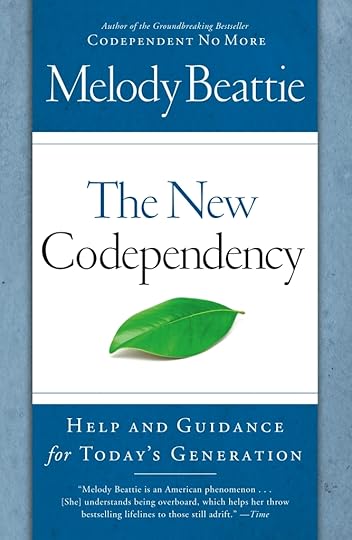
As mentioned before, I have engaged in over nine years of self-therapy for a myriad of issues. I’ve not only read each one of these books, but I’ve also practiced what experts have suggested. Each is valuable for a different reason.
Melody Beattie’s Codependent No More Louise Hay’s Mirror Work: 21 Days to Heal your LifeIyanla Vanzant’s Get Over It!: Thought Therapy for Healing the Hard Stuff Dr. Elaine N. Aron’s The Highly Sensitive Person: How to Thrive When the World Overwhelms You Kelly McDaniel’s Mother Hunger INSTAGRAM ACCOUNTSI don’t think you can become a better person by simply reading and liking a gif, meme, or picture quote; however, I do believe that these types of visuals can help us feel seen and affirm our emotions in immeasurable ways. What follows are mental health professionals’ IG accounts, not lay people with opinions. If you’re not on IG, I’m sure these folks have other platforms on TikTok, FB, or X.
Dr. Nicole Le PeraNedra Glover TawwabHailey Paige MageeJennifer Arnise Black Mother WoundDr. Gabor MatéSEX ADDICTION RESOURCESAlthough sex addiction is not included in the most recent Diagnostic and Statistical Manual of Mental Disorders, and quite honestly, because it is not listed, I thought I’d add these resources for anyone who has lived with these compulsions or for any spouse who has endured being married to a person who identifies as a sex or porn addict.
The Best Books to Understand Female Sex Addiction , K E GarlandNew Legacy Family Counseling, Roy KimCenter for Relational Recovery (Betrayal Trauma), Michelle MaysBethesda WorkshopsPorn Addiction and Betrayal Trauma Coach, Joshua SheaI truly hope these help, and if you have additions, then by all means, add them in the comments. We’re all connected, and if one of us becomes a better human being, then all of us become better human beings.
Mental Health Matters: Curated Resources for Mental Health Awareness MonthMonday Notes: When I Was a Child, I Spake as a ChildInspiring Image #149: Transient (JAX)Monday Notes: 5 Ways to Become a WriterGuest Blog: 3 Things I Hoped to Accomplish with In Search of a SalveMay 6, 2024
Monday Notes: When I Was a Child, I Spake as a Child
My childish ways used to appear as a popular South Park episode. I walked around like Cartman, shouting, “Whatever. I do what I want!” Suffocated by overprotective parents and then a controlling grandmother, I couldn’t wait to grow up, so I could do what I want! But what did I want? To ignore everyone and call it young adulthood? To party and drink my life away as much as possible with little to no consequences? Or to ignore impending and obvious effects? Yep.
But that was childish.
And because everyone in your life is a mirror, my relationships showed this immaturity. Connections are not accidents, but instead, reflections of who we are and where we are. You cannot be close to someone with whom you are not alike in some way. For me, this has rung true. In the past, I surrounded myself with those who behaved as I felt; some were reckless; others rude; many emotionless—a cacophony of I do what I want shaded in varied tones. As time wore on, friends grew younger, symbolic of where I was in time. I was becoming older, but not wiser. Jill Scott once poignantly described this as being a “grown girl,” instead of a grown woman. On the outside, I was an adult, but inside? I was a teenager.
For three decades, I chose experiences that fed my ego, or as the Collins dictionary defines it, a sense of a person’s own worth. Synonyms for ego include self-respect and self-image. No matter what you call it, my opinion of my selves was low. So, I engaged in external activities that fed my ego in an effort to boost self-worth, self-respect, and self-image. Each looked like marriage, degrees, and children. Each raised my sense of self. But not really. This, too, was childish.
11but when I became a man, I put away childish things.According to astrology, we each have a Saturn return. The phenomenon occurs every 27-30 years. The first is a time for coming of age. The second signals maturity. The third, a phase of wisdom. My second Saturn return began years ago. Though astrology is controversial, for me, the concept is not something to be believed or not believed. Before my birth chart reader explained this cosmic idea, I had sensed it. I hate to be cliché, but like a butterfly, the cocoon grew tight, uncomfortable. It was time to grow up and out.
It was time to put away childish things.
The process began with identifying a clear sense of who I wanted to be in the world. In essence, I wanted the external and internal versions of me to match. So, I first swept the inside, until it formed a small clump of dust; I threw out what I didn’t like. Then, I made small changes along the way, like caring more about my community by being of service. If I could volunteer, then I did. I expressed gratitude for people and experiences, not in a performative way, but in ways that showed people I truly appreciated who they were and how they’d shaped my life.
As I gained a sense of self, I lost relationships. Either I began the unraveling, or others cut the cord. Losing friends and family hurt. Like many, I was taught to value the length of knowing a person, as opposed to the depth of knowing. But the cocoon was more painful. And when you’re in a conscious Saturn return, depth will always win. I had to put away childish things. Thus, friendships and familial connections evolved with or without me. Soon, I found myself surrounded by people who were emotionally mature, who outstretched their hands to lift me up, and who practiced reciprocity.
Healing my self-worth issues shifted the types of opportunities I was offered. Gaining clarity about my gifts and strengths has helped me to function in an ideal sense of adulthood. Consequently, it has become unnecessary to perform as proof of worth. Today, I walk into rooms out of a desire to provide offerings that may improve a situation, not to bolster my selves.
Slowly, I put away childish things. Slowly, I became an adult. Slowly, I embodied 1 Corinthians 13 … the whole of it. Slowly, I have become closer to being fully actualized.
Monday Notes: When I Was a Child, I Spake as a ChildInspiring Image #149: Transient (JAX)Monday Notes: 5 Ways to Become a WriterGuest Blog: 3 Things I Hoped to Accomplish with In Search of a SalveMental Health Matters: How to Establish 4 Types of Boundaries