K.E. Garland's Blog
November 18, 2025
Adoptee Awareness Month: From One Adoptee to Another: Let’s Develop Self-Awareness, Identity, and Empathy
Ever since 1995, November had been Adoption Awareness Month. But two years ago, adoptees began reclaiming the month as a way to demarginalize our voices and to raise awareness. So, we celebrate ADOPTEE AWARENESS MONTH as way to reshape the narrative. I mean, adoption was supposed to be about us, right?
So, for Adoption Awareness Month, I’m sharing the latest piece I published, which shows what I learned about interacting with people who are adopted. In a lot of ways, it can be challenging because we sometimes lead with our pain, which can cause harm to those around us.
Please read From One Adoptee to Another: Let’s Develop Self-Awareness, Identity, and Empathy. I’ve turned off comments here, so you can share what you’d like on the Adoption Knowledge Affiliates site.


November 11, 2025
Adoptee Awareness Month: Acknowledging the Primal Wound: How Relinquishment Can Lead to An Intimacy Disorder
Ever since 1995, November had been Adoption Awareness Month. But two years ago, adoptees began reclaiming the month as a way to demarginalize our voices and to raise awareness. So, we celebrate ADOPTEE AWARENESS MONTH as way to reshape the narrative. I mean, adoption was supposed to be about us, right?
So, for Adoption Awareness Month, I’m sharing the first piece I published specifically about adoption. I’d had an AHA moment when I found out that research shows adoption is trauma.
Please read Acknowledging the Primal Wound: How Relinquishment Can Lead to An Intimacy Disorder. I’ve turned off comments here, so you can share what you’d like on Adoption Knowledge Affiliates site.
Adoptee Awareness Month: Acknowledging the Primal Wound: How Relinquishment Can Lead to An Intimacy DisorderAdoptee Awareness Month: Letter From the Outside DaughterA Halloween Photo Story: Power RangersMonday Notes: 5 Ways to Become a WriterMonday Notes: Jealousy: A HaikuNovember 4, 2025
Adoptee Awareness Month: Letter From the Outside Daughter
Ever since 1995, November had been Adoption Awareness Month. But two years ago, adoptees began reclaiming the month as a way to demarginalize our voices and to raise awareness. So, we celebrate ADOPTEE AWARENESS MONTH as way to reshape the narrative. I mean, adoption was supposed to be about us, right?
So, for Adoption Awareness Month, I’m sharing the latest piece I published about interacting with my birth father and his family. I was hella triggered, and the best way I knew to deal with it was to write it out.
Please read Letter From the Outside Daughter. I’ve turned off comments here, so you can share what you’d like on the Adoption Knowledge Affiliates site.
Adoptee Awareness Month: Acknowledging the Primal Wound: How Relinquishment Can Lead to An Intimacy DisorderAdoptee Awareness Month: Letter From the Outside DaughterA Halloween Photo Story: Power RangersMonday Notes: 5 Ways to Become a WriterMonday Notes: Jealousy: A HaikuOctober 31, 2025






October 20, 2025
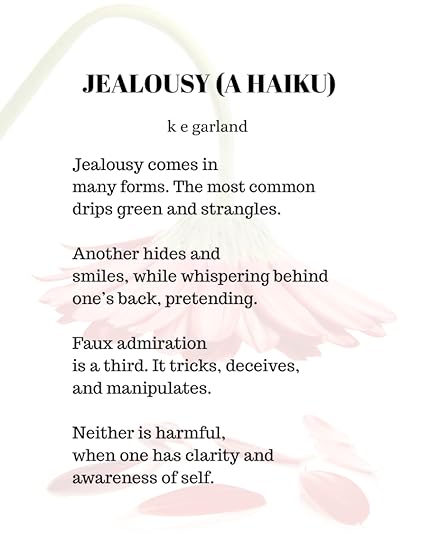
Monday Notes: Jealousy: A Haiku
Writing is my muse. This medium helps me to process emotions, so that I don’t communicate in inappropriate ways. I wrote this poem months ago, while steeped in confusion about someone and their behavior. Once it was clear, these words flowed.
October 13, 2025
Monday Notes: 5 Lessons Learned From Planning Black Adoptees Meetup by Myself
In 2024, I co-founded a group called Black Adoptees Meetup. Another woman and I organized that event within two months. We brought 25 Black adoptees from around the States to meet for the first time. It was beautiful. It was necessary. It was powerful. So, we thought we would do it again. But this time, we had twelve months to plan. This time, it would be better! Well, that’s what I thought.
January and February of 2025 we met virtually. Then, our meetings and communication about the event stopped abruptly. Something was wrong with the woman I was working with—something that to this day, she hasn’t explained. So, the hyper independent little girl in me sprang into action: I chose the venue and the menu, selected the hotel, created a website, manned the email, partially managed the social media account, and executed two virtual meetups, all without her help.
Months later, 31 adoptees arrived in Chicago. The energy was electric. For some, this was the first time they’d been in community with others who had similar experiences and who looked like them. This meetup helped them to feel less isolated.
An event like this should’ve felt like an accomplishment, a culmination of hard work. But it didn’t.
I wasn’t prepared for my cofounder to stand slack jawed as everyone showered her with thank yous and gratitude for all the work she’d done. I wasn’t prepared for her to shirk accountability through silence. Saying nothing leaves everything up for interpretation; saying nothing creates assumptions. People thought she’d done something. And she allowed them to hold that assumption.
After the meetup, when everyone had returned home, she called to apologize, but by then, the damage was done. The narrative set. And I was left feeling used and betrayed.
However, as usual, I’ve taken time to process my emotions. What follows is what I’ve learned with brief explanations:
DON’T PLAN MAJOR PROJECTS WITH PEOPLE YOU BARELY KNOWI met this woman in February 2024. Six months later, we called each other “friends,” and planned an event. This is absurd. Tricia Hersey once posted that People really think they can connect with you on Monday and yall gonna be collaborating on business on Wednesday. According to Hersey, this is a result of capitalism, and subsequently, grind culture. I agree. I should’ve slowed down, gotten to know her and her work ethic, and then made a decision.
RECOGNIZE RED FLAGS SOONERIf I would’ve gotten to know this woman first, then I would have noticed small things. In retrospect, she had used me before. There was the time she wanted to go live on social media—even though it was my birthday—to capitalize on “a reel that had gone viral.” There was the time she asked me to fly out of town to interview her for a live podcast. Even after leaving me to plan this event solo, she thought it appropriate to ask if I’d interview her for her 100th episode. It’s giving exploitation and I’m no longer here for it.
 FUNCTION IN A MORE BALANCED WAY
My sister and I frequently discuss how we’ve accomplished great things all while living with mental health issues. Sometimes, we judge others for not being able to just pull it together and go be great, even when they’re not feeling well. I know this sounds very GenX of us. I’m not saying smile when you feel shitty. But I am saying our mental health issues shouldn’t debilitate us. Mental health is at the forefront of many conversations now. So, I think it’s time we attain some self-awareness and find ways to do better. This year, I did something I shouldn’t have—planned the meetup to the point of burnout. I shouldn’t have done this.
GET MY GEMINI SUN IN CHECKShe’s unruly, y’all. This year, I planned and co-hosted a workshop about sexual liberation, planned and co-hosted a workshop about indie publishing, memorized Doechii lyrics and did a mini performance at my birthday party, published a new essay, and planned this meetup. Trust me, I’m not bragging. As I write this, I’m literally recovering from a cold brought on by the above-mentioned burnout. I’m aware that I must do less. Geminis are known to be quick and flighty: we spawn ideas, execute ideas, then run toward new ideas. That’s me all day! But not anymore. Just like vetting people, I will limit the number of projects I agree to.
USE MY VOICE WITHOUT CUSSING SOMEBODY TF OUTI’ve share this before: Back in the day, I used to just say whatever came to mind. Today, I no longer do that, but if I’m in a situation that requires careful communication, I’m quiet. I know my mouth is reckless, and I don’t want to say something my future self will regret. The energy around this meetup was familiar. At the event, I was hella angry, but I didn’t want to throw my cofounder under the bus. I said nothing in order to protect her public persona, while making myself physically ill. I know how to use my voice when necessary, but in some moments, I freeze. I’ll be working on this.
Welp. That’s what’s been going on with me. Let me know if you have any advice or if anything resonates. I’m all ears.
Postscript: There is one woman who recognized I was doing everything by myself. She reached out, offered help, and made the load lighter. I’m not naming names. She knows who she is. And for her, I’m forever appreciative.
Monday Notes: 5 Lessons Learned From Planning Black Adoptees Meetup by MyselfWriter’s Workshop: VoiceInspiring Image #165: In the Shadows*Monday Notes: Third ChakraMental Health Matters: Triggered (Part III)October 8, 2025
Writer’s Workshop: Voice
My first blog post was “Why I Refuse to Judge Any Mother.” In it, I describe my observations of a friend’s mother, juxtapose her mother with how I felt about my own mother, and then explain how I hope my own daughters will see me as a mother—when they eventually begin to reflect.
Out of all the texts I received, I appreciated my journalist friend’s the most.
“Kathy, this is good,” she said. “You have what they call voice. In grad school, they used to always talk about how you should have voice in writing. You have it.”
In literature, “voice” refers to the rhetorical mixture of vocabulary, tone, point of view, and syntax that makes phrases, sentences, and paragraphs flow in a particular manner.
https://www.masterclass.com/articles/how-to-find-your-writing-voice
Whenever I write, I want the reader to experience exactly what I was thinking or feeling.
But how do I do this?
Brace yourself.
I may tell you something that goes against what you’ve been told before:
I pretty much write how I talk and think. Even that last sentence is an example. I promise you a grammar program will tell you to remove “pretty much” because it’s unnecessary, but I left it in because that’s how I talk and think. If we were together, and you asked me how do I write? I’d say I pretty much write how I talk and think.
What is also helpful is my brain’s duality. I was raised in a family that valued so-called standard English, so I grew up learning the syntax appropriate for news personalities and job interviews. However, I was also raised on the West Side of Chicago, which by all accounts is the hood. I quickly learned how to switch the verb “to be” around or to insert a cuss word so as not to be accused of talking like a White girl. I’m not special. Many Black people know how to codeswitch in this way.
What this means for my writing is I can create a sentence that appeals to White folks and Black people…or should I say Black folks and White people. You see how just interchanging those two words—folks and people—shifts meaning and tone?
I also want my writing to be accessible. I want to have a conversation with you. In order to do that, I have to write how I would talk if we were together having a latte, green tea, or Caipirinha. So, sometimes I stop, and address you directly. Maybe I’ll add a question, like what do ya’ll think to invite you into this conversation we’re having, while also throwing in the southern dialect I’ve acquired from living in Florida for over two decades.
Most of my in-real-life friends who read my blog say, “Girl, I could hear you saying…” And that’s what I want.
To reiterate, if you’re concerned with developing voice in writing, then you have to determine what “vocabulary, tone, point of view, and syntax” you want to use and why. Only you know what that is.
And remember, voice, kind of like personality, cannot be imitated because it’s something only you possess. (Full disclosure: I sat here for five minutes flip-flopping between the word possess and own).
Do you worry about voice in writing? Does it matter?
Writer’s Workshop: VoiceInspiring Image #165: In the Shadows*Monday Notes: Third ChakraMental Health Matters: Triggered (Part III)Monday Notes: BlueberriesOctober 1, 2025

September 29, 2025
*Monday Notes: Third Chakra
*woo-woo warning: this is a metaphysical conversation, and it’s a little longer than normal.
“…and do it with joy!” my mother used to add whenever I’d crumple up my face and slink off to do whatever she’d asked that interrupted my reading or daydreaming—wash the dishes, polish the wooden coffee table. Whatever the task, ‘do it with joy’ meant don’t pout, look angry, or be upset about it.
It wasn’t a request. It was a demand. And it became a running demand. Later, when she shared it with my grandmother, it became a running joke.
I never thought much of it, until a few weeks ago, when I was talking to Megan, the naturopath.
I’d divulged that I am tired of my job, and I have a nagging suspicion it is time to go. But as of now, I don’t know where to go, so I just do my job.
“Sounds like you may be having issues with your third and fifth chakras,” she suggested.
The fifth chakra is associated with your throat: communication, speaking, etc. I immediately shot that down. “I’ve been speaking my truth. I write. I blog. I’m an author. I freelance,” I told her, while the phlegm that accompanies my cough began building up in my throat.
“Hmmm,” she said. “What about the third? Were you raised in a house where you were made to do things you didn’t want to?” she asked.
“I was,” I said. And then I told her about the ‘do it with joy’ story.
“Sounds a lot like going to a job you don’t like but smiling about it anyway.”
She sent me away with a lot of information, and some of it included affirmations for strengthening my third chakra, which is focused on the stomach area, and subsequently, self-esteem, personal power, and courage.
I’ve reflected on this for a month or so. What does it mean? Is her assessment valid? Is this something I should consider? I decided what Megan said is very useful, and here’s how.
When I graduated with a PhD in 2010, all family and friends saw was KG with a doctorate. However, during that time, I still suffered with the low self-worth and self-esteem that had affected my marriage. Now, it just shifted over to how I looked for jobs, and subsequently, how I dealt with academic rejection.
I received my first position a month before the semester started. Typically, candidates are vetted and offered jobs way before that. The applicant needs time to move, and the institution needs time to prepare for their arrival. I knew this because the process was explained in the first five campus interviews I’d had. By the time I was hired, my (career) self-esteem was waning.
Two years later, I attained my second job in academia, again, a month before the semester started, but the issue was it wasn’t tenure track; I consciously took a job I was overqualified for. At this point, my (career) self-esteem tanked. Why can’t I secure the job for which I’m qualified? Why won’t they pick me?
Three years later, a colleague DMd me and asked if I wanted a job. It was at a community college, which I already had a judgment about, but I said yes for varied reasons. However, accepting this job reinforced what I’d already been thinking: I’m not good enough for these high-level positions. I have no personal power in this area. When it comes to attaining academic jobs, I’m not in charge of shit! So, why even try? Before I developed a gratitude practice or learned to look at a situation from a different perspective, I simply gave up ya’ll!
But I also never resolved these beliefs about jobs in academia, which were tied to my self-esteem and third chakra. Today, I am still sitting in a job I’m overqualified for, as if I have no power to change my circumstances.
So, what happens to emotional energy if you don’t deal with or talk about the situation? People like Louise Hay, believe it stays with you and becomes stuck in the body, eventually creating disease associated with that energy center. Last year, my good, blogging friend, Dr. Dinardo also showed me how anxiety shows up and can stay in your body.
And I agree.
For me, emotions have always developed in my stomach area: excitement and nervousness feel like trapped butterflies; sadness feels like a rollercoaster ride, right before you take that big dive into the unknown; anger feels as if someone has gathered all my internal organs, tied them in a knot, attached them to an anchor, and left them in my belly as a tangled mess to sort out. These are probably common for others, but for me, they’re also constant.
Over the years, I’ve begun jogging before I speak at conferences or practicing yoga before doing something that may be triggering. Exercising helps move energy. Exercising helps me to become unstuck.

The problem occurs when exercise is not an option, which is more frequent, like when I talk to my grandmother.
The other day we had a conversation, where she couldn’t figure out why she was crying. For some reason, she couldn’t connect it to the fact that her last living sister has been diagnosed with dementia and is now in an uncontrollable situation.
“I never cry,” she said with pride. “I never understood why people cry, like at funerals and stuff.”
“Maybe because they’re sad,” I suggested.
“Because they’re sad?” she questioned. “Sad?” she repeated. “Well, you know what they say about that?” she asked me.
“What?”
“You’re sad? You better scratch your butt and be glad!” and then she laughed.
Not only was this phrase not funny to me, but it also sounded like ‘do it with joy’ remixed. Suddenly, my belly started flopping and sinking, and freezing at once. Normally, I wouldn’t say anything (insert lack of personal power with Grannie here). But I’ve been forcing myself to speak up, no matter what, even if it’s uncomfortable.
“Well, that’s not very nice, Grannie,” is all I could muster.
“Huh? It’s not nice?”
“No. That’s not a very nice saying.”
We eventually ended the conversation. My belly wasn’t flopping, and I felt good about expressing my opinion (which is associated with the throat chakra).
Of course, I’ll continue to take my probiotic and finish my elimination diet to re-set my gut; however, I think there is something to acknowledging how we hold energy in our bodies, which is oftentimes associated with a specific chakra. This is the first time I’ve publicly acknowledged how my self-esteem was tied to my inability to find a job aligned with my qualifications. That’s a start. I’ll continue with re-building my (career) self-esteem in small ways and also with using my voice with specific people, even when it’s wobbly or when my belly plummets. While I’m powerful behind this keyboard, it’s also important to me to have a well-rounded sense of personal power in all areas.
Looking forward to hearing what you think.
*Monday Notes: Third ChakraMental Health Matters: Triggered (Part III)Monday Notes: BlueberriesMental Health Matters: ResourcesMonday Notes: Shows About Women in Midlife Through the Lens of And Just Like ThatSeptember 22, 2025
Mental Health Matters: Triggered (Part III)
As a writer, I’d love to end the story with, and I never returned. As a person showing up in authentic spaces, I’ve created for myself, I want to tell the rest of the truth.
Of course, I returned. I had to get my purse.
But I didn’t want to.
That evening, I’d stayed up well past midnight journaling: writing and processing, processing and writing. It had worked when my father died, so perhaps it would work with this situation. I wrote until my eyes were heavy. Part I of this series is the result.
“I don’t belong here,” I told Dwight the next morning.
“Here in Covert or here in your family?”
“Both,” I sighed.
But we had a wedding to attend. I’d decided the only way I could live through the remainder of my time in Michigan was to drink, to remain self-medicated so as to numb any future pain.
Forget pranayama.
Forget exercising.
Forget cognitive behavioral therapy.
I didn’t want to feel the heat rise should my grandmother tell me to speak up or beg me to engage in meaningless conversation.
So, I drank until I ran out of the liquor I’d bought for myself. Then, I started on what was available, which included bottles reserved for college dormitories.
By the time my cousin went from Miss to Mrs., and by the time the last car backed out of the driveway, I…was…drunk.
Dwight, my aunt, her beau, and I stood in the kitchen. I don’t remember what set me off into a Shakespeare-like soliloquy, but I projected all of my thoughts from the time I was sixteen to present day onto my aunt. For over two hours, I expressed my likes, dislikes, wants, and needs from all the adults who raised and didn’t raise me. I cried and purged. I spewed almost every part of my life, from stories I’ve written for this blog, to words encompassed in an unpublished memoir. I left it all there in that kitchen in Covert, Michigan.
I’ve gone back and forth with myself about sharing this, but I’ve decided it’s okay for a few reasons:
Healing isn’t linear. I’m not sure where I first read this, but it resonated. In this culture, we act as if there’s a magic healing wand. I blame popular media, as well as the instant nature of society. Once you do x, y, and z, then you’re “cured” of your trauma and you live happily ever after. That’s simply not the truth. I’ve spent years working on myself. Most days, I’m super good and never think about my past. Other days, I visit my grandmother and feel like an oppressed teenager who’s learned to silence my own voice before someone does it for me. That doesn’t mean I’m not healed. It means I’m a human being, who can be triggered.
People are not perfect. We want the “I Have a Dream” speech MLK, but we don’t want to hear about his alleged adulterous behavior. We want our heroes unblemished, like fictional Marvel caricatures. But Spiderman loses frequently, and Tony Stark seems to be a bit of a jerk. I’ve written The Greatest Thing About My Grannie and meant every word; however, I also see her as a multidimensional human being who isn’t always very nice or emotionally supportive. Likewise, as I noted at the beginning, I’d rather present my own self as a whole person, rather than a perfect being who walks around quoting pithy reflections.
One moment is one moment. Everyone asked how the wedding was, and I wanted to say, it was good, except for the part when…but there was no need to repeatedly mention this situation. Doing so would be a form of unnecessarily beating myself up and carrying energy that needed to dissipate in my grandmother’s kitchen. The best thing to do was to contemplate what happened, apologize to my aunt for the timing and manner in which I expressed myself, and move on. It was one moment.
You can be gifted, helpful, and flawed. When we returned home, I received several pieces of good news that have come and gone. Someone from the United Negro College Fund (UNCF)/Mellon Mays Conference contacted me about a paid presentation. One of my essays was published in another anthology. Dr. Dinardo’s institution, St. Clair, and their SRC revised our video on situational anxiety and showed it on IGTV. I know that a lot of people believe you have to have it all together before you can be impactful in the world. I’m here to tell you…you don’t. Your favorite celebrity is proof enough of that.
I began this series with my husband’s question, “Can you imagine living here?”
My answer is clear. Not only can I not imagine living in Covert, Michigan, I also have no intention on returning.
Triggered Part ITriggered Part IIWatch Dr. Dinardo’s keynote, “Emotional CPR: Catch Triggers Before They Escalate” to learn how to recognize and rein in triggers before they get out of hand.