K.E. Garland's Blog, page 10
April 29, 2024
Monday Notes: 5 Ways to Become a Writer
I’ve written since I was in elementary school, fifth grade to be exact. However, I didn’t consider myself a writer until 2014. Once I accepted this part of my identity, I started observing and listening to writers and “aspiring” writers. I’ve determined if you want to be a writer, then this is what you’ll have to do:
START WRITINGNow that my writing is public knowledge, people confide in me. Cousins, the man at the Florida Writers Association conference, and the woman who asked me to ghostwrite her novel each want to write. But when I ask them what they’ve written so far, the answer is nothing. I advise each of them the same. Start writing. Whether it’s a public blog or a private diary, the first step is to begin.
MAKE TIME TO WRITE
I often thought my job was getting in the way of writing. That wasn’t the truth. And because no one was going to offer me more time in the day, I had to shift my priorities. Instead of watching TV every morning, I wrote for two hours. Then, I began my regular day. Where could you shift your priorities so that you can make time to write?
TAKE TIME TO EDITAfter you’ve written something, consider that your first draft. All writers have first drafts, and second, and thirds, and … you get the picture. As a former English teacher, rarely have I seen a masterpiece written in one fell swoop. When you take time to write, that means you might find yourself pondering over the use of the word stroll, saunter, or walk because you know each one of those words will change the connotation and flow of your sentence. So take the time to think about the words you’ve written in a meaningful way.
YOU THINK YOUR STORIES HAVE ALREADY BEEN HEARDProbably. I mean an infinite number of books have been written and read. But not yours and not the way you can write it. Comments about The Unhappy Wife validated this concept. Years ago, Story Teller Alley approved me to sell my book on their site. One of the reasons it was accepted is because of originality. A reviewer said,
Although stories of unhappy marriages have been told before, because these are all true stories and each person is different, the stories are all different.
In Search of a Salve reviews have been similar. A BookLife reviewer said this:
Stories of addiction and recovery are familiar, but Garland’s memoir shines in its willingness to expose the author’s darkest, ugliest moments: In Search of a Salve is uniquely unsparing and, ultimately, triumphant.
I’m glad the innovation of my words shines through. Sometimes people read titles and assume they know what’s inside. But it’s a false assumption. Likewise, if I would’ve thought these book concepts were trite narratives, then I might not have written either of these books. So my advice? Don’t worry about it. Somebody wants to read it the way you’ve written it.
YOU’RE WORRIED ABOUT WHAT OTHER PEOPLE THINKOn my blog, I write about many things that have happened in my life. Stories include family, friends, and people I barely know. I couldn’t write half of what you read here if I stopped to worry about someone’s hurt feelings and revisionists forms of history. Initially, an Anne Lamott quote helped me forge ahead with authentic writing. Lamott said, “If people wanted you to write warmly about them, they should have behaved better.” That quote changed my entire creative nonfiction writing life. The other part that has helped me write the truth is to separate fact from emotion. For example, it’s a fact that my dad packed up my belongings in the middle of the night while I slept. However, the emotion I experienced was abandonment. Stick to the facts and make clear when you’re describing an emotion.
I hope one of these sparks the writer in you. Trust me. Someone, somewhere is waiting to hear your voice, even if the someone is you.
RELATED POSTS

April 26, 2024
April 22, 2024
Mental Health Matters: How to Establish 4 Types of Boundaries
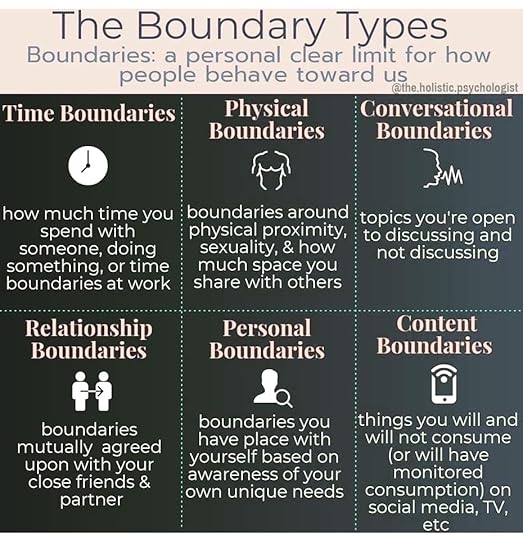
A while ago, I shared how developing self-worth has helped me be less codependent. Today, I’ll discuss how maintaining four types of boundaries has been useful:
RELATIONSHIPRelationship boundaries seem to be the most common. This kind of boundary is mostly discussed within romantic relationships, but over the past five years or so, I’ve developed relationship boundaries with existing friendships. The BFF breakup I recently re-blogged, where I realized I didn’t like to be my friend’s therapist, is a great example. To avoid slipping into a psychologist’s role, I rarely give others advice when asked. Instead, my go-to answer is you know what you should do. Not only does this answer embody my firmly held belief that most of us do have the internal guidance required to live, it also keeps me from establishing relationships where folks constantly lean on me to help them solve their problems.
TIMEThe next type of boundary isn’t discussed as frequently, and I suspect it’s because people in relationship feel entitled to copious amounts of one another’s time. Take phone conversations, for example. They aren’t really my thing, but I recognize them as something many people enjoy as a way to preserve relationships. However, seldom do I want to talk on the phone, and even when I want to, most days, my lifestyle doesn’t allow for lengthy dialogue. So, friends get a time boundary. Sometimes this looks telling the person ahead of the call that I will only have X number of minutes to speak. Other days, it’s someone asking me if I have ten minutes to answer a question or hear a story. Either way, time boundaries are set, and friendships are intact.
 PERSONAL
Personal boundaries are my favorite because they’re unique to each of us. An example of this occurred a few years ago. My grandmother wanted visit. My answer was no. I didn’t offer her a reason, but for blogging purposes, here’s why: It was August. My semester begins in August. My oldest daughter was moving to another city. My youngest daughter was beginning her second year of high school. My husband and I were looking for a house every Saturday and Sunday. There was too much going on and I’d just begun understanding that when life is too much, anxiety kicks in. The last thing I needed was my 90-something-year-old grandmother wanting to be involved in all of the things and asking 1,999 questions while doing so. Nope. That’s what a personal boundary is: personal based on your needs.
CONVERSATIONALFinally, it is important to set boundaries around what you will and will not discuss. Though it may seem as if there is no topic I won’t share via blog, believe it or not, conversational boundaries exist in this space. Y’all can’t know everything. Similarly, I have conversational boundaries with my in-real-life friends, depending on the person. I’ve learned not to talk about anything too serious with a friend I’ve known since senior year, because when I do, he jokes about the subject and never follows-up to see if or how it was resolved. We’re friends, but he’s demonstrated he doesn’t want to hear all that. I only have one or two people with whom I’ll talk about my marriage. Everyone else has proven they can’t handle anything perceived as negativity about my husband, whom they believe to be an unflawed human being. Conversational boundaries ensure I avoid what feels like toxicity and instead include love and support from the appropriate person. This is not to say I avoid hard conversations, but rather, all topics are not for all relationships.
Relationship, time, personal, and conversational boundaries have supported healthier ways for me to be in relationship with others. Relationship boundaries help me to define how I want to be someone’s friend of family member. Time boundaries ensure I’m not giving too much of myself or asking others to unfairly give of themselves. Personal boundaries allow me to know when to prioritize my needs, and conversational ones help me to not share topics with those who do not have the capacity to deal, while also allowing me to know with whom I can engage.
I hope exemplifying these boundaries helps. Let me know if anything resonates with you.
RELATED POSTSApril 17, 2024
Inspiring Image #148: Detroit Mural #1: The Sound of Change
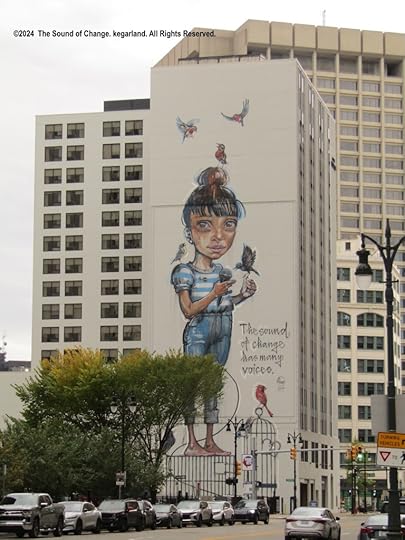
October 2023, my husband and I stayed in Detroit for a week in this apartment/Airbnb. We watched a “Free Palestine” protest/march from our window. This is one of the things I miss most about living in a major city—the progressive activism that is a part of the culture.
April 15, 2024
Monday Notes: Reframing the Adoption Narrative By Reckoning with the Primal Wound
What do you think of when you hear the word adoption? Does your brain conjure two parents made whole because they’re able to solve their infertility problems and grow their family? Do you envision a child being saved from their mother’s or father’s bad decisions and deleterious living conditions?
It’s normal to see these myopic scenarios. After all, the adoption narrative has been largely co-opted by adoptive parents, their needs, and their superhero like qualities. Stories of adoption have partially been shaped by the media of yesteryear. Annie, for example, offers a quintessential adoption story. I mean who doesn’t want their own personal “Daddy Warbucks” to swoop in and give them love, with a billion dollars on the side? Likewise, Diff’rent Strokes and Webster continued the savior trope, while normalizing transracial adoption.
Decades later, audiences were given Randall, a transracial adoptee on This is Us. His was the first media portrayal that I saw, which not only considered an adoptee’s perspective, but also showed that we are not forever infantilized. Many do not realize that we grow up and become adult adoptees. Though I appreciated Randall’s in-depth and well-rounded character, this fictional story didn’t resonate with my experience. One reason is because I am a Black, same-race adoptee. Another is because my adoptive parents were not rich; even for the 70s and 80s, they were not considered middle class. My parents were a part of the working poor. I didn’t feel saved.
But even with these differences, there seems to be one similarity that many adoptees share. No one asks us how we feel about being adopted. For me, this resulted in believing my adoption story was insignificant, especially in the grander scheme of adoption, anyway.
However, my feelings are slowly shifting. I have recently been folded into adult adoptee communities. There have been many eye-opening revelations, but one has blown my mind—a documentary called Reckoning with the Primal Wound. In this piece, Rebecca Autumn Sansom, an adult adoptee, outlines the process of reconnecting with her biological mother and links her experience to Nancy Verrier’s (1993) theory called the primal wound.
The primal wound, according to Verrier, is developed when a biological mother and her child are separated. In the documentary, Verrier clearly explains that it is not only unnatural for a mother to be separated from her baby, but it is also unnatural for another person to care for someone else’s baby; subsequently, a wound is created—a primal wound.
Y’all. It’s brilliant. I have never felt so seen in my 50+ years of life. Even my husband, who typically needs several pieces of evidence to subscribe to an idea, watched this film and saw reflections of me, such as the disassociation, the sense of loss, and the relationship problems. The theory of the primal wound describes my life.
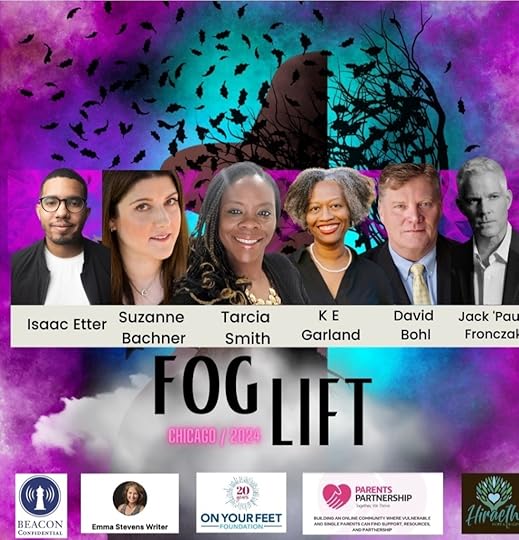
Luckily, Autumn didn’t stop with producing a documentary. She’s also created an event called Fog Lift, an interactive art experience crafted to raise awareness and alleviate the burdens of fear, obligation, and guilt experienced by adoptees. The event’s location alternates between New York and Chicago each year. May 2024, it will be in Chicago. And I will be there interviewing someone who has become a good friend, Tarcia Smith, host of the Adoption Journey Podcast.
Anywho, I’m sharing this for a few reasons. I hope that you will do one of the following:
Suggest Reckoning with the Primal Wound to an adoptee in your circle. It can be viewed online or cast to their TV.Attend Fog Lift if you’re an adoptee or adoptive parent. It takes place the third weekend of May in Chicago.Virtually attend Fog Lift if you cannot make it to Chicago.Contribute to Autumn’s GoFundMe. She’s an independent artist who creates opportunities for adoptees to commune and heal through art.Adult adoptees don’t have a lot of resources or safe spaces to discuss and process our experiences. We have been marginalized by a community that was created to help. So, if you can do none of the above, I suggest trying one thing. Ask the adoptee in your family this: How did it feel to be adopted? If they are open and honest, their answer may surprise you.
Monday Notes: Reframing the Adoption Narrative By Reckoning with the Primal WoundWriter’s Workshop: VoiceInspiring Image #147: Ferris WheelMonday Notes: I Let GoWomen’s History Month: The Women of In Search of a Salve: KathyApril 10, 2024
Writer’s Workshop: Voice
My first blog post was “Why I Refuse to Judge Any Mother.” In it, I describe my observations of a friend’s mother, juxtapose her mother with how I felt about my own mother, and then explain how I hope my own daughters will see me as a mother—when they eventually begin to reflect.
Out of all the texts I received, I appreciated my journalist friend’s the most.
“Kathy, this is good,” she said. “You have what they call voice. In grad school, they used to always talk about how you should have voice in writing. You have it.”
In literature, “voice” refers to the rhetorical mixture of vocabulary, tone, point of view, and syntax that makes phrases, sentences, and paragraphs flow in a particular manner.
https://www.masterclass.com/articles/how-to-find-your-writing-voice
Whenever I write, I want the reader to experience exactly what I was thinking or feeling.
But how do I do this?
Brace yourself.
I may tell you something that goes against what you’ve been told before:
I pretty much write how I talk and think. Even that last sentence is an example. I promise you a grammar program will tell you to remove “pretty much” because it’s unnecessary, but I left it in because that’s how I talk and think. If we were together, and you asked me how do I write? I’d say I pretty much write how I talk and think.
What is also helpful is my brain’s duality. I was raised in a family that valued so-called standard English, so I grew up learning the syntax appropriate for news personalities and job interviews. However, I was also raised on the west side of Chicago, which by all accounts is the hood. I quickly learned how to switch the verb “to be” around or to insert a cuss word so as not to be accused of talking like a White girl. I’m not special. Many Black people know how to codeswitch in this way.
What this means for my writing is I can create a sentence that appeals to White folks and Black people…or should I say Black folks and White people. You see how just interchanging those two words—folks and people—shifts meaning and tone?
I also want my writing to be accessible. I want to have a conversation with you. In order to do that, I have to write how I would talk if we were together having a latte, green tea, or Caipirinha. So, sometimes I stop, and address you directly. Maybe I’ll add a question, like what do ya’ll think to invite you into this conversation we’re having, while also throwing in the Southern dialect I’ve acquired from living in Florida for over two decades.
Most of my in-real-life friends who read my blog say, “Girl, I could hear you saying…” And that’s what I want.
To reiterate, if you’re concerned with developing voice in writing, then you have to determine what “vocabulary, tone, point of view, and syntax” you want to use and why. Only you know what that is.
And remember, voice, kind of like personality, cannot be imitated because it’s something only you possess. (Full disclosure: I sat here for five minutes flip-flopping between the word possess and own).
Do you worry about voice in writing? Does it matter?
Writer’s Workshop: VoiceInspiring Image #147: Ferris WheelMonday Notes: I Let GoWomen’s History Month: The Women of In Search of a Salve: KathyMonday Notes: A Balanced and Progressive Society?April 3, 2024
Inspiring Image #147: Ferris Wheel
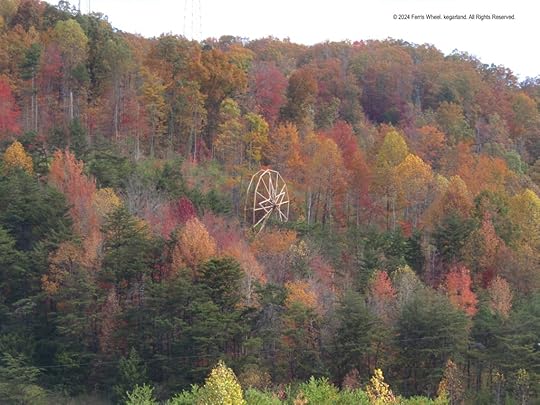
Isn’t this picturesque? I took it on the way back from my roadtrip to the Midwest and Canada. I don’t remember what state it was. Maybe Kentucky? Maybe Georgia? If it looks familiar to someone, please let me know.
April 1, 2024
Monday Notes: I Let Go
I let go of relationships of convenience, where people put you on hold, until you fit into their lives.
I let go of relationships which lack symbiosis, where I visit, and they make excuses for passing my home en route to see someone else.
I let go of relationships where I am not a priority, where careers and other people constantly come first.
I let go of relationships bound to outdated traditions, ones where innovative ways to interact are dismissed.
And when I let go, I allow for experiences aligned with who I am today.
I open space for new relationships to develop. Relationships where I have authentic discussions with friends about overall wellness—mental and physical.
I recognize friends who have been consistently present, those who communicate in multiple ways during varied times and those who’ve settled in for a lifetime of connection.
I embrace my sister, someone I’ve known for four years, but someone with whom interacting is as natural as breathing. An international trip solidified what I’ve always suspected; relationships are not hard.
I notice old friends reentering, reengaging, and recalibrating at just the right moment. Either I need them, or they need me right now.
I accept my cousin’s invitation to commune with her and her family post-Christmas in a different city and state. Her suggestion is timely.
When I let go, I allow myself to expand in newness.
And when I expand in newness, I’m no longer stagnant, resentful, or bitter. Instead, I am growing and evolving in self-awareness and self-love. In this state, I can begin accepting current circumstances, accepting that all relationships don’t last forever, not even if you wish upon a star and meditate on them during the new moon. Some connections are seasonal, and that’s okay.
Peace to everyone letting go of something this fall.
Monday Notes: I Let GoWomen’s History Month: The Women of In Search of a Salve: KathyMonday Notes: A Balanced and Progressive Society?Women’s History Month: The Women of In Search of a Salve: Grandma HunnyIn Search of a Salve: Stephanie’s ReviewMarch 29, 2024
Women’s History Month: The Women of In Search of a Salve: Kathy
In honor of Women’s History Month, I’m sharing thoughts about three women or types of women from In Search of a Salve. Each one comes with an excerpt, my own or someone else’s commentary, and a final thought about how they influenced my life. The first was Eddie’s Mama (and those like her), and the second was Grandma Hunny. The last woman I’ll discuss is…Kathy.
WOMAN #3: KATHYI was a guest on Black Writers Read, where the focus is centered on the art of writing, not the content, but when you’ve written a memoir, the two are inextricably linked. During the episode, the host, Nicole asked about the character “Kathy:”
As memoir is a fictionalized exploration of the self, what have you learned about yourself while working on your book? I’d also love to know what you did and do for self-care when you’re writing about such personal experiences and themes like abandonment, sexuality, sexual exploration, addiction, grief, family issues, and self-discovery?
Answering this question was challenging because I literally learned everything about myself while working on Salve. In the book, the character Kathy’s life and consequences are obvious. But in real life? I didn’t know anything about myself until I began putting stories on the page.
KATHY WAS IN EMOTIONAL PAINThough in the book it is apparent, in real life, I didn’t realize I was as sad as I was. With every aspect of my childhood, I was encouraged to disconnect from my sadness and grief and move on with life. It didn’t matter that I was molested. It didn’t matter that I was adopted. It didn’t matter that my adoptive mother died when I was a teenager. It didn’t matter that my father kicked me out of the house and gave up his parental rights when I was seventeen. No so-called negative event ever mattered. With this upbringing, I learned to suppress emotions, and as a result, an addiction developed. I didn’t realize the depths of my pain until I had a rock-bottom moment and was forced to face myself. Writing helped me to do that.
KATHY LIVED A DISSOCIATED LIFEDisconnecting from thoughts, feelings, memories, and surroundings is called dissociation. I sparingly use the word disassociate in the book, but I do show how, at an early age, I learned to be mentally absent, while in the room with people, because even if the conversation was about me, my opinion about myself was irrelevant. This morphed into a woman who knew how to be physically with people, while living in my mind. Eventually, it led to what my editor termed, “a double life.” Sometimes, I was a mother and a wife, and other times, I was someone else altogether. Though the term double life is commonplace, the description never sat well with me. In my mind, someone who lives a double life is doing so intentionally, like a spy. It wasn’t until I heard my friend, Dr. D. say I was dissociating that something clicked. Dissociating seemed more applicable. That term felt more comfortable to describe my actions.
KATHY HAS MENTAL HEALTH ISSUESNicole was shocked when I shared that I didn’t realize I had anxiety until I was writing this book. But it’s true. I used writing and researching to self-therapize. My process looked like this:
Write about a memory.Reflect on that memory.Research information related to the memory (e.g., grieving teenagers).Return to writing and revise in narrative style about how I grieved/didn’t grieve as a teenager.Wash, rinse, and repeat for another concept.This is why it took nine years to write Salve. I was steeped in self-therapy, learning about myself and processing my background. It wasn’t until I read information about anxiety and depression, that I realized, I more than likely had undiagnosed anxiety and depression. From childhood through adulthood, I thought the way my body and mind felt was normal. The same went for the unhealthy coping mechanisms I’d developed; Addiction, alcoholism, and codependence were natural parts of my life. I didn’t have the names for things, only feelings, which I had ignored.
Thus, I wrote Salve for many reasons. One of those reasons is so that little girls and women can be seen. I wanted the one in nine girls who are sexually abused or assaulted to be seen. I wanted the estimated 6 million children in the U.S. who will experience the death of a parent by age eighteen to be seen. And I wanted the 7% of the U.S. population that is adopted to be seen; to know that the issues I described in the book are not anomalies.
Deep in my core, I want everyone to know that our quality of life is dependent upon how we and our families deal with these types of adverse experiences. Though each person handles challenges differently, I hope that Salve encourages women, in particular, to face their trauma head on, in hopes of improving mental health and creating a better life.
Read Women’s History Month: The Women of In Search of a Salve: Eddie’s Mama or Grandma Hunny.Listen to my interview on Black Writers Read.Buy In Search of a Salve.March 18, 2024
Monday Notes: A Balanced and Progressive Society?
I was listening to a podcast the other day. The guest, Lori Gottlieb, a psychotherapist, said that we’re at a crossroads of sorts when it comes to gender roles and relationships. One example she gave is that some women are making more money than men, but those women still want the men they date and marry to make more money than they do; that some men want women to work, but if they make more money, then those men see it as a problem.
This is a conundrum. And it’s one I’ve noticed over the past few years. Many of us don’t seem to know what we really want, or we want our cake and eat it too, as the saying goes. You can’t eat cake and have cake. It doesn’t work that way for anyone.
The idea of not knowing what we want was echoed in another podcast, where Andre Bustamante said as much. This former CIA intelligence officer said that we’re a very young country, and we haven’t quite figured out how we feel about all of the things. Things like rights and freedom. We say we’re a country who believes in rights and freedom, but then we create laws that hinder some citizens’ rights and freedoms. Do we really want everyone to have the right to do what they want? Is everyone free to live how they desire, or is this just a nice idea for a minority of folks?
Bear with me. I promise this isn’t just a blog of podcast summaries. There’s one more podcast I listened to. This one was focused on political affiliation. The guest, Jonathan Haidt, a psychologist, broke down the differences between conservative republicans and liberal democrats. Then, he did something interesting—he traced the roots of conservatism and liberalism to countries with longstanding cultures, like India. Conservatism and liberalism are not new concepts or ways of being. He explained how important it is to have both: without rules, there is chaos; with too many restrictive rules, there is rebellion.
Seems like common sense, right? So, why is it so hard for us to figure out how to coexist?
What I’ve gathered is it’s a combination of the messages from these three podcasts: some of us are still wired to believe specific things that were established and passed on centuries ago. Whether it’s about gender, race, social class, or politics, some of us just can’t see life a different way or refuse to move forward. For example, I live in the South, and every semester, I have to tell a student not to call Black people “colored,” as if it is 1962. These twenty-something-year-old students were taught to refer to Black people this way, and refuse to move forward, even though the country and world have (and even though, they will one day be someone’s teacher).
In other cases, some people seem to only envision chaos when discussing the rights and freedoms of a group different than they are. Not being able to foresee a life where people who don’t look like you have rights and freedom equal to you can leave one stuck in a time that doesn’t exist, or angry about the changing world they find themselves a part of.
But we cannot escape social evolution. Change is natural and inevitable. We inherently know things cannot stay the same. I’m also pretty sure many of us wouldn’t want to return to how some things used to be anyway. I know I don’t. As a Black person, I enjoy moving about the country without being surveilled. As a woman, I enjoy manifesting my dreams without facing explicit sexism. As a wife, I’m glad I function equally within my marriage.
However, this isn’t everyone’s reality.
Diversity, equity, and inclusion programs have been cut from Florida’s and Texas’ university systems, with very little pushback. Today’s students of color will receive a different experience at college than I did.
After Roe v Wade was overturned in 2022, a deluge of issues has followed, such as court case after court case, proving women in the States do not have bodily autonomy.
I’ve searched for words to describe what’s happening—devolution, regressive evolution, and stagnation seem to fit. Even though these reversed forms of evolution do occur; there seems to be something unnatural about it, something forced. Instead of fighting the natural progression of society, whether it is at the macro level, like the country, or microlevel, like relationships, it seems we need balance of laws, ideology, and lifestyle. I’m just not sure how we’re going to get there.
Y’all have any ideas?
Monday Notes: A Balanced and Progressive Society?Women’s History Month: The Women of In Search of a Salve: Grandma HunnyIn Search of a Salve: Stephanie’s ReviewMonday Notes: 3 Lessons from a 28-Day MeditationWomen’s History Month: The Women of In Search of a Salve: Eddie’s Mama