K.E. Garland's Blog, page 11
March 15, 2024
Women’s History Month: The Women of In Search of a Salve: Grandma Hunny
In honor of Women’s History Month, I’m sharing thoughts about three women from In Search of a Salve. Each one will come with an excerpt, my own or someone else’s commentary, and a final thought about how they influenced my life. The first was Eddie’s Mama (and those like her).
WOMAN #2: GRANDMA HUNNYThe “Grandma Hunny” chapter was the hardest to write, because unlike other caregivers, Grandma Hunny is still alive and somewhat alert. I wrote that chapter four times, because with each rendition, my editor implied I wasn’t digging deep enough. There was one version where I kept repeating the phrase, I love Grandma Hunny, but…, to which the editor replied, “I don’t believe you.” She was right. You’re supposed to love your grandmother, and I didn’t want readers to think I was bashing mine. But that lens caused me to maintain a surface-level interpretation—and it was for one reason—I didn’t want Grandma Hunny’s feelings to be hurt.
In worrying about Grandma Hunny, I had forgotten the one rule that allows me to write about real people and events. And that is, write as if no one will ever read my words. My concern was causing a block.
The day I made the decision to be as truthful as possible, I had a revelation. My grandmother was the only person who devoted time, energy, and money to see me through young adulthood, and I hated it. I held deep resentment for her, not only because she was oftentimes mean and rude, but also because she was and still is one of the most emotionally unavailable people I know. Up until January 23, when I was mired in revisions, I continued to live in a fantasy world of what my life was supposed to have been like. Revising “Grandma Hunny” helped me to see the fissures in my healing journey.
After my a-ha moment, words flowed, and I wrote this:
I’m embarrassed to feel what seems like ingratitude from the one person who was willing to pick up the pieces of my life. Sixteen years isn’t a long time to have a mother, but over forty years is a lifetime to contend with a grandmother who is not only unaffected by emotions but also oblivious to them. I’d much rather have had tenderness from a matriarch who asked me about how I’m faring in the world, than one who used my achievements as proof that my background didn’t matter. Adoptees are supposed to be grateful, and Grandma Hunny reminds me that sometimes, I am not. The perception of being an adoptee is that one is lifted out of a horrendous situation and gently placed into a more loving one. Many times, adoption has felt as if I was taken out of a frying pan and dipped into the fire of life’s trials and tribulations, culminating in being passed around and landing with one of the least compassionate people I know. I got the short end of the adoption stick, and I hate that no one seems to understand this.
The day I wrote this, I took a walk and cried for 60 minutes. It was a lot to accept, and I knew it had to be written. The editor agreed, and that was one of my final revisions.
In literary terms, Grandma Hunny would be considered a static character, one who doesn’t change throughout the novel. While “Grandma Hunny’s” name is made up, her personality is not; she is, indeed, stoic and predictable. Still, I gifted her a copy of Salve and held my breath for the phone call.
After she read it, she gave her thoughts. She said I was “dumb for being sad for so long,” and added that I “made up abandonment.” To protect my emotions and peace, I muted my phone, pulled out my laptop, listened intently, and typed her other 16 offensive comments. “You’re an excellent writer,” she buffered in between each insult. Since November, I’ve gone back-and-forth about if I should share her remaining phrases on this blog, but I’ve decided against it. I don’t want to re-live them, and I don’t have the bandwidth for a pseudo-analysis on the morality of it all. As they say, it is what it is. I’ve moved forward in ways that are emotionally safe and psychologically healthy.
But I will leave you with this: In my opinion, women should be soft and vulnerable. Women should provide emotional spaces for their children and their children’s children. Women should use words to breathe life and love into their children’s and grandchildren’s lives. And while I know that each generation functions differently, age should not provide a pass for women to be verbally and emotionally abusive. However, I cannot change my grandmother. Instead, I have actively worked to improve myself, in hopes of becoming the type of woman I value with the young women who choose to be in my life.
Read Women’s History Month: The Women of In Search of a Salve: Eddie’s MamaWatch In Search of a Salve: Healing Tour ’23, where we discuss Grandma Hunny around the 11:16 minute.Buy In Search of a Salve .

March 8, 2024
March 4, 2024
Monday Notes: 3 Lessons from a 28-Day Meditation
Recently, I completed a 28-day meditation. I’m purposely not including the name of the system or how I accessed it for a couple of reasons: I’m not trying to sell you on the idea, and the meditation is focused on developing extra-sensory perception, intuition, and improved memory and brain functioning, thus the methods are controversial. However, I do want to share some unexpected lessons I gleaned over the 28 days:
MORNING ROUTINES ARE IMPORTANT.Before this meditation, I began my day as many do, by scrolling social media and looking at the day’s news. Additionally, I would remain in bed responding to and initiating text messages. This took about an hour. However, the system emphasized doing the meditation first thing in the morning because your waking state is the most receptive. So, every morning for 28 days, I did that, instead.
The most noticeable thing that happened is that I was less grumpy. Prior to this meditation, I would come downstairs, where Mr. Garland would give me a swift side eye to gauge how I was doing. For those 28 days (and after), he recognized that I was calmer and more agreeable. Not only was the meditation app right, but also this Forbes article, which explains how beginning your day with social media can cause anxiety and prime your day for distraction. It’s better to begin the morning with a grounding exercise, as opposed to viewing the terribleness of the world or engaging in someone else’s dire circumstances.
RE-PROGRAMMING THE MIND IS IMPORTANT.One of the 28 lessons explained the importance of personal belief systems. The idea is that we all have beliefs that we either learned from our caregivers or that we developed over time. Here’s an example: While I know I can achieve anything I set my mind to, I also (have implicitly) believed there’s gotta be some hardship along the way, a struggle, if you will. Nothing comes easy. I’m not sure where I got this from, but I do know my life’s experiences were sometimes heavy on the uphill battles, with a side of rainbow at the end.
This meditation helped me to see that I first needed to control my perception about how life can be and then proceed from there. The law of attraction had taught me something similar through this mantra: I manifest easily and quickly. The issue is that mantras alone will not shift years of an embedded belief system. Sometimes, you have to take additional steps to re-program your brain at the alpha or theta level, which may require a guided process.
TRAINING IS IMPORTANT. PRACTICE IS MORE IMPORTANT.On day 28, the instructor reminded us of the different types of meditations we had been introduced to, as well as their purposes. He also said that we could continue to use the audios he’d created, but that would be like “using a crutch.” Instead, we should be practicing the meditations on our own, three times a day for the next three months.
This idea of practice made sense to me. When I attend yoga class, it is to learn how to put my body in a parasympathetic state, so that when I am off my mat, I can practice being calm, as opposed to spiraling into an abyss of anxiety or anger. Training provides us with the tools necessary to live life. The same can be said about therapy sessions and workouts. Unless you have a major issue with your mind or body, I don’t think you’re meant to be in therapy for life or to be working out with a physical trainer until death. We’re supposed to learn lessons and then go practice healthier ways of being as a means to support ourselves and others.
Please feel free to share your thoughts on any or all of this.
Monday Notes: 3 Lessons from a 28-Day MeditationWomen’s History Month: The Women of In Search of a Salve: Eddie’s MamaMonday Notes: The GiftIn Search of a Salve: A Response to Chandra’s ReviewMonday Notes: Love is…March 1, 2024
Women’s History Month: The Women of In Search of a Salve: Eddie’s Mama
In honor of Women’s History Month, I’m sharing thoughts about three women from In Search of a Salve. Each one will come with an excerpt, my own or someone else’s commentary, and a final thought about how they influenced my life.
WOMAN #1: EDDIE’S MOTHEREddie was a boy I met when I was forced to move to Covert during my senior year. Within one month of beginning school, he became my boyfriend, and I became pregnant. Here’s an excerpt from when I was trying to figure out what was going on with my female body:
It was late September when I noticed I hadn’t had my period since August. It had been seven years since my father showed me how to put a condom on a banana, so I wasn’t entirely sure what was happening.
“What does it mean if my period is late?” I asked Eddie’s mother.
She took a drag of her cigarette, blew out a puff of smoke, and said, “You either skipped a month or you pregnant. And if you pregnant, you need to talk to Eddie.”
Eddie’s mother appears three times in the book. This excerpt is the first. I always thought her response to my truly ignorant question about my missing period was an odd one, especially coming from a person who was both a woman and a mother. I was seventeen, and Eddie was sixteen. Her abrupt and dismissive tone always seemed jarring. What would two high school teenagers know about resolving a possible pregnancy scare?
But as an adult two things are clear. The first is that these are the types of women who raised my Gen X peers and me. Oftentimes, you will see memes and gifs about how resilient and independent my generation was and continues to be. Well, this is how some of us developed into hyper-independent people. We don’t easily depend on others because we were trained not to.
The second thing that has become apparent is that for some, being a mother supersedes being a woman. Eddie’s mother had two teenage sons. She’d moved from Chicago to a small Michigan town because it was a safer environment for them. Eddie had done well. He was on the football team, played an instrument in band, and consistently received A’s. His mother was a teacher; the result of her guidance was clear. As a mother, I can imagine her initial feelings. They were probably along the lines of who is this little fast-tail girl from Chicago, who got her son’s nose wide open and has come up pregnant? Her ambivalent tone was probably a combination of anger and disappointment, which left little room for compassion.
However, over the years, this lack of compassion from an adult woman toward an adolescent girl became common for me.
While I was coming of age, I met three boyfriends’ mothers. Neither embraced me. They smiled but their eyes always betrayed their thoughts. They glared as if I was stealing and corrupting their baby boy, as if I was re-enacting original sin right before their eyes, slithering my femininity around their son’s genitals and destroying their futures. No boyfriend’s mother had ever approached me as if I was a young woman trying to make sense of life.
Anywho, like all Gen X children, Eddie and I did “figure it out.” And when we did, Eddie’s mother softened her face and showed care for exactly twenty-four hours. The day we visited Planned Parenthood, she helped me hide my car in her garage and nursed me with a home-cooked meal. I’ve always wondered if it was because her son had re-calibrated his life and re-set the journey she’d so carefully crafted for him.
Either way, Eddie’s mother and women like her taught me about the woman I wanted to be. With my daughters’ friends and beaus, I am kind and inviting. Our home is a safe space when their own is not; my text messages overflow with advice about college, young womanhood, and relationships. Because of Eddie’s mother and women like her, I have become the type of woman who recognizes and leans into my role in shaping not only my own daughters’ lives, but also other young women’s. I never expect them to “figure it out” independently, especially if the “it” is a major life decision.
post-script: I edited Eddie’s mother’s book years ago. During that time, she told me she was proud of me and who I’d become.
Read What It Really Means to Be Pro-Choice.Purchase In Search of a Salve .February 26, 2024
Monday Notes: The Gift
My brother-in-law, his wife, and I are estranged. We haven’t spoken since 2018, when I happened to be attending a conference in Houston, two-and-a-half hours from their home. My husband decided to rent a car and drive there. I rode along and spent a couple of days with them. That’s the last time I saw or spoke to them.
There have always been few words between us, because, in 1999, when I had the opportunity to establish a relationship with my new sister-in-law, I chose bitterness and hatred. I reciprocated the undercurrent of behavior that I was offered when I married my husband. My brother-in-law didn’t like me. His parents knew it. His aunts knew it. And eventually, I knew it. He told anyone who would listen that I wasn’t the right person for his big brother. In his mind, we shouldn’t have even dated, let alone married.
Thus, there has always been nothing more than familial cordiality on his part and disappointment on mine.
We hadn’t spoken in five years, because in 2015, I’d surmised, once and for all, that he and his wife didn’t like me very much because when my father died, neither of them personally reached out with condolences. Instead, one provided a “sorry for your loss” on social media. The other offered silence, two responses I found inappropriate for the death of one’s parent.
So, when I saw a box in the mail addressed to K. Garland, return sender: brother-in-law’s name, I was leery. My heart raced and the pit of my belly sank.
It sat on the dining room table for days. I stared and wondered, what’s in this box: cyanide or ricin?
Maybe it’s not for me, I hoped.
“Can you reach out to your brother and ask if the K. is for me or our eldest?” I asked. “I mean, you can’t just address something to K. Garland when two K. Garlands are in this family.”
“It’s for you,” he said a few text messages later.
So, they are trying to poison me. The ridiculous ricin thought slowly dissipated, and I opened the box.
Inside, was a black travel mug, adorned with a sunflower and a pithy 21st century quote about being your strong self and such. You know. Girl power and all that. On the other side, was my name: Kathy.
Hmmmph, I thought. This is nice. But why did they send it? This is a nice gift, but it’s weird, considering we don’t speak.
“I’m throwing this away,” I announced to my husband, who seemed mildly annoyed. “Can you find out why they sent this to me?”
More text-messages. “They started making things during the pandemic. Sounds like they had some materials leftover. They made you one.”
“Well, that’s a dumb-ass reason to send one to me. We don’t even talk. We haven’t talked since we were in Texas. They don’t even like me. I’m still throwing this away.”
“Why? Just because you don’t like the reason they sent it?”
“It’s the energy,” I justified. “I don’t like the energy around it. They had some leftover pandemic stuff sitting around and made me one…and sent it…without a note explaining why or anything, even though we haven’t spoken in five years?”
I’ve already reached my self-imposed word limit, so I’ll spare you the remaining over analysis of the mystery mug.
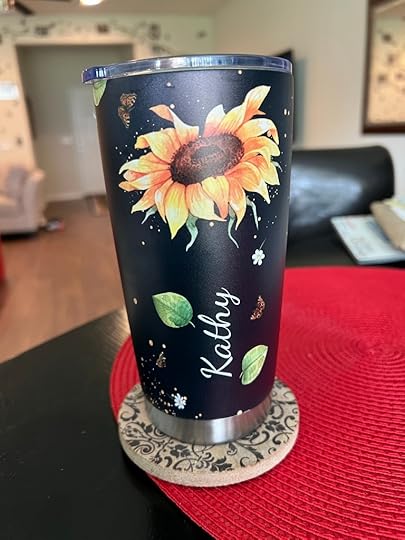
Eventually, I decided none of the details mattered. It didn’t matter how they determined I should be the recipient, or if it was intentional, or if it was an ‘olive branch,’ (another rationale that surfaced). All that mattered was my reaction. Was I going to add to the landfill by throwing away a perfectly good travel mug or was I going to use it because, well, I do travel a lot, and I love monogrammed things?
I decided to do the latter.
Monday Notes: The GiftIn Search of a Salve: A Response to Chandra’s ReviewMonday Notes: Love is…In Search of a Salve: Marilyn’s ReviewMonday Notes: Life Beyond FacebookFebruary 23, 2024
In Search of a Salve: A Response to Chandra’s Review
Chandra, over at Pics and Posts, wrote a review of In Search of a Salve, for which I am very grateful. I usually don’t respond to these, but hers was a bit different, and I felt a reply was required. Please see my answers below:
Garland shows us trauma doesn’t just begin with one individual. It has a long history. She skillfully outlines the devastation of trauma and how it weaves its way through generations and impacts present life.Thank you, Chandra. Part of my purpose for writing Salve was to demonstrate how trauma can influence us before we utter our first word. Though I didn’t use the term epigenetics, I showed it in the chapter called, “Joyce,” which was about my biological mother. A baby can begin life stressed, simply from being connected to her mother and her mother’s mother.
Candor! Unabashed, unflinching honesty—without apology. When one sees the full title, I’m sure all sorts of salacious thoughts about the book’s content are conjured. However, Garland was tasteful in her “tell all” approach. She leaves readers with no reason to “cover their eyes.”Thank you for this acknowledgement. I have two young adult daughters and I’m still married to “Brent.” I wanted to be as tasteful as possible, while still showing the chokehold of sex addiction and hypersexuality.
The book illustrates very plainly the hard work required for healing. Garland makes it clear that the work of healing from trauma is difficult and ongoing. She probably has to deal with a lot of flak from family and friends who feel she reveals too much in her book, but this project is about her journey and her healing.To be honest, my immediate family functions a bit different than the norm. My youngest daughter, for example, read the book cover-to-cover, came to me with a list of questions, and recited a poem she wrote called, “I Am My Mother; My Mother Am I” at the book release. She posted about the book on social media and damn-near begged her friends to read it; two of them did, and of those two, one sent me several questions. Only one family member had a hard time processing that I was going to reveal so much to the public. I’ll let you guess who that could’ve been.
Outside of my immediate family, my father’s side of the family, several cousins, and friends have been hella supportive. I’ve only heard from one person on my mother’s side, and that is “Grandma Hunny.” Her comments were largely negative, rude, and disrespectful. I’ll briefly share a few of her thoughts next month.
Salve demonstrates how we can appear perfectly “normal” and “well” while fighting fierce demons inside. Garland had a lot of questions for which she needed answers and those questions left her feeling fragile and alone, but those closest to her often missed this, perhaps because she projected a different person to them. Her book requires that we let go of our illusions of who people are.This sounds like a question. My short answer is we see who we want to see. The longer answer is this: what occurred is a matter of both/and/both. An early expectation was set that I should suck it up and ignore any negative emotion; consequently, I became a master at hiding my feelings; however, I was no master manipulator. A lot of friends and family saw what they wanted to see, instead of what was sometimes in front of them. Also, each of us has our own barometer of what we think “okay” looks like. There were times when my behavior and emotions were not a secret, but people used their own barometer to determine what “okay” looked like to them. Again, I learned early on that no one wanted to see my tears or my pain, so it became second nature to portray what I knew everyone wanted to see, thus both/and/both.
Salve is well-written and free of egregious errors and grammatical mishaps perpetrating as poetic license or trendy. I know that’s not important to everyone, but as an English professor/grammarian, it’s vexing [for me] to read books replete with errors (Sorry–not sorry—if I sound like a snob).Girl. THANK YOU for acknowledging this. I read a lot of books, and even the best traditionally published ones have errors. The worst indie books have so many that you can barely get through the story. It’s distracting. My editor read this book six times, and I read it twice as many. Fun fact, after she sent me the copy editor’s version, I found 50+ errors. We went through each and every one, because…no ma’am, Pam. Error-free is just as important to me as it is to you. I want the reader to enjoy the story, not wonder what I meant due to improper grammar and usage.
The pace. Garland warned me to pace myself when I said I would read Salve over the Christmas holidays, but the pace and cadence of her work kept me riveted. I couldn’t stop reading it! And, because I have little time to read “for pleasure,” it’s wonderful when I can knock a book out in a day or two. Garland’s right though. This book is not a quick read for the”faint of heart.” Because of my academic work and writing, I read a lot about insanity, trauma, and violence, so I have developed a deeper tolerance for the heavy topics she broaches.Not one person has listened to me when I warn them not to binge read. Not one lol
Garland gives fullness and depth to the people in her life. It is difficult to see them as simple cogs in her story. She makes us want to know their stories too.Thank you for noticing this, as well. I’ve read so many memoirs where it’s like someone’s sounding off about their family, spouse, or whoever. That’s not a memoir; it’s a journal. I also wrote it this way because, in real life, I tried to understand everyone’s background. For example, it seemed if I could just figure out my father’s life story, then I would understand why he functioned the way he did. Unfortunately, there are some stories we’ll never know.
Bonus answer: Black Boy is one of my favorite memoirs, and I think it should be required reading for all United States citizens. That is a high bar, indeed, and I appreciate you mentioning the great, Richard Wright in a review about my work.
Read Val’s review.Read Yecheilyah’s review.Read Crystal’s review.Read Barb’s review.Read Khaya’s review.Read Marilyn’s review.February 12, 2024
Monday Notes: Love is…
Since I released In Search of a Salve, quite a few people have asked me if I now know what love is. Initially, my answer was I’m not sure. But when my husband asked me, I had to dig a little deeper. To answer this question, I first thought about what love is not, because over the years, I’ve been able to pinpoint a lack of love when I feel it. From there, I’ve described the reverse. Here’s what I’ve come up with:
Love is not dismissive.Love is not sarcastic.Love is not lying.Love is not confusing.Love is not control.Love is not manipulative.Love is not inattentive.Love is being interested.I once read a study that showed this: people who stopped what they were doing to listen to what their romantic partner had to share stayed together longer than those who were dismissive. In my experience, it is a loving act to show interest in what someone has to say. Oftentimes, my husband and I interrupt one another’s workday with our thoughts and opinions of what is currently happening. Unless one of us is really busy, we usually stop what we’re doing, listen to one another, and have a conversation. Love is being interested in what your partner has to say, even if it may be inconvenient.
Love is sincere.Sarcasm is the use of irony to mock or convey contentment. In my experience with sarcastic conversations, as either the user or receiver, it requires saying the opposite of what you mean but in a so-called joking way. However, love requires sincerity, which means being clear about the words that come out of your mouth. Don’t you want the person on the other end of your love to know how you feel, without making them wade through shaded meanings?
Love is truthful.At the end of Salve, I make an elaborate point of explaining how important it is to tell the truth if you love someone, whether romantic, platonic, or familial. I got this idea from bell hooks book, All About Love, where she explains that lying is not love. I know we’ve been socialized otherwise; however, I firmly believe that there is no good reason to lie to someone, especially someone you say you love. You’re not protecting them from hard truths. You’re just lying.
Love is clear.I can name several people who have claimed to love me and whom I believe that to be true. Their actions match their words. I’ve been in relationship with just as many people, who say, “I love you,” but their actions show something different. This is confusion. I’m not here to parse out the motivations for this paradox. I’m here to say a healthy feeling of love is clear. Unhealthy displays of love (i.e., emotional, physical, or psychological abuse) are not love. These demonstrations blur intent. For example, a person says, “I love you,” while berating you in conversation. Rarely, when you feel love do you question if it really is what the person claims.
Love is free.I have seen many people explain why their young adult children should remain nearby. I have seen parents create a life for their children for many reasons (e.g., living vicariously through them, fear they’ll make similar errors, etc.). I would argue that controlling one’s children in this way is not love. It is bondage. It is abuse of a power differential. It lacks boundaries. But it is not love. Love is freedom. Love is knowing you’ve raised your children to the best of your ability. Love is trusting they will make appropriate decisions, and if you dislike the trajectory of their journey, love is still freedom for them to make choices with which you disagree.
Love is respecting one’s wishes.Manipulation is the exploitation of others for one’s own gain. Exploitation, one’s own gain, aren’t those terrible phrases? Who wants to be exploited for a loved one’s gain? But we do it all the time to those we say we love. We convince people to do something against their own desires if they love us. I think it was Oprah who said if someone asks you to do something, and you say, “No,” then everything that person says after your no is manipulation. That stuck with me. Love is respecting your loved one’s “no.” If someone doesn’t want to do what you want them to, let it go, and decide if you can deal with their decision. If you can’t, then self-exploration can help to understand root causes.
Love is attentive.Love is paying attention to the person you say you love. This is different than being interested. How many of us have lived in the same house with someone for multiple years and don’t know their dreams or wishes? Their favorite color? Paying attention means noticing: does the person seem distant, sad, angry? Excited, anxious, proud? Have you not heard from the person in a while? Does the person have a pattern of behavior that seems destructive to their self or others? You can only know the answers to these questions if you’re attentive. And if you’re not, I’d argue you’re not functioning in love.
Please feel free to add what you’ve come to know love is based on your experiences below. I’m interested in hearing about it.
Monday Notes: Love is…In Search of a Salve: Marilyn’s ReviewMonday Notes: Life Beyond FacebookIn Search of a Salve: Dr. Mountain’s ReviewMonday Notes: Bravery and Truth TellingFebruary 9, 2024
February 5, 2024
Monday Notes: Life Beyond Facebook
I deactivated my Facebook account on December 31, 2020, and I haven’t looked back. Here’s how my life has been since leaving the social media platform.
BIRTHDAY MESSAGES ARE BACK TO NORMALBirthday messages were the best part of Facebook. And I don’t wanna brag, but hundreds of folks used to wish me a happy birthday. What a big ole ego boost that was. But then something happened; I stopped seeking external validation, and as a result, I slowly no longer felt the need for hundreds of people to wish me a happy birthday. Now, when my birthday rolls around I hear from people, who not only know when my birthday is without a FB reminder, but also who actually love and care about me. Likewise, I’ve learned that I can make a note of people’s birthdays for whom I love and care about. I use what’s called a calendar lol It hangs on my home office wall. Hipster, I know. But it works.
AUTHOR MARKETING IS SUSTAINABLEIn addition to a personal FB account, I had an author one. Whether it was cross sharing blog posts, responding to comments, or paying for an advertisement that was supposed to boost my work, I spent a lot of time online. When I deactivated, a couple of writer friends wondered how I was going to sell books without a FB presence. What helped me not worry about the how was hearing that Eddie Murphy has never used social media. Yet, somehow, he is still a successful celebrity. Now, I’m not comparing myself to Murphy. But it did make me think about the innerworkings of marketing. People know who Murphy is. When he has a movie out, he does press. Someone creates reels and posts them via social media, and we watch. So, I began to trust the idea that other people would share videos or essays via FB if that’s where I wanted them to be. So far, that’s worked. A few friends have referenced seeing me do something on Facebook, even though I’m not on there.
CONNECTING WITH PEOPLE IS AUTHENTICOne of the biggest justifications I have heard for why people continue to use FB is that it helps them to connect. But I’ve always wondered if people are really connecting. For example, when I was on there, I did feel connected, but I’m also a very social person. I used to interact and flit around, as if I were at a perpetual online party. I used FB as an extension of my real-life relationships, not as the relationship itself. But everyone doesn’t function like that. Some like to hang out at the periphery of the party, observing everyone’s actions like daytime TV. FB is literally how some people find out what and how someone is doing. Is this connecting? I don’t know. But what I do know is that since leaving FB, I have had to make more of an effort to engage with people. It does take a lot more energy and intention to reach out and communicate, even if it’s just a text, than it does to like someone’s post about their recent announcement, vacation, or achievement. But kind of like the birthday thing, I’ve found that those who truly want to connect will, whether I have Facebook or not.
Are you on Facebook? What’s the best part for you? What parts can you let go of? Would you ever leave, and if not, why?
Monday Notes: Life Beyond FacebookIn Search of a Salve: Dr. Mountain’s ReviewMonday Notes: Bravery and Truth TellingMonday Notes: 3 Types of People From Whom I Take AdviceMonday Notes: “Family Ties” Essay on Midnight & Indigo