
Peter Cameron's Blog, page 8
January 20, 2021
*Boy by James Hanley (Knopf, 1932)
Boy is the story of...
*Boy by James Hanley (Knopf, 1932)
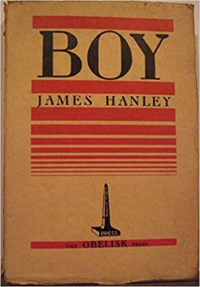 Boy is the story of Arthur Fearon, a 15-year-old boy who lives with his impoverished parents in Liverpool. They take him out of school, where he is happy and flourishing (he wants to continue his studies and become a chemist) and send him to work on the docks along with his father. The work he is given there is miserable -- hard, dirty -- and Arthur cannot face a future working in those inhuman conditions, so he stows away on a freight ship bound for Alexandria, hiding in the coal bunker. He is discovered there, unconscious, after three days and given a job as a seaman cleaning the ship and acting as a servant to his superiors, several of whom try to take advantage of him and all of whom treat him badly, except for two, including the Captain, who inspires him to work hard and rise up the ranks, which Fearon attempts to do. But all his hard work is either ridiculed or ignored by the crew, who continue to taunt and abuse him.
In Alexandria his is taken by another sailor to a brothel where he contracts syphilis. Back on the ship, as it makes its way toward Salonika, the boy is told that he is incurable and should jump overboard and kill himself. But before he can do this he is smothered in his bed by the Captain, who "placed his greatcoat over the face of Fearon and laid all his weight upon it."
The book is engaging and Arthur is a sympathetic character but none of the other characters -- with the exception of the parents and the Captain -- are distinctly developed. The scenes on the ship are vividly rendered, but there is a certain amount of obfuscation about sexual matters that leaves the contemporary reader wondering what, exactly, has happened. Would an attractive boy really be able to fend off the advances of able-bodied seamen?
An interesting but somewhat murky book with an unsatisfying ending.


The Silent Woman: Sylvia Plath and Ted Hughes by Janet Ma...
The Silent Woman: Sylvia Plath and Ted Hughes by Janet Malcolm (Knopf, 1994)
This is a brilliant and fascinating book that attempts to untangle the webs of controversy and conflict surrounding the many biographies of Sylvia Plath, which uses Anne Steveson's biography, Bitter Fame, as a focal point. That biography, which was guided, controlled, and perhaps even co-written by Olwyn Hughes, Ted's sister and agent for the Plath estate (Ted is the executor) reverses the perspective of earlier biographies by being sympathetic to Ted and critical of Plath. For this reason it was condemned upon publication and Stevenson was considered a literary pariah.
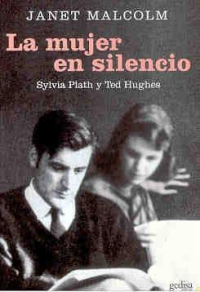 Malcolm interviews all the parties involved (except Ted): Stevenson, Olwyn Hughes, the previous biographers and memorists, and in sifting through all this material brilliantly reveals the perils and pitfalls of writing a biography, questioning the purpose and worth of what she concludes is an impossible, inherently flawed, and foul genre.
The book moves circuitously through its material, following tangents so assiduously that the main track is frequently and lengthily abandoned. Reading the book is like swirling around in a big pot of flavorful stew that is constantly being stirred. This sacrifice of clarity (and chronology) may frustrate a reader, who longs for the mess to be cleaned up rather than enhanced, but ultimately it feels like the best form for a book about the impossibility of objectivity to take.
Malcolm has a tendency to offer some of her opinions and interpretations as facts, although she is up front about his biases and sympathies. The Hughes siblings seems to want to have their cake and eat it too, and I wished Malcolm had looked harder and more critically at their hypocrisy along with everyone else's.
*They Wouldn't Stop Talking by John Pollock (Anthony Blon...
*They Wouldn't Stop Talking by John Pollock (Anthony Blond, 1964)
Because I so enjoyed reading Pollock's The Grass Beneath the Wire (see below), I bought his two other novels, and read this one first.
 It's October, which means the season is over and everyone has left the Italian island of x. But the narrator, a young, alcoholic, gigilo-ish man and his friend and keeper, an older woman named Helen, remain on the island staying in the only hotel that hasn't closed, eating and drinking (lots) on credit because they don't have the money to go anywhere else (Helen is expecting a large sum of money but its arrival is delayed). They befriend Gustavo, a Swedish man who is developing holiday properties on the island, and Barbara, his German secretary. A wealthy American couple arrive at the hotel and provide some diversion and amusement, but as the weeks and months pass, our narrator begins hearing a multitude of voices talking to him, and plotting on behalf of "The Avenger," the leader of the organization to which they all belong, to capture him and torture him to punish him for some crimes or behaviors that aren't specified.
So the book becomes a psychological thriller. It is intermittently amusing -- the voices can be quite funny as they squabble and plot, but because the narrator is rather a cypher and the paranoiac plot rather familiar, the book is only distinguished by Pollock's acid and amusing writing, resulting in a book that just barely sustains its short length.
Loving by Henry Green (Anchor, 1953)
I read this book m...
Loving by Henry Green (Anchor, 1953)
I read this book many years ago, in college, I believe, and remember I didn't quite know what to make of it. Well, reading it again 40 years later hasn't changed my response -- I still find it somewhat maddening and inscrutable.
Loving is set in a castle in Ireland during WWII, and mostly concerns the servants, all English (except for Paddy, the almost sub-human "lamp" man) who are employed by Mrs. Tarrant, of Anglo-Irish gentry. She lives in the castle with her daughter-in-law, Mrs. Jack. Mrs. Tarrant's son Jack is in the army but spends quite a bit of time on leave in London or at home in Ireland.
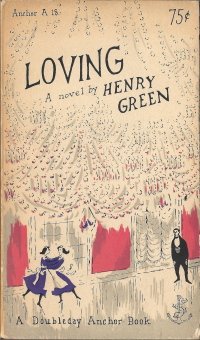 The main character is Raunce, who ascends to being the butler at the beginning of the book, when Eldon, the ancient former butler, dies. Raunce is a scoundrel -- dishonest and ambitious, but quite charming despite his deficient character. He is in love with Edith, one of the two maids (the other is Kate) who toil under the watchful eye of the sanctimonious housekeeper, the lonely spinster Miss Agatha Burch. There's also an alcoholic and paranoid cook, Mrs. Welch, and two kitchen maids, Alice and Jane, a very young footman named Albert, and Miss Swift, the nanny, who spends most of the book on her deathbed.
Green, as always, depends almost entirely on dialogue to tell his story, and he brilliantly captures the disparate voices of all these people, both above and below stairs. He has a pitiless eye for detail and presents his characters like specimens on a microscope slide. This makes for a smart and amusing read, but the narrative remove and lack of sympathy for all the characters leaves the reader with a bitter taste. And the end of the book seems truly perverse: Raunce's health fails; he seems to be dying. Green brings us to a place of tenderness and pathos, and then punishes us with a final sentence that bullies us for caring.
Lapsing by Jill Patton Walsh (St. Martin's, 1987)
This ...
Lapsing by Jill Patton Walsh (St. Martin's, 1987)
This is a novel about a young English woman named Tessa. Tessa is a devout Catholic and most of the novel centers around her years in Oxford (evoked in great detail) in the early 1960s, where she studies literature and is a member of a Catholic students group led by Father Theodore, a brilliant, beautiful, and charismatic mathematician/priest, who Tessa falls (platonically, she thinks) in love with. She misguidedly marries Ben, a fellow Catholic student, so that they can provide a home for Father Theodore, but of course this doomed menage self-destructs and in a what seems to be a hastily appended flash-forward, we learn that Tessa has found a new life as a fabric artist in the United States.
Tessa is a naive and sometimes unbelievably clueless character, but Patton Walsh is a good and smart writer who elevates this story above the dubious plot and makes it into an interesting exploration of faith and love.
January 19, 2021
*The Grass Beneath the Wire by John Pollock (Anthony Blon...
*The Grass Beneath the Wire by John Pollock (Anthony Blond, 1966)
I'm not exactly sure why, but I loved reading this book -- I didn't want to put it down and didn't want it to end. The characters are not sympathetic and the books is thoroughly dark and depressing, but its forthright and unapologetic tone is fascinatingly seductive.
The Grass Beneath the Wire is the story of Michael Richmond, a young English gentleman. It is set in 1943, in the midst of WWII, and Michael is intent upon not serving in the army. He fails to report for duty, leaves Oxford for London so he can be with John Batchelor, the young man he is hopelessly in love with. He keeps John by cashing bad checks in the nightclubs and restaurants they frequent all day and night, moving along a circuit dictated by closing and opening times, along with a crowd of similarly alcoholic and amoral young people.
 This gin-sodden good time is ended when Michael is court-martialed for being AWOL and for his criminal check-cashing, and he is sent to military prison, where the middle third of the book takes place. He spends his time in prison performing tedious and useless tasks like plucking the grass from behind the electric wires that encircle the camp, and polishing pots that are then left outside to rust so that they can be polished again. He sleeps with a beautiful boy named Alf, and in a violent brawl in his hut he loses an eye, which invalids him out of the army. He returns to Oxford where he quickly amasses gambling debts, so he returns to London and borrows 500 pounds from Mary Arbuthnot, who had been keeping John Batchelor in his absence. Once again (seemingly) solvent, he regains John's affection and companionship, but when the borrowed money runs out he resigns himself to either kiting checks or prostituting himself, learning absolutely nothing from his dark journey.
Almost everyone behaves selfishly, stupidly, and badly in this book, but the characters are so vividly depicted that they become almost irresistible and the descriptions of days in bars and evenings in nightclubs are trenchant and funny. The lack of moral judgement and the unhesitatingly frank portrayals of homosexuality are surprisingly candid and bracing and the picture, though dark, is clear and thrilling.
A Whole Life by Robert Seethaler; translated by Charlotte...
A Whole Life by Robert Seethaler; translated by Charlotte Collins (Farrar, Straus, & Giroux, 2016)
I bought this book for $1 at the Dollar Tree because it looked interesting -- a short novel, originally published in Germany, about a solitary rural man's life throughout much of the 20th century. It was an "international bestseller" and published by FSG.
 Although it spans nearly eight decades, at only 150 pages, it's a glancing portrait, but it seems a deep one, by virtue of its empathy and vivid recreation of important moments from Egger's life. Orphaned as as small boy, he is raised by his tyrannical uncle, a farmer, without love. He is brutally beaten and become independent as soon as he grows strong enough to defend himself. He lives alone and works at physically taxing odd jobs until he meets Maria, a waitress at the local village inn. When he marries her he begins working for a company that builds cable-cars and ski-lifts in the mountain valleys. Maria is killed and their humble home is destroyed in an avalanche, and he spends eight years in a Russian prison camp during and after the war. When he finally returns to his village in 1951, the world has changed. He lives alone in rooms or mountain shacks and supports himself by guiding tourists through the surrounding mountains.
A Whole Life is a quiet, sad, but lovely book about the solitary life of a thwarted yet decent man. Curious and memorable.
The Index of Self-Destructive Acts by Christopher Beha (T...
The Index of Self-Destructive Acts by Christopher Beha (Tin House, 2020)
 The Index of Self-Destructive Acts is a big, ambitious New York City novel -- rather similar in scope and tone to Bonfire of the Vanities (I imagine). Its wealthy and privileged characters are well-developed and interesting, and the book has no post-modern gloss or attitude -- the rich Trollopian narratife is conventionally presented and offers all the many satisfactions of 19th-century novels.
It takes place over about six months in 2009 -- after the crash of 2008 -- and seamlessly combines the worlds of high-finance, baseball, and journalism. Beha writes with a confident authority about all these things and whatever research he did is unobtrusively incorporated into this very accomplished and enjoyable book.
*Sanctity or There's No Such Thing as a Naked Sailor by D...
*Sanctity or There's No Such Thing as a Naked Sailor by Dennis Selby (Simon and Schuster, 1969)


The oddest thing about this very odd book is that it was published by a mainstream publisher in 1969. I'd love to know who acquired it at S&S, and what they were thinking.
Sanctity... is the story of a young man, improbably named Shelley Skull, a homosexual scientologist from Wales who is living in New York City in the late 1960s searching for another gay man named Rocco Sabine, who has mysteriously disappeared -- or perhaps been murdered -- after living a somewhat legendary life in the underworld. Shelley's episodic search takes him to orgies, gay bars, brownstones owned by millionaire transvestites, Tucson Arizona, and finally Morocco, where he is kidnapped and forced to donate his eyes to the above-mentioned millionaire (who's sight is failing).
None of this is particularly well-written or funny, or sexy, or cleverly-plotted, or amusing. It's just bad -- a gay lark that falls quickly and desperately flat.
*Obsession by George Hayim (W. H. Allen, 1970)
This au...
*Obsession by George Hayim (W. H. Allen, 1970)
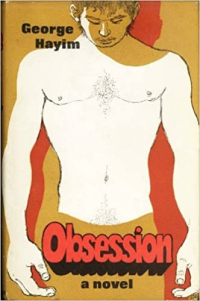 This autobi
ographical novel is an account of George Hayim's doomed and dangerous affair with a (mostly) straight French boy of Moroccan descent. George meets the young and sexually magnetic Edouard in Paris, and brings him to England, so that Edouard can learn English and make some money. Edouard relies on George, is sometimes charmed by him, but mostly seems to hate his interference and treats him rudely and badly. George, who feels that Edouard is not sufficiently and consistently appreciative of all that he has done for the boy, alternates caring slavishly for him and threatening him with deportation and humiliation.
All this bad behavior gets a little repetitive, but both George and Edouard are original and compelling characters, and are surrounded by George's various friends, who are mostly wealthy European bohemians, and Edouard's friends, who are mostly prostitutes and other assorted low-lifes.
The book is too long and the dynamic between the two men is too predictably recurrent, until the final page when a shift occurs and their relationship seems to change into something resembling an old friendship. (There is a charming five-minute documentary video featuring George Hayim in his eccentric home in Sydney on YouTube.)
Peter Cameron's Blog

- Peter Cameron's profile
- 589 followers

