
Peter Cameron's Blog, page 16
January 31, 2018
A Source of Embarrassment by A. L. Baker
Hogarth Press, 1974
Another fascinating book by this interesting and idiosyncratic writer; I think that I liked this best of the three I have read. There is something antiseptically bracing about A Source of Embarrassment that makes reading it both disturbing and delightful.
The source of embarrassment is a middle-aged Englishwoman, Edith Trembath, who lives with her husband and two children in some provincial city or town in England. She is a difficult character to describe, partly because she is so unusual and partly because Baker doesn't strive to reveal her characters: she observes them dispassionately from a distance.
At the beginning of the book Edith is diagnosed with a brain tumor and told she has three months to live, and the book explores how both she and her family and friends respond to this tragic situation. Complicating matters is the fact that Edith is a pathetic figure of fun to everyone she knows. They all mistake her clumsiness and her inability to detect sarcasm or irony or scorn as proof that she is some sort of imbecile -- even her children and husband, though fond of her, patronize and marginalize her. It is only the reader, who observes her at a slightly different angle, who can discern her integrity and true worth.
This book is also inclusive of its characters' varied sexual lives. Attention is paid to everyone of them, and there is frank and candid mention of incest, impotence, and adultery. In this way, the book seems very adult and ahead of its time.
Baker's writing is, as always, funny and brilliant. Her tone is unique, although at moments this book made me think of both James Schuyler's What's For Dinner and any number of Iris Murdoch novels. I'd like to read this book again, for Baker's writing isn't always easy to comprehend or appreciate, and I feel that a second reading would reveal many additional delights and satisfactions.


Down Below by Leonora Carrington
New York Review of Books, 2017
(originally published by Dutton in 1988 as The House of Fear)
In 1940, Leonara Carrington was living with her lover, Max Ernst, in Provence. When the Nazis invaded France, Ernst was sent to a concentration camp and Carrington "suffered a psychotic break."
This memoir is a riveting and hallucinatory account of that breakdown, and her often barbaric treatment in a private asylum in Spain. Carrington, who was also a talented and original painter, writes with passionate energy, and the reader begins to feel trapped inside the book's nightmarish world. A unique book.

Beverly Nichols: A Life by Bryan Connon
Timber Press, 2005
 I was intrigued by this (authorized, I think) biography of the English 20th-century writer Beverly Nichols. It follows Nichols from his birth at the turn of the century to his death in 1983. Nichols was extremely prolific, publishing more than 50 books during his lifetime, which included novels, plays, poetry, memoir and autobiography, political and religious non-fiction, mysteries, and books about homes and gardens, a series of which, beginning with Down the Garden Path, he was best known for.
Nichols, a homosexual, was friends with both Noel Coward and Cecil Beaton, and was extremely social within theatrical, publishing, and royal circles. He was a terrible and well-known snob and very ambitious, and consequently not particularly nice. He often wrote dishonestly about himself and those around him, particularly his mother, who he adored, and his father, who he reviled.
All this makes for a rather unsavory, but busy and interesting life, and the biography is very well researched and written with elan. And Connon is often brutally honest about his subject's shortcomings, which makes for a brisk and bracing read.
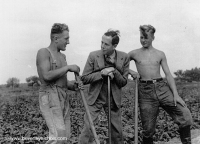 Nichols with some local talent
May 7, 2017
Puppies by John Valentine
(Erstwhile Press, 1979)
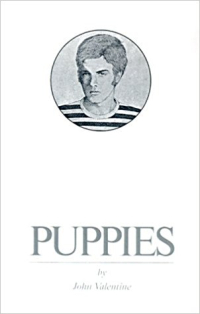 This book is pretty much entirely devoted to John Valentine's sexual encounters with teenage boys (the youngest is 12). His sexual obsession with boys began while he was in high school, when he slept with many of his friends and often fooled around with them. He can't seem to grow out of this phase and continues seducing and molesting boys well into his adulthood (mostly in Los Angeles). He justifies his illegal behavior by telling himself (and the reader) that he only seduces boys who are willing or come on to him, and this rational seem to save him from any moral doubt or guilt.
Given the controversial and disturbing focus of this book, it's surprising to report that, for the most part, it is charming. Valentine's lack of guilt or worry makes him a very affable and (almost) sympathetic narrator. He describes all the boys he meets with a sympathetic complexity; they don't appear to be victims or or sexual objects, but quite charming and appealing boys who are happy to engage in sexual relations with an older man.
Valentine worked on fringe and countercultural newspapers and always seems to be living in wretched conditions, but he seems not to mind his squalid existence in the least. He's a good writer, and a generous one; there's a poignancy to many of these portraits, especially those of his high school friends, most of whom were killed in the Korean War.
May 5, 2017
The Gustave Sonata by Rose Tremain
(Norton, 2016)
This new novel by a writer I have long admired is divided into three distinct parts. I loved the first two and did not like the third section very much at all, so the book was ultimately disappointing.
The main character of this novel is Gustave Perl. He is born in a town in Mitterland, Switzerland, and spends the rest of his life there (except for a trip to Paris when he's middle-aged). Gustave was born in 1942, when Switzerland and the Swiss were doing their best to stay out of the war that raged all aroun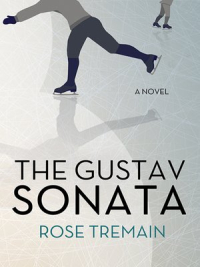 d them. Gustave's sympathetic father loses h is job as the town's Assistant Chief of police for falsifying records to allow Jews to enter Switzerland after the emigration from Germany has been outlawed. He dies shortly thereafter from a heat attack, and Gustave and his mother Emilie are left to fend for themselves in post-war Switzerland. Gustave befriends Anton Zweibel, a Jewish boy his age who is the only child of doting and well-t0-do parents. The only fun or warmth Gustave experiences in his childhood and youth occurs only when he is with the Zweibles, who are very good to him. Anton, a brilliant piano prodigy, attempts to win awards at national competitions but is always too nervous to perform well.
The second part of the book goes back in time to relate the courtship and troubled marriage of Gustave's parents, and Tremain does a wonderful job of evoking these interesting characters and the the world they live in (this is true of both the first two sections). The reader is transported and engaged and the book seems poised to conclude in the same compelling way.
But it doesn't. In the third section Tremain jumps ahead 40 years to the 1990s. Gustave and Anton are both middle-aged and Emilie is now a nasty and querulous old lady. This section is ostensibly about Gustave and Anton realizing that they have loved one another since they were young boys, but not before Anton has a nervous breakdown and is committed to a psychiatric hospital. There's nothing, of course, inherently wrong with this conclusion, but somehow Tremain, who is usually so smart and sure-footed, falters. All the characters seem less alive and less engaging that their younger counterparts, and the world they inhabit -- the same small Swiss city -- seems less vibrant and authentic. A somewhat mawkish fuzziness hands over this last section, almost as if it were written by a different, inferior, writer.

The Ha-Ha by Jennifer Dawson
(Virago Modern Classics, 1985)
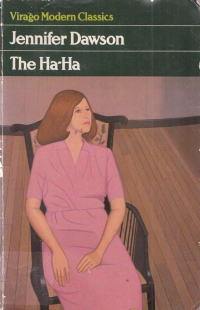 This book was originally published in 1961 by Anthony Blond Ltd. It is the story of Josephine, a young woman who has a "nervous breakdown" while a student at Oxford and is sent to a "mental asylum." Her therapy there seems to be mostly confined to chats with a sympathetic German refugee nurse, electroshock treatments, and long walks in the surrounding countryside. And then she meets a young man, another patient at the asylum, who draws her out of herself, introduces her to the pleasures of sex, and then abruptly leaves her (and the asylum) without saying goodbye. But Josephine, despite her mental fragility, is a strong, resourceful, and oddly cheerful woman who takes her boyfriend's abandonment in stride, as she does with her beloved and somewhat suffocating mother's death.
It's interesting to note that this book predates Sylvia Plath's The Bell Jar by two years, but deals with a similar character in a similar situation. Joesphine is nowhere near as smart and savvy as Esther Greenwood; in fact she's rather dense about most things, and so this book lacks The Bell Jar's poetic brilliance. Nevertheless, it's a quirky and interesting read, and Josephine is an original and engaging character (and narrator).

That Uncertain Feeling by Kingsley Amis
(Harcourt Brace, 1956)
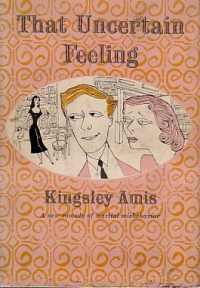 That Uncertain Feeling is Amis' s second novel, published a few years after Lucky Jim. It's a comedy in much the same vein, about the misadventures, professional and romantic, of a young Welshman. John Lewis is married to an unsentimental and practical woman names Jean. They have two children (one only referred to as "Baby"), and John works as an assistant clerk in the local public library. His decision to apply for the job of sub-director leads to all sorts of comical mayhem, especially when he begins an affair with the elusive yet demanding wife of the Library Committee's chairman.
Most of the characters in the book are selfish and unlikable, but they seem human, and Amis does a good job of creating farce around their botched assignations. I laughed out loud several times while reading this book (which I rarely do). Like Lucky Jim, it leaves a bitter aftertaste, but the darkness is better integrated in this book and it is far less misogynistic. For these reasons, I enjoyed it far more than Lucky Jim.
Eminent Maricones by Jaime Manrique
(University of Wisconsin Press, 1999)
 I've had this book by my old friend Jaime Manrique on my shelf for many years, and I'm glad I finally got around to reading it. The eminent maricones Jaime writes about (in separate essays ) are himself, Manuel Puig, Reinaldo Arenas, Federico Garcia Lorca, and another man also named Jaime Manrique.
The book opens with a wonderful autobiographical essay about Jaime's childhood and adolescence in Columbia. He was the illegitimate son of a wealthy man from an old and important Columbian family, but grew up in poverty with his mother and sister. Jaime's portrait of Manuel Puig and his remembrance of Reinaldo Arenas are fresh and interesting, and do a nice job of revealing both Jaime and their subject. His essay on Federico Garcia Lorca, which focuses on Lorca's own homophobia and gradual liberation, is an important and clarifying piece of work.
Eminent Maricones is a engaging and exciting book.
May 3, 2017
The Joy Ride and After by A. L. Baker
(Charles Scribner's Sons, 1963)
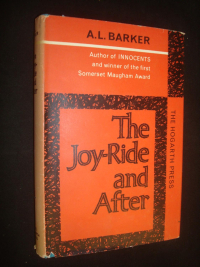 This novella (the title novella in this book of several) by a British writer was published by Charles Scribner's Sons in the US, and The Hogarth Press in the UK, in 1963. I had never head of A. L. Baker (a woman) . Apparently, she published quite prolifically throughout the second half of the 20th Century and was highly regarded in literary circles but never had much commercial success.
I found her writing in The Joy Ride to be bracing and vivid, and beautifully controlled and regulated. Very calm and assured. Clean, but not antiseptic. This story, which is set in a provincial mid-century English city, revolves around a struggling automobile garage and the cafe across the street: both cheerless places, as are the people who work at, or visit, them. Barker creates engaging and complex characters who are all struggling -- some compassionately, some ruthlessly -- for a better life. I liked and admired this book, and look forward to reading more A. L. Baker.
As If By Magic by Angus Wilson
(Secker and Warburg, 1973)
I didn't manage to finish this book, but I read more than 300 of its 400 pages before I gave up. It's a messy, poorly conceived and paced novel that follows two characters who are distantly related: Hamo, a middle-aged botanist who has developed a new form of "magic" rice that is changing agricultural practices around the world, and Alexandra, his goddaughter, who flees with her two male lovers first to a commune in Morocco and later to see a Swami in India.
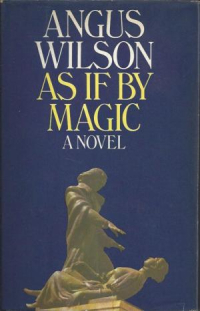 The encounters that Hamo and Alexandra have with many people on their journeys (Hamo is going around the world to visit rice-producing areas) are related in punishing and exhaustive detail, and scenes where very little is actually happening drag on for pages and pages. With some brutal editing, a dark and daring comic novel might be achievable, but the length and scope of the book -- intended no doubt to make it an "important" novel -- slowly but surely prevent it from assuming any sort of compelling shape or pace. This is a shame, because there are a few very funny scenes, and many original and interesting characters. Alexandra's simultaneous affairs with two men (one of who is the father of her baby) is erotically charged but never ignites, and Hamo's obsession with, and pursuit of, beautiful boys, while daring and boldly explored, finally becomes tedious and distasteful.
Peter Cameron's Blog

- Peter Cameron's profile
- 589 followers

