
Peter Cameron's Blog, page 10
December 28, 2020
Scented Gardens for the Blind by Janet Frame (George Braz...
Scented Gardens for the Blind by Janet Frame (George Braziller, 1964)
 I read this book because I had so admired and enjoyed Frame's Owls Do Cry, but I was very disappointed. The three characters here are all crazy in different unbelievable ways, and Frame attempts to capture, or convey, their craziness by unconventionally using language, which makes the writing seems self-indulgent, and doesn't have anywhere near the effect and brilliance of Owls Do Cry.
Even worse than being a book about three crazy people, it is ultimately revealed that this is a book about one crazy woman who thinks she is three crazy people.


Scented Gardens for the Blind by Janet Frame by Janet Fra...
Scented Gardens for the Blind by Janet Frame by Janet Frame, George Braziller, 1964
I read this book because I had so admired and enjoyed Frame's Owls Do Cry, but I was very disappointed. The three characters here are all crazy in different unbelievable ways, and Frame attempts to capture, or convey, their craziness by unconventionally using language, which makes the writing seems self-indulgent, and doesn't have anywhere near the effect and brilliance of Owls Do Cry.
Even worse than being a book about three crazy people, it is ultimately revealed that this is a book about one crazy woman who thinks she is three crazy people.
June 10, 2020
Couples by John Updike (Knopf, 1968)
I suppose the rea...
Couples by John Updike (Knopf, 1968)
I suppose the reason I've never read John Updike's Couples is because, based on everything I've ever heard about it, I thought I would hate it. It is, in many ways, a hateful book--in every sense of that word--but I didn't hate it. It exasperated and disgusted me, but I also found it compelling, vividly observed, and often beautifully written.
 My problems with the book come from the characters, as conceived and presented by Updike. They are all portrayed crudely and simplistically, stereotypically: the Asians are sallow (if not yellow); the Blacks, while mainly non-existent, are sub-human when they do appear; women are not much more than a sum--or cipher--of their sexual parts (tits, ass, and cunt); and the Jews have hooked noses and pockmarked skin.
The character at the center of all this white hetero smug male cluelessness is Piet Hanema, married to the beautiful and implacable Angela and fucking Georgene, Foxy, Bea, and Carol. He is not a sizable or interesting enough character to support the book's length and scope, which are overreaching. Most of the interesting things he thinks seem to be Updike's ideas grafted inorganically upon the character, and he sinks below the surface of authorial weight.
I actually, and surprisingly, liked some of the women characters: both Angela, Piet's wife, and Foxy, his (primary) mistress and second wife, are smart, funny, and refreshingly straight-forward and practical. They are both much too good for Piet.

Couples by John Updike, Knopf, 1968
I suppose the re...
Couples by John Updike, Knopf, 1968
I suppose the reason I've never read John Updike's Couples is because, based on everything I've ever heard about it, I thought I would hate it. It is, in many ways, a hateful book--in every sense of that word--but I didn't hate it. It exasperated and disgusted me, but I also found it compelling, vividly observed, and often beautifully written.
My problems with the book come from the characters, as conceived and presented by Updike. They are all portrayed crudely and simplistically, stereotypically: the Asians are sallow (if not yellow); the Blacks, while mainly non-existent, are sub-human when they do appear; women are not much more than a sum--or cipher--of their sexual parts (tits, ass, and cunt); and the Jews have hooked noses and pockmarked skin.
The character at the center of all this white hetero smug male cluelessness is Piet Hanema, married to the beautiful and implacable Angela and fucking Georgene, Foxy, Bea, and Carol. He is not a sizable or interesting enough character to support the book's length and scope, which are overreaching. Most of the interesting things he thinks seem to be Updike's ideas grafted inorganically upon the character, and he sinks below the surface of authorial weight.
I actually, and surprisingly, liked some of the women characters: both Angela, Piet's wife, and Foxy, his (primary) mistress and second wife, are smart, funny, and refreshingly straight-forward and practical. They are both much too good for Piet.
June 9, 2020
*Men and Cupid: A Reassessment of Homosexuality and of Me...
*Men and Cupid: A Reassessment of Homosexuality and of Men's Sexual Life in General by Harold Martin (The Fortune Press, 1965)

This book, as its subtitle suggests, is an exploration of and explanation for (male) homosexuality written by an apparently crackpot layman and published during the interval between which the Wolfeden Report was submitted (1957) and its recommendations legally adopted (1967).
Martin proposes there are two distinct types of homosexuality: contingent/optional and positive/independent. The first includes men who seek sexual relief with other men only because sexual intercourse with a woman is not possible. The second includes men who have sex with men because they are physically disgusted by women and are naturally attracted to men. (He also proposes a third category, a sort of combination of the two: heterosexual men whose long-term exposure to their wives renders them impotent from lack of desire and who then turn to sex with men because it is novel and therefore stimulating.)
Martin does argue that homosexuality is not a disease and cannot be cured, that it is (in the second instance) an innate quality that can be found in any man, disregarding physical attributes and gender-stereotypical appearance. (He informs that although he is undoubtedly heterosexual, he has a slight, feminine build and a voice that is often mistaken as a woman's on the telephone.) That is all well and good, but beyond that Martin proposes several theories that are rather absurd. He posits that there is a natural difference between genders that feminism wishes to negate, resulting in dominate women who are also by virtue of their smaller stature and softer bodies, incapable of become real adults (like men) but remain illogical, petulant, and selfish children all their lives. (One wonders about his poor wife, and their "happpy" marriage.) Because these childlike attributes of women are physically innate, the goals of feminism are doomed and dangerous. So this is why homosexuality is much more prevalent in the Western (European) world, where women are not properly subjugated as the inferior creatures they are.
Martin also suggests that Western Christian religion makes sex tabu and that men can not engage in it, especially during their sexual prime (late teens) when they are not yet married. The preponderance of men with enlarged prostates in the Western world is evidence of this: in other cultures men are sexually active throughout their lives and their prostates are regularly emptied (he doesn't consider how masturbation fits into all of this--he appears to think that if men feel guilty about having sex, the idea of masturbation is simply too devastating to even contemplate). Therefore, all Western men become celibates with enlarge prostates.
His theories of the innate physical and mental immaturity of women and the cultural scourge of prostatitis don't seem to have much bearing on his theories of homosexuality, but most of the book, and by far the most passionately argued passages, concern these two irrelevant subjects.

Men and Cupid: A Reassessment of Homosexuality and of Men...
Men and Cupid: A Reassessment of Homosexuality and of Men's Sexual Life in General by Harold Martin, The Fortune Press, 1965
This book, as its subtitle suggests, is an exploration of and explanation for (male) homosexuality written by an apparently crackpot layman and published during the interval between which the Wolfeden Report was submitted (1957) and its recommendations legally adopted (1967).
Martin proposes there are two distinct types of homosexuality: contingent/optional and positive/independent. The first includes men who seek sexual relief with other men only because sexual intercourse with a woman is not possible. The second includes men who have sex with men because they are physically disgusted by women and are naturally attracted to men. (He also proposes a third category, a sort of combination of the two: heterosexual men whose long-term exposure to their wives renders them impotent from lack of desire and who then turn to sex with men because it is novel and therefore stimulating.)
Martin does argue that homosexuality is not a disease and cannot be cured, that it is (in the second instance) an innate quality that can be found in any man, disregarding physical attributes and gender-stereotypical appearance. (He informs that although he is undoubtedly heterosexual, he has a slight, feminine build and a voice that is often mistaken as a woman's on the telephone.) That is all well and good, but beyond that Martin proposes several theories that are rather absurd. He posits that there is a natural difference between genders that feminism wishes to negate, resulting in dominate women who are also by virtue of their smaller stature and softer bodies, incapable of become real adults (like men) but remain illogical, petulant, and selfish children all their lives. (One wonders about his poor wife, and their "happpy" marriage.) Because these childlike attributes of women are physically innate, the goals of feminism are doomed and dangerous. So this is why homosexuality is much more prevalent in the Western (European) world, where women are not properly subjugated as the inferior creatures they are.
Martin also suggests that Western Christian religion makes sex tabu and that men can not engage in it, especially during their sexual prime (late teens) when they are not yet married. The preponderance of men with enlarged prostates in the Western world is evidence of this: in other cultures men are sexually active throughout their lives and their prostates are regularly emptied (he doesn't consider how masturbation fits into all of this--he appears to think that if men feel guilty about having sex, the idea of masturbation is simply too devastating to even contemplate). Therefore, all Western men become celibates with enlarge prostates.
His theories of the innate physical and mental immaturity of women and the cultural scourge of prostatitis don't seem to have much bearing on his theories of homosexuality, but most of the book, and by far the most passionately argued passages, concern these two irrelevant subjects.
June 8, 2020
The Bachelor by Stella Gibbons, Longmans, 1944
The on...
The Bachelor by Stella Gibbons, Longmans, 1944
The only book I've read by Stella Gibbons is the creepily hilarious Cold Comfort Farm, so when I came across some of her other books I bought them and began with The Bachelor.
 It's a novel set in a country house just outside of London during WWII, or "the Nazi War," as it is always referred to here. The house, Sunglades, is inhabited by Constance Fielding, her brother Kenneth, and their cousin Frances ("Frankie') Burton. A third Fielding sibling, Joan, lives with her husband in London. The occupants of Sunglades are all unmarrried, in their 40s (Kenneth), 50s (Constance), and 60s (Frankie). Because their house is large and comfortable and a safe distance (23 miles) from London, it becomes a much-desired refuge for evacuees from the blitz, and the novel features four in particular: Betty Marten, a beautiful and jolly woman, a friend of the family's (and once a particular friend of Kenneth's--her refusal to marry him has thwarted his romantic life); Betty's 27-year-old son, Richard, a tall, and sensible intellectual and semi-invalid (lung problems); Vartouthi, an immigrant from a tiny made-up European country somewhere between Italy and Turkey and now occupied by Italians; and the elder Mr. Fielding, a gay rou�� of 78 whose involvement with night clubs and fast living has estranged him from his family for many years. Alicia Arkwright, a well-bred young woman and a neighbor of the Fieldings is also involved.
 The plot, which spins around three or four romances amongst these characters, is funny and engaging (although over-extended at nearly 400 tight pages). The characters are all cleverly conceived and portrayed, some sympathetic, some endearingly ghastly. Miss Fielding is particularly entertaining--she finds fault with everyone and everything with a blithe hostility she thinks is humanitarian. And Vartouthi, the young foreigner in their midst, hired as maid-of-all-work, ends up running the household and stealing (almost) everyone's heart. She receives two marriage proposals in the book, and accepts the second, from Kenneth, much to Miss Fielding's chagrin. She (Vartouthi) is a unique and delightful character, refreshingly honest and free-spirited.
Half-way through I felt that things slowed down and that the book was much too long, but as I continued reading I liked it more and more and was sorry when it (finally) ended.
The Bachelors by Muriel Spark, J. B. Lippincott & Co....
The Bachelors by Muriel Spark, J. B. Lippincott & Co., 1961
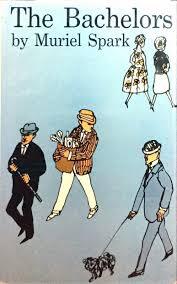 An early novel--the fourth?--of Spark's many novels, The Bachelors is set in London and revolves around two groups: one (mostly, or ostensibly, heterosexual) bachelors, the other a group of spiritualists, who conduct seances with a venal criminal as a medium. The plot centers upon a court case and trial that brings these two groups together in an entertaining way, and the novel has a large and varied cast of vividly eccentric characters.
One of these, Ronald Bridges, a graphologist and epileptic, is the decent moral center of the book, and endears himself to the reader and pretty much everyone around him.
The Bachelors by Muriel Spark, J. B. Lippincott & Co., 19...
The Bachelors by Muriel Spark, J. B. Lippincott & Co., 1961
An early novel--the fourth?--of Spark's many novels, The Bachelors is set in London and revolves around two groups: one (mostly, or ostensibly, heterosexual) bachelors, the other a group of spiritualists, who conduct seances with a venal criminal as a medium. The plot centers upon a court case and trial that brings these two groups together in an entertaining way, and the novel has a large and varied cast of vividly eccentric characters.
One of these, Ronald Bridges, a graphologist and epileptic, is the decent moral center of the book, and endears himself to the reader and pretty much everyone around him.
My Own Unaided Work by Hermione Gingold, Werner, Laurie, ...
My Own Unaided Work by Hermione Gingold, Werner, Laurie, 1952
A collection of sketches, monologues, lyrics, and a short autobiography by the truly fabulous La Gingold.
Her uncanny intelligence and sly, original sense of humor are much evident in these souffle-like pieces, that are delicious but melt like spun sugar as one reads them.

Peter Cameron's Blog

- Peter Cameron's profile
- 589 followers

