
Peter Cameron's Blog, page 11
June 8, 2020
Mr. Bridge by Evan S. Connell, Jr., Picador, 1987 (origin...
Mr. Bridge by Evan S. Connell, Jr., Picador, 1987 (originally published by Alfred A. Knopf in 1969)
A companion volume to Mrs. Bridge (see below), published ten years later in 1969.
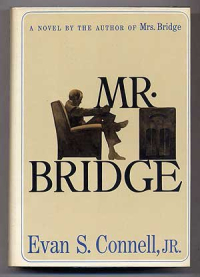 Mr. Bridge is a much less pleasing book than Mrs. Bridge, mostly because Mr. Bridge is a much less sympathetic character. And the book is a third longer than Mrs. Bridge, so one feels overexposed to Mr. Bridge, and grows tired of him long before the book ends. Many of the incidents related are repetitive and Mr. Bridge is impervious to just about everything that happens to him, maintaining self-control and small-mindedness and bullying confidence until the very end. It's written in the same style as Mrs. Bridge, in brief, glancing chapters capturing specific moments and encounters, but it lacks Mrs. Bridge's bonsai-like exquisiteness--it's somewhat lumpy and unpleasant.


Mrs. Bridge by Evan S. Connell, Jr., Viking, 1959
I f...
Mrs. Bridge by Evan S. Connell, Jr., Viking, 1959
I found this book to be wrenchingly, almost punishingly, sad. It details the life of Mrs. India Bridge, which is, by all external accounts a good life: she marries a successful, hardworking, and wealthy lawyer, lives in a beautiful home in a wealthy and exclusive suburb of Kansas City, has a maid to do all the cooking and cleaning , has three healthy children, lives a life of plenty (diamonds, trips to Europe, expensive cars), enjoys robust good health, and yet is always depressed, panicked, confused, bored. She is a stranger to her mostly absent and tyrannical husband, an embarrassment to her children; even her friends seem to tolerate her with a combination of amusement and pity, for she is totally incapable of being honest or genuinely intimate with any of them. One of her friends, Grace Barron, who shares Mrs. Bridge's existential anguish, is able to express her feelings of despair, but no one really listens or takes her pleas seriously, so she ends up killing herself.

Connell tells this story by relating small moments and incidents in a mosaic that is beautifully detailed and exquisite. He is unsparingly brutal with all his characters, who all fail and punish one another in known and unknown ways. There is no love in this book, at least no love that is successfully and directly expressed and acknowledged.
Is this a heartless exposure of the American Dream and the myth of the happy family? Connell's tone is so cool and distant it's hard to know what he is thinking, or wants the reader to think. If there are moments of love and warmth, he overlooks them, and works especially hard to find the moments of failure and mortification. Mrs. Bridge, despite its gentle and polite tone, is a brutal and terribly sad book.

You've met her in your own town.
She's seen often at card parties, P.T.A. meetings, and Country Club dances.
You think you know her, but do you?
God on the Rocks by Jane Gardam, Europa, 2010 (originally...
God on the Rocks by Jane Gardam, Europa, 2010 (originally published by Hamish Hamilton in 1978)
This short novel has the typical Gardam eccentric and poignant flavor, but it seems somewhat under-baked and carelessly wrought. It is amusing and lively and bright; it's just not particularly moving or coherent. But as its subject is the effect of other people's past on our present--particularly a parent's past on their children--perhaps that ramshackleness is appropriate.
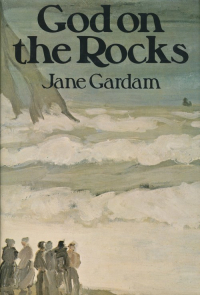 The novel takes place in small English seaside town during a warm summer in the 1930s, when Margaret Marsh is eight years old. Her father, a bank manager and fundamentalist Christian, and her mother, a spirited and independent woman whose real love was thwarted by class differences, are not at all well-matched and fall dramatically apart. Their disunion is aided and abetted by two people: Lydia, Margaret's sensual and morally unfettered nanny, and Charles, the decent, but inconsequential upper-class man that Elinor, Margaret's mother, loves but was forbidden to marry (by Charles' mother).
Gardam moves freely in time and space, and sometimes skips abruptly from character to character, in glancing takes. I think the problem may be Margaret herself, whose preternatural wiseness and maturity are somewhat difficult to believe. She is an interesting and engaging, but not an entirely believable character. Gardam leaves a lot out of her story, expecting the reader to make connections and fill in the blanks. This gives the book a pleasant airiness and softness, but one perhaps wishes the entire thing was a bit more digested. But this book's fresh crispness may satisfy--and delight--less expectant readers. I can image a better, more potent and devastating version of this book.
Seventeen: A Diary of the Teens by a Boy (Aubrey Fowkes),...
Seventeen: A Diary of the Teens by a Boy (Aubrey Fowkes), Fortune Press, no date (1940)
This is the penultimate (I think) in a long series of diaries published anonymously by Fortune Press in the 40s and 50s. Aubrey Fowkes, their alleged author, is 17 in 1918, and this volume chronicles about six months, from June through December--his summer holidays and his last term at public school, during which his invalid father dies and the First World War ends. I had read several of the first (chronologically) diaries, when Fowkes is a very young schoolboy, developing his fascination with bums, lavatories, homoerotic roughhousing, and corporal punishment.
 At 17, he has outgrown none of this obsessions and has aged into the role of aggressor and user, alternatively torturing and coddling his fags (or, in the local parlance, "ticks"). He also has crushes and passions for boys his own age, and describes all these varied relationships in exhaustive and (fairly) graphic detail. His passionate yet unconsummated friendship with a young farmworker during the summer holiday is especially poignantly described, along with his relationships with his mother, father, older brother, and school masters.
Aubrey is a complex, interesting, self-aware and observant narrator. He has a great eye for detail and ear for dialogue. The final days of both his father and the War are movingly evoked, and his mixed feelings about leaving school--and childhood--are complexly and engagingly rendered. This is a book of surprising humanity and depth--far realer and more honest and compelling than Peter Waring (see below).
May 6, 2020
Peter Waring by Forrest Reid
Readers' Union, 1939
Pe...
Peter Waring by Forrest Reid
Readers' Union, 1939
Peter Waring is a completely rewritten version of Following Darkness, one of Reid's early novels, published in 1912.
It is the coming-of-age story of Peter Waring, a boy growing up in Newcastle, Northern Ireland, early in the twentieth century. Peter's father is a bitterly unhappy school teacher, whose wife left him for another man when Peter was a child. So Peter grows up shuttling between his father's cold and mean cottage and their neighbor Mrs. Carrol's lovely seaside estate, Derryaghy, which is full of warmth and color and love (and perhaps ghosts). Mrs. Carrol virtually adopts Peter, allowing him to spend long periods at Derryaghy, pays for his education, and introduces him to Kathleen and Gerald Dale, her sophisticated niece and nephew from London, who are both a bit older than Peter (he is about 16 when he first meets them). Peter falls in love with Kathleen, and Gerald seems to fall in love with Peter. Peter is sent away to a grammar school in Belfast, and made to live with his father's sister's family, who are an unattractive lot struggling with poverty and to whom Peter feels superior. In Belfast Peter meets and befriends Owen Gill, an attractive, intelligent, and highly moral and intellectual boy from a wealthy family.
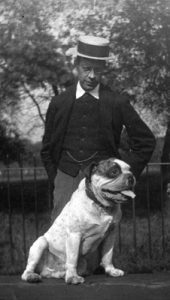 The novel mainly concerns itself with Peter's friendship with Owen, and his misguided and doomed pursuit of Kathleen, who likes Peter but doesn't love him, a fact which Peter is curiously and maddeningly unable to believe or accept. His pursuit of her ends in an act of sexual assault that is much more disturbing than it is treated, and from which Kathleen mysteriously absolves him. Peter tries to kill himself by exposing himself to the cold night rain, but only suffers a long illness, the cure for which is happily a months-long trip to Southern Europe, paid for by the ever-generous Mrs. Carrol.
Peter is a hard character to like--he's not self-aware, he misjudges other people, he's a snob, he's petulant and often nasty. While these qualities make him a believable adolescent, they don't make him particularly sympathetic or engaging, and he doesn't seem to mature very much despite his experiences. Many of the secondary characters are more complex and interesting than Peter.
There is also a constant reference to some unnamed and unexplained "thing" that is bothering Peter throughout the book, something Peter longs to confide in someone but cannot, not even to the reader (the book is narrated in first person). He finally divulges all to Mrs. Carrol, but the reader is only told the fact of his confession, not its content. It seems as if Reid assumes the reader--or certain (gay?) readers--will know what is plaguing Peter, but the effect is a maddening obscurity at the very depth of the book that today seems extremely coy and unsatisfying, especially as Peter is not allowed to have--or at least reveal- any homoerotic feelings or actions.

Tropical Night Falling by Manuel Puig
Simon & Schuster, ...
Tropical Night Falling by Manuel Puig
Simon & Schuster, 1991
A lovely book, tender and sad, and completely engaging. Tropical Night Falling is Puig's last book, finished shortly before his death in 1990.
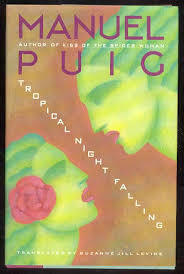 TNF is a story about two octogenarian sisters, Luci and Nidia, Argentinians living in Rio de Janeiro. Most of the book is composed of their unadorned dialogue, which includes Luci's relating to her sister the long and complicated story of her neighbor Silvia's affair with an inconsiderate widower. Nidia befriends the handsome young night watchman from the neighboring building, a friendship that, despite Nidia's good and generous intentions, ends by devastating her.
The novel is masterfully written, its complex and unorthodox narrative structure--dialogue, letters, police reports--brilliantly conceived and sustained. I was very moved by this book's elegiac tone, and its deep sense of empathy and humanity. Perhaps reading it during this time of quarantine and estrangement made me particularly susceptible to its melancholy charm.

Bright Center of Heaven by William Maxwell
Harper & Brot...
Bright Center of Heaven by William Maxwell
Harper & Brothers, 1934
Maxwell "suppressed" his first novel, published in 1934, by not allowing it to be reprinted in his lifetime. (It was included with his other early novels in the Library of America two-volume set of his work published in 2008, eight years after his death).
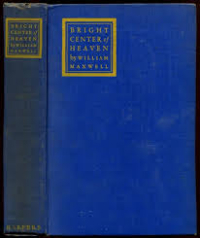 Bright Center of Heaven is not a good book. It chronicles a mid-summer day in a sort of improbable mix of guest house/artist colony/farm in Wisconsin run by the widowed Mrs. West and inhabited by Thorn and Whitey, her two sons; Aunt Amelia, her sister-in-law; an actress; a painter; a pianist; a "reformed" schoolteacher; a German cook; and a (perhaps) Norwegian elderly farmhand. Into this mix Mrs. West invites Jefferson Carter, a Harvard-educate "Negro", a public speaker, and a "leader of his race." Also, the actress, who is in love with the ex-schoolteacher, thinks she might be pregnant. Maxwell deals bravely but ineptly with both of the developments, and most of this book is confused and unconvincing. It is not the beautiful assured performance of his subsequent novels, although there are a few glimmers of what's to come: an animation of rooms and furniture (a la the short story "The Lily-White Boys") and a sympathetic and appealing portrait of adolescent boys (a la The Folded Leaf). The issues of race are no doubt rendered sensitively for the time in which the book is set and was written, but now give the book an unpleasant and troubling veneer.
One of the reasons Maxwell suppressed the book was that he felt it was too obviously influenced by Joyce's Ulysses and Woolf"s To The Lighthouse, but I don't think there is more than a very superficial trace of either of these books. A curiosity.
May 3, 2020
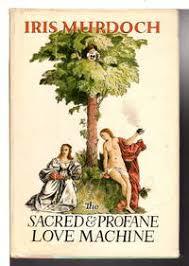
The Sacred and Profane Love Machine by Iris Murdoch
Viki...
The Sacred and Profane Love Machine by Iris Murdoch
Viking 1974
A typically engaging and well-written novel by Murdoch, but not among her best. Like all her novels, this one deals with a tangled web of many characters: Blaise and Harriet Gavender; their sixteen-year-old son David; Emily McHugh, Blaise's mistress; Luca, Blaise's and Emily's eight-year-old son; Montague Small, the Gavender's neighbor (they live in a suburb of London), who is a best-selling and famous writer of detective novels; Edgar Demarnay, Montague's childhood friend; Constance Pinn, a sort of mysterious go-between amongst all parties; and Kiki LaFoy, a 17-year-old student who is loved by David, loves Blaise, and is deflowered by Montague. After Blaise leaves Harriet to set up house with Emily, Harriet alternately throws herself at Montague and Edgar.
None of these people are remotely likable, with the exception of Harriet and Edgar, who are both so selfless they become annoying and pathetic. All the remaining adults are monsters. (The children are all much-abused innocents.)
Murdoch does a good job establishing all these characters, and their various complicated relationships; she's a master at combing exposition, description, dialogue, and internal monologue to create a rich, sensual, and engaging brew. She's not concerned with plot and despite some clever machinations in the first two-thirds of the book, the ending is seriously marred by an overabundance of coincidence and not one but two violent deaths (one death by terrorist attack, one near-death by dog attack). So one finishes the book feeling a bit drained, exhausted and disappointed, like a ride on a scary but not thrilling rollercoaster.
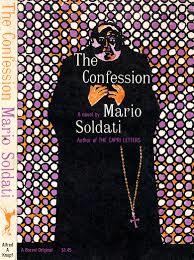
The Confession by Mario Soldati, translated by Raymond Ro...
The Confession by Mario Soldati, translated by Raymond Rosenthal
Knopf, 1958
I'm fairly certain that I've read this book before, but my memory of it was vague and became no clearer as I read it: proof of how (almost) completely I now forget the books I read. That is sad to me, for I do feel that books enrich and expand one, and I believe they can only do that to the extent that they are assimilated and remembered. But perhaps assimilation and memory are two different things, and the first does not depend upon the second.
The Confession is a short novel about a very pious 14-year-0ld boy (Clemente) in Turin shortly after the WWII. He believes he is called to be a Jesuit priest, and this belief is supported and encouraged by his devout grandmother and the priests who educate him. And so, striving to remain pure and sin-free, he is constantly examining his conscious and confessing.
 During a summer holiday at a villa on the beach he finds himself seriously attracted to and unsettled by Jeanette, a voluptuous and flirtatious friend of his mother, who is staying with the family. He manages to avoid the temptation of Jeanette (they spend the night in adjoining hotel rooms) only to fool around with a handsome boy he meets on the beach a few days later. Ironically, neither Clemente nor his grandmother nor his confessor consider this homosexual dalliance a sin: Clemente, because he feels it happened without him willing it; and the grandmother and the priest because they think that playing (chastely) with other boys his age will prevent him from other venal and mortal temptations.
It was interesting to read this book directly after reading Strait is the Gate, which also deals with the damaging and warping effects devout Catholicism can have upon adolescent psyches and sexualities.
A beautifully produced mid-century Knopf book, with a decorated boards and a stunning cover by Milton Glaser.
Strait is the Gate by Andre Gid��, translated by Dorothy ...
Strait is the Gate by Andre Gid��, translated by Dorothy Bussy
Vintage 1956 (originally published in 1909)
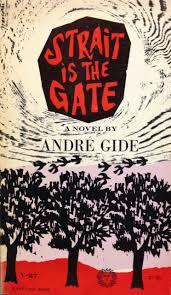 I found this slim book among my paperbacks and realized I have no memory of ever reading Gide, so I began it at once. Strait is the Gate is a very simple story set in France in the 1880s, of two cousins, Alissa and Jerome, who fall in love as children and, although their love and devotion only deepen as they age, are unable to marry. It is Alissa who constantly demurs: she thinks she is too old for Jerome; she want her younger sister, Juliette (who also loves Jerome) to marry first. And then it is slowly revealed that her desire to love God somehow prohibits her from loving Jerome; she feels that marrying him would prevent him from fully loving God, and so inspired by a sense of perverted piety, she toys with him for several years before finally rejecting him and dying from what appears to be heartbreak.
Jerome narrates the first two-thirds of the book; the final third is comprised of Alissa's journals, which she bequeaths him and which explain her mysterious behavior, and a coda in which Jerome meets Juliette many years later. He confesses he is still in love with Alissa and will never marry, never love anyone else.
The book is elegantly composed and written, but its central concerns of Alissa's romantic/theological dilemma did not make much sense or interest me. And Jerome's apathy and blindness--his continued misguided and unfounded devotion to Alissa only makes the book that much more impotent, unable to deeply move or engage the reader (me).
Peter Cameron's Blog

- Peter Cameron's profile
- 589 followers

