
Peter Cameron's Blog, page 14
January 12, 2019
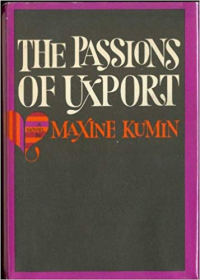
The Passions of Uxport by Maxine Kumin
(Harper & Row, 19...
The Passions of Uxport by Maxine Kumin
(Harper & Row, 1968)
 I found this book, one of a few novels written by the Pulitzer-prize winning poet Maxine Kumin, on my bookshelf and thought I would give it a go. I'm glad I did.
The book is set in a suburb of Boston (Uxport) in 1965 and covers much of the same ground as many John Updike novels from that same period -- marital relations and infidelities in the suburbs. Kumin's novel centers on two couples. The wives are close friends (their friendship is somewhat based upon Kumin's intense friendship with fellow poet Anne Sexton). While mainly focussed on one of these wives, a Jewish girl who marries a WASP because she gets pregnant in college, the book also moves fluidly and compellingly amongst many other characters, including the three remaining spouses and several townspeople, and the ancient Freudian psychoanalyst the main character consults when a pain in her abdomen persists but cannot be diagnosed, or cured. The other wife is an artist, a painter whose fragile mental equilibrium is devastated by the sudden death of her delightful young daughter.
Kumin is a wise, generous writer, sympathetic to all her characters, and, like many poets, a beautiful and original writer of prose. I enjoyed reading this ambitious (400 pages) and thoroughly engaging book, and felt it deserved wider acclaim and attention, as it is just as good -- or better -- than anything Updike wrote.



The Passions of Uxport by Maxine Kumin
Harper & Row, 196...
The Passions of Uxport by Maxine Kumin
Harper & Row, 1968
I found this book, one of a few novels written by the Pulitzer-prize winning poet Maxine Kumin, on my bookshelf and thought I would give it a go. I'm glad I did.
The book is set in a suburb of Boston (Uxport) in 1965 and covers much of the same ground as many John Updike novels from that same period -- marital relations and infidelities in the suburbs. Kumin's novel centers on two couples. The wives are close friends (their friendship is somewhat based upon Kumin's intense friendship with fellow poet Anne Sexton). While mainly focussed on one of these wives, a Jewish girl who marries a WASP because she gets pregnant in college, the book also moves fluidly and compellingly amongst many other characters, including the three remaining spouses and several townspeople, and the ancient Freudian psychoanalyst the main character consults when a pain in her abdomen persists but cannot be diagnosed, or cured. The other wife is an artist, a painter whose fragile mental equilibrium is devastated by the sudden death of her delightful young daughter.
Kumin is a wise, generous writer, sympathetic to all her characters, and, like many poets, a beautiful and original writer of prose. I enjoyed reading this ambitious (400 pages) and thoroughly engaging book, and felt it deserved wider acclaim and attention, as it is just as good -- or better -- than anything Updike wrote.
Miss Hargreaves by Frank Baker
(Tom Stacey Reprints, 197...
Miss Hargreaves by Frank Baker
(Tom Stacey Reprints, 1973; originally published in 1940)
This is a case of a book with a delightful and original premise that fails to successfully exploit it -- it goes on too long, and the reader's delight wanes, as what seemed so clever and original begins to seem over-labored and trite.
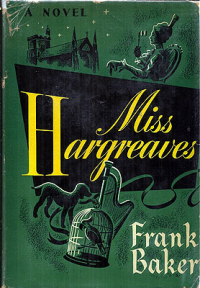 The titular character, Miss Constance Hargreaves, is imagined -- conjured, invented -- by two English men on a holiday in Ireland. While visiting a nondescript country church, they are commandeered by a garrulous warden, and to escape they invent Miss Hargreaves, an eccentric English gentlewoman who plays the harp and travels with her cockatoo, dog, and bath tub. Soon she has materialized and is visiting their village, much to men's shock and chagrin. (She's a difficult and demanding guest.)
The narrator, one of the young men -- the one most responsible for the creation of Miss Hargreaves and the one most plagued by her and most devoted to her -- works as an organist and choirmaster at the cathedral in the town, and much of the life of the book centers around ecclesiastical characters and matters.
The book is often charming (although it often panders to the characters and the reader) and Miss Hargreaves is a worthy invention -- one just wishes the book did a bit more with her, or more succinctly related her short preposterous life.
Miss Hargreaves by Frank Baker
Tom Stacey Reprints, 1973...
Miss Hargreaves by Frank Baker
Tom Stacey Reprints, 1973 (originally published in 1940)
This is a case of a book with a delightful and original premise that fails to successfully exploit it -- it goes on too long, and the reader's delight wanes, as what seemed so clever and original begins to seem over-labored and trite.
The titular character, Miss Constance Hargreaves, is imagined -- conjured, invented -- by two English men on a holiday in Ireland. While visiting a nondescript country church, they are commandeered by a garrulous warden, and to escape they invent Miss Hargreaves, an eccentric English gentlewoman who plays the harp and travels with her cockatoo, dog, and bath tub. Soon she has materialized and is visiting their village, much to men's shock and chagrin. (She's a difficult and demanding guest.)
The narrator, one of the young men -- the one most responsible for the creation of Miss Hargreaves and the one most plagued by her and most devoted to her -- works as an organist and choirmaster at the cathedral in the town, and much of the life of the book centers around ecclesiastical characters and matters.
The book is often charming (although it often panders to the characters and the reader) and Miss Hargreaves is a worthy invention -- one just wishes the book did a bit more with her, or more succinctly related her short preposterous life.
Portrait of an Artist as a Young Man by James Joyce
(Pen...
Portrait of an Artist as a Young Man by James Joyce
(Penguin Classics Deluxe [!] Edition, 2016)
 An unpleasant, unengaging, and frustrating book. Stephen Dedalus, the young man and artist, is shrouded by Joyce in prose that is abstract, cliched, impenetrable, and boring (often all these qualities are present simultaneously). Consequently he's an indistinct and uncompelling character, and the reader neither cares for him or understands him. It's a shame this book is considered a classic bildungsroman and forced upon so many young readers -- it's a book to labor and suffer through, not love, not enjoy.
Portrait of an Artist as a Young Man by James Joyce
Peng...
Portrait of an Artist as a Young Man by James Joyce
Penguin Classisc Deluxe (!) Edition, 2016
An unpleasant, unengaging, and frustrating book. Stephen Dedalus, the young man and artist, is shrouded by Joyce in prose that is abstract, cliched, impenetrable, and boring (often all these qualities are present simultaneously). Consequently he's an indistinct and uncompelling character, and the reader neither cares for him or understands him. It's a shame this book is considered a classic bildungsroman and forced upon so many young readers -- it's a book to labor and suffer through, not love, not enjoy.
Left To Themselves by Edward Prime-Stevenson
(Vallencour...
Left To Themselves by Edward Prime-Stevenson
(Vallencourt Books, 2016)
 This novel, written for (and about) boys, was published in 1891 and is believed to be the first book ever published to be (self-proclaimed) "homosexual" in essence. Edward Prime-Stevenson (1858 - 1942) was an American journalist and novelist living in Europe. In 1908 he published The Intersexes, a defense of homosexuality from legal, moral, biological and personal perspectives.
Left To Themselves is an adventure story about two boys, the twelve-year-old Gerald Saxton and the seventeen-year-old Phillip Touchstone. Gerald's father, who is vacationing with a group of (all) men in Nova Scotia, has sent for Gerald, and Phillip is enlisted as his chaperone on the journey, which goes repeatedly and dangerously wrong. The story thrillingly follows them from a resort camp in the Adirondacks to New York City to a shipwreck to an idyllic deserted island and finally to an ornery seaside town.
The two boys -- or the boy and the boy/man - immediately form an uncommon and deep friendship and are devoted to one another in a tender and profound way. They are pursued and hounded at all stages of their journey by a handsome man who is intent upon kidnapping Gerald (for reasons that are never clearly defined), and who blackmails and threatens Phillip to gain access to his prize. This constant threat of blackmail is what, according to Eric L. Tribunella, who wrote the very interesting introduction, signifies the homosexual subtext of the book, for blackmail was a crime that originated with, and was primarily associated with, homosexuality.
The plot itself is reliant on coincidences that make no narrative or practical sense, and this fault weakens and blurs the reader's enjoyment of the book. But as most adult readers will be reading the book for its literary and cultural merits, this narrative failure is of no real import.
A unique, fascinating glimpse into how homosexuality and adolescent sexuality were regarded in an earlier age.

Left To Themselves by Edward Prime-Stevenson
Vallencourt...
Left To Themselves by Edward Prime-Stevenson
Vallencourt Books, 2016
This novel, written for (and about) boys, was published in 1891 and is believed to be the first book ever published to be (self-proclaimed) "homosexual" in essence. Edward Prime-Stevenson (1858 - 1942) was an American journalist and novelist living in Europe. In 1908 he published The Intersexes, a defense of homosexuality from legal, moral, biological and personal perspectives.
Left To Themselves is an adventure story about two boys, the twelve-year-old Gerald Saxton and the seventeen-year-old Phillip Touchstone. Gerald's father, who is vacationing with a group of (all) men in Nova Scotia, has sent for Gerald, and Phillip is enlisted as his chaperone on the journey, which goes repeatedly and dangerously wrong. The story thrillingly follows them from a resort camp in the Adirondacks to New York City to a shipwreck to an idyllic deserted island and finally to an ornery seaside town.
The two boys -- or the boy and the boy/man - immediately form an uncommon and deep friendship and are devoted to one another in a tender and profound way. They are pursued and hounded at all stages of their journey by a handsome man who is intent upon kidnapping Gerald (for reasons that are never clearly defined), and who blackmails and threatens Phillip to gain access to his prize. This constant threat of blackmail is what, according to Eric L. Tribunella, who wrote the very interesting introduction, signifies the homosexual subtext of the book, for blackmail was a crime that originated with, and was primarily associated with, homosexuality.
The plot itself is reliant on coincidences that make no narrative or practical sense, and this fault weakens and blurs the reader's enjoyment of the book. But as most adult readers will be reading the book for its literary and cultural merits, this narrative failure is of no real import.
A unique, fascinating glimpse into how homosexuality and adolescent sexuality were regarded in an earlier age.
The Outward Side by James Colton
(The Other Traveller, 1...
The Outward Side by James Colton
(The Other Traveller, 1971)
 The Other Traveller was a publisher affiliated with the Olympia Press that published books with frank homosexual content. The Outward Side takes place in the 1960s in a small Californian town outside of San Diego. Marc Lingard is a Protestant minister and a well-liked and respected participant in the civic life of the town. He has a lovely wife named Margaret and is handsome and charming. The problem is he is homosexual, but has successfully repressed his sexuality except for a passionate and affectionate affair with a visiting theatrical director the summer he was 17.
Six months after his marriage he replaces the marital double bed with singles and stops having sex with Margaret. He masturbates compulsively and fantasizes about having sex with the young hunky California boys who parade around town in their tightly-fitting swim trunks. When a (male) librarian in the town is arrested for hosting a "ring" of high school boys for orgies in his (nicely decorated) bachelor pad, Marc is thrust into a drama that results in him coming out and moving out of town with a hot blond 17-year-old, who after one night of sex pledges himself to Marc for the rest of his life.
James Colton is a pseudonym for the well-regarded writer Joseph Hansen (1923 -2004; best known for his series of Dave Brandsetter gay mystery novels), and there is an attempt to make Marc a sympathetic and believable person. The book is pro-gay and liberal, advocating for sex education and the rights of migrant workers. The sex scenes (both real and imagined) are plentiful and explicit, and the writing about sex is, within the constraints of a pornographic vocabulary, erotic and unsensational.
So an odd book -- a strange combination of tones and genres that is an interesting depiction and product of a specific time and place: small town America on the cusp of Stonewall.
The Pure Lover by David Plante
(Beacon, 2009)
This ...
The Pure Lover by David Plante
(Beacon, 2009)
 This beautiful book, subtitled A Memoir of Grief, is a memorial to Plante's long-term partner, Nikos Stangos and their relationship. They lived together in London for almost all of their adult lives. Nikos was Greek by birth, born there during the German occupation in the 1940s. He was educated in the United States and settled in London, where he wrote poetry and worked as an editor at Thames and Hudson. By all accounts he was a brilliant and charming man and a passionate and dedicated lover.
In a series of very brief (a few sentences) recollections and observations. Plante recalls Stangos' life and the life they shared. Yet despite this minimalistic approach, the portrait he creates is both large and complex. Plante's observations and admissions seem to be self-aware and honest, and this acuity lends an astringent tone to what might have been a sentimental and indulgent work.
A beautiful and moving memorial to the mysteries and complexities of marriage.
Peter Cameron's Blog

- Peter Cameron's profile
- 589 followers

