
Peter Cameron's Blog, page 13
October 17, 2019
Celibates by George Moore
(Brentano's 1915; originally p...
Celibates by George Moore
(Brentano's 1915; originally published MacMillan 1895)
I became interested in George Moore after reading his novel Esther Waters (1894), which is a classic Victorian novel about a fallen woman: the heroine, a maid at a country estate, is seduced by a stablehand, becomes pregnant, is fired, and decides to move to London and raise the child by herself. It is an engaging book about an incredibly resilient and sympathetic woman who struggles her entire life against impossible and punishing odds.
 Brentano's republished many of Moore's books in 1915 (he was prolific, publishing more than 40 novels during his life), Celibates among them, which was originally published a year after Esther Waters in 1895. Celibates is an odd book -- it isn't really a novel but a collection of a novel (250 pages) and two novellas (both 100 pages) that share only a theme: characters who have chosen to be celibate.
The first of these, Mildred Lawson (all three books feature titular characters) is the longest and most dynamic and interesting. Mildred is a young lady of means in Victorian England. She lives with her kind but extremely dull brother Harold in a near-suburb of London. She is engaged to an equally dull man who is not as well off as the Lawsons and must work for his money. Mildred, realizing how dreary and unfulfilling married life can be (for a woman) decides to break off her engagement and use her moderate income (Harold controls the family fortune) to learn oil painting and become an artist. She begins by taking drawing lessons with Ralph, a talented but indigent painter at the National Gallery, who soon falls in love with her. Mildred likes him, but realizes that she does not want to be married to anyone, because she does not want to have sexual relations with any man. She likes men but has no physical desire or even attraction to them.
So she abandons Ralph and travels to Paris, where she begins two years of relentless study in a painting studio under the tutelage of M. Daveau, a successful French artist. She makes friends with two other English girls who are also studying at Daveau's studio. Ralph follows her to Paris and proposes marriage, but Mildred rejects him and he returns to London, devastated.
 With her English girl friends Mildred travels to Barbizon for the summer to paint en plein air. She enchants Morton, a young English painter, and steals him away from his drab and devoted girlfriend Rosa. But of course Mildred doesn't want to marry him either, and decides that only two options are available to her: commit suicide or join a convent. Since neither of these options appeal to her, she enters into a strange menage a trois with an older French aristocratic couple, flirting with the husband and befriending the wife. She begins to write and publishes essays in a Socialist newspaper in which she invests most of her money, which she loses, and so she returns to England and resumes her dreary life in the suburbs, resigned at last to getting married, as there seems to be no other possible alternative for a woman in her position. She attempts to charm her spurned fiancee, who is now a successful businessman, but he has lost his motivation for marrying, now that he is rich and she is poor. Fortunately, Harold suddenly dies of early onset heart problems, and Mildred inherits the family fortune, making her independent at last -- but alone and passionless.
The second book, John Norton, is about a young man of wealthy family who has converted to Roman Catholicism and flirts with the idea of becoming a monk, mostly because women disgust him in every conceivable way. He lives as a sort of benefactor/hanger-on in a Catholic men's college, where he gets all the advantages of monastic life with none of the duties or obligations. But on a return visit to his widowed mother, he finds himself falling in something perhaps like love with a flat-chested young lady who he thinks has the appealing figure of a (male) Greek youth carved in marble. Despite knowing that he feels no sexual attraction to this lady and would much rather return to his pseudo-monastic life, he proposes, and is accepted, but his new fiancee is accosted by a tramp while walking home from the the scene of their engagement, goes mad, and conveniently and mortally flings herself out of her bedroom window. So John, who knew he could never "be her husband" or "fulfill their marriage" decides to convert his ancestral home into a monastery.
This third book is the story of Agnes Lahens, a 17-year-0ld girl who was sent to a convent at an early age to shield her from her scandalous mother, who spurns her deadbeat husband (she banishes him to a maid's room in the attic) and begins a public affair with Lord Somebody. The girl loves the convent life and wants to take vows, but before she may do this her parents insist she spend one year in the "outside" world. The plan is for the scandalous mother to bring her out into society and marry her off to some old rich pedophile. Well, the poor girl is so shocked by her mother's amorality and the cynical decadent crowd that hang around their home day and night that after a failed attempt to liberate her father from his abusive treatment hightails it back to the convent before the first month has ended.
All three of these character are not only celibate but virginal, although allusion is made to some naughty fun John Norton had with older boys at school. He tells himself that he has conquered his youthful struggles with himself and vows to never again let these thoughts enter his mind. Of the three, his celibacy is most clearly the result of homosexual suppression. Mildred seems to be asexual, and Agnes seems to be unaware of her sexual nature. The portrait of Mildred Lawson is particularly complex and interesting because her aversion to men is portrayed as a form of self-protection; she knows that if she marries she will become a less fulfilled and less happy person. She is the most spirited and admirable of the celibates, and is aware that she must act cruelly and ruthlessly to protect herself from the clutches of matrimony. John believes his only options are becoming a monk or becoming a husband, and knowing that he would fail at both, turns his home into his prison.
The illustration above is Geroge Moore as caricatured by Walter Sickert in Vanity Fair, January 1897


Delta Wedding by Eudora Welty
(Harvest/HBJ, 1979)
Th...
Delta Wedding by Eudora Welty
(Harvest/HBJ, 1979)
This is a beguiling, and unusual novel, so unusual that it doesn't seem very much like a novel at all -- it's a long work of fiction with no plot, not even the semblance of one. The entire books takes place over three or four days in, or in the near vicinity of, Shelllmound, a large cotton plantation in the Mississippi Delta. Shellmound is inhabited by three generations of the Fairchild family, with several other relatives living close by or visiting for the wedding that is at the novel's center.
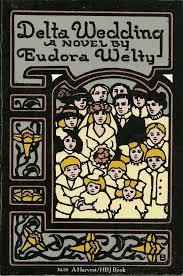 The Fairchilds are an impressively fertile clan, and so the cast of characters in this book seems to number in the thousands. The main family in the house -- the Battle Fairchilds -- have eight children (a ninth is on the way) and Battle is one of eight siblings, all of whom, if alive, are gathered round for the wedding of Danby, Battle and his wife Ellen's second child. (Danby's older sister Shelley is a bit overshadowed -- or overshone -- by her beautiful and vivacious younger sister.) There are also several great aunts hanging around the action, and the many "Negroes" that work on the plantation, both in the fields and in the house, are featured in the book to the extent that they interact with the family (which is often and and seemingly very happily).
Welty is an amazingly good descriptive writer, and brings this whole world vividly alive. And she's as accomplished creating and describing people as she is with places. Every one of the many (many!) characters in this book is distinct and fully present. They complexly reveal themselves to the reader by their words, thoughts, and actions, not to mention their vivid physical presence.
The book begins with the arrival at Shellmound of Laura, a young cousin who lives in Jackson with her father. Her mother, Battle's sister, has recently died and Laura and the Fairchilds are all still grieving. Laura's exclusive point of view that opens the book, and leads the reader to believe that this will be her story, is a ruse, for very quickly it shatters and the rest of the book is told from myriad perspectives, in a somewhat chaotic fashion that matches the excitement and tension in the house as the wedding approaches.
If there is a central character in this book, it isn't Dabney, the bride, but her mother, Ellen, who married Battle at a tender age and moved to the Delta from Virginia, which everyone agrees is a different, and lesser, world. In addition to preparing her daughter's wedding, which is to be held in the house followed by a huge reception to which everyone in the Delta has (supposedly) been invited, Ellen must attend to the wants, needs, and fancies of her eight children and many (many!) houseguests. That she does all this with an unwavering good cheer and grace seems somewhat miraculous, and she becomes the book's hero, although no one in the book realizes or acknowledges this, not even Ellen herself.
One very odd thing about this book is the fact that although it is set in 1923 (it was published in 1945) it seems as if the Civil lWar has effected virtually no change in the socio-economic culture. It is mentioned that there is a payroll for the plantation workers, the bills of which Great Aunt Mac laboriously irons every week, but otherwise it seems as if the plantation is functioning exactly as it did sixty years ago. If it weren't for the mention of the payroll, one might think that all the people working for and serving the Fairchilds were slaves.
A rich, immersive, beautiful book.

Eudora Welty in 1946
Like This Afternoon Forever by Jaime Manrique
(Kaylie J...
Like This Afternoon Forever by Jaime Manrique
(Kaylie Jones: Akashic Books, 2019)
A novel of two Columbian priests which follows them from childhood through seminary and into their lives in the Catholic Church in the tumultuous years of the 199os and 2000s.
Juan and Ignacio become lovers in their teens and maintain a devoted relationship throughout their lives. They both end up as priests in Bogota: Lucas ministers to a conventional middle-class parish but Ignacio, whose belief in social justice is stronger than his faith, serves the poor and disenfranchised in the slums of Soacha. His life and ministry is complicated by violence, political corruption, guerrilla warfare, and the AIDS epidemic. Lucas finds himself unable to save his lover and friend from mental, physical, and spiritual self-destruction.
Jaime writes simply and engagingly about both the world and its people, especially his two main characters. A brave honest, and appealing book.

October 7, 2019
The Vagabond by Collette
Colette's novel tell...
Colette's novel tells the story of a young Parisian woman who is reduced to working as a "mime" in musical halls after her brief and disastrous marriage to a total cad ends, leaving her alone in the world. She enjoys the independence and autonomy her new working life affords her, so when the perfect suitor appears -- he's young, handsome, kind, devoted, and rich -- she balks when he proposes marriage. Is it worth it to her to lose her freedom and become a wife? She decides that it is not, and promptly departs on a tour of South American.
The Vagabond is engaging and the characters and locations are wonderfully vivid. Colette delights and excels in sensually describing the natural world, and as a result the book seems almost fragrant and lush. The character of the suitor seems somewhat rigged to facilitate our heroine's decision -- it would be more fun if he were slightly more of a contender. A fresh and engaging exploration of the evolving relationship between men and women in the early 20th century.
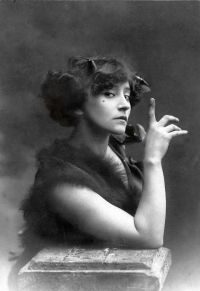
a young Collette
to see more photographs of the young Collette visit:
https://www.vintag.es/2019/08/20-fascinating-vintage-photos-of-young.html
I Would Be Private by Rose Macaulay
(Harper & Brothers, ...
I Would Be Private by Rose Macaulay
(Harper & Brothers, 1937)
A trifling yet somewhat charming novel by Macaulay, set mostly on a fantasy Caribbean island called Papagano. ? and ? (their names are already forgotten), a loving and sensible young couple, find themselves the parents of quintuplets, who become immediate celebrities and shatter their parents' quiet middle-class life in London.
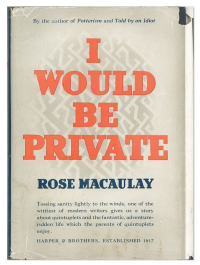 In order to get away from all the bother and attention their amazing progency have caused, the ?s decide to move to a small island in the Caribbean, where the wife's father, a former sailor, is now living with his native wife. The wife's sister and brother, and the sister's Venezualan suitor (and later husband) accompany the ?s to the new world. [Note: note total avoidance of proper names.] Papagano is sparsely populated. A British Church of England Rector lives with his two daughters, one man-crazy and the other crazy about boats, and three rather fey young British men who are spending an extended holiday in the abandoned insane asylum, pursuing different artistic endeavors.
Macaulay's writing is bright and wryly funny, but the sunnyness and silliness of this book is frequently spoiled by its racist and misinformed depiction of the Native population, and all non-English people and animals in the world.
The Grandmothers by Glenway Wescott
(Harper & Brothers,...
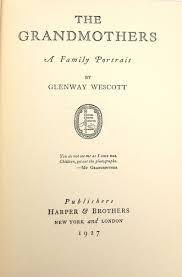
The Grandmothers by Glenway Wescott
(Harper & Brothers, 1927)
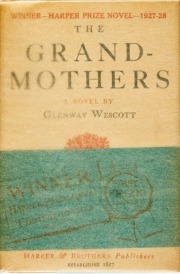
A Family Portrait. I had bought this book many years ago when I had first become interested in Glenway Wescott after reading Continual Lessons (his fascinating journals). I've read The Pilgrim Hawk (of course) and Apartment in Athens, but for some reason never read this early book -- his first, I think, published in 1927 when Wescott as 26. [Note: Actually, it is his second novel, following The Apple of the Eye in 1924.]
The Grandmothers is a beautiful and moving tribute to Wescott's forebears, particularly his great grandparents, grandparents, parents, and great- aunts and uncles . The family has been (paternally) renamed the Towers, and the book follows them through the last half of the 19th century, as they settle in the wilderness of Wisconsin. Wescott writes movingly and perceptively about his assorted relatives, and his description of the Arcadian world around them is tender and beautiful. The Grandmothers memorably recreates a way of life and a type of American that have both disappeared.
July 17, 2019
Separate Tables by Terence Rattigan
(Random House, 1955)...
Separate Tables by Terence Rattigan
(Random House, 1955)
I was traveling to Brooklyn on the subway and wanted a smaller, easily carry-able book to bring with me, so grabbed this slim volume from my bookshelf.
I believe I had seen the film version of Separate Tables many (many) years ago, but I remember nothing about it except for its poignance and that might have starred Deborah Kerr*.
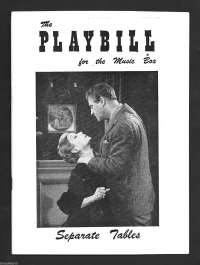 The play, which is set in the dining room and lounge of a small modest sea-side hotel in Bournemouth England (I think) is comprised of two one-act plays that are cleverly linked but narratively independent. The first involves a glamorous divorcee from London who comes to the hotel for a "rest" and encounters her first husband, an abusive but sexually charismatic man who beat her. She, somewhat disturbingly, convinces him that they belong together and should make another try at a relationship that is obviously doomed to violence and heartache.
Curtain.
In the second act, Margaret Leighton, who onstage played the glam divorcee in the first act, plays the mousy, hysterical spinsterish daughter of the reigning queen of the hotel, a horribly bossy and insufferable woman named Mrs. Something-Something. It is revealed in the local newspaper that another guest, a retired and very proper General, has been arrested for interfering with women in dark movie theaters. Mrs. Something-Something organizes a campaign to have him immediately exiled, but it is revealed that in addition to having an affair with the proprietress of the hotel, he has been walking out with the mousy hysterical daughter/spinster, who defies her moth and organizes a counter-campaign to allow the molester to stay. The daughter's campaign wins, much to her mother's chagrin.
So a rather unsavory and disturbing evening at the theater, despite the genteelly-British trappings. One wonders how the audience was expected to react to these disturbing scenarios, and how, and if, this play could ever be successfully revived.
*In fact in the movie version the two roles that Margaret Leighton played on the stage are divided between Rita Hayworth (glam divorcee) and Deborah Kerr (mousy hysteric spinster), and the two leading male roles, which were played onstage by the same actor (Eric Portman), are divided between Burt Lancaster (charismatic abuser) and David Niven (molesting General). Which confirms that theatrical actors are more versatile than movie actors.
Separate Tables by Terence Rattigan
Random House, 1955
...
Separate Tables by Terence Rattigan
Random House, 1955
I was traveling to Brooklyn on the subway and wanted a smaller, easily carry-able book to bring with me, so grabbed this slim volume from my bookshelf.
I believe I had seen the film version of Separate Tables many (many) years ago, but I remember nothing about it except for its poignance and that might have starred Deborah Kerr*.
The play, which is set in the dining room and lounge of a small modest sea-side hotel in Bournemouth England (I think) is comprised of two one-act plays that are cleverly linked but narratively independent. The first involves a glamorous divorcee from London who comes to the hotel for a "rest" and encounters her first husband, an abusive but sexually charismatic man who beat her. She, somewhat disturbingly, convinces him that they belong together and should make another try at a relationship that is obviously doomed to violence and heartache.
Curtain.
In the second act, Margaret Leighton, who onstage played the glam divorcee in the first act, plays the mousy, hysterical spinsterish daughter of the reigning queen of the hotel, a horribly bossy and insufferable woman named Mrs. Something-Something. It is revealed in the local newspaper that another guest, a retired and very proper General, has been arrested for interfering with women in dark movie theaters. Mrs. Something-Something organizes a campaign to have him immediately exiled, but it is revealed that in addition to having an affair with the proprietress of the hotel, he has been walking out with the mousy hysterical daughter/spinster, who defies her moth and organizes a counter-campaign to allow the molester to stay. The daughter's campaign wins, much to her mother's chagrin.
So a rather unsavory and disturbing evening at the theater, despite the genteelly-British trappings. One wonders how the audience was expected to react to these disturbing scenarios, and how, and if, this play could ever be successfully revived.
*In fact in the movie version the two roles that Margaret Leighton played on the stage are divided between Rita Hayworth (glam divorcee) and Deborah Kerr (mousy hysteric spinster), and the two leading male roles, which were played onstage by the same actor (Eric Portman), are divided between Burt Lancaster (charismatic abuser) and David Niven (molesting General). Which confirms that theatrical actors are more versatile than movie actors.
Brothers and Sister by Ivy Compton-Burnett
(Zero Press, ...
Brothers and Sister by Ivy Compton-Burnett
(Zero Press, 1956)
It's been several years since I've read a novel by Ivy Compton-Burnett, and I forgot what an enjoyable and stimulating--and singular--experience it is.
 Brothers and Sisters is one of her better books, because everything she does in a novel she does very skillfully and effectively here. There are five pairs of brothers and sisters featured in this book, and they pair off (and break up) in matrimonial units in more ways and more times than seems possible. Some of these pairings are shocking, and most of them seem to be curiously unromantic and expeditious, which makes the reader wonder what, exactly, these strange people truly desire.
The book is centered around the curious ever-loving marriage of Sophia and Christian Stace, who inhabit the manor house in the village of Moreton Edge. Christian was adopted by Sophie's father, and the two were raised as siblings, so their marriage, which was forbidden by their father, is somewhat suspect. But they live happily together with their three adult children: Andrew, Dinah, and Robin, who pal around with (and are periodically affianced to) several local siblings pairs: Edgar and Judith Dryden, the local rector and his intellectual sister: Julian and Sarah Wake, wealthy and cosmopolitan who live between Moreton Edge and London; and Gilbert and Carrie Lang, who have recently moved to Moreton Edge with their elderly mother, who is, in fact, Christian Stace's mother.
Although all the characters pretty much speak in the same odd, glib, highly-decorative Compton-Burnett vernacular, they manage to distinguish themselves and delight the reader in a multitude of ways. Sophia is an especially fascinating creature--her passive-aggressive methods of mothering are both comic and heartbreaking. Beneath all the farcial silliness of the plot lurks a rather dark and disturbing gloom, and a bleakness about human relationships that gives the book a scintillating, acid edge.
Brothers and Sister by Ivy Compton-Burnett
Zero Press, 1...
Brothers and Sister by Ivy Compton-Burnett
Zero Press, 1956
It's been several years since I've read a novel by Ivy Compton-Burnett, and I forgot what an enjoyable and stimulating--and singular--experience it is.
Brothers and Sisters is one of her better books, because everything she does in a novel she does very skillfully and effectively here. There are five pairs of brothers and sisters featured in this book, and they pair off (and break up) in matrimonial units in more ways and more times than seems possible. Some of these pairings are shocking, and most of them seem to be curiously unromantic and expeditious, which makes the reader wonder what, exactly, these strange people truly desire.
The book is centered around the curious ever-loving marriage of Sophia and Christian Stace, who inhabit the manor house in the village of Moreton Edge. Christian was adopted by Sophie's father, and the two were raised as siblings, so their marriage, which was forbidden by their father, is somewhat suspect. But they live happily together with their three adult children: Andrew, Dinah, and Robin, who pal around with (and are periodically affianced to) several local siblings pairs: Edgar and Judith Dryden, the local rector and his intellectual sister: Julian and Sarah Wake, wealthy and cosmopolitan who live between Moreton Edge and London; and Gilbert and Carrie Lang, who have recently moved to Moreton Edge with their elderly mother, who is, in fact, Christian Stace's mother.
Although all the characters pretty much speak in the same odd, glib, highly-decorative Compton-Burnett vernacular, they manage to distinguish themselves and delight the reader in a multitude of ways. Sophia is an especially fascinating creature--her passive-aggressive methods of mothering are both comic and heartbreaking. Beneath all the farcial silliness of the plot lurks a rather dark and disturbing gloom, and a bleakness about human relationships that gives the book a scintillating, acid edge.
Peter Cameron's Blog

- Peter Cameron's profile
- 589 followers

