
Peter Cameron's Blog, page 9
January 18, 2021
Nancy by Rhoda Broughton (Richard Bentley and Son, 1893)
...
Nancy by Rhoda Broughton (Richard Bentley and Son, 1893)
I had come across a reference to Rhoda Broughton in a novel I recently read -- or perhaps it was the biography of Beverly Nichols? It was mentioned as being seen on a character's book shelf and was, I believe, an indication of their being middle-brow. So I ordered two of her books -- Nancy and Not Wisely but Too Well.
Although this book has problems with pacing and sustainability, I enjoyed reading it and thought it was interesting and engaging, and often quite witty and biting.
Nancy is a 19-year-old girl who lives with her wealthy curmudgeonly father, her kind but ineffectual mother, Barbara and Ton-ton, her older and younger sisters, and Algy, Pratt, and Bobby, her three charming and high-spirited brothers. Her father's childhood friend Sir Roger Tempest visits the family and he and Nancy fall surprisingly in love. They marry, honeymoon in Dresden, where they meet Frank Musgrave, a young neighbor of Roger's who Nancy finds exasperating but strangely attractive. She flirts with him by constantly sparring, not comprehending the mixed message she is sending.
Once back in England, Nancy and Roger return to his house and are visited by the beautiful and angelic Barbara. For mercenary reasons Nancy attempts to instigate a romance between Barbara and Frank, but her intentions misfire and only succeed in making Frank fall more deeply in love with her. Meanwhile, Sir Roger goes to Antigua for eight months to restore proper business procedures at his sugarcane plantation, which had been (mis)managed by a scoundrel.
Nancy is 400 pages and the plot, which concerns the estrangement between Nancy and Sir Roger, does not make much sense and becomes tiresome. But Nancy is an unusual character, and her present-tense, first-person narrative voice is charming. The pithy and witty dialogue often put me in mind of Ivy Compton Burnett, while at other times the distinct shadow of Jane Austen falls across these pages.


Corrigan by Caroline Blackwood (New York Review of Books,...
Corrigan by Caroline Blackwood (New York Review of Books, 2002; originally published by William Heinemann in 1984)
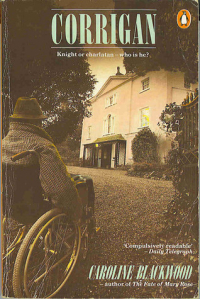 An odd, compelling book, ambitiously and originally conceived but rather repetitively executed.
Mrs Devina Blunt is a genteel and well-off British widow who lives in a charming house in Wiltshire, where she and her late husband, the Colonel, landed after living in India for most of their lives. She is devastated by the loss of her beloved husband, and inexplicably estranged from her daughter, Nadine, who lives in London with her insufferable husband (Justin) and their unruly and spoiled twins.
One day a man in a wheelchair -- Corrigan -- arrives at Mrs Blunt's door collecting for charity, and an odd symbiotic relationship evolves between them. Corrigan pushes Mrs Blunt to happily re-invent herself, all the while swindling her out of thousands of pounds. The book's exploration of how people affect one another regardless of their intentions is complex and ingeniously observed, but the book itself is diminished by its static narrative: the dynamic between the characters never changes despite how long and how often they communicate, and the reader wishes a good editor would cut a third of the book, leaving intact a swift and thrilling book about the complexities of good and evil.
Relative Successes by A. L. Barker (Chatto & Windus/T...
Relative Successes by A. L. Barker (Chatto & Windus/The Hogarth Press, 1984)
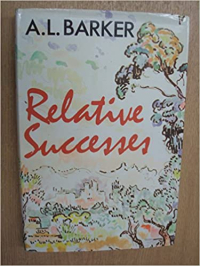 Another smart and astringent book by a writer who continues to intrigue me.
Relative Successes is a book in three parts. The first part relates a summer in southern Frances, as experienced by two teenage British schoolboys, Jessell and Waldo, and Waldo's beautiful and beguiling mother, who enchants Jessell, who remains enthralled by her well into his adulthood. The middle section deals with Jessell's later encounters with Waldo's wife Daisy, who claims her husband has mysteriously disappeared. So Jessell travels to southern France with Connie, his wife, because he has a hunch that Waldo may have returned there. The concluding section takes place in France where Jessell and Connie befriend a strange couple staying at their resort -- a middle-aged woman who is a kleptomaniac and her handsome and virile much younger husband. The book ends with Jessell thinking he has caught of glimpse of Waldo at a circus.
It's hard to know what all this means -- the novel doesn't seem to amount to anything, although page by page it is engaging and curious. The writing isn't quite as idiosyncratically brilliant as in some other of Barker's books, but it's vivid and witty. So not a first-rate Barker, but an interesting and worthwhile read nonetheless.
*No End to the Way by Neville Jackson (Barrie and Rocklif...
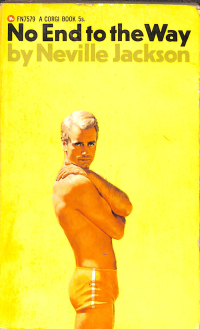
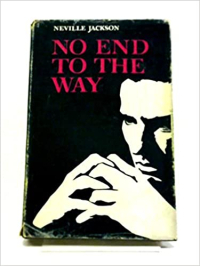
*No End to the Way by Neville Jackson (Barrie and Rockliff, 1965)
This is an interesting novel about homosexuality in Australia in the mid-1960s. It is set in a small western city -- Perth? -- and chronicles the relationship of Ray and Cor, two men in their 30s who meet, fall in love, live together, consider themselves married, and then part with violence and hate.
Ray runs his own advertising business and lives with his parents; Cor, who emigrated to Australia from Holland with his wife, is a bartender at a gentleman's club. Mia, his wife, is pregnant and Cor is also kept by a Mr. Hamilton, so he is hardly an ideal candidate for a committed relationship.
The book is engaging and easy to read (I read it in two days) but has several formidable problems. The first is that its written entirely in second-person, which is awkward and alienates the reader from Ray, who should be the first-person narrator. The book is also, unsurprisingly but disturbingly, of its time: it's full of homophobic self-loathing (Ray and Cor, who are both closeted and "straight" acting and appearing, have no sympathy or use for anyone who is effeminate or apparently homosexual, and Ray's attitude towards women is unremittingly misogynistic). The deeply closeted and paranoid nature of the two men is a direct product of their relentlessly and dangerously homophobic society, which makes it impossible for gay men to live without constant fear and shame.
December 28, 2020
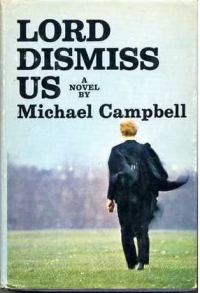
*Lord Dismiss Us by Michael Campbell (G. P. Putnam's Sons...
*Lord Dismiss Us by Michael Campbell (G. P. Putnam's Sons, 1968)
Lord Dismiss Us is a big, ambitious, and mostly successful novel about homosexuality in English public schools, circa 1960.
The novel is set entirely at Weatherhill, a small (200 students, all boys) second-rate (one boy is sent there because he can no longer afford to attend Eton) public school in Buckinghamshire. Its large scope is made up of intimate portraits of a wide cross-section of Weatherhill citizens: Mr. and Mrs. Crabtree, the new headmaster and his sepulchral wife (and their deeply unhappy daughter, Lucretia); a variety of schoolmasters, including Rowles, who has been there for 45 years, hates women and boys older than 18, and gives the boys some stoic and begrudging compassion; Ashley, a young master, brilliant and creative, who is unhappily languishing at Weatherhill, his alma mater, because he did not get a position at Cambridge; Cyrus Starr, the chaplain, who is dying from stomach cancer and lives a strange life of indolence and indulgence in his sumptuous private apartment, attended to by a pack of dirty boys called the "Starlings," ; and several boys of various ages, including our hero, Carelton, who experiences his first overwhelming love with Nicky Allen, a circumspect and beautiful boy a year or two younger
 The action takes place over a sing summer term, which is Carelton's last -- he will attend Oxford in the fall. Carelton is blessed -- he is athletic, beautiful, intelligent, moral, kind, and creative and his first experience of love is overwhelming and poignantly described. The plot of the book revolves around the Crabtree's mission to cleanse the school of "moral laxity" -- meaning any and all relationships between the boys, emotional or carnal, casual or profound. Crabtree (with much sinister and underhanded help from his wife) goes about this in a brutal and stupid way that produces tragic and devastating results, despite the tepid interference of a few enlightened masters.
Campbell creates a rich, complex, and engaging world full of original and interesting characters. The book is quite funny and involving, and I enjoyed reading it very much. There are a few places where the action blurs and the reader wonders what is actually happening, but the overall picture is beautiful and bright.
Iris Murdoch heralded this novel with a blurb that perfectly captures my response: "Marvelous. I read it very slowly because I was enjoying it so much. I think it achieves a sort of tragic beauty and is really about LOVE, which all novels profess to be about, but hardly any are."
Lord Dismiss Us by Michael Campbell, G. P. Putnam's Sons,...
Lord Dismiss Us by Michael Campbell, G. P. Putnam's Sons, 1968
Lord Dismiss Us is a big, ambitious, and mostly successful novel about homosexuality in English public schools, circa 1960.
The novel is set entirely at Weatherhill, a small (200 students, all boys) second-rate (one boy is sent there because he can no longer afford to attend Eton) public school in Buckinghamshire. Its large scope is made up of intimate portraits of a wide cross-section of Weatherhill citizens: Mr. and Mrs. Crabtree, the new headmaster and his sepulchral wife (and their deeply unhappy daughter, Lucretia); a variety of schoolmasters, including Rowles, who has been there for 45 years, hates women and boys older than 18, and gives the boys some stoic and begrudging compassion; Ashley, a young master, brilliant and creative, who is unhappily languishing at Weatherhill, his alma mater, because he did not get a position at Cambridge; Cyrus Starr, the chaplain, who is dying from stomach cancer and lives a strange life of indolence and indulgence in his sumptuous private apartment, attended to by a pack of dirty boys called the "Starlings," ; and several boys of various ages, including our hero, Carelton, who experiences his first overwhelming love with Nicky Allen, a circumspect and beautiful boy a year or two younger
The action takes place over a sing summer term, which is Carelton's last -- he will attend Oxford in the fall. Carelton is blessed -- he is athletic, beautiful, intelligent, moral, kind, and creative and his first experience of love is overwhelming and poignantly described. The plot of the book revolves around the Crabtree's mission to cleanse the school of "moral laxity" -- meaning any and all relationships between the boys, emotional or carnal, casual or profound. Crabtree (with much sinister and underhanded help from his wife) goes about this in a brutal and stupid way that produces tragic and devastating results, despite the tepid interference of a few enlightened masters.
Campbell creates a rich, complex, and engaging world full of original and interesting characters. The book is quite funny and involving, and I enjoyed reading it very much. There are a few places where the action blurs and the reader wonders what is actually happening, but the overall picture is beautiful and bright.
*The Chameleons by John Broderick (Ivan Obolensky, Inc., ...
*The Chameleons by John Broderick (Ivan Obolensky, Inc., 1961)
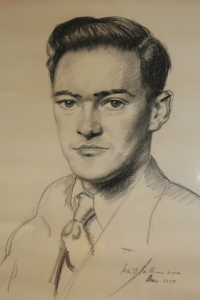 The Chameleons is a short novel set in a small village outside of Dublin about a strange group of nastily inter-related people: Michael Glynn, a middle-aged, closeted homosexual, bedridden with rheumatoid arthritis; Stephen, a creepy (mostly) homosexual young man who cares for Michael; and Julia, Michael's wife, who married him for comfort and security (he's rich) but is having a passionate affair with Jim Glynn, Michael's handsome nephew who also happens to be his doctor. Father Victor, the ever-tippling parish priest, hovers around them all, mooching whiskey and planning a trip for them to Lourdes, to seek a miracle cure for Michael.
Early in the book Jim abruptly ends his affair with Julia to marry a girl from a good family, and Julia immediately starts an affair with Stephen, who has been blackmailing her about her affair with Jim. Their affair gets off to an awkward start when Stephen rapes her. Two young homosexual men in Dublin also appear in the book, and neither of them is happy: one kills himself and the other attempts suicide.
This is all rather sordid and unpleasant, but Broderick is a good writer, and the characters, despite their damp and dark lives, are vivid and engaging. Especially Julia, who's an odd heroine to find a mid-century novel: she enjoys and values sex, and does not hesitate to use men to satisfy and occupy her. She pursues her eventful sex life without guilt or misgivings, which makes her an unusual and refreshing character.
The illustration is a portrait of John Broderick by Sean O���Sullivan
The Chameleons by John Broderick, Ivan Obolensky, Inc., 1...
The Chameleons by John Broderick, Ivan Obolensky, Inc., 1961
The Chameleons is a short novel set in a small village outside of Dublin about a strange group of nastily inter-related people: Michael Glynn, a middle-aged, closeted homosexual, bedridden with rheumatoid arthritis; Stephen, a creepy (mostly) homosexual young man who cares for Michael; and Julia, Michael's wife, who married him for comfort and security (he's rich) but is having a passionate affair with Jim Glynn, Michael's handsome nephew who also happens to be his doctor. Father Victor, the ever-tippling parish priest, hovers around them all, mooching whiskey and planning a trip for them to Lourdes, to seek a miracle cure for Michael.
Early in the book Jim abruptly ends his affair with Julia to marry a girl from a good family, and Julia immediately starts an affair with Stephen, who has been blackmailing her about her affair with Jim. Their affair gets off to an awkward start when Stephen rapes her. Two young homosexual men in Dublin also appear in the book, and neither of them is happy: one kills himself and the other attempts suicide.
This is all rather sordid and unpleasant, but Broderick is a good writer, and the characters, despite their damp and dark lives, are vivid and engaging. Especially Julia, who's an odd heroine to find a mid-century novel: she enjoys and values sex, and does not hesitate to use men to satisfy and occupy her. She pursues her eventful sex life without guilt or misgivings, which makes her an unusual and refreshing character.
The illustration is a portrait of John Broderick by Sean O���Sullivan
Slaughterhouse-Five by Kurt Vonnegut (Delacourt Press [Se...
Slaughterhouse-Five by Kurt Vonnegut (Delacourt Press [Seymour Lawrence], 1969)
I was underwhelmed and disappointed in Slaughterhouse-Five, which I had been led to believe was a classic of anti-war and counter-culture literature.
 Like so much auto-fiction being published today, Vonnegut writes himself into the story of Billy Pilgrim, his stand-in; in fact, Vonnegut acknowledges himself as author as narrator, and includes his own stories from the war alongside and often conflated with Billy's. For a book purportedly about the bombing of Dresden, the tragedy itself is barely acknowledged and quickly dispatched. A few incidents about the war are alarming and affecting, but much of the book, especially the sections about Billy's post-war life as an optometrist in a small town in upstate New York which involves ceaseless time travel and a stint being displayed in a zoo on a distant planet after being abducted by aliens -- all of this, which is much of the book, just seems silly and childish, neither funny nor chilling.
And Vonnegut's inability to write ten sentences without including "so it goes" is maddening; you just want to get away from this storyteller with a relentless tic. Perhaps I'm missing something, but Slaughterhouse-Five seems like an inferior book that has not aged well.
Slaughterhouse-Five by Kurt Vonnegut, Delacourt Press (Se...
Slaughterhouse-Five by Kurt Vonnegut, Delacourt Press (Seymour Lawrence), 1969
I was underwhelmed and disappointed in Slaughterhouse-Five, which I had been led to believe was a classic of anti-war and counter-culture literature.
Like so much auto-fiction being published today, Vonnegut writes himself into the story of Billy Pilgrim, his stand-in; in fact, Vonnegut acknowledges himself as author as narrator, and includes his own stories from the war alongside and often conflated with Billy's. For a book purportedly about the bombing of Dresden, the tragedy itself is barely acknowledged and quickly dispatched. A few incidents about the war are alarming and affecting, but much of the book, especially the sections about Billy's post-war life as an optometrist in a small town in upstate New York which involves ceaseless time travel and a stint being displayed in a zoo on a distant planet after being abducted by aliens -- all of this, which is much of the book, just seems silly and childish, neither funny nor chilling.
And Vonnegut's inability to write ten sentences without including "so it goes" is maddening; you just want to get away from this storyteller with a relentless tic. Perhaps I'm missing something, but Slaughterhouse-Five seems like an inferior book that has not aged well.
Peter Cameron's Blog

- Peter Cameron's profile
- 589 followers

