
Peter Cameron's Blog, page 6
February 7, 2022
*Despised and Rejected by Rose Allatini (Persephone Books...
*Despised and Rejected by Rose Allatini (Persephone Books, 2018, originally published in 1918 by C. W. Daniel).
A fascinating book about homosexuality and pacifism, two dangerous subjects that caused the book to be banned, with all remaining copies destroyed, when it was first published in 1918.
The book begins in the summer of 1914, with the threat of war with Germany looming. The first part of the book is set at a country hotel where several genteel families are spending their summer holiday. We're introduced to the Blackwoods, a family with three sons and one daughter. Antoinette De Courcey, a young woman with French parents who was born and is living in England, has joined another family, the Fayne's, as a guest of their daughter. Antoinette's beauty and high spirits attract the attention of everyone, but she has eyes only for Hester Cawthorn, a mysteriously beguiling woman in her 30s who is staying at the hotel by herself and holds herself apart from all the other guests. Dennis, the Blackwood's oldest child, is "sensitive" and "artistic" -- he's a composer and arrives at the hotel for a weekend visit while on a walking tour with his friend Crispin (who is also sensitive and artistic). Dennis detects Antoinette's fascination with Hester, and immediately identifies her as a fellow traveler. He invites her out for a long moonlit walk in the countryside, and alludes to their shared "abnormality," which Antoinette neither denies or confirms. Dennis wants to tell her the truth about himself, but cannot bring himself to, despite their mutual interest in and sympathy for one another.
 Dennis, who can't imagine a life for himself as a homosexual, decides that he and Antoinette should marry one another and spends most of the book trying to convince her that it is a good idea. Antoinette is not sure, but after she is rejected by Hester -- whose social aloofness is not a reflection of lesbianism as Antoinette assumed, but a screen to obscure her love affair with a married man -- reconsiders and thinks that perhaps she does love Dennis enough to marry him. But by that time Dennis has met a beautiful and charming young man named Alan, and fallen completely and hopelessly in love.
There is an almost farcical nature to these various overlapping love stories, and ultimately Dennis, who is open about his pacifism, is jailed for it, although he is despised and rejected for both his homosexuality and pacifism. What was most interesting about this book -- which is competently but indifferently written -- is the different ways that Dennis and Antoinette regard their sexuality: Dennis is frightened and ashamed, and despondent, while Antoinette feels that her attraction to women is perfectly natural and delightful -- she pursues Hester openly and honestly. I wonder if this is somewhat indicative of the difference between how society perceived male versus female homosexuality in the early 20th century.


Treasure Hunt by Molly Keane (Virago Modern Classics, 199...
Treasure Hunt by Molly Keane (Virago Modern Classics, 1990, originally published in 1952)
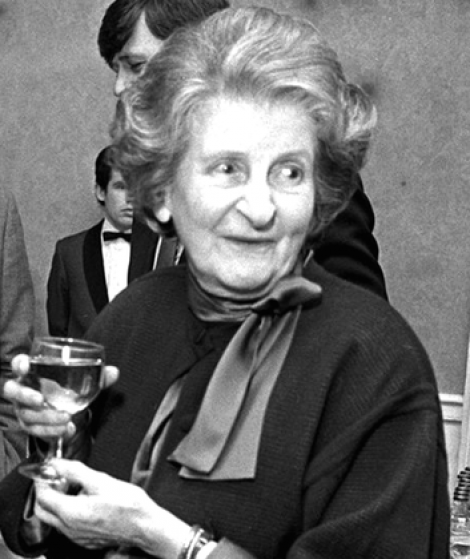 This novel (originally published under the pseudonym M. J. Farrell), is about three generations of an Anglo-Irish family who inherit a magnificent family house, full of beautiful and valuable things, but have no money to maintain it, so must resort to hosting "paying guests," an idea the younger generation, who are most responsible, propose, but that the careless and selfish middle generation reject and attempt to sabotage. The paying guests are three wealthy Londoners eager to escape the deprivations of post-WWII England, and imagine that at an Irish castle they will be warm, well-fed, and cosseted. They are immediately and severely disappointed, but stay on nevertheless, and eventually things work themselves out, much helped by the discovery of precious rubies hidden in a stuffed bird.
Molly Keane writes with eccentric brio and originality. Her thoughts, and sentences, are odd and interesting, and one feels fortunate to experience the world from her unique point of view.
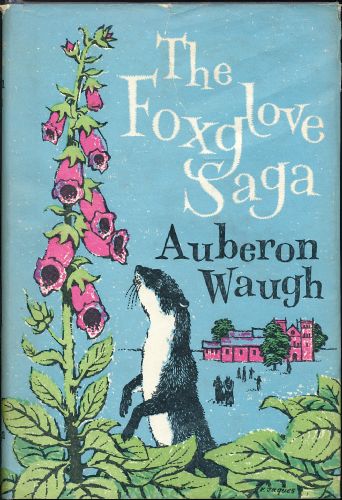
The Foxglove Saga by Auberon Waugh (Chapman & Hall, 1...
The Foxglove Saga by Auberon Waugh (Chapman & Hall, 1960)
This rather slap-dash, silly novel is amusing -- it follows three English boys from their days at a Catholic prep school through their early adulthood, detailing their misadventures in both civilian and military life. The most amusing character is Lady Julia Foxglove, one of the boys' mother, a beautiful and ostensibly pious and charitable woman who is actually a selfish and interfering monster. Her ability to manipulate others under the guise of helping them is quite entertaining, but the satire and humor here is gentler and less trenchant then Eveyln Waugh's (the author's father), and the book seems correspondingly negligible.
*The Imperfect Marriage by Edith de Born (Chapman & H...
*The Imperfect Marriage by Edith de Born (Chapman & Hall, 1954)
 As its title suggests, this novel is a portrait of a marriage. Roger and Louise (nee de Castillac) Warnier are married in 1936. Roger is the scion of a wealthy family that owns fabric mills in a provincial city north of Paris; Louise is from an aristocratic but impoverished land-owning family in the South of France. They meet in Paris, fall quickly in love, and marry to the delight of their families, who see their combination of wealth and aristocracy as beneficial to all. Louise moves to the estate in the ugly industrial city where the Warnier empire located, and has several children. Everything seems fairly happy until Roger becomes a prisoner during WWII and spends several years living in a German prison camp. When he returns to France after the war he seems changed, and is no longer sexually interested in Louise. He finally admits that he now prefers men to women, and begins (or more likely resumes) to have a not-entirely-discreet affair with a younger Frenchman he met in the prison camp. Louise sees no alternative other than to continue living with Roger under these disappointing circumstances, although she does have a short-lived affair with a young philosophy teacher she meets on the train to Paris.
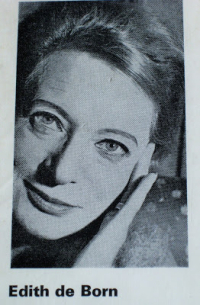
Edith de Born (which is the pen-name of Edith Bisch, an Austrian writer born in 1901) treats this subject with sensitivity and complexity. Both Roger and Louise are complex, interesting, and sympathetic characters, and they are surrounded by a gallery of vivid secondary characters, including two old aunts of Roger's who both loved the same man -- one as his wife and one as his mistress. The scenes of the provincial northern city, of Paris, and of the de Castillac's estate and vineyard in the South are all nicely evoked.
The Imperfect Marriage is an unusual, accomplished book that I enjoyed reading very much -- I felt immersed in its world and interested in its characters, and was sad to finish it.

August 30, 2021
*Jonah and His Mother by Montague Haltrecht (Andre Deutsc...
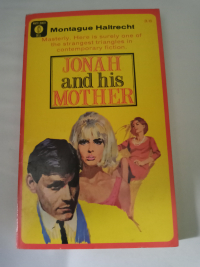
*Jonah and His Mother by Montague Haltrecht (Andre Deutsch, 1964)
This is the second novel of Montague Haltrecht that I've read (see A Secondary Character, below) and I think he's an interesting and talented queer writer from the pre-Stonewall era. This book, with its focus on the toxic and perverse relationships between mothers and (perhaps) homosexual sons and the gothic horror therein, reminded me at times of Tennessee Williams.
Federika has lived parasitically off of wealthy men, using her beauty and glamour to ensnare them and then proceed to exploit them financially before moving on. When this book begins, she is living on fumes in a hotel with her beautiful 17-year-old son, Jonah. One evening, they go to the opera at Covent Garden, which has always proved to be a happy hunting ground for Federika (she likes her men wealthy and cultured), and this evening is no exception. At the first interval they meet Gray, a prosperous looking middle-aged gentleman, and Federika flirts with him until she realizes he is more interested in her beautiful son. Being a practical woman, she encourages this attention although she is a bit shaken not to be the object of desire -- is she getting old, losing her market value? Yes.
Gray takes Jonah home and into his bed but Federika soon joins their menage as a sort of housemother. Jonah, who does not enjoy the time he spends in bed with Gray, becomes acquainted with a young woman who lives in their building and who sells hats at Harrods (does anyone still a hat?). He begins to court her, ineptly, with Gray's reluctant permission, as Gray realizes clutching Jonah will only hasten his inevitable departure. The novel follows the decline and dissolution of all these relationships, except for Jonah and his mother, who, in the final scene, are back at the opera seeking new prey, with Jonah having unquestionably replaced his mother as the bait.
Haltrecht is a good writer, able to create vivid and interesting characters and make lively scenes with amusing dialogue. This is a slim, inconsequential book, but I enjoyed reading it.
August 29, 2021
A Summons to Memphis by Peter Taylor (Knopf, 1986)
Pete...
A Summons to Memphis by Peter Taylor (Knopf, 1986)
Peter Taylor is a gentle, accomplished writer, but this book bemused and often irritated me. I think part of the problem may be that Taylor is not a natural or adroit novelist; this book is very oddly (and ineptly) paced and structured. It moves slowly, if at all, like those traveling sprinklers that never seem to be moving yet eventually traverse a lawn.
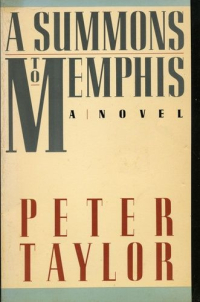 A Summons to Memphis is narrated in first person by Philip Carver, a bland middle-aged man who lives in New York City and works as a rare book dealer and editor, but we never hear much about his life's work and he expresses very little interest in or passion for books. He expresses very little interest in or passion for anything, perhaps because when he was 13 his father, due to a cataclysmic business failure caused by his partner, uprooted his family from their idyllic life in Nashville and moved them to Memphis, which had mysteriously disastrous effects on all the family members: Philip's mother lost her Nashville grace and poise and became a chronic invalid and recluse; his two sisters, Josephine and Betsy were forced into spinsterhood when their father sabotaged both their engagements; Georgie, his brother, was killed in WWII; and Philip's own great love with a young woman named Carla Price was also brutally (and inexplicably) terminated by his father, who was the only Carver to thrive in their new life in Memphis. (Philip escaped to New York City where he now lives with a younger woman in a static, unsatisfying relationship that seems tepid at best.)
The present action of the book, such as it is, revolves around the elder Mr. Carver's attempt to marry after his wife dies and leaves him a widower in his 80s. The two sisters summon Philip to Memphis and enlist him in thwarting their father's matrimonial plans, an ugly act that seems part revenge and part safeguarding their inheritance. But this potential conflict is resolved off-page with no drama, and the book's denouement is equally bloodless and inscrutable.
All these seemingly genteel people act ruthlessly to destroy one another's happiness, but it is never clear what motivated all this bad behavior or what satisfaction, if any, it affords. So a very puzzling book -- somewhat Chekhovian in its minor-key uneventfulness, but lacking Chekhov's resonance and mysterious, beautiful, and heartbreaking, depth. The reader is barely involved, let alone moved.
*Out with the Stars by James Purdy (Peter Owen, 1992)
A...
*Out with the Stars by James Purdy (Peter Owen, 1992)
Another strange -- of course -- book by James Purdy, and although it has all the usual Purdian qualities, it seems a bit forced and haphazard. It's set in New York City in 1965, and concerns itself with a number of homosexual artists, mostly composers, photographers, actors -- some ancient, some striplings.
What little plot there is revolves around the world premiere of Abner Blossom's opera Cock Crow, which is based on the life of Cyril Vane, whose life-long passion and work was photographing and fetishizing naked Black men. Cyril's Russian silent-movie-star wife, who is incensed by her husband's proclivities and jealous of the attention he pays to men, vows to prevent the opera from opening, and much unbelievable drama ensues.
Purdy seems to let the book go wherever it likes; it has no discernible structure or shape, but then one doesn't read Purdy for those things. Yet a certain magical resonance is missing in Out with the Stars -- too often Purdy seems to be on autopilot -- it's like a complicated gourmet recipe copied by a not-fully-informed chef, who omits several key yet secret ingredients, and produces a dish that is comestible rather than delicious.
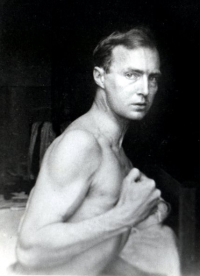 A young James Purdy
*The Moon and Sixpence by W. Somerset Maugham (Modern Lib...
*The Moon and Sixpence by W. Somerset Maugham (Modern Library, 1919)
The Moon and Sixpence (the intriguing title is never explained or mentioned in the book itself) is a novel inspired by the life Paul Gauguin. In Maugham's version, he's Charles Strickland and English, a well-to-do businessman in London who abruptly and mysteriously abandons his wife and two children and moves to Paris to paint, although he's never shown any interest in painting and has no training and apparently not much talent.
Today Strickland would be considered to be "on the spectrum" and closer to one end than to the other. He is devoid of sympathy and empathy, thinks only of himself, and is impervious to any and all creature comforts. The book is narrated by an acquaintance of Strickland's who met him briefly when he still lived in London, became quite involved in Strickland's life while they were both living in Paris, and just happens to be in Tahiti shortly after Strickland's death there so that he can learn all about Strickland's final chapter from witnesses and participants.
Maugham is a skilled and adroit writer, and this book is engaging, but all the characters, with the exception of Strickland's abandoned wife, who is interestingly alive and surprising, are one-dimensional and exaggerated. And here is yet another book that is narrated by a man who is very apparently homosexual, yet never alludes to his romantic or sexual life, thus negating himself as a character.

I Am Mary Dunne by Brian Moore (Viking Press, 1968)
An ...
I Am Mary Dunne by Brian Moore (Viking Press, 1968)
An odd book, both brave and foolish, that begins promisingly and then slowly deteriorates into tedious melodrama.
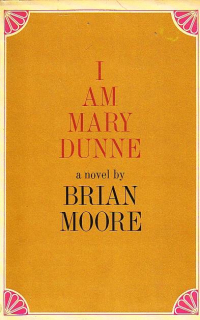 Mary Dunne grew up in a small village Nova Scotia and got away as quickly as she could by eloping with a high school friend who just happened to have a ticket out. She ends up, after two more marriages, living the high life in 1960s New York: married to a nice, sexy British playwright and man-about-town, living in a two-bedroom apartment on the Upper East Side, lunching with friends, drinking, and feeling hysterically depressed -- perhaps because she's about to have her period or perhaps because she's crazy and suicidal. So during a long NYC day she reviews her entire life for her own (but mostly the reader's) benefit: her attempts to be a writer and an actress, her mostly disastrous marriages. The frequent shifts between the past and the present are often unwelcome, and the reader feels tugged around. Moore is a skillful writer but despite his extensive examination of his character's gynecological and sexual experiences, Mary Dunne remains rather fake: distant and unlikeable, and the microscopic attention that this book pays to her begins to seem unwarranted, and finally rather boring.
The Polyglots by William Gerhardie (Prion Books, 2011)
...
The Polyglots by William Gerhardie (Prion Books, 2011)
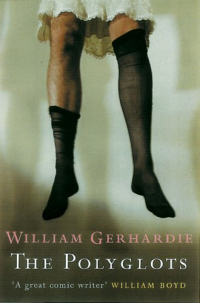 Another odd, beguiling book by this unique and interesting writer. The Polyglots (originally published in 1925) is set in the far east -- mostly in Japan and China during the period of the Great War and the Russian Revolution.
Its narrator is a British military man of Belgian descent, born in Russia, who is posted rather autonomously, it seems, in the far east, where he reunites with his eccentric Aunt ? and lives with her very large, very eccentric family which includes many hanger-ons. All these people, whether French, Belgian, British, or Russian are outcasts, waifs, people once firmly ensconced in empires or regimes that have failed or are floundering. So they go on living as best they can on ever-diminishing resources and finances, unable, until the very last moment, to give it all up and head for home -- a home that is theirs only geopolitically, not sentimentally.
The narrator falls in love with Aunt ?'s beautiful and decorative but pathetically vacant daughter. Their inert romance, and the family's necessary removal from Tokyo to Harbin, China via Vladivlastock, is as much of a plot of Gerhardie can muster, but the real strength and charm of this book is its gallery of eccentrically poignant characters and its wonderfully strange atmospheres -- a world that is vanishing so quickly that at times it seems already lost.
Flawed and shaggy, but a lovely book.

Peter Cameron's Blog

- Peter Cameron's profile
- 589 followers

