
Peter Cameron's Blog, page 4
December 1, 2022
Barchester Towers by Anthony Trollope (Literary Guild, 19...
Barchester Towers by Anthony Trollope (Literary Guild, 1945)
Barchester Towers is set in the upper echelons of the clerical world in Barchester, a fictitious cathedral city in England. A spineless new Bishop arrives to the consternation of the Warden and the Archdeacon, and upsets the status quo. He is controlled by his formidable wife, Mrs. Prudie, and his revoltingly ambitious Chaplain, Dr. Slope. A triangularized romantic plot centering around an independent and wealthy young widow (the Archdeacon's daughter) allows happy endings for all the good characters, and appropriate come-uppences for all the bad.
Perhaps because the edition I read (published by the Literary Guild in 1945) featured several cartoonish color illustrations (by Donald McKay), this book seemed considerably less nuanced and complex than other Trollope novels (especially the Palliser novels), and therefore less satisfying -- but entertaining and fun to read nonetheless.

illustration by Donald McKay


November 27, 2022
Notes from the Underground by Fyodor Dostoevsky
Hated i...
Notes from the Underground by Fyodor Dostoevsky
Hated it. An endless rant by an inordinately uninteresting crazy man followed by a very brief inconsequential narrative about his liaison with a gold-hearted prostitute. This book seemed, like Joyce's Portrait of an Artist as Young Man, especially designed to discourage young readers from ever wanting to pick up another book.
A Summer Bird-Cage by Margaret Drabble (William Morrow an...
A Summer Bird-Cage by Margaret Drabble (William Morrow and Company, 1964)
Having recently re-read The Garrick Year, which I believe was Drabble's second novel, I decided to revisit her debut, which I first read in 1979 (fifteen years after it was first published in 1964).
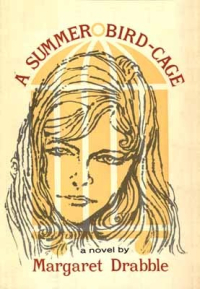 A Summer Bird-Cage -- the title is never mentioned in the book, but it must be a reference to something* -- is a rather tepid, underdeveloped story about two sisters, one who is recently married to a somewhat famous but completely undesirable author (he might be queer). Neither sister is very sympathetic, but there is something bracing about their nastiness, and Drabble's intelligence and eloquence are both fully displayed, especially as manifested in the first-person narrative voice. One feels that Drabble is, at this very early stage of her career, an excellent writer but a facile observer of human life. She is ahead of herself technically, which results in a polished but minor book.
*According to Wikipedia, the title of the novel is taken from a quotation from the play The White Devil by John Webster: ���"Tis just like a summer bird-cage in a garden: the birds that are without despair to get in, and the birds within despair and are in a consumption for fear they shall never get out."
*The Exquisite Corpse by Alfred Chester (Simon and Schust...
*The Exquisite Corpse by Alfred Chester (Simon and Schuster, 1967)
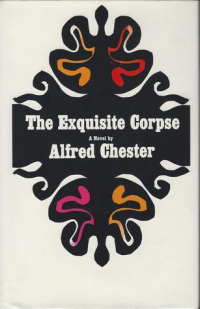 The Exquisite Corpse is an audacious and fascinating, but failed, attempt to push the boundaries of literary fiction to the extreme edges (or beyond) of obscenity.
It is designed to work in the manner of the folded-page drawing game whereby a picture of a human body is created by juxtaposing parts randomly drawn by various artists. In the novel Chester moves arbitrarily from one chapter to the next by introducing a new character, or a different version of an already introduced character, and in this way attempts to create a whole that is larger and more meaningful than the sum of its many parts. Unfortunately, Exquisite Corpse doesn't achieve that goal, but individual chapters provide a unique and stimulating reading experience. Chester embraces -- nay, celebrates -- many subjects not often encountered in conventional, mainstream fiction: sexual aberration (homosexuality, transvestitism, necrophilia, bestiality, S&M), colostomy bags (erupting), and many other taboos. His smart, funny, and oddly humane writing make all of this almost palatable, and often quite amusing, yet one wishes all the sex and gore amounted to something a bit more powerful and resonant.

August 1, 2022
*Glenway Wescott Personally by Jerry Russo (University of...
*Glenway Wescott Personally by Jerry Russo (University of Wisconsin Press, 2002)
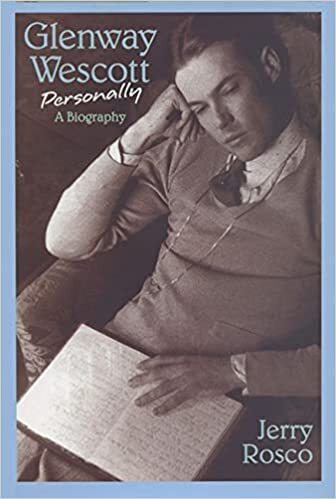
Wescott, a writer I have long admired, apparently lived a charmed, productive, creative, satisfying, golden and long life. Russo's biography, which repeats much of the information contained in Wescott's journals (Continual Lessons, FSG, 1997) elegantly and succinctly details that life, from cradle to grave. The journals end in 1955; Wescott lived for 30 more (less creative but eventful) years, and a second volume of journals has recently been published.
Born to a farming family in Wisconsin in 1901, Wescott went to the University in Chicago, and from there to New York City, and from there to Europe, spending most of the 1920s and 30s in England and France. He met his life-long partner, Monroe Wheeler when they were both young men in Chicago, and the two remained together, devoted partners, in a sort of open -- in all senses -- marriage that accommodated many affairs, including a years-long menage-a-trois with George Platt Lynes. The years after the war were mostly spent in New York City, where Wheeler worked as director of publications at the Museum of Modern Art, and Wescott devoted much time and energy working with the American Academy of Arts and Letters and with the Kinsey Institute in Bloomington, Indiana.
Wescott's fiction, which was predominately autobiographical, was greeted enthusiastically by both reviewers and readers early on -- both his novels The Grandmothers (1927) and Apartment in Athens (1945) were bestsellers, and his novella, The Pilgrim Hawk (1940), was heralded as a contemporary classic. But he struggled to write fiction in the second half of his life, turning instead to perceptive and appreciative literary essays about Colette, Katherine Anne Porter, E. M. Forster, W. S. Maugham, and many of the other writers he befriended and admired.
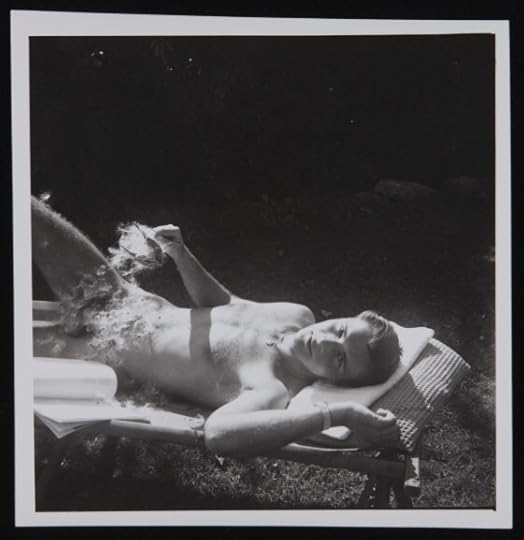
Russo's portrait of Wescott is extremely flattering, and deservedly so: he was a brilliant writer and conversationalist, a generous and loving friend and devoted partner, civic-minded about democracy and literature, humble, hard-working, and handsome.
May 10, 2022
The Siege at Krishnapur by J. G. Farrell (Modern Library,...
The Siege at Krishnapur by J. G. Farrell (Modern Library, 2012; originally published by Weidenfeld & Nicolson, 1973)

The Siege at Krishnapur is an odd, dark, rather brutal book about a native Indian mutiny in the 1850s that traps a small community of British citizens and their servants and hangers-on in a poorly fortified compound for several grueling months, where they all suffer (and many die) from warfare, lack of water and food, cholera and other diseases.
Farrell seems to find most of these people (justifiably) reprehensible and ridiculous, and takes much humorous delight in their ever-worsening suffering. Yet the reader can't help feeling a little sorry for them, as the hardships and discomforts they endure are so thoroughly and vividly described. So the book has a strange, off-putting yet extremely engaging tone, and reading it is an intense and discomforting experience.
Farrell is an excellent writer -- good with both characters and place, all of which are described, or actually recreated and enlivened, with complexity and brilliance.
*A Shower of Summer Days by May Sarton (Rinehart & Co...
*A Shower of Summer Days by May Sarton (Rinehart & Company, 1952)
This early novel of May Sarton's (and the only one I have read) is set in Ireland, among the Anglo-Irish gentry, sometime in the early 1950, when the Empire was crumbling, inone of the great country houses not incinerated in The Troubles.
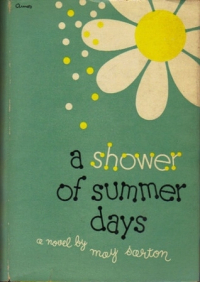 Charles and Violet (Dene) Gordon return, after many years in Burma, to Dene's Court, the house that Violet grew up in and has inherited, but which has been left derelict and disintegrating during their long absence. They are both beautiful charming people and love one another (despite Charles' discreet infidelities) and go about establishing a third act for themselves in the beautiful house, which they restore to habitability, if not its former grandeur. Charles manages the estate and Violet does the flowers.
Into this idyl Violet's niece Sally arrives, banished from America where she has grown up with her mother, Violet's sister Barbie, and her American father, because she has made an inappropriate romantic engagement with an actor (even though his handsome and rich). Sally initially feels that Dene's Court is a prison and that her aunt and uncle are her jailors, but rather (too) quickly succumbs to the charms of the house, Charles, and Violet, falling passionately in love with all three. By the time Ian, her fiancee, arrives and jilts Sally (and falls in love with the irresistible Violet), we know that Sally has become a Dene, and like her ancestors, will always return to Dene's Court, which she will, in due time, inherit.
The graceful and beautifully descriptive writing is the finest thing about this book. Sarton gives her characters complicated and well-spelunked interior lives, but it is her poet's attention to the house itself and the world and weather surrounding it that gives the reader the deeper and more lasting satisfaction. One sometimes wishes the annoying characters would clear out so that one could enjoy the house and the demense (a new word for me and frequently used here, meaning land attached to a manor and retained for its owner's use) without their sometimes tedious interruption.

Told By An Idiot by Rose Macaulay (Boni & Liveright, ...
Told By An Idiot by Rose Macaulay (Boni & Liveright, 1924)
Told by An Idiot is a social history of England disguised (not all that successfully) as a family saga. It follows the Gardner family from the final years of Victoria (1890) through the fin de siecle, and into the Georgian and Edwardian Ages, detailing much of the politics, social mores, fashions, and culture of these periods -- sometimes interestingly and sometimes (often?) not.
The Gardner patriarch is the least believable character, a caricature of a religious man who cannot settle upon a religion, and so tries them all. This allows Macaulay to satirize many sacred cows (and other religious flora and fauna), but it quickly seems like the gimmick it is and becomes tiresome. The mother, a sort of Christian martyr, supports her husband's fecklessness with unwavering (and unbelievable) devotion and good cheer.
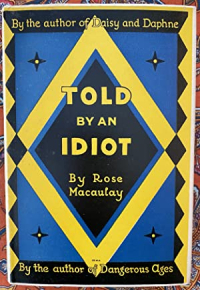 There are six children, whose different characters allow Macaulay to conveniently explore different topics: Victoria, Marcus, Sydney, Rome, ?, and Una. Because there are so many of them and so much of the book concerns itself not with the family but with general socio-political lectures, none of these second-generation characters are very much developed, except for Rome, a free-thinking and passionate woman who decides not to mary and leads a sensuously indulgent and independent life (a self-portrait of the author?).
This book retains Macaluay's witty and irreverent style of narration, but is encumbered, and finally undone, by its ambitious yet misguided premise.
March 29, 2022
The Copenhagen Trilogy by Tove Ditlevsen, Farrar Straus &...
The Copenhagen Trilogy by Tove Ditlevsen, Farrar Straus & Giroux, 2021
This trilogy of memoirs (individually titled Childhood, Youth and Dependency) was originally published in Denmark in the 1960s and 70s and only now translated and published in English.
They are unique and fascinating books, mostly because Tove Ditlevsen is a unique and fascinating person, and an original and captivating writer. As a small child in an impoverished and emotionally repressed household, she takes a sudden interest in language and poetry, and vows to become a poet, a goal she quickly achieves by augmenting her talent with fierce ambition. This drive to publish plays havoc with her personal life, and she ends up addicted to painkillers, a debilitating habit she seems unable to break.
All the attention paid to her drug dependency in the last volume causes her to lose all her agency and much of the reader's sympathy, and the world of the books, which heretofore was complex and engaging, loses dimension and becomes much less interesting. As the sequence of titles suggests, this the rather sad story of fiercely autonomous child who loses her independence as she matures.

Faster! Faster! by E. M. Delafield, Harper & Broth...
Faster! Faster! by E. M. Delafield, Harper & Brothers, 1936
I bought this book because it was by E. M. Delafield, the author of The Provincial Lady series of books, which I, like so many, enjoyed. This novel, while interesting, was less accomplished and enjoyable than the PL books, perhaps because its rather ordinary third-person narrator lacks the sparkle and wit of the PL's first-person voice.
The (tragic) heroine* of Faster! Faster! (I love titles with punctuation marks, especially exclamation points) is a bright, attractive, accomplished, 40-ish English woman of good breeding (there's a family house) but small means (no money to upkeep the mortgaged house). . Her husband is a sometimes charming but mostly irritable and annoying fellow who is unemployed (it's the Depression and jobs are scarce). They have three pleasant and intelligent children who they are raising in a modern way, allowing their two daughters and one son to make their own choices (and subsequent mistakes).

What makes this book interesting is that it very directly explores a social dilemma that is common today, but was less prevalent a century ago: Can a woman be equally devoted to and invested in her career and her family? That challenge is the undoing of our heroine, who, partly because her husband isn't winning any bread but mostly because she's good at it and enjoys it, runs a successful agency in London called Universal Services. This small agency, which is staffed exclusively with competent and hard-working women, does all the things no one wants to do themselves (the ultimate women's work): schlepping children to schools and doctors, paying bills and filling out forms, dealing with bureaucracy, translating documents, cleaning up literal and figurative messes, nursing the ill, and burying the dead.
Our heroine runs Universal Services with tireless energy and microscopic attention to detail, and tries to devote equal time and care to her husband and children. But of course that can't be done, and everyone realizes she is exhausted and must take a rest. And the reader begins to wonder if her hands-off approach to child-rearing is not a philosophical choice but a desperate coping technique, as her hands are full of work. And so we observe, along with her family and friends, as she drives herself (quite literally -- a traffic accident) to death.
This strange and tragic conclusion to a book that is often sunny and delightful might seem jarring, bit it is appropriate, for we all know that it is impossible to be a perfect wife and mother and have a successful career, unless one has made a bargain with the devil or is Amy Coney Barrett (or both).
*Of course I have forgotten her name.
Peter Cameron's Blog

- Peter Cameron's profile
- 589 followers

