
Peter Cameron's Blog, page 7
August 29, 2021
*Bachelor's Hall by Reginald Underwood (The Fortune Press...
*Bachelor's Hall by Reginald Underwood (The Fortune Press, 1937)
Bachelor's Hall is one of the many queer books the Fortune Press published in the first half of the 20th-century. It's an odd, singular book because its ideas about homosexuality seem very strange and dated, as does the world of the book, ostensibly set in the 1920s, after the Great War. It seems much more like a 19th-century world -- perhaps because it is set entirely in a small, rural English village that seems years behind the times.
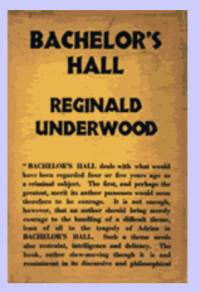 Adrian Byfield is our interesting hero. He is a bastard or perhaps the legitimate product of his mother's first, brief, secret marriage, but grows up believing he shares a father with his two younger brothers, although he shares nothing else with them: from an early age he is disgusted with the idea of physical love, hates women, and longs for a "pure" romantic friendship with a male friend. He finally finds this with Ronald, a sweet lovely boy a few years younger than Adrian. They love and admire one another, but eventually it becomes clear that Ronald's love isn't as pure as Adrian's: he has carnal desires for his beloved friend, which disgust Adrian, whose cruel abandonment drives poor Ronald to suicide. The book ends with Adrian, devastated by the loss of his friend, perhaps understanding that love can possibly be physically manifested and expressed.
An odd subplot has Adrian being pursued by a local woman who is ten years older. When she finally realizes that Adrian is not the marrying (or fucking) type, she gets pregnant by an evil married doctor and secretly gives birth prematurely to a ghoulishly deformed baby she kills and throws down an old well.
Asexuality seems to be the ideal in this book, and procreative heterosexual sex is seen as being animalistic and crude. Of course Adrian's fear and loathing of all kinds of sexual intimacy seems to be a product of his total homosexual repression.


*The Promise by Damon Galgut (Europa Editions, 2021)
Ga...
*The Promise by Damon Galgut (Europa Editions, 2021)
Galgut is a writer I very much enjoy and admire. His books are smart and odd and challenging. The Promise is perhaps the most conventional of the ones I have read (which I think is all), but I liked it very much.
It's the story of white middle-class family living on a farm outside of Pretorian the late 20th and early 21st centuries. The novel is divided into four sections, each set about ten years apart, and each section centers around the death and burial of a family member: the mother, the father, the brother, and the older sister, leaving only the younger sister, Amor, alive at the end of the book.
She is the most interesting character in the book -- perhaps because she's the most mysterious -- but all the characters are complex and engaging. The novel obliquely reveals the death, rebirth, and swift deterioration of South Africa before, during, and after the end of apartheid.
A conversation I had with Damon Galgut about the book can be accessed at this link. It was hosted by Lambda Literary and Europa Editions.

August 28, 2021
*A Secondary Character by Montague Haltrecht (Andre Deuts...
*A Secondary Character by Montague Haltrecht (Andre Deutsch, 1965)
An odd, slight, generally unappealing novel.
Christopher, our (anti-) hero, is a young homosexual man, who has been raised in the most repressive and thwarting conditions of post-war England. His mother is a monster of misguided propriety and hate and fear, and tries to control every aspect of her son's life in fear that he might act naturally and embarrass her in some way. Shortly after Christopher manages to move out of his parents' suburban prison into a rooming house in London, his mother kills herself and leaves Christopher a small legacy. He takes the money and runs to a small town on the Mediterranean where he begins a tortured relationship with Leon, a manipulative and abusive gay man. They live together unhappily, and then Leon bolts, owing Christopher lots of money. Christopher picks up a local boy, beats him to death, then kills himself by drowning in the sea.
Nothing in this book quite works. The most engaging character is the monstrous mother, but she is dispatched early on, and the book suffers from her absence. A curious but unsuccessful book. Jonah and his Mother, Haltrecht's first book, is superior in just about every way.
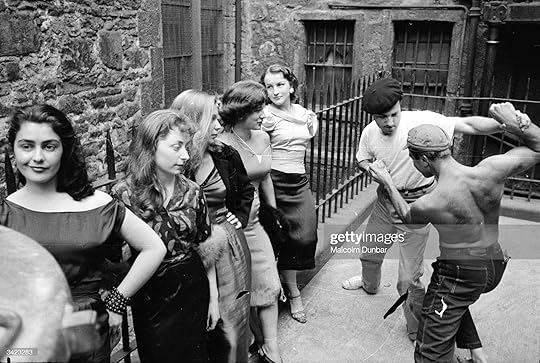 19th September 1955: Stripped to the waist, Montague Haltrecht rehearses his piece for the Edinburgh Festival with Rod Robertson, watched by Ira Heath, Angela Crow, Judy Cockburn, Jenipher Wolff and Judith Grundy. Original Publication: Picture Post - 7989 - Bohemians Of The Royal Mile - pub. 1955 (Photo by Malcolm Dunbar/Picture Post/Hulton Archive/Getty Images)
The Garrick Year by Margaret Drabble (William Morrow, 196...
The Garrick Year by Margaret Drabble (William Morrow, 1965)
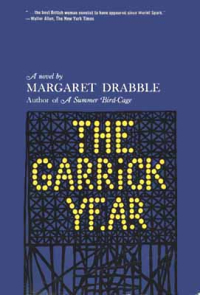
I believe I first read this book in 1979, during my first year at Hamilton College, in Elaine Hansen's Modern Women Writers class. We also read (I think) Jerusalem The Golden, A Summer Bird Cage, The Millstone, and The Waterfall (along with Tell Me a Riddle by Tillie Olsen and The Edible Woman by Margaret Atwood) and I remember loving these early Drabble novels and admiring them for their focus on the intimate lives of young women during a time when women's lives were changing. A few weeks ago, when I emptied my bookshelves in order to install new floor-to-ceiling shelves, The Garrick Year ended up on top of one of the many piles I had placed on the floor, and so when I was looking for a book to read, there it was, and I thought it would be interesting to read it again 40 years later.
It was interesting: this is Drabble's second novel, (following A Summer Bird Cage). It's the story of Emma, a bright and beautiful woman who is married to a charismatic and sexy Welsh actor, David. They have two children: Flora, who's 3 or 4 years old, and Joe, who is a baby. The Garrick Year takes place during the spring and summer in an early '60s year, and is mostly set in Hereford, a small town near the Welsh border where an eccentric American woman has funded a new regional theatre, and David is hired as one of the company that will inaugurate the theatre with a season of three plays presented in repertory.
So Emma, David, and the children leave London (where Emma had just been offered a fabulous job as a news reader on TV, which the move requires she sacrifices) for Hereford, where they rent a house in the village. Emma begins an affair with the director of the company, an older, rather pompous gentleman, who intrigues Emma but whom she doesn't find sexy, so she and her lover spend most of their time together motoring around the countryside in his Jaguar and having meals in restaurants, where Emma habitually orders several appetizers rather than an entree, flirting with him but not encouraging his physical advances. Meanwhile, unbeknownst to her, David is having an affair with Sophie Brent, the youngest and least talented actor in the company, but the most beautiful.
Emma is a smart and engaging narrator, but she isn't very sympathetic. She's selfish, entitled, rude, lazy, and her behavior with the director (what's his name? Farquhar or some other pretentious English surname) becomes tiresome and boring. So there isn't much narrative momentum in the middle third of the book, and I felt my interest steadily declining. As if sensing this, in the book's final third, Drabble suddenly overcompensates for the lack of action heretofore with a plane crash, a near drowning, and a car accident, all of which shock the plot into concluding rather hurriedly and easily.
But in the last few pages, as Emma looks back over the events of the summer and draws conclusions about her own and other's behavior, the writing takes on a complexity and polish that transcends the floundering narrative and the book ends on a rich and wise grace note, which is, I think, indicative of the complexity, beauty, and wisdom of the books Drabble would soon write: The Needle's Eye, Jerusalem the Golden, The Waterfall.
 Paul Newman reads Margaret Drabble's The Garrick Year
*Dusty Answer by Rosamond Lehmann (HBJ, 1975)
Dusty Ans...
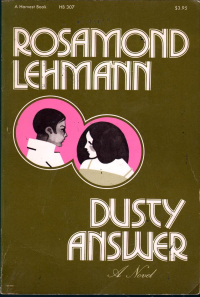
*Dusty Answer by Rosamond Lehmann (HBJ, 1975)
Dusty Answer, first published in 1927, is Lehmann's first novel, and it is an impressive debut. It's a novel about a young girl's difficult passage into adulthood, and examines in nuanced detail her emotional, romantic, and sexual maturation.
Judith Earle is the only child of wealthy and distant parents, raised in a beautiful house full of beautiful things on a river not far from London. Five cousins spend summers and holidays in their grandmother's house next door: the brothers Julian and Charlie, and Roddy, Martin, and Mariella. Judith is enchanted by them all, but her favorite is the charming and cavalier Roddy, who she loves despite his sometimes flirtatious indifference and his ardent devotion to his best friend Tony.
 Judith is sheltered and inexperienced but smart and somewhat ruthless. At Cambridge she enjoys a passionate romantic friendship with the popular and charismatic Jennifer, and she is crushed when Jennifer abandons her for an Geraldine, an older, wiser, and more cosmopolitan woman. Yet Judith brilliantly concludes her academic career and returns home to find the cousins once again in the residence next door. She pursues Roddy and is seduced and abandoned by him. Shocked and wounded by his callous selfishness, she agrees to marry Martin, the dull but kind cousin who has always doggedly loved her. She realizes instantly that this is a horrible mistake, and cruelly extricates herself, only to succumb to Julian's pursuit of her. He proposes she should become his mistress, as neither of them (he claims) are well-suited for marriage. But before they can put this plan into action, Martin dies in a yachting accident, a tragedy that puts the kibosh on Julian's and Judith's liaison. In the final pages Judith reconnects with Jennifer and arranges to meet her back at Cambridge, at "their table" in "their" teashop. Jennifer stands her up, but not before Judith observes Roddy and Tony pass by outside the teashop, obviously happy and in love with each other. So Judith once again returns alone to the house on the river (her father has died and her mother is living in Paris) and in the ruins of her adolescent romances, all misguided or doomed, begins to imagine a new adult life for herself -- a sadder but wiser girl.
On the back cover of the HBJ Harvest paperback edition of this book (which features one of the ugliest and most poorly-designed jackets imaginable) the copy states that Dusty Answer is a "sensitive treatment of homosexuality," a bold statement that really doesn't correspond with the book's atmosphere, for the same-sex relationships that these characters have are not overtly homosexual; they are perfect examples of the passionate friendships that were once allowed, though perhaps discouraged, between boys and boys and girls and girls in British public schools. Judith's relationship with Jennifer and Roddy's with Tony may or may not be sexual, but they are passionate, romantic, loving, and publicly evident. While Jennifer may be a lesbian, as her relationship with Geraldine suggests, Judith's infatuation with her is seemingly an adolescent fancy, as it coincides with her infatuation with Roddy. This cloudiness and ambiguity is interesting, and perhaps preferable to today's clear-cut and exhaustively defined gender roles and sexual orientations, for it leaves room for shadows and nuances, as well as, of course, wounding misunderstandings.
Will Warburton by George Gissing (Hogarth, 1985)
This ...
Will Warburton by George Gissing (Hogarth, 1985)
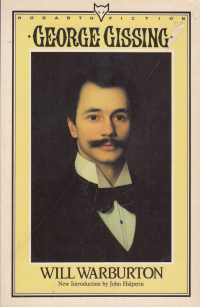 This was Gissing's final novel, written when he was dying and published in 1905, two years after his death (at 46) in 1903.
Will Warburton, a young man from a good but modest family, runs a sugar exporting company with his friend and business partner Godfrey Sherwood, but when a better business opportunity comes along he invests all of his, and his family's (his mother's and sister's) fortune in it, only to lose everything when Sherwood embezzles the funds and gambles them all away.
Will is forced to start work as a grocer and loses all his social respectability and class status. He is scorned by those who once would have respected and welcomed him, and is considered "common" and unworthy of all that was previously his social due. He works hard and honestly at his new trade and treats people with kindness and generosity, and is (somewhat unbelievably) able to keep his reduced circumstances a secret from his mother and sister and close friends, but is disheartened and exhausted by living a false life. He loses a woman he thinks he loves when his true identity is revealed, and finds himself in love with a better woman who loves him for who he is rather than what he does.
Will Warburton is a novel about class and its effect on social relationships and romance in English society at the turn of the previous century. Will is a wonderfully sympathetic and admirable character: honest, brave, generous to a fault, good-humored, faithful, and hard-working, and the characters that surround him are varied and all vividly evoked, and I enjoyed reading this novel very much. Gissing has an engagingly straightforward style that is a pleasure to read.
The Reef by Edith Wharton (Everyman's Library, Knopf)
...
The Reef by Edith Wharton (Everyman's Library, Knopf)
I enjoyed reading this (perhaps) minor novel of Wharton's, first published in 1912. It's a novel of compact and limited scope, focussing on four characters who become connected in a complex menage a quartre.
George Darrow, an American diplomat stationed in England, is reunited with Anna Leath. They loved each other in their youth, but Anna married a boring half-French, half-American man who conveniently died before boring her to death with his collection of snuff boxes. Anna returns to France where she lives with her daughter and mother-in-law, an imperious American who married a French nobleman. Darrow journeys to France to visit Anna but she abruptly and inexplicably cancels their rendezvous, and he takes up with Sophie Viner, a charismatic and charming young woman he meets on the ferry who is fleeing to Paris to pursue a life on the stage after losing her job as a private secretary and companion to an odious English woman. Sophie and George spend a week together in Paris, and charm each other. George's interest is mostly avuncular, but they do end up sleeping together, before parting for what they believe will be for good.
But through a twist of fate (or narrative contrivance), Sophie gets hired as Anna's daughter's governess and becomes engaged to Anna's step-son, Owen. When George arrives at Anna's chateau to ask her to marry him, he encounters Sophie and a crisis ensues. George and Anna weather the storm, but Sophie and Owen do not.
Like Ethan Frome, this seemed more like a chamber piece -- the cast is few and the scope is small. But within these confines the book succeeds as an interesting and engaging novel that adroitly examines the lingering effects of romance past -- effects that linger more indelibly (and damagingly) for women than for men.

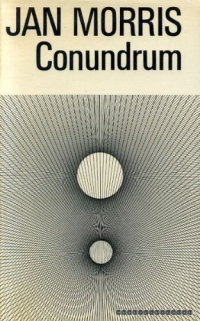
Conundrum by Jan Morris (HBJ, 1974)
Jan Morris's recent...
Conundrum by Jan Morris (HBJ, 1974)
Jan Morris's recent death prompted me to buy a copy of this book, which has always interested me but that I have never read. It's a memoir about her life as a transexual man, and the gender correction surgery she finally had in her 40s.
Morris writes engagingly and openly about her conundrum, but this is a short book that covers a lot of time and place, so that the treatment often seems glancing and somewhat superficial. Nevertheless, an interesting book by a talented but somehow distant writer.
January 26, 2021
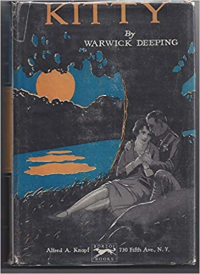
Kitty by Warwick Deeping (Knopf, 1927)
I enjoyed readin...
Kitty by Warwick Deeping (Knopf, 1927)
I enjoyed reading this book very much, although my opinion of it sank lower and lower as I read more and more. It's not a terrible book by any means -- just not very well-written and melodramatically conceived and executed. But it is a good, engaging story with a large collection of vivid and colorful characters. So a good read on a purely narrative level. I can understand why Deeping was a popular author in his time (this book belonged to my grandmother, who also had a few other Deepings in her library).
Kitty is the story of the risky courtship and troubled marriage of two young English people of slightly but irrevocably different classes. Kitty is 24 -- small, pretty, charming. She lives with her mother and sister above the tobacco shop they own and successfully run in London. Her mother, "Mrs Sarah," was married to a doctor but has been widowed for quite some time, and is wealthy and independent, merry and life-loving. She is proud of her two beautiful and sensible daughters.
 Alex is the only son of Mrs St. George, a widowed upper-class woman who has a house in both the town and the country. She is a hateful person: cold, mean, humorless, and vindictive. When Alex meets Kitty a few days before he is to be sent to fight in France (it's 1918) and falls in love with her, he marries her without telling his mother, because he knows she will not approve. He's right -- she doesn't, and when she learns of her son's marriage she tries everything possible to destroy it. She hires a lawyer and personal investigator and lying, tells her son (who's still in France) that she has proof that Kitty is a prostitute and that the tobacco shop is really a brothel. Alex receives this news the day before he is wounded in battle. He suffers both paraplegia and amnesia and returns to England and his mother's powerful and unyielding clutch. Mrs St. George foibles any attempt Alex and Kitty make to communicate or reunite, and Kitty, despairing, decides she must establish a home to which she can bring and care for her paralyzed, addled-brained husband.
And so with the help of her formidable mother, Kitty buys an inn/shop/boatyard on the Thames outside of London and sets about restoring it and creating a tea and dance hall for weekend trippers. She finally manages to cleverly kidnap Alex and settle him in their new home, where, despite, regaining his identity and memory, he becomes terribly depressed because he feels useless. Kitty gives him a stiff talking-to and tells him to buck up, and he learns that although he is unable to walk, he is capable of many tasks (including interior decorating). Together Kitty and Alex make a success of their establishment. Kitty decides that a shock to his system may restore her husband's mobility so she capsizes a punt and pretends to be drowning, whereupon Alex leaps out of his wheelchair and rescues her. Mrs St. George is summoned to come and behold the miracle that Kitty has performed, but her enmity has caused her to wither and her health to fail. She arrives and is reunited with her restored son, but is it too late to make amends?
January 20, 2021
*The Young Have Secrets by James Courage (Jonathan Cape, ...
*The Young Have Secrets by James Courage (Jonathan Cape, 1954)
This book, set in New Zealand, is about a young boy, Walter, who has been sent by his wealthy parents, who own a sheep "station" to Christchurch to attend a small private school and board with the family of the headmaster. This man, Mr. Garnett, has three daughters and one son, and a curmudgeonly and hypochondriacal wife. One of the daughters is married to an architect from Scotland, who secretly loves another of the daughters, and is secretly loved by the third daughter. The (gay?) son is a lighthouse keeper; he comes for a visit but isn't integral to the story. The young Walter becomes embroiled in the sisters' complex and ultimately tragic menage by becoming a confidant to all three them, who find him a sympathetic listener and are emboldened by his innocence to share secrets.
So this is a book about the loss of innocence, and despite the vividly rendered settings and characters, it feels somewhat formulaic and familiar. A subplot involves Walter's friend, Jimmy Nelson, whose mother is a goodnatured and gossipy washerwoman and whose father is a Maori who raped Mrs. Nelson (although she claims she enjoyed it).
James Courage is an excellent writer; he creates a believable and engaging world with sympathetic, distinct characters. Although there are some lovely moments and scenes in the book, the familiarity of the plot and the rather oblique ending (Walter placidly returns to his parents' house) prevent it from distinguishing itself in a memorable way.


Peter Cameron's Blog

- Peter Cameron's profile
- 589 followers

