
Peter Cameron's Blog, page 3
March 11, 2024
*At the Cross by Jon Rose (Andre Deutsch, 1961)
A memo...
*At the Cross by Jon Rose (Andre Deutsch, 1961)
[image error]A memoir by this fine writer about two years he spent in Sydney's bohemian ghetto when he was 16 and 17. Jon Rose leaves his unloving and thwarting family in Melbourne at the tender age of 16 and travels with a couple -- a man and a woman who both are (sexually) interested in him -- to the "Cross," an enclave in Sydney that is home to artists, homosexuals, and other outliers. Jon quickly moves in with Bella, a middle-aged prostitute, who guides him with kindness and wisdom through the complicated and sometimes dangerous world of the Cross. Jon meets and befriends a wonderful gallery of eccentric and vividly drawn characters, and learns a lot about life and love before being drafted into the army at the age of 18, in the midst of WWII.
Rose's writing isn't as luminous as in Peppercorn Days, but it is wonderfully engaging and vivid. Like Denton Welch, Jon Rose was a vulnerable young man with an amazing sense of empathy for both objects and animals. He's less adept at understanding people than Welch, but his experiences related in this book move him towards a more mature understanding of human nature.
This is a funny, wise, heartbreaking book -- a brilliant depiction of a rare young individual growing into himself in a long-lost but memorable time and place.


March 7, 2023
*The Harness Room by L. P. Hartley (Hamish Hamilton, 1971...
*The Harness Room by L. P. Hartley (Hamish Hamilton, 1971)
This intense, short novel reminded me very much of Joycelyn Brook's The Scapegoat. Both novels are about a young, sensitive, passive boy who is entrusted to a macho military man in order to be masculinized. And both transformations end up killing the boy as a result of homosexual attraction -- mostly repressed in The Scapegoat but overtly expressed in this book.
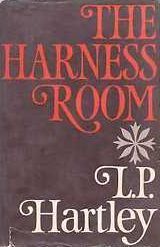 The boy's father, a military man and a long-time widower, marries a much-younger woman from an old but insolvent family. While they honeymoon for a month, the father enlists his handsome, masculine and bisexual chauffeur to make man of his son. The chauffeur obliges by seducing the boy while teaching him boxing and bodybuilding calisthenics. When the father and his bride return, the boy suspects that his step-mother's affections and interest are directed at him rather than his father, and decides he must run away with the chauffeur to avoid a tragedy. But before that can be achieved they have a boxing match in order for the father to witness his son's newly acquired manliness. The chauffeur intends to hold back and allow the boy to triumph, but trips over a hole in the rug and accidentally deals the boy a lethal blow.
The brevity of the book prohibits any of the characters or themes to be successfully developed, so The Harness Room seems slight and sensational, and consequently disappointing,
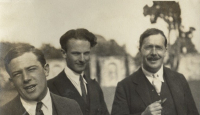 (left to right) Sir Maurice Bowra, Sylvester Govett Gates and Hartley,
by Lady Ottoline Morrell
*Why We Never Danced the Charleston by Harlan Greene (St....
*Why We Never Danced the Charleston by Harlan Greene (St. Martin's/Marek, 1984)
A southern gothic tragic novel about a group of young gay men in Charleston. They form the "Sons of Wisteria Society" and congregate nightly in Peacock Alley, a gay bar owned and managed by a dwarf. They are all attracted to the preternaturally masculine and beautiful Hirsh Hess, whose tormented inability to accept his degenerate sexuality leads to inevitable violence and death.
 Greene, in his first novel, writes with sensual ripeness about the dark, haunted world of Charleston, where so much is hidden, repressed or ignored. Three of the men, including the narrator and Hess, work in the museum, which is run by Miss Wragg, a no-nonsense Yankee who seems intrigued by the gay boys surrounding her but also manipulates them.
I wasn't entirely or consistently convinced by this world and these characters -- Greene presents it all with a gothic voluptuousness that is entertaining but often unsubtle and distorting.
*N***** Heaven by Carl Van Vechten (Knopf, 1927)
This ...
*N***** Heaven by Carl Van Vechten (Knopf, 1927)
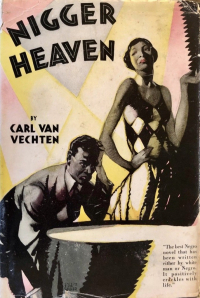 This unfortunately titled novel, written by a white man, is set entirely among the Black community in Harlem, a world Van Vechten experienced and felt he knew well enough to write about (his friend, Langston Hughes, wrote the many spirituals that are quoted often throughout the book). It was extremely interesting to read this book, which would never be published today.
Van Vechten's characters are wealthy, well-educated, sophisticated, and have established their own jazz-age world in Harlem because they are excluded from the downtown white world. The plot revolves around a doomed love affair between Mary, a well-brought up librarian, and B, a handsome young man just graduated from the University of Pennsylvania, who wants to be a writer, but because of his race can only find employment as an elevator operator. He drops the good Mary when he is taken up by a beautiful, wealthy, and sensual woman who tires of him rather quickly, with disastrous consequences.
An odd, problematic book that illuminates (and most probably misrepresents) a fascinating world that one wishes one could experiences less circuitously.
*The Ant Colony by Francis King (Constable, 1991)
Yet a...
*The Ant Colony by Francis King (Constable, 1991)
Yet another book about a community of British ex-patriots living in Italy, this time in Florence sometime after WWII -- probably the early 50s, but published, and written (one supposes) in 1991.
The book follows Iris Crediton and Jack Prentis, two very young Brits, who have arrived in Florence to each English for a year at a Language Institute. Iris is pretty and titled, has lovely clothes and is socially poised; Jack is middle-class, handsome, has a very limited wardrobe, and is shy but charming. They are both embraced (literally and figuratively) by the much-older -- some rather ancient -- British expats who, for one reason or another (homosexuality included) have remade their lives in more tolerant (and affordable) Italy.
 Iris lodges in a pensione and Jack boards with the school's sub-director, Giles, who is unhappily married to an unhappy woman, Margot, their two children, Prunella and Piers, and Maria, their attractive maid. Both Iris and Jack get involved romantically, sexually, and/or professionally with many members of the expat and local community, including a hunchbacked Italian poet, a Fascist Countess, a wealthy alcoholic woman, a homosexual man, a lesbian mourning the loss of her life partner.
Francis King is an engaging writer, and The Ant Colony is vividly charactered and located. The book is episodic and not strongly plotted, and consequently not particularly potent or coherent. But it is warm and gentle, and reading it is much like taking a pleasant but forgettable Italian holiday.
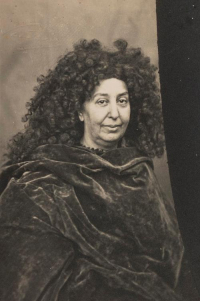
Indiana by George Sand
Indiana is a novel about marriag...
Indiana by George Sand
Indiana is a novel about marriage but Sand's wide-ranging interests and intelligence inform the book, and substantially broaden and deepen the canvas.
Indiana is 16 years old when she moves from the Ile de Bourbon in the Indian Ocean to France, and marries a much older man, who is an ex-soldier and successful factory owner -- he has money but no class or sophistication. The match is loveless, and Indiana falls in love with a rakish, titled neighbor who, while seducing Indiana, has an affair with Noun, Indiana's Creole maid. Noun tragically kills herself when she becomes pregnant. The plot is operatic and melodramatic, and neither Indiana or Reynaldo, her lover, are very sympathetic or interesting. But Sand's writing is vivid and vigorous, and the frequent philosophical asides about society and marriage are modern and engagingly expressed.
An unusual book, difficult to place in the chronology of literature, as it is many ways old-fashioned and romantic and in others quite modern and bold.
December 7, 2022
*The Last Boat by John Pollock (Anthony Blond, 1958)
An...
*The Last Boat by John Pollock (Anthony Blond, 1958)
Another relentlessly dark and morbid novel by John Pollock, but once again enlivingly laced with his dark humor and keen observation of human behavior at its most desperately alcholic-besodden level.
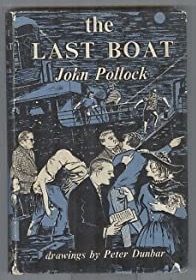 Some bureaucratic nitwits in the British foreign office decide to stage a trial evacuation of British residents on a small (fictitious) Italian island named Pizza (of course). The off-season weather on Pizza is cold and dreary and the island is populated only by about a dozen British expats (aka outcasts) and the few enterprising locals who earn a meager living housing and feeding them, and keeping them liquored up. We're introduced to this colorful but damaged and self-destructive (madness, alcoholism, nymphomania, and homosexuality) group of characters, and watch as they attempt to pull themselves together and board the unseaworthy boat that has been commandeered for their exodus. With the help (?) of a minor British magistrate, who sees this mission as an opportunity for advancement in the diplomatic corps, and the locals, who sense an opportunity to rid their community of these degenerates and make some money doing so, the boat is finally populated and sets out to sea, where it almost immediately sinks. Everyone on board drowns.
I continue to be intrigued by John Pollock -- this is the third book of his I've read -- and wish I could learn something about him. All his books share the same acidic and anti-social world view expressed with malevolent glee. He writes unsentimentally and brutally about outcasts, those men and women who, for one reason or another, have voluntarily or forcibly stepped off the good high road we are all told to walk along, and find themselves crawling in the gutter.
The Last Boat by John Pollock (Anthony Blond, 1958)
Ano...
The Last Boat by John Pollock (Anthony Blond, 1958)
Another relentlessly dark and morbid novel by John Pollock, but once again enlivingly laced with his dark humor and keen observation of human behavior at its most desperately alcholic-besodden level.
Some bureaucratic nitwits in the British foreign office decide to stage a trial evacuation of British residents on a small (fictitious) Italian island named Pizza (of course). The off-season weather on Pizza is cold and dreary and the island is populated only by about a dozen British expats (aka outcasts) and the few enterprising locals who earn a meager living housing and feeding them, and keeping them liquored up. We're introduced to this colorful but damaged and self-destructive (madness, alcoholism, nymphomania, and homosexuality) group of characters, and watch as they attempt to pull themselves together and board the unseaworthy boat that has been commandeered for their exodus. With the help (?) of a minor British magistrate, who sees this mission as an opportunity for advancement in the diplomatic corps, and the locals, who sense an opportunity to rid their community of these degenerates and make some money doing so, the boat is finally populated and sets out to sea, where it almost immediately sinks. Everyone on board drowns.
I continue to be intrigued by John Pollock -- this is the third book of his I've read -- and wish I cold learn something about him. All his books share the same acidic and anti-social world view expressed with malevolent glee. He writes unsentimentally and brutally about outcasts, those men and women who, for one reason or another, have voluntarily or forcibly stepped off the good high road we are all told to walk along, and find themselves crawling in the gutter.
The Provincial Lady in Russia (I Visit the Soviets) by E....
The Provincial Lady in Russia (I Visit the Soviets) by E. M. Delafield (Cassandra Editions/Academy Chicago, 1985; originally published by Harper Brothers, 1937)

The Provincial Lady is tasked by her American publisher to spend several months in the Soviet Union and write a funny book about her visit: a brilliant idea. Delafield accepts the challenge and acquits herself triumphantly: the resulting book is a vividly rendered and keenly observed account of (what tourists were allowed to see of) Soviet life in the 1930s, when the USSR was but twenty years old.
The PL, who had heretofore proven herself an amusing and sharp observer of English rural and urban life, now sets her gimlet eye upon a very different environment and society. She travels (laboriously) to Leningrad, Moscow, Rostov, and Odessa, spends several weeks on a communal farm, and visits countless hospitals, factories, schools, and museums, always accompanied by official government guides who constantly spout propaganda (often blatantly contradicted by what is being observed) and are inevitably late. The glimpses of Soviet life and the wry yet sympathetic portraits of people are fascinating, and everything is observed and recorded with Delafield's shrewd eye, intelligent mind, and empathetic heart.
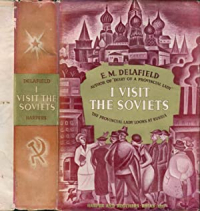 Harper and Brothers, 1937
December 1, 2022
Is He Popenjoy? by Anthony Trollope (Oxford University Pr...
Is He Popenjoy? by Anthony Trollope (Oxford University Press, 1973)
Because I so enjoyed reading Barchester Towers, I searched abe.com and bought several Trollope novels I haven't yet read. Among them was Is He Popenjoy? and being intrigued by the title (as mentioned elsewhere, I like titles with question marks and other punctuation) I began reading it, and was hardly able to put it down over a very few days.
Perhaps it was my mood and my current disenchantment with life, but I found that being immersed in Trollope's world was far preferable (and pleasurable) to languishing in my own. Is He Popenjoy? is, like Barchester Towers, broader and more consistently comic than the Palliser novels, and, although it features a Dean in a primary role, it is less ecclesiastically concerned than the Barchester novels. This Dean is quite merry, and spends as little time as possible at the Deanery or in the Cathedral, much preferring to seek social pleasure and amusements in London.
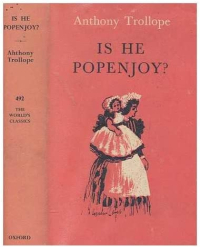 The plot -- the main plot; there are, of course, several -- concerns the Dean's daughter, Mary Lovelace, who inherits a small fortune from a wealthy Great Aunt, which allows her to marry into the aristocracy. She weds Lord George Brotherton, a second son, who lives with his somewhat senile mother, the Marchioness, and his four pious and cheerless spinster sisters. They are all dependent upon Mary's money, for the family's fortune belongs entirely to Lord George's older brother, Lord Brotherton, the Marquis, who lives in Italy and shuns his native land and family. His sudden and unexpected return to Cross Manor, the family estate, with a perhaps an illegitimate Italian Italian wife and correspondingly illegitimate son, not only displaces his family but causes a scandal concerning the Brotherton legacy. The Dean, born of humble origins and socially ambitious and eager for his daughter to become a Marchioness and his (expected) grandson to one day become a Marquis, instigates and funds an investigation into the legitimacy of the present Marquis' marriage, hoping to disqualify his son (Popenjoy) from inheriting the title, which would then pass to Lord George.
This central plot is refracted in several subplots involving the difficulties of reconciling love and economic reality in terms of marriage; too often a mutual attraction is not supported by the financial means on either side to enable a prosperous (or even possible) marriage, and the resulting matches, often made on purely pecuniary grounds, destabilize the society around them.
Both Mary and her father are flawed characters, and Lord George is a rather a dreary and unlikeable man. Despite this -- or perhaps because of it -- the book is addictively compelling and I enjoyed reading it very much.
Peter Cameron's Blog

- Peter Cameron's profile
- 589 followers

