
Brian Solis's Blog, page 27
July 19, 2022
THE Top 11 Digital Transformation Influencers, Thought Leaders, Writers and Experts to Follow in 2022

via IA: Intelligent Automation Network
Top 11 Digital Transformation Influencers 11 DX thought leaders, writers and experts to follow in 2022Staying up-to-date on the latest digital transformation (DX), RPA, intelligent automation and enterprise data trends can be exhausting. However, as the digital transformation “thought leader” arena becomes more and more crowded, effectively identifying voices that are both reliable and resonant can be difficult.
To help you break through the noise, we curated this list of the top 11 influencers in the digital transformation space. While some of these individuals are well-established names, others are on the rise. Our goal was to create a well-rounded list that incorporated a mix of tech visionaries, pragmatic operational perspectives, digital leadership experts and editorial POVs.
Brian SolisTwitter: https://twitter.com/briansolis
Linkedin: https://www.linkedin.com/in/briansolis/
Website: https://www.briansolis.com/
Youtube: https://www.youtube.com/briansolistv
Focus: futurism, customer experience, scaling innovation, digital leadership, web3, creativity, cognitive enterprise, enterprise automation, humanizing AI, leading digital transformations
A digital anthropologist and futurist, Brian Solis has built a career on his ability to translate technology trends into actionable strategic insights. In addition to frequently speaking at tech conferences all around the world, Solis has also published 9 books, dozens of research papers and countless articles. As Saleforces’s Global Innovation Evangelist, much of Solis’s recent work centers around the customer experience and marketing transformation. However, as one of the tech industry’s leading futurists, he also produces strong content pertaining to emerging technology, navigating disruption and transformational leadership.
Antonio GrassoTwitter: https://twitter.com/antgrasso
Linkedin: https://www.linkedin.com/in/antonio-grasso-0544007/
Facebook: https://www.facebook.com/AGrassoBlog
Instagram: https://www.instagram.com/agrassoblog/?hl=en
Focus: digital transformation, artificial intelligence, cybersecurity, the Internet of Things, blockchain, enterprise technology trends, business process automation and sustainability.
When it comes to condensing complex data and trends into digestible infographics, no one does it better Antonio Grasso. With over 240K followers on Twitter, Antonio Grasso is one of the most retweeted digital transformation thought leaders on the platform. In addition to being a dominant voice on social media, Antonio Grasso is also the CEO and founder of Digital Business Innovation srl, a boutique advisory firm.
Ian BarkinLinkedIn: https://www.linkedin.com/in/ianbarkin/
Twitter: https://twitter.com/ibarkin
Focus: Intelligent automation, digital transformation, RPA, transformational leadership, continuous improvement, the future of business process automation, hyperautomation, digital strategy
The man who literally wrote the book on Intelligent Automation, Ian Barkin has become one of LinkedIn’s leading industry voices. In fact, he’s authored multiple LinkedIn trainings on intelligent automation, process mining and RPA. A must-follow for seasoned digital transformation veterans and newbies alike, Ian offers multiple perspectives in one: that of an experienced digital transformation practitioner, innovation visionary and tech investor.
Linda GrassoTwitter: https://twitter.com/LindaGrass0
Linkedin: https://www.linkedin.com/in/linda-grasso-335b34139/
Website: https://deltalogix.blog/en/home-english/
Focus: digital transformation, organizational leadership, enterprise data management, sustainability, data ethics, digital strategy development, change management, cybersecurity, applied machine learning, artificial intelligence trends, business process automation
Last name sound familiar? Continuing the family tradition, Linda Grasso founded DeltalogiX, a technology blog that focuses on digital transformation in particula, but also covers cybersecurity, sustainability, AI, data analytics and IoT. Follow Linda for viral infographics and practical insights pertaining to the latest digital technology trends.
Maribel LopezTwitter: https://twitter.com/maribellopez
LinkedIn: https://www.linkedin.com/in/maribellopez/
Website: https://www.lopezresearch.com/
Focus: digital transformation, artificial intelligence, edge computing, enterprise technology trends, intelligent automation strategy, futurism, natural language processing, cloud computing, data management and governance
Tech industry analyst, speaker and business advisor, Maribel Lopez has helped companies “understand and navigate digital transformation” for over two decades. In addition to hosting multiple podcasts and contributing to various publications, she’s also the founder of Lopez Research, a market research and strategy consulting firm. For those looking to stay up-to-date on enterprise IT trends, emerging technology and organizational design.
Hamilton MannTwitter: https://twitter.com/hamiltonmann?lang=en
Linkedin: https://www.linkedin.com/in/hamiltonmann/
Website: https://www.hamiltonmannconversation.com/
Focus: digital transformation for good, digital marketing, sustainability, technology ethics, leadership, global collaboration, change management, customer-centricity, innovation trends
As the Group Director of Digital Marketing and Digital Transformation at Thales, Hamilton Mann “leads the implementation of Group transverse Digital initiatives to drive Business Innovation and Growth by making experimentation the norm.” In addition to leading marketing transformation efforts across 68 countries for Thales, Mann is also the founder of The Hamilton Mann Conversation. A sort of MasterClass on how digital technology can be used to benefit society, The Hamilton Mann Conversation regularly publishes interviews with corporate executives, entrepreneurs, public officials and academics.
M. Nadia VincentLinkedIn: https://www.linkedin.com/in/m-nadia-vincent-mba-b98470/
Twitter: https://twitter.com/ittransleaders
Focus: digital transformation, artificial intelligence, sustainable innovation, physical automation, digital leadership, enterprise innovation, global perspectives, cultural transformation, change management, personal development
As both a technology expert and executive leadership coach, Nadia doesn’t only just post about the latest industry trends, she offers actionable advice on how to spearhead them. In addition to being a regular speaker at industry events, Nadia has authored two books: Leveraging Digital Transformation and The Digital Transformation Success Formula.
Anthony J JamesLinkedIn: https://www.linkedin.com/in/ajjames/
Focus: digital marketing, digital transformation, commercialization, innovation trends, creativity, leadership, spearheading change, global perspectives, martech
Currently the CEO of Trinity Consulting, Anthony is an expert on linking digital technology to business growth. In addition to regularly posting inspirational quotes, Anthony also offers sound advice pertaining to digital leadership, commercializing innovation and business resilience.
Laszlo BockTwitter: https://twitter.com/LaszloBock
LinkedIn: https://www.linkedin.com/in/laszlobock/
Focus: executive leadership, workplace technology, HR transformation, the future of work, cultural transformation, organizational psychology, startup trends
Formerly the CHRO of Google, Laszlo Bock has worked at the intersection of technology, people and business for close to two decades. He’s even published a manifesto of sorts: Work Rules! Insights from Inside Google That Will Transform How You Live and Lead. A regular contributor to Fortune, Forbes and Yale Insights, Lazlo’s expertise lies in combining empathy, technology and structure to maximize human performance.
Shailendra KumarTwitter: https://twitter.com/meisshaily
LinkedIn: https://www.linkedin.com/in/shaily/?originalSubdomain=au
Focus: data monetization, data transformation, artificial intelligence, data analytics, machine learning, startups, machine learning
No digital transformation strategy is complete without a sound enterprise data strategy. The former Chief Evangelist at SAP and the author of “Making Money Out Of Data,” Shailendra’s expertise lies in the business of data and analytics. For those looking to monetize enterprise data as part of their digital transformation, he’s a must-follow.
Cade MetzTwitter: https://twitter.com/cademetz?lang=en
Focus: general technology reporting, investigative journalism, artificial intelligence research, tech industry news, autonomous vehicles, cyber risk, AI ethics, quantum computing, virtual reality, the business of technology
Ok, we’ll admit, to call Cade an “influencer” is a mischaracterization. In truth Cade Metz is a seasoned tech reporter for the New York Times. A reliable resource for general tech industry news as well as more thoughtful long-form investigative pieces, Cade reports on everything from the safety autonomous driving tech to developments in quantum computing to alleged “cult-like religious sects” infiltrating the ranks at Google. Last year he also published “Genius Makers: The Mavericks Who Brought AI to Google, Facebook, and the World,” a recent history of deep learning and artificial intelligence (AI).
The post THE Top 11 Digital Transformation Influencers, Thought Leaders, Writers and Experts to Follow in 2022 appeared first on Brian Solis.


July 11, 2022
The Magic of Stories: How to be an Amazing Storyteller When Everyone is a Storyteller
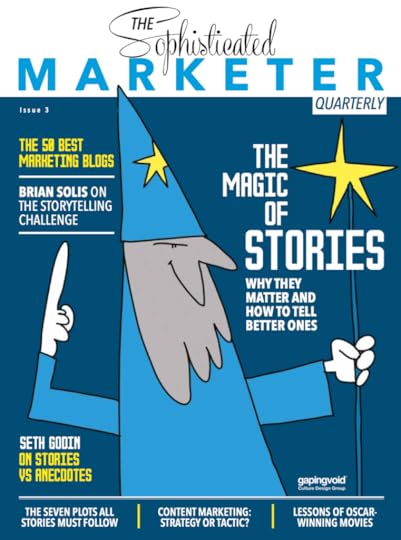
“There are over half a million Linkedln members with storytelling listed in their profile.”
Once upon a time, I collaborated with LinkedIn and GapingVoid Culture Design Studio to explore the art and science of storytelling and inspire marketers to reimagine how they connect with their audiences. That partnership led to an interview, shared below, an ebook, “Once Upon a Digital Time“, and a video conversation, “Can Storytelling Save Marketing?” (video at the end of the post).
Please continue to help elevate your journey in storytelling…
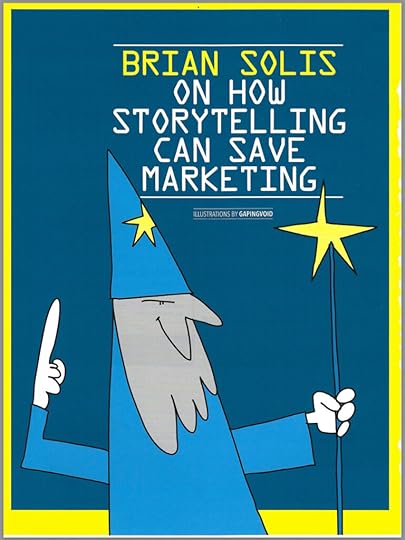
Marketing has long embraced the idea of storytelling. Some might go so far to say that marketing has co-opted it, using storytellers as a form of marketing for itself, attempting to make marketers and storytellers one and the same. But storytelling isn’t synonymous with content marketing, social media, digital marketing, growth marketing, web3, or any form of traditional marketing. Storytelling is not marketing, but that doesn’t mean that marketers cannot also be storytelling. You wouldn’t call someone who grills or cooks a chef, no matter how tasty the food. For those seeking an elevated, more meaningful, spiritual, and memorable way of connecting with people, learning and practicing true storytelling is nothing short of life-changing.
Storytelling is sacred discipline, a delicate balance of art, science, and also humanity. It connects people to one another and to generations that follow.
One of the best examples of understanding the power of narrative and building upon a framework of human engagement is the legendary “memo” authored by Christopher Vogler, then a story analyst and student of Joseph Campbell at Disney in 1985. Eventually, the memo grew to 15- and then 40-pages as Vogler refined his ideas, finally becoming a book, “The Writer’s Journey: Mythic Structure for Storytellers & Screenwriters.”
“The Memo That Started It All” by Christopher Vogler
How Storytelling can Save Marketing“There are only two or three human stories, and they go on repeating themselves as fiercely as if they had never happened before.” – Willa Cather
Brian Solis, author of LifeSCALE: How to Live a More Creative, Productive, and Happy Life, and X: The Experience When Business Meets Design, teamed up with LinkedIn and GapingVoid Culture Design Studio back in the day to create a special ebook, Once Upon a Digital Time. LinkedIn’s Megan Golden spent time with Brian to explore how telling better stories can help future-proof marketing and branding.
Megan Golden
There are over half a million Linkedln members with storytelling listed in their profile. Why are modern marketers self-categorizing themselves as storytellers?
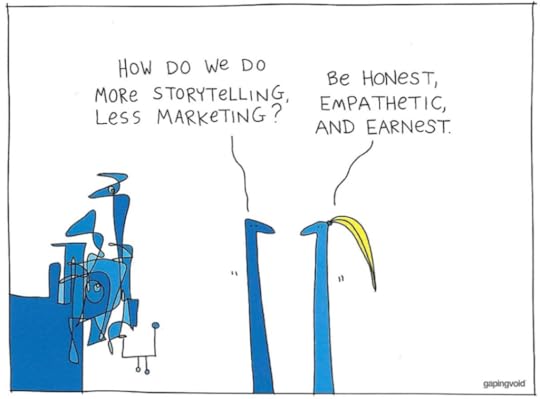
Illustration from, “Once Upon a Digital Time” by Gapingvoid and Brian Solis
Brian Solis
I always remember a quote from a very interesting, well-known advertiser, who was fond of saying to agencies and other marketers, “You’re not an effing storyteller!” This advertiser had read an interview with one of the most famous rollercoaster designers in the world, and this rollercoaster designer categorized his work as storytelling.
For the advertiser, this showed how easy it is for us to believe we’re storytellers, just because we produce content or we produce experiences. He was making the point that being a storyteller takes much more than just saying you’re a story teller. We keep saying it, not because it’s true, but because it feels good to say you’re storytelling instead of admitting you’re in marketing.
Personally, I think of storytelling as an aspirational title of sorts. I’m an optimist and so I want to believe that marketers do genuinely believe that they’re storytellers. What they need to consider though, is that this is a very sacred word. We’ve bought into the aspiration and the ideal of storytelling-based marketing, but we haven’t yet gone through the exercise of what it actually takes to become a storyteller.
I realized this several years ago when I was writing my book, X:The Experience When Business Meets Design. I was guilty of thinking that, because I was in control of the narrative, I was a storyteller. I wasn’t. My response was to find a storyboard artist to teach me the art and science of storytelling. That made a big difference, but I can tell you that even after going through that, I would never put storyteller in my title. It’s too sacred a term and we have to respect that.
You say in our book that marketers have ended up distracted by social media follower numbers, and lost their sense of purpose. How do you know when the purpose is missing? And how can you reclaim it through storytelling?
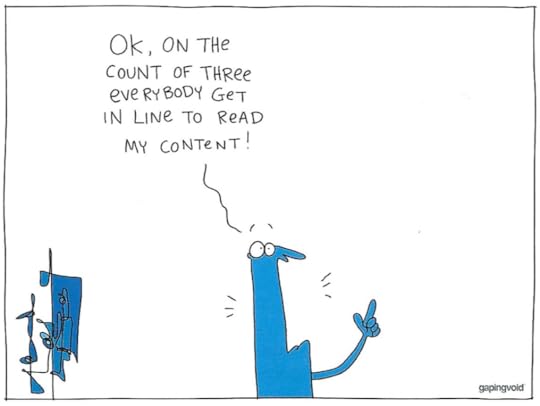
Illustration from, “Once Upon a Digital Time” by Gapingvoid and Brian Solis
Megan
You say in our book that marketers have ended up distracted by social media follower numbers, and lost their sense of purpose. How do you know when the purpose is missing? And how can you reclaim it through storytelling?
Brian
The challenge for marketing is that it’s adapting storytelling, it’s adapting social media, it’s adapting mobile, it’s adapting all of these new channels on the basis of a classical foundation of what market ing means. It has a traditional matrix that has to adapt to new times, technologies and trends. That matrix ends up focused on the wrong things.
It’s not that marketers don’t get it. It’s more that they’re packaging technology into a construct that they know. It’s self-reinforcing. Executives there fore see marketing in these terms, and fund it and support it in these terms. They’re supporting what marketing is, not what it could be.
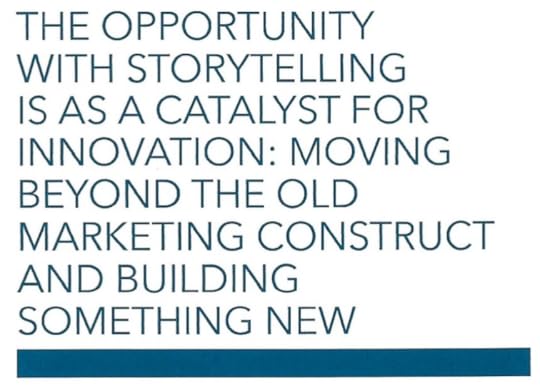
This is a time for reinvention and innovation. In the book, we talk about using storytelling not just as a guiding light for the future of engage ment and experience, but also as a catalyst to drive innovation. What does it take to tell a great story? What does it take to really understand your audience? What does it take to be really compelling? What does it take to move, guide and inspire them?
The answers to those questions are going to take some marketers out of that old construct and start them building something new: a new generation of marketing that’s less about ‘Marketing’ and more about experience and engagement.
This raises the question: once I have your attention and you have my attention, what are we going to do about it? When you start thinking in these terms, you’re stepping in a new direction, and you continue to step in new directions as you pursue these ideas. I call it ‘progressive transparency; moving beyond what marketing used to focus on and taking an interest in ‘The Embrace; or what happens when you engage.
The challenge that marketers have today is that their budgets, resourc es and expertise are all emblematic of how we viewed marketing yester day, not of how marketing needs to be tomorrow. We get caught up in these cycles of allowing marketing to be driven and guided by executives, who want to see certain things communicated in certain ways. I mean the fact that legal has such a strong voice in what we can say and what we can’t say, or what the narrative has to be according to the “optics of the organization”. These are all designed based on yesterday’s view of what marketing is, and this holds marketing back from what it could be.
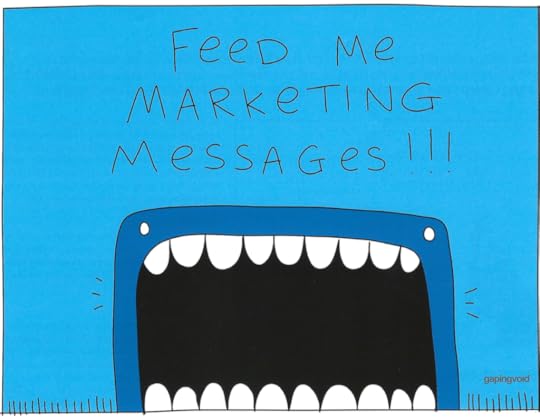
Illustration from, “Once Upon a Digital Time” by Gapingvoid and Brian Solis
Megan
How were you originally connected with Hugh MacLeod and what is it about Hugh’s illustrations that you feel really bring your words to light?
Brian
I was part of the startup community that eventually became Web 2.0 and then developed into social media. Hugh was also part of that group. He was coming from Savile Row and leaving the advertising world behind. He was using cartoons to expre& some of the really amazing things that technolo gy was starting to empower us with, and all of the paradoxes that it had introduced into our lives. He was also taking shots at the way marketing kept focusing just on the next advertisement. We orbit ed the same circles in the Web 2.0 world and in its earliest stage, that community wasn’t just about working. It was also about validation and self-help and support. We would meet for drinks and bring all of the entrepre neurs together to talk about what we were working on, and help us get everything to the next level. I just instantly bonded with Hugh. He’s a wonderful human being and so witty and clever.
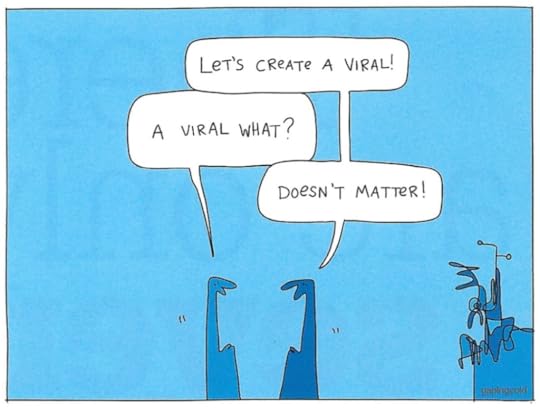
Illustration from, “Once Upon a Digital Time” by Gapingvoid and Brian Solis
Megan
You wrote a book a couple years ago, X: The Experience When Business Meets Design. In there you talked about the need for businesses to invest in experience architects. Can you explain how storytelling plays into the design of those experiences?
Brian
Once I got to the core of what an experience was, I realized that you can’t design experiences unless you’re intent on them. When someone comes into contact with your brand, your product, your service, your packaging or your representative, you don’t want them just feeling the value of those parts; you want them to feel more than the sum of those parts. You have to design the experience as a story where everything comes together into an arc that people will feel, walk away with, and talk about. So, it was very intentional way of looking at experiences. I think it was a little early as an idea, and now it’s starting to be appreciated a bit more.
So, the idea of becoming an experience archi tect is essentially not unlike becoming a storyteller. It’s about being able to build experiences by trans forming every aspect of a company around the experiences you want to deliver.
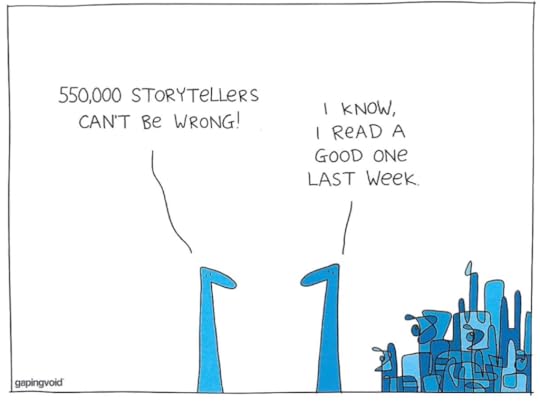
Illustration from, “Once Upon a Digital Time” by Gapingvoid and Brian Solis
The real challenge is that we approach all this acting like marketers. We talk like marketers. We measure like marketers. We talk at people based on what other people have approved us to say and none of it feels human. That has to change. The first step is realizing that we’re in denial. Then we can accept the need for change and start moving in a new direction.
“I love receiving generic emails and text messag es;’ said no-one ever. We have to understand that marketing is what it is. The reason it doesn’t have a seat at the table in most C-suite discussions is because it’s not aligned with business growth and it’s not aligned with customer experiences.
But it could be! Marketing doesn’t have to be a discipline or a function. It could become the work that customer experience teams are doing by using communication, touchpoints, technology and channels to deliver experiences holistically. I think marketing’s futures are bigger than we give them credit for because we’re still stuck looking at what marketing was rather than what it could be. The reason storytelling in marketing matters is because it starts to force us to move beyond that. When we accept it as the sacred term that it really is, it absolutely demands transformation. It’s not just another marketing tactic.
Lifescale
Explore Brian’s vision of storytelling in marketing along with Gapingvoid Culture Design Group by downloading “Once Upon a Digital Time” at lnkd.in/storyteller
So, Can Storytelling Save Marketing? Let’s DiscussDid you know that over half a million marketers list storytelling in their profile on LinkedIn? Marketers have become obsessed with telling stories. As a result, has storytelling fallen into the bucket of marketing buzzwords — a bucket full of words like authentic and transparency? Words we use in our marketing jargon but don’t actually take seriously and put into action?
Tune in for our latest episode of Live with Marketers to hear from master storyteller & LinkedIn Influencer Brian Solis and learn:
What storytelling really means for marketersHow our discipline needs to evolve in order for storytelling to thriveHow storytelling can make an honest impact on the way you engage with your audienceOriginal
The post The Magic of Stories: How to be an Amazing Storyteller When Everyone is a Storyteller appeared first on Brian Solis.
July 7, 2022
ITWeb Names The Next Web Keynote Brian Solis as a Top 5 Speaker at The Next Web
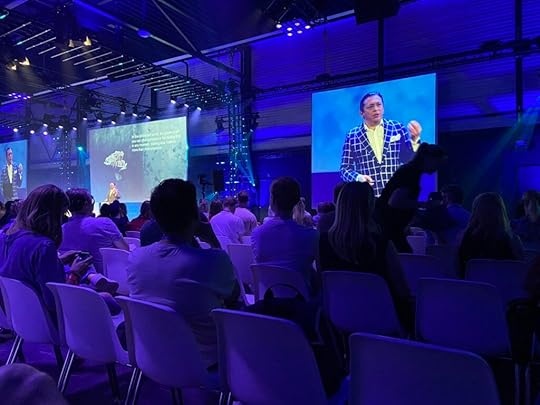
Image Credit: Leyla Boulton, FT Live and senior editor, FT
Brian Solis was named a “top 5 speaker” at The Next Web conference in Amsterdam by ITWeb.
From the original article…
Another standout speaker at The Next Web was Brian Solis. The ‘digital anthropologist’ and celebrated author spoke powerfully about his new book Lifescale: How to Live a More Creative, Productive, and Happy Life in a manner both simple and true, which had the audience questioning their own impediments to happiness and productivity. Solis’ work is credited with strongly influencing the early digital, innovation, and social media landscape. He continues his work in global innovation at Salesforce.
Thank you, Mélody Deunier-Lisene!
@briansolis captured full house of digital natives at #TNWConference with this simple message: the route to creativity and a full life is to put your smartphone away (more in his book Lifescale) pic.twitter.com/gXDckTdoii
— leylaboulton (@leylaboulton) June 17, 2022
The post appeared first on Brian Solis.
July 6, 2022
The Next Web Conference Amsterdam: Foreseeing the future of the web

by Mélody Deunier-Lisene, Voys Telecom, ITWeb, South Africa (excerpts published from original)
Taking place every year in Amsterdam is The Next Web Conference, which gathers some of the world’s sharpest tech minds for an intense two days in June. Tim Berners-Lee, Natasha Chamuleau, Brian Solis, Edward Snowden, Meik Wiking and Mo Gawdat were among the over 200 speakers at the 2022 event. Mélody Deunier-Lisene from Voys South Africa went along to take a dizzying dive into the future of digital technology.
To boldly goIn a realm where the phrase ‘the next big thing’ has more miles on it than a photon from the Big Bang, ‘The Next Web’ is a particularly apt moniker for a conference devoted to examining the outermost frontiers of the web. What are they, what do they reveal, are we going to go there, when and how? Attempts to answer these questions form some of the most exhilarating investigations, innovations and inventions currently emerging from many of the keenest minds of this or any age.
We are currently experiencing a technological hyper-renaissance where so much is changing so quickly that it can be both liberating and terrifying.
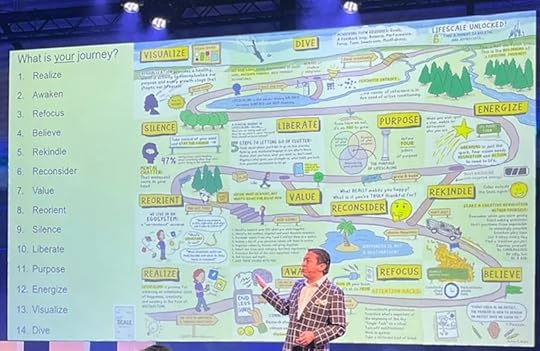
Brian Solis: The celebrated author discusses his new book Lifescale.
Up, up and away
Another standout speaker at The Next Web was Brian Solis. The ‘digital anthropologist’ and celebrated author spoke powerfully about his new book Lifescale: How to Live a More Creative, Productive, and Happy Life in a manner both simple and true, which had the audience questioning their own impediments to happiness and productivity. Solis’ work is credited with strongly influencing the early digital and social marketing landscape.
Final frontiers
This could quite easily describe the purpose of The Next Web Conference as a whole. For anyone who fears the future or is troubled by technology, this conference is the perfect antidote: rarely have so many people been so excited about technology’s inherent potential to make the future a fun, free and fascinating place to be.
Please read the full article here, in addition to summaries of other standout speakers including, Mo Gawdat, Edward Snowden, Alisa Cohn, and Jason Silva.
The post The Next Web Conference Amsterdam: Foreseeing the future of the web appeared first on Brian Solis.
June 30, 2022
Web3, a Decentralized internet, will evolve, but must first pass through a phase of disillusionment
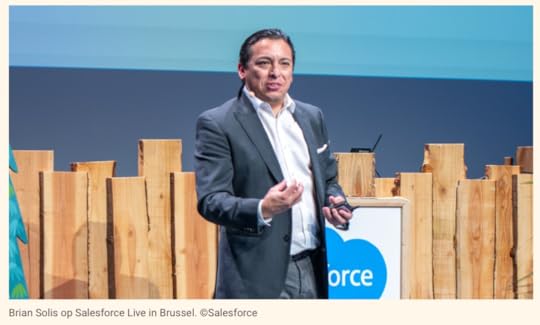
Source: De Tijd, Roland Legrand, Translated
Anthropologist and futurist of the digital world Brian Solis is optimistic about attempts to reform the web, make it more decentralised and give users more power. He warns, however, that this so-called web3 must first pass through a ‘valley of disillusionment’.
The web is now ready for a third version, web3, a movement that aims to decentralise the internet and give users more control over their data and possessions. The blockchain plays an important role in this, the technology that keeps track of property and transactions in a digital register.
It is a response to Web 2.0, the web of social media and the large internet companies that collect and control vast amounts of data about their users. When it emerged, the promise was that everyone could express themselves on the web. Solis was decidedly positive then, but that assessment has changed. I believed that Web 2.0 would democratise information and give everyone a voice, says anthropologist and futurist Brian Solis, who is Global Innovation Evangelist at US software company Salesforce.
The good side of social media is that it did give us a voice, but that is also the bad side. It also led to sowing discord. I didn’t expect society to be so vulnerable to manipulation and disinformation,’ says Solis.
The social media also foster addiction by encouraging you to do more and more on their websites and apps based on the number of likes and followers. That is an
That’s an unhealthy relationship with technology and it gives a wrong idea of what the meaning of life is. Nobody likes to hear that they are addicted, but we need to do much more about the problem and we need help from our government to do that,’ says Solis.
PromisesWeb3 is supposed to be an alternative to that. The promise of web3 is that you will have control over your data and how it is used, instead of that data being in the hands of a few large companies who control all that information,’ says Solis. But, he goes on to say, ‘that’s the promise, we just don’t see it yet.
At the moment, a great disparity is striking in the web3 system, notes Solis. 80 per cent of the market value of non-fungible tokens (NFTs) is concentrated in 9 per cent of accounts. Such tokens are proofs of ownership on a blockchain of digital objects and grew into a real hype last year. The strong concentration of ownership is also noticeable in the production of crypto currencies. 0.1 percent of bitcoin miners account for half of the “production” of the currency.
‘In addition, it is very difficult to start using web3,’ says the futurist. ‘You have to have a digital wallet, buy crypto coins like bitcoin or ethereum and then use that to purchase an NFT, and then that NFT has to be stored securely. We can complain about the traditional banks, but they offer a reliable experience. The user experience of web3 will improve, but is currently a big hurdle.’
Meanwhile, crypto currencies are under severe pressure, with several coins worth significantly less (in dollars) since the beginning of this year. According to US venture entrepreneur Kevin Rose, this will discourage projects that are solely focused on making money.
Rose is focused on the substructure of web3 that turns us from ordinary users into stakeholders,’ says Solis. The digital anthropologist cites research firm Gartner’s hype cycle, which describes how a technology descends from a peak of exaggerated expectations to the ‘valley of disillusionment’, then up a slope of understanding, and finally ending up in productive use.
DisillusionFor web3, Solis thinks ‘we are at the beginning of the journey to the valley of disillusionment. Crashes, loss of trust and scams can be part of it’. But eventually, useful projects will emerge and provide better user experiences. ‘We’re not going to see that tomorrow or next year, but over the next five years. It will lead to experiences we can’t imagine yet.’
People already understand that there is a certain value associated with crypto currencies and that you can own NFTs, but that doesn’t tell them the importance of having a digital wallet to manage your own data. That data can also include your social contacts, which is a whole new thing. In other words, understanding and using web3 involves some effort. Entrepreneurs, users and politicians are going to have work to do to exploit the new possibilities and combat the ills of web 2.0.
‘Decentraler internet komt er, maar moet eerst door fase van desillusie’ | De Tijd.pdf from Brian Solis
The post Web3, a Decentralized internet, will evolve, but must first pass through a phase of disillusionment appeared first on Brian Solis.
De Tijd: ‘Decentraler internet komt er, maar moet eerst door fase van desillusie’
I had the opportunity to meet De Tijd’s Roland Legrand while in Brussels, Belgium. It was an incredible conversation that I’m sure could have led to a series of articles. Thank you for the honor, Roland.
Source: De Tijd
De antropoloog en futurist van de digitale wereld Brian Solis is optimistisch over de pogingen het web te hervormen, decentraler te maken en de gebruikers meer macht te geven. Hij waarschuwt wel dat dat zogeheten web3 eerst door een ‘vallei van de desillusie’ moet.
Het web is intussen toe aan een derde versie, web3, een beweging die streeft naar decentralisering op het internet om gebruikers meer controle over hun data en bezittingen te geven. De blockchain speelt daarin een belangrijke rol, de technologie die bezit en transacties bijhoudt in een digitaal register.
Het is een antwoord op web 2.0, het web van de sociale media en de grote internetbedrijven die grote hoeveelheden data over hun gebruikers verzamelen en controleren. Bij de opkomst daarvan was de belofte dat iedereen zich kon uiten op het web. Solis was toen uitgesproken positief, maar die inschatting is veranderd. ‘Ik geloofde dat web 2.0 informatie zou democratiseren en dat het iedereen een stem zou geven, zegt antropoloog en futurist Brian Solis, die Global Innovation Evangelist is bij het Amerikaanse softwarebedrijf Salesforce.
‘De goede kant van de sociale media is dat het ons inderdaad een stem gaf, maar dat is meteen ook de slechte kant. Het leidde ook tot het zaaien van verdeeldheid. Ik had niet verwacht dat de samenleving zo kwetsbaar was voor manipulatie en desinformatie’, zegt Solis.
De sociale media werken bovendien verslaving in de hand door je op basis van het aantal likes en volgers aan te zetten steeds meer te doen op hun websites en apps. ‘Dat is een ongezonde verhouding met technologie en het geeft een verkeerd beeld van wat de betekenis van het leven is. Niemand hoort graag dat hij verslaafd is, maar we moeten veel meer doen aan het probleem en daarbij hebben we hulp nodig van onze regering’, zegt Solis
BeloftesWeb3 moet daar een alternatief voor vormen. ‘De belofte van web3 is dat jij de controle krijgt over je data en hoe die worden gebruikt, in plaats van dat die data in handen van enkele grote bedrijven zijn die al die informatie controleren’, zegt Solis. Maar, zo vervolgt hij meteen, ‘dat is de belofte, we zien het nog niet.’
Op dit moment valt een grote ongelijkheid op in het web3-systeem, merkt Solis op. 80 procent van de marktwaarde van non-fungible tokens (NFT’s) is geconcentreerd bij 9 procent van de accounts. Zo’n tokens zijn eigendomsbewijzen op een blockchain van digitale objecten en groeiden vorig jaar uit tot een ware hype. Ook bij de productie van cryptomunten valt die sterke bezitsconcentratie op. 0,1 procent van de bitcoin-ontginners is goed voor de helft van de ‘productie’ van de munt.
‘Daarnaast is het heel moeilijk om web3 te beginnen gebruiken’, zegt de futurist. Je moet een digitale portefeuille hebben, cryptomunten zoals bitcoin of ethereum kopen om daar vervolgens een NFT mee aan te schaffen en vervolgens moet die NFT veilig worden opgeslagen. ‘We kunnen klagen over de klassieke banken, maar zij bieden wel een betrouwbare ervaring. De gebruikservaring van web3 zal verbeteren, maar is momenteel een grote hinderpaal.’
Inmiddels staan de cryptomunten onder zware druk, met verschillende munten die sinds begin dit jaar aanzienlijk minder waard werden (in dollar). Volgens de Amerikaanse durfondernemer Kevin Rose zal dat projecten ontmoedigen die enkel gericht zijn op geld verdienen.
‘Rose is gefocust op de onderbouw van web3 die ons van gewone gebruikers tot belanghebbenden maakt’, zegt Solis. De digitaal antropoloog haalt er de hype-cycle van het onderzoeksbedrijf Gartner bij die beschrijft hoe een technologie van een piek van overdreven verwachtingen afdaalt naar de ‘vallei van de desillusie’ om vervolgens een helling van inzicht op te gaan om uiteindelijk te belanden bij een productief gebruik.
DesillusieVoor web3 denkt Solis ‘dat we aan het begin staan van de tocht naar de vallei van de desillusie. Crashes, het wegvallen van vertrouwen en oplichting kunnen daar deel van uitmaken’. Maar uiteindelijk zullen er nuttige projecten in de kijker komen en zullen die betere gebruikservaring bieden. ‘We gaan dat niet morgen of volgend jaar zien, maar wel de komende vijf jaar. Het zal leiden tot ervaringen die we ons nog niet kunnen voorstellen.’
Mensen begrijpen al dat er een zekere waarde verbonden is aan cryptomunten en dat je NFT’s kunt bezitten, maar daarmee weten ze nog niet wat het belang is van een digitale portefeuille om je eigen data te beheren. Bij die data kunnen ook je sociale contacten zitten, een geheel nieuw gegeven zijn. Aan het snappen en gebruiken van web3 zijn met andere woorden wat inspanningen verbonden. Ondernemers, gebruikers en politici gaan werk hebben om de nieuwe mogelijkheden te benutten en de kwalen van web 2.0 te bestrijden.
De essentieBrian Solis is een digitaal antropoloog en futurist. Hij waarschuwt voor de ongezonde invloed die sociale media hebben op gebruikers.
Web3 kan die gebruikers tot stakeholders maken en hen de controle teruggeven over hun data, maar die beloftes zijn nog niet ingelost.
Web3 gaat de komende tijd door een fase van ontgoocheling, de ‘vallei van de desillusie’, maar de komende vijf jaar komen er nuttige toepassingen en nieuwe mogelijkheden, zegt Solis.
The post De Tijd: ‘Decentraler internet komt er, maar moet eerst door fase van desillusie’ appeared first on Brian Solis.
June 29, 2022
What is the Metaverse? Defining the Metaverse as it Evolves
Even though the term is inextricably linked with web3, the popular virtual worlds often referenced today are closer to web2 in operation and business models than they are to a decentralized platform. Roblox, Fortnite, World of Warcraft, Meta (formerly Facebook) Horizon Worlds, Second Life, Decentraland, are all in their own way example of an evolving metaverse.
The original term was coined by Neal Stephenson in his 1992 science fiction novel, “Snow Crash.” In it, he envisioned a place where humans, as programmable avatars, interact with each other and software agents, in a 3D virtual space that uses the metaphor of the real world.
Since then, the idea of the metaverse has become synonymous with virtual worlds, virtual reality (VR), and immersive games.
To simplify its working premise, a metaverse can be thought of as an immersive social network that exists in a virtual world where users can participate through a virtual or augmented presence. It is described as the successor to a web1 and web2 desktop and mobile internet.
In a conversation with McKinsey for its new report, “Value Creation in the Metaverse” I shared thoughts on how the metaverse will be an iterative experience, a front-end to a web3 back-end.
The metaverse is a virtual immersion into the next generation web. The metaverse will be iterative, not any one size or shape. And the capabilities we have within it will be unlocked by both open standards and the devices that we wear/use to interact in these worlds.
The post What is the Metaverse? Defining the Metaverse as it Evolves appeared first on Brian Solis.
What is the Metaverse? Here’s a Simple Definition
The metaverse is a virtual immersion into the next generation web. The metaverse will be iterative, not any one size or shape. And the capabilities we have within it will be unlocked by both open standards and the devices that we wear/use to interact in these worlds.
from McKinsey’s new report, “Value Creation in the Metaverse.”
The post What is the Metaverse? Here’s a Simple Definition appeared first on Brian Solis.
June 28, 2022
Innovative Leadership vs. Management
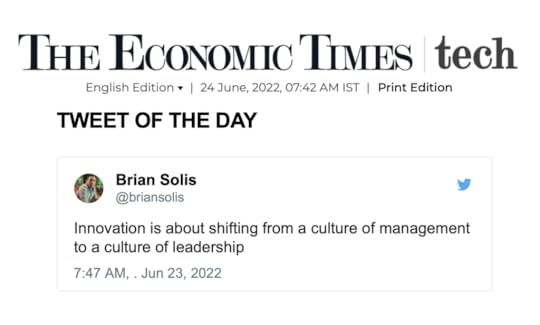
“Innovation is about shifting from a culture of management to a culture of leadership.” via The Economic Times
The post Innovative Leadership vs. Management appeared first on Brian Solis.
June 27, 2022
Podcast: The Future of Global Retail

In this episode, Retail Doctor Group welcomes Brian Solis, a global innovation evangelist from Salesforce, from the US to discuss the changes in the global retail sector, particularly shoppers’ behaviours, that are accelerated by the pandemic. Brian Solis and our CEO Brian Walker will together explore emerging concepts such as “Shopping at the edge” and how retailers can apply new technology and insights to maximize engagement at all touchpoints on the customer journey.
We hope you enjoy the session.
The post Podcast: The Future of Global Retail appeared first on Brian Solis.


