
Brian Solis's Blog, page 31
March 1, 2022
How do we make customer-centricity more than a tagline?
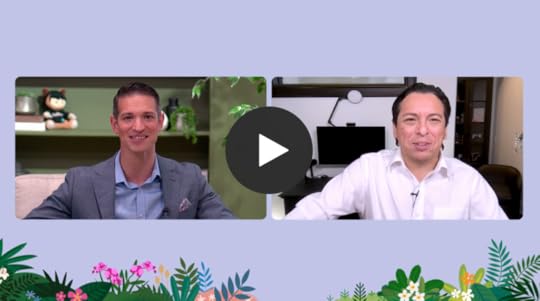
Business as a construct needs a reset! And our current disruption is that moment.
In this Salesforce Executive Conversation, VP and global innovation evangelist Brian Solis explains the new mindset required for true customer-centricity, and how humanizing technology can put the magic back into customer service.
Everything is different from the way we used to work yesterday.
When we innovate by creating new value, using service to get closer to customers rather than being transactional, defining new metrics for customer service – these are the markers of today’s leading organizations.
The post How do we make customer-centricity more than a tagline? appeared first on Brian Solis.


February 28, 2022
In a Digital-First World, Ignite Moments Reimagine Omnichannel Journeys from Customer’s Experience

Try a simple exercise the next time you plan your CX, marketing, service, and commerce strategies. Add an apostrophe “s” to make customer experience possessive. It’s really about the “customer’s” experience that counts for everything. And as a result, that perspective will change the way you design your omnichannel strategy and your customer’s journey at the edge. It will center how you design touchpoints, engagement, and shape experiences from a position of empathy. I call this designing for #Ignitemoments.
I wanted to share a conversation I recently had with Elizabeth Roscoe at ClickZ to help you design your #Ignitemoments.
Do I have your attention? Creating ‘ignite moments’ with Brian SolisA view. A glance. A pause. That flash of time where I have your attention and you have mine. As we all move quickly in an evergrowing digital world, these ‘ignite moments’ can make a tremendous impact on how and where you focus your marketing efforts.
In a special session at the October 2021 ClickZ Experience, world-renowned digital pioneer and 8x best-selling author Brian Solis shared his research on how customers have changed at a human level and how brands must adapt down to their core.
Q: In our last conversation we were talking about the concept of ‘generation novel’, specifically about creating a signature experience. Let’s start there.Brian: Yes, any brand, as they get to know their post-pandemic customers, must discover what it is they value. The good news is that they want you to know them. And, they’re willing to share personal details with you if you can promise value-added personalized experiences.
They value empathy, they value personalization, and they value experiences. In fact, repeated studies show that they’re willing to share very personal information in exchange for value-added experiences. They value these types of experiences as much, or even in some cases more than products and services.
When doing any kind of customer journey work, ask, what are the moments that define the experiences your customer have and walk away with? Is your signature experience transcending each touchpoint? Have you defined your signature experience? What are the experiential elements conveyed to someone in each step? What is it that they’re going to remember and potentially share with others? Where are weak links in the journey taking away from the desired experiences?
This is the bedrock of digital and hybrid customer engagement and it’s the next generation of marketing Marketing IS customer experience.
Q: Before we get into ignite moments, describe briefly the concept of micro-moments, as the two are related.Brian: Micro-moments, a term coined by Google six years ago or so, that we brought to market together, are moments of high intent and engagement. They’re the moments when a customer picks up their mobile device and aims to take the next step in a specific journey…
I want to go…
I want to do…
I want to know…
I want to buy…
Many of these micro-moments happen in spare moments, such as waiting in line, commuting, or generally when not preoccupied with something else. The journey then continues later either on mobile or through an entirely different channel such as a laptop or tablet. You, as a marketer, can design for these mobile-first opportunities and design a customer journey that’s intuitive and useful in these moments toward desired outcomes. Make no mistake, they are, still to this day, among the most important opportunities for engagement, not distractions. As you think about omnichannel journeys, also make sure to optimize those journeys for device and context. They should be intuitive and end-to-end. Mobile UX, after all these years, is still underappreciated and maybe even misunderstood as an on-demand medium and portable experience… Remember, smartphones are the device that most customers have on- or in hand almost always.
Q: What is an ignite moment then and how is it different from a micro-moment?Brian: Ignite moments are built on top of the micro-moments and any moment of truth. Ignite moments, in short, are the moments when I have your attention, and you have my attention. Now, what do we do? Well, we make that moment count for everything. Ignite moments understand context, device, intention, with personalization, create a personal, dynamic journey optimized for the customer. And, ignite moments, with edge capabilities, can also deliver next-level experiences in physical and hybrid applications.
As we said, customer experience is defined as the sum of all the engagements a customer has with your brand. People are moving fast. During the pandemic, they too were digitally transformed, expected to work and live online more than in years leading up to 2020. I know they’re distracted, we all are. I know they’re moving fast. I know they’re multitasking. If you’re looking for something that’s incredibly personal or meaningful when you’re looking for a desired outcome and I, as the marketer, or better yet, an experience-designer, have to design for you, your way, in that very moment.
Q: Where are these ignite moments found?Brian: They aren’t found, they’re created. I want you to think about your ignite moments as “wow” moments, an opportunity to sprinkle a little magic on top of each touchpoint. These are special moments to remind people that they matter, that you value their time, that you intend to build a relationship built upon exceptional experiences—whether it’s an email, whether it’s a text, whether it’s a website or a landing page, whether it’s packaging, whether it’s a script for customer service, or whether it’s a process or a policy that affects customer experiences in any way.
Experiences happen anywhere and everywhere, even on platforms, you don’t control. And, they are all opportunities to create an ignite moment. They require design.
Another way to think about it is this way. Experiences are more emotional than they are transactional. But for the most part, especially in this race to digital transformation, customer journeys are becoming increasingly transactional. While technically, transactional touchpoints and journeys work, they are most likely not delightful, enjoyable, or memorable. That’s because touchpoints aren’t typically designed for emotion, and as such, not they’re not inherently experiential, at least not intentionally,l by design.
The extraordinary customer experience is the result of exceptional experience design. Experience is an emotional interpretation of any given moment. It reflects expectations, self-interest, and aspirations. If it is unusual in any way, it can become memorable, hopefully in the most wonderful way. Here’s what’s really interesting though, and maybe even counterintuitive. Any transaction that meets expectations, is most likely forgettable. If though, touchpoints are designed as extraordinary, meaning, unusually great, customers will most likely remember it.
If you desire to create a memorable experience, it must then also be exceptional.
Q: How can looking for these moments further our marketing efforts?Brian: Marketing is no longer a department or a function. Because experiences are emotional and the experience people have can be memorable, for better or worse, or forgettable, marketing should take responsibility for the parts and the total sum of the customer’s experience. Like IT is to business, marketing too must align and collaborate with and even unite silos and functions to shape and unify the customer’s experience.
Start by defining your signature experience and ensure that it aligns with the brand and brand promise. If the brand doesn’t not translate to emotion, then perhaps it’s time to rethink the brand for these new times.
I would suggest always looking at the customer’s experience through the lens of an existing experience and then compare those experiences to aspirational ignite moments. Look for what’s broken, what adds friction, what causes issues, what’s forgettable, because we have to build upon that. We have to fix those things first. Then, look for opportunities to deliver your signature experience through each engagement. This is where ignite moments…ignite.
Q: Any final thoughts?Brian: Learn what matters to your customer. Study the best experiences in the world, beyond your industry. Winning customer journeys and experiences will be rooted in these ignite moments.
Be the light in every touchpoint
Build trust
Align with values
Be compassionate
Make customers smile
Find opportunities to sprinkle magic and make transactional touchponts more experiential, memorable, and desirable.
Create #Ignitemoments to enchant your customer and enhance your customer’s experience at the edge and across their omnichannel journeys!
The post In a Digital-First World, Ignite Moments Reimagine Omnichannel Journeys from Customer’s Experience appeared first on Brian Solis.
February 21, 2022
Reimagining the future of marketing and why CMOs will drive business growth in the future
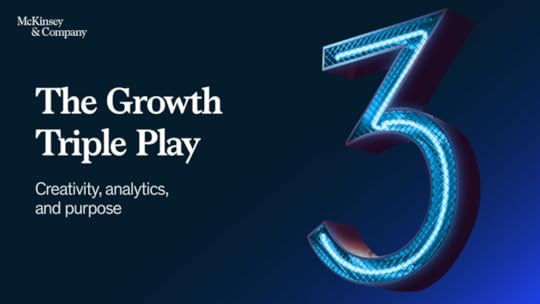
COVID-19 overturned lives and livelihoods across the globe, forcing people to find new ways of working, shopping, and playing. Homebound consumers abandoned deep-seated shopping habits overnight, going online in droves and compressing a decade’s worth of digital adoption into months.
Although businesses responded quickly to a flood of new online customers, they faced unprecedented disruption, with a staggering 75 percent of consumers trying new brands, products, and channels. These seismic shifts are transforming the role of marketers and marketing, and McKinsey research indicates that 78 percent of CEOs are counting on chief marketing officers (CMOs) to drive growth.
Marketing leaders have a once-in-a-generation opportunity to combine creativity, analytics, and purpose—the growth triple play—to help their companies grow at twice the rate of their peers. Brian Solis, Salesforce’s global innovation evangelist, keynote speaker, and best-selling author, shares his insights with McKinsey about the future of marketing and the interlocking roles these three elements play to boost growth.
Making marketing more experientialMcKinsey: When you look to the future of marketing, what do you see?
Brian Solis (31:41): We should start with what marketing is and what it shouldn’t be. At its core, it’s people on the other side of the screen and in front of us who all have expectations and aspirations.
The future of marketing is to understand what those aspirations are, whether that’s through analytics, or whether that’s just through talking to customers. The roles of creativity, purpose, and analytics in the future of marketing mean that marketing isn’t what it used to be, just like the future isn’t what it used to be.
(32:32): Marketing now becomes much more experiential—it’s what customers see, hear, and feel, and it plays a role in transforming the entire customer journey. If it’s driven by creativity, purpose, and insights that are actually representative of the very people we’re trying to engage, then that means marketing will help businesses grow by being relevant and empathetic. And that is what customers are looking for.
Creativity + analytics + purpose = innovation and growthMcKinsey: How can marketers harness creativity, analytics, and purpose to drive growth?
Brian Solis (02:41): Growth is driven by customer success, success is driven by engagement, and engagement defines customer experiences. In order to deliver the types of experiences that customers want, we need analytics.
At Salesforce, we talk about building a customer-360 company, which is organizing literally around the customer to deliver real-time value throughout their journey and throughout their life cycle. I think the pandemic highlighted for everyone that there are real people on the other side of the screen, and that we all suffered, learned, and grew through this as individuals, and also as markets.
We also realized that personalized engagement is really what customer centricity means. It’s not about transactions, which is how marketers operated and measured before. But when you add purpose, a set of values, a set of things which we can align around between business and customers, that changes the entire dynamic, and that is really what customers are looking for in brands.
(05:20) The thing about growth is that you can’t have it unless businesses help you drive it. And in order to help businesses collaborate and co-create toward growth, we have to really understand them. One of the pillars here in the future of marketing, which is purpose, means that we have to understand not only what values we represent as a business, but what values customers stand for.
Salesforce found that 61 percent of customers have stopped doing business with a brand because its values did not align with theirs. So customer loyalty is up for grabs, and that means acquisition and retention are more important than ever.
Thinking like a customer-360 companyMcKinsey: What capabilities or attributes will be critical to marketers in the future?
Brian Solis (07:58): I don’t believe that striving toward normalcy should be any brand’s ambition right now.
This is an opportunity to create and invent and innovate. The attribute that businesses need to succeed in this regard is to really start thinking like a customer-360 company, which means that customer insights not only have to be at the center, they also have to be empathized with. I call this digital empathy, which is using data in a way that humanizes the people on the other side of the screen, but also reveals what life is like through their lens, not just through our goals, not just through our ambitions.
(08:51): That means that we have to teach things like empathy, creativity, and listening skills. It also means teaching creativity in terms of practicing new ideas and not being limited by the traditional marketing boundaries. That means making data available not just to the marketers, but to anyone throughout the organization who touches the customer, because everything now becomes marketing.
I refer to this new journey as the ignite moment. Once you have someone’s attention and know their intention, you can deliver the best, most personalized, efficient, convenient, and wow experience possible that wasn’t available to us before. It is available to us now, and that is why the three pillars of creativity, purpose, and analytics, are really powered by digital empathy.
Using analytics to understand “accidental narcissists”McKinsey: How should marketing leaders approach customer experience?
Brian Solis: (10:21): For a marketer to build an effective customer experience, they need to be driven by the very things that help them make their customers successful.
(11:03) The bar is very high. I call customers today “accidental narcissists” because technology has conditioned them to believe that they can have whatever they want, whenever they want it, wherever they are, within minutes. Analytics are going to help us understand those trends in real time. With AI and automation, we can actually understand how to predict and deliver against those trends ahead of time.
We then need digital empathy to humanize those things and look inward to inspire our sense of purpose. It’s not good enough anymore to come up with a mission statement and hang it on the wall.
We have to be driven by what matters to people and also what we stand for, because together we are a community. It isn’t just a market—it’s a relationship between customers and businesses, powered by marketers creating the experiences that bind us within this community.
What it means to start with the customerMcKinsey: What advice do you have for organizations on where to start this journey?
Brian Solis: (13:37) The number-one question that I get from executives—whether it’s the head of service, CMO, or CIO—is where do I start? Start with the customer. But don’t stop with the customer. You also have to remember that the employee is also part of the customer experience. In fact, employee experience plus customer experience—EX+CX—is what will equal growth. Because it’s that humanization of those experiences that is going to inspire what you stand for. It’s going to inspire your purpose.
This is a time to reimagine your brand based on that purpose and those values. You also have to be bold, inventive, and innovative. You have to be willing to take a stand and say there are customers you don’t want to do business with. And in order to get there, you need data-driven empathy. Data has to be at the center, and it has to be solid, consistent, and representative of the customer’s experience, including their journey and aspirations.
Data-driven empathy is about humanizing data, but human empathy is about seeing and feeling the world others do. Those pieces together—digital plus the human side of engagement—are what I believe will help marketers and the C-suite understand what to prioritize, where to invest, where to experiment, and what to unlearn and let go. Only then can we start becoming a human-centered brand empowered by personalization, analytics, technology, and innovation.
Transforming the CMO into a unifierMcKinsey: How will the role of the CMO evolve in the future?
Brian Solis: (36:42) Certainly, before the pandemic, the CMO was already taxed with doing so much around digital transformation, performance marketing, and big data to help companies thrive during the past 20 years.
Brian S (37:57): Now we have a much more conscious customer on the other side, who has been woken up by the pandemic and reminded that they’re empowered. They’ve been given the tools they need to make decisions, find solutions and services they wanted, live the life that they aspired to, and work the way they wanted to work.
This means the role of the CMO now has to be one that’s experience-driven, and human and empathetic at the core. But it needs to use technology in a way that delivers much more human, relevant, and meaningful experiences to customers throughout their journey.
I see the role of the CMO actually evolving into an experience officer that becomes cross-functional, empowering other customer-facing parts of the organization to deliver the consistent experience that customers need in those moments of truth.
That means the CMO has to act as a unifier to bring people to the table who didn’t necessarily collaborate before, because the customers’ experiences are actually the sum of all engagements they have with that brand. It’s not just one moment, it’s all the moments.
Someone has to be the conductor of all of this, to put their arms around all of this and say, “This is the standard for which we’re engaging,” so that we’re branding, marketing, and selling across this standard—and measuring that experience for the customer. And since it’s about experience, the unifier has to be the CMO.
The post Reimagining the future of marketing and why CMOs will drive business growth in the future appeared first on Brian Solis.
February 17, 2022
MARK UP: Darwinismo digitale: come la pandemia sta impattando sul ‘Retail reset’ – Digital Darwinism: how the pandemic is impacting the ‘retail reset’
via Giovanna Chiara Italiano, MARK UP
Writing for MARK UP in Italy, Giovanna explores the “Great Reset” and its impact on the future of retail. She references Brian Solis and his work studying “Digital Darwinism.”
The article is in Italian, but is also available in translated form here.

Il Retail e le sue supply chain possono resistere agli scossoni pandemici investendo sulla customer experience, che è diventata il vero carburante che alimenta e genera il cambiamento
Lo scorso World Economic Forum 2021 (WEF) che si è tenuto a Davos ha avuto un titolo iconico per quel che riguarda il mondo alle prese con una pandemia con cui convivere e da debellare il prima possibile: “The Great Reset”. L’idea di sfruttare gli effetti della pandemia sul business (e non solo) per cercare di resettare, ristrutturare e riorganizzare diversi settori, con un occhio di riguardo alle varie storture, colli di bottiglia ed, in generale, esternalità negative, è qualcosa che è maturato come reazione costruttiva ai disagi e alle difficoltà imposte dal virus. L’onda lunga del “Great Reset” ha investito anche il comparto del retail, che sta facendo i conti con l’azzeramento di molti modi operandi e con la trasformazione di altrettanti comparti ad esso connesso, affondando di fatto il suo “Retail Reset”.
In tal senso però, è bene fin da subito esplicitare che l’elemento centrale su cui si basa oggi tale reset è il digitale spinto dal fenomeno pandemico a cui ha fatto da boost nella sua diffusione, piuttosto che dell’applicazione del paradigma tecnologico di per sé, che era già in atto in tempi pre-pandemici. La realtà attuale è, infatti, “ibrida”, ed è alle prese sia con forme analogiche che digitali che interagiscono tra loro (integrandosi o sostituendosi) in maniera più o meno fluida.
Evoluzione in corsoAppare, allora, interessante proporre il concetto di Darwinismo Digitale (Digital Darwinism, espressione coniata dall’esperto di innovazione tecnologica Brian Solis), con cui si fa riferimento “all’evoluzione (o rivoluzione) della filosofia aziendale, dei processi, dei modelli e dei sistemi per competere in un’economia digitale. La tecnologia è e non è la risposta al cambiamento”. Utilizzando l’indicativo hashtag-monito #AdaptOrDie, Brian Solis vuole sensibilizzare al fatto che bisogna sapersi adattare e convivere con la sfuggevolezza e l’inafferrabilità di cambiamenti repentini esogeni alle aziende, che devono però sapere reagire anche in maniera endogena. Le aziende, quindi, sono concepite per migliorare gradualmente nel tempo, per ottimizzarsi, per riprodursi in modo selettivo, per diventare migliori attraversi un’evoluzione lenta ma coerente e collaudata.
Tuttavia, se questo sistema ha funzionato prima della pandemia, ed anzi era già messo alla prova dalla velocità del cambiamento tecnologico e sociale, ora la situazione è diversa. Il darwinismo digitale, di fatti, con la pandemia assume una nuova connotazione, perché la diffusione del contagio entra a far parte delle variabili darwiniste di sopravvivenza. Agilità e soprattutto accettazione del rischio sembrano due prerogative imprescindibili, anche per trovare un nuovo stile di leadership, nuovi modi equi di retribuzione e di una nuova cultura aziendale.
Full article here (Italian).
Brian’s portion in English
Evolution in progressIt therefore appears interesting to propose the concept of Digital Darwinism (Digital Darwinism, an expression coined by the technological innovation expert Brian Solis), which refers to “the evolution (or revolution) of corporate philosophy, processes, models and systems to compete in a digital economy. Technology is and is not the answer to change “. Using the hashtag-warning #AdaptOrDie, Brian Solis wants to raise awareness of the fact that we need to know how to adapt and live with the fleetingness and elusiveness of sudden changes exogenous to companies, which, however, must also know how to react endogenously. Companies, therefore, are designed to gradually improve over time, to optimize themselves, to reproduce themselves selectively, to become better through a slow but consistent and proven evolution.
However, if this system worked before the pandemic, and indeed was already tested by the speed of technological and social change, now the situation is different. Digital Darwinism, in fact, with the pandemic takes on a new connotation, because the spread of the contagion becomes part of the Darwinist survival variables. Agility and above all risk acceptance seem to be two essential prerogatives, also for finding a new style of leadership, new equitable ways of remuneration and a new corporate culture.
The post MARK UP: Darwinismo digitale: come la pandemia sta impattando sul ‘Retail reset’ – Digital Darwinism: how the pandemic is impacting the ‘retail reset’ appeared first on Brian Solis.
February 16, 2022
The AI Journal: Top 20 Digital Transformation Pros you NEED To Follow
Via The AI Journal
According to IDC, over the next four years, worldwide Digital Transformation technology investment is set to reach at least $7.4 trillion and will be the first time that DX will account for the majority of IT spending – predicted to be a huge 53% of budgets.
Digital transformation is a set of methodologies and tools which are used by modern companies to optimize their operational activities, such as increasing their reach power, providing differentiated service and increasing performance. However, digital transformation is not just a new department in the firm, but it is definitely a game-changer in technology’s role in the corporate environment.
That’s why it is increasingly being seen as the 4th Industrial Revolution.
“Think of digital transformation less as a technology project to be finished than as a state of perpetual agility, always ready to evolve for whatever customers want next, and you’ll be pointed down the right path.”- Amit Zavery, VP and Head of Platform, Google Cloud.
This is clearly an important topic and one where there’s a lot to learn. For that reason, we wanted to share with you 20 people that can help you understand digital transformation and the topics that fall underneath them.
 Brian Solis
Brian Solis is Global Innovation Evangelist. He’s also an 8x best-selling author, international keynote speaker, and digital anthropologist. Forbes has called him “one of the more creative and brilliant business minds of our time” and ZDNet has said that Brian is “one of the 21st century business world’s leading thinkers”. For over 20 years, Brian has studied Digital Darwinism to understand the impact of disruption on businesses, markets and society. In his work, he humanizes technologies and trends to help leaders gain new perspectives and insights and inspire new ideas to thrive in the future.
Why should you follow Brian?
Brian’s research explores digital transformation, CX, experience design, innovation, the cognitive enterprise, and “the future of” industries, trends and human behaviour. His insights on the future of technology and business trends have made him a go to resource among executives, media and market experts. He has published over 60 research papers and also actively shares his work in industry-leading publications including Forbes, ZDNet, CIO, eWeek, Fast Company, Adweek, and Singularity University.
As a keynote speaker, Brian has travelled the world to help audiences embrace change, learn what’s coming next and why, and to take a leading role in shaping the future they want to see.
Brian’s latest book, Lifescale: How to Live a More Creative, Productive, and Happy Life, is a research-based (and personal) journey to help defeat the disruptive effects of digital distractions.
You can follow Brian on the following channels:
LinkedIn: https://www.linkedin.com/in/briansolis/
Twitter: https://twitter.com/briansolis
Website: http://www.briansolis.com/
The post The AI Journal: Top 20 Digital Transformation Pros you NEED To Follow appeared first on Brian Solis.
February 11, 2022
Data-Driven Empathy Helps Businesses Develop a Human-Centered Approach to Digital Transformation and Innovation
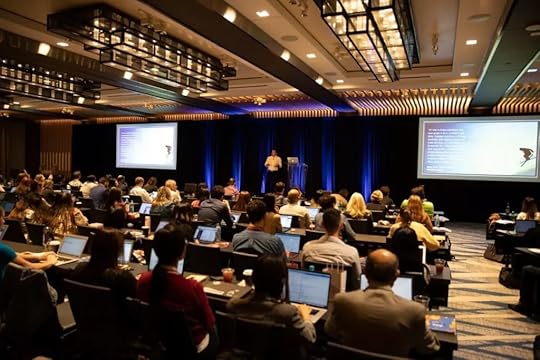
Brian Solis Keynotes Netbase Quid Live in New York and Los Angeles
While onsite in New York, I was interviewed by the Netbase Quid team to share highlights from my presentation on data-driven empathy.Every technology revolution moves people in new directions. Human-centered insights, data-driven empathy, create meaning, relevance, and helps identify opportunities for new value creation to close the relationship gaps between businesses and customers.
The post Data-Driven Empathy Helps Businesses Develop a Human-Centered Approach to Digital Transformation and Innovation appeared first on Brian Solis.
February 10, 2022
TheStreet Quotes Brian Solis Exploring the Future of Cashless Commerce

via Veronika Bondarenko, TheStreet
With the use of cash dropping around 15% per year since 2017, it is no surprise that we’re starting to see more and more cashless restaurants pop up around us. Between the pandemic and general digitalization, only 16% of Americans were found to “always” have cash on them in 2020.
The move toward credit cards, apps, and phone-based payment methods has become a self-fulfilling prophecy. If people stop using cash, then places will consider stopping accepting cash.
Cash may no longer be king and that’s a concept that one growing fast-food chain has made plans to embrace.
The Texas-based chicken wing chain Wingstop (WING) – Get Wingstop, Inc. Report just launched what it calls its first “restaurant of the future” in Dallas — a lobby without dining seats, a small ordering area and larger back-of-house, and a cash-free environment. The decor is meant to advertise different Wingstop products while also keeping orders moving quickly.
The 1,300-square-foot restaurant was designed as a pilot location meant to test who comes into Wingstop stores and why as, according to the company, delivery and carryout already account for nearly 100% of its orders. While drop-in customers can use the displayed QR codes to order, Wingstop aims to have 100% of the orders at this location done digitally in the future.
“A glimpse into our Lovers Lane location is a glimpse into the future of Wingstop – focused on 100% digital transactions, seamless back of house operations, ongoing flavor innovation, and a business model centered around our fans, who love to dine off-premise with friends, while gaming, or just about anywhere you can think of,” Marisa Carona, Wingstop’s chief growth officer, said in a statement.
“Over the last 12-24 months, technology systems were upgraded to facilitate mobile access, on-demand reservations, orders for delivery and pickup, contactless payments, digital menus, and loyalty programs to serve a ‘contactless’ dining experience,” Brian Solis wrote for Restaurant Dive.
The post TheStreet Quotes Brian Solis Exploring the Future of Cashless Commerce appeared first on Brian Solis.
February 8, 2022
Mashed Quotes Brian Solis in Article that Explores Burger King Customer Engagement Strategies
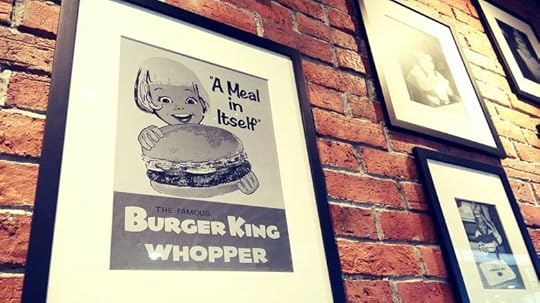
Mashed featured Brian Solis in a recent article that explored how Burger King’s design and marketing is so effective in customer engagement.
Excerpt…
Brian Solis, a digital anthropologist who studies technology and its impact on society, writes in Forbes that instant gratification actually increases impatience. And what do increasingly impatient people crave? Instant gratification. The process triggers an endless loop that feeds itself, and Burger King is undeniably a part of that system as one of the biggest purveyors of fast food in the world.
The post Mashed Quotes Brian Solis in Article that Explores Burger King Customer Engagement Strategies appeared first on Brian Solis.
February 7, 2022
Top Virtual Keynote Speakers via readwrite

via readwrite…
This article will provide you with the top 28 virtual speakers and what distinguishes them from other speakers. You can also learn about what to look for in a virtual speaker as well as discover how to create a successful online conference or workshop.
Brian Solis made the list!
The post Top Virtual Keynote Speakers via readwrite appeared first on Brian Solis.
February 3, 2022
What’s Standing Between Your Business Transformation Strategy and the Experiences Customers are Seeking

Originally published on the Salesforce “360 blog“
Customers care about end-to-end experiences, not how your company is organized. Business leaders are quick to say that a connected customer experience is a major business priority. But the truth is that they are struggling to do it well. New data captures the gap between business and digital transformation and the integrated experiences customers desire.
Countless growing departments, new services abound, and the truth remains: Customers have to see you as one company. This is why a connected, personalized, and seamless customer experience (CX)can make or break your brand. But telling this to executives is preaching to the choir. Eighty-eight percent believe a complete and consistent view of their customers is crucial to the future of their business. But fewer than one-third say they currently have that unified view. And for those 31% executives who have a single 360-degree view of customer data? Half say they lack the organizational structure to actually make use of those customer insights.
Those are a few insights from 1,000+ global senior leaders on how to meet the future of customer experience from new research conducted by Harvard Business Review Analytic Services sponsored by Salesforce (and led by me!) The research points to a clear discrepancy: Business leaders are quick to say that establishing a seamless and connected CX is a major business priority, but by and large, they are struggling to do it well. This is because, going back decades, organizational design didn’t account for customer or data-centricity. But that was a different time. Customers now demand otherwise, and technology makes the shift to a unified, customer-centric model a reality today.
To materialize true CX potential, companies need to make significant changes to how they operate. They need to ensure that all functional leaders – even those whose roles have historically been disconnected from customers – feel a sense of CX ownership. They need to guarantee a level of company-wide proficiency when it comes to analyzing and acting on data insights. And they need to look beyond the traditional functions of their CRM, shifting its use from a system of record to a platform for more effectively managing customer relationships with artificial intelligence (AI) and predictive capabilities over time.
But perhaps most importantly, business leaders will actually need to pause, look around, and spend some quality time learning directly from the customers themselves.
It’s about organizing, connecting, and scaling quality customer data. It’s about uniting cross-functional counterparts to own roles in collecting data and surfacing critical insights, at every stage of the customer journey, to help key decision-makers learn what customers really need.
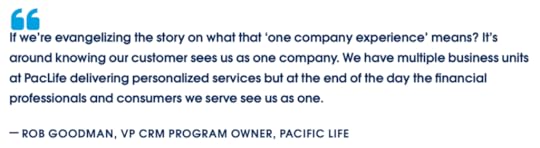
Companies are more likely to consistently deliver great customer experiences when employees across the organization have a customer-centric mindset. After all, it is the customer’s experience that matters. And unless employees get a sense of what customers experience, CX becomes more about facilitating transactions than about the meaningful, relevant engagement that customers value.
A great personalized shopping experience, for example, can be undercut by an onerous checkout process. An automated customer service portal or chatbot function will be of no use if the company doesn’t train customer-centric teams to humanize it at every step. The customer’s experience is the sum of every touchpoint, and every component of that journey must work together. Now more than ever, finance and HR, along with other back-of-house functions, will be as crucial to the CX equation as many of their customer-facing counterparts. In fact, about a fifth of business leaders who responded to the survey expect both finance (21%) and HR leaders (19%) to be significantly involved in their companies’ CX efforts over the next two years, with nearly twice that many expecting them to be somewhat involved.
“No matter how good your product or service is, all touchpoints through the customer journey must come together, or the customer experience will be bad,” said Michael Krigsman, industry analyst and host of executive discussion platform CXOTalk. “To deliver a great customer experience, your infrastructure must work properly.”
Get comfortable with dataKnowing who your customers are, how they behave, what they want, and why they want it is critical to designing a game-changing CX strategy. Getting there starts with sourcing and unifying data that’s seamlessly aggregated from previously disparate (or missing) sources and silos in real time.
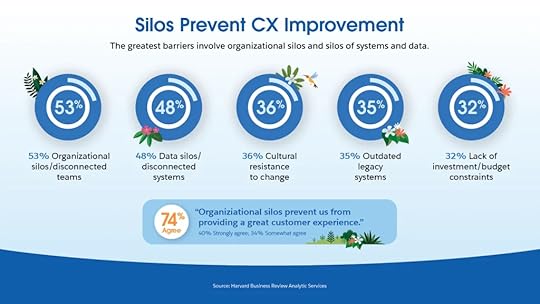
According to data from the Harvard Business Review Analytic Services survey, “Making Customer Experience the Heart of the Enterprise, sponsored by Salesforce,” 74% of respondents agree that organizational silos prevent teams from providing a great customer experience. The silos that prevent CX improvement include disconnected teams (53%), disconnected systems (48%), cultural resistance to change (36%), outdated legacy systems (35%), and lack of investment (32%).
“The hardest part in this is getting the data science muscle built to ensure that we have the opportunity to uncover those data signals,” said Josh Blacksmith, senior director of global consumer relationships and engagement at Kimberly-Clark Corp.
Employees can only respond to customer trends or make decisions based on the information they have on hand. Given the right information, employees can act more successfully and with autonomy, which ultimately improves their own experience at the company.
Most survey respondents ranked the oft-cited overall customer satisfaction measure (CSAT) as the top metric for their organization’s success. But that metric doesn’t tell us a whole lot about how customers’ satisfaction influences their next purchase. Instead, businesses should be looking at other metrics, such as customer lifetime value (CLV), which the most customer-centric organizations in our research ranked as their priority.
“It’s really easy to sell something once. It’s difficult to secure that second and third order,” said Rob Birse, head of global B2B ecommerce at Kellogg’s, who has used CLV to better predict customer orders. “The metric you want to focus on is the repetitive purchasing patterns.”
Push your CRM to the limitHistorically, in times of normal business, sales leaders have relied on their CRM software to keep tabs on prospects and update the status of pitch meetings. But the modern CRM is capable of so much more – it’s just that most business leaders don’t know it.
This is especially true in a volatile post-pandemic transition period, when many big businesses are struggling to smoothly transition into untested hybrid or remote-work models.

A well-integrated CRM can serve as the central hub that helps teams avoid the coordination and communication hiccups brought on by distributed work. It can also be an engine for bridging internal silos and discombobulated customer experiences.
Birse from Kellogg’s sees a future where customers can scan a product on the shelf, prompting the Kellogg’s system, using AI, to recommend a quantity for their order based on everything it knows about that market and consumer demand.
“That’s where we need to be,” he said.
But as companies build out these data-driven capabilities, they should not forget an equally-important ingredient: Their teams and employees. Indeed, as much as data represents customers and clients, it’s the employees who need to feel empowered to read, analyze, and act on that data.
As companies become more data-driven, CRM systems will evolve into a unified, single source of customer truth. This is the key to empowering all teams with relevant, value-added insights to prioritize the R in CRM – customer relationships.
[simple-author-blog]The post What’s Standing Between Your Business Transformation Strategy and the Experiences Customers are Seeking appeared first on Brian Solis.


