
David Allen Sibley's Blog, page 15
May 2, 2012
Quiz 33: Small songbirds by their wings
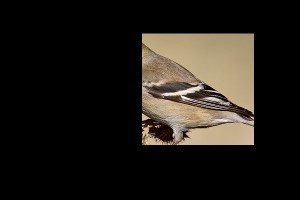 This quiz shows just the bodies of five species of small drab songbirds with wingbars. In other quizzes I’ve given a big clue in the form of telling you the family of the birds in the quiz (e.g. “More Warblers”), but in this quiz your challenge is to identify the family.
This level of identification – telling a warbler from a goldfinch from a kinglet – is something we learn to do automatically through experience. We memorize, and actively look for, field marks that distinguish Blackpoll Warbler from Bay-breasted. But distinguishing a female Blackpoll Warbler from a goldfinch? We “just know” from behavior, movements, proportions, calls, overall plumage colors, etc. There’s no need to know how the wing pattern of a goldfinch differs from the wing pattern of a warbler, so we don’t consciously memorize that.
I’m not sure if this quiz will be hard or easy. I suspect it will be easy for experienced birders, but I haven’t been able to come up with any concise explanations to add to the answers, which makes me think that less experienced birders might find it really challenging.
In any case, it is a good opportunity to step back and really think about what it is that distinguishes these unrelated groups of birds.
With thanks, again, to Brian E. Small for providing the beautiful photos. You can see lots more at his website.
Wing-barred Songbirds
Please wait while the activity loads. If this activity does not load, try refreshing your browser. Also, this page requires javascript. Please visit using a browser with javascript enabled.
If loading fails, click here to try again
Congratulations - you have completed Wing-barred Songbirds.
You scored %%SCORE%% out of %%TOTAL%%.
Your performance has been rated as %%RATING%%
Your answers are highlighted below.
Question 1
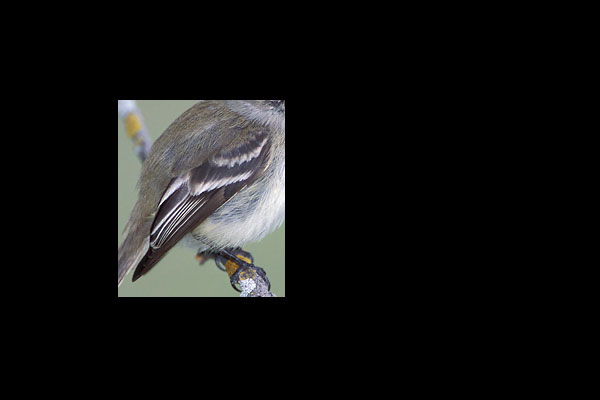
GoldfinchFlycatcherKingletVireoQuestion 1 Explanation:Least Flycatcher
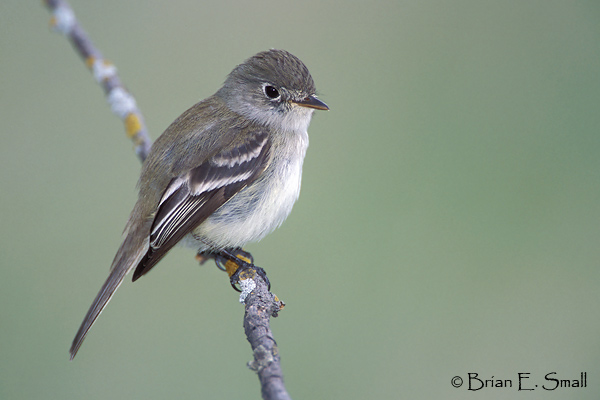 Question 2
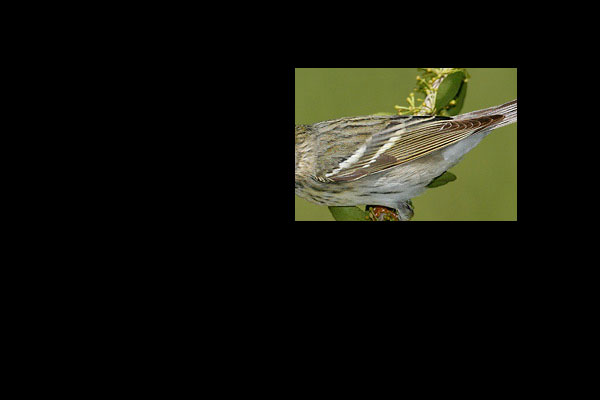
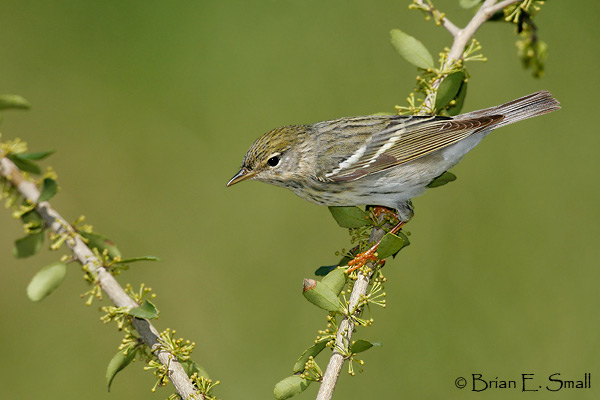
KingletWarblerVireoFlycatcherQuestion 2 Explanation:Blackpoll Warbler
 Question 3
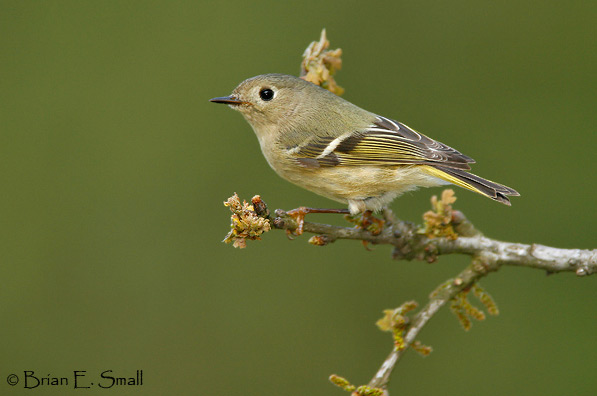
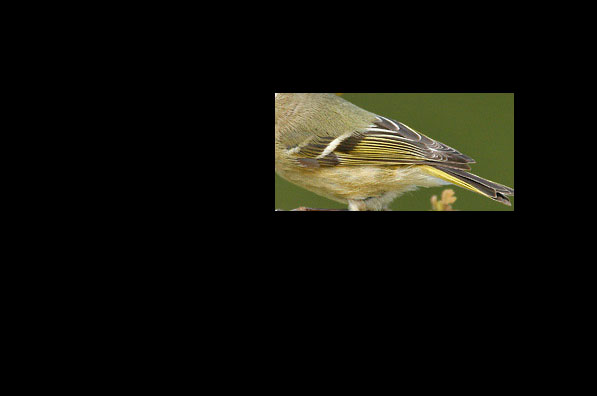 VireoKingletWarblerFlycatcherQuestion 3 Explanation:Ruby-crowned Kinglet
 Question 4
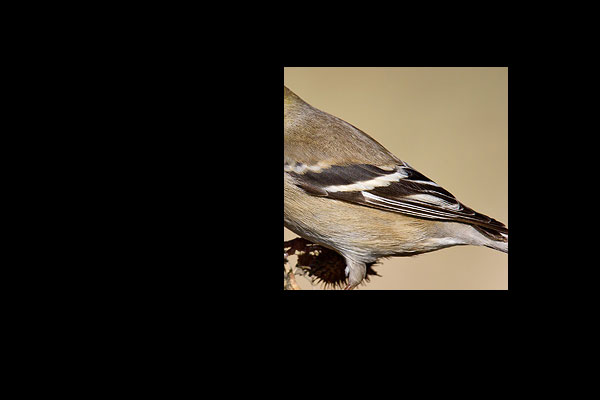
GoldfinchVireoKingletFlycatcherQuestion 4 Explanation:American Goldfinch
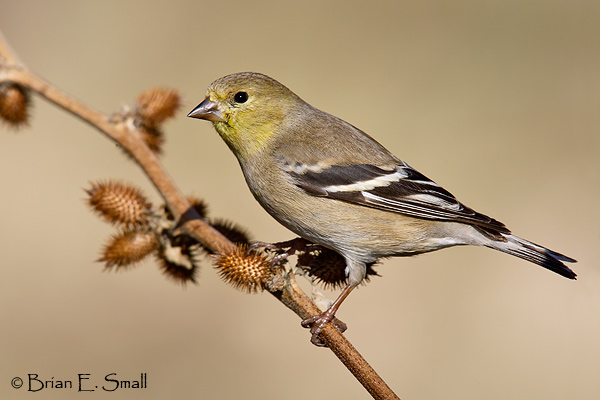 Question 5
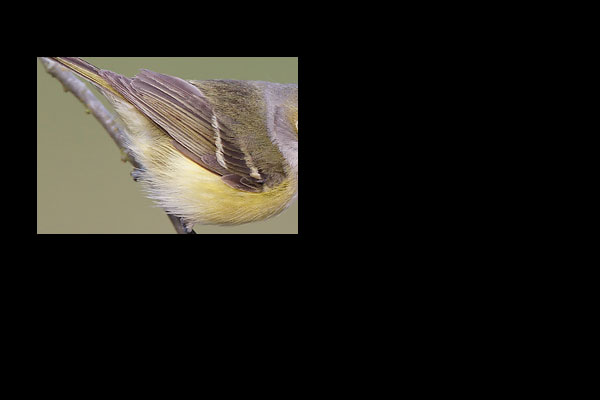 FlycatcherWarblerVireoKingletQuestion 5 Explanation:White-eyed Vireo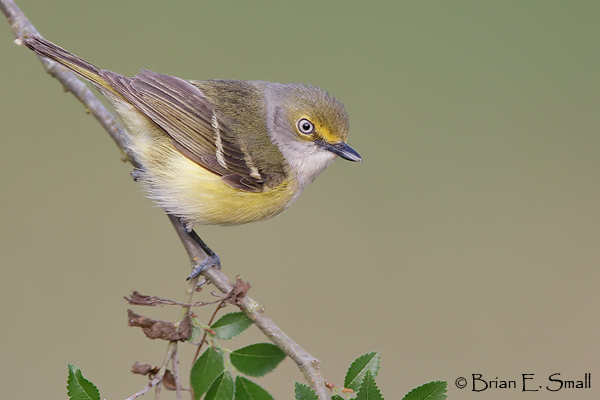
Once you are finished, click the button below. Any items you have not completed will be marked incorrect.
Get Results
There are 5 questions to complete.
You have completed
questions
question
Your score is
Correct
Wrong
Partial-Credit
You have not finished your quiz. If you leave this page, your progress will be lost.
Correct Answer
You Selected
Not Attempted
Final Score on Quiz
Attempted Questions Correct
Attempted Questions Wrong
Questions Not Attempted
Total Questions on Quiz
Question Details
Results
Date
Score
Time allowed
minutes
seconds
Time used
Answer Choice(s) Selected
Question Text
All doneNeed more practice!Keep trying!Not bad!Good work!Perfect!


May 1, 2012
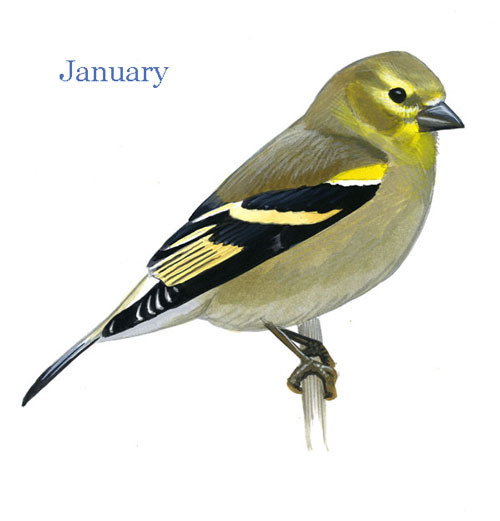
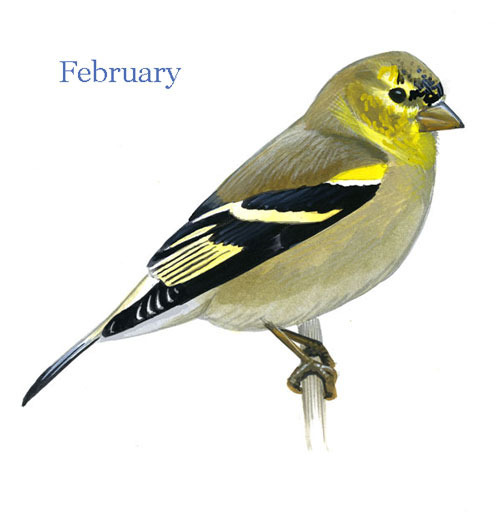
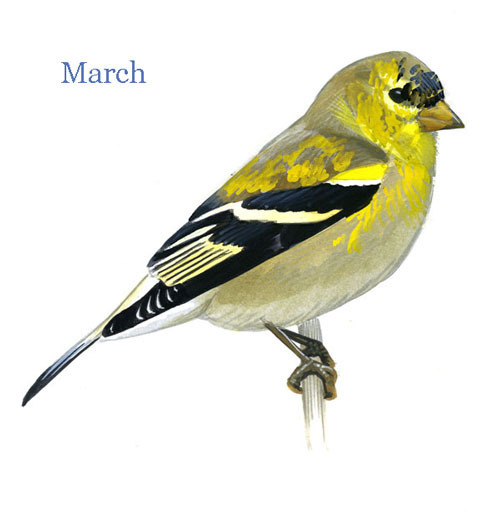
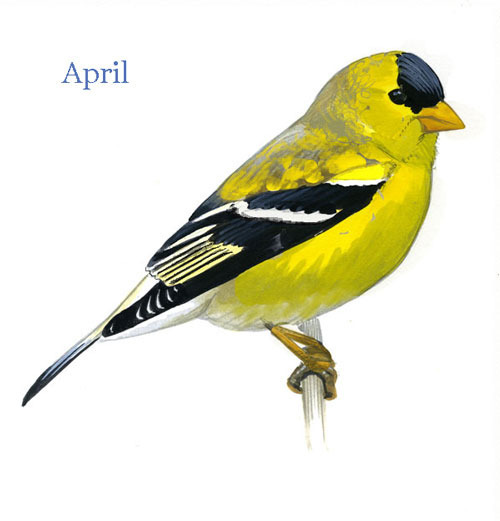
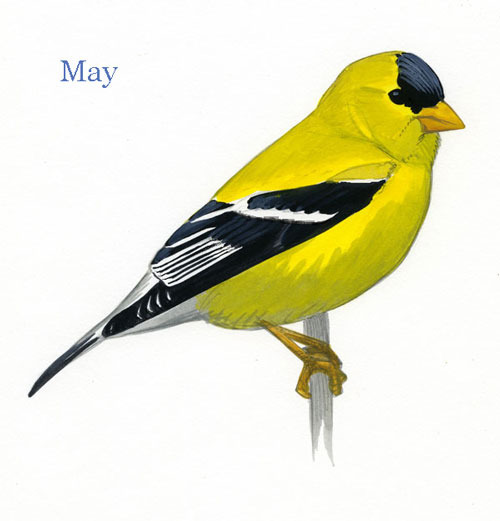
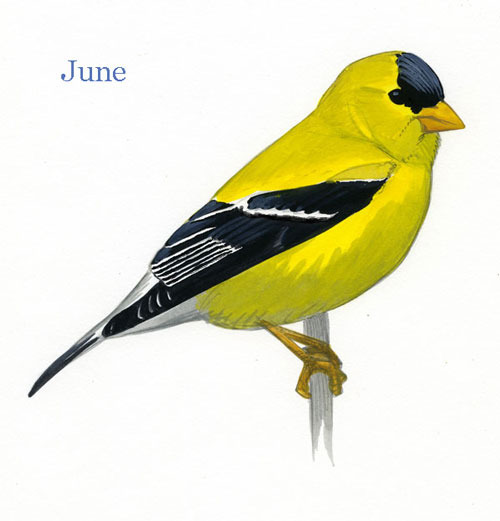
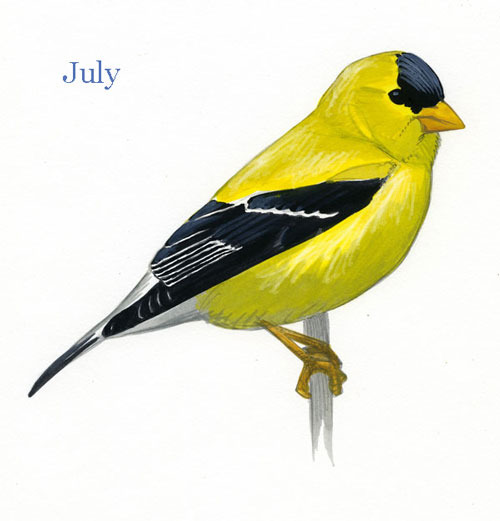
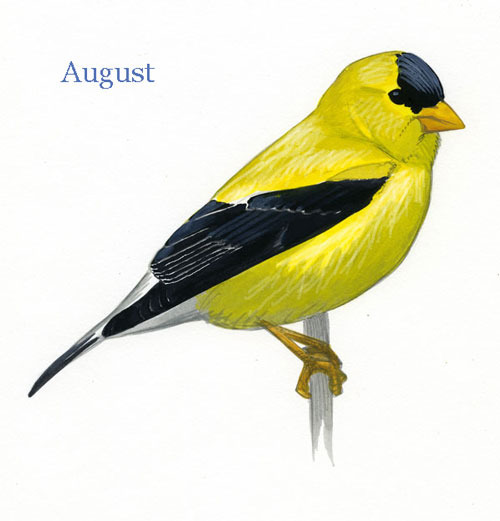
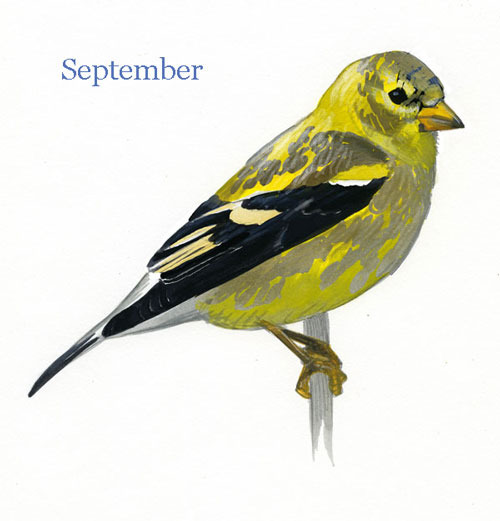
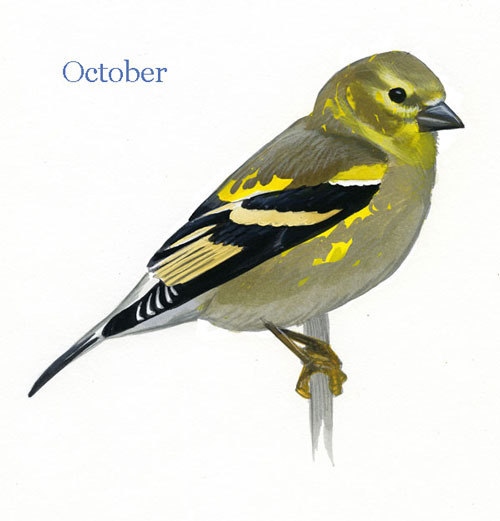
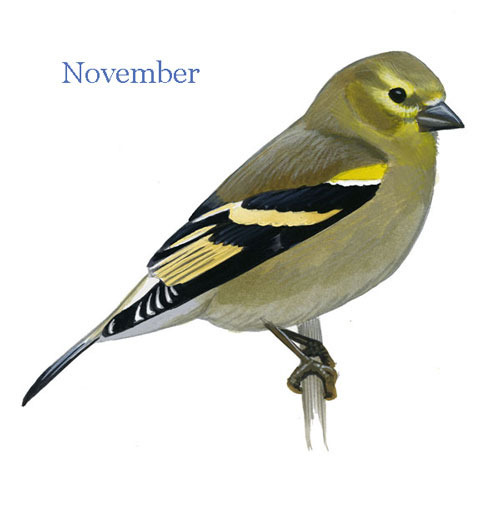
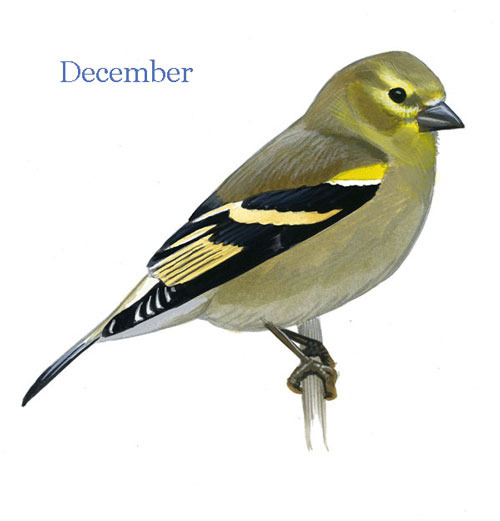
The annual plumage cycle of a male American Goldfinch
Molt is the process of feather replacement. All birds do it; they have to grow new feathers once or twice a year to stay warm, dry, and airborne, and in many cases they grow differently colored feathers at different seasons to match their surroundings or to impress others of their species.
Among the small songbirds, virtually all species have a complete molt (replacing all of their feathers) in late summer, and in addition many species have a partial molt (replacing some of the body feathers but not the wing or tail feathers) in the spring.
American Goldfinch follows this pattern. Beginning in September, and continuing for six to eight weeks, they molt all of their feathers, ending up with a completely new and pristine set of feathers (and drab colors) as they head into the winter. In the spring, as they grow new body feathers the males especially transform into bright yellow breeding plumage, but the wing and tail feathers remain from the previous fall. As these wing feathers get older the pale buff edges fade to white and disintegrate, so that by the end of the summer the wings look essentially all black. And in September another complete molt begins.
Watch the slideshow, click the thumbnails, or click on the main image to advance, and see what other patterns you can notice.

Quiz 32 – Warblers from below
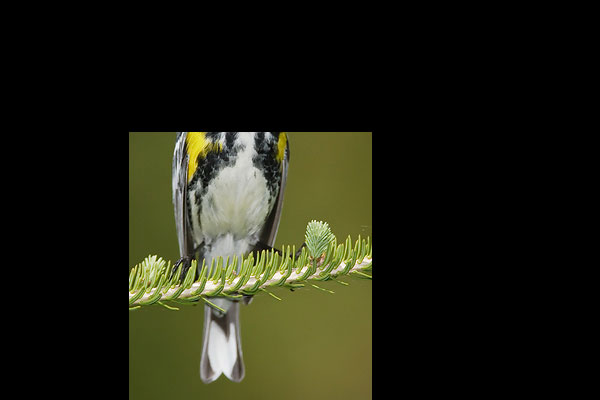
This quiz shows warblers as they are so often seen in the field – with just the underside of the body visible. Clues such as tail shape, overall size, behavior and other subtleties can be very helpful with experience. In this quiz I focus on the more objective features of plumage.
When all you can see is the belly, flanks, and tail of a warbler, take note of tail pattern, any streaking, and the overall pattern of dark/light and bright/drab. You should be able to identify most species by matching those patterns to the pictures in the guide, and with practice you will recognize more and more warblers from these small clues.
With thanks, again, to Brian E. Small for providing the beautiful photos. You can see lots more at his website.
More Warblers
Please wait while the activity loads. If this activity does not load, try refreshing your browser. Also, this page requires javascript. Please visit using a browser with javascript enabled.
If loading fails, click here to try again
Congratulations - you have completed More Warblers.
You scored %%SCORE%% out of %%TOTAL%%.
Your performance has been rated as %%RATING%%
Your answers are highlighted below.
Question 1
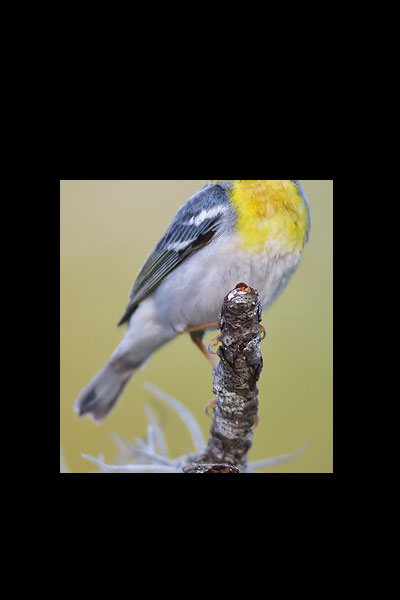
Northern ParulaBlackburnian WarblerMagnolia WarblerYellow-rumped WarblerQuestion 1 Explanation:Northern Parula - the combination of yellow breast with unstreaked gray-white belly and flanks is unique to Parula. In the partly obscured view above the blue-gray wings with two short white wingbars help confirm the species.
 Question 2
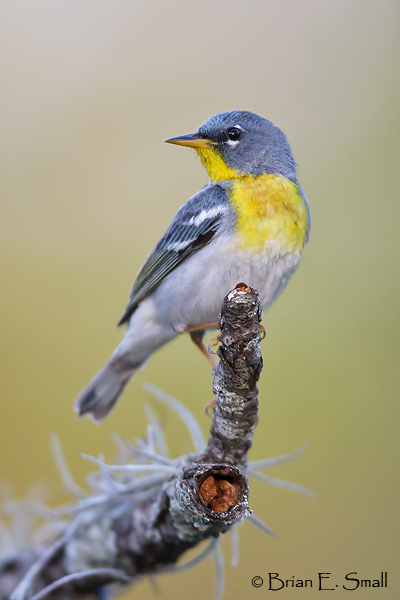
Magnolia WarblerAmerican RedstartYellow-rumped WarblerNorthern ParulaQuestion 2 Explanation:Yellow-rumped Warbler - This is a male, and the pattern of blackish streaks on the flanks and breast, leaving a tapered white belly patch is unique to Yellow-rumped. And of course the bright yellow patches on the sides of the breast are distinctive as well.
 Question 3

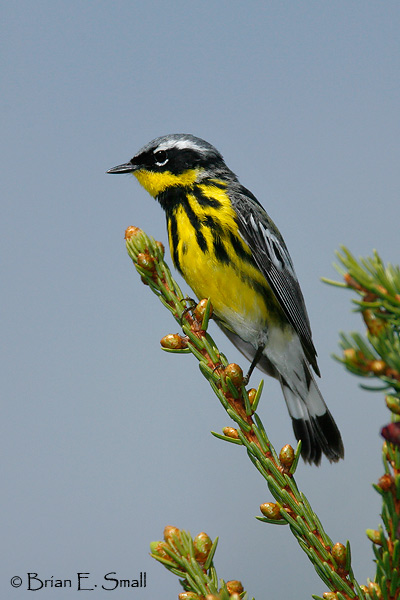
Yellow-rumped WarblerPrairie WarblerMagnolia WarblerNorthern ParulaQuestion 3 Explanation:Magnolia Warbler - The pattern on the tail, white at the base and black at the tip, is unique and you don't need to see anything else to identify this bird. Also, no other eastern warbler has such thick black streaks on bright yellow flanks (Townsend's is similar in the west, but the tail is almost entirely white from below).
Once you are finished, click the button below. Any items you have not completed will be marked incorrect.
Get Results
There are 3 questions to complete.
You have completed
questions
question
Your score is
Correct
Wrong
Partial-Credit
You have not finished your quiz. If you leave this page, your progress will be lost.
Correct Answer
You Selected
Not Attempted
Final Score on Quiz
Attempted Questions Correct
Attempted Questions Wrong
Questions Not Attempted
Total Questions on Quiz
Question Details
Results
Date
Score
Time allowed
minutes
seconds
Time used
Answer Choice(s) Selected
Question Text
All doneNeed more practice!Keep trying!Not bad!Good work!Perfect!
April 29, 2012
Mystery Bird Song – Concord, MA
I recorded this sound (with my iPhone, please excuse the poor quality) on 29 April 2012 near my house in Concord, MA. Have a listen and see what you think. For a little additional background information, which will also give you a hint, read the footnote below.1
Click this link to listen to the sound:
MysterySound_ConcordMA_Apr2012_crop
And when you’re ready to know the answer click here.
This is a fairly common variant of the song of a common bird here in Massachusetts. I suspect that local birders, at least, will identify it easily, but I think it is specific to this area so I’m curious to know if it sounds familiar to birders from other regions.
April 27, 2012
Quiz 31: More warblers by partial cues

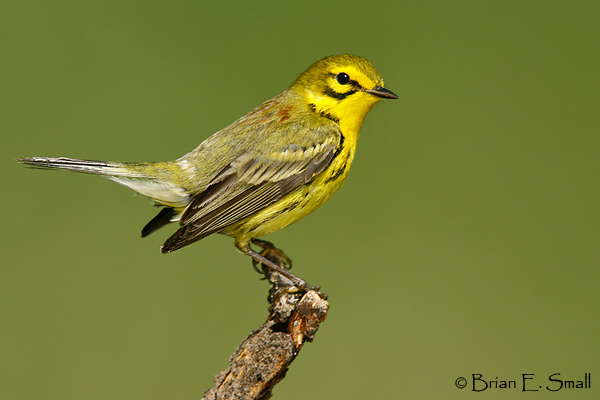
Here are some partially obscured warblers to test your knowledge. Look especially at the pattern of wingbars to distinguish these three.
With thanks, again, to Brian E. Small for providing the beautiful photos. You can see lots more at his website.
Warbler mid-sections
Please wait while the activity loads. If this activity does not load, try refreshing your browser. Also, this page requires javascript. Please visit using a browser with javascript enabled.
If loading fails, click here to try again
Congratulations - you have completed Warbler mid-sections.
You scored %%SCORE%% out of %%TOTAL%%.
Your performance has been rated as %%RATING%%
Your answers are highlighted below.
Question 1

Yellow WarblerCape May WarblerPrairie WarblerMagnolia WarblerQuestion 1 Explanation:
 Question 2

Magnolia WarblerCape May WarblerYellow WarblerPrairie WarblerQuestion 2 Explanation:
 Question 3

Yellow WarblerPrairie WarblerMagnolia WarblerCape May WarblerQuestion 3 Explanation:
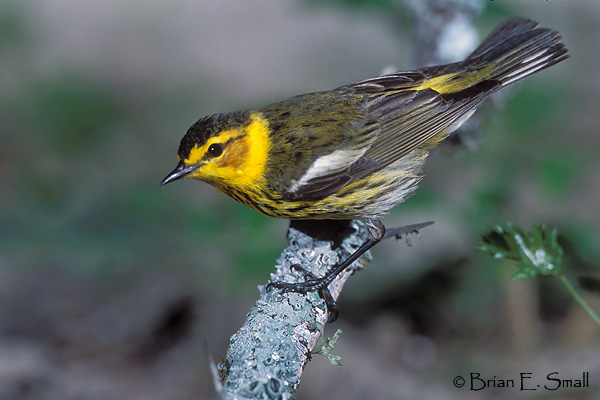 Question 4Now look at the greater coverts on each of the three species above. Two species have all of the greater coverts more or less the same pattern, and one species has a strikingly different color pattern on some of its greater coverts. Which species has non-uniform greater coverts?Prairie WarblerCape May WarblerYellow WarblerQuestion 4 Explanation:Correct! Cape May Warbler. The median coverts are bright white, and merge with white on several of the middle greater coverts, But the innermost (upper) and outermost (lower) greater covert are dark gray with greenish edges. No other warbler shares this pattern, and neither does the female Cape May. You can see more photos, including a female, here - http://briansmallphoto.com/cape_may_warbler.html
 Once you are finished, click the button below. Any items you have not completed will be marked incorrect.
Get Results
There are 4 questions to complete.
You have completed
questions
question
Your score is
Correct
Wrong
Partial-Credit
You have not finished your quiz. If you leave this page, your progress will be lost.
Correct Answer
You Selected
Not Attempted
Final Score on Quiz
Attempted Questions Correct
Attempted Questions Wrong
Questions Not Attempted
Total Questions on Quiz
Question Details
Results
Date
Score
Time allowed
minutes
seconds
Time used
Answer Choice(s) Selected
Question Text
All doneNeed more practice!Keep trying!Not bad!Good work!Perfect!
April 26, 2012
In praise of mystery

Unidentified Elaenia, Chicago, IL. April 2012. Photo copyright Ken Koontz, used by permission.
The still-unidentified Elaenia, found by Ethan and Aaron Gyllenhaal in Illinois, has provided one of the most exciting and interesting bird identification challenges in recent years. It is either a first North American record of Small-billed Elaenia, or second North American record of White-crested (or third if an earlier record from Florida was White-crested).
Both species nest in southern South America and spend the austral winter (our summer) in northern South America. Like Fork-tailed Flycatcher, occasional misoriented migrants can show up in the US, and identifying Elaenias here offers new challenges. It’s one thing to identify the species where they are common, in familiar surroundings, and usually calling. Identifying a silent Elaenia in Chicago, where neither the bird nor the observer has any familiar point of reference, is another matter.
The Chicago Elaenia never called (which would have solved the mystery easily). As the days went by there was increasing interest in trying to catch the bird, primarily to get a feather for DNA testing. A firm diagnosis would have been nice, but the discussion was so good that I voted against trying to get a DNA sample.
That’s an easy position for me to take, being a thousand miles away with no investment in the outcome of the ID discussion. But the idea of testing a DNA sample felt a little bit like cheating. It was as if we were all working on solving a difficult puzzle, and someone suggested turning to page 57 to peek at the answer.
I’m not against the use of technology in birding. DNA testing is an incredibly powerful tool and will undoubtedly lead to many more surprising discoveries (like the Illinois Rufous Hummingbird last winter). I’m just suggesting that we stand to learn more from the intellectual curiosity that will now be focused on identifying the photos of the Chicago Elaenia, than we would by just running a test and knowing the answer.
In the words of Isaac Asimov:
The most exciting phrase to hear in science, the one that heralds the most discoveries, is not “Eureka!” (I found it!) but “That’s funny…”
Links
Discussion of the Chicago Elaenia, 16 pages and growing on the Illinois Birders Forum: http://www.ilbirds.com/index.php?topic=50480.0
More of Ken Koontz’s photos: http://kkoontz.com/p626194979
Discussion of the Chicago hummingbird, Broad-tailed or hybrid then confirmed by DNA as Rufous: http://www.ilbirds.com/index.php?topic=49536
April 24, 2012
Quiz 30: Comparing bird weights
Continuing the challenge of comparing bird weights, here are some familiar species to test your knowledge.
Still more bird weights
Please wait while the activity loads. If this activity does not load, try refreshing your browser. Also, this page requires javascript. Please visit using a browser with javascript enabled.
If loading fails, click here to try again
Congratulations - you have completed Still more bird weights.
You scored %%SCORE%% out of %%TOTAL%%.
Your performance has been rated as %%RATING%%
Your answers are highlighted below.
Question 1Which species weighs more?Northern CardinalAmerican RobinQuestion 1 Explanation:American Robin 75g --- Northern Cardinal 45 gQuestion 2How does an ordinary can of soda compare to the weight of a Little Blue Heron?Soda weighs moreHeron weighs moreAbout the sameQuestion 2 Explanation:both weigh about 340 grams or 12 ounces
Question 3Which species weighs more?Northern Mockingbird
European Starling
Question 3 Explanation:European Starling 82g --- Northern Mockingbird 48g
Question 4Which species weighs more?Purple MartinEuropean StarlingQuestion 4 Explanation:European Starling 82g --- Purple Martin 57gQuestion 5Which species weighs more?Rock Pigeon
Pied-billed GrebeQuestion 5 Explanation:Rock Pigeon 254g --- Pied-billed Grebe 425g
Once you are finished, click the button below. Any items you have not completed will be marked incorrect.
Get Results
There are 5 questions to complete.
You have completed
questions
question
Your score is
Correct
Wrong
Partial-Credit
You have not finished your quiz. If you leave this page, your progress will be lost.
Correct Answer
You Selected
Not Attempted
Final Score on Quiz
Attempted Questions Correct
Attempted Questions Wrong
Questions Not Attempted
Total Questions on Quiz
Question Details
Results
Date
Score
Time allowed
minutes
seconds
Time used
Answer Choice(s) Selected
Question Text
All doneNeed more practice!Keep trying!Not bad!Good work!Perfect!
April 23, 2012
Quiz 29: Comparing bird weights
Today’s quiz revisits the challenge of comparing bird weights. In the field we get a sense of the “bulk” of a bird, and that is a very important part of judging overall size. Learning the actual weight can be a great help in making those comparisons.
For example, Hutton’s Vireo and Ruby-crowned Kinglet look very similar, and are about the same length, but the vireo weighs almost twice as much!
If you are aware of this you might notice it in the way the bird moves, the way a twig shakes as the bird hops on and off, and other clues that will allow an instant identification.
Test yourself and learn from the questions below.
More Bird Weights
Please wait while the activity loads. If this activity does not load, try refreshing your browser. Also, this page requires javascript. Please visit using a browser with javascript enabled.
If loading fails, click here to try again
Congratulations - you have completed More Bird Weights.
You scored %%SCORE%% out of %%TOTAL%%.
Your performance has been rated as %%RATING%%
Your answers are highlighted below.
Question 1Which species weighs more?
Yellow Warbler
American Goldfinch
Question 1 Explanation:Yellow Warbler 9.3g --- American Goldfinch 13g
Question 2Which species weighs more?Mourning DoveCommon Nighthawk Question 2 Explanation:Common Nighthawk 62g --- Mourning Dove 120g
Question 3Which species weighs more?Cedar WaxwingLazuli or Indigo BuntingQuestion 3 Explanation:Cedar Waxwing 31g --- Indigo or Lazuli Bunting 15g
Once you are finished, click the button below. Any items you have not completed will be marked incorrect.
Get Results
There are 3 questions to complete.
You have completed
questions
question
Your score is
Correct
Wrong
Partial-Credit
You have not finished your quiz. If you leave this page, your progress will be lost.
Correct Answer
You Selected
Not Attempted
Final Score on Quiz
Attempted Questions Correct
Attempted Questions Wrong
Questions Not Attempted
Total Questions on Quiz
Question Details
Results
Date
Score
Time allowed
minutes
seconds
Time used
Answer Choice(s) Selected
Question Text
All doneNeed more practice!Keep trying!Not bad!Good work!Perfect!
April 16, 2012
Bird Topography – How it helps identify birds
I was musing on the value of learning bird topography this morning, wondering why it is so important to know the greater coverts and supercilium and all the rest. The easy answer is that it gives us a framework to describe the color patterns of birds, but I think there’s even more to it than that.
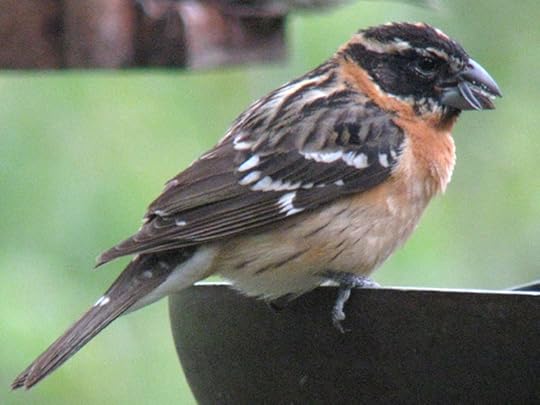
Black-headed Grosbeak - a "field-guide-style" profile view. Find the scapulars, the supercilium, or any other group of feathers you like, and compare their appearance here with the two photos below. Notice how the shape and angle of the feather groups seems to change as our view of the bird changes. This information can be applied to any species of bird, and helps to understand the changing appearance. Photograph copyright David Sibley, June 2009, Pine Butte Guest Ranch, Montana.
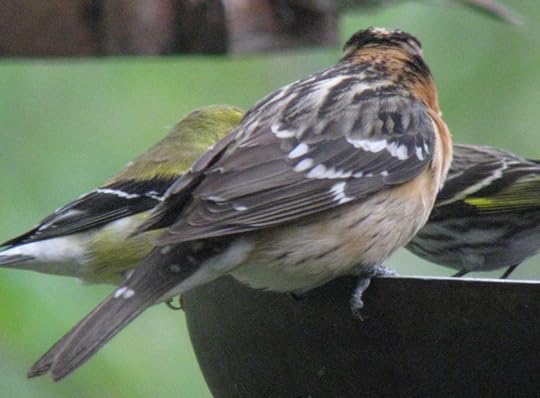
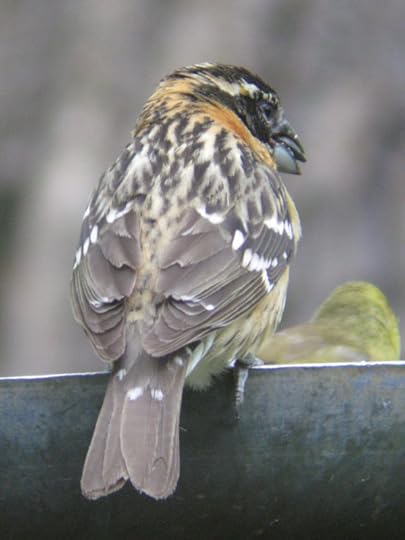
When we study a field guide we can memorize the color patterns in standard profile illustrations, but birds are 3-dimensional and they move around. It wouldn’t be practical to memorize hundreds of different “patterns” specific to different angles, and that’s not how our visual perception works. We memorize one pattern and apply basic rules of perspective to adapt to different viewing angles.
One of the keys to successful bird identification in the field is being able to translate the two-dimensional pattern we know from the field guide, and apply it to a three-dimensional bird that keeps showing us different angles.
Our general experience with visual perception has taught us rules of perspective that allow us to account for changes in appearance, but that has to be informed by simple things like knowing the planes of the surfaces of a birds body. The wings fold up on the sides of the body, the supercilium is mostly on the side of the head, crown stripes on top, etc. Anyone who watches birds a lot will learn this, but learning bird topography will help explain it.
It’s very helpful to know what parts of the bird will be visible from any angle, what plane they are in, and the arrangement of feathers that form those parts. That will allow you to apply perspective and anticipate the color pattern. Bird topography provides a framework for describing color pattern, and also provides a framework for understanding structure and perspective.
April 14, 2012
Auction of my Original Art – Closing Tomorrow (Sunday)
More info about the medium – ink on scratchboard – and my technique can be found in this post.
I am currently testing the feasibility of selling my original art in an open auction format. I will be offering several pieces in auctions over the next few weeks, and will make a decision after that whether to continue this format.
The current auctions can be seen in the sidebar to the right. This auction uses “proxy” bidding or automatic bidding, the same method used on eBay. If you’re not familiar with how that works you can read the explanation on eBay here.
Please check it out, let me know if you have any questions, and post a bid if you like. And stay tuned for more auctions over the next few weeks! 

David Allen Sibley's Blog

- David Allen Sibley's profile
- 151 followers

