
Quiz 32 – Warblers from below
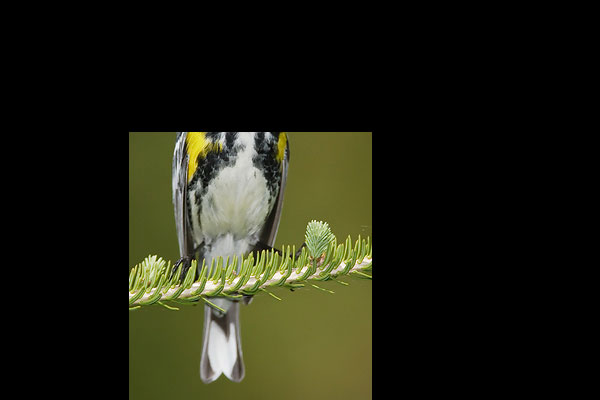
This quiz shows warblers as they are so often seen in the field – with just the underside of the body visible. Clues such as tail shape, overall size, behavior and other subtleties can be very helpful with experience. In this quiz I focus on the more objective features of plumage.
When all you can see is the belly, flanks, and tail of a warbler, take note of tail pattern, any streaking, and the overall pattern of dark/light and bright/drab. You should be able to identify most species by matching those patterns to the pictures in the guide, and with practice you will recognize more and more warblers from these small clues.
With thanks, again, to Brian E. Small for providing the beautiful photos. You can see lots more at his website.
More Warblers
Please wait while the activity loads. If this activity does not load, try refreshing your browser. Also, this page requires javascript. Please visit using a browser with javascript enabled.
If loading fails, click here to try again
Congratulations - you have completed More Warblers.
You scored %%SCORE%% out of %%TOTAL%%.
Your performance has been rated as %%RATING%%
Your answers are highlighted below.
Question 1
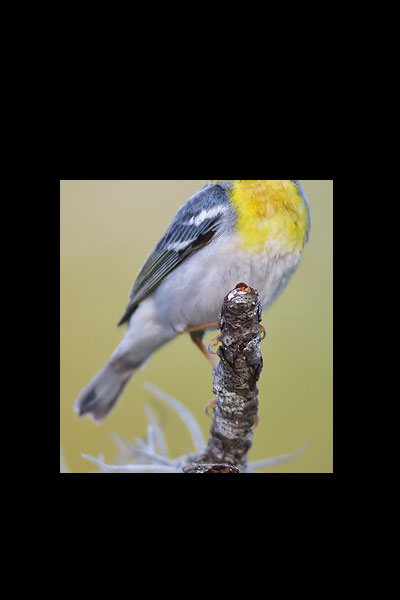
Northern ParulaBlackburnian WarblerMagnolia WarblerYellow-rumped WarblerQuestion 1 Explanation:Northern Parula - the combination of yellow breast with unstreaked gray-white belly and flanks is unique to Parula. In the partly obscured view above the blue-gray wings with two short white wingbars help confirm the species.
 Question 2
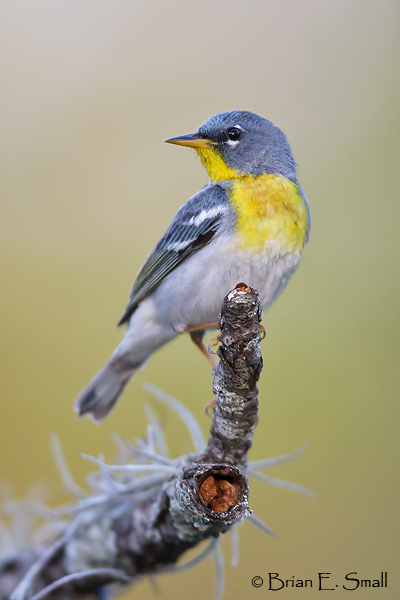
Magnolia WarblerAmerican RedstartYellow-rumped WarblerNorthern ParulaQuestion 2 Explanation:Yellow-rumped Warbler - This is a male, and the pattern of blackish streaks on the flanks and breast, leaving a tapered white belly patch is unique to Yellow-rumped. And of course the bright yellow patches on the sides of the breast are distinctive as well.
 Question 3

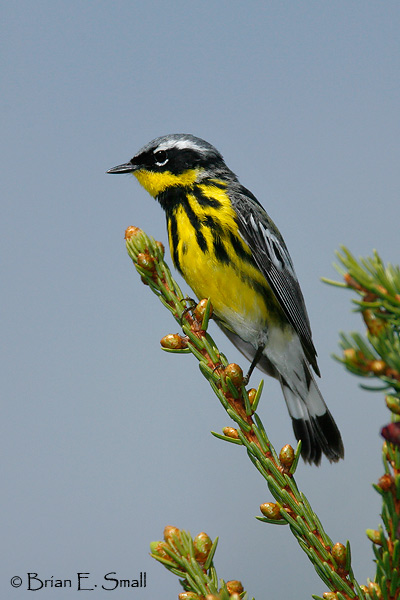
Yellow-rumped WarblerPrairie WarblerMagnolia WarblerNorthern ParulaQuestion 3 Explanation:Magnolia Warbler - The pattern on the tail, white at the base and black at the tip, is unique and you don't need to see anything else to identify this bird. Also, no other eastern warbler has such thick black streaks on bright yellow flanks (Townsend's is similar in the west, but the tail is almost entirely white from below).
Once you are finished, click the button below. Any items you have not completed will be marked incorrect.
Get Results
There are 3 questions to complete.
You have completed
questions
question
Your score is
Correct
Wrong
Partial-Credit
You have not finished your quiz. If you leave this page, your progress will be lost.
Correct Answer
You Selected
Not Attempted
Final Score on Quiz
Attempted Questions Correct
Attempted Questions Wrong
Questions Not Attempted
Total Questions on Quiz
Question Details
Results
Date
Score
Time allowed
minutes
seconds
Time used
Answer Choice(s) Selected
Question Text
All doneNeed more practice!Keep trying!Not bad!Good work!Perfect!


David Allen Sibley's Blog

- David Allen Sibley's profile
- 151 followers

