
David Allen Sibley's Blog, page 19
February 23, 2012
Upcoming event: March 3rd in Massachusetts
I'll be at MassAudubon's annual Birders Meeting next Saturday, March 3rd, in Waltham, Massachusetts. Directions and more info is here.
The theme is seabirds, and there is a great lineup of presentations by such luminaries as Debi Shearwater and Dr. Steven Kress. When you're not engrossed in the presentations, you can find me at a table in the vendor area with original art to show and some art for sale. I will also have samples of posters, t-shirts, books, the new flash cards, and other products. And I'll have the Sibley eGuide to Birds on iPhone and iPad, so if you've been wondering what those are like this is a good chance to take them for a "test drive". And I'll be happy to autograph any books you bring. Mostly I'm looking forward to meeting people and talking birds. If you're in the area, be sure to stop by.
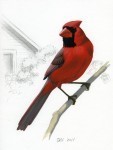
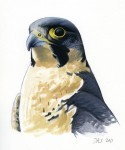
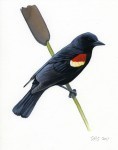
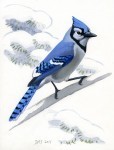
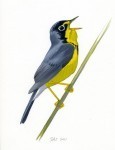
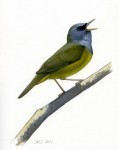
A sample of the original art that will be for sale at the meeting:


February 22, 2012
Quiz 11: Head feather groups and simple color patterns
This quiz is about taking the feather groups you've learned in previous quizzes, and applying them to real birds, to see how color patterns follow the basic feather groups.
And big thanks to Brian E. Small for allowing the use of his superb photographs for the quiz feature here. You can see more at his website and clicking any photo also links there.
Black-and-white head patterns
Please wait while the activity loads. If this activity does not load, try refreshing your browser. Also, this page requires javascript. Please visit using a browser with javascript enabled.
If loading fails, click here to try again
Congratulations - you have completed Black-and-white head patterns.
You scored %%SCORE%% out of %%TOTAL%%.
Your performance has been rated as %%RATING%%
Your answers are highlighted below.
Question 1
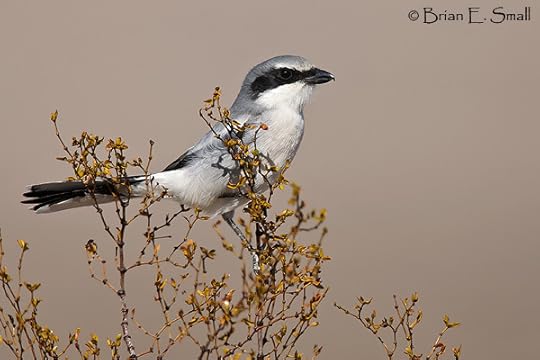
Loggerhead Shrike, photo copyright Brian Small
The malar (or submoustachial) is white.The malar (or submoustachial) is gray.The malar (or submoustachial) is black.Question 2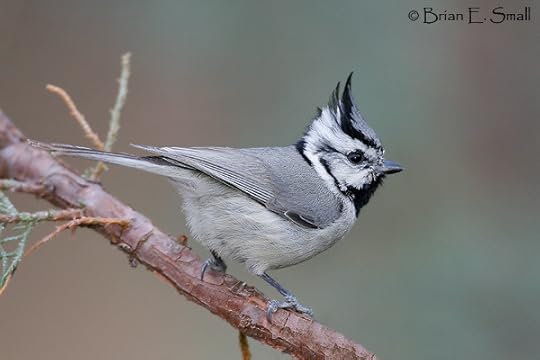
Bridled Titmouse, photo copyright Brian Small
The supercilium is mostly black.The supercilium is mostly gray.The supercilium is mostly white.Question 3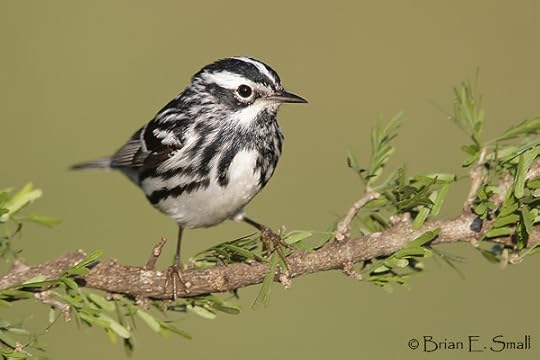
Black-and-white Warbler, photo copyright Brian Small
The auriculars are mostly black.The auriculars are mostly white.Question 4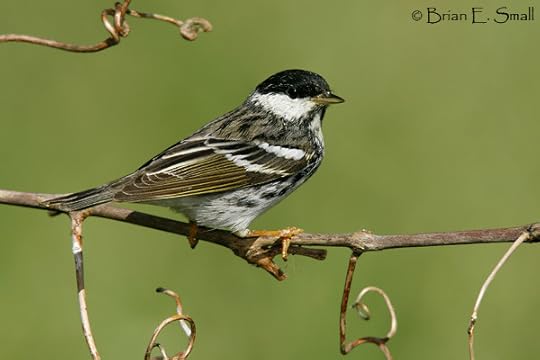
Blackpoll Warbler, photo copyright Brian Small
The auriculars are mostly black.The auriculars are mostly gray.The auriculars are mostly white.Question 5BONUS QUESTION: On the Loggerhead Shrike, the feathers of the supercilium are:blackgraywhiteall of the aboveQuestion 5 Explanation:The feather groups are a general guide to color patterns, but some birds have multiple colors within one feather group. In this case black surrounds the eye and tapers back along the lower edge of the supercilium, the part of the supercilium just above the eye is white, and the whole rear part of the supercilium is gray like the crown.Once you are finished, click the button below. Any items you have not completed will be marked incorrect.
Get Results
There are 5 questions to complete.
You have completed
questions
question
Your score is
Correct
Wrong
Partial-Credit
You have not finished your quiz. If you leave this page, your progress will be lost.
Correct Answer
You Selected
Not Attempted
Final Score on Quiz
Attempted Questions Correct
Attempted Questions Wrong
Questions Not Attempted
Total Questions on Quiz
Question Details
Results
Date
Score
Time allowed
minutes
seconds
Time used
Answer Choice(s) Selected
Question Text
All doneNeed more practice!Keep trying!Not bad!Good work!Perfect!
February 21, 2012
Quiz 10: Head feathers – without markings
This quiz features a Dark-eyed Junco, a species with no discernible color pattern on the head. How can you distinguish groups of head feathers with no color patterns? By looking for the subtle creases and shadows at the edges of the feather groups, and differences in the orientation of the feathers.

Head Feathers without pattern
Please wait while the activity loads. If this activity does not load, try refreshing your browser. Also, this page requires javascript. Please visit using a browser with javascript enabled.
If loading fails, click here to try again
Congratulations - you have completed Head Feathers without pattern.
You scored %%SCORE%% out of %%TOTAL%%.
Your performance has been rated as %%RATING%%
This photo shows the feather groups outlined, to compare with the original photo above. The area in front of the eyes is the lores, and was not included in the quiz.

Your answers are highlighted below.
Question 1The crown is labeled:ABCDEQuestion 1 Explanation:Covering the top of the head, the crown feathers are fairly simple to recognize. At the front on the forehead they become very short and stiff, merging with the lores below.Question 2The auriculars are labeled:ABCDEQuestion 2 Explanation:The auriculars cover the ear, which is just behind and below the eye. There is usually a prominent crease straight behind the eye, which marks the upper edge of the auriculars, and a less prominent crease at the lower edge. At the front, just below the eye, the auriculars merge into the short bristly feathers of the lores.Question 3The malar or submoustachial is labeled:ABCDEQuestion 3 Explanation:These feathers cover the side of the lower jaw, and can be found by looking at the base of the lower mandible and following the band of feathers that begins there. It shows fairly prominent creases at the edges close to the bill, but farther back the malar feathers merge into the feather groups above and below. Notice the shadow created at the perpendicular angle between the malar feathers (on the side of the lower jaw) and the group of feathers below that spans the underside of the jaw.Question 4The throat is labeled:ABCDEQuestion 4 Explanation:The throat is easily recognized. It includes the feathers that span the underside of the lower jaw, in a plane perpendicular to the feathers on the sides of the head. Question 5The supercilium is labeled:ABCDEQuestion 5 Explanation:The feathers of the supercilium grow out from the sides of the head and curve up, in contrast to the feathers on the top of the head which simply grow back and lay flat on the head.
At its front end, just above and in front of the eye, the supercilium merges into the short bristly feathers of the lores.
Once you are finished, click the button below. Any items you have not completed will be marked incorrect.
Get Results
There are 5 questions to complete.
You have completed
questions
question
Your score is
Correct
Wrong
Partial-Credit
You have not finished your quiz. If you leave this page, your progress will be lost.
Correct Answer
You Selected
Not Attempted
Final Score on Quiz
Attempted Questions Correct
Attempted Questions Wrong
Questions Not Attempted
Total Questions on Quiz
Question Details
Results
Date
Score
Time allowed
minutes
seconds
Time used
Answer Choice(s) Selected
Question Text
All doneNeed more practice!Keep trying!Not bad!Good work!Perfect!
Rough-legged vs. Red-tailed?
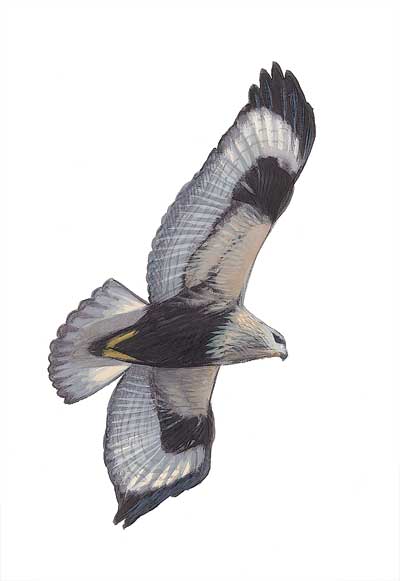
Juvenile Rough-legged Hawk. Original gouache painting copyright David Sibley.
The other morning I was passing a farm field near my house. It's a place where I often go birding and as I glanced around I was thinking "maybe there could be a Rough-legged Hawk today". But I've never seen a Rough-legged Hawk here in 12 years in the neighborhood, and all I could see was one of the resident Red-tails. And I realized that if any Rough-legged Hawk was passing by and paused to hunt over this field, the resident pair of Red-tailed Hawks would probably chase it away immediately.
Anyone who has been birding in the northeast for more than a decade has noticed the increase in Red-tailed Hawks. They have adapted to the suburbs and increased in numbers steadily for at least 50 years, becoming a widespread and omnipresent part of the avifauna.
These Red-tails are mostly resident. As long as they have enough food, pairs of adults remain on their territories and aggressively defend them year-round. In the same fifty year period the number of Rough-legged Hawks found on Christmas Counts in Massachusetts has declined dramatically.
A similar pattern shows in other Northeastern states, but in Manitoba and nearby states and provinces, where Red-tailed Hawks are not resident, the number of Rough-leggeds found on Christmas Counts has increased over the last fifty years.

Number of Red-tailed Hawks seen per party-hour on Massachusetts CBCs over the last fifty years.

Number of Rough-legged Hawks seen per party-hour on Massachusetts CBCs for the last fifty years.
A similar sort of displacement was the leading hypothesis for the decline of Purple Finch in the northeast. They were being "outcompeted" by introduced House Finches, so the story went, but I don't think there's any evidence to support that. The increase of very aggressive Mute Swans in the northeast may be leading to declines of other nesting waterfowl. There are presumably other examples of this kind of interaction between species.
The number of Rough-legged Hawks wintering in Massachusetts was always small, so changes here are probably not significant to the species as a whole, and I'm not suggesting that there is any cause for alarm or action. It's possible that the decline of Rough-leggeds here has more to do with the well-documented loss of open farmland and increasing forest cover in the last few decades. I'm just curious.
Have you noticed interactions between Red-tailed Hawks and wintering Rough-legged in your area? Do Rough-legged Hawks and resident Red-tails coexist anywhere? Is there any place Rough-legged Hawks have declined where Red-tails are not resident?
Graphs are from the Audubon Christmas Bird Count website at http://birds.audubon.org/historical-results
February 20, 2012
Quiz 9: More on Head feathers

Here is a close-up of the head of a Song Sparrow, showing the feather groups and feather markings really well. In the copy below, I've outlined the feather groups, so that you can test your knowledge in the quiz that follows.

Head Feathers 2
Please wait while the activity loads. If this activity does not load, try refreshing your browser. Also, this page requires javascript. Please visit using a browser with javascript enabled.
If loading fails, click here to try again
Congratulations - you have completed Head Feathers 2.
You scored %%SCORE%% out of %%TOTAL%%.
Your performance has been rated as %%RATING%%
Your answers are highlighted below.
Question 1The malar or submoustachial is labeled:ABCDEFQuestion 2The auriculars are labeled:ABCDEFQuestion 3The throat is labeled:ABCDEFQuestion 4The crown is labeled:ABCDEFQuestion 5The lores are labeled:ABCDEFQuestion 6The supercilium is labeled:ABCDEF
Once you are finished, click the button below. Any items you have not completed will be marked incorrect.
Get Results
There are 6 questions to complete.
You have completed
questions
question
Your score is
Correct
Wrong
Partial-Credit
You have not finished your quiz. If you leave this page, your progress will be lost.
Correct Answer
You Selected
Not Attempted
Final Score on Quiz
Attempted Questions Correct
Attempted Questions Wrong
Questions Not Attempted
Total Questions on Quiz
Question Details
Results
Date
Score
Time allowed
minutes
seconds
Time used
Answer Choice(s) Selected
Question Text
All doneNeed more practice!Keep trying!Not bad!Good work!Perfect!
February 16, 2012
Quiz 8: Introduction to head feathers
Color patterns on the heads of birds are some of the most complex, and also some of the most important for identification. Understanding those patterns is significantly easier if you learn the five major groups of head feathers, since the contours of the feathers define most of the color patterns shown by birds.
In the photo below, you can see these feather groups and how they relate to the color patterns. To recognize these feather groups even on a species where they are all the same color, look for subtle "creases" where feather groups meet, and for the different planes of the head. For example, the feather group labeled D below is broad when viewed from the side but appears narrow (foreshortened) when viewed from the front.
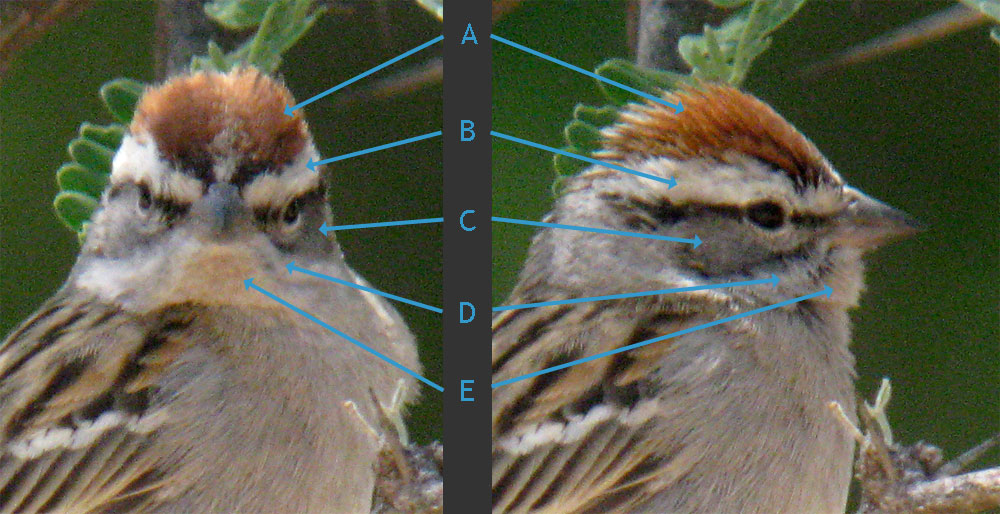
Photos from Patagonia, AZ, May 2011; copyright David Sibley.
Head Feathers: Introduction
Please wait while the activity loads. If this activity does not load, try refreshing your browser. Also, this page requires javascript. Please visit using a browser with javascript enabled.
If loading fails, click here to try again
Congratulations - you have completed Head Feathers: Introduction.
You scored %%SCORE%% out of %%TOTAL%%.
Your performance has been rated as %%RATING%%
Your answers are highlighted below.
Question 1The supercilium is labeled:ABCDEQuestion 1 Explanation:This can also be called the eyebrow (but that would have been too easy). I actually prefer the term "eyebrow stripe" when referring to a contrastingly colored stripe. In this case the pale eyebrow stripe covers essentially the whole supercilium, but in other species the pale eyebrow stripe can be broader or narrower (with more pale feathers than this, or fewer).Question 2The malar or submoustachial is labeled:ABCDEQuestion 2 Explanation:This feather group has a confusing history of names. Many other modern field guides call it the "submoustachial stripe", and use "malar stripe" to refer to a dark line just below these feathers. In the Sibley Guides I call it the malar feather group (like older field guides and most ornithology texts), but to escape the confusion I may need to rethink the name.Question 3The crown is labeled:ABCDEQuestion 3 Explanation:This feather group is simple, easily recognized, and well-named. Notice how all of the feathers grow up and straight back, lining up in rows that form the crown stripes shown by so many species.Question 4The throat is labeled:ABCDEQuestion 4 Explanation:Like the crown, this feather group is well-named and easy to recognize. It spans the underside of the lower jaw.Question 5The auriculars are labeled:ABCDEQuestion 5 Explanation:These are also known as the "ear-coverts", and are a very complex bunch of feathers that can be subdivided into multiple groups. On this bird, the auriculars are dark along the top edge (the eye line), and the bottom edge just below the eye (the moustachial stripe). The area between the eye and the bill is called the lores.Question 6And the species is:House SparrowAmerican Tree SparrowWhite-crowned SparrowChipping SparrowRufous-winged SparrowQuestion 6 Explanation:Rufous-winged Sparrow would have a grayish supercilium (not white), rufous line behind the eye (not blackish), and a prominent dark lateral throat stripe just below the malar.
American Tree Sparrow would also show a grayish supercilium and rufous eyeline, as well as a bicolored bill.
House Sparrow and White-crowned Sparrow differ in many ways.
Once you are finished, click the button below. Any items you have not completed will be marked incorrect.
Get Results
There are 6 questions to complete.
You have completed
questions
question
Your score is
Correct
Wrong
Partial-Credit
You have not finished your quiz. If you leave this page, your progress will be lost.
Correct Answer
You Selected
Not Attempted
Final Score on Quiz
Attempted Questions Correct
Attempted Questions Wrong
Questions Not Attempted
Total Questions on Quiz
Question Details
Results
Date
Score
Time allowed
minutes
seconds
Time used
Answer Choice(s) Selected
Question Text
All doneNeed more practice!Keep trying!Not bad!Good work!Perfect!
February 15, 2012
Quiz 7: more on bird weights, with a twist
In this quiz your challenge is to compare the weight of the birds with common household items. There is variation in the weight of the birds, and variation in the weight of some of the other items, so this is meant to be a comparison of the average weight for each. We could quibble over how much the average banana or deck of cards weighs, but we won't (unless you think one of my numbers is really far off).

Yellow Warbler and two nickels - which weighs more?
Bird Sizes: Weights 2
Please wait while the activity loads. If this activity does not load, try refreshing your browser. Also, this page requires javascript. Please visit using a browser with javascript enabled.
If loading fails, click here to try again
Congratulations - you have completed Bird Sizes: Weights 2.
You scored %%SCORE%% out of %%TOTAL%%.
Your performance has been rated as %%RATING%%
Your answers are highlighted below.
Question 1Which weighs more?A Cherry TomatoA Least SandpiperQuestion 1 Explanation:Cherry Tomato 15g: Least Sandpiper 20g
It's pretty close, and I'm sure some cherry tomatoes weigh more than the average Least Sandpiper. Question 2Which weighs more?A deck of cardsA Least BitternQuestion 2 Explanation:Deck of cards 90g; Least Bittern 80gQuestion 3Which weighs more?A Bonaparte's GullA BananaQuestion 3 Explanation:Banana 170g; Bonaparte's Gull 200gQuestion 4Which weighs more?A quarterA Golden-crowned KingletQuestion 4 Explanation:Both weigh 6 gramsQuestion 5Which weighs more?A Yellow WarblerTwo NickelsQuestion 5 Explanation:Two nickels 10g; Yellow Warbler 9g
Once you are finished, click the button below. Any items you have not completed will be marked incorrect.
Get Results
There are 5 questions to complete.
You have completed
questions
question
Your score is
Correct
Wrong
Partial-Credit
You have not finished your quiz. If you leave this page, your progress will be lost.
Correct Answer
You Selected
Not Attempted
Final Score on Quiz
Attempted Questions Correct
Attempted Questions Wrong
Questions Not Attempted
Total Questions on Quiz
Question Details
Results
Date
Score
Time allowed
minutes
seconds
Time used
Answer Choice(s) Selected
Question Text
All doneNeed more practice!Keep trying!Not bad!Good work!Perfect!
February 14, 2012
It's right where I'm looking!
Discussions of birding techniques dwell mainly on finding and identifying birds, as they should, but as soon as you've accomplished one or both of those things, it's essential to be able to direct other people to the bird you are seeing. Unfortunately this aspect of birding skills gets less attention than it deserves, and the discussion pretty much begins and ends with the suggestion to use the "clock" method. Here I've tried to describe some of the basics of pointing out birds, and added a little quiz.
Giving directions well allows everyone to see the birds, more quickly and easily, and makes for a smooth and pleasant birding experience. Giving directions badly leads to missed birds, frustration, and hard feelings. This is a learned skill, and it needs to be practiced.
The essential principles are:
Start with the basics – really basic. Is it flying or sitting? on the ground or in a tree? etc
Find an obvious landmark and use that to get everyone in the ballpark (e.g. "see the burning tires… go left") then get more specific to zero in on the location
Keep giving directions and describing what the bird is doing; bad directions can be frustrating, silence is more so
For a bird in a flock, it's helpful to describe what it's doing – "just flapped" or "preening its belly" or "looking toward us" are all helpful hints.
For a flying bird, please don't say "flying left to right" (my pet peeve). That means it's flying right, and in the urgency of the moment your listeners will be reacting to the words "flying left…" before you can finish saying "…to right"
As the person responsible for directing, you may need to lower your binoculars momentarily to look for landmarks, but try not to lose track of the bird when you do this! One option is to use your binoculars to scan the immediate surroundings of the bird – shift quickly left, then back to the bird, then right, then back to the bird – so you don't lose track of it. If you can spot a landmark such as a colorful leaf or broken branch, that might help people find it. For a flying bird, you can pan ahead of it briefly with your binoculars to see what's coming up, then say, it's almost to the boat/house/tower/etc.
Below are a few photos to practice on. This quiz is partly to test your ability but even more to give some real-world examples of the right and wrong way to describe a bird's location. Each photo shows a scene, with the location of a bird indicated by the orange dot. Your challenge is to choose the best description of the bird's location from the available answers.
Bird Location Quiz
Please wait while the activity loads. If this activity does not load, try refreshing your browser. Also, this page requires javascript. Please visit using a browser with javascript enabled.
If loading fails, click here to try again
Congratulations - you have completed Bird Location Quiz.
You scored %%SCORE%% out of %%TOTAL%%.
Your performance has been rated as %%RATING%%
Your answers are highlighted below.
Question 1
 In the white pine, dead centerSee the deepest shadow, with a thin pale tree trunk in it, it's in the tree just left of that, on a branch coming straight towards us about halfway up the treeOn a branch in the middle of the tree. That tree... right... there... [holding binoculars to eyes with one hand, pointing unsteadily with the other] Right in front of me!Question 1 Explanation:If you and you companions can all recognize the white pine, then "In the white pine, dead center" is the best description and you get extra credit for knowing the tree. Give yourself 2300 extra points! I only marked it wrong because I think a lot of people won't know which is the white pine.Question 2
 In the big lone tree, about 10 o'clock, a couple of feet in from the tip of the branchIn the round tree, where there's a kind of a dip on the side, just above a big branch on the left, all aloneIt's the tree straight ahead, maybe a pine tree, about 100 feet away, and it's near the tips of the branchesQuestion 3
 Flying left to right, high up, passing a tall tree
Flying right, above the treetops, about to go over the pathStraight ahead, right where I'm looking, ooh...quick!
Once you are finished, click the button below. Any items you have not completed will be marked incorrect.
Get Results
There are 3 questions to complete.
You have completed
questions
question
Your score is
Correct
Wrong
Partial-Credit
You have not finished your quiz. If you leave this page, your progress will be lost.
Correct Answer
You Selected
Not Attempted
Final Score on Quiz
Attempted Questions Correct
Attempted Questions Wrong
Questions Not Attempted
Total Questions on Quiz
Question Details
Results
Date
Score
Time allowed
minutes
seconds
Time used
Answer Choice(s) Selected
Question Text
All doneNeed more practice!Keep trying!Not bad!Good work!Perfect!
February 13, 2012
Quiz 6: Bird weight
Below is a chance to test your knowledge of bird size, by selecting the heavier species in each of five pairs of birds. Weight, or apparent bulk, is one of the key factors in our impressions of overall size, and it's helpful to think about it explicitly. Watch the birds at your bird feeder or your local patch, paying attention to how they move, how stable they are in the wind, how a perch moves under them, etc. to get a sense of weight.
Bird Sizes: Weights 1
Please wait while the activity loads. If this activity does not load, try refreshing your browser. Also, this page requires javascript. Please visit using a browser with javascript enabled.
If loading fails, click here to try again
Congratulations - you have completed Bird Sizes: Weights 1.
You scored %%SCORE%% out of %%TOTAL%%.
Your performance has been rated as %%RATING%%
Your answers are highlighted below.
Question 1Which bird weighs more?Eastern or Spotted Towhee Barn SwallowQuestion 1 Explanation:Barn Swallow - 19g; Eastern or Spotted Towhee - 40g
Question 2Which bird weighs more?Black-capped or Mountain Chickadee
Brown CreeperQuestion 2 Explanation:Brown Creeper - 8.2g; Black-capped or Mountain Chickadee - 11g
Question 3Which bird weighs more?American RobinBelted KingfisherQuestion 3 Explanation:Belted Kingfisher - 141g; American Robin - 76g
Question 4Which bird weighs more?Downy WoodpeckerWhite-breasted Nuthatch Question 4 Explanation:Downy Woodpecker - 27g; White-breasted Nuthatch - 21g
Question 5Which bird weighs more?House Sparrow Eastern or Western Wood-PeweeQuestion 5 Explanation:Eastern or Western Wood-Pewee - 13.5g; House Sparrow - 28g
Once you are finished, click the button below. Any items you have not completed will be marked incorrect.
Get Results
There are 5 questions to complete.
You have completed
questions
question
Your score is
Correct
Wrong
Partial-Credit
You have not finished your quiz. If you leave this page, your progress will be lost.
Correct Answer
You Selected
Not Attempted
Final Score on Quiz
Attempted Questions Correct
Attempted Questions Wrong
Questions Not Attempted
Total Questions on Quiz
Question Details
Results
Date
Score
Time allowed
minutes
seconds
Time used
Answer Choice(s) Selected
Question Text
All doneNeed more practice!Keep trying!Not bad!Good work!Perfect!
February 10, 2012
Quiz on Bird Topography: Wings 3

Each label in the photo above points to a feather group associated with the wings. In the quiz below, choose the correct name for that labeled feather group.
Bird Topography: Wings 3
Please wait while the activity loads. If this activity does not load, try refreshing your browser. Also, this page requires javascript. Please visit using a browser with javascript enabled.
If loading fails, click here to try again
Congratulations - you have completed Bird Topography: Wings 3.
You scored %%SCORE%% out of %%TOTAL%%.
Your performance has been rated as %%RATING%%
Your answers are highlighted below.
Question 1The feathers labeled 1 are the:Greater covertsMedian coverts BackScapularsQuestion 1 Explanation:The scapulars grow from the shoulder (think scapula) and curve back and down to cover the base of the wing. They form an oval just above the wing coverts and below the mantle feathers. Compare the pattern and orientation of the scapular feathers with the feathers above and below. Also notice the difference in texture between the more fluffy scapulars (and mantle) and the more sturdy-looking and streamlined wing coverts below.
 Question 2The feathers labeled 2 are the:Primary covertsMedian covertsGreater covertsScapularsQuestion 3The feathers labeled 3 are the:Primary covertsSecondariesMedian covertsGreater covertsQuestion 4The feathers labeled 4 are the:ScapularsLesser covertsPrimary covertsMedian covertsQuestion 5The feathers labeled 5 are the:PrimariesSecondariesGreater covertsTertialsQuestion 6The feathers labeled 6 are the:SecondariesTertialsPrimariesGreater covertsQuestion 7Identify the species of the subject bird (the big one).Rose-breasted GrosbeakHouse FinchBaltimore OrioleWhite-winged CrossbillBlack-headed GrosbeakQuestion 8Identify the species of the two smaller birds. They are two different species, and you need to select both from the answers below.Lesser GoldfinchPine SiskinAmerican GoldfinchCommon RedpollHouse Finch
 Once you are finished, click the button below. Any items you have not completed will be marked incorrect.
Get Results
There are 8 questions to complete.
You have completed
questions
question
Your score is
Correct
Wrong
Partial-Credit
You have not finished your quiz. If you leave this page, your progress will be lost.
Correct Answer
You Selected
Not Attempted
Final Score on Quiz
Attempted Questions Correct
Attempted Questions Wrong
Questions Not Attempted
Total Questions on Quiz
Question Details
Results
Date
Score
Time allowed
minutes
seconds
Time used
Answer Choice(s) Selected
Question Text
All doneNeed more practice!Keep trying!Not bad!Good work!Perfect!
David Allen Sibley's Blog

- David Allen Sibley's profile
- 151 followers

