
David Allen Sibley's Blog, page 23
July 30, 2011
New bird names in the 52nd AOU Checklist supplement
The North American Checklist Committee of the AOU has published the 52nd supplement to the AOU Checklist of North American Birds. This supplement includes a lot of changes "under the hood" which will hardly be noticed by the average birder. Several splits result in new names but none have an immediate impact on the North American species count. Some scientific name changes (mostly from the reshuffling of Wood-Warblers – see my post here), and a few other changes in genus and family assignments. Below is a summary of the changes to English and Scientific names of species in the Sibley Guide. To read more about the changes as well as the changes in sequence of species, check out the pdf of the 52nd supplement. When combined with a previous post about and , this updates all species and names in the Sibley Guide to Birds.
Splits:
Kentish Plover Charadrius alexandrinus
Snowy Plover Charadrius nivosus
A long-anticipated split, the Old World Kentish Plover has never been recorded in North America, but has the potential to do so. The two species have always gone by different English names, which remain the same, but the scientific name of Snowy Plover changes to distinguish it from Kentish.
Common Moorhen Gallinula chloropus
Common Gallinule Gallinula galeata
Old World Common Moorhen is distinguished from New World populations by voice and by subtle differences in appearance and the English and scientific names of the North American birds change (see my posts on identification here and here). One record from the Aleutian Islands in fall 2010, if confirmed, will be North America's first Common Moorhen, adding a new species.
Transvolcanic Jay Aphelocoma ultramarina
Mexican Jay Aphelocoma wollweberi
The population of Mexican Jay in the southern highlands of Mexico (not recorded in our area) is now split as a new species and takes the existing scientific name A. ultramarina. This requires the northern population to take a new scientific name, although retaining the current English name.
Changes to species names:
Mourning Warbler Geothlypis philadelphia
formerly Oporornis philadelphia
MacGillivray's Warbler Geothlypis tolmiei
formerly Oporornis tolmiei
Kentucky Warbler Geothlypis formosa
formerly Oporornis formosus [note change in spelling of species name]
Hooded Warbler Setophaga citrina
formerly Wilsonia citrina
Kirtland's Warbler Setophaga kirtlandii
formerly Dendroica kirtlandii
Cape May Warbler Setophaga tigrina
formerly Dendroica tigrina
Cerulean Warbler Setophaga cerulea
formerly Dendroica cerulea
Northern Parula Setophaga americana
formerly Parula americana
Tropical Parula Setophaga pitiayumi
formerly Parula pitiayumi
Magnolia Warbler Setophaga magnolia
formerly Dendroica magnolia
Bay-breasted Warbler Setophaga castanea
formerly Dendroica castanea
Blackburnian Warbler Setophaga fusca
formerly Dendroica fusca
Yellow Warbler Setophaga petechia
formerly Dendroica petechia
Chestnut-sided Warbler Setophaga pensylvanica
formerly Dendroica pensylvanica
Blackpoll Warbler Setophaga striata
formerly Dendroica striata
Black-throated Blue Warbler Setophaga caerulescens
formerly Dendroica caerulescens
Palm Warbler Setophaga palmarum
formerly Dendroica palmarum
Pine Warbler Setophaga pinus
formerly Dendroica pinus
Yellow-rumped Warbler Setophaga coronata
formerly Dendroica coronata
Yellow-throated Warbler Setophaga dominica
formerly Dendroica dominica
Prairie Warbler Setophaga discolor
formerly Dendroica discolor
Grace's Warbler Setophaga graciae
formerly Dendroica graciae
Black-throated Gray Warbler Setophaga nigrescens
formerly Dendroica nigrescens
Townsend's Warbler Setophaga townsendi
formerly Dendroica townsendi
Hermit Warbler Setophaga occidentalis
formerly Dendroica occidentalis
Golden-cheeked Warbler Setophaga chrysoparia
formerly Dendroica chrysoparia
Black-throated Green Warbler Setophaga virens
formerly Dendroica virens
Fan-tailed Warbler Basileuterus lachrymosus
formerly Euthlypis lachrymosa [note change in spelling of species name]
Canada Warbler Cardellina canadensis
formerly Wilsonia canadensis
Wilson's Warbler Cardellina pusilla
formerly Wilsonia pusilla
In higher-level changes, Tityras and Becards are moved into the new family Tityridae, and Bluethroat (and relatives), Wheatear, and Stonechat are moved from the family Turdidae to the family Muscicapidae.


Can Short-tailed Shearwater be identified in the field?
Usually. Experienced observers can almost always identify these species correctly based on careful judgment of head shape and bill size, but these are subtle and subjective impressions, and require a foundation of experience and/or direct comparisons with Sooty. Other features can offer supportive clues or draw attention to a potential Short-tailed, but are not very reliable on their own.
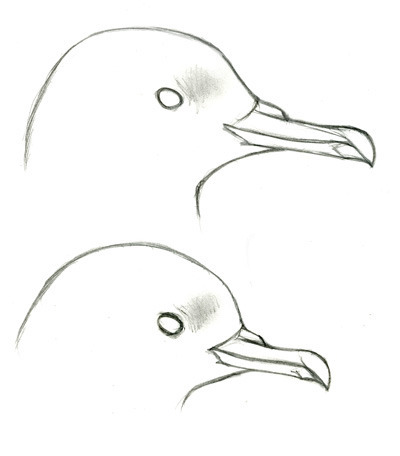
Sooty Shearwater (upper) and Short-tailed Shearwater (lower) showing differences in typical head shape and bill proportions. Pencil drawing copyright David Sibley.
Short-tailed vs Sooty Shearwater
These two species are clearly among the most difficult species-pairs to identify. Differences are small and subjective, and the birds are usually seen in flight and at a distance, often from an unstable boat deck. Their overall similarity is shown by the fact that only a few field marks have ever been proposed.
rounder head and shorter bill – Short-tailed usually appears "cuter", with a slightly steeper forehead, more rounded crown, and smaller bill, best appreciated on a swimming bird at close range
darker underwing coverts – fairly reliable, slightly darker and more uniform on Short-tailed, but the color in both species is variable, with a silvery sheen, and is profoundly influenced by lighting. Furthermore it can be extremely difficult to see clearly, with wings often flickering in and out of shadow.
narrower wing shape – slightly narrower wings (and quicker wingbeats) on Short-tailed, but this is extremely subtle and subjective, and dependent on weather conditions and flight style
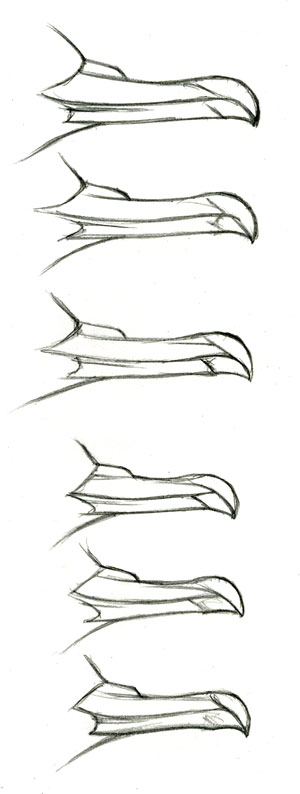
Three Sooty Shearwaters (upper) and three Short-tailed (lower) showing difference in bill length, but similarity in bill shape. Pencil drawing copyright David Sibley.
smaller overall size – slightly smaller overall, but with all the usual cautions about the difficulty of judging size
darker head and paler chin – Short-tailed sometimes looks obviously dark-hooded with pale chin, unlike the more uniform color of Sooty, but not always, and this impression varies depending on lighting
shorter tail (?) – feet often project beyond tail tip in flight, which is seen less often on Sooty Shearwater. Both species often tuck their legs into the flank feathers when flying, so a lack of toes beyond the tail means nothing. (Note that measurements do not really support the "shorter tail" hypothesis, the toe projection may be the result of slightly longer legs, or it may have another explanation)
Of these six features, only head and bill shape offer the promise of a consistent and reliable field mark that might convince a records committee of the identity of a Short-tailed Shearwater outside its normal range. This requires high-quality views from close range, preferably of a bird swimming on the water (not flying).
Bill shape and size
My study of specimens at MCZ1 shows that there is actually no appreciable difference in bill shape. Proportions of nostril tubes, shape of feathering at bill base, size of the nail, etc. is all identical. The only difference is in bill length (and a very subtle difference in relative thickness, see below). The drawings at right show three bills of each species, traced from specimens and adjusted to the mean length of that species. Subtle differences in individuals make each bill look a little different, but if we ignore overall size it is impossible to distinguish Sooty from Short-tailed.
Measurements (from Pyle 2008) show that Short-tailed averages about 24% shorter-billed than Sooty with no overlap in measurements: Short-tailed 29-35 mm, Sooty 38-46 mm. In practice, however, the difference is less obvious because Short-tailed is a smaller bird overall.
Short-tailed Shearwater measurements expressed as a percentage of Sooty Shearwater measurements:
wing
91%
tail
89%
tarsus
93%
bill length
76%
bill depth
82%
If we could enlarge the body of Short-tailed Shearwater to match Sooty in wing, tail, and tarsus measurements, the bill would still be shorter – about 84% as long as Sooty. This is a significant difference and should be apparent under good views in the field, but not as much as the 76% value the absolute bill measurements would suggest. Furthermore, when this correction for body proportions is applied, there is overlap in the apparent bill length relative to body size.
Bill depth is about 20% smaller in Short-tailed than Sooty, while bill length is 24% smaller, so the bill of Short-tailed is proportionally thicker. In other words, if we enlarged the bill of a Short-tailed to be the same length as a Sooty's, it's bill depth would average about 8% thicker than Sooty. While a difference of this magnitude is often visible in the field, a relative difference like this requires a careful assessment of bill proportions, making mental adjustments for overall size, and in actual field conditions this relative difference is probably of little value.
Interestingly, while looking at specimens I was fairly certain that the difference in bill length was due to a reduction of the length of the mid-section of the bill of Short-tailed – that the nasal tubes and nail were similar on the two species, but Sooty had an elongated middle section. Tracing bill shapes and overlaying them showed conclusively that this was not true, and that the proportional lengths of bill parts of both species were the same. But my impression of a shorter mid-section persists even in the drawings shown here. I think the explanation is that this is due to the relatively thicker bill of Short-tailed, and what I interpreted as a shorter mid-section relative to the tubes and nail is actually a shorter mid-section relative to the bill depth.
Head shape
It has often been noted that Short-tailed has a steeper forehead and more rounded head than Sooty, and this is certainly a very consistent impression in the field. The skulls of the two species do not show a difference in forehead angle, but Sooty does show a slightly longer forehead to match the longer bill (photos of Short-tailed skull here and photos of Sooty here). In practice this difference in head shape can be striking, but variation in the attitude of the individual bird, different angles of view, etc mean that it is common to find a Sooty that appears momentarily very round-headed and small-billed.
The differences in head shape are subtle and subjective. There is no quantifiable, objective difference in head shape that can be used to distinguish the two species. A significant effect of the steep forehead is to enhance the small-billed appearance of Short-tailed. The interaction of head shape and apparent bill size cannot be overemphasized, and the two things must be considered together. A bird with a small bill will appear round-headed, and vice versa. A Sooty with its forehead feathers fluffed, or seen from an angle that makes the forehead appear steep, will look shorter-billed than one with the forehead sloped. So, while measurements suggest that Short-tailed and Sooty Shearwater can be very similar in bill length, the slightly shorter bill, in concert with the slightly steeper forehead, creates a distinctly different impression.
Conclusions
Experienced observers within the normal range of Short-tailed Shearwater can identify the species with reasonable confidence, even at a distance, by subtle clues of shape, size, color, and season, but such identifications will never reach the highest level of confidence. These are educated guesses and are easily influenced by all of the pitfalls of expectations and confirmation bias.
Identifying the species with a higher level of confidence requires close and prolonged views, and should focus on bill proportions. Judging this will require previous experience with Sooty and/or Short-tailed Shearwater, and ideally should be based on direct comparisons between the bird in question and Sooty Shearwater.
In the end the most reliable difference seems to be the gestalt impression of the overall head and bill proportions – an inherently unreliable feature, but one that experienced birders will be comfortable using.
References
Gillson, G. 2001. Separation of Sooty and Short-tailed Shearwaters. http://thebirdguide.com/pelagics/book/id_sosh_stsh.htm
Gillson, G. 2008. Field separation of Sooty and Short-tailed Shearwaters off the west coast of North America. Birding 40:34-40. http://www.aba.org/birding/v40n2p34.pdf
Pyle, P. 2008. Identification Guide to North American Birds. Part II. Slate Creek Press.
Notes
Museum of Comparative Zoology, Harvard UniversityObviously the former common name of Slender-billed Shearwater was incorrect. The new name – Short-tailed – is not much better, since the tail is no shorter than Sooty's relative to the rest of the body.
David Allen Sibley's Blog

- David Allen Sibley's profile
- 151 followers

