
David Allen Sibley's Blog, page 13
July 16, 2012
Quiz 39: Bird ID by legs and feet
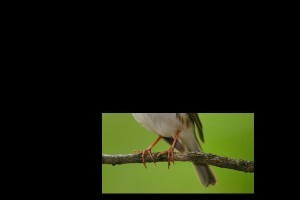 The structure and color of birds’ legs is extremely variable. Everyone knows the difference between the webbed foot of a duck and the unwebbed toes of a chicken, and we can tell the thick, yellow toes of a chicken from the delicate black toes of a flycatcher. Often overlooked, however, is the fact that we can tell most small songbirds apart by their legs and feet – vireos from warblers from flycatchers from sparrows.
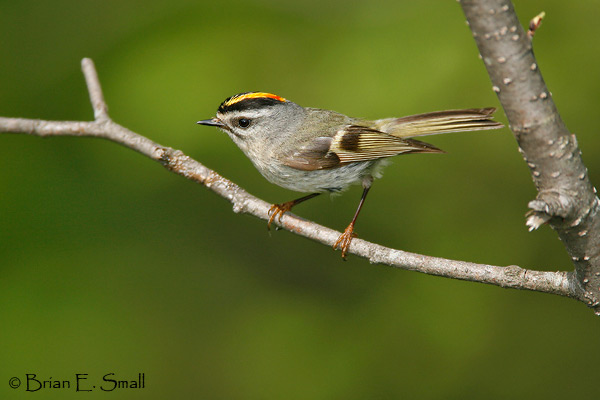
The quiz here introduces this idea with legs and feet of three different species of birds. In the answers you only have to identify the bird to family. The legs and feet of other species in each family are generally similar.
With thanks, again, to Brian E. Small for providing the beautiful photos. You can see lots more at his website.
Legs and feet of songbirds 1
Please wait while the activity loads. If this activity does not load, try refreshing your browser. Also, this page requires javascript. Please visit using a browser with javascript enabled.
If loading fails, click here to try again
Congratulations - you have completed Legs and feet of songbirds 1.
You scored %%SCORE%% out of %%TOTAL%%.
Your performance has been rated as %%RATING%%
Your answers are highlighted below.
Question 1

OrioleVireoKingletWood-WarblerQuestion 1 Explanation:Ovenbird - typical of warblers, with slender legs, weak claws, and delicate toes spreading wide. Pale flesh color shared by only a few other warblers. Thrushes have very similar leg color and structure. Some sparrows have similar color but more robust legs and feet with more obvious claws.
 Question 2

OrioleVireoSparrowKingletQuestion 2 Explanation:Golden-crowned Kinglet - very slender legs and delicate toes; black legs with yellow toes are typical of kinglets and shared by only a few other songbirds (wood-warblers).
 Question 3

VireoSparrowWarblerFlycatcherQuestion 3 Explanation:Red-eyed Vireo - thick legs and toes, bluish gray, are typical of vireos. The way the toes are all pressed tightly together, not spread out, is reminiscent of jays and crows, which are related.

Once you are finished, click the button below. Any items you have not completed will be marked incorrect.
Get Results
There are 3 questions to complete.
You have completed
questions
question
Your score is
Correct
Wrong
Partial-Credit
You have not finished your quiz. If you leave this page, your progress will be lost.
Correct Answer
You Selected
Not Attempted
Final Score on Quiz
Attempted Questions Correct
Attempted Questions Wrong
Questions Not Attempted
Total Questions on Quiz
Question Details
Results
Date
Score
Time allowed
minutes
seconds
Time used
Answer Choice(s) Selected
Question Text
All doneNeed more practice!Keep trying!Not bad!Good work!Perfect!


June 11, 2012
The joy of finger-painting
The painting featured here was done during my recent birding workshop at the Pine Butte Guest Ranch in Montana, and is being auctioned to support the great work of Kate Davis’s Raptors of the Rockies program.
The auction will run until Sunday evening, June 17th, and can be seen in the sidebar to the right.
More info about Kate Davis and Raptors of the Rockies
More info about the Nature Conservancy’s Pine Butte Guest Ranch
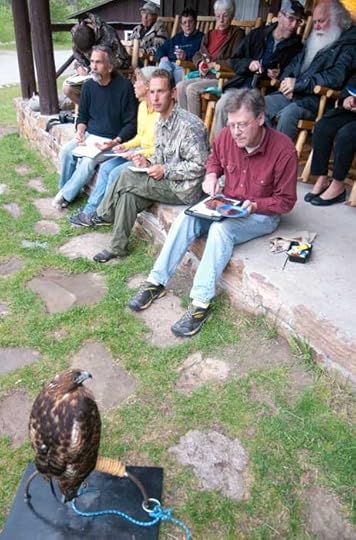
On the porch of the Pine Butte Guest Ranch during a drawing and painting demo. That's me at the front right, then ranch naturalists Jeff Wohl and Nikki Mann, and my co-leader Keith Hansen at the left, with Alisa the Red-tailed Hawk posing. Photo by Kate Davis.
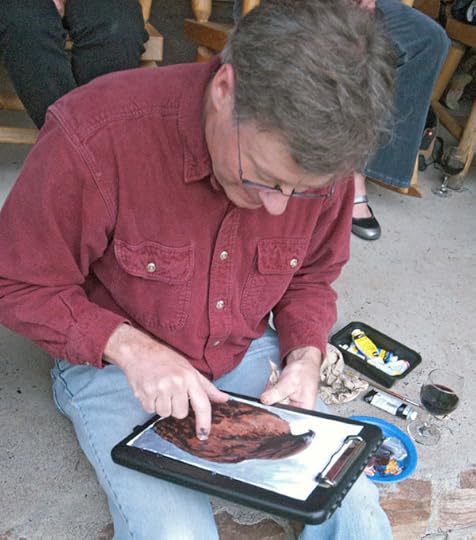
It's a finger-painting. meaning I used my finger, really. Photo by Kate Davis.
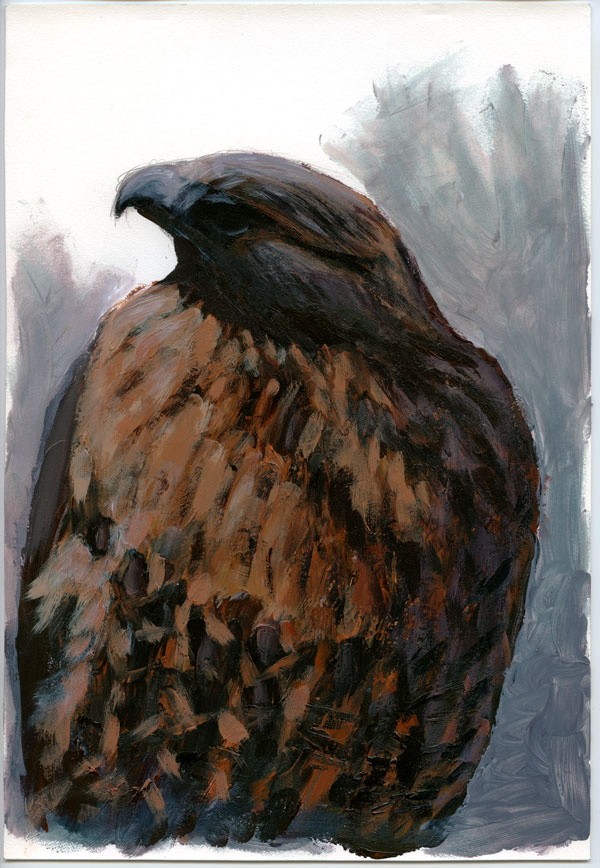
Original acrylic finger painting of Alisa the Red-tailed Hawk, copyright David Sibley.
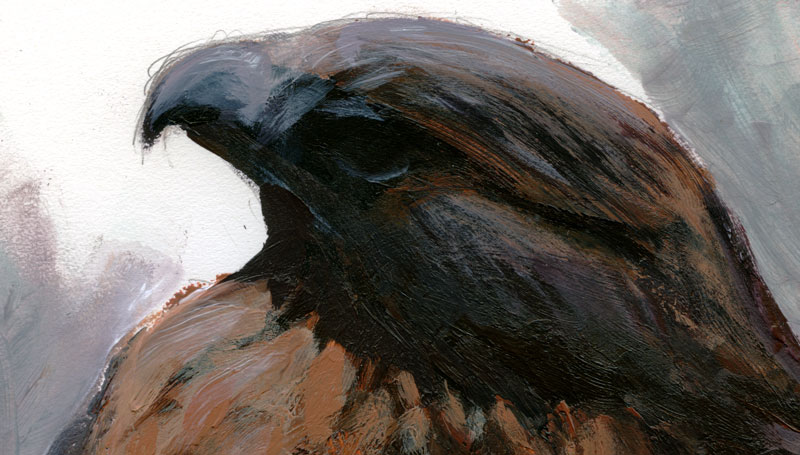
Detail of original acrylic finger painting of Alisa the Red-tailed Hawk, copyright David Sibley.
My fascination with finger-painting goes back a few years to a painting I did with my kids, and I fell in love with the simplicity of it, especially for painting in the field. Just squeeze some acrylic paint onto a disposable palette (small paper plates work well) mix with your finger and smear it on the paper. When you need to change colors just wipe your finger clean on a paper towel and continue. There’s no need for water, no rinsing of brushes; just you, the paint, and the paper.
A finger is a fairly limited means of delivering paint to paper, but I like the fact that there is no chance of getting bogged down in details in the painting. It forces me to simplify the image to broad patterns and blocks of color that I can manage with a finger. (I confess that I do use a brush to touch up some of the finer details, but very little, and I usually end up smudging it with my finger anyway).
My palette is also as simple as I can make it, and developed during the years that I worked on the Guide to Trees. I used four colors for this painting – green, red, yellow, and white. Sometimes I need to use a fifth color (blue) but not here.
I mix red and green to create a neutral black, which always varies a little from the green side to the red side. Adding white makes gray and reveals the color shift of the latest version of “black”. If I add more red and some yellow it makes a reddish brown, and I can add more yellow and white to make a lighter orange-brown. Using so few colors makes it easier to control the subtle variations, and helps to keep the whole painting unified and all of the colors related.
For me, at least, reducing the tools, the colors, and the image to the bare minimum leads to a more enjoyable painting experience.
June 3, 2012
Auction of original art closing soon
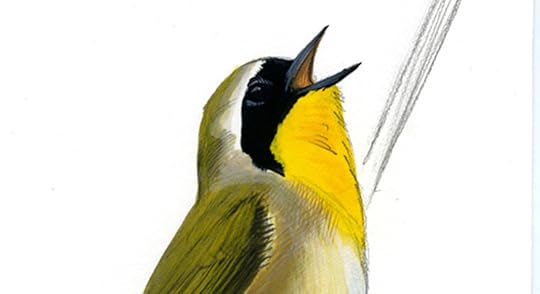
Detail of singing Common Yellowthroat, an original gouache painting by David Sibley.
The auction for this painting will be closing in about 48 hours – at 9 PM Eastern time on Tuesday June 5th. You can see the auction and closing time in the sidebar to the right. This is a small gouache painting of a singing male Common Yellowthroat, which will be appearing here soon in a blog post about bird song.
For more images and more details about the auction and the painting click this link. Check it out, and please share this with anyone else who might be interested.
May 29, 2012
Western Grebes can walk!
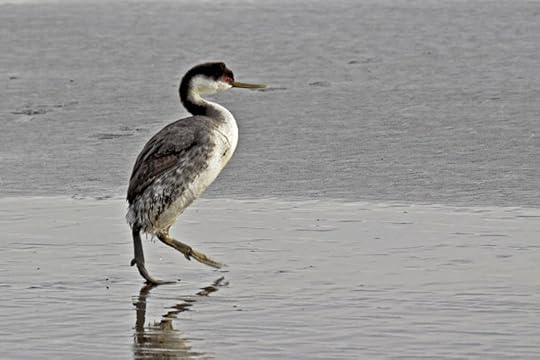
Western Grebe walking. Ocean Shores, WA. 7 Mar 2012. Photo copyright Larry Engles.
In the Sibley Guide to Birds I wrote that Western and Clark’s Grebes are “incapable of walking”. I thought they could only push themselves along on their bellies, but I should have known that I was flirting with danger by writing such an absolute statement. Soon after the book was published I heard that they are capable of walking, although they do it rarely and it’s not very easy for them.
Now Larry Engles has emailed me with a really nice series of photos confirming that Western Grebe can walk. One photo is here, and you can see the rest of the series at Larry’s website.
May 28, 2012
New art for auction
Detail of singing Common Yellowthroat, an original gouache painting by David Sibley.
I’ve just posted a new painting for auction. You can see the auction and closing time in the sidebar to the right. This is a small gouache painting of a singing male Common Yellowthroat, which will be appearing here soon in a blog post about bird song.
For more images and more details about the auction and the painting click this link. Check it out, and please share this with anyone else who might be interested.
More unusual Cattle Egrets
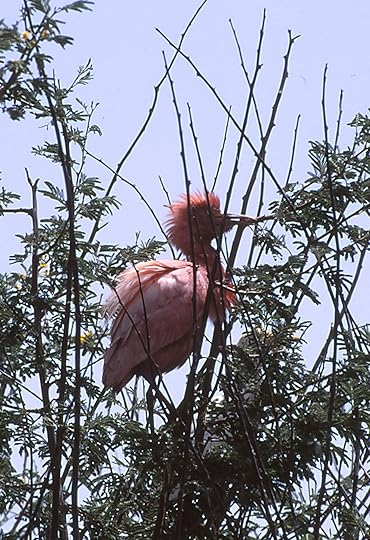
A dark buff-colored Cattle Egret, photographed in the Nile Valley of Egypt on 1 May 1995. Photo copyright Sarah McKenzie.
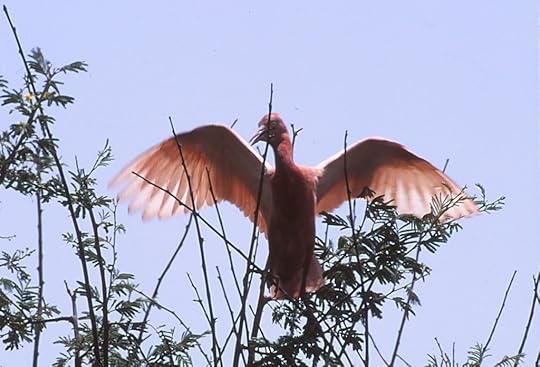
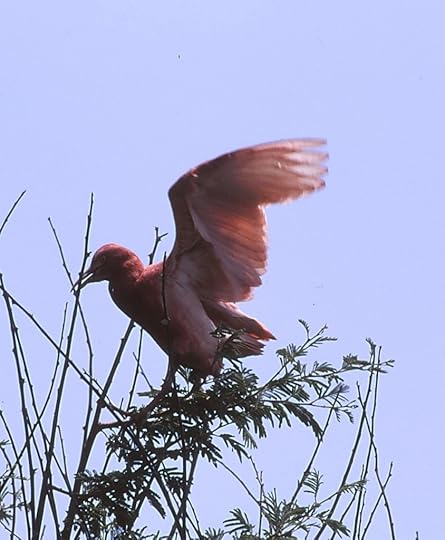
After my post a few days ago about the unusual Cattle Egret in Florida, I heard from two people with interesting observations to add. Robert Edgar and Sarah McKenzie sent the photos featured here and said “We photographed a very similar bird on 1 May 1995 at a breeding colony in the Nile Valley, Egypt.It is even more rusty buff than the Florida example, perhaps even darker on the face and breast. With wings raised the flanks look slightly paler as were the upperwing coverts. It is very much darker overall than your left-hand ‘aberrant’ on p.64 of your book. I wondered at the time if it was coromandus but it was too dark”.
I agree. It looks darker than the Florida bird, although some of that could be the effects of lighting. The overall buff color, slightly blotchy on the upperwing coverts, is very similar to the Florida bird, and is wrong for Asian coromandus.
I also heard from Angie who reports seeing similar birds four times in the last eight years around Marion and Lake counties, Florida. She reports a pale buff bird present this spring at Emeralda Marsh in Lake County, FL. That observation, and the darker color of the Egypt bird, suggests that there may be a range of color variation from normal to dark. All of this is consistent with abnormal pigments produced by the birds, and less so with staining from an external source.
Another question comes to mind: since males apparently have more buff color than females, it’s possible that all of these extremely dark birds are males. That could be determined by watching behavior at the nest, and would be interesting to know.
I would be very interested to hear of other sightings, and especially other photos, of buff-colored Cattle Egrets.
A dark buff-colored Cattle Egret, photographed in the Nile Valley of Egypt on 1 May 1995. Photo copyright Sarah McKenzie.

A dark buff-colored Cattle Egret, photographed in the Nile Valley of Egypt on 1 May 1995. Photo copyright Sarah McKenzie.
A dark buff-colored Cattle Egret, photographed in the Nile Valley of Egypt on 1 May 1995. Photo copyright Sarah McKenzie.
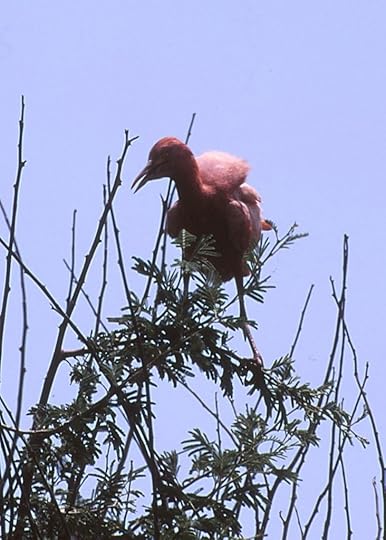
A dark buff-colored Cattle Egret, photographed in the Nile Valley of Egypt on 1 May 1995. Photo copyright Sarah McKenzie.
May 27, 2012
Understanding Alarm Calls of Birds
Among the many benefits of paying attention to bird sounds is that they give you an insight into what the birds are doing. Through their songs and calls the birds announce not only their presence, but also what they are doing.
One example is the mobbing of predators. Birds give alarm calls when they see a predator, and in many cases they even have calls specific to an avian predator like a hawk or owl. In June 2011 I was at the Pine Butte Guest Ranch in Montana, and heard alarm calls from several species including some very agitated American Robins. By carefully tracking the sounds up the hill through the forest I was eventually able to find and digiscope this Northern Pygmy-Owl, sitting at the base of a big Douglas-Fir with a Red Crossbill in its talons.
The robins led me right to it (which was probably their intention), but only because I understood their calls and thought that I might find a predator there. This is something you can learn through experience, and you can learn more quickly just by paying attention to these calls. The next time you see a hawk or an owl, or if you’ve attracted some songbirds by using an owl call imitation, listen carefully to the sounds they are making, and then listen for the same sounds later while you’re birding.
Birds give a lot of “false alarms” or brief low-level alarms. With practice you will become sensitive to the higher intensity of real alarm calls, and when these calls are sustained for several minutes, and directed at one spot, you can be fairly certain a predator is there. If you hear robins that sound like the ones in this video, go check it out!
May 24, 2012
Quiz 38: More feathers, and a prize
Today’s quiz features a bonus
Everyone who submits a perfect score by 9 PM Eastern Time on Thursday May 24th, will be entered in a drawing to win a prize.
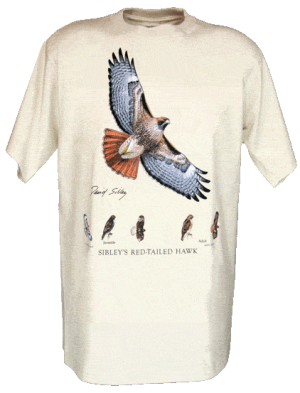
The prize this week is my Red-tailed Hawk t-shirt design from Liberty Graphics. Or take your pick of any of my other t-shirts from Liberty Graphics – Bluebird, Saw-whet Owl, Warblers, Hummingbirds, etc.) Of course, even if you don’t win, you can still order the shirts from Liberty Graphics here.
After you get all five questions correct, just click the “Get Results” button at the end of the quiz and then submit your results.
There is no limit to how many times you can attempt the quiz, so feel free to keep trying until you get all five questions right.1
Scroll down to take the quiz, and good luck!
More Upperparts feathers
Please wait while the activity loads. If this activity does not load, try refreshing your browser. Also, this page requires javascript. Please visit using a browser with javascript enabled.
If loading fails, click here to try again
Congratulations - you have completed More Upperparts feathers.
You scored %%SCORE%% out of %%TOTAL%%.
Your performance has been rated as %%RATING%%
Quiz Results
NameFirstLastEmailmTouch Quiz Populated FieldsmTouch Quiz will automatically populate the fields below. Feel Free to add additional fields for the Quiz Taker to complete using the "Add Fields" options to the right.Quiz NameThe name of the quizResults SummaryScoreThe number of correct answers. This has the same value as the %%SCORE%% Variable on the Final Screen.Total QuestionsThe total number of questions. This has the same value as the %%TOTAL%% Variable on the Final Screen.PercentageCorrect answer percentage. This has the same value as the %%PERCENTAGE%% Variable on the Final Screen.Wrong AnswersNumber of wrong answers. This has the same value as the %%WRONG_ANSWERS%% Variable on the Final Screen.
');jQuery('#gform_wrapper_1 .gform_previous_button').attr('disabled', true); jQuery('#gform_wrapper_1 .gform_next_button').attr('disabled', true).after('');});}jQuery(document).ready(function($){gformInitSpinner_1();jQuery('#gform_ajax_frame_1').load( function(){var contents = jQuery(this).contents().find('*').html();var is_postback = contents.indexOf('GF_AJAX_POSTBACK') >= 0;if(!is_postback){return;}var form_content = jQuery(this).contents().find('#gform_wrapper_1');var is_redirect = contents.indexOf('gformRedirect(){') >= 0;jQuery('#gform_submit_button_1').removeAttr('disabled');if(form_content.length > 0){jQuery('#gform_wrapper_1').html(form_content.html());jQuery(document).scrollTop(jQuery('#gform_wrapper_1').offset().top);if(window['gformInitDatepicker']) {gformInitDatepicker();}if(window['gformInitPriceFields']) {gformInitPriceFields();}var current_page = jQuery('#gform_source_page_number_1').val();gformInitSpinner_1();jQuery(document).trigger('gform_page_loaded', [1, current_page]);}else if(!is_redirect){var confirmation_content = jQuery(this).contents().find('#gforms_confirmation_message').html();if(!confirmation_content){confirmation_content = contents;}setTimeout(function(){jQuery('#gform_wrapper_1').replaceWith('
Your answers are highlighted below.
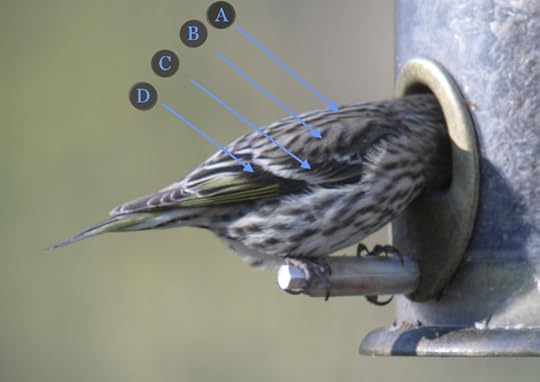
Question 1The species is:House FinchPine SiskinNorthern WaterthrushSavannah SparrowQuestion 1 Explanation:The fact that it's sticking its head completely into a feeder eliminates waterthrush and Savannah Sparrow, it can only be a finch. The crisp streaking and faint yellowish edges on the wing and tail feathers make this a siskin. Question 2The feathers marked A are the:MantleGreater CovertsNapeScapularsQuestion 2 Explanation:The mantle feathers grow on the center of the back, forming streaks aligned with the body.Question 3The feathers marked B are the:ScapularsGreater covertsMantleSecondariesQuestion 3 Explanation:The scapulars grow out and down from the shoulder and overlap the base of the wing. In this photo the difference in the angle of mantle and scapular feathers is very clear.Question 4The feathers marked C are the:Greater covertsScapularsLesser covertsSecondariesQuestion 4 Explanation:The greater secondary coverts form a rectangular panel angled across the forward half of the wing. Here they are dark with pale tips that form a wingbar, and farther forward on the wing you can see the narrow pale tips of the median coverts forming another wingbar. Question 5The feathers labeled D are the:RumpSecondariesPrimariesScapularsQuestion 5 Explanation:The secondaries of songbirds are most of the rear half of the folded wing, behing the greater coverts. On Pine Siskin they have pale edges towards their tips, but the base is all dark forming a dark band just behind the greater coverts. The primaries are just visible below them and form the long point of the wing.
Once you are finished, click the button below. Any items you have not completed will be marked incorrect.
Get Results
There are 5 questions to complete.
You have completed
questions
question
Your score is
Correct
Wrong
Partial-Credit
You have not finished your quiz. If you leave this page, your progress will be lost.
Correct Answer
You Selected
Not Attempted
Final Score on Quiz
Attempted Questions Correct
Attempted Questions Wrong
Questions Not Attempted
Total Questions on Quiz
Question Details
Results
Date
Score
Time allowed
minutes
seconds
Time used
Answer Choice(s) Selected
Question Text
All doneNeed more practice!Keep trying!Not bad!Good work!Perfect! %%FORM%% -----------
Fill in the form here and click submit to enter the drawing for the prize.
Some more rules: This contest is open to anyone, however, the prize must be deliverable by the United States Post Office to an address in the United States or Canada only. No shipments outside of this area will be made.
The winner will be notified by email.
Entering your email address means that you might receive occasional emails from me in the future about Sibley Guides news and events, but I will never give your email address to anyone else.
May 23, 2012
Quiz 37: Bird topography
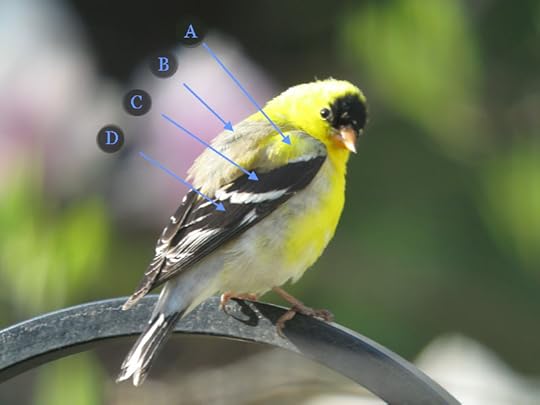
Concord, MA. 29 Apr 2009. Copyright David Sibley.
Test your knowledge of bird feather topography with the questions below.
Bird Topography - upperparts and wings
Please wait while the activity loads. If this activity does not load, try refreshing your browser. Also, this page requires javascript. Please visit using a browser with javascript enabled.
If loading fails, click here to try again
Congratulations - you have completed Bird Topography - upperparts and wings.
You scored %%SCORE%% out of %%TOTAL%%.
Your performance has been rated as %%RATING%%
Your answers are highlighted below.
Question 1The species is:American GoldfinchBaltimore OrioleYellow-bellied FlycatcherYellow WarblerQuestion 2The feather labeled A are the:ScapularsMantleGreater CovertsSecondariesQuestion 2 Explanation:The scapulars grow from the shoulder and cover the base of the wing from front to back. These could be confused with the lesser coverts (so I did not include that as an option here) but the yellow feathers indicated by the arrow look relatively long, arching down from the shoulder like scapulars, rather than the short flat contours of the lesser coverts.Question 3The feathers labeled B are the:Greater CovertsMantleNapeScapularsQuestion 3 Explanation:The mantle feathers grow from the center of the back, between the scapulars. On this bird the mantle is still all non-breeding plumage - faded pale gray-brown - while the nape and scapulars have molted to yellow breeding plumage.Question 4The feathers labeled C are the:ScapularsGreater CovertsMedian CovertsSecondariesQuestion 4 Explanation:On songbirds the greater secondary coverts always form a more or less rectangular panel just forward of the middle of the wing. On this bird they are mostly black, with contrasting white tips that form a wingbar.Question 5The feathers labeled D are the:ScapularsSecondariesGreater CovertsPrimariesQuestion 5 Explanation:The secondaries are the large wing feathers on the "arm" or inner part of the wing. Here they are mostly black, with white edges towards their tips that form a pale panel there and leave a solid black patch at the base of the secondaries, indicated by the arrow.
Once you are finished, click the button below. Any items you have not completed will be marked incorrect.
Get Results
There are 5 questions to complete.
You have completed
questions
question
Your score is
Correct
Wrong
Partial-Credit
You have not finished your quiz. If you leave this page, your progress will be lost.
Correct Answer
You Selected
Not Attempted
Final Score on Quiz
Attempted Questions Correct
Attempted Questions Wrong
Questions Not Attempted
Total Questions on Quiz
Question Details
Results
Date
Score
Time allowed
minutes
seconds
Time used
Answer Choice(s) Selected
Question Text
All doneNeed more practice!Keep trying!Not bad!Good work!Perfect!
May 22, 2012
An unusual Cattle Egret in Florida
In late April 2012, Roy Halpin found and photographed an entirely buff-colored Cattle Egret in Saint Augustine, Florida. This is a particularly interesting bird because it provides an opportunity to consider the unusual nature of Cattle Egret coloration, as well as the identification of Cattle Egret subspecies.
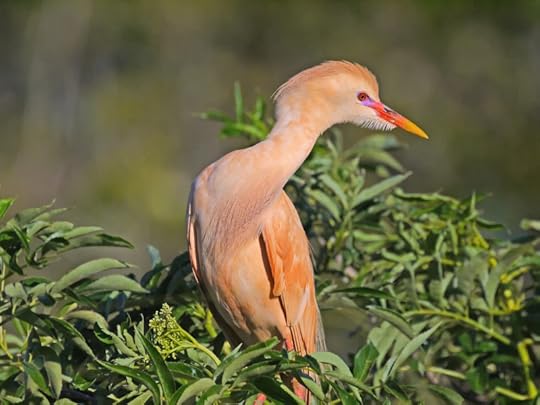
Buff-colored Cattle Egret, photographed at the Gator Farm in Saint Augustine Florida, 27 April 2012, copyright Roy Halpin.
Coloration in Cattle Egrets
To understand this bird’s coloration, it’s important to understand the unusual source of the buff color in Cattle Egrets. Evidence suggests that the buff color of Cattle Egrets is essentially a stain, coming from pigmented oil from specialized powder-down feathers (Delhey et al, 2007). When a Cattle Egret molts in late summer the new feathers are all-white, and they slowly turn buff in winter and spring without molting.
I don’t think the Saint Augustine bird is stained by some man-made chemical because the color of the head and back plumes looks typical for Cattle Egret, and because the color is so smooth and uniform throughout, including even the underwing coverts. I will speculate that this bird is over-producing the oils from powder-down, and coloring the whole plumage. The darker color on the wing coverts could be the result of the pigmented oil interacting with differently-textured feathers there.
Obviously there is a lot more to learn about Cattle Egrets and the details of their coloration. If this individual can be refound and photographed at different seasons or in subsequent years that might offer some clues, and looking for similar anomalies in other Cattle Egrets could add important clues. I can’t help but wonder if the dark Cattle Egrets discussed in a previous post here are related in some way to anomalies of powder-down coloration.
Identification issues
First, this is clearly a Cattle Egret, despite the unusual coloration. There is no other small egret that could be confused with it, and no hybrid combination that would account for the color. It is simply a Cattle Egret with a lot of buff color.
Identifying the subspecies is another matter. The Asian subspecies of Cattle Egret is distinguished from the African/American subspecies primarily by its more extensive (and darker) buff color on the neck and body. This subspecies has been recommended for full-species status, and has occurred in the western Aleutians. It is a potential vagrant anywhere in North America, and a potential species and therefore would be of great interest to birders here.
Briefly, the Asian subspecies B. i. coromandus differs from the common American/African subspecies B. i. ibis in the following ways:
buff color is more extensive, covering the entire neck, but leaving the face and most of the body white
the buff color is distinctly darker, more cinnamon-orange, rather than the pale frosty pinkish-buff of ibis
overall size averages slightly larger
bill averages slightly heavier and longer
legs average slightly longer
Differences in size and proportions are slight and overlapping, making the extent and shade of the buff color the only really useful features to distinguish these two subspecies. In both respects the Saint Augustine bird does not fit the Asian subspecies.
In the 1980s I saw an extensively buff-colored Cattle Egret in southern Florida, which was the model for the illustration on page 64 of the Sibley Guide to Birds. Recently I was thinking about that sighting, and wondering if it could have been a vagrant from Asia. I will never know for sure, but this Saint Augustine bird shows that American Cattle Egrets can be buff-colored all over, and offers a much more likely explanation. Still, any Cattle Egret with extensive buff color should be checked for the possibility of the Asian subspecies.
Buff-colored Cattle Egret, photographed at the Gator Farm in Saint Augustine Florida, 27 April 2012, copyright Roy Halpin.
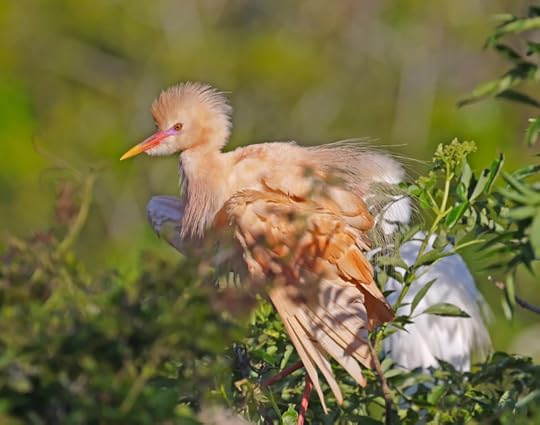
Buff-colored Cattle Egret, photographed at the Gator Farm in Saint Augustine Florida, 27 April 2012, copyright Roy Halpin.
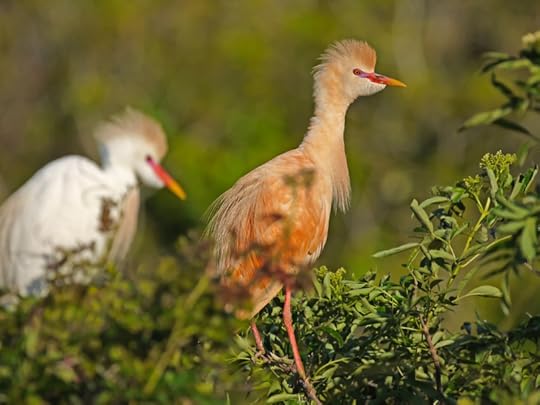
Buff-colored Cattle Egret, photographed at the Gator Farm in Saint Augustine Florida, 27 April 2012, copyright Roy Halpin.
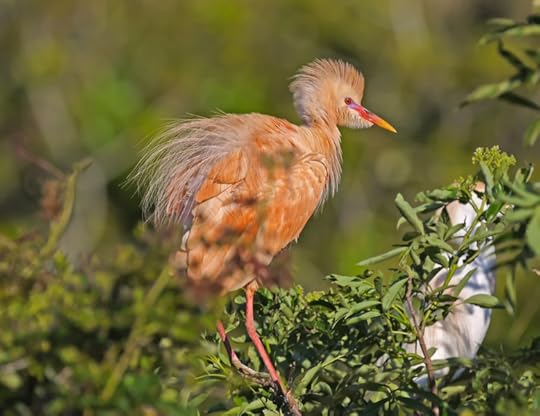
Buff-colored Cattle Egret, photographed at the Gator Farm in Saint Augustine Florida, 27 April 2012, copyright Roy Halpin.
References
Delhey, K., Peters, A. & Kampenaers, B., 2007. Cosmetic Coloration in Birds: Occurrence, Function, and Evolution. The American Naturalist, 169, pp.S145–S158.
Notes
Photos by Roy Halpin, originally posted at Digiscoper Magazine here: http://digiscopermagazine.com/?p=2478
Thanks to Satoko Lincoln for bringing this to my attention, and to Roy Halpin for allowing use of his photos.
David Allen Sibley's Blog

- David Allen Sibley's profile
- 151 followers

