P.J. Fox's Blog, page 40
June 18, 2014
My Top 10 Questions About The Mankini
Ahem, asymmetric man thong.
Apparently this is a fashion term. Fashion world, really…you couldn’t come up with anything better than this? Surely, your lack of imagination in the title alone should’ve been an ENORMOUS RED FLAG. And by “red flag” I IN NO WAY mean any kind of dirty double entendre. You must NOT think of “just like a waving flag” by Chani, or picture these [flags] waving. NO. JUST NO. Put down the computer and back away slowly.
I mean, good God, why am I writing about this anyway? Because, everywhere on the internet, everyone is only ten seconds away from looking at a cat video and I’m THAT desperate to keep your attention? No, actually. I’m writing about this because I legitimately have questions and I’m appealing to The Oracle the internet to help me. Because, you know, the Oracle of Delphi isn’t a real thing anymore. I mean, well it is, you can go there, but–you know what I mean. I hope. I digress.
Here is the mankini asymmetric man thong:

Now, I’m as big a fan of naked men as the next guy/girl. But my understanding was that the whole point of lingerie swimwear was to reveal by concealing. To enhance. Which is where all those discussions of modesty come in, and just how appropriate it is to judge a book by it’s cover. But never fear, mankini-wearing world, no one who sees you in this will ever find you attractive. If Satan is trying to enter by your thoughts, it won’t be through this portal. In fact, plastering a few pictures like these on your wall would be a great way of ensuring that you pretty much never had sinful thoughts about the male body ever again.
Which leads me to my questions:
Wait–this is an UNDERWIRE? The reviews on Amazon (excerpted for you in this Buzzfeed piece) indicate that wearing this contraption correctly involves PRESSING A PIECE OF METAL INTO YOUR GROIN. WHY? GOOD GOD, WHY? And where, exactly, does the metal part that, again according to reviewers, “needs to fit very snugly” GO?
Wait–you need GLUE? As one reviewer put it, “this product doesn’t fit without glue in your ass crack.” Er, hardly the Bard’s phraseology but does paint a rather distressing picture.
How does it stay on, without permanently affixing your man part to the side of your leg?
What happens if the wearer gets, er, excited? Does it pop out?
Why are straight men wearing these, if every gay man I know has the good sense not to?
What happens when it DOES pop out?
Do whatever conventions of modesty associated with wearing this piece require the shaving of one’s visible pubic hair? I mean, there must be some notion of “covering up;” otherwise why not just go nude? Nude would surely be more attractive. But how much reveal is too much?
Wait–one size fits most? Even women’s bikinis come in sizes. Out of respect to the fact that, well, women are different sizes. Some need more fabric than others to achieve the same level of coverage. Surely this product, too, should have different…ahem, pouch sizes?
If the wearer DOES get excited, does it pop off like a slingshot and hit the object of his affections mid-torso?
What happens if you actually try to go swimming?
Alright, world…did I miss anything?


Things To Do With Your Cat
Cats are underrated as activity partners.
I learned this the hard way. I wasn’t ever planning on owning a cat, you see, and now I own two. Both were, ah, for lack of a better term, “gifts” from a crack-addled biological relation. The first she found while on a bender. She called me, out of the blue–I have no contact with my family of origin, so this was something of a treat–telling me that she’d picked it up, didn’t know if it was a boy or a girl or a kitten or not, and didn’t know what to do with it except it seemed hungry. “Feed it,” I told her. “What a good idea,” she replied earnestly.
The next morning, she called me to ask if I wanted a cat. “My husband is allergic,” I said. “I don’t know, I’ll have to ask him.” To which she replied that she was already in her car and had driven through several states; if I didn’t want the cat, she’d just dump it by the side of the road again. “Sure,” I said. “I’ll take the cat.”
You can imagine how pleased my husband was with this announcement. He came home from work, realized that he was being, in his words, “not productive,” and left again to go on a run. He came back an hour later, ready to keep right on yelling, and instead confronted two urine-drenched beings–my relative and the cat–standing in his driveway. He invited them in. My relative demurred. The cat stayed.
Luckily, my cat, a mostly-Siamese who was, in fact, still mostly a kitten at the time, took to me right away. Took to me so much, in fact, that I found it difficult to even put my new pet down for a few minutes to use the bathroom. We tried keeping him out of our room at night, on account of Mr. PJ’s allergies; he hurled his little body at the closed door so hard that we were afraid he’d hurt himself. So, he began his regular routine of sleeping on my head (or sometimes Mr. PJ’s) and eventually, in the allergist’s words, Mr. PJ “became desensitized.” He is, according to that helpful medical consultant, no longer allergic to cats.
Although I wouldn’t recommend such drastic exposure therapy!
In the years since, I’ve adapted. Since I work from home now, there’s virtually no reason, ever–at least in Wonder Cat’s mind–for Wonder Cat to not be sitting on me at all times. Inspired by those “they sit beside your bed so you’re co-sleeping but not really co-sleeping” cribs, which cost the earth, I made one of my own. For Wonder Cat. Because him actually sitting ON my arm, while I’m trying to type, significantly slows down my writing process. Whenever I get up, he waits to see if I’ve gone to use the bathroom or get another cup of thinking juice or check the mail or whatever and, if I appear to have actually gone somewhere else semi-permanently–as in, if I’m gone for longer than five minutes–he follows me.
What I’ve learned is that cats make wonderful activity partners. They enjoy doing exactly what you’re doing. They listen when you talk to them, and talk back. At least mine does. Siamese are very vocal. Our cats, at least, are great with kids; Pooh more than Wonder Cat, although Wonder Cat has adapted from necessity. I pay the bills with my cat. I color with my son with my cat. I weed the garden with my cat. I do the laundry with my cat. What he’s getting out of all this I have no idea, but at this point I’ve had him almost as long as I’ve had Mr. PJ and I have to say, there hasn’t been a single thing–as bizarre as this sounds–that I could do with the hypothetical dog we don’t have that I haven’t done with my cat.
Occasionally I suggest getting a third cat.
Mr. PJ says no.


June 17, 2014
Twitter, Goodreads or Facebook?
As a writer, you need a platform. Everyone throws around this “platform” word without really explaining what it is but basically you need an identifiable online presence. A personality to go along with your books, a discrete person to think of. Which, the idea here is that you’re going to use your platform to help sell your books, not alienate your readers. I’ve written about that before, so I won’t bore you by regurgitating my rather simple (and yet, astonishingly, usually ignored) wisdom. I’m hardly the first person to have thought of it, anyway. Which is why it’s so amazing that it’s usually ignored; I don’t expect anyone to listen to me.
And yet here you are, so let’s get going.
The common advice is to pick one social media outlet and go with it. Along with, of course, having a blog that will presumably provide interesting content. Try to spread yourself too thin, and you’ll a) run yourself ragged and b) won’t have any time left for writing. Not to mention, the quality of your online output will suffer. Which is why I’m not a fan of the various auto-tweeting services, or platform-producers like HootSuite. People aren’t stupid; they know they’re seeing the same vapid one liners over and over again. You’re a lot better off (in my opinion) taking the time to thoroughly investigate which outlet is best for you and then really invest in doing the best you can with it. After all, people are going to be annoyed if you expect them to pay attention–let alone shell out money–when you’re not even asking in real time.
The goal, here, after all is to develop personal relationships that reflect well on you; well enough that people want to invest in you. Their time. Their energy. Asking someone to read your book…that’s more than the 2.99 Kindle price. That’s their day off. That single half hour they finally have to themselves, in between getting the kids to bed and passing out from exhaustion.
So, which one should you pick?
The good news is that they’re all very different, and all play to different strengths.
Good for you if you…
Are funny.
Can pull off a good one liner.
Are not cruel. Interestingly, there’s much less tolerance for cruelty on Twitter than there is on Facebook.
Are patient. Building any kind of presence takes a LONG time, as well as a serious investment of time.
Bad for you if you…
Are not funny.
Don’t respond well to people making fun of you.
GOOD READS
Good for you if you…
Think in long, paragraph-style format.
Have a lot to say, and need a lot of room to say it in.
Bad for you if you…
Want a lot of immediate social interaction.
Don’t fit in well with the other personalities on Goodreads. There’s definitely a “type.” If, for example, raunchy humor is your thing then Goodreads probably isn’t. Goodreads is entirely full of people who (in my opinion) take themselves WAY too seriously and won’t thank you for trying to liven up the situation.
Good for you if you…
Are working up the courage to start your own blog.
Have a high tolerance for cruelty.
Don’t have quite enough to say to be on Goodreads, but can’t compose your thoughts into less than six or seven sentences.
Bad for you if you…
Have a problem with Facebook’s increasingly shifty privacy policies.
Have a low tolerance for the clique-driven, pack of (illiterate) wild hyenas mentality that seems to dominate its culture.
As you know, you can find me on Twitter. There’s even a handy follow button on this page (upper right-hand side, in my “widgets” section). I think the people I’ve met on Twitter are pretty amazing, and for my two cents it’s the place to be if you’re a writer. The community is, as a whole, both large and cruelty free. As well as extremely supportive.


Caveat Emptor
When it comes to writing–anything, actually–don’t take advice from someone you don’t want to be more like. I’m amazed by how many people ask for advice from people they’d never want to actually emulate. And how many people dispense advice who really have no business dispensing advice. Someone of Mr. PJ’s acquaintance, for example, talks incessantly about what a relationship guru she is and how everyone should “respect” her–her word–by slavishly adhering to every word she utters. Except this woman, when not talking herself up, is constantly complaining about her (latest) unhappy marriage, how much she hates everyone she knows, how unfulfilling she finds her life and how her own children won’t talk to her.
Which begs the question: why is she qualified to give advice?
For that matter, why am I?
I dispense a lot of writing advice on this blog. It’s the advice I’ve used to get myself to where I am, and that’s really the only endorsement I have. So if you like my writing, you’ll probably like my advice. Same goes with my reviews–including of your work, should you ask me for one. When people ask me to review their work, which they do from time to time, I always tell them the same thing: read something of mine (I feel comfortable making this request, since you can do so on this site for free), and then ask me again. They mostly ignore me; feeling, no doubt, that I’m being awfully self aggrandizing. Which I’m not; I’m not telling them (you) to read my work because it’s so great but, rather, in order to get a sense of whether my advice is something they (you) actually want.
Because, realistically, it might not be. You might hate my writing, both style and content, in which case my advice won’t be all that helpful. Not because I’m not ready, willing, and able to offer it but because it might not be what you actually need. And it certainly won’t be what you want. That being said, if you think I’m critical of your work then believe me, I’m a thousand times more critical of my own. I apply a slash and burn theory of editing; no “darling” is sacred. And that’s another issue: I endeavor to be kind, because I like to consider myself a decent person, but I’ve always been a coach rather than a cheerleader.
Which brings me to my final point: when you’re poring through writing advice or, indeed, asking someone to read your work, be upfront–with yourself, and with the other person if you’re actually asking them to read something–about what it is you want. Trust me, it’s much better to say, “I really need some encouragement in my craft, to bolster me up so I can keep going” if that’s what you want, rather than saying, “I’m looking for criticism,” because that’s what you think you’re supposed to want. In writing as in (other) relationships, open and honest communication is the key to success.
There’s a reason you ask your best friend the diva drag queen to help you shop for curtains, and not your husband. Different people fulfill different roles; and the more honest you are with yourself about what you’re looking for, in each situation, the better able you’re going to be to meet your own needs–and the easier it’s going to be, in the long run, to separate the wheat from the chaff. Which, caveat emptor–buyer beware or, in legal terms, the joke’s on you. And you, and ONLY you, can look out for your own best interests.
In short: evaluate everything, not by what people are promising to do for you but what you actually want from them.


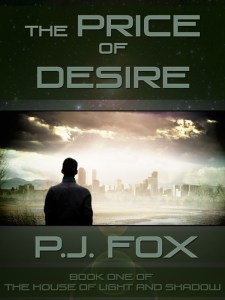
‘The Price of Desire’ Available Now!

I find this review to be both accurate, and thrilling.
 Originally posted on Evil Toad Press:
Available now at Amazon.com!
The Price of Desire, Book One of The House of Light and Shadow, by P.J. Fox, is available now at Amazon.com and other major online retailers! Click the image to the left to buy it now.
The Price of Desire is military science fiction at its finest. It’s a story of two people–a psychologically damaged Imperial naval commander and the woman he rescues from slavers while en route to an assignment meant to end his career–finding a common fate against a backdrop of galactic imperialism, war, and revolt.
The planet Tarsonis, to which Kisten Mara Sant was dispatched following an ill-advised assault on his uncle, the Imperial Chancellor, on the Senate floor, is a mining world chafing at the bit of imperial rule. As a Prince of the Blood and the scion of a powerful family, Kisten’s sentence was commuted to exile: exile on a distant, troubled…
View original 164 more words


Why Online Research Isn’t Enough
Yesterday, Mr. PJ, Tiny Satan and I were sitting outside on the screen porch. Mr. PJ was doing some work-related things, Tiny Satan was coloring and I was writing. “As a fantasy reader,” I asked him, “are you interested in the fact that most moats weren’t in fact repositories of delightful fresh water but of raw sewage?”
The look on his face was priceless.
That little tidbit of historical color isn’t something I learned online, or from watching fantasy movies. I learned it, rather, at [insert name of university you've probably heard of]. In class. I earned a degree in medieval history for the same reason that one of my series is set in the high middle ages: I love the period. Not what everyone thinks they know, Lord of the Rings-style, but the actual period. How misunderstood it is by most enthusiasts. How, placed in the appropriate historical context, that cartoonish specter of evil the Sheriff of Nottingham would have actually been the good guy. The “heroic” Lord Locksley–and of course neither of these men actually existed, we’re talking archetypes but in a way they’re all the more powerful for that, because they do so much to inform the consciousness about what “should” be true–and his ilk were all killed off for a reason. And yet, all too often, we see these archetypes repeated because they’ve gained the kind of permanence that makes them true; if not as representatives of historical fact then as myth.
Which, there’s a lot of validity to that. We need myth. I mean, I make up stories for a living, I would think that. The problem arises when you’re trying to write something historically accurate, or at least based in history: fully armored destriers charging across an open plain, when in fact a fully armored destrier could advance no further than a trot. That armor…was heavy. And, like plate armor for human warriors, didn’t come into fashion until after the introduction (to western warfare) of gunpowder. Because armor, despite what certain fantasy authors will tell you, wasn’t about fashion and people didn’t flock to specialized armor smiths because they made pretty helmets. Chain mail, like today’s bulletproof vests, withstood punch impact pretty well but was zilch against concussive blasts. Plate armor was devised, not to be pretty but to solve this problem. Which it did surprisingly well; kind of like the Michelin Man-looking suits that bomb techs wear now.
Everyone didn’t sit around drinking to get drunk; they mixed a few tablespoons of wine into their water to kill germs. Which, while the notion of actual germs was still heretical at that point and would be well into modern history, practical knowledge of their effects was not. And most of the food they ate was actually pretty normal; sweet and sour chicken was an invention of medieval England.
The problem is that, if you go online to look up, say, moats, whatever article you find won’t teach you all of that. And might not even be accurate. There’s a reason that, as obnoxious as this may sound, the University of Google isn’t a real thing. You have to have at least a solid general grounding in a topic before you can know, as it were, what you don’t know. If you’re too ignorant, you have no way of taking responsibility for the gaps in your knowledge–which is, as we see, a self-perpetuating problem. Without enough basic knowledge to know what basic knowledge you need, you don’t know that you don’t have the basic knowledge to acquire it. Which is why looking up issues piecemeal is so dangerous, from a research-oriented perspective. Even if an article on moats does teach you what you want to know, it won’t teach you about destriers. Or the fact that the average woman got married at around age 18 (not 12).
I think–for what my opinion is worth–that if you really want to write about a period (or a particular place, or thing) then you need to immerse yourself in it. Buy actual books, or check them out from the library, and read them cover to cover–whether you think they’re going to contain anything of interest to your story or not. Take notes. Read more books. Hopefully, as you do, your story (and characters) will evolve.
Writing about any period in history is a lot like writing, in general: you have to know what the rules actually are, and be conversant with them, before you break them. A great example of a book that breaks a lot of THE RULES, writing-wise, is Clive Barker’s Coldheart Canyon. But, you know, that’s Clive Barker. He’s someone who definitely knows THE RULES, and for whom breaking them is a conscious choice. And Coldheart Canyon is an excellent novel, by the way; if you haven’t read it yet, you should.
Incidentally, it’s also a great example of what I’m talking about in terms of writing what you know: Barker’s novel is a pretty searing (and also gripping, and hilarious) view into the stupidity, decadence, and ultimately misery of Hollywood. He portrays all the different angles–business, artist, would-be starlet–with equal understanding. And, hidden in his mockery, compassion. No amount of research into what Hollywood is like, or is supposed to be like, or should be like could possibly match Barker’s decades-long experience of working there. When you’re writing about the middle ages, you’re essentially trying to do the same thing: speak in the voice of someone who’s been there. But since time machines haven’t been invented yet (at least to my knowledge) we have to do the next best thing: hit the books.
Thoughts?


June 16, 2014
The Toddlerizer
Do you want rock hard, washboard abs? Do you want them in 21 days or less? Do you want to, in fact, terrorize impress your friends by pulling up your shirt at inopportune moments just to show them off? Then you’re in luck, because do I have the solution for you.
Imagine doing crunches while a 30 pound human being sits on your stomach, gleefully shouting “whee!” with every rise and fall. Imagine doing leg raises and, indeed, attempting to hold that coveted heels 6″ off the ground posture while that same tiny human hurls its weight back against your knees! All still while shouting “whee!” and laughing at your ensuing agony!
Imagine the fun you’ll have!
The toddlerizer is available for three easy payments of one fun night with your partner, room and board for (at least) two decades and one savings-crippling college fund!
Act now!