P.J. Fox's Blog, page 36
July 13, 2014
What Makes A Family?
I asked my husband if I should post this; he said I should. So if you hate it, blame him! In all seriousness, though, this post is churchy so if you’re not into that you might want to give it a miss. That being said, it’s also a fairly rare opportunity to hear me talk about myself. Until I started this blog, I’d never really talked about myself–with anyone. Friends used to tease me, sometimes rather pointedly, that it was like I’d sprung fully formed from the head of Zeus. It was someone at church (in our ward’s bishopric, i.e. a leader in our congregation) who, the product of a similar upbringing, himself, challenged me to start writing about my life. The first real post I wrote on this blog was an open letter to my family; talking about all the things I’d never had the courage to tell them in person. Since then, I’ve been blessed with more love, support, and acceptance, from my family and friends and even from total strangers, than I could have ever imagined.
A few months later, I was asked to give a talk in church. Which I’m doing, later on today. What follows is the text of that talk:
I’m speaking to you today, on extending the love of Christ in all things, because the fact that I’m standing here at all, before you or anywhere else, is proof that Christ’s love saves lives. And proof, too, that we as everyday missionaries have the power to do His work and through so doing, to save lives. Without His love, and all the ways in which its manifested itself in my life, brothers and sisters, I would be dead.
In foster care, they teach you a lot of minute strategies for coping with stress and for disempowering your abuser. One of those strategies is to think of alternate names for your biological family members. Particularly if, as was the case with me, you’re in the situation you’re in because they’re more or less permanently unfit. Calling the person who burns you with cigarettes or fractures your scull and locks you, unconscious, in a closet for four days mother reinforces some very unhealthy attitudes—and the guilt that goes along with them. Particularly if, like most foster children, you’ve grown up with your abuser (or abusers) telling you that the abuse was your fault. If you’d only be a little nicer, a little sweeter, they could love you like a mother.
That’s not how a mother behaves is the healthiest lesson a social worker can teach you. Because, implicit in it, is the idea that titles like mother are earned. So, after long and careful consideration, I decided to call my—for lack of a better term—life-giver Gargamel. Because Gargamel was, at once, both a villain and ridiculous. She started seriously abusing me when I was about two or three or, at least, that’s as far back as my memories go.
Sometimes, she beat me because I made the wrong face. Other times, she was simply in a beating mood. I learned when it was safe to ask her for food, and when I was better off just drinking water from the toilet bowl. The first time I was removed from my home, I hadn’t gotten a change of underpants in almost six months and there was a hive—an actual hive—of lice so bad at the base of my scalp that the tissue there had to be debrided. I remember that period of my life very clearly, even though I was only about nine years old.
I had scabies.
After that, the next few years were a constant parade of one house after another, from family member after family member who, after being threatened by Gargamel, gave me back to the state. Where I eventually learned to hate myself. I’d spent the first decade of my life being wanted by nobody. My own flesh and blood didn’t want me, and neither did anyone else. The sad truth is that, once you’re old enough that prospective families can no longer pretend that you’re their baby—i.e. once you’re no longer a baby—no one wants you at all. This is, believe me, a truth that foster children learn early on. If for no other reason than that their social workers have to discuss it with them. Foster care works, to the extent that it does, by making the facts of your situation just the facts of life. Spend too much time laboring over the emotion of it all and you’ll lose your mind–you and your social worker, and whatever foster family you’re staying with, and just about everybody else involved. What can seem like cruelty from the outside, really isn’t. The fact is, you and your foster care brethren are basically the human equivalent of those puppies you see at mall pet stores; looking out at the world and hoping that maybe, just maybe, this once, someone will stop. When enough people have stopped, and moved on, because you weren’t lovable enough to join their family…someone has to address this issue with you.
I used to lie awake at night, thinking about the fact that nobody wanted me, and wondering what I’d done to be so unlovable. I didn’t pray, because I didn’t know about praying yet, but in my heart of hearts I do think I was asking God. It was the hardest lesson of my life so far, realizing that the fact of my biological parents not loving me had also somehow made me unlovable to everyone else.
And then I went to church.
I’d seen an ad on TV. And as it so happened, there was a ward building a few blocks from my placement at the time. Nobody particularly noticed or cared where I went, and for once I was grateful. To this day, I’m surprised that I did what I did, because I have terrible social anxiety and new situations are hard. But this just felt…right. Inexpressibly right. And once I walked through that door, I discovered a world of adults I’d never before known existed: adults who were safe. Who weren’t violent, or rage-filled, or disinterested. Whom I could trust. And I knew, although I didn’t know much about the church yet, that I’d found the right place.
It’s through church that I met my family. Or, rather, they found me. My sister took one look at me, knew that I was her sister, and took her home with me. And that was the first time that I felt the love of Christ, and of my Heavenly Father. We all come with baggage, a teenager who’s never had a real home before the most baggage. But for the first time, here were people who wanted me anyway. Who’d chosen me, and who every day continued to choose me. Who responded to my anger, and my self-hatred, and my conviction that at any moment they’d toss me out the door with we love you, and we want to adopt you
And then: we want to be sealed with you, in the Temple.
I have a powerful testimony of the atonement, because it was—and continues to be—through the atonement that I learned to stop hating myself. To even love myself, a little. To understand that I truly did have a Heavenly Father, and that He loved me. That I had never been unlovable in his eyes; that my mistakes didn’t make me unlovable. That I was part of His plan. People ask me, sometimes, why I’m so cheerful all the time and I tell them: it’s because of the atonement. The peace that the atonement has brought into my life is the greatest peace that I’ve ever known.
President Uchtdorf counsels us to, “instead of being thankful for things…focus on being thankful in our circumstances, whatever they may be.” And I’m thankful in my circumstances, and for everything that’s happened to me; because they brought me to Heavenly Father—and through Heavenly Father, to my family. Every day of my adult life has been, and continues to be, an opportunity to witness miracles: the miracle of going to bed in safety, and of waking up in safety. Of experiencing the truth of our Gospel in my life, and of having the freedom to share that Gospel in both word and deed. Of experiencing the truth of the statement that the family truly is God’s creation, given to us by Him as both a blessing in our lives today and a tool for our eternal progression.
Because no one in my family is biologically related to me, I have a special testimony of this principle: that happiness in family life is most likely to be achieved when founded up on the teachings of the Lord, Jesus Christ. Ultimately, no matter how our families are formed, or sustained, or who they involve to include, this is always true; that family is a choice. A choice we make every day; a series of covenants we renew every day. I’ve been blessed to know, for much of my life, that my family is a choice; literally. And the decision to become a family, first made by myself, along with my parents and siblings, and then made, later, by myself and my husband, was indeed founded on our shared knowledge of His plan for us; that families are eternal and that the decision to add to one’s family, and thus to affirm that true wealth is family, is the best decision that one can make.
I have a special testimony of the power of Temples, because the Temple is, to me, all that symbolizes family, and, through family, my knowledge of God’s plan for me. Each and every Temple stands as proof that family is a choice and that Heavenly Father sees our families of choice with the same eyes as our families of flesh and bone. My son is my first family member to be biologically related to me, but because of the Temple, and because of the love I feel there, and the love I feel when I share about the blessing of the Temple with my non-member friends, I know that my family—my family of choice—is no less legitimate.
Brothers and sisters, I know that sometimes the challenge to share the love of Christ in all things can be overwhelming. If you’re like me, then you spend a lot of your time not feeling particularly Christ-like. Worrying about deadlines at work instead of visiting teaching obligations; feeling anger, or resentment, toward the people we love for failing to meet our expectations. Carrying the burden of anger toward those who’ve wronged us, which seems so hard to put down.
But I want you to remember that my life was saved because imperfect people made me welcome. Christ saved all of our lives and He was perfect; but you don’t have to be perfect, to do as He did. You just have to love. Our Gospel is one of love; of repentance, and of acceptance.
You might not know the effect you’ve had until years later; God’s timeline is different than ours. But I challenge you to share your love. Not the love you think you should have, some ocean of kindness that overlooks all wrongs; but your authentic love. Share of yourself, as an individual, warts and all. Have the courage to be yourself, and to love as yourself.
For thereby will you make the greatest difference.
I want to testify to you, in closing, that this church is true. This is God’s restored church upon the earth. The Book of Mormon is a true document; it contains the revealed word, and will, of God. The Doctrine and Covenants, and the Pearl of Great Price, are also true and revealed scripture, containing within them the wisdom we need to return to God. And because our God is a kind and loving Heavenly Father who knows us, He knows that we need proof: and He gives us proof, in the ability to follow the commandments and see for ourselves their workings in our lives, and judge their source. And in hearing each other share our stories, and testify to the workings of the Spirit in our lives.
The love of Christ is, and can, and should be in all things.
I leave these words with you in the name of Jesus Christ, amen.
If anyone has any questions, comments, or concerns, or would like to know more (about anything), then please don’t hesitate to ask.


July 11, 2014
The White Queen: Coming Soon
I’m pleased to say that The Demon of Darkling Reach has built up quite a–no pun intended–cult following. And, speaking to those fans right now, you and I both are waiting for this series to reach a wider audience. But in the meantime, I have some exciting news for you: The White Queen is coming soon! I don’t have exact release dates yet, and of course will share them when I do, but in the meantime I believe we’re looking at a framework of a couple of months.
I think fans of the first book will be excited by the sequel; many of your questions will be answered, as well as new ones–and new characters–introduced. You’ll also learn more about Tristan, and his origins (and perhaps more, but I don’t want to ruin the surprise). The blurb is as follows:
The captivating sequel to The Demon of Darkling Reach…
Having survived the harrowing experience of her courtship, Isla must now make a decision. A decision that will affect the course of her life and that, if she chooses unwisely, indeed might end that life before it’s truly begun. But before she can take control of her future, there are things she needs to know about the lover who remains so much a stranger. Is this dark, tormented man merely misunderstood? Or is he, in fact, the Devil made flesh? What truly motivates him—and what does he want from her?
And what, indeed, does she want for herself?
The White Queen is, of course, the second installment in a trilogy. The third installment, The Black Prince, concludes that trilogy. Which brings me to my other exciting piece of news: if everything goes according to plan, I’ll be releasing The Black Prince shortly after I release The White Queen. I’ve gotten several emails, tweets, and Facebook messages from fans dying to know what happens next; so to them (you) I say, you’re about to find out! I personally love The White Queen, which is shortly off to the editor; I’m excited for The Black Prince, too, and think that it will be just as exciting. This whole series, to me, gets more and more exciting as it goes along.
So, as they say, the mystery unfolds…


D.B. Jackson on Historical Accuracy
 Originally posted on Evil Toad Press:
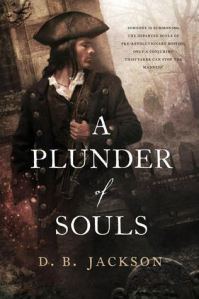 Historical accuracy can be a tricky subject for writers, particularly when it comes time to choose between what’s historically accurate and what makes the story better. D.B. Jackson, author of the Thieftaker Chronicles, wrote an insightful article for A Dribble of Ink on his own approach to historical accuracy in his work. Jackson holds a Ph.D in American History. His most recent novel is A Plunder of Souls, the third book in the Thieftaker Chronicles, out this week from Tor Books. (He’s also the author a dozen fantasy novels under the name David B. Coe.)
The Thieftaker Chronicles is a historical urban fantasy set in pre-revolutionary Boston. The main character is Ethan Kaille, a “conjuring thieftaker (sort of an eighteenth century private investigator).”
Jackson has a lot of interesting things to say about when to keep the historically accurate and when to throw it out…
View original 549 more words


Self Publishing: Start Up Costs?
Deciding to publish–whether traditionally or on your own, either completely on your own or with the help of an indie portal like Evil Toad Press–is essentially deciding to go into business for yourself. And I believe, personally, that the reason a lot of writers fail is that they don’t realize this. Or choose to ignore the business-side realities of life as a writer. Which is fine–if you want writing to remain a hobby. Which, again, is fine. There is absolutely nothing wrong with pursuing writing as a hobby. I have a lot of hobbies, including woodworking. There are a lot of reasons that, although I’m quite passionate about woodworking, I elected not to start my own furniture-making business. It was a love I had, that when I was really honest with myself about why I was building furniture and what I wanted to get out of the experience of building furniture, I realized was only ever going to be a private love.
The word amateur comes from a Latin word meaning “lover of.” An amateur is someone who does something simply for love. And love really is what makes the world go ’round, so don’t knock love. Doing something simply for love is special, and wonderful, and noble. So long as you’re writing sheerly for love, you can focus solely on your writing–and if that’s you, for the rest of your life, then you’ve already accomplished something. We live in a world that, increasingly, puts the focus on money and indeed values things in terms of the money they’re likely to produce. Which is unfortunate, because things like satisfaction with your own life–the things that matter–can’t (and shouldn’t) be reduced into those terms. There is absolutely nothing wrong with writing simply for the joy of writing; in my opinion, everyone should.
But if you want to make a living as a writer, a second unfortunate truth is that you have to get real about the nuts and bolts of writing as a business.
There’s an axiom, you have to spend money to make money. Sometimes, that axiom is used to justify throwing good money after bad, Restaurant Impossible-style, when in fact what it speaks to is the need for a business plan. Not a willingness to spend money, willy nilly, in the hopes that something exciting will happen but in a careful, logical, well-researched plan where every dollar is accounted for. You need to know both how much money you’ll be spending, and what you’ll be spending to achieve. And, too, when to pull the plug. If you’re spending and spending, and not achieving the results you want, then the answer isn’t to spend more but it step back and evaluate your business plan. Is it realistic? Is it detailed enough? Have you learned things, since you started trying to make a living as a writer, that you didn’t know before–and that should cause you, rationally, to reevaluate your business plan and perhaps make a few changes?
A business plan shouldn’t be rigid; it should update, as your understanding of your industry updates.
I’ll write another, separate post detailing what I think a (sample) business plan should be, for emerging writers, and how to tailor it to your own needs, if anyone’s interested. Just let me know in the comments. But for right now, I’m going to focus on the start up costs shared by all indie writers, regardless of how they choose to progress in terms of marketing their books, etc. If you’re going to tell the world, I’m a writer, then you need to start by producing a quality product. The writers who succeed, whether they’re published by someone in the Big Five or whether they’ve gone the indie route, all have one thing in common: they’ve invested this money, and in the same things.
There’s a common misconception among writers, incidentally, that a contract with the Big Five means that “someone else” has paid for these things. They haven’t; that’s incorrect. What they’ve done, in that case, is front the money–which they’ll then take out of the back end, in terms of royalties. Remember, in exchange for all that editing, copyediting, cover art, etc, they now own the rights to your work in perpetuity. And they’ll take their cut, and keep taking their cut, long after they’ve made back what they’ve spent on you. Because, as someone who works in this industry, I have a secret for you: publishing costs are all, regardless of how you’re published, more or less the same. Cover art is cover art; it doesn’t cost more for a representative of the Big Five to buy a cover from an illustrator than it does for you. And the same goes with web design, editing, etc. Web designers, interior formatters, etc; they charge what they charge.
Now, if you’re going the indie route, you’re also paying; the only difference is that you’re paying up front. Your costs, unlike those of your traditionally published competitors, are fixed. You might also, say, pay 2,500 USD for a website; the difference is that you’ll know exactly how much you’re paying, and what you’re getting in return. And because you retain creative control, you can work directly with the web designer to produce exactly what you want. Unlike your traditionally published competitor, who may wind up having no say in his website and who may, once he’s been published for a few years, have ended up paying for a hundred different websites!
Because another issue is that, as an indie publisher, you’re only responsible for your costs. Whereas, in terms of traditional publishing, the cut taken from the more successful authors is also what covers the asses of that same publisher in terms of its failures. Not everyone is going to wind up being the next Neil Gaiman; so Neil Gaiman gets to, indirectly, pay for all the websites for all the authors who wound up with their first and only book being remaindered.
Being a writer isn’t just something you do; any more than being an electrician, or an attorney, is just something you do. It takes hard work, planning, and preparation; so while you’re perfecting your novel (and, if you’re smart, working on the next one), save your pennies. Because, before you can launch your business, you’ll need the following:
A website. As an author, you need a platform. You need visibility. Which, in your case, means a place for fans to a) find you, b) interact with you, and c) learn more about you. A lot of authors mistakenly believe that having a Twitter account, and/or a Facebook page can take the place of a website; they are incorrect, for a couple of reasons. First and foremost being, google does not troll social media websites for content. Yes, if you search for your own name, it’ll come up. If I search for “P.J. Fox,” my name appears, and Google tells me that I have a Facebook page. Which isn’t that helpful, since I already know this. But what about people who’ve never heard of P.J. Fox, and who are just looking for a new book to read? Who are, maybe, googling terms like “feminist science fiction?” Searches like that won’t bring them to my Facebook page, or my Twitter account; but they will bring them here, to this website. Moreover, a website is permanent in a way that, say, a Twitter account is not. Your website is where all of your most relevant content is gathered into one place, along with charming graphics. Your website is, in essence, your public face.
A Twitter account. This is where you’ll do the bulk of your actual social media interactions. Fans feel more comfortable approaching their favorite writers, actors, etc on Twitter precisely because it’s so much more informal. I, personally, think that a website (ideally with a blog) and a Twitter account are all the social media you need. You’re better off focusing your energies on two separate platforms, each of which serves a separate and distinct purpose, rather than spreading yourself too thin over too many places.
A decent cover. Cover design is everything. You’ve poured your heart and soul into your book; don’t skimp now.
Professional interior formatting. Yes, you can just “throw it up on Amazon;” that doesn’t mean you should. Trust me on this, if you want to succeed as a writer, then you need to offer a product that makes you look legitimate. Your book may in fact be the best book ever written but if it looks amateurish, or if rookie formatting problems cause you to loose chapters, have funny punctuation problems, random appearances of code (yes, all of this happens), then you’re going to be fighting a serious uphill battle. Readers want a book that makes them feel confident.
Professional editing. There’s a reason that your Big Five publisher will subject your book to editing–regardless of how you feel about the subject. You need an editor. There is no writer on earth so good that he can’t benefit from an editor; only writers with egos grown so large that they’ve become an actual handicap. Listen, my day job is working as a professional editor and I have someone else edit my work. If nothing else, you want someone to catch those typos that you’ve missed. And trust me, they’re there.
There are obviously other things you can spend money, or time, on but these are the big ones; the gatekeepers, as it were. And, as harsh as this sounds, if you’re not willing to invest your hard-won time and your hard-earned money in these things, then you should ask yourself how serious you really are about making a living at this. It’s absolutely fine to treat writing like a hobby and to say, “I don’t want to spend my hard-earned money on a website for my hobby.” But you can’t treat something like a hobby and at the same time expect it to succeed for you like a business. Success, in any field, will only come as the result of your total commitment.
So a hypothetical breakdown of costs might look like the following:
A website: depending on the complexity of your design, and the functionality you want your website to have, you’re probably looking at somewhere between 1,500 and 5,000 USD. You can get a beautiful, professionally produced website with a blog and as many additional static pages as you want or need, tons of beautifully written content and even more beautiful graphics, for 1,500 USD. And don’t let anyone tell you differently; I’ll design it for you, I do that.
A Twitter account: free. However, if you’re already paying for a website, and/or some advertising material, I’d highly suggest that you get your designer to design you a couple of professional Twitter covers. Mine, for example, are the same mix of header-advertisements that you see on this website. The cost to you for this should be, depending on what else you’re spending, either a) already included in your graphics package or b) around 75 USD.
A decent cover: usually starts at around 300 USD, and can go up from there. If you want the kind of cover I have on my books, that’ll cost you about 300. If you want a professional illustrator (and I work with several excellent professional illustrators), that can cost you anywhere from 300 to 1,500 and up. Entirely, one hundred percent custom artwork isn’t cheap. But the good news is, nor is it a necessary component of a beautiful, custom cover. Most custom covers, in fact, do not feature proprietary artwork (other than that, of course, of the graphics designer).
Professional interior formatting: depending on the length of your book, this can run you from 750 to 1,500 USD. This is including formatting for your print book as well as your e-book. Both versions are (in my opinion) necessary, and since there are no upfront costs with using a print on demand outfit like CreateSpace, you really have nothing to lose.
Professional editing: depending on the length of your book, this is going to run you between 1,000 and 2,000 USD. Trust me, it’s worth every penny. You can learn more about how to get the most out of hiring a professional editor here. When I say, hire an editor, I don’t mean hire me–although that would be nice! I mean, hire someone who’s competent and with whom you can work well.
So for total start up costs, you’re looking at somewhere between 3,550 and 10,075; but realistically, your total costs should probably be somewhere in between. And yes, that’s a lot of money; but again, this is looking at writing as a business. And of course, as a business, there are other costs you’re going to be looking at later on: like advertising campaigns. Audible versions. And, according to Mr. PJ, any writer’s budget should include a healthy margin for Starbucks runs. But the goal of starting right is that, later on, when you do do things like advertise, you won’t be hemorrhaging money because no one’s ever heard of you before or knows that they might want to buy your books. Indeed, starting out with a great website, and some competent professional guidance on how to use that website, and how to make your book look its best, should save you a lot of money in the long run.
And by long run, I do mean long run. You’re not going to make this money back overnight, unless you publish your first book and immediately become a NYT bestseller. Realistically, you’re not going to start seeing real returns until you’ve published at least three books; the golden number that Hugh Howey uses, in terms of a backlist, is ten and I think that’s accurate. Which, again…no business ever succeeded overnight, and without months–and years–of hard work.


July 10, 2014
The Price of Desire: “Mediocre” at Best
An Amazon reviewer (who chose not to leave his/her name, not even come up with anything spunky and amusing) left the following thoughts:
Initially interesting characters do nothing in a mediocre send-up of pseudo-Islamic society.
The character and worldbuilding is excellent, and leads to some initial hopes, but it’s follwed by zero delivery and no actual dramatic peak or denoument, the book just ends and on a cliffhanger no less. Of course it’s not much of a cliffhanger since you’ve long given up on any rational act by either main character.
Well, mystery reader, I’m glad you thought my characters were at least initially interesting. But I’d like to correct you on one thing: it’s not a “pseudo-Islamic” society; it’s a society based on British-occupied India. I do owe a nod to historian William Dalrymple’s work on Islam in India, specifically in terms of how he’s fleshed out our understanding of the interaction between cultures. And fans of (the historical figure) Shahjahan will also recognize aspects of Moghul influence. But ultimately, if there’s a key religious theme here, it’s Hinduism.
I’m sorry, too, that you felt there was no dramatic peak; obviously, as a writer, there’s nothing you can really do about a reader who says “your book is boring.” It’s disappointing, to be sure, but not everyone is going to like everything. Although I would like to point out, again, that the reason the book ends on a cliffhanger is because it’s the first in a series. Were everything to be resolved in book one, there’d hardly be material left over for the next four books.
This is, indeed, a book about a grown man with the maturity of a jellybean and the woman who hates him. A woman who’s been through a great deal, herself. You’re quite right in observing that not all of their acts are rational; had I wanted to write 150,000 words about precisely the sort of thing you’d see, when you looked out your window on your daytime-deserted suburban street, I could have done that. Although, to be honest, one thing you discover working from home is that nothing is quite as rational as we’d have ourselves believe.
Thank you for your feedback, dear reader, and may your next experience–with whatever book–be more positive.


July 7, 2014
What We Do: A La Carte Self-Publishing Services
Originally posted on Evil Toad Press:
At Evil Toad Press, we offer what we call “a la carte self-publishing services.” What do we mean by that, you ask? It’s simple. We offer a variety of services related to self-publishing that our clients can pick and choose from to create a package that fits their exact needs.
Thanks to the self-publishing revolution, anyone with access to a computer can easily publish a book themselves. Services like Amazon’s Kindle Direct Publishing and CreateSpace allow you to create your own ebook or paperback and list them for sale on Amazon.com for free. Amazon only takes a cut if and when you sell a book. But the fact that you can do something yourself doesn’t necessarily mean that you should, and the fact of the matter is that even the relatively simple process that is publishing through Amazon can be intimidating to those unfamiliar with things like formatting, distribution…
View original 823 more words


Indie Authors Be Seen!
I’m thrilled beyond words to announce that Evil Toad Press is now offering publicity services!
If you haven’t read this post, detailing Hugh Howey’s thoughts on the state of self publishing, you should. The short answer is that self publishing is what’s up–and where the publishing industry, moreover, is headed. In one way or another. You no longer need a traditional publisher to get your book out there and–guess what–you no longer need a traditional publisher to help you create cover art, advertising campaigns, press releases, and to help you investigate new and exciting distribution channels. You can access the same level of quality, in some cases the exact same services, without signing away your copyright. Or, indeed, giving up any creative control at all. With us (and others like us) you can access the wealth of all that traditional publishing has to offer while still retaining complete creative control.
I started doing this, because I wanted to publish a book and I was sick of being told “no” by people who couldn’t even be bothered to read my manuscript or who had such delightful thoughts to offer as, a woman who advocates for bodily autonomy is “unlikable, judgmental, and preachy.” I kept doing this, because I love this industry and I want to help other writers succeed.


Location Inspiration
When you’re writing fantasy you are, by definition, writing about places that don’t exist. But I find that, even so, when I’m creating a new corner of my world it helps to have a little visual inspiration. Not because I’m going to slavishly copy that place into words but, rather, because I do my best work when I have a jumping off point. Something to look at that stirs my soul, and inspires me. Inspiration, of course, starts at home; when weather permits (such as right now), I write on our screen porch. It’s actually drizzling, and my thinking juice is getting cold a little too quickly, but I’d trade a little comfort for the sheer joy of looking out at my garden.
Even though, when I’m actually writing, I’m not looking at it; I can feel the breezes wafting over my body and smell all the myriad scents of the natural world. Right now that’s rain, earth, and that undefinable scent that is just green growing things. There’s also honeysuckle, which I love, and from over my neighbor’s fence the scent of climbing roses. Humidity, while terrible, brings one great blessing in that it amplifies and intensifies the scent of everything. Wonderful when the honeysuckle begins to bloom; not so wonderful on trash day.
But because I do in fact do most of my writing sitting in one place, and that place is in the vastly uninteresting and somewhat soul-sucking American suburbs, and because I haven’t yet achieved the sort of pinnacle in my literary career where lavish “fact finding” trips are acceptable tax write-offs, I turn to pictures. Some of places I’ve been; others, of places I’ve only wished to go. The picture below, for example, is of a place I’ve been and that inspired a major plot arc in The Black Prince Trilogy: the now-defunct rose garden of the Crane Estate in Ipswich, Massachusetts.

Creepy, isn’t it?
Because I thought other people might be interested, either fans who’d read my books and were curious about my creative process or other writers, who needed a little inspiration themselves, I started collecting my pictures in a central location: my Facebook page. Under “albums” is an ever-growing collection of various structures (including ruins and haunted places, as well as castles), amazing outdoor locations, and objets d’art. One or two of them you may recognize, particularly from the forthcoming The White Queen. Others, I haven’t used yet but plan to. And others are simply…too amazing not to share.
If you want to follow along with my progress, or have suggestions about what you’d like to see more of (suggestions are always welcome), then “like” my Facebook page!


July 6, 2014
How To Tell If Your “Publisher” Is a Fraud
In part due to the lingering stigma surrounding self publishing, so-called “indie” and “niche” publishers are appealing to many authors. They seem to represent the best of both worlds: an accessibility not found with the Top Five, but the legitimacy of having someone else’s name on your spine. You’re not just Joe Q. Public, entering the market all on your own; you have a team behind you.
At least…that’s the theory.
In practice, may so-called “publishers” are little better than scam artists, charging you an arm and a leg for things you could’ve done on your own for free. As an artist, you have to be your own advocate; and that starts by getting informed. This is a topic I could, and probably in the future will, go on about at length. But for right now, here are some things to watch out for. Each and every single entrance on this list is a HUGE red flag; ignore it at your peril.
A publisher who promises to “distribute” your work to Amazon, Apple’s iBooks platform, Barnes and Noble, Kobo, Scribd, Oyster (and possibly one or two other outlets, depending on your genre). Guess what: you can do that, yourself. Amazon, through Amazon’s KDP direct program and the rest through Smashwords. Both services are free to join, with no up front costs. You don’t need a “publisher” to do this; Amazon and Smashwords are your publisher. Which is why, in return for the use of their services, they’re going to charge you a cut.
A publisher who tells you that you need a publisher in order to create a print book. You don’t. There are a couple of popular print on demand platforms; Creatspace, which is an Amazon-owned company, is probably the most popular. Their work is top notch and they, too, offer their own design services. Which, although I don’t use them for myself, are also top notch.
A publisher who charges royalties, but who also expects you to pay out of pocket for other expenses; i.e. for cover art or marketing campaigns. This is a ripoff. The entire point of charging a royalty in the first place is that you’re NOT also charging other fees. You’re taking a cut per unit sold instead of charging by the hour, etc.
A publisher who claims to offer “direct, as opposed to third party” distribution through sites like Amazon. The so-called publisher, in this case, is the middleman; “direct” would be if you, the author, were interacting with Amazon directly. In general, I think it’s a wise move to avoid ANY professional who obfuscates the process or who isn’t 100% clear, honest, and upfront about what services they’re providing. Which includes being honest about who else is capable of providing these services, and for what price point.
A publisher who charges a royalty of more than 15%. Essentially, what many of these so-called “publishers” are, are agents. If you’re publishing through Amazon, Createspace, Smashwords, etc, your “publisher” isn’t actually your publisher. Those outlets are. Amazon, as a for example, is doing the hard work of making your book both visible and available. Unless your boutique publisher is doing something for you that you absolutely 100% could not do on your own, i.e. get you a booth at the next Comic-Con, they’re agenting your work rather than publishing it. And they shouldn’t be asking more than an agent’s cut.
One of the reasons I feel so strongly about offering a la carte services to indie authors, which we do through Evil Toad Press (where you can hire my services as an editor), is that I don’t think the royalty contract model serves authors. Virtually all authors, in my opinion, can get a better deal by paying upfront for the services they actually need; after that point, their royalties are their own. Which, if you end up making any kind of sales, as an author, is a tremendous benefit in the long run. And I worry, too, that too many so-called “publishers” are taking advantage of hopeful and often extremely talented individuals who don’t know that much about the industry.
Part of the joy of being a self published author is that, if you need, for example, a publicist to design a media campaign or a graphic designer to design you some beautiful advertising, you can hire those people! Without signing away your life in royalties! Because I have business ethics, if someone comes to me wanting one thing, and they could actually be served far better by something else, which would benefit them more but net me less, I’ll tell them so. Because I’d rather a) they get what they actually need and b) I build and maintain my reputation as a person of integrity, than make a quick buck.
I’m not going to lie; I have an angle here, of course I do. I was one of the people who founded Evil Toad Press, because I was sick–like they were–of traditional publishing. We wanted to offer nontraditional books a home but, at the same time, we also wanted to offer authors the same services that the Top Five offered, with the same quality, but without the “sign your life away on the dotted line” contract. But really, the reason I’m still helping other writers is because I’m passionate about this work.
I want them–you–to succeed.


Talk To An Actor!
I don’t understand screenwriters, and other writers, who denigrate actors. At one end of the spectrum I think are lemmings, blindly following along behind famously anti-actor types like George Lucas. They don’t know much about either craft, writing or acting, and just want to sound cool. And then at the other end are writers who, for whatever reason, misunderstand the relationship between writer and actor. They’re jealous of their own characters, or they look down on actors–and pretty much everyone else–as stupid. Which, labeling every actor a dumb bunny and a himbo is as silly as labeling every writer brilliant. Actors, as a group, tend to be interested–in learning about their character, in learning about themselves, in whatever–whereas a great many writers tend to adopt the world-weary attitude of “I’m too good for this” that they think signals them as a creative genius. So there’s often a lack of communication, too.
Which is unfortunate, because you can learn a lot from an actor.
I’ve always found the tenets of method acting tremendously helpful to character creation, and time spent with actors has helped me to better understand method acting. You can, as a writer, learn a tremendous amount about what it means to really invest in your character–and how to do that, in practical terms–by following along with the titans of the movement like Daniel Day Lewis. His career is, in of itself, both an inspiration and an education.
But if you’re fortunate enough to know any actors, and fortunate enough that they actually want to work with you, whether formally or informally, then you can learn even more: because you have the opportunity for feedback and, if your character is coming alive on the big screen, potentially serious improvement. The actor playing your character, if he’s any good, is going to have a perspective on who that character is; embodying them is, for him, a personal act. A lot of writers misunderstand this, too, and that’s where the jealousy comes in. They feel like they’re loaning their character out, and this hateful actor is taking over.
When, in actual fact, if you’ve accomplished what you’re supposed to as a writer, then you’ve created a real person. The actor in question isn’t making off with your character; he’s merely giving form to another person who, in your heart and mind, and his, and possibly in the hearts and minds of fans, is already alive. Which is why, when he challenges you about your script, or says, I don’t think my character would do that, you should listen to him.
This person is just as invested in your character as you are. He’s become a shared person, really, between the two of you; a shared person who, again, if you’re both doing your jobs right, is going to become greater than the sum of both of you. This is–and I’m speaking as a parent, here, so I know what I’m talking about–in a sense a birth. And like any good parent, as your child grows and evolves, you need to rein in your ego and begin the hard work of appreciating your child as an individual and letting him go. Not letting go of loving him, or being there for him when he needs you; but of letting him become his own person.
You, as a writer, have created your character; the person playing this character on screen is now in charge. He’s picked up where you’ve left off. And if you recognize that, and focus on being a useful member of a team rather than fighting for creative dominion, you can learn a lot. This actor is giving you the gift of talking to your character. How many writers get that?
Make the most of the opportunity.