P.J. Fox's Blog, page 38
June 28, 2014
Advance Copies?
Because there’s been some interest, I’m thinking of (with my publisher’s support) passing out a few advance review copies of I Look Like This Because I’m A Writer. The idea being that those dubiously lucky fools get to preview the goods–and put up with the occasional typo, because they hasn’t been through final copy editing yet–and then write about how awesome, or how sucktastic, they are on their blogs. Or Twitter. Or wherever.
Does this sound interesting, o! reading public? Hearing what other people think of the product, before it becomes available for purchase in late July? Tell me what you think in the comments.


June 27, 2014
How To Have A Popular Blog
I’m writing this post in response to some questions I’ve received, about blog content and how to decide what to write. “I want to start a blog, but I don’t know what to write about” and “I’m told that I should have a blog, because writers are supposed to have blogs, but blogging frightens me” are common comments. And of course if you read this blog you already know that my writing advice, in a nutshell, is just do it. Just write. Just a little more each day. The more you blog, and the more diligent you are about blogging, the more you’ll find your voice. Because finding your voice, like building up the means to share it–whether via blog, or manuscript, or whatever–should be an organic process. Books and articles promising topic-specific information are rarely ever useful, producing as they tend to a fairly generic and “canned” seeming result. The best individual posts, like the best overall blogs, are going to be about you. Your thoughts, your feelings, your unique perspective on the world.
That being said, here are some specific rules to help you out.
DON’T be gimmicky. I’ve seen too many blogs that read like an informercial, promising me all kinds of things–from the best writing advice I’ve ever encountered to how I should land a husband. What none of them give me, however, is a flavor for the voice of the person writing. I’m not reading your blog as a substitute for, say, going to a psychiatrist. Don’t try to sell me on your blog, by selling me on your supposed credentials. Sell me on your blog by creating worthwhile content. I’ll decide for myself, after reading, whether you can in fact teach me something.
DO be funny. A lot of times, new writers seem to feel like they have to prove how serious they are; or how seriously they take their craft, or whatever. You can discuss serious topics while still sounding like yourself. In fact, you should. Moreover, when you’ve been writing long enough, you’ll inevitably discover that humor helps. That people having a sense of humor during trying times doesn’t mean that they don’t take themselves, or those times, seriously. Usually, quite the opposite. Humor can be a coping mechanism, but it’s also a way of bridging what can often feel like an impossible divide.
DO define your purpose. What’s your blog about? The more narrowly defined your purpose, the easier it’s going to be for you to attract readers and, in turn, to tailor your content to those readers. I’d been writing this blog for about a month when all of a sudden the questions–incidentally, almost all of them via email, you guys seem pretty shy when it comes to commenting–started pouring in. Questions, and requests for posts on specific topics. The fact that, for the most part, I write about writing–both the actual nuts and bolts of the process as well as what it’s like to be a professional writer–has helped me grow my audience. Because people know what to expect.
DON’T be afraid to branch out–and to be yourself. The best blogs, at least in my personal experience, also aren’t completely one-note. I’d hardly call my own blog a “best blog” in any category, but I’ve tried to follow my own advice in terms of sharing other content. No, I don’t give out personal details (my son isn’t really named Tiny Satan), but I do talk about him on here. My perspective on writing is flavored by the fact that I’m a parent, a (probably bad) Mormon, a feminist, etc. You may find this perspective interesting, or it may completely turn you off. Believe me, I’ve had plenty of people stop following me here, and on Twitter, because I was either too religious or not religious enough, or they finally noticed that I was a woman, or whatever. It’s a little scary, to be honest, putting yourself out there. You’re going to alienate some people, simply by virtue of not being a cardboard cut-out. But the people who do keep reading, you know at least that something in your voice speaks to them.
DON’T be afraid to discuss difficult topics. But, at the same time, don’t troll popular post titles and keywords just to seem “relevant.” You may get a lot of hits, but unless the content is there to back it up those hits won’t translate into long-term readers. Wait until a topic comes along, where you actually have something to say.
DO post regularly. Some people advocate for once a week; I advocate for once a day (or more). The more content you have, the more chances people have to find you and the more they’ll think of actually looking at your blog when they want something new to read. I’ve found a few interesting blogs over the years where I loved one or two posts, but then whoever was maintaining the blog seemed to just disappear. They may, in fact, have reappeared after a few months but by that time I’d stopped checking to see.
DO vary your content. Even if it’s all on the same general theme. Some posts should be long and thought-provoking, others merely funny. Buzzfeed is a great example of this; Buzzfeed’s “long form” articles contain actual newsworthy content, which is nicely interspersed through the rest of the site with pictures of cats.
DO pay attention to categories and tags. Without some (decent, and oft-policed) system of organization, your readers won’t be able to find the content they want. Pay attention, when you’re developing said categories and tags, to how people–how you–search for things and make sure that you’re being clear about what’s what. This isn’t the time to get cutesy. Remember, your most devoted reader is only ever about ten seconds away from watching funny cat videos; make your content hard to find and they’ll just get frustrated and leave.
DO talk about something other than yourself. And by “yourself,” I don’t mean your writing process (interesting), perspectives on your own work (interesting), the challenges you’ve faced, or are currently facing in your own life (interesting), or your views on current political and social issues (again, also interesting). What I mean is, don’t make every post about how awesome you are. I’ve seen this. People literally talking about nothing but how they’re the most amazeballs creature ever to cast a shadow and doing so non-ironically. Telling me you’re interesting doesn’t actually convince me that you’re interesting; if you were really interesting, you wouldn’t have to tell me. You’d just, you know, be too busy being interesting.
DON’T solicit donations. And no, I’m not talking about your Kickstarter. If you feel like you absolutely must have that PayPal button somewhere on your blog, okay. A classier way is to sell advertising space (a lot of blogs do, and I don’t mean monetizing their sites through Google or whomever). But to make your advertising not, like, a total ripoff, you first have to have–you guessed it–visitors. Who are attracted by–you guessed it–content. None of the most monetarily successful blogs (at least that I’m aware of) shill for donations outright. So if you have to have that PayPal button there…let it be silent. If every other post is about how I should donate, well…unless you’re running a (legitimate) charity, just stop.
Did I miss anything?


Self Publishing: License to Ill
Self publishing is, as Karen L. Oberst points out, “either freedom or a license for mediocrity.”
Usually it’s the latter.
Oberst and I both agree that “Self publishing is the wave of the future. As publishers merge, and grow closer to one huge publishing house, it becomes harder and harder for new authors to get anything published. You may need to self-publish if you have a controversial title, a niche title, a quality title that is not likely to make a lot of money, or are just plain unknown.” And I, after all, am hardly in a position to criticize self publishing as an option because in choosing to work directly with a boutique publisher I essentially did the same thing. I’ve been, to the extent that I’ve enjoyed success with my writing–and for those of you who’ve helped, and are continuing to help that happen, thank you–a beneficiary of the same leveled playing field that I’m now describing as a license for mediocrity.
So what gives?
For every serious writer, who takes themselves seriously as a writer, there are ten thousand hacks clogging up the market and making us look bad. People who’ve essentially vomited whatever onto the page, often in a completely incomprehensible fashion, and then opened a Twitter account and spent the next six months telling you that their book is “the best thing ever written” and “un-putdownable” and “a gripping page turner” and you need to buy it now. Because there’s this myth, out there, that all you need to achieve literary success is access to a computer.
One of the major impetuses for the so-called self publishing revolution in the first place was that the gatekeepers of traditional publishing were no longer doing their job. Instead of sorting the wheat from the chaff, they grew ever more inward-looking. Traditional publishing, over time, became less and less about scouring for new talent and more about making a quick and obvious buck. Which, when you’re a talented writer and people keep coming back to you with nonsensical rejections like “Asians don’t sell,” is obviously going to make you think twice about the process.
But the problem is that there is still a need for gatekeeping–just not the kind of gatekeeping that, these days, mostly anyone is doing. It matters whether your writing is any good. It matters whether you’re committed enough to your craft to, say, proofread your own work or whether you have sufficient artistic integrity to do anything more than copy Twilight. That you can go out and publish anything doesn’t mean that you should.
One of the things I talk a lot about in my forthcoming writing guide, I Look Like This Because I’m A Writer, is paying attention to your audience–and recognizing that they are an audience, not a collection of coin-operated robots. Selling your book involves a lot more than vomiting onto the page and then commanding people to read it. You have to create something that they’ll actually want to read. And that means, whether your work has any obvious commercial appeal or no, taking yourself seriously enough to actually produce your best work.
Stephen King observed, and I’m paraphrasing, here, that you’re either writing for an audience or for yourself. Which I think is generally correct, and something really important to think about; the problem is that too many aspiring writers take “I’m writing for myself” as license to produce drivel. Which, you’re perfectly entitled to produce drivel; what you’re not entitled to do is then rush out and publish it and expect miracles to occur. Personally, I think all of the great writers are to some extent writing for themselves–if not wholly and completely–in the sense that they feel compelled to write. I know I certainly do. And of course, I sell my work and of course, I hope you’ll buy it. Both because, let’s get real here, I have bills to pay but more importantly because I want to share something I love. But the fact is, I’d still be writing, and still be writing the exact same things, if I were trapped on a desert island. Because the stories I’m telling are, although fiction, really personal to me and are to some extent born of the experiences in my life. They’re a part of who I am.
I think you can learn a lot about the patience and dedication required of the publishing process, however you choose to publish, by being a parent. My son is now two and just beginning to master the art of complete sentences. He gets frustrated a lot, because of the communication barrier; so I’ve been working with him on teaching him new words. His especial favorite thing is drawing, and being a child of the 90′s myself I one day started drawing on him to cheer him up. Over the past few weeks, we’ve been working–at his insistence–on learning all of the body parts and his reward is that every time he correctly names a body part I draw a star on it.
Usually, this ends up in smudges of marker everywhere (thank God for Crayola’s washable markers line) and even pools of brightly colored water all over the kitchen floor (and everywhere else) as he splashes in the puddle the cat has made by flipping over his water dish in disgust at the entire situation and then tracking the results through the house. But he’s happy, and that’s what counts.
Now, as far as how this applies to the self publishing process, what you can take away is:
Nothing’s instantaneous. Expecting yourself to become an accomplished writer overnight is like expecting your toddler to master language in one afternoon. Success comes from a combination of patience, diligent (and repeated) effort, and realistic expectations.
Creation is messy. You learn more, and you have more fun, when you’re willing to get a little ink on your feet.
Balance is essential. As a parent, the balance is between respecting your child as an autonomous individual and helping him to actually interact with the world around him. But in either case, you should be doing whatever you’re doing for his benefit. Likewise, as a writer, the balance is between telling your story and making your story fit for public consumption. Things like grammar and correct punctuation aren’t restrictive to your creative process, any more than teaching your child not to hit other children is restricting his development as a human being. Rather, it’s doing the opposite; it’s giving someone (or something) you love the tools they need to succeed in the broader world.
Perhaps the hardest thing about self publishing is that you have to be your own gatekeeper; no one will tell you, get this edited. No one will assign you a proofreader. No one will write your ad copy for you, or give you step by step directions on how to market yourself. Which is why, at least theoretically, you’re getting a larger slice of the royalty pie: you’re earning it. But there really is no such thing as a free lunch. If you’re not ready, willing and able to be self directing–up to and including embracing the notion of self criticism–then self publishing probably isn’t for you.


June 26, 2014
Prepare Yourselves, It’s Coming!
July 22, 2014.
It’s coming.
Prepare yourselves.
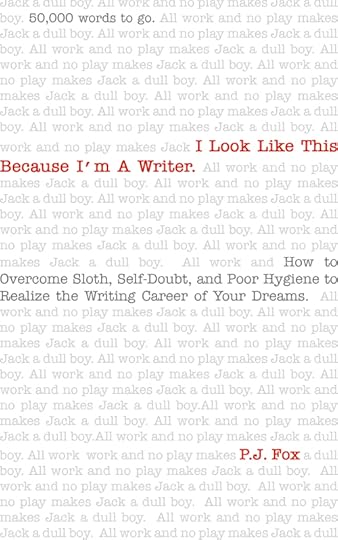


Husbands Are The Best Advertising
“I wish I’d had this book when I was starting to write,” said Mr. PJ, who’s recently completed the first installment in a YA adventure series (and of whom I’m exceptionally proud).
“But you had me!” I replied. “Your most ardent, adoring fan, a girl who never shuts up and who you can’t put down and ignore like you can a book and who always asks you what’s for lunch and demands sexual favors and gives you babies!”
“Like I said,” he replied. “I wish I’d had the book.”
Several marathon writing sessions have produced the manuscript for I Look Like This Because I’m A Writer. So, that’s pretty thrilling. I’m working on the blurb right now and, in terms of spitballing my ideas, like I indeed suggest doing in said manuscript, I haven’t gotten much beyond “this isn’t your grandmother’s how-to book” and “if you like crotchety old men yelling at you, you’ll probably enjoy my special brand of inspirational pep talk.”
What would you, as the reader, like to be told–or not told–in a book of this nature?
What are you sick of?


June 25, 2014
“Come Inside, It’s Fun Inside”
I hear this song multiple times a day because, of course, I have a toddler.
And every time I wonder, did they know how this sounded when they wrote it? Is there actually supposed to be a level of double meaning, here, or am I just that sick-minded? I’d probably be too ashamed to admit that I see innuendos (and downright disturbing things, like those stripper platform dances they do at the end of every episode) in my son’s favorite program but Disney is notorious for including dirty jokes in its films. So why not in The Mickey Mouse Club, too?
So…am I the only one?
What disturbs you about your kids’ favorite shows, or toys?


June 23, 2014
I Look Like This Because I’m A Writer
What follows is the introduction (as always, more or less a work in progress until the actual publication date) of my forthcoming book, I Look Like This Because I’m A Writer: How to overcome sloth, self-doubt, and poor hygiene to realize the writing career of your dreams. I plan on releasing, over the next few days and weeks, a couple of sample chapters and, am always, am interested in your feedback. I’m writing this book, because–what passes for market research in my world–has convinced me that there’s a need for it and that some of my readers, at least, will be pleased to see it appear. Tomorrow, in honor of #TeaserTuesday, I’ll be releasing the first chapter.
INTRODUCTION
The idea for this book was born from my wildly popular series of “how to” posts, on my blog, and from my realizing therefore that there was a market out there for frank, honest writing advice. I don’t sugarcoat things on my blog and I don’t sugarcoat things in this book; you won’t find flowery discussions about the glory of the imagination, and not limiting your potential. What you’ll find, instead, are practical tips and concrete information about the writing process that you can use, today, to become a better writer by tonight.
But before I get into detailing, specifically, what you’ll find, I’m going to tell you a little more about what you won’t find. Because if you’re looking for these things, below, you’re holding the wrong book. This isn’t a book about gimmicks, or shortcuts, because there aren’t any. This isn’t a book about how to get rich quick via the powers of Amazon, because no book can guarantee your future earnings potential and writing—regardless of what the media might have led you to believe—isn’t a get rich quick scheme. Writing, whether as a hobby or professionally, requires a tremendous commitment of time and energy; more so, I believe, than almost any other profession.
And in no profession is success, monetary or otherwise, achieved without hard work. If you’re looking for guarantee of a fat paycheck at the end of it, though, I’d suggest becoming a lawyer. You’ll make a lot more money, and a lot more quickly, right out of the gate. Trust me, I know; I was one for several years, before I gave it up to write full time.
About a year ago, a now-former friend of mine plagiarized one of my manuscripts. She and I were in a writing group together, so she had access to it. And about three months after I’d given her a copy of The Price of Desire, she surprised everyone with a manuscript of her own: an unlikely love story, set amidst war, in space. When I confronted her about what she’d done, she informed me that she’d made my story better: she had, in her words, “taken out all that boring part about planets and politics and stuff.” She’d also denuded the story of its interpersonal conflicts. And, of course, of the science. She had, in essence, re-written military science fiction as a Harlequin-style romance in space.
“You can’t do that,” I told her.
“But I want a shortcut,” she whined.
She went on to tell me that the reason she was writing was that so she could “be the next Stephenie Meyer”—someone she’d also ripped off, in a previous (and to the best of my knowledge still unsold) manuscript, so I was in good company. She wanted to, again, in her words, “sell a book and make a million dollars.” The rest of our conversation involved her describing, in loving detail, exactly what she planned to do with her million dollars.
The assumptions she made, in doing what she did, are assumptions that will stop you dead in your tracks as a writer.
There’s a pervasive belief in our culture right now that writing is easy. I can’t tell you how many people have informed me, perfectly seriously, that since [insert book of your choice] is crap, and that author was wildly successful, then they can write any old thing and be successful too. Twilight and Fifty Shades of Grey are popular books to pick on, here, because the internet is full of armchair critics who’ve panned them both. But what people who blindly follow along with the hype don’t realize is that ultimately critics don’t call the shots. Readers do. And both books have been, and continue to be, wild bestsellers not because they happened to be available on Amazon but because readers love them. Both books have, indeed, their own separate and extremely devoted followings.
And whatever the internet, or your high school English teacher, has taught you to think about “correct” writing that’s nigh on impossible to achieve. To create characters that people love is the skill; not to craft some arbitrarily perfect sentence. Which isn’t to say that the rules of grammar aren’t important. They are, vitally. But that, rather, it’s unwise in the extreme to ignore the strange alchemy that these and other writers have achieved.
A strange alchemy you can’t achieve through plagiarism. Or, indeed, through any degree of artistic theft. E.L. James might have been writing fan fiction, but her characters were distinctly her own. For confirmation, just look at all the thousands of self-published odes to Twilight and Fifty Shades of Grey on Amazon. If it were really that easy, then they’d all be bestsellers, too.
Moreover, it’s another internet-promoted fallacy that all you need to succeed is one book. Which, as charming as the image might be to struggling writers, is wrong for so many reasons. A classic example is Stephen King; the first time anyone had heard of him might have been when he published Carrie, but he’d been writing professionally for years beforehand. The utilities in his trailer were routinely turned off between sales of stories, something he’s discussed in numerous interviews. And this was while he had a baby.
Hugh Howie, the self-made success story, had ten books on Amazon before he struck it big. Dan Brown, who was traditionally published, had two before the Da Vinci Code took off. And that book wasn’t an overnight success, either.
What all of these authors had in common was their commitment to their craft; and their recognition, moreover, that this was a marathon and not a sprint. Because even if, by some miracle, you write the Great American Novel on your very first try, query the best agent in the business and immediately capture her attention, and go on to land the publishing deal of the century…then what? As Cypress Hill points out, each single doesn’t last very long. Writing professionally is like doing anything else professionally: you have to show up, every single day, and do your best, every single day, or you’ll never succeed.
So what is in this book?
This book is broken up into five sections, each of which deals with a different aspect of the writing process. Section one is about the nuts and bolts of writing and covers everything from where to (and where not to) get ideas, to how to open your novel and how to write dialogue. But what’s different about this book, too—and about me as a writing coach—is that the nuts and bolts are only the beginning. They are, to borrow some legalese, necessary but not sufficient. In other words, writing the greatest novel opener ever is pretty vital—but, on its own, will only take you so far.
Which is why section two is all about how to succeed. Not financially, and not on Amazon, but against your inner demons. How to overcome the negative programming telling you that focusing on your writing is a waste of time and how, too, to overcome the idea that if it’s art it should be easy. I offer motivational advice, as well as a series of concrete, practical tips, that you can use to help ensure that all of your brilliant ideas actually do become reality.
In section three, I talk about soliciting feedback: from friends and family, from the editor of your choice, and from the general public.
In section four, I talk about the publishing process.
And in section five, the final section, I talk about social media. Not, how to open a Twitter account. Or even, indeed, to tell you that you need one. My goal, here, isn’t to insult your intelligence. Rather, my goal is to help you use the tools at your disposal—Twitter, Facebook, your blog—to promote yourself successfully. All too many writers, at every stage of the writing game, set up the social media platform of their dreams and immediately start filling it with tweets and posts and tweets and posts…and don’t understand why they’ve suddenly alienated everybody. Social media should work for you, and not against you.
So if you’re still with me, read on…


Your Feedback Is Needed!
On all subjects, but particularly on that of writing, what specific topics would you like to see me cover?
Would you like to see more about the nuts and bolts of writing? How I keep my characters straight? What not to write? More about the editorial process? Or would you really rather just see more humor, and pictures of cats?
Please, let me know!


June 22, 2014
How To Get The Most Out of Hiring a Professional Editor
Note I said professional editor. Your friends, however well-intentioned, aren’t substitutes for a once-over by a pro. Even if they are, indeed, professional editors themselves. I tell people this for the same reason that all lawyers, myself included, still repeat the old axiom that a lawyer who represents himself has a fool for a client. What you’re really paying for, when you hire a professional–apart from the obvious–is distance. Your editor does not know you. Is not hoping to maintain a friendship with you. Is not worried about offending you. Your friends, to the degree that they’re invested in your success at all, are emotionally invested.
Which means that, at best you’re talking about people desperate to see you succeed and at worst indifferent. Neither is what you want. Moreover, as I learned the hard way (read: my writing group experience), that someone is your friend–or you think they’re your friend–doesn’t mean they have your best interests at heart. Someone who, however unrealistically, perceives themselves to be in competition with you is not going to give you the best advice possible. But, you say, your friends aren’t like that. They’re all equally invested in your success, they have nothing else going on in their lives that might distract them from making your success (as opposed to their own) their priority, and they’re all ready, willing and able to read your book.
Okay. But are they capable of editing it? What are their qualifications?
Yes, when you hire a professional editor, you’re shelling out cash. Cold, hard cash that you’ve earned. But ask yourself: how invested in your own success are you? The old “you have to spend money to make money” adage is sometimes true, sometimes not, depending on the situation. But what’s always true is that, in order to succeed, you have to invest in yourself. Sometimes that means grueling hours at the computer, when you’d rather be outside napping in the sun. And sometimes that means parting with a little money, in order to assemble the best team possible. People, as a general rule, don’t work for free; not because they lack altruism but because they, too, have obligations.
So what do you get, when you hire a professional editor?
First and foremost, you get someone who’s on your team. Who’s 100%, 110%, invested in your success and who wants to help you succeed according to your own goals and values. An editor at a publishing company doesn’t work for you; he works for the publishing company. His goal isn’t to see you succeed, as an individual, but to see his company succeed. He’ll edit, according to his own best judgment of what will make your book salable. Disagree with his choices? Too bad; you signed away your copyright when you signed on the dotted line.
A freelance editor, on the other hand, answers to no one but you. You set the parameters, in terms of the kind of editing you want. You explain what kind of story you want to tell, and your editor’s job is to help you help that happen. To help you hone your manuscript until it achieves your ideals.
Which doesn’t mean that she won’t be brutal. A good editor IS brutal. Someone telling you, “this is the greatest thing ever written,” that’s what friends are for. You’re not paying someone a couple thousand bucks to hear, “great job.” And I think that’s the hardest thing for some aspiring writers to wrap their minds around: that an editor who praises you to the skies isn’t doing her job and should be fired. If they can’t make your manuscript better, it doesn’t mean that you’ve written the perfect manuscript; it means that they lack the skill to improve it.
That all being said, there are some discrete things you can do to maximize your experience:
Edit your manuscript, yourself, at least twice before you hand it in. You don’t want to waste your time and theirs, on first run edits. Rather, the more polished your manuscript is when you hand it in, the more your editor is going to have to work with and the greater the heights your story can achieve.
Save any chapters, or paragraphs, you’ve cut out. Sometimes, when we as authors second guess ourselves, we end up making changes we shouldn’t; like cutting what turn out to be critical chapters because we’ve read somewhere that successful YA has to be 85K words or under and now we’re freaking out. Part of an editor’s job is to discuss those issues with you, and to help you make responsible decisions. Which, again, is why I stress professional. However well-meaning someone is, if they can’t talk to you intelligently about issues like word count then you’re wasting your money.
Discuss, beforehand, your expectations–in detail. And, if you want, don’t be afraid to request a contract spelling everything out. Any editor who’s on the up and up should be happy to agree to this request; after all, it protects them, too. But, legalese aside, you want to make sure that you both really are on the same page as regards the type of editing, etc that you’re looking for. These initial negotiations are also a good time to determine whether you and your prospective editor can communicate effectively. I told people the same thing when I was practicing law: they needed to feel comfortable telling me the truth, and to tell me what I could do that would help them do so. And if they truly didn’t feel like they could communicate with me, then the best course of action would be for me to help them find another lawyer. If communications break down, or if something happens that strikes a wrong note, don’t be afraid to fire your editor. The goal here isn’t to save someone else from hurt feelings but to be your own–and your book’s own–best champion.
That being said, listen. Don’t fly off the handle and fire your editor the first time your editor tells you something you don’t want to hear. Remember, you are paying this person to tell you what you don’t want to hear. If you don’t understand why they’re advocating for certain changes, or corrections, ask. Realize that this person’s goal is to help you. They became an editor in the first place, because they wanted to help people. But sometimes help, like surgery, has unpleasant side effects. Not to mention a recovery period.
If you find yourself getting really discouraged, say so. In my personal opinion, another part of a (good) editor’s job is to support her client. To be a coach, not just a critic. Good coaching, after all, is criticism that empowers. But if you’re feeling down, or need a little extra encouragement, communicate that. Give your editor a chance to help you. And if they don’t want to help you…next!
And yes, in case you’re wondering, in addition to writing my own books I also edit other people’s. You can purchase my freelance services through my publisher’s website, which also offers a wide range of other a la carte author services (such as advertising, cover design, ebook formatting, etc). But my goal in writing this piece isn’t to say, “hire me.” You may or may not want to hire me. There are a lot of terrific editors out there. Most charge about 50 per hour (or more) and although that sounds like a lot, at the end of the experience you should walk away feeling like you got a bargain.
Since I am a writer, my final tip is that if you are considering an editor, ask them what they themselves have written. Ask, if possible, to see a sample. As I point out here, you should never take advice from anyone you don’t want to be more like. And although a capable editor can and will tailor his work to your individual writing style, rather than trying to impress his own, it’s still worth finding out if the person you’re proposing to pay can write–and if, indeed, you think at all highly of their writing. I’m not saying, for example, that you should love my books; only realize that they do tell you something about my creative outlook.
Did I forget anything?


Yes All Men?
We’ve talked a lot, as a universe, over the past few months (as well as on and off since the dawn of time) about what women should be doing–and not doing. Specifically how they should be dressing; shorts, in particular, seem like a popular topic. Whether it’s “okay” for a woman to go outside without her burqa wear clothes that might “tempt” men. That there has been no cessation of the birthrate in Iran suggests that men might be, indeed, tempted by something about a woman other than her clothes but that’s not the point, is it, really. We’ve talked entirely too much about women. Now, for once, let’s talk about men.
A troll, this morning, summed himself up to say something that he no doubt thought was incredibly clever. He may have even worked it out beforehand, practicing in front of the mirror Mr. Collins-style until he had every character exactly right. “It’s called a civilized society,” he tweeted, “women don’t need to run around naked.”
Well now, that’s a high polish turd if ever I’ve encountered one.
“No,” I replied, “in a civilized society it wouldn’t matter what a woman wore because civilization wouldn’t depend on it.”
Ironically for these so-called “men’s rights” champions, all of their arguments seem to depend on women doing a certain thing. Which presupposes, logically, that women have all the power in society. They’re not asking themselves to change; they’re asking women to liberate them from their problems, by changing. An interesting argument, coming from people who claim that men should rule the world. If men–at least these men–should indeed be ruling the world then why aren’t they doing it? Why are they, instead, telling women what to do much like a particularly inept group of lobbyists might tell the president?
There seems to be no sense that men, indeed, have to do anything at all–or indeed have the power to do so!
But were they, I’d like to suggest the following list of rules for men:
Don’t take your shirt off at the beach. If a woman is able to crush civilization merely by wearing a bikini, just think what worse damage your studly self could do. Except really, given our culture’s standards for beauty…unless you look like Wentworth Miller, you really shouldn’t go to the beach at all. Then again if you’re too attractive, you might cause some woman–or man–to lose control and if you’re not attractive enough, you might offend them with the unwelcome reminder that we’re all just short-lived sacks of flesh and what matters is on the inside. So I guess you’d better stay home, either way.
If you’re afraid that seeing a woman’s legs might cause you to think impure thoughts, stay home and pray until God delivers you from them. After which, continue to pray for enlightenment on the topic of self control. Don’t forget: everything from groceries to video games can be delivered. There’s no reason for you to go outside at all, unless you can guarantee your own safety from impure thoughts.
Go do something–but don’t leave home unless you’re certain that you won’t offend anyone. Remember that actual alpha males, the ones you’re trying to emulate, don’t sit around being armchair apologists for other people’s actions; they go out and change the world. If you’re unable to change the world, simply because you’re too lazy or because you lack the moral fiber, that’s okay; just try not to interfere.
Remember that what you fear about going to prison, a woman fears about leaving her house.
Get a gun. Since it’s unrealistic to expect that men learn self control, realize that one of them may find you attractive. Start going armed at all times, out of recognition for the fact that you really don’t have any right to feel safe. Why should law and order, that great system into which you pour your taxes, help you? Safety doesn’t come from the rule of law, foolish mortal; it comes from recognizing that you don’t deserve society’s protection because you’re either too attractive or not attractive enough. Or you stayed late at work. On second thought, you really should’ve just stayed home.
Women are taught, from birth, to apologize: for being too attractive, for not being attractive enough. For having an opinion; for not having enough of an opinion. For not being educated enough; for being too educated. For not making enough money; for being in the workplace at all. We’re taught, in other words, that our existence is somehow dangerous–that we’d better behave or terrible things will happen, to us or others. That we’re responsible, not only for ourselves but for the men around us.
While they, in turn, are responsible for…what, exactly?
We’re taught both that civilization somehow depends on how we dress, or act, but at the same time that we’re worthless of its protection. Now, a number of women (and men) have started to notice that this program is pretty much bullshit. And they’re speaking out about that. And I think…the fact that the proverbial worm has turned is pretty shocking to some people. Kind of like if a couple of kids were playing with a spider, trying to light it on fire with a magnifying glass or whatever, and it suddenly turned into Spiderman. You’re not supposed to have this response has been the overwhelming theme of the trolling. Here, let me re-educate you about what you should think. And when that doesn’t work, they get nasty. Because they’re scared.
This isn’t about liking men, but about realizing that not all men are likable. And, let’s get real, here: show me someone who’s morally ambivalent about rape and I’ll show you a rapist. I don’t care what your gender is, bubbaloo, respect is earned. And if you haven’t earned it from me, or anyone else, well then too bad so sad.
And remember:
![rcs[topten]pcarda6fin2reverse](https://pjfoxwrites.files.wordpress.com/2014/06/rcstoptenpcarda6fin2reverse.jpg)
Thoughts?