P.J. Fox's Blog, page 32
August 18, 2014
Some Great Free e-Books
Looking for something new to read, that’s free?
Through August 20, The Demon of Darkling Reach, the first installment of The Black Prince Trilogy, is free from Amazon. This is in celebration of its sequel, The White Queen, being released. The Black Prince Trilogy is a story of love, lust, betrayal, and dark magic. Of unwilling partners, unwanted romance, and the choices we make when we have no choices. The third and final installment, The Black Prince, is coming in 2015.
Through August 21, I Look Like This Because I’m A Writer is also free on Amazon. This book is both a personal reflection on the writing process, as well as a guide to how to write both regularly and well. If you’re interested in how I wrote 500,000 published words and quit my day job, then this is the book for you.
Through August 21, a book not written by me, but my favorite book of the year so far, James Cormier’s Exile, is also free on Amazon. Although billed as Young Adult, I think adults will like it, too. I’m not normally a huge fan of YA, but I absolutely loved this book and can’t wait for the sequel. It was–and I don’t say this lightly–quite honestly, gripping. The story itself is wonderful, faced paced and not in the least predictable, but even better were the sense of mystery that the story evoked and the strong female lead. We need more–genuinely–strong women in science fiction. Women who are strong of mind, and heart, and spirit, not just of body.
Download these books. TDODR and Exile are both firsts in their respective series. There’s more to come!



August 17, 2014
‘Exile: The Book of Ever’ Free August 17 – 21, 2014

The best book I’ve read all year! Gripping!
 Originally posted on James Cormier:
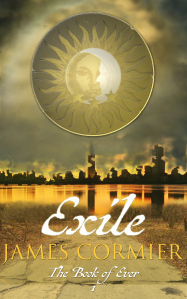 The Kindle version of my first novel, Exile: Part One of The Book of Ever, will be free on Amazon starting tomorrow, Sunday, August 17th, until Thursday, August 21st. Now’s your chance to read the first part of The Book of Ever, my young adult science fiction series.
You can also read the first five chapters of Exile free right here on my website.
Centuries after the Fall, the United States has been wiped away. The crumbling remains of the great American empire are home now only to savage, lawless tribes and packs of ravening Damned—the twisted children of the apocalypse. Most of those few who survived humanity’s destruction spend their short lives in a violent struggle for survival. But some light still flickers in the darkness: the Blessed of Bountiful live in seclusion, relying on walls both physical and spiritual to protect them from the…
View original 117 more words


What It Means To Be A Bestseller
The word “bestseller” holds near-mythical connotations for most readers, and many writers. But why? Being a “bestseller” is a relative term. First you have to decide, bestseller according to whom? The NYT bestseller list is somewhat disingenuous, in terms of how its compiled, which not everyone realizes it. Cadging a spot doesn’t automatically mean that you’ve sold a hundred thousand books, or that anyone even likes your book. Nor does it guarantee–much like with Billboard’s Top 100–that you’ll be there tomorrow. And, toting up all of Amazon’s various bestseller lists, you end up with something like 11,000 books.
I’m currently, as of this writing, at #4 in the paranormal romance subsection “demons and devils” and at #7 in the historical romance subset “medieval.” I’m pretty proud of this, because these are popular categories where I have a lot of stiff competition. But, depending on how your book is shelved, getting a top spot might be harder or easier. There are a number of books out there that are “bestsellers,” which actually don’t sell that well. That’s because the authors, sometimes fortuitously and sometimes by design, have chosen to shelve their books where there’s less competition (or if they’re traditionally published, their publishers have).
A better indication of how someone is doing is their overall sales rank. Someone who’s, say, near the top in one or two obscure categories but whose overall sales rank is hovering somewhere in the 300,000’s probably sold–and I’m just spitballing, here, based on my own experience, obviously Amazon keeps a pretty tight lid on its data and, therefore, what its sales rank actually means in terms of sales–a couple of books in the last week. If that. Because, of course, especially in the higher numbers, what your sales rank means depends too on how many books those below you are selling. It’s more impressive to be at the 100K mark if everyone beneath you is selling a hundred books a day or more, versus if the current bestseller on all of Amazon has only just managed to sell a hundred books.
Make sense?
The overall sales rank, as of this writing, for The Demon of Darkling Reach is 593. Which is because, like I said, I’m privileged to be in some really excellent company. Both paranormal and historical romance are hot right now, and have attracted some terrific talent.
But the thing is, sales rank changes–and, as I’m fond of pointing out, each single doesn’t last very long. The first time I sold over a hundred copies in a day, I was over the moon. I knew I probably wouldn’t sell a hundred copies every day, but I also had no idea what, in this field, constituted “reasonable expectations.” An attempt to provide myself with some parameters failed miserably, although I learned that Stephenie Meyer sells about 16K copies of her books per day on average. This is because, as I later learned, the common refrain of “sales are unpredictable” is the world’s worst understatement. You can’t predict the next day’s sales based on the sales of the day before any more than you can predict the outcome of the next coin toss based on the outcome of the previous coin toss. Oh, if you sold a hundred books one day, you probably won’t sell one the next. But you might. Or you might sell 500, or three times that. Nobody knows. The market is fickle.
Which is why you should do two things.
First, you should still be proud of your sales rank, whatever it is, because the fact that you have one means you’ve outsold everyone who hasn’t written a book. If you’re hovering around the 1,000 mark, or even the 10,000 or the 20,000 mark, then you’re still outselling the fifteen million or so other books currently available for sale on Amazon. Don’t be discouraged. Everyone has to start somewhere. And speaking as someone who’s had books shoot up the charts and then shoot right back down, it happens. Slow and steady really does win this race and just like failure is an event, not a person (Zig Ziglar), a sales rank is just a number. Be proud, not of how high or low it is, but of what it represents: you, chasing your dreams. You, affirmatively choosing to place your mark on the world.
Second, you shouldn’t draw any conclusions about your earnings potential–positive or negative–from short term data. Selling 500 books yesterday doesn’t mean you’ll sell 500 books today and it certainly doesn’t mean you’ll sell 500 books every day this month. It’s not unachievable, selling 500 books in a day–I’ve done it which, believe me, means anyone can–but I’ve yet to earn 30K in a month.
And yet I hear authors make statements all the time about how they “earn 1,200 in a month,” or whatever. Based on one month’s income. Earning 1,200.00 USD in a month means, if you publish with Amazon, that you sold about 600 books that month or 20 per day. Which is great. Except a sales funnel is not a machine and instead of selling 20 every day you probably sold a couple hundred one day and five (just five) the next. You might sell double that number of books the next month, or you might get a bad batch of Amazon reviews and see your sales nosedive.
So what should you do?
First, like the guy I wrote about yesterday, you need to divest yourself of this mentality of equating books with lottery tickets. No career is built in the short term. Keep writing. Keep publishing. Understand that your book achieving bestseller status in any category is temporary, does not represent the apex of your career, and is not the end of the road. Imagine if the Stones had retired after their first single, deciding that, well, we hit the charts, so that’s as good as we’re ever going to get. The idea sounds ludicrous, doesn’t it? And yet this is exactly the attitude that many writers adopt. They either don’t achieve instant success, or their success doesn’t last indefinitely, so they give up.
Second, you need to save your pennies. Talk to a CPA. Get a handle on how much you should be putting aside for taxes. Because yes, taxes. Treat every royalty payment, at least in the beginning–and by “beginning” I mean at least the first six months, ideally the first year–as a windfall. Don’t rely on that income any more than you absolutely have to. Don’t quit your day job. And don’t decide that, because you made X amount last month, that you can now budget your expenses to reflect X amount as your new monthly income.
And above all, keep writing!


August 16, 2014
“My Amazon Bestseller Made Me Nothing”
Today, we’re going to unpack an article that appeared on Salon.com over a year ago. Why? Because it’s still relevant today. Even more relevant, arguably, in light of the increasing tensions between self and traditionally published authors and between just about every publishing platform in the universe and every other publishing platform. The basic thesis of the author is that everyone thinks authors are millionaires, that success as an author means being a millionaire, but that truly successful authors aren’t millionaires and in fact don’t make any money at all. HIs ultimate point being that choosing to write for a living sentences one to poverty and that “real” writers accept this fact.
So what’s he getting wrong?
His thesis, and his conclusions, are based on a handful of underlying assumptions:
That success equals becoming a millionaire.
That making the same income from writing that you would from, say, working at Wal-Mart equates to failure.
That publishing one book, and seeing it do well over a discrete period of time, equals success.
All of these assumptions are wrong. Let’s start with the last one first. As I point out in my forthcoming guide to success in self publishing, pinning your dreams of success on one book is a terrible mistake. And it’s also a rookie mistake, since most of us have been raised since birth to think of publishing as the ultimate gatekeeper. Just getting published seems so impossible that few, if any, of us think about what’s going to happen once we are published. What’s the next step?
Rather, we see publishing as both the first major hurdle to career success and the endgame. And there’s a certain rationale behind that belief, which stems from the fact that traditional publishing is usually a one shot deal. Dan Brown was lucky in that his books hung around on shelves, doing modestly well, before he was “discovered.” But most writers don’t get two years; they get a few weeks, before their books are remaindered. If you haven’t done well enough with your first book, then convincing your publisher to take a chance on your second book can be challenging.
However, the fact is that however you’re published, you need to write–and sell–more than one book. Self publishing offers an advantage, here, in that you only need to convince yourself. You don’t need to also convince your third party publisher to keep taking chances on you. I talk a lot about the magic of the backlist, and that’s because having a solid backlist really is everything. Even if your first book does become a bestseller, each bestseller doesn’t last for very long.
Plan on one book catapulting you to stardom and you’re no different than the kid in Tom Petty’s song “Into The Great Wide Open.” You write one book. It does well. That’s great. But nobody’s running a charity, here; where’s your next book? What are you doing, to capitalize on your success?
I get really sick of people complaining that their one book wonder didn’t make them a millionaire. Yes, there’s a certain degree of luck involved in getting your book discovered in the first place–but then it’s up to you, as the captain of your own ship, to leverage that fifteen minutes of fame into something more permanent. Resting on your laurels is great and all, but it won’t help you build a meaningful career. In anything.
Now, on to the second point. The title of the article is “My Amazon Bestseller Made Me Nothing.” Which, by nothing the author means about 12K. If he’d been self published, then he would have made closer to 25K. But still, last time I checked, 12K was not “nothing.” That’s a respectable second job. It’s enough to pay for two years at BYU. It’s a down payment on a house. Dismissing non-millionaire level earnings as “nothing” is the kind of snotty, backwards thinking that’s ruining this country.
Ironically, it’s these same people who judge my generation (millennials) for thinking we’re “too good” for minimum wage. Do you know how long it takes to earn 12K working at McDonald’s? Because I do. Although somehow I doubt this literary showcase did, or does. It’s really the generation above us who seem convinced that anything, which doesn’t instantaneously produce millions, isn’t a “real” job. I, for one, would be perfectly happy to earn 12K. I have, in fact, been doing alright with my writing and editing and other creative pursuits and while I’m not a millionaire just yet I’m happy to report that my son has an exceptionally robust college fund.
Which takes me to my last point: as Bob Marley pointed out, money is just numbers. If you make your belief in your own success dependent on numbers, then you’ll never succeed. Because there are always more numbers. To me, “success” means waking up every morning and doing exactly what I want to do. In monetary terms, it means helping to, along with my husband, provide for our family.
If my goal were simply to own a larger house and a better car, then I’d have stuck with practicing law. But, you know, you don’t need to be a millionaire to buy groceries, or pay your mortgage, or fund your child’s college fund. Or, indeed, to give yourself the freedom to follow your own path. I guess, for every writer who “only” makes 12K and then gives up in disgust, there are others–like me–who keep on plugging. Because we’re not in it to be millionaires; we’re in it to be happy.


August 15, 2014
The Truth About the Ice Bucket Challenge
The ice bucket challenge, like anything that’s managed to capture people’s imaginations, has gotten a lot of haters. Haters are like iron filings, attracted to anyone or anything that threatens to make a difference in the world. Trust me, as a writer, you learn this. Nothing brings people out of the woodwork like actually finishing and publishing a book. A phenomenon, which encapsulates the sad truth that it’s much easier to convince yourself that you’re being productive by critiquing others’ efforts at productivity, than to actually get off the couch and make an effort on your own initiative.
And yes, dumping a bucket of ice on your head doesn’t make you a philanthropist. But was anyone confused on this point? I’m fairly certain that none of these haters are taking time away from their efforts as full time volunteers with the Peace Corps, or Doctors Without Borders, to fill us in on what we’re all doing wrong. Because nothing equips someone for telling people how they’re writing a book wrong, or being a philanthropist wrong, or doing anything else wrong, like having never successfully done those things, themselves.
Nevertheless, we’re all supposed to listen to them because–without that constant stream of positive reinforcement, they might actually have to hold themselves accountable for their own choices. Want to see more philanthropy in the world? Get off your butt and do something. Don’t criticize others’ efforts, because the sheer fact of their actually making efforts is too intimidating.
You don’t score any points in my book by shaming people for trying to do good. You know, we all have to start somewhere. Shaming someone who may have never participated in a challenge like this before is like shaming someone who’s trying to lose weight by telling them that they’re too fat to try. They should remain on the couch, getting fatter, because if you can’t instantly run a marathon the first time you strap on running shoes then why bother? You’re just holding everyone else back with your desire to improve.
Confident people support each other. When I told my friends about my weight loss/new boobs challenge, they were all incredibly supportive. A good friend of mine asked me to join her running team as a team “angel,” someone who pushes the wheelchairs of those less motile team members. As she pointed out, I might not be an olympian but I’m still lapping everyone on the couch. It’s the effort which should be rewarded, not the success. Because what is success, really? For every different person, you’re going to get a different definition. Is the likelihood that I, with my persistent spare tire and heart condition, will never win a gold medal enough to disqualify me from being proud of my own efforts?
We all have to start somewhere. The some good that ice bucket challenge adoptees are achieving is better than the no good that their heckling bystander counterparts are achieving. Trolling “for a cause” is still trolling. Because trust me, the people who feel passionately about how much Aquaman sucks or how much my books suck or whatever feel just as passionately. There’s really no such thing as “but my trolling is more valid than your trolling, because my opinion is more valid than your opinion.” You’re still transforming your passion into tearing down others instead of doing something useful.
And honestly, if seeing people come together for something like the ice bucket challenge is that offensive to you, then you should question what’s wrong with you. Not them. You.


The White Queen is OUT!
The Kindle version of The White Queen, sequel to The Demon of Darkling Reach, is OUT! Expect the print version to join it before the end of next week. I’m thrilled about this sequel, and think there’s a lot in it that will gratify and intrigue fans of the series. Questions are answers, and new mysteries introduced. And you learn more about Tristan…
Both books are free with your Kindle Unlimited subscription and, August 16 through August 20, in celebration of the arrival of The White Queen, The Demon of Darkling Reach is free to own on Kindle!


August 14, 2014
The P.J. Weight Reduction Challenge Update 1
I used to be thin and now I’m kind of–the term my husband uses is “shapely.” And, indeed, there’s a whole lot of shape. It doesn’t help that I used to be skinny, and had (previously and foolishly) thought that I “had trouble” losing weight. Which essentially meant that not every outfit was equally beautifying and that ticked me off. Well…humility, thy name is P.J.
I’m 5’9 and until a few years ago I was a size 6 or an 8. Then a combination of depression, medical issues, and finally pregnancy kind of torpedoed that. Which, I’m not complaining. I put the Cheetos in my mouth when I was depressed and I would’ve gained any amount of weight to have my awesome son who is (to me) perfect. But the upshot is that I’m now 50 pounds heavier than I was and a robust size 16.
Which, all of this is embarrassing to admit. But I figure, on the off chance that anyone else is going through the same thing, I’m going to share my adventures and hopefully we can have a bonding experience. My initial goal is to lose 35 pounds before my 10 year wedding anniversary, which is this coming February. We’re having a party. My entire family is flying in from Utah. I figure, even if I don’t make that goal, at least I will have lost something. And 90%, or 85% of a goal is better than 0% of a goal, right?
My long term plan is to, as a reward to myself when I reach my goal weight, buy myself a pair of new boobs.
Hey–they say pick a non food-based reward, right?
The P.J. Weight Reduction Challenge actually began almost three weeks ago, with the arrival of my brand new Treadclimber (which was a present from my husband). In that time, I’ve worked out fairly consistently, averaging about five days per week. And this is what I’ve experienced so far:
Sweat. Sweat like you’ve never seen sweat before. Buckets of sweat. Every time I get off that thing, I feel like I’ve gone swimming. I’d like to be doing 45 minutes per day, but at this point that has turned out to be too ambitious so I’m averaging more like 30. Which is rough for someone who once climbed Mt. Washington. I was also, as it turns out, in serious denial about just how out of shape I’d gotten. But honestly…I’ve done a few different workouts in my day and nothing, absolutely nothing, has given me a workout like this. It’s the kind of bracing, invigorating workout where you enter your cool down period feeling a little like a hollowed-out gourd. My pro tip, though, is to wait a few minutes between finishing your stretches and getting in the shower; getting out of the shower and still sweating is super gross.
Flatulence. It turns out that runner’s trots aren’t just for in shape people. I’m told by my (legitimate, they get paid to do this for a living) athlete friends that this is completely normal and especially common when you’re working out your abs a lot. Which…this Treadclimber works out your abs like nothing else on the planet. My husband has been…unhappy about this turn of events, and my cat has been making airplane ears at me every night for a week. So why am I sharing this? Because the level of misery, and embarrassment-induced misery could conceivably be enough to discourage one. Don’t be discouraged! This too shall pass. And if it doesn’t, you’ll hear about it in my updates and that’ll encourage you to keep going. If nothing else, then so you can make fun of me.
A tightening of the pants. A problem I’ve always had, and that’s less common for women but still a common enough issue, is a tendency to gain muscle quicker than I lose fat. Which has meant that my butt has (I hope temporarily) gotten bigger. Again, this might also discourage one. After all, weight reduction is also supposed to be about size reduction. But I’m operating on the principle that this is a long term thing and pushing through it.
A loosening of the pants. My waist has, on the other hand, shrunk. Which is a good thing, believe me.
Exhaustion. Because going from “I do nothing” even to “I’m working out a marginal amount” is a huge transition. I’m not gonna lie, I’ve been sleeping like a log. I get jealous when my toddler takes naps.
Overall, though, one thing that my experience so far has reminded me of is that we don’t just move around to lose weight. We also do it to feel good–about ourselves, not just on the outside but on the inside. And I really do feel better already. My energy levels may have temporarily taken a nose dive and I might be kind of smelly, but I feel way more alert and focused when I’m writing. I’ve also found that I just plain feel…better. It’s hard to put into words. All this sweating is doing wonders for my skin, too.
I’ve lost a few pounds. There are varying opinions within my family on where this weight has come from, with different body parts being suggested at Sunday dinners. And yes, extended family Sunday dinners are a thing with us. A lot of people who write pretty subversive stuff are, in real life, offensively wholesome. We get together, pray, talk about the kinds of boring things that families talk about, and eat enchiladas fish tacos chocolate chicken the best Mexican food you’ve ever had.
So that’s the news this week.


August 13, 2014
The “Self-Publishing Is For Losers” Kickstarter Is Live!
Originally posted on James Cormier:
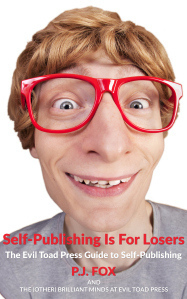 Now’s your chance to get behind a great book designed to help indie / self-published authors not only publish their work but achieve the writing career of their dreams. Written by P.J. Fox, author of the bestselling The Price of Desireand The Demon of Darkling Reach, Self-Publishing Is For Losers: The Evil Toad Press Guide to Self-Publishing cuts through all the BS that’s out there about self-publishing and tells you what you need to hear to make it as an indie author.
The unfortunate truth is that as many strides as self-publishing has made, there are still many out there who deride it as a license for mediocrity–hence the ironic title, Self-Publishing Is For Losers. That’s what traditional publishing wants you to think, whether they admit it or not. This book teaches you how to put that thinking aside and focus on building a business and career…
View original 216 more words


Why You Should Back Our Kickstarter
Our Kickstarter is live. So what are we raising money for? A book that will help you, the aspiring writer (or, indeed, previously published writer) transform your dreams of a writing life into an actual, meaningful career. Our self publishing guide is about more than how to produce a book; it’s about how to earn a living from the proceeds of your work, and on your own terms, while maintaining the integrity of your own goals, dreams, and values.
To which you might be wondering, so? How does this benefit me? Why should I care?
Oh, I’m so glad you asked…
Helping us reach our goal will benefit your career. Are you a writer? Are you thinking of one day becoming a writer? Are you either considering self publishing right off the bat, and wondering if it’s a worthwhile idea to pursue–or are you a traditionally published writer, thinking about making the leap? No matter what your situation, this book can help you. For the price of a couple of Starbucks runs, you can gift yourself with some meaningful advice that will stick with you throughout your career.
There’s no other book like this on the market. There are a lot of books, which treat writing as a get rich quick scheme. Or which promise to teach you about this month’s latest and greatest print on demand platform. Or which promise to teach you how to code. But there’s no book, which lays out, step by step and in meaningful, practical terms, how to transform your creative efforts into a career.
You’re helping other writers. Too often, we fall victim to the scarcity mentality–that there’s only so much success to go around, and one person’s success diminishes our chances of achieving that same success. When, in reality, the truth is the opposite: we are in charge of our own success. And the more we give to the world, the more comes back to us. Success isn’t something we take; it’s something we create. Helping us helps everyone.
We are offering some amazingly cool rewards. This is not another smorgasbord of coffee mugs and posters. Among our–very long list of–rewards are the chance to have a novella written about the fantasy (or nightmare) of your choice, and Evil Toad Press’ author services at a fraction of their fair market cost. We’re also open to considering reward requests (but no renting Mr. PJ).
Our book is funny. This is a book that, in addition to being chock full of useful information, is something you’ll actually want to read. It’s not (yet another) encyclopedia-like list of boring and often outdated references. It will make you laugh out loud. Which, face it, is something we could all use a little more of.
Are you convinced? Do you have any questions? Please let us know!


August 12, 2014
Why Funny People Kill Themselves
I could have written this article by David Wong myself. Not as well, but everything he says in it describes me perfectly–my struggles, outward and inward, and the reasons behind them. Also, everything on this list is true. Including the part about how you can find a real, meaningful community of people online who can help you when you can’t save yourself. And trust me, I know all about being powerless in the face of your problems: my own battle with anxiety and depression has been so crippling that, at times, its left me utterly non-functional. At least on the inside. So instead of reiterating his excellent points, I’m going to tell you a little bit about why I didn’t kill myself and why you shouldn’t, either.
I’m going to start by pointing out something that should be obvious, but isn’t: depression doesn’t make you grow horns, or start lip synching to Ryan Adams. You can’t tell what’s going on on the inside, with someone, by judging the outside. Plenty of “successful” people are in dire need of help. On the outside, I’ve always been “on,” always been funny, always been able to hold down a job and do well at that job and convince other people that I was successful. I never asked for help, either, until others intervened on my behalf. Why? Well, I’m pretty sure that everyone who struggles with self hatred has an internal monologue that goes something like, everybody only likes you, because they don’t know what you’re really like. So it doesn’t help when, in addition, you’re also actually hearing that all the time.
I grew up being told, by my biological “mother,” that nobody who knew me could possibly like me and, when people did like me, that they only liked me because they didn’t know what I was really like. Her exact words. This started, certainly by the time I could talk, and has continued up until the present moment–or, rather, was still going strong the last time I spoke with her, which was by accident and a few years ago at this point. She used to get down on her knees, starting when I was about six, and beg me to kill myself. She’d wake me up in the morning by telling me how the whole world hated me and was waiting for me to kill myself, because I was a blight on humanity, and that the only possible contribution I could ever make to the world that would mean anything would be to die.
So in a way, finally rejecting me–although she kept coming back, rearing her ugly head to remind me that I’d ruined her life by being born–was the kindest thing that woman ever did. In the meantime, I pushed myself to get the best grades, look the best, and…it was never enough. When I was young, it was “who cares if you got an A in English, you’re not on the soccer team, we’re so disappointed in you.” By the time I was in high school, I’d internalized that monologue to the point where my efforts all had a certain joylessness. I had to succeed; success would prove, to someone, that I had worth. That I deserved to exist, after all.
I ended up with a great family who was always proud of me. Regardless of what grades I got, or what awards I won. They were proud of me for trying my hardest and for being a decent human being. Even when I wasn’t actually being a decent human being–high school was not my best time–they recognized that I was trying. I got free ride to a Top New England College You’ve Heard Of, did well there (I graduated with a 4.0), and then I got a free ride to a Top New England Law School You’ve Heard of, where I continued to do well. I met and married a wonderful man.
And then, at some point along the line, I had a nervous breakdown.
My family got me help.
I decided not to be a lawyer anymore, but–with my family’s full support–to do what I’d always wanted to do since I was a little kid, which was write.
But the thing is about families is that, no matter how much they love you, they are only one–or two, or ten–people. They don’t have superpowers. They can love you, but they can’t love you better. Their support, and their love, is–to use a legal term–necessary but not sufficient. Meaning that, if you have a support network, and are getting help, your family’s help is going to be invaluable. But if you’re not there yet, they can’t pull you out of the drink all by themselves. You have to want help. And that, you can’t always want on your own, either. The cruelest paradox of depression is that you actually have to start getting better before you can begin to feel like you deserve to get better. Like there’s anything the least bit unnatural or illogical about hating yourself.
Everyone’s support group is going to be different. I can’t tell you, join this one or find that group. But what I can tell you is that the right support group is the place where you feel completely accepted for exactly who you are. And I mean exactly, no strings attached. For me, that place was church. I’m more or less a lifelong Mormon, but it wasn’t until I finally acknowledged that I had serious problems that I began to appreciate what my church membership was offering me. The church was the first place where I felt completely accepted for exactly who I was. My family, of course, completely accepted me for exactly who I was–but I felt too much guilt about them, and my relationship with them, to appreciate that. I felt like, by having the problems I had, I was ruining their lives. It made me close off.
Whereas, my church leaders, at every level, had no such personal relationship with me. They weren’t obligated to tell me the things they did, or to say the things they did in talks, which I’d lie awake at night reading. I was usually up at night because I slept all day, because I was useless. But I’d read about how anxiety and depression were medical conditions, and seeking help for them was a sign of strength. About how I was a daughter of Heavenly Father, and He made me exactly the way I was for a reason. And then–cue the religious moment–I started learning about the Atonement, really learning, for the first time, not the theological concept but how it was relevant to my own life. I realized, finally, that I wasn’t enslaved to my past. Not to the mistakes I’d made, or felt I’d made, or to the views that others had, at times, had of me.
And that was when I started getting better.
Part of living with depression is knowing that it’s a lifelong battle. Much like recovery from substance abuse; you might go into retirement, as it were, but you’re never “cured.” You can come out of retirement at any time, regardless of what support network you have, or what medication you’re on, or what else you’re doing. Advice like “just exercise,” or “just feel better” are as useless as every other statement, which fails to acknowledge that this is a chronic disease. It’s not something you have control over. What you do have control over is how you choose to manage your disease–and making the right choices, and by right I mean right for you, requires support. Not censure, and not judgment.
I started taking medication. I started working out. I started writing fiction. I started therapy. I made new friends, who didn’t tell me things like one friend did, which was that now that I wasn’t practicing law anymore and we were on a reduced budget, that she couldn’t hang out with me anymore because I was “too poor.” Or the “friend” who told me he wasn’t friends with people who had children.
You can’t magic away your illness, but you can take responsibility for it–just like a diabetic can stop eating cake for breakfast, someone with depression can choose to remove those influences from his life, which contribute to his disease rather than aid his recovery. I completely cut ties with my biological “family,” who’d never been much of a family anyway. The aunt who told me it was my fault that my mother beat me, because I “wasn’t sweet enough.” The cousins who forgot I existed until they wanted money. I quit a job that wasn’t fulfilling, prioritizing my own goals and ambitions above simply agreeing with what we, as a society, at some point defined as “success.”
I realized that if you want different results than you’ve gotten before, you have to do something you’ve never done before. And that was hard, and that was scary. But, in the end, facing a life of misery was a lot scarier.
A mentor at church, who is also a product of foster care, challenged me to start opening up about my experiences. I never had. I hid behind a wall of being funny and never talked about myself at all. But after about six months of talking with him, I wrote an open letter to my family. And then, a few months after that, I gave a talk at church wherein I told several hundred people, many of them complete and total strangers, what had happened during my childhood and how that had led me here. After which I understood why getting up and sharing your story is part of AA: by doing so, you’re giving yourself a chance to understand that you aren’t actually hateful. That your experiences haven’t made you hateful. That you don’t need to isolate your true self from the world, for anyone to think positively of you.
Or, again, at least not hate you.
People started telling me things like, that what I’d said inspired them. That my having the courage to share my story had given them courage, too. I wasn’t quite sure how to take that, and I’m still not, but the one thing I do know is that I wasn’t alone then and I’m not alone now.
You’re not, either.
Ask for help, if you need help. Tell people how you’re–really–feeling. I’m still here because I came home from winning a case, got into bed with a bag of cheese puffs, and stayed there for a month. During which time I gained thirty-five pounds. And you know what? A lot of people didn’t care. One friend–who isn’t my friend anymore–actually came over, saw me in this state, made fun of me and left. He doesn’t understand why, now that I’m better, we’re not friends again. But that’s okay. Things that seem devastating while you’re experiencing them really can seem funny in retrospect. I’m glad I procrastinated–that’s what I was doing, you see, procrastinating while I decided which method of suicide would be best–long enough for my family to intervene.
They weren’t sure how, at first. I wasn’t sure how. Nobody knew what was happening.
But not everybody is as lucky as I was, and am; they’re more decisive, and act too quickly, and don’t get the chance to realize that it really does get better.
Because it really does get better.