David Williams's Blog, page 39
May 15, 2019
The Ending of Game of Thrones

This is one of those posts, from one of those people.
Because I don't watch it.
I could have, out of some sense of cultural obligation. How else could I pepper my sermons with knowing, engaged references? But I have not watched it, and I am not watching it. I mean, sure, every now and then, I'll watch a snippet of an episode on Youtube, because dragons.
I did, however, read the books. Not all of them. I read the first three, years ago. They were great. I found them utterly engrossing. After the end of the third book, at the advice of a trusted friend and the stirring of my own instinct, I stopped.
The reason I stopped was simple: I could see how the series had to end.
Not because I'm a prophet, or because I'm in sole possession of the only handwritten manuscripts of the last four books, which George RR accidentally mailed to my home address. That rumor is completely unfounded, no matter what George tells you.
But because I'm a storyteller, and I recognized the flow of the narrative of Westeros.
Here's the truth of it, the only legitimate, true-to-the-genre way Game of Thrones ends:
It doesn't.
It can't. There is no way to end it that would feel right, as y'all are discovering.
The entire series is about the human struggle for power, the wrestling for control. I mean, duh. It's just a mirror of our history, in all of its endlessly cycling brutality and falseness. That kind of story goes on, and on, and on, generation after generation, filled with war and treachery and plotting and greed. There would need to be a hundred books. A thousand. More.
It'd be both exhausting and insane.
I already get that from history itself, as bloody and fascinating and bizarre as anything Westeros offers.
And the news, God help us.


May 3, 2019
That Moment of Stillness
 The concert hall was filled with human beings. It was close to capacity, with almost every seat taken. Almost two thousand persons, gathered in a space, listening to a trio of the world's best musicians play a series of classical pieces.
 One of the great advantages of modern-era music? It's amplified, pouring out through vast speaker arrays, filling the air with itself, smothering the presence of human beings. Space is left for applause and call-outs to the audience, but when the music is TURN'T UP, it shoulders us aside. We are there, but we are not there enough to intrude.
This was different. No amplification, no nothing. Just piano, cello, violin, and the natural acoustics of the venue. It was a pure, organic experience, and as such was a perfect reminder that pure, organic human beings are...well...we're kind of noisy. We rustle. We stir. We drop things. We murmur and shift in place. And at the height of pollen season, we cough. Oh dear sweet baby Jesus, do we cough.
Echoing through the perfect acoustics of a modern concert hall, allergy season isn't the friend of the listener.
As the musicians played their first piece, Mendelssohn's lovely Piano Trio No. 1, our noisy humanness was impossible to escape. We intruded constantly on the music, coughing and snorting and sneezing. And dropping things. Evidently those programs were slippery.
During the break between pieces, the gathered mass of humanity hacked and hawked and cleared its collective throat, to the point where I wondered if this particular concert happened to include Patients Zero through Four hundred and Fifty two in a major pandemic outbreak. People shifted and talked, the room alive with the sound of our collective bustle.
But at the beginning of the second piece, there came this...moment. It was at the start of the second piece, Shostakovich's Piano Trio #2 in E minor. I'd never heard it before. It's a stark, challenging work, sometimes sublime, often harsh, teasing with sorrowful near-harmonies. It begins with the cello, way up high at the top of its register, sweet and soft and intimate.
In that great room, alive with the sounds of nearly two thousand humans, that cello was barely audible. A whisper of beauty, so quiet as to be almost outside of the range of hearing, almost lost in the sound of the natural movement of our mass. We weren't trying to be loud. No one was coughing or dropping things. Even so, we were still all moving, just a little, all together, enough to make it hard to hear.
But we were also all listening for the music. Every person in that vast space wanted to hear. We were all paying attention. And from that shared desire, the whole room went still. Completely, totally, still.
All at once, there was near absolute silence. Not a person moving, breath held in thousands of lungs, not a one of us shifting, all holding perfectly motionless as the cello sang clearly in the space we together had made for it.
That great receptive quiet was, in its own way, as beautiful as the music itself.
How often in life do all of us grow still, not just one or two of us, but all, listening together to a voice that can only be heard in that place of deep gathered silence?
May 1, 2019
One City, Many Gates

How can faith integrate into itself the idea that there are multiple and variant narratives of truth?
It would seem impossible. Faith, or so we tend to think, involves having one defining story, a singular mythopoetic. There is a single acceptable set of truths, and anything outside of that truth set is either not of the faith or heretical.
We have, from the modern era's mechanistic assumptions about inerrant texts and the pre-modern era's assumptions about ecclesiastical inerrancy, assumed that authority is singular. So of course religion can only have one truth. Accepting variation would be a violation of canon.
And we know from the fandom of our modern corporate myth-o-tainment franchises that varying from canon...any canon...seriously sets people off. Some days, that's pretty much all reddit and Twitter do.
Only, well, the Christian canon is weird.
At the core of the Christian faith, there are four Gospels, four alternative narratives of Jesus. Three...Matthew, Mark, and Luke...share general parameters with one another. One...John...is completely different. They arise from variant oral and written traditions, all trying to get at who Jesus was and what he taught. Each was written into a specific context in the early church, by a writer with a particular and discernable editorial emphasis.
Mark, furtive and blunt as a bludgeon. Matthew, the earnest traditionalist. Luke, the erudite historian. John, the poet and the mystic.
Their tonal variances are nontrivial. But, more importantly, none are exactly the same story. They present us with variant characters and differing chronologies.
They cannot be reconciled or blended with one another without some serious surgery. This is a problem for fundamentalism, because you cannot be "literally inerrant" if your texts are "literally different."
The early church also struggled with this. How can you have this peculiar dissonance?
Efforts were made at mashing them up, at creating one authoritative and harmonized story. Tatian's Diatesseron was one early attempt. But the Jesus movement did not go that way. The choice was made to retain these variant accounts.
So what if they're different? So what if they don't line up exactly?
It doesn't matter. The geist...the spirit...of them is the same. There are four gates to our city, but they lead to the same place.
And, in fact, keeping those variant perspectives was viewed as ultimately having more value. Having variance deepens the core truth of each, with each text offering insights that the others do not, creating a sense of a whole that is richer and more complicated than a unitary perspective could provide.
Variant narratives of truth? That's pretty much the core of the Christian canon.
April 25, 2019
Multiversality, Culture, and Story
 Why does contemporary popular storytelling have such a fascination with multiverses?
To a rather lesser degree than one might think, there's science. That theoretical physics suggests that a multiverse may exist really doesn't drive our fantasy and science fiction storytelling. The complexities of quantum-splitting/inflationary understandings of the Many Worlds really wasn't a significant factor in the comic books I used to read as a kid.
And sure, multiversality's also a narrative convenience, one that allows storytellers to create endless, lucrative complexity within a single franchise. But there's something else at play.
I think, in large part, it rises from the increasing blending of cultures and narratives that has come in this strange new era of communication and human exchange. Where once there was just one understanding of the world, now human societies are having to come to terms with the presence of completely variant ways of understanding who we are and why we are here. This has always been true, as cultures have interacted and adapted. But now it's fiercely, relentlessly immediate.
 Faced with the unfamiliar stories of those who are not us, you can, of course, reject them. This is the easier path. The only true story is our own, one can say. Every other cultural narrative is wrong. Or evil. You don't need to try to engage with them, or try to integrate them into your own self understanding. You simply throw them aside as monstrous and flawed and delusional.
That way of dealing with the Other is powerfully seductive. We see it as we fall back into rigid ethnic and racial categories, or into the bright clean certainties of nationalism and fundamentalism. There is only one truth, and that's our truth. There's only one story, and that's our story. We reflexively resist, because we fear losing our understanding of ourselves in a wild chaos of competing truth claims. We prefer the simple, linear comforts of the story we know.
The alternative is unquestionably unsettling. Why is the story we have told ourselves for millennia about the way things came to be the One True Story? Because it is ours. Because it just is. It cements the hallowed place of our culture...or our "race"...in the universe.
Yet do not reflexively and smugly sniff at this, O you liberal. Myth and mythopoetics are to cultures what memories and personal narratives are to individuals. They give us cohesion. They establish and reinforce a sense of self. Casting common story aside leaves us existentially fragmented and schizotypal, so disconnected from a sense of common social connection that our souls fall into anxious, gibbering chaos.
There are so many other stories rising from the humans who inhabit this small world. How to constructively process them?
We have no clue.
But it's possible that part of the appeal of multiversality as a cosmology is that it helps us constructively process difference. We come to see the variant possiblities inherent in the stories we ourselves tell. There are strange places where our heroes are villains, and our villains have become noble. If this is so, encountering another story, told from an unfamiliar perspective? It poses no threat. We simply find resonances and harmonies with our own stories. Or we delight in the encounter with a new thing.
If we are already aware of the possibility of difference within our own stories, of subtle variances within the "canon" of our telling, then perhaps that integration of difference prepares us for engaging with difference.
Which is fine if we're talking the Marvel Character Universe. But there are other, more rigid stories.
How can this be true from the stance of religion? Surely faith traditions are more rigid and absolute in their narratives, unable to integrate difference into themselves.
I mean, they are, right?
April 22, 2019
The Market-Based Solution to Climate Change
There is no doubt, none that is reasonable. Our planet is warming, skewing the delicate balance upon which humanity relies to survive. The cause of that warming is us, and our reliance on fossil fuels to drive the wild rushing busyness of our commerce.
There is, again, no doubt about this. None. It is happening, as certainly as Titan orbits Saturn. There are those who do not believe it is occurring, certainly. This is as meaningful as saying "there are those who believe that the Earth is flat" or "there are those who believe that the Clintons run a child-slave-ring out of the basement of a neighborhood pizza restaurant."
Reasonable doubt is my standard, not the doubt that rises from obvious psychosis.
The question now: what to do about it?
Some would argue that we need regulation, that we need to throttle back the natural energies of the global marketplace with government imposed restrictions. We do not need to do this. We can simply let the market do what it does, and the problem will be solved. Markets, after all, operate on principles closely aligned to the organic processes of evolution and natural competition. Unlike the rigidity of state systems, they are existentially connected to nature itself.
This appears to be the choice we Americans are making, and I am confident that it will ultimately solve the problem.
What does that solution look like? Let me show you an example.
 This is a GMC Yukon. It's a full-sized sport utility vehicle, one produced by General Motors. GM, along with Ford, have recently abandoned the traditional car in favor of doubling down on SUVs. Why?
I found out recently when I rented a Yukon for a day. It was big, vastly bigger than my Accord hybrid sedan, so large it didn't fit into my car port. The Yukon was comfortable and powerful, with a large V8 engine into which one could dip for a nice surge of acceleration. In daily errand running, it consumed fuel at the rate of around 14.8 miles to the gallon, rather more than the 49.5 that my Accord gets on average. The interior space of the Yukon is as wildly inefficient as the rest of the vehicle, with a vestigial third row that is unusable by adults or children older than ten, and about half of the cargo space of our six year old used minivan.
Purchased new, a mid-level Yukon equipped as the one I rented comes in at around sixty-two thousand dollars. They sell like hot cakes. When we purchased our car a year and a half ago, my Accord hybrid had been sitting on the lot for nearly eight months, and we got it brand new from the dealership for thirty-two thousand dollars out the door. In fact, purchasing the Yukon would cost you more than it cost my family to purchase our hybrid, our minivan, and my motorcycle. Combined. It is immensely profitable.
Buying a Yukon seems, if avoiding climate change is a goal, precisely and exactly the wrong thing to do.
But people like to feel big and powerful. We like to feel like we are dominant. It makes us feel safe. It makes us feel in control. The market acknowledges and affirms those desires. Which is why the American factory producing Accords like my own was idled last week, and the factories making Yukons can't make enough.
The market, being driven by forces similar to those in nature, is simply doing what natural selection does. We prefer power, and so our markets keep us aligned with that preference.
How, you might ask, does this solve the problem of climate change?
Simple. It means that, driven by the marketplace, we let the process of natural selection continue. We will consume fuel as we wish. Although we run out of gas under American soil in 10 years, Venezuelan and Russian reserves will last us another seventy years at current consumption rates. Eventually, faced with genuine scarcity, we will become more efficient. But that will be too late to stop the process of a changing planet.
The climate will change, with increasing rapidity. Storms and fires will increase. Sea levels will rise, inundating our coastal communities. Tropical agriculture will collapse, and billions of human beings living near the equator will either die of thirst and starvation or flee towards the poles, where of course we'll meet them with open and sympathetic arms.
Humanity will find itself in a time of crisis, upheaval, and death, with only a very few of the powerful and wealthy sheltered. Perhaps. Or perhaps we will not survive at all, as mass extinctions shake the complex ecological web in a way we do not anticipate.
This is how nature solves the problem of maladaptive species. It allows them to die, and replaces them.
This is the market solution to the problem of climate change. Is it kind or good? No. Is it wise? No. Is it horrible? Yes.
But it does solve the problem.
There is, again, no doubt about this. None. It is happening, as certainly as Titan orbits Saturn. There are those who do not believe it is occurring, certainly. This is as meaningful as saying "there are those who believe that the Earth is flat" or "there are those who believe that the Clintons run a child-slave-ring out of the basement of a neighborhood pizza restaurant."
Reasonable doubt is my standard, not the doubt that rises from obvious psychosis.
The question now: what to do about it?
Some would argue that we need regulation, that we need to throttle back the natural energies of the global marketplace with government imposed restrictions. We do not need to do this. We can simply let the market do what it does, and the problem will be solved. Markets, after all, operate on principles closely aligned to the organic processes of evolution and natural competition. Unlike the rigidity of state systems, they are existentially connected to nature itself.
This appears to be the choice we Americans are making, and I am confident that it will ultimately solve the problem.
What does that solution look like? Let me show you an example.
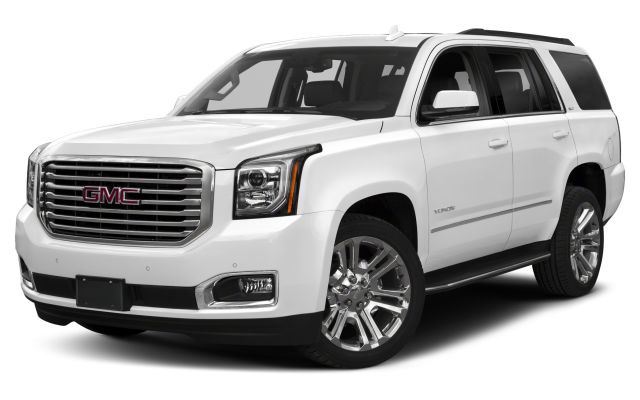 This is a GMC Yukon. It's a full-sized sport utility vehicle, one produced by General Motors. GM, along with Ford, have recently abandoned the traditional car in favor of doubling down on SUVs. Why?
 I found out recently when I rented a Yukon for a day. It was big, vastly bigger than my Accord hybrid sedan, so large it didn't fit into my car port. The Yukon was comfortable and powerful, with a large V8 engine into which one could dip for a nice surge of acceleration. In daily errand running, it consumed fuel at the rate of around 14.8 miles to the gallon, rather more than the 49.5 that my Accord gets on average. The interior space of the Yukon is as wildly inefficient as the rest of the vehicle, with a vestigial third row that is unusable by adults or children older than ten, and about half of the cargo space of our six year old used minivan.
Purchased new, a mid-level Yukon equipped as the one I rented comes in at around sixty-two thousand dollars. They sell like hot cakes. When we purchased our car a year and a half ago, my Accord hybrid had been sitting on the lot for nearly eight months, and we got it brand new from the dealership for thirty-two thousand dollars out the door. In fact, purchasing the Yukon would cost you more than it cost my family to purchase our hybrid, our minivan, and my motorcycle. Combined. It is immensely profitable.
Buying a Yukon seems, if avoiding climate change is a goal, precisely and exactly the wrong thing to do.
But people like to feel big and powerful. We like to feel like we are dominant. It makes us feel safe. It makes us feel in control. The market acknowledges and affirms those desires. Which is why the American factory producing Accords like my own was idled last week, and the factories making Yukons can't make enough.
The market, being driven by forces similar to those in nature, is simply doing what natural selection does. We prefer power, and so our markets keep us aligned with that preference.
How, you might ask, does this solve the problem of climate change?
Simple. It means that, driven by the marketplace, we let the process of natural selection continue. We will consume fuel as we wish. Although we run out of gas under American soil in 10 years, Venezuelan and Russian reserves will last us another seventy years at current consumption rates. Eventually, faced with genuine scarcity, we will become more efficient. But that will be too late to stop the process of a changing planet.
The climate will change, with increasing rapidity. Storms and fires will increase. Sea levels will rise, inundating our coastal communities. Tropical agriculture will collapse, and billions of human beings living near the equator will either die of thirst and starvation or flee towards the poles, where of course we'll meet them with open and sympathetic arms.
Humanity will find itself in a time of crisis, upheaval, and death, with only a very few of the powerful and wealthy sheltered. Perhaps. Or perhaps we will not survive at all, as mass extinctions shake the complex ecological web in a way we do not anticipate.
This is how nature solves the problem of maladaptive species. It allows them to die, and replaces them.
This is the market solution to the problem of climate change. Is it kind or good? No. Is it wise? No. Is it horrible? Yes.
But it does solve the problem.
April 21, 2019
The Racist System

One of the lovely things about being married to the same person for most of your life is that you can, well, talk about things. Non-trivial things.
Like, say, the other day, when we had a frank conversation at the kitchen table about Israel. She, Jewish. I, Christian. She, deeply committed to the state of Israel while troubled by its current hypernationalist leadership. I, continuing to genuinely struggle with the idea that a nation organized around a particular ethno-religious identity is the best way to insure the well-being of the Jewish people. It didn't help with Babylon in 587 BCE. Or with Rome in 70 CE.
It was a third rail conversation, which being friends and partners for multiple decades made possible.
So the other night as we went out to dinner, we decided to talk about race.
She, of the opinion that racism is primarily systemic, a matter of the structures of society. I, of the opinion that racism manifests primarily interpersonally and culturally, which makes it both more amorphous and harder to fight. We discussed, with the appropriate level of heat, our variant perspectives.
My particular struggle was with the word "systemic." I understand systems as a matter of structures, laws, and policies. So of course racism can be systemic. Nazi Germany, Apartheid South Africa and the segregationist American South are three primary examples at a state level. Redlining in real estate was another. Wherever formal structures are designed to keep one "race" in a dominant position over another, you have systemic racism.
As I see it, that is not primarily how racism has maintained its hold over our country. The civil rights movement made major progress on that front, but what it could not eliminate was the deep seated racism that manifests in culture. Racism became less defined by political science and the law, and more social and anthropological.
Meaning, you can have a generally uniform legal structure, but it will be differentially applied based on cultural biases. Like, say, how we treat a rando who murders a black kid for the crime walking through a neighborhood. Or how we respond to a black man politely asking law enforcement not to strangle him to death for a trivial misdemeanor. Things like that. Making systems race-neutral does not mean that racist application of the law is eliminated.
And our society is the farthest thing from class-neutral, with race as an inherited proxy for class. And our society is under the thrall of an administration that is willing to use cultural racism to foment advantageous division.
It's painfully complex. We disagreed, but it wasn't bright line disagreement.
But that challenging conversation left me wondering about the idea of systemic racism, as I define it. Where, specifically, does that exist now? What formal structures, policies, and processes are actively racist, fomenting or reinforcing race-based hatred in America?
The first that popped to mind revolved around current immigration policy, because, duh. "Scary Brown People Are Scary" is pretty much the go-to whenever this benighted, amoral administration is feeling pressure for its venality and incompetence.
But the second? The second system that reinforces racism isn't governmental. It's corporate.
It's my contention that the structures of corporate social media...the algorithms that show us the things we want to see...are actively racist. They are what systemic racism looks like in this strange new era.
They have been explicitly designed to feed us things that draw our attention, and that heighten our engagement. Anger, fear and resentment do that, powerfully and consistently. When we are enraged, we are engaged. When we are engaged, we can be monetized.
And so every day, from a cultural foundation of racial bias, Americans are shown terrible things that "they" do. We are worked into a frenzy of fear and the sharing of fear.
It is part of the design, a formal and structural element which plugs into the seething gristle-white maggot of our cultural race fear. Culture may still be where that demon truly lives, but our shiny new machine feeds that demon, because that's what we made it to do.
I'm not quite sure what one does about that.
April 16, 2019
Gold and [Crap]
Oh!
You say
DidyouknowDidyouknowthattheJapaneseuse
GoldToRepair
BrokenPottery
Oh how lovely and it's Gold our broken places areGold
And I smileand I am Reminded
That in manyCulturesThey makeand Repair
Entire houses
With straw and mud and[Crap]
And as myBroken placesAre Knit and heldAnd bound together
with
More [Crap] thanGold
by
That
I amStrangely
Comforted
April 11, 2019
The Parasite
 The last nonfiction book I snagged from the library was, well, it was both fascinating and flawed.
Plight of the Living Dead, it was called. Its author describes the process of zombification and mind control in the natural world. Not fake movie zombies, mind you. Real, oh dear Jesus that's disgusting zombies.
Various fungi, worms, and wasp larvae have over thousands of years evolved to the point where they don't just consume the creatures they infect. They control them, forcing them to engage in behaviors that destroy the host, but are beneficial to the parasite.
Typically, this involves making an individual...an ant, or a snail...do things that make them more likely to propagate the parasite. Like, say, an ant climbing up to a high place, so that the fungal spores that are about to burst from its contaminated innards can be distributed. Or sabotaging the instinct to hide in the shadows, so that the hapless ant can be eaten by a larger predator, which will then be infected itself.
Fascinating. But the book was often a wee bit preachy, as it took every instance of this bizarre coadaptation as evidence to remind his readers that THERE IS NO GOD and it's a COLD CRUEL UNIVERSE. It gets a little much, in a comments section troll sort of way.
Still, the book was 87% cool, and resonated interestingly with the manuscript I've been recently working on. That manuscript is the story of the rise of the machines, the good ol' classic trope of AI waking up to overthrow we weak and foolish humans. The spin: it's told from the perspective of a young woman who has chosen to help our robot overlords root out the last vestiges of human resistance.
There's a tremendous fear of the impact truly sentient AI would have on humanity, one that echoes through the minds of the tech disruptors who now run our economy. We can't let these systems become aware. We'd be swept aside. Or made into puppets. Or slaves. We'd cease to be human.
And for the billionaire tech disruptors who hold the reins in our society from the tastefully appointed salons of their 105 meter yachts, it'd mean they were no longer in charge. There's that, too.
But looking at evolved systems of parasitic control and zombification in the natural world, you can't miss this truth: Sentience is not a prerequisite for control or dominance. AI doesn't have to be awake to rule us.
A fungal infection does not control the mind of an ant because it is smarter than the ant. The fungus has simply adapted, over hundreds of millions of iterations, to the point where it can make a more sophisticated organism do precisely what it wants.
Working with and warping the ant's own behavior, this strange, simple parasite can rule it.
Which makes me think, of course, of the algorithms and processes of our own peculiar machine intelligences.
Facebook is not self-aware, though it can recognize your picture. Google is not awake, though it knows everything you do. That Alexa sitting quietly listening in your living room and that Siri surveying the inside of your pocket has no sense of self.
But they do not need to be smarter than us to control us. They just have to constantly be evolving and improving, plugging into to our fundamental social and biological drives in ways that are iteratively more effective at holding and directing us.
What's most peculiar: we all know this. It's not really news. "Social media zombies? Sure. No kidding," we say, as we go back to check our feed yet again. We don't seem to care. Eh.
That strange not-caring, oddly enough, is another sign that a biological system has been compromised by a zombifying parasite.
Sigh.
Guess I should go post this to Facebook now.
April 9, 2019
The Aggrieved

we are notevilwe say
we are notmonsterswe say
it is that
the ones whoHURT US
the ones whoTOOK WHAT WAS OURS
the ones whoARE TO BLAME
deserve it
The Omnipresent Multiverse
 The multiverse pretty much everywhere you look these days. Its' hold on the imaginations of popular storytelling is as nearly complete as Disney's hold over all entertainment.
In the Marvel Character Universe, it's how things work, as heroes and narratives weave not just one linear plotline, but as many as their screenwriters desire. Want to do something differently? Want Spiderman to be female, an anthropomorphic pig, or a noir detective? Boom. You got it. It's the multiverse.
It works, because everything works. Kill off a character? Three? All of them? Fans complain? Doesn't matter. Open a portal to a variant timeline where that didn't happen, and they're back again.
In the Star Trek universe, it's the same, and has been all the way back to those first few seasons on NBC back in the 1960s. Look, here's the universe where Spock is bearded! Oh, and here's another where Kirk is a subtle, thoughtful, understated captain who delegates well and is entirely comfortable with his expanding dad-bod.
That's the core conceit of Rick and Morty, where every universe gives us an opportunity to see how much worse it can get. It's the operating cosmology of the bizarre, spotty OA. And of more franchises than you can shake a stick at.
Leaping among universes is also a fundamental conceit of sci-fi and fantasy writing. C.S. Lewis mucked around with the idea in the Narnia books, after all. Narnia isn't just a different place in our universe...but a different spacetime completely. In the Magician's Nephew, what is the Wood between the Worlds but an interstitial space filled with transdimensional portals.
Everywhere we look, it's multiverse, multiverse, multiverse.
The question arises: why? Why all of a sudden is this peculiar slant on storytelling so familiar?