David Williams's Blog, page 84
June 17, 2014
Israel, the PCUSA, and "Divestment"
 Divestment? From Israel?
That's the rumbling issue that's raising eyebrows, as the PC(USA) holds our biannual Meeting di tutti Meetings.
For all the kerfuffle, I don't know that what the Presbyterian Church is considering can even be meaningfully described as "divestment." Sure, there are folks out there advocating for that approach, but that's not what's being done. At no point has any proposal been seriously considered that would sell my old-line denomination's collective holdings in all businesses that operate in Israel. That's just not gonna happen.
The question, for Presbyterians, is whether or not we can treat businesses who operate in Israel in the same way we treat business which operate in the United States. For example, the PC(USA) does not invest in American businesses that build or design weapons. We also do not, as a matter of principle, invest in the very profitable businesses that own or manage privatized prisons.
We don't hold stock in Lockheed Martin. We don't hold stock in the Corrections Corporation of America.
Do such businesses serve the security of the United States? Sure, on some level, as icky as it is. Would we be wealthier if we'd laid all our money into them? Just click those links, and see how profitable human brokenness can be.
But as a free association of individuals, we are fully entitled to place our capital into endeavors that more clearly articulate our shared values as a community. Because those values are fundamentally countercultural in this society, profitability and maximization of shareholder return are not our only metrics. Far, far from it.
While that impacts the sorts of businesses in which the church invests, having a socially responsible investing strategy could not be sanely understood as "divesting from America." Neither would it be rationally defensible to describe choosing not to invest in such business as a "slippery slope" to "divesting from America."
Similarly, choosing not to invest in businesses--American ones, I might add--that serve the purposes of coercive power in the Israeli/Palestinian mess does not mean that we are "divesting from Israel."
If a business is owned and operated in Israel, that's all well and good. It could make funky and practical little sandals, or cosmetics, or gaming software. These are not weapons, or part of an oppressive power structure within a nation state. Those companies, the PC(USA) can still invest in. They are simply creating products from the economy of a democratic ally of the United States. If an American business works in Israel? Also not an issue, so long as it doesn't do the same things there that would lead us to not invest in here in the US.
There are some on the left who call for more expansive punitive sanctions against the whole nation of Israel, the complete withdrawal of resources from any business that works with that state. As a denomination, the PC(USA) has never seriously considered being part of the "BDS" movement.
More significantly, broad calls for blanket divestment make no sense in this context. If an entire system is fundamentally and unworkably corrupt and oppressive, sure. It's why people who care about the good do not invest in Iran, or in North Korea.
But Israel, troubled and imperfect though it is, is not in the same category as such states. There is a viable parliamentary democracy in Israel. Speech there is free, and the press is not muzzled or beaten into silence. There is active and unsuppressed debate, including the voices of Israelis who are deeply troubled by the way a right-wing led Israel is treating the Palestinian people.
It would not be in the interests of peace--or justice--for the Presbyterian church to disengage from Israel. If we have anything to contribute to the cause of peace, it is in respectful and honest conversations with our Jewish friends and colleagues. There, we can share the pain we hear from our Palestinian brothers and sisters in faith, who yearn for peace even under the harsh conditions in which they live.
If we slam that door closed, using the power of our mammon to build a wall between us, then that role would be compromised. Which is why that is not even close to being on the table. Nor should it be, so long as Israel remains a state worthy of its sacred name.
The more radical BDS folks want to say that what we're doing is "divestment", because it would represent a "win." Those reactionaries who want folks who care about Israel to be afraid? They want to say this would be "divestment." That fear of an isolated Israel conveniently obscures hard realities that they don't want seen or discussed. But the reality of what's being proposed remains.
It's three American businesses, and if they were doing what they were doing in Israel in the United States--facilitating a peculiar mix of war and the incarceration of an entire people--we'd sell our stock in them.
All we're trying to be is consistent.


June 14, 2014
Walking Away From Iraq
 When do you walk away from an irresolvable mess? When do you walk away from a mess that you yourself made?
After over a decade of American military engagement, tens of thousands of American casualties and hundreds of thousands of Iraqi casualties, Iraq today is falling apart.
As U.S. forces have stood down, the nation that we've left behind crumbles like a drying sandcastle in the desert wind.
Mosul has fallen, as 30,000 U.S. supplied Iraqi troops fled the city before an advancing insurgent force of 800. In the north, Kurdish rebels have seized Kirkuk. So much effort, so much energy, so many lives, and it is not possible to say that it made anything better. Different? Yes. Better? No.
There are reasons for this. Iraq itself was held together by despotism. That--as in Tito's Yugoslavia--was what gave that nation-state cohesion. Assuming that waving the magic wand of democracy over a people will suddenly change the social dynamics? That was, is, and will always be a tragic neoconservative foolishness. Democracy must arise organically. It cannot be imposed. Empire? That you can impose. But a republic must be the creature of the people who yearn to be its citizens.
Our adventurism there, undertaken under false pretenses and with amorphous goals, has been a disaster. I feel that strongly for the Iraqi people, who have and do suffer mightily. But I feel that equally strongly for the men and women of our military. These are Americans, my fellow citizens, doing their duty with honor, and being sent--for decades--into a bloody fray that served no coherent strategic or national purpose.
Now that we're finally out, things are collapsing. The false stability we provided--the illusion of a nation-state, maintained only through our agency--is gone.
There will be those, as there always are, who want to double down. Our only weakness was lack of commitment, they will insist.
And yet I can't imagine, not for a moment, that America has a heart to throw itself back into that fray. The mess there is ancient and deep, and goes well beyond the cruel despotism of a now-dead tyrant. There are hatreds and lines of conflict that run deep into the culture of that region, ones that have not been worked through to the point of resolution.
That we broke through the surface of one mess does not mean that the problem was solved. We just shattered the evil that was repressing another evil. Had we been thinking longer term and seeing clearly, we'd not have acted as we did--or at least been willing to acknowledge our motivations.
So now, with one mess replacing another, we are left with mess. We cannot spin it as success. Nor, frankly, does doubling-down work.
From church life, I know this. If a ministry or church is failing, and has critical flaws in its assumptions about life together, pouring energy into failed efforts does nothing. Simply "doing it harder" does not work. It must be done differently. It must be re-created.
But if a failing community does not want to live together differently, then it will fail, no matter how much energy and noise it pours into the process of doubling down on "the way we've always done it." That desire for change must be organic, rising intrinsically from a repenting culture. In a church, that desire is a work of the Spirit, given freely, and responded to freely.
Where that change comes in a society? I cannot say, as I'm not quite sure even our fractious republic has that one down yet.
Again, the values of the good culture--freedom, tolerance, mutual care and a sense of shared purpose--cannot be imposed. They can be taught, and modeled, and encouraged. But they cannot be imposed.
Which is why sometimes, if you've modeled and worked and tried, and still nothing has changed for the good, you need to walk away.
June 13, 2014
SBC, Transgender Identity, and Isaiah
 It's been out there, fluttering around on the outskirts of my social-media awareness.
The Southern Baptist Convention, recently in gathering, elected to pass a resolution condemning and opposing transgendered folks. This is not surprising, to the point of eliciting a yawn.
Here, a staunchly conservative denomination in decline elects to make a bold stand against a tiny minority of individuals who are sexually different. My gracious, what a surprise.
I'm assuming, honestly, that there aren't that many transgendered Southern Baptists. I can't imagine why, in a free society in which one may choose one's religious affiliation, there would be. And given that the Southern Baptists--like all religious entities in this nation--can have no power outside of the power to persuade, I just wasn't sweating it.
So long as folks are clear that their authority over me extends no further than my authority over them, we're good. Believe as you will, and do not force me to your position, and let our views engage in the field of a free and open culture.
I don't generally like kerfuffle, or see much point in getting into the thick of one of those online yell-fests, and so I was ready to let this one get filed away.
Until this morning, when the actual wording of their amendment flitted before my eyes. In it, something caught my mind's eye.
There's a whole bunch of language that amounts to "loving the sinner" in there. The SBC academics who drafted this position statement tried, they do, to be gracious about their position. Take this language, for example:
RESOLVED, That we extend love and compassion to those whose sexual self-understanding is shaped by a distressing conflict between their biological sex and their gender identity; and be it furtherThat, I can agree with. Heck, that could be part of an MCC position statement.
RESOLVED, That we invite all transgender persons to trust in Christ and to experience renewal in the Gospel (1 Timothy 1:15-16); and be it further
RESOLVED, That we love our transgender neighbors, seek their good always, welcome them to our churches and, as they repent and believe in Christ, receive them into church membership (2 Corinthians 5:18-20; Galatians 5:14); and be it further
RESOLVED, That we regard our transgender neighbors as image-bearers of Almighty God and therefore condemn acts of abuse or bullying committed against them.
But it's a strange welcome, because it is woven deep in the thickets of other, condemnatory language, language that makes the invitation seem a bit peculiar in context. Words of invitation embedded in a diatribe against the person you're inviting have a tendency to be ignored.
"Hey transgendered people! Your choices are evil, your hard-fought sense of yourself is an abomination, and you are an expression of all that is wrong and broken in the world. We love you! Join us for the coffee hour after worship, and be sure to use the appropriate bathroom in the fellowship hall!"
Humans are so odd.
The SBC sociopolitical position is one I radically and fundamentally disagree with, but again, it is their right. It is their house, so to speak. I do not live there. If they struggle with transgendered identity--and it is hard to grasp, for the vast majority of human beings do not experience that---but would not refuse transgendered persons acts of compassion and mercy, well, I'll let Jesus work our differences out between us.
None of those things struck me. What bugged me was the misuse of scripture.
There are, to be fair and honest, many places one could go in scripture to justify opposition to sexual difference. I know this, and therein lies the grist of much debate about scripture and the nature of its authority.
But the SBC used the book of the Prophet Isaiah to justify its position, in a couple of places. That, I just can't let slide without dropping in my two cents. Why?
Well, let's take one of the resolution-statements as an example:
RESOLVED, That we continue to oppose steadfastly all efforts by any court or state legislature to validate transgender identity as morally praiseworthy (Isa. 5:20);The quote is, of course, just a single verse. Just one. This, in and of itself, tends to be a flag. It's a snippet which says, basically, "Don't say evil is good and good is evil."
That's a moral principle, one to which I myself adhere. But it doesn't have a single thing to do with the question at hand. It does not illuminate. Instead, it works under the assumption: "Our position is correct, and therefore the good."
If you knew absolutely nothing or very little about the Bible, and Isaiah in particular, you might just take that as authoritative. But legalistic out-of-context prooftexting--a little here, a little there--is spiritually dangerous, as Isaiah himself noted thousands of years ago.
The problem you have with this, of course, comes when you read the Bible. Because if you know Isaiah, you are aware that Isaiah is one of the books of the bible that talks about surgical gender modification explicitly.
Yes, it does. He didn't have much to say about smartphone addiction, or GMOs, or climate change, but Isaiah did talk directly to this particular issue.
Back then, it wasn't really a choice. Being a eunuch was probably not most folk's first career choice, but it was a real thing in the Ancient Near East. After what was probably not the most pleasant surgical procedure, individuals--now functionally genderless--were in a position to serve as overseers of concubines.
What was their place among God's people?
Isaiah spoke directly to them. His specific message to them, and to the foreign stranger in the land: You are welcome in God's house. Here's the quote...not one verse, but many, from Isaiah 56:3-7:
Do not let the foreigner joined to the Lord say,
“The Lord will surely separate me from his people”;
and do not let the eunuch say,
“I am just a dry tree.”
For thus says the Lord:
To the eunuchs who keep my sabbaths,
who choose the things that please me
and hold fast my covenant,
I will give, in my house and within my walls,
a monument and a name
better than sons and daughters;
I will give them an everlasting name
that shall not be cut off. And the foreigners who join themselves to the Lord,
to minister to him, to love the name of the Lord,
and to be his servants,
all who keep the sabbath, and do not profane it,
and hold fast my covenant—
these I will bring to my holy mountain,
and make them joyful in my house of prayer;
their burnt offerings and their sacrifices
will be accepted on my altar;
for my house shall be called a house of prayer
for all peoples.What is Isaiah doing here, directly and explicitly?
To use the terms of the Southern Baptist Convention: He's "validating transgender identity as morally praiseworthy."
Sure, he's doing it with a groaner of a pun. "Shall not be cut off?" Dude, really?
But the point Isaiah is making is clear, and the context makes it directly applicable.
Those whose gender identity is nontraditional are loved by God. If they embrace the covenant--which they are implicitly allowed to do--they should be valued as part of the community. If that identity has been changed from the one into which they were born?
It. Does. Not. Matter.
Isaiah does not bandy around, qualifying his language of welcome with thinly veiled contempt. He just plain ol' welcomes the eunuch and the foreigner. What matters is every person's commitment to the deepest truths of the faith: to justice, to mercy, to faithfulness in our relationships, and to a radical love for God and neighbor.
It seems so simple.
But the simple things are the easiest ones to mess up.
June 12, 2014
Looking Backward
 I finished up a strange book last night, one that I'd randomly encountered in my other reading.
It was the novel Looking Backward, by Edward Bellamy. If you haven't heard of it, well, that kinda figures. It's one of those lost works of fiction, one that was profoundly influential at the time but that has vanished into the mists of history.
It's 1873 scifi, meaning it's from the same heady era that gave us Jules Verne. Here was an era when progress was sweeping humanity forward, and society was changing in unprecedented ways. In the thickets of that industrialization, the world was a mess.
That sense of purpose, the sense of engagement with history, it was all in flux. With the rise of the robber barons, things were miserable. There was a wild and historically unprecedented imbalance of wealth. The wild swings and irregularities of the free markets left most human beings in poverty, and made wreck and ruin a distinct possibility for all but the richest tiny percentage.
Nothing at all like today, in other words.
Bellamy reached forward with his imagination, and envisioned a future in which all of that mess had been resolved.
The far off year? 2000. In 2000, humanity has figured it all out. Sigh.
As he saw it, in that time there was no poverty. There was no war. Bellamy spells that dreamy vision out through storytelling that is very much crafted in keeping with his era. The characters speechify at one another at great length. "What is this new thing," asks the protagonist. "Let me tell you," says the person from the future, "for the next four pages of monologue." It's a different and peculiarly formal way of writing.
Like, say, the way Bellamy describes the protagonist in a romantic encounter with a woman of the year 2000:
"As may be supposed, I would have been quite content to waive explanations, but Edith was resolute that there should be no more kisses until she had been vindicated from all suspicion of precipitancy in the bestowal of her affections, and I was fain to follow the lovely enigma into the house."Not quite how things went when the wife and I were dating.
In some ways, the society he envisions was modern. Women were equals, fully self-sufficient and independent. Industry was efficient and centralized, with goods being distributed via a central organization that seemed almost Amazon-esque. They used pneumatic tubes instead of drones and UPS, but the idea seemed remarkably close.
Shopping was centralized, too, with the thousand tiny stores replaced by one huge one where you could get absolutely anything you wanted. Walmart/Target, anyone?
Media was distributed and electronic, meaning that if you wanted to listen to music, you could choose whatever you want and listen to it.
Even churches were different. In the year 2000 that Bellamy created, you'd listen to the sermon of your choice, pitched over the network. Faith was entirely net-based, in other words. Every pastor a televangelist, thought I, with some trepidation.
So in some ways, he seemed prescient. In others, well, he missed the mark.
What was hard, reading the book, was doing so through the lens of history.
In Bellamy's 21st century, this had been done by ordering all of society as a single centralized corporation, drawing organizational structure and inspiration from the military. It was all very rational, very scientific, very utopian.
Bellamy's ideals--and this bestselling book--gave brief rise to an American movement called Nationalism. The movement tried to figure out ways to further the vision Bellamy pitched out there, which on the surface was hopeful, progressive, and deeply rational. Everyone was equal, wealth had been functionally abolished, as had all of the waste of our struggling against one another instead of working together towards a common goal.
But Bellamy's nineteenth century nationalism--mingled with his utopian socialism--just kept echoing though my twentieth century remembrances. A Nationalist socialism, structured like the military? Why did that seem so familiar?
Hmmm.
That, ultimately, seemed the flaw in reading through this vision of where humanity might head. There was, within it, the assumption that human beings would willingly set down hatred in the name of reason. There was, within it, the idea that power over others would suddenly become something human beings did not want.
We'd all just magically work together, because it's so obviously the best thing to do.
On the one hand, yes it is.
On the other, that has proven far, far more difficult than we human beings have imagined. Perhaps that's why we struggle now with the idea of utopia.
Dystopia seems so much more us.
June 11, 2014
America's Prayer After So Many Shootings
 Dear Heavenly Father,
Here again there comes to us news of another school shooting. Two dead this time, both kids. That comes right on the heels of a psychotic right-wing couple killing two cops, both of whom were young and nice looking and had wives and kids.
Then they killed that concealed-carry guy who tried to help the cops, which totally blew a hole in most of my fantasies about being the hero. Which came right after that guy with a shotgun opening up on students at a Christian college.
And then I think there was one before that, with the rich Youtube kid who hated women, and another one, maybe, but I kind of forget.
Dear Lord Jesus, they're getting to be something of a blur.
It just feels so relentless, so oppressive, and it feels like something has become more deeply wrong. The world is broken, and I want you in your Glorious Power to just do something about it.
Heavenly Father, can you please space them out just a little bit more, or something? I'd adapted to the previous schedule, but this is getting to be annoying. It's getting me down, and making me not feel good about myself. And how can I prosper and be blessed by You if I'm not feeling good about myself as your beloved child?
You know my heart, Lord. I have no intention of making the changes that would stop this from happening, because, well, I don't want to. I've already accepted your Son as my Lord and Savior, and as pastor says, that's all I need.
But when these killings come so close and so fast, Father God, it's much much harder for me to tune out.
I want to blame violence in movies, but of course, I thought Captain America: Winter Soldier was pretty freakin' awesome, and I haven't seen that wild new Tom Cruise alien flick yet, so please, Lord, don't change that. I know I've got the right to have a gun without any regulation or training or significant safety measures, because your son Jesus said so right there in the Constitution. I want to blame violent video games, or crazy people, or anything other than just having a whole bunch of guns just lying around everywhere in a snarling, selfish society that has lost its way.
I'd blame Benghazi, but I can't for the life of me figure out how to make that work. Don't think I haven't tried.
Honestly? I don't want to even have to think about it, and there it is every single day.
So maybe if you could, Father God, just, you know, just put the shootings back on schedule so that it's every other month or something. We'd pretend to be sad, and say now is not the time because it would be disrespectful in a time of loss, and forget, and go back to watching Duck Dynasty.
I realize that I cannot tell you what to do, because you are the Almighty God, the Alpha and the Omega, a Consuming Fire. So if you don't want to change the predestined shootings, maybe you could, just, do something simpler?
Change my heart, Lord. Turn me, Lord. Set me to repentance.
Turn me so I just don't have to see anything about it at all. Guide me with your Holy Spirit, so that I never watch the news and so that all of my Facebook friends only post about kittens and little kids getting up in front of the judges and OMG-You-Won't-Believe-What-Happened-Next.
Maybe throw in a dancing grandma or two, because old people are funny, especially when they do crazy stuff that doesn't make me think about how much getting old in America sucks.
Or maybe keep me angry about far away things that I can't do anything about. Or obsessed about some person or group that makes me uncomfortable, because it's just so much easier to justify my inaction.
So there's my prayer, Father God. If you could, just, make one of those things happen, that would be such a blessing on my heart.
In the name of Jesus I pray,
AMEN
June 10, 2014
Tax Dollar Ferraris
 It had been a lovely, lovely spring here in and around Washington, DC. Summer is finally arriving.
We've not had one for years, as our winters have blanged right into summer. One day, it's bitter. The next day, it's fetid and cloying and oppressive. Why our nation chose to build its capitol on Dagobah is ever beyond me, but I suppose we're stuck with it.
But this spring was a spring. Gorgeous days, with clear blue skies and perfect temperatures. Nights with a hint of lingering crispness. You couldn't have asked for more.
And that meant that the Ferraris came out to play.
My commute to my little church takes me through some of the richest turf in Washington, and snakes along the beautiful country roads of the Western Upper Montgomery County Agriculture Reserve.
This spring, it feels like every Washingtonian who owns a trophy vehicle has taken it out on those roads. They've been as omnipresent as the pollen. That means, on my every commute, I pass at least two Ferraris. And a Lamborghini. Mixed in with the Mercedes and Jags and Lexuses (Lexi?) that are every other vehicle here, there are the toy cars. Behind the wheel, men of a certain age, the tanned and toned silverbacks of industry.
These are vehicles that sit covered in the three-to-five car garages of the mansions that stretch for miles up the Potomac. They aren't driven, not often, because though they are impossibly fabulous, they aren't meant for daily--or even monthly--use. That's why you have your Audi or your Mercedes, which are as common in certain Washington suburbs as Chevys and Toyotas.
The Ferraris and Lamborghinis say: I am not just well off. I am absurdly well off, so wildly and excessively successful that I can purchase a car that I drive once or twice a year.
It's the kind of car that you show off during a catered dinner party, as you bring a few select guests into the garage to ogle it over your third martini.
These are unquestionably beautiful vehicles. I admire them, as objects of industrial art. The boy in me finds them delightful.
Yet I wonder at them, too, because there is only one industry in Washington. We are in the business of government here. I have no beef with that. Government has a role in any society.
But what's troubling--knowing how much the rest of the country still struggles with underemployment and the explosive deindustrialization of our nation--is that the resources that my fellow citizens are obligated to render under Caesar are buying these cars.
Perhaps it's my pastor's bias against ostentation and consumption, but if your position is that of a servant, then that implies certain things. I look seriously askance at pastors who enrich themselves at the expense of their flock, and I have the same feeling about public servants. Should they be desperate and hungry? No. But neither should they be Croesus.
The owners of these vehicles aren't public servants, though, not technically. The federal employees and oft-reviled "bureaucrats" putter around in their Hondas and Fords and Subarus, and live in smaller townhomes and old ramblers.
The owners of these glistening trophies are the lawyers and politicos, the lobbyists and--mostly--the captains of those vaunted "public-private partnerships." These are the businesses who took over so many of the tasks of governance from public servants back in the Reagan Years. It was all done in the name of "efficiency," which is absurd. Profit-driven systems thrive on inefficiency. They feast on it. What is profit, after all, but inefficiency?
And for those businesses, government has proven very, very profitable indeed.
That seems worth remembering, as those gorgeous tax-bought Ferraris are tucked away until the first beautiful fall morning in Washington.
June 9, 2014
Christian and Libertarian
 At a conference this last week in Washington, DC, a group of Catholic bishops and thinkers gathered to discuss the deep schism between Catholic teaching and American libertarian thought. The title of the conference laid out the core premise pretty clearly:
"Erroneous Autonomy: The Catholic Case Against Libertarianism."
The speakers and presenters weren't there for dialogue with the libertarian movement. They were there to present the Vatican's position, which is pretty solid. That position is that...as it is manifested in the United States right now...libertarian thought is fundamentally opposed to Catholic teaching.
The reasons for this are various.
The most obvious, is that the "libertarian" thought typified by Ayn Rand and some right-wing masters of global capital is utterly alien to the teachings of Jesus. You cannot hold the poor, the outcast, and the weak in contempt and consider yourself a Christian. You cannot have personal profit or "shareholder value" serve as your primary moral compass and consider yourself a Christian. That cannot be so.
This is the thrust of the Vatican's case against what often passes for "libertarian" thought in American political discourse. What does this look like?
It looks like the cretin wandering through Target with a faux-assault long gun.
It looks like the CEO who couldn't care less about workers, customers, clients, or community, but only thinks about maximizing profits.
If you use your freedom to threaten or prey on others, Jesus has beef with that. In that, I find myself in agreement with my Catholic brothers and sisters.
I'm not totally there, though, because I think it's easy to assume from the morons and magnates who tend to become the public face of libertarianism that that's all there is to it. That's a flawed assumption.
I'm also aware that Catholicism is a deeply hierarchical and authority-based faith tradition. If you are a traditional Catholic, all autonomy is erroneous. Final authority for all spiritual matters rests with the Vatican. One can resist, of course, or disagree. And I know folks do, and still consider themselves Catholic. But within that system of faith, autonomy is not a core value.
Or to put it another way, when Catholicism errs, too much freedom ain't the error.
While it is not possible to be an acolyte of Ayn Rand or Milton Friedman and also Christian, it is entirely possible to be libertarian and Christian.
I can speak this with confidence, because I've bothered reading the Bible. Jesus has plenty to say about freedom and the law, in both his actions and his teachings. While he honored the intent of the law in both his actions and his teachings, he was also not willing to be bound by authority when authority itself transgressed against the purpose of the law.
The Apostle Paul--not "deutero-Paul," but the Apostle himself--taught precisely the same value set. Honor and respect the law, even if it kills you. He'd say this. But at the same time, he recognized that following Jesus meant we no longer felt under the pressure of coercive power. There's one law. Just one. Other than that, we're completely free.
That's the same position held by the Letter of James. The "Royal Law" is also the Law of Liberty.
The Gospels and Epistles make it clear: liberty exists so long as love is the rule of our life. If we do not love our neighbors as ourselves, then the systems and cultures we create will become the enemies of our own freedom.
If this is how you live, valuing your neighbor's freedom as deeply as your own, then liberty is a meaningful value for you. You're both Christian and libertarian.
If not? If all that matters to you are your rights, your wealth, and your power? It is not a love of liberty that guides you.
That so many in our culture choose to understand liberty otherwise creates an interesting and observable irony: profit-driven capitalist "libertarianism" is the enemy of human freedom. It controls with hunger and fear, and zealously defends its selfish freedom even if the liberty of others is trampled in the process.
So we can talk endlessly about liberty, while doing everything in our power to destroy it. It never ceases to amaze me how many novel ways human beings can come up with to screw things up.
June 8, 2014
The Pentecost Divergence
On the cusp of Pentecost, I found myself with an evening open to read for pleasure.
 Usually, when this festival day arrives in the year of the church, I'm scrambling to find a way to say things about the arrival of the Holy Spirit that don't sound exactly like the things I'd said the year before. Or the year before that. Or the year before that.
But this year, the liturgical calendar and the annual schedule for my tiny little church created a conjunction. It's Pentecost, the Fiftieth, the day when the Holy Spirit pours down like fire from heaven, and the church itself was born. On this day? The kids of the church will be running the show. Sunday School Pentecost, it will be.
I'll bless and benedict, sure. But the readings and the prayers, the singing and the sermon? That's all for the younglings to handle. This is a good thing.
So I got to read for pleasure. The book I blazed through, in three long inhales, was the book "Divergent." I hadn't ever gotten around to it, despite it being just about everywhere for a while. I do my own thing in my own time, man.
And sure, it's Young Adult Fiction. Was it serious fiction? Honestly, I didn't particularly care. Sure, some snooty folks might describe it as "transparently trashy," but a fun read is a fun read.
This wasn't hard sci-fi, or even a realistic portrayal of how a future society might intentionally divvy itself up for optimal efficiency and management.
Factions? In which every faction member is the same and has the same gifts and cultural place? What is this, denominational Christianity? C'mon.
We Presbyterians would totally be the Erudites. AND the Ravenclaws. Like, totes. Srsly.
Oops. Sorry. for the clumsy youngspeak. Too much YA Fic, evidently.
If you want a better and more complex vision of an intentionally structured culture, Aldous Huxley's Brave New World serves up a far meatier and terrifying reality. Not because it's dystopian, but because Brave New World is a utopian novel. It is. Read it again sometime. What could be more alien and horrifying than a culture that makes the vast majority of those within it completely happy? And...spoiler...leaves space for those who transcend it to leave in peace, so that they can be perfectly free? Utopian. It is.
What struck me, reading Divergent's simple, entertaining narrative, was that it played interestingly off of today. The point of Pentecost, the entire purpose of the day, is the annihilation of the boundaries of nation and ethnicity.
Here we have an event in the life of the Way that tears down the boundaries between languages and cultures, where the fires of the Spirit burn down the barriers between us. The great gift of Pentecost was that tearing down, that radical shattering of human categorical thinking towards one another.
It is a day of Divergence, where we stop thinking about why we are different, and recognize that what matters is God's fire, burning in all of us.
Way back when, when the Pentecostal Movement began on Asuza Street in San Francisco, that was the true gift of that movement. In that wild revival, a worship that ran for *years*, what was notable was not that they spoke in tongues. It was that all of the boundaries that divided them were cast aside.
Women preached and proclaimed. African Americans preached and led. Asian immigrants came and exhorted. And children? Even the children were brought to the front, and listened to, and truly heard.
In this crass market era, when we are divided not just by nationality and class, but also neatly segmented into a countless array of market demographics, that's the gift of Pentecost.
It reminds us not to replicate those structures of control and division into our lives together. We can't do that, if we want our Way to look like the Reign of God.
 Usually, when this festival day arrives in the year of the church, I'm scrambling to find a way to say things about the arrival of the Holy Spirit that don't sound exactly like the things I'd said the year before. Or the year before that. Or the year before that.
But this year, the liturgical calendar and the annual schedule for my tiny little church created a conjunction. It's Pentecost, the Fiftieth, the day when the Holy Spirit pours down like fire from heaven, and the church itself was born. On this day? The kids of the church will be running the show. Sunday School Pentecost, it will be.
I'll bless and benedict, sure. But the readings and the prayers, the singing and the sermon? That's all for the younglings to handle. This is a good thing.
So I got to read for pleasure. The book I blazed through, in three long inhales, was the book "Divergent." I hadn't ever gotten around to it, despite it being just about everywhere for a while. I do my own thing in my own time, man.
And sure, it's Young Adult Fiction. Was it serious fiction? Honestly, I didn't particularly care. Sure, some snooty folks might describe it as "transparently trashy," but a fun read is a fun read.
This wasn't hard sci-fi, or even a realistic portrayal of how a future society might intentionally divvy itself up for optimal efficiency and management.
Factions? In which every faction member is the same and has the same gifts and cultural place? What is this, denominational Christianity? C'mon.
We Presbyterians would totally be the Erudites. AND the Ravenclaws. Like, totes. Srsly.
Oops. Sorry. for the clumsy youngspeak. Too much YA Fic, evidently.
If you want a better and more complex vision of an intentionally structured culture, Aldous Huxley's Brave New World serves up a far meatier and terrifying reality. Not because it's dystopian, but because Brave New World is a utopian novel. It is. Read it again sometime. What could be more alien and horrifying than a culture that makes the vast majority of those within it completely happy? And...spoiler...leaves space for those who transcend it to leave in peace, so that they can be perfectly free? Utopian. It is.
What struck me, reading Divergent's simple, entertaining narrative, was that it played interestingly off of today. The point of Pentecost, the entire purpose of the day, is the annihilation of the boundaries of nation and ethnicity.
Here we have an event in the life of the Way that tears down the boundaries between languages and cultures, where the fires of the Spirit burn down the barriers between us. The great gift of Pentecost was that tearing down, that radical shattering of human categorical thinking towards one another.
It is a day of Divergence, where we stop thinking about why we are different, and recognize that what matters is God's fire, burning in all of us.
Way back when, when the Pentecostal Movement began on Asuza Street in San Francisco, that was the true gift of that movement. In that wild revival, a worship that ran for *years*, what was notable was not that they spoke in tongues. It was that all of the boundaries that divided them were cast aside.
Women preached and proclaimed. African Americans preached and led. Asian immigrants came and exhorted. And children? Even the children were brought to the front, and listened to, and truly heard.
In this crass market era, when we are divided not just by nationality and class, but also neatly segmented into a countless array of market demographics, that's the gift of Pentecost.
It reminds us not to replicate those structures of control and division into our lives together. We can't do that, if we want our Way to look like the Reign of God.
June 7, 2014
The Missing Chapter: How to Level Up
 So you’ve noticed, you have, that this one little bit of information was missing. Here you have your guide to being a Christian Cleric, filled with spells and the wisdom of our Order. I’d promised, I had, that I would tell you how to level up.
I didn’t.
That little detail is missing.
How does the whole “advancement” thing work? How do you go from being an acolyte, as wet and fragile and helpless as a newly hatched golden dragon, to being the Clerical equivalent of mighty Bahamut himself? How do you know you’ve notched it up a bit? How can you tell when you’ve advanced?
How do you make that happen?
The answer, of course, is experience.
We advance in the Order when we do the things that the Teacher taught. It is as simple and as basic as that. It has to do with our actions, our deeds, the particular ways we embody and live out the Way. It must be this, because the only way we serve our Teacher is by spending our lives doing exactly what he told us to do.
We are terrible at this.
Oh, we think we’re not. We see signs that we’re changing, and we work under the assumption that we’ve cued in to what it means to move ahead. We’re sure we’re leveling up. We get more and more focused on taking out those heretics within our Order who’ve betrayed our Teacher, either with their regressive ignorance or their drifting apostasy. We spend every day focused on going after them, casting our spells against them, spinning out shared dreams in the ethereal realm, speaking out loudly and confidently in earnest gatherings of like-minded clerics.
That path can lead to fame and fortune, glory and power. But it’s also not the path of the cleric. Sure, you’re leveling up and gathering henchmen and hirelings by the hundreds. But you’re leveling up as a fighter, not a cleric.
Or we can cast our Chant spells by the dozens, weaving out a spell of seduction and charm to the gathered throngs. Be here and prosper, we coo. Give, and give abundantly, and abundance shall be yours! Look at how I prosper, we say, as our glistening palace and shining carriage stand as evidence of our blessedness.
And they will, come, by the hundreds, filled with hope and hunger, to hear the promises we whisper into their desperate ears. They will give us all they have, each gold piece a downpayment on a magical blessing that we have no power to bring about. We do these things, and we feel that we must surely be leveling up. Look at all of the blessity-blessings we’ve been blessed with! Our large oaken treasure-chests runneth over!
Sure, you’ve been leveling up. As a thief.
To level up as a cleric following the Way of the Teacher, you must repeatedly act as he would have you act towards those around you. That means showing love. That means going full-throttle support class for everyone around you, with no thought given to your own reward.
Whatever spells you know, whatever abilities you have, whatever your ability scores, that truth remains the same. Do what you’ve been taught.
Note what I did not say. I did not say: believe what you’ve been taught. I did not say: have a solid conceptual grasp of what you’ve been taught.
Those things do not hurt, of course. If you believe, you are more likely to do, as our beliefs guide our actions. If you understand deeply, you are likely to do effectively and skillfully. But it is simply not enough to have the idea of what needs to be done in your head. It is not enough to talk about it, or to write about it, or to hold long earnest conclaves about it.
Some will say that our actions do not matter. They will justify this by pointing to the truth that our intentions are known to the Maker. We must have right intentions, they say, and they are not wrong. It is faith that matters, they say, not our actions. There is truth in that. But it is not the fullness of the Way, because the Way is everything that we are.
The Teacher once told a story, if I am remembering it correctly, about two dwarvish brothers. Their father, Thane of the Dwarfhold, called them before the Council. There, he asked them both to journey to a deep and long abandoned mine. Word had come from a nearby tribe of wood elves that two of their children had gone missing, and it was thought that perhaps they had become lost in the rocky, labyrinthine depths.
The elder brother, knowing his position and right as Thane-First, knelt and honored his father with his words. He spoke fiercely of the honor of the Hold, of the might of the Thane’s Hammer, of the practical wisdom of his teachings.
“This shall be done, O my Thane, O my father!” But the elder brother was also proud of his warrior nature. He was Thane-First, heir to the hammer of his father. He was in no rush to go play hide and seek with some woodland snickerers. He would do it. Just in his own time, when it felt right to him. He returned to the meadhall, where he sang rousing songs of the Honor of the Hold.
The younger brother was dour and darkbearded, and a dwarf of few words. He was skilled with his axe, and known for his ferocity in battle. The Thane’s Hammer was forever beyond him, and he did not aspire to it. He did not care for it. “Why would we waste our time on these stupid elflings,” he mumbled under his beard. “Stupid, lost, frail elflings, with their stupid songs and empty heads.”
And yet that very hour, he set out to obey the words of his Thane-Father. He journeyed to the mine, set into the heart of the forest. From the yawning mouth of that hewn pit came the smell of smoke, and the smell of goblin.
In he went, axe in hand.
An hour later, out he came. With him, the two elvish children, bruised but alive. On his axe, the dark blood of a dozen goblins, who’d been at the moment of slaughtering the elves for their evening meal when he roared into the cavern.
“Which of these dwarves,” the Teacher asks us, “did the will of his Thane-Father?”
The answer is simple. The one who did it.
It must be done.
If it is not done, it is not real. If it is not real, it cannot manifest the Deep Real into this branch of the Material Plane. If it does not manifest, then it does not count as experience.
So it is not enough for you to consider the implications of casting a Blessing on that orcish child. You must do it. It is not enough for you to reflect on the ramifications of Removing Fear from that disgraced merchant who comes to you--desperate and alone and in fear for his life--because he has been cast out of the guildhall for his dishonesty. You must do it.
If the world does not experience your commitment to the Teacher’s path, you will not ever level up.
But if you learn to pattern your days so that your every action is mercy and justice, so that your words are grace and forgiveness? Then things will change for you.
Not that you’ll be richer, or more powerful. That’s not what we’re about, remember? But you will change, and your effect on the world around you will be felt.
Each day, in every action, you’ll find yourself in a new place on the path. And in every new place, you will find a new opportunity to grow and to serve the Way.
That’s what it means to level up.
Let that be so, for you, and for me.
There's a New World Coming
My uncle passed away recently, after succumbing to pulmonary fibrosis.
And so, one afternoon, I found myself back in the attic of his little house in Beaufort, South Carolina. It was odd, being there, because it had been decades. Odder still, it felt much the same. It had been cleared out, mostly, but there were still memories there from when I was a little boy.
Specifically, the boxes of comic books. He'd been a collector, which meant that I spent many an hour as a lad sorting through the boxes upon boxes of old comics he kept. They were there in his house, and also at my grandparents house in Athens, Georgia. They were neatly kept, carefully sorted and stored, and like catnip to my boy-mind.
By the time he passed, most of the best ones had been sold, the old horror-comics and the mint condition stuff. But the three tidy boxes that remained were neat. I remembered the covers, some of them, the images still etched into my mind after almost four decades.
Old war comics from WWII. Old Archies, and a bunch of superhero mags. There were even a handful of classic Will Eisner "The Spirit" comics...not the comic books themselves, but the newspaper supplements, from 1940 and 1941. Not in great shape, but still pretty dang cool.
So on that afternoon, I leafed through them, one by one, in the heavy, familiar mustiness of that attic. Then I encountered this: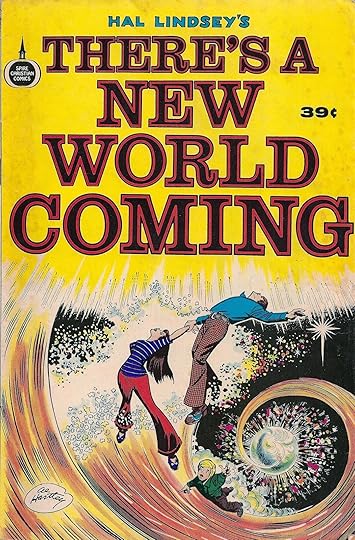
It would have slipped right by my ten year old mind years ago, as I moved quickly on to some comic about barbarians or PT boat captains.
But now, now that I'm a pastor, this just jumped right on out at me. It was a comic penned by Hal Lindsey, author of the peculiar apocalyptic book The Late Great Planet Earth, which was to the evangelical Christianity of the last 1960s and 1970s what the Left Behind Books are to evangelical Christianity today.
The comic itself was peculiarly plotless, as some wide-eyed and bell-bottomed Jesus People mouthed their way through the trippy interpretive bizarreness of Lindsey's theology. That theology had one purpose: adapt the fever-dream of John of Patmos to the sociopolitical realities of today.
Or, rather, the sociopolitical realities of the early 1970s.
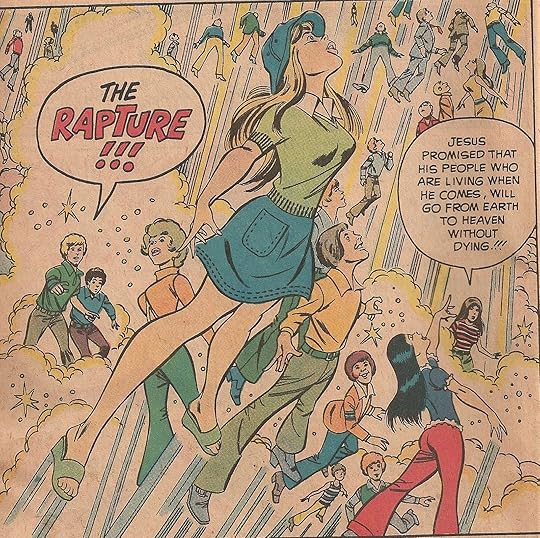 It was peculiar for a range of reasons, not least of which was the radiant Seventiesness of the whole thing. On one page, a drawing of white man Jesus at the second coming, his hair perfectly parted in the middle and feathered back. There's the comic book's exclusively honkey-American vision of the Rapture. Because when it comes time for Jesus to bring home his chosen ones, they'll evidently look like they're the cast of some Off Broadway version of "Brady Bunch: The Musical."
It's a bizarre little comic, because it's radically a product of its era, as all apocalyptic literature tends to be. The assumption in this bit of Jesus psychedelia is that the moment of the "new world" coming will look and feel exactly like the world of that very moment.
And so now, four decades later, the 1974 vision of the end of things starts feeling more and more like the end of things in some alternate universe timeline. The predicted standoff between Jesus and the Soviets and the Communist Chinese, all dressed in olive drab? Didn't happen.
The rise of the occult, led by a New Age Hippie-Chick of Babylon? Not in this universe, I fear. The rise of the internet and globalized industry? Not a peep about it, not a mention at all. And the image of cartoon-Christian-raptured America, 99.9 percent white, and not a single person carrying an extra pound or ten? We're inhabiting a different world.
A generation has passed, a full biblical 40 years, since this comic would have been handed out to youth groups in the seedling megachurches that were beginning to blossom all around America. The young evangelical teens who would have had this placed in their hands are now in their late fifties.
That's the challenge, always, of taking a universal and eternal message and trying to cram it into the peculiarities of a particular time and place. We want to do this, of course, but it's peculiarly selfish of us. We seem to think, for no reason that I can see, that we are the whole and entire point of what Jesus taught. The entirety of creation revolves around the fulcrum of us, our moment, our time, our way of being.
This is not true, at least, not in the way we think it is.
Is the message Jesus brought relevant and transforming and urgent now? Yes.
But it was also equally relevant and urgent the first day it was preached in my little church, way back when in 1847. It will be similarly urgent when I am a hundred years gone.
There is always a new world coming.
And so, one afternoon, I found myself back in the attic of his little house in Beaufort, South Carolina. It was odd, being there, because it had been decades. Odder still, it felt much the same. It had been cleared out, mostly, but there were still memories there from when I was a little boy.
Specifically, the boxes of comic books. He'd been a collector, which meant that I spent many an hour as a lad sorting through the boxes upon boxes of old comics he kept. They were there in his house, and also at my grandparents house in Athens, Georgia. They were neatly kept, carefully sorted and stored, and like catnip to my boy-mind.
By the time he passed, most of the best ones had been sold, the old horror-comics and the mint condition stuff. But the three tidy boxes that remained were neat. I remembered the covers, some of them, the images still etched into my mind after almost four decades.
Old war comics from WWII. Old Archies, and a bunch of superhero mags. There were even a handful of classic Will Eisner "The Spirit" comics...not the comic books themselves, but the newspaper supplements, from 1940 and 1941. Not in great shape, but still pretty dang cool.
So on that afternoon, I leafed through them, one by one, in the heavy, familiar mustiness of that attic. Then I encountered this:
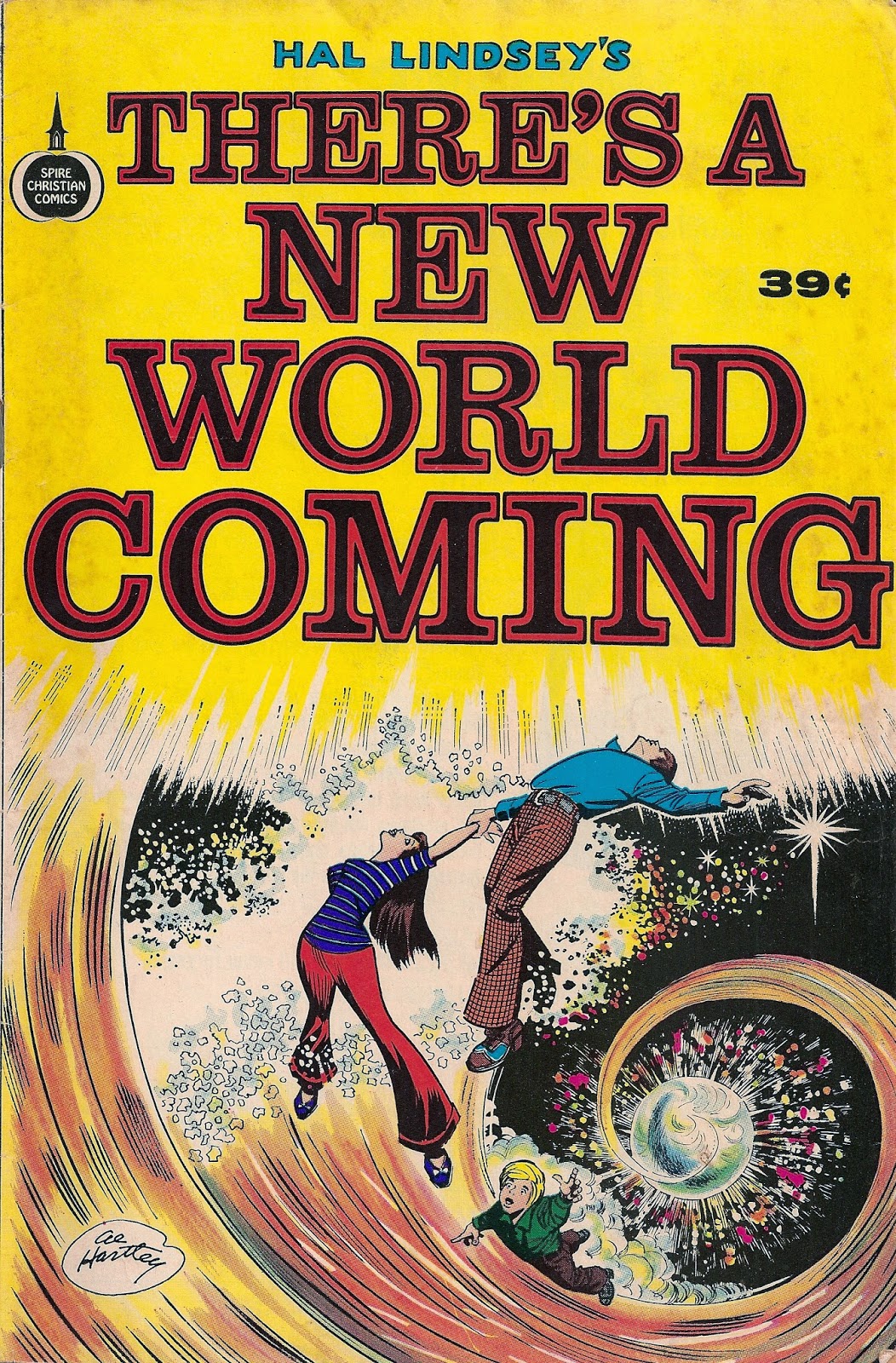
It would have slipped right by my ten year old mind years ago, as I moved quickly on to some comic about barbarians or PT boat captains.
But now, now that I'm a pastor, this just jumped right on out at me. It was a comic penned by Hal Lindsey, author of the peculiar apocalyptic book The Late Great Planet Earth, which was to the evangelical Christianity of the last 1960s and 1970s what the Left Behind Books are to evangelical Christianity today.
The comic itself was peculiarly plotless, as some wide-eyed and bell-bottomed Jesus People mouthed their way through the trippy interpretive bizarreness of Lindsey's theology. That theology had one purpose: adapt the fever-dream of John of Patmos to the sociopolitical realities of today.
Or, rather, the sociopolitical realities of the early 1970s.
 It was peculiar for a range of reasons, not least of which was the radiant Seventiesness of the whole thing. On one page, a drawing of white man Jesus at the second coming, his hair perfectly parted in the middle and feathered back. There's the comic book's exclusively honkey-American vision of the Rapture. Because when it comes time for Jesus to bring home his chosen ones, they'll evidently look like they're the cast of some Off Broadway version of "Brady Bunch: The Musical."
It's a bizarre little comic, because it's radically a product of its era, as all apocalyptic literature tends to be. The assumption in this bit of Jesus psychedelia is that the moment of the "new world" coming will look and feel exactly like the world of that very moment.
And so now, four decades later, the 1974 vision of the end of things starts feeling more and more like the end of things in some alternate universe timeline. The predicted standoff between Jesus and the Soviets and the Communist Chinese, all dressed in olive drab? Didn't happen.
The rise of the occult, led by a New Age Hippie-Chick of Babylon? Not in this universe, I fear. The rise of the internet and globalized industry? Not a peep about it, not a mention at all. And the image of cartoon-Christian-raptured America, 99.9 percent white, and not a single person carrying an extra pound or ten? We're inhabiting a different world.
A generation has passed, a full biblical 40 years, since this comic would have been handed out to youth groups in the seedling megachurches that were beginning to blossom all around America. The young evangelical teens who would have had this placed in their hands are now in their late fifties.
That's the challenge, always, of taking a universal and eternal message and trying to cram it into the peculiarities of a particular time and place. We want to do this, of course, but it's peculiarly selfish of us. We seem to think, for no reason that I can see, that we are the whole and entire point of what Jesus taught. The entirety of creation revolves around the fulcrum of us, our moment, our time, our way of being.
This is not true, at least, not in the way we think it is.
Is the message Jesus brought relevant and transforming and urgent now? Yes.
But it was also equally relevant and urgent the first day it was preached in my little church, way back when in 1847. It will be similarly urgent when I am a hundred years gone.
There is always a new world coming.