David Williams's Blog, page 80
September 3, 2014
Humans: It's Not About Us
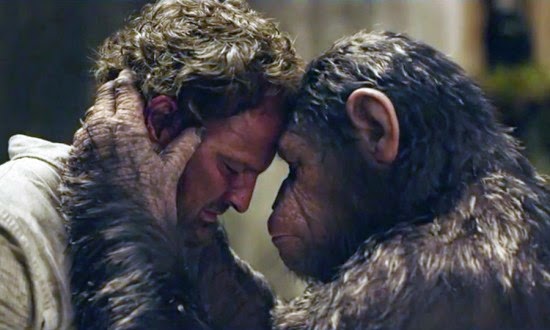 It was the last night of summer, and we needed to mark it somehow.
So I and the wife and the lads went to see one of the big blockbuster films that we'd not quite gotten around to seeing over the course of our busy summer. Dawn of the Planet of the Apes had gotten decent reviews, and I'd enjoyed the first one, so I found it playing at a nearby twenty-two-plex that I wasn't even aware existed. Ah, the joys of living in a huge metro area. We piled into the car, and off we went.
We got a large refillable popcorn and one large refillable soda between the four of us, and with our bucket of carbs and fizzy fluid, we settled in for the last gasp of summer.
The film itself was solid, and a better bit of cinema than its predecessor, Rise of the Planet of the Apes. I found it completely enjoyable, and a good bit of storytelling. It wasn't perfect, as it got a tick overblown and overlong at times.
Most notably, it shared the primary "flaw" of the first film in the series: The humans just weren't very interesting.
It wasn't as noticeable as the first film, where the performances by the human characters were flat and formulaic. There, we were stuck with James Franco sort of phoning it in, and...what...the guy who played Draco Malfoy? I can't remember much else.
What you did remember were the apes, who were--despite being CG--compelling, emotionally affecting, and far more "human" than the humans.
That was also true in the second film. The human actors did a better job, a solid, creditable job, but this wasn't their story. It was the story of Caesar and Koba, of Blue Eyes and Ash and Maurice. Sure, there was good and evil, trust and betrayal, justice and the dark selfishness of power.
Homo sapiens sapiens wasn't the focus of the tale. We weren't the point.
Which, I think, is generally true of creation.
Oh, we can be part of the purpose of all sentient life. We can participate in it. We can choose to be aware, and connected, and creative, and kind. We can seek knowledge, and justice, and then transcend justice with grace.
Or we can choose not to, as we do, more often than not.


September 2, 2014
Doubtfully Stumbling Towards a Bumbly Fumbling Something
 Maybe it's because I now and again go back and re-read Paul Tillich. I don't know. But recently, I was reminded of Tillich's assertion that to integrate doubt into faith is not just necessary. It's an act of radical existential courage.
"The element of uncertainty in faith cannot be removed, it must be accepted," he wrote, in one of his more lucid, less inaccessibly Germanic moments. "And the element in faith which accepts this is courage."
This is sort of funny, I think, because just about twice a week, I'll read some earnest Christian or another talking about doubt. Hoo boy, do we talk about doubt.
"I'm a Christian, but I'm really really awful in thus and such a way," they'll say. "I try to follow Jesus, but here are five ways I have no clue what I'm doing." "I wish I could say I truly believed, but in my heart of hearts I'm an aimless, struggling wreck of a human being." "My church is a total mess, and here's why I can't for a moment believe it has a chance of survival."
On one level, I can appreciate this. Of course we're all a mess. It's my general operating assumption about most human beings, one that's empirically borne out in our complete inability to get our [excrement] together as a species. We're selfish, confused, anxious, angry creatures. Here, in this no-reason-it-can't-be-utopia horn-of-plenty world, we manage to both inflict hunger and war and interpersonal anguish on one another.
So yeah, I know, I feel you. I've got my own things I'm working through. We all do. Sharing that on occasion is a good thing. Keeps us real.
But what I hunger to know, honestly, is less about your dysfunction, and more about what's really and genuinely working for you.
Where is your joy? Where is your lifegiving, hopeful place? Where does God's Spirit move? What makes you laugh from the sheer wonder of it? Where are your creative, powerful moments of life?
Tell me those things. Share them. Teach me. Tell me the good news.
Progressive Christians in particular seem to be remarkably bad at this. We fret about church, about decline and bad things people have said and done to one another. We spend our energies deconstructing ecclesiology and tearing down those we see as perpetrating injustices. Church is terrible! People are terrible!
We anguish over our personal doubts, dwelling on them, magnifying them to the point where they become the defining feature of our identity.
Is this doubt? Absosmurfly. Is this the doubt that manifests as the courage to transform both self and culture?
Is it the doubt that shapes our hope?
I don't quite think so.
September 1, 2014
Mystery, Scripture, and the Need for Creation's Witness
 As I walked through the steamy air of a late summer morning, I had John Calvin on my mind.
Lord help me.
It was a lovely morning, but for the burgeoning heat of what was to be an intensely swampy Southern day. The sky was thick with clouds, the air was damp with the lingering wetness of evening storms. Here and there, drops fell from the wet leaves above.
And I was thinking about Calvin. More specifically, the thing that rose unbidden from my memories as I engaged with creation was a reflection on Calvin's Institutes, and one of the justifications for our Reformed focus on the Scriptures.
There were many reasons the Reformers felt that Christians should focus on the Bible. First and foremost, being engaged with the texts of Scripture yourself meant that you were connected with them. At that point in history, most Christians were illiterate, and the church made no meaningful effort to teach the meaning of the faith. Going directly to the texts was a liberation, and a counterbalance on ecclesiastical overreaches.
But there were other reasons. Among them was the argument from Creation. The world around us was God's work, Calvin suggested.
"There are innumerable evidences both in heaven and on earth that declare his wonderful wisdom; not only those more recondite matters for the closer observation of which astronomy, medicine, and all natural science are intended, but also those which thrust themselves upon the sight of even the most untutored and ignorant persons, so that they cannot open their eyes without being compelled to witness them..." (Institutes, I.v.1)But creation is also wildly and deeply inscrutable, a profound mystery that could confuse and distract us in our smallness.
"It is therefore in vain that so many burning lamps shine for us in the workmanship of the universe to show forth the glory of its Author. Although they bathe us wholly in their radiance, yet they can of themselves in no ways lead us to the right path. Surely they struck some sparks, but before their fuller light shines forth these are smothered." (Institutes, I.v.14)Thus, the need for Scripture, because we're just too stubborn, stupid, and self-absorbed to grasp the unmediated self-expression of the Creator. We need something more, something to help us integrate that awareness into a cohesive purpose.
And there, the teachings of the Tanakh and the Gospels and Epistles come into play. They become the lens that helps us focus, to see our purpose clearly.
I get that. I do. It's helpful to have a framework.
On the other hand, the same thing that structures our thinking can also be spiritually dangerous, for reasons that are implicit in Calvin's own argumentation. The Creator of the universe speaks directly through existence, all of which articulates the Divine Intent.
And sure, it tends to blow our minds a bit.
But shouldn't it? I mean, really. Looking at the scale and wild complexity of our space-time, and the potentially infinite depth of a yawning multiversal cosmos, we are, as Calvin put it, "whirled and twisted about" by our encounter with a power that so vastly exceeds our own that we can feel utterly lost. (Institutes I.v.11)
That's certainly the reality encountered by modern science, which--after a brief and heady period when it thought it had it all worked out--is beginning to surface complexities so impossible that they seem profoundly beyond our capacity to grasp.
And that, it strikes me, is a necessary part of a robust and authentic faith. Sure, we need a framework. But we also need encounters that are unmediated by that framework, encounters that shatter and reform us. We need something that tears us from our self-absorption, that gives us a sense of scale and mystery and God's transcendent, numinous power.
Contemplating creation, as it so happens, is really good at that.
August 30, 2014
"Biblical" Counseling
 What is Biblical Counseling?
It was the sort of title that jumps right out at you, if you're a pastor flipping through a magazine where you generally don't encounter faithy stuff. The magazine in question was Pacific Standard, a fascinatingly readable bi-monthly mag I was gifted a while back. It's equal parts science and whimsy, and seems more interested in finding the interesting and unusual than riding the tides of cultural faddishness.
Pacific Standard is a quality read, and it also takes pretty much no advertising, which is at first startling, and then refreshing. Page after page of well-written and researched articles, and no shiny ads? Lord, I could get used to that.
The article--which appears in the September/October edition--explores the Biblical or "nouthetic" counseling movement, which arose out of conservative Presbyterian circles in the late 20th century as a reaction to more overtly secular forms of psychotherapy.
The idea? Push back against the concept that pastors are not equipped to counsel, and that "counseling" is something best left to clinically--and secularly--trained professionals. Best to get back to the core principles of faith, argued the pastors who presented this concept, and to use them as they were meant to be used--to heal.
Scripture is sufficient, or so goes the mantra of the movement.
On some levels, I get this. Given that the Greek word used in the Bible for "soul" is psyche, the idea that pastors are out of their depth when it comes to souls is a little troubling. I got this line repeatedly in some of my counseling coursework, and it always bugged me a bit. For some reason.
The article itself is remarkably balanced in the way that the Pacific Standard always is. It presents some of the flaws and overreach of this movement, sure, particularly in the tendency of some practitioners to avoid or dismiss helpful clinical interventions. Some practitioners are also less helpful than others, as they focus on "curing" homosexuality and insufficiently obedient wives.
But it also notes that it *works* a surprisingly large percentage of the time, with a success rate essentially identical to other secular methodologies. It notes that many of the practitioners and leaders in the movement do not rule out working in tandem with medical science, and that they're motivated by a genuine desire to care for others.
It's talk-based and semi-directive therapy, after all, just grounded in a particular corner of a faith tradition.
What I wondered, though, was at the foundational assumption of Biblical counseling: that what mattered was that it be "biblical."
I could see rooting a counseling method in the teachings of Jesus of Nazareth. Personal transformation towards a self aligned with God's most gracious purpose? That was at the heart of what he taught. When I talk to people about things that are troubling them, I'd hope that's what I'm doing. It's certainly what I'm trying to do.
But "biblical" can mean so many different things. The Bible, as one discovers when one spends a lifetime studying it, does not have a single voice. That's what makes our canon so rich, and so real, and such a deep source of wisdom. And there is so very much powerful, life transforming truth woven into it.
But seen through the wrong eyes, very "biblical" things can be damaging. The Bible can be made into an excuse to justify ancient biases, against women, against other nations or peoples, against those who are differently wrought.
"Christ-centered," perhaps. "Spirit-led," maybe. "Oriented towards the Reign of God Jesus of Nazareth taught and lived out and was willing to die for?" Well, that's a bit too wordy, but conveys the idea. And sure, you get that from the Bible. But there's scripture, and there's Scripture.
That a thing is "Biblical" does not, of itself, convey authority or even any coherent sense of direction.
August 28, 2014
The Best of All Possible Worlds
 In the best of all possible worlds, that's his actual hair.It was a semi-random connection. In fact, I can't even remember what I was studying, but suddenly, I was reading Gottfried Wilhelm von Leibniz.
Ah, the joys of being a small church pastor.
Leibniz, in the event that you don't regularly come across him on TMZ, was one of the most brilliant minds of the early modern era. He was a seventeenth century philosopher and mathematician, and was notable for, among other things, inventing calculus at exactly the same time Newton did. Because, you know, he needed it. That, and he developed a binary logic system, the conceptual precursor of all modern computing.
In the seventeenth century.
He was also a deeply committed Christian, and what had caught my eye was the name of a "proof" for God's creative handiwork, something that's popularly called "the best of all possible worlds" argument.
That argument, roughly, was that our world was the best of all possible worlds. Everything about our world had been designed optimally, Leibniz suggested, even the difficult things. Challenges existed to create strength. Struggle and suffering existed to create courage and endurance. The Department of Motor Vehicles existed to instill patience. And so forth.
This argument for divine beneficence doesn't really hold, not if you look at the dynamics of our little species. Holocausts and wars and a cornucopia of petty unnecessary human cruelties are far too deep a blight on our world to imagine that this is the best possible thing that could exist. When Voltaire launched his ultimately successful challenge to this assumption, that was kinda the point he drove home.
Yet the cosmology that Leibniz felt undergirded his "best possible world" argument was startlingly contemporary. The universe, he suggested, was not just one single necessary reality. It was, instead, just one possible universe. In the mind of God lay the knowledge of every other possible thing that might conceivably exist, every probable outcome, and every variant iteration of every sentient being. The mind of God, as Leibniz would have it, contained the vision of the multiverse.
This, from the co-creator of calculus. Dude.
Throughout his writings, this idea was iterated and reiterated. In his Essays on The Goodness of God, he wrote it as a myth, in which a priest is lead to the truth by a vision of Pallas Athena, Goddess of Wisdom:
The halls rose in a pyramid, becoming even more beautiful as one mounted towards the apex, and representing more beautiful worlds. Finally they reached the highest one which completed the pyramid, and which was the most beautiful of all: for the pyramid had a beginning, but one could not see its end; it had an apex, but no base; it went on increasing to infinity. That is (as the Goddess explained) because amongst an endless number of possible worlds there is the best of all, else would God not have determined to create any; but there is not any one which has not also less perfect worlds below it: that is why the pyramid goes on descending to infinity. (Leibniz, Theodicy, p. 416)Leibniz thought, of course, that the only world made "real" was our own. That meant it was, by necessity, the best. The rest remained unspoken by God, like a story untold, or a book conceptualized but not written.
I don't agree there, as our understanding of the cosmos points more and more to a wildly richer, deeper, and nonlinear creation. But then again, I honestly don't know that the actual, physical, and material existence of other universes makes them any more accessible.
The best possible universe we will ever know is the one we inhabit, after all.
It's what gives such existential weight to our choices, and what makes grace so very, very important.
Who Is and Is Not a Pastor
 Who is a "pastor?" Who speaks meaningfully for the Christian faith?
That question popped and hummed around my mind this morning, as some of my progressive friends anguished over the latest terrible thing circulating on the Huffington Post about what a Christian leader has said. Michael V. Wilson is the pastor/preacher in question, as he'd posted a peculiar and inflammatory video calling for a Constitutional Amendment to incarcerate gays in some sort of gay gulag.
A constitutional amendment to imprison gays would insane and antithetical to the liberty outlined in the rest of the Constitution, of course, so wildly off that it'd go nowhere. It is, however, the sort of thing that people get riled about and pass around on the interwebs. Look! A horrible, offensive, insane pastor! Oh, what a horrible thing Christianity has become! This being controversial and all, there were hundreds of comments, many reposts, and in just a day or so, over 100,000 Google-hits.
I'm a curious sort, so I actually bothered following up on Pastor Wilson. Who is he? What sort of community does he lead?
Real pastors are not hard to trace. Like say, me. As the part-time pastor of a very small church, I'm not exactly the biggest fish in the sea. But you can know who I am.
Right here on the blog, you can see my social media identity, and the identity of my congregation. Google my very very common name and the name of my church? There it is. More information about me. You can hear my voice, and see news articles from local media quoting me. Go deeper, and you'll find record of me through my denomination. I am the person I say I am, and you can independently verify that.
Why is this? Because I'm not hiding anything. Why in the blessed name of Jesus would I? I actually want you to know about my church, where it is, and how to come experience it and consider being part of the gracious Way we walk together. Because, you know, that's my job as a pastor. That's perhaps the most important part of being a pastor.
It shouldn't be hard to find a pastor, particularly a pastor with an intentional media presence.
So I went looking for my dear brother Pastor Wilson.
Wilson's website is called "Preaching Politics," and it has extensive links to the radical right wing media. It's all wild, inflammatory, fringe-politics stuff. Link-images on the home page network him in with groups affiliated with the Pajamas Media blog network, along with a few fundamentalist sites, and a link to BibleGateway, which is an utterly awesome online bible resource. I use it all the time.
But anyone can link to anything, so that tells me nothing about who he actually is. And Wilson? He doesn't seem to claim to be a pastor, frankly. He doesn't claim to be much of anything.
I tried to go deeper, and it got weird. There's no link to a social media profile or page, which is odd for any media-savvy leader. There's no information about his identity at all, just a picture or two. He appears to be Texan, and at one point took a picture with a kid who he claims as his grandchild, but even that's vague. He does not want you to know who or where he is.
Vaguer still is his "church." His website indicated some unclear affiliation with something called The Church on the Rock, so I clicked through to the page. It's a picture of a dark brown church building across an empty parking lot. There are no people, just an empty building. It's a drab, lifeless picture, the sort you could take if you cruised through any mid-sized church parking lot at seven-fifteen on a Monday morning before the staff arrived.
On that page there was no text, no information at all about the church. Not what they believe, not where they are. Instead, there were four "announcement" videos, presumably for a congregation. Each was 40 seconds long, so I watched them.
It got weirder. Each one of the four videos is a video of Wilson, standing in front of a green screen. Yes, a green screen. Using the green screen, he's "in front" of a blurry generic church office background.
"Hello, I'm Michael Wilson," he says in the first video. "Next month is Januarynthat means it's time for the discipleship class." Where he said "Januarynthat," the video had been crudely cut. What followed the cut was a generic description of a new members class in a stereotypical fundamentalist church.
In the second video, he says, "Hello, I'm Michael Wilson. Next month is Aprilnthat means it's time for the discipleship class." Same cut. Same place. And after the cut, the same video sequence, exactly.
That was true for all of the "church" videos.
There's nothing else about the church, or where to find this "discipleship class." No address. No phone. No sermons. Just four very odd videos. If you've spent any time around evangelical churches, you know this is seriously, seriously sketchy.
So to Google I went, with some targeted searching. While there are many congregations called "Church on the Rock," and some are in Texas, but none of them has a Michael Wilson formally affiliated with them. None.
For some small church pastors, particularly pastors of tiny, rural congregations, this might not be surprising. A lot of little family-sized churches don't have a web presence, as they still relate to one another the same way they did forty years ago. But those congregations are old, and part of the old-line. They also don't have pastors who are web-savvy enough to produce green-screened videos...but who won't do the same for the community they're trying to build.
If you went looking for other far-right small-church conservative pastors--like that bushy dude who burned the Quran, or the bizarre Republican candidate for Lieutenant Governor in the last Virginia election cycle--you could find them. They were crazy, but they were real. You could find their churches.
This is something else. This is a thing that does not add up. Michael Wilson's identity as a "pastor" comes apart like wet tissue paper in your hands, the way that any untrue thing does when you dig into it deeper.
Is he a preacher? Perhaps, sure, in the technical sense of the term. In the pre-web days, anyone with a bullhorn could ensconce themselves on a street corner and berate passers by. But as someone woven together with a community, the shepherd of a flock? No.
He's just an eccentric right-wing guy with a video camera, editing software and some opinions. Which are his right to express, but which should be mine to ignore.
What I struggle with, honestly, is why...just a few days after he pitched it out there...so many souls would briefly care enough to worry about it.
Or, frankly, why I would care. Jeez. I have other things to do.
Sigh.
Sometimes I think the internet is driving us insane.
August 27, 2014
Mark Driscoll, Luhv, and the Meaning of NeoReformation
 I'm not sure why, precisely, so many folks in my social media feeds seem to care about Mark Driscoll.
Driscoll, in the event you do not know him, was the pastor of a large nondenominational Seattle congregation. He was the purveyor of a hip, muscular, hyperaggressive style of Christianity. Jesus was a butt-kicker, according to Driscoll, a manly-man who brooked no mess.
I got to know of him during the brief rise of "emergent" and "emerging" Christianity back in the last decade. Relative to the deconstructive, self-doubting, pomo crowd that tended to make up that movement, Driscoll was something of an anomaly.
Driscoll's approach to faith was an alpha-male testosterama, and he was perfectly willing to emphasize the "tough" part of "tough love" to the point where the latter seemed to evaporate away into nothing. He yelled a people a whole bunch, to the point where his preaching reminded me of the pre-fight monologues in the WWE. Sure, he was confident. Bullies always project confidence, as they cut down everyone and cement their own power. Tens of thousands flocked to hear him. But I never understood the appeal, frankly. Why would I go to church to be yelled at and berated?
Now, his large church is struggling, and his media-empire is shaken.
I struggle to understand why he should matter. He's just this one guy, who only ever had authority because people--a tiny fraction of the population of a single nation--gave it to him. Now, as his pattern of aggression has reached a tipping point, his influence within Christian culture is dissolving. It felt inevitable. I feel no shadenfreude-glee at the collapse of his work. It's just sad.
One lingering fragment of Driscoll's work, though, was that he was supposed to represent a "Neo Calvinism" or...more painfully.. a "Neo-Reformation."
Thing is, I could never see anything new or reforming about anything he was doing. Oh, sure, he wore hip t-shirts and talked the lingo and used presentation software. But that was just window-dressing. It meant nothing.
What Driscoll and Piper and others have been hawking as "new" was just the same old judgmental, isolationist, abstracted-from-reality approach to theology that has always defined Pharisaic faith. It's the kind of theology that presents "love" as if "love" was just a sound we make.
"Luhv," he would say, but though vibrating air that came out of his well worn vocal cords seemed to be the same sound I make, it meant something completely different. It meant obedience to power. It meant control. It meant the dominance of the strong over the weak.
It meant projecting the dynamics of our primate-nature onto the heavens, and declaring that "God's Love" looked just like you doing exactly what I say or else. The Creator of the Universe is just a tiny bit more demanding than that.
That's not to suggest that a new reformation isn't necessary. As fundamentalist literalism has done to scripture what Catholicism once did to ecclesiastical authority, there's a real need for a return to what matters.
Maybe one of these millennia, we'll figure that out.
August 26, 2014
Understanding Evil
 In a recent article distributed by CNN, human rights author James Dawes suggested that calling the actions of ISIS "evil" was counterproductive.
"We only call people 'evil' as a pretext for killing them," Dawes said. And there is, without question, truth in that. Once you have affixed that label, it's far easier to radicalize your perspective, to see only a caricature of a person. You shroud them in your own image of them, obliterating their humanity, seeing only everything that justifies your choice to hate them.
It's how we approach our falsely binary political "system," certainly. The Clintons were not a left of center political couple. They were murderous jackbooted liberals who were taking away our freedoms! George Bush was not a genial, straightforward guy with a gladhanding way. He was a genocidal monstrous tyrant who secretly engineered 9/11! Obama is not a centrist intellectual. He's a socialist crypto-Muslim traitor!
It's the easiest way to engage in conflict.
Once we decide someone is evil incarnate, that becomes all that we see. And because it is all that we see, we can fail to go deeper. We become so focused on destroying that personification that we do not see what shaped them as a person. So we slice away at the surface, shaving at it, poking it. We don't go to the heart of it.
That's not to say, of course, that ISIS is not evil. They are. Their actions, their ideology, and the fevered mockery of faith that rules them? All of those things must be called evil, because they are the inverse of good. Of course, you can always putter around with academic deconstructions of the idea of the Good, but...dude. It's compassion, love, grace, patience, kindness, and mercy. Those things are good.
The danger of naming things "evil," according to the article, is that it causes us to view things in a binary, absolutist way. And I'm fine with that, up to the point where Dawes uses that observation to make a binary, absolutist statement.
"There is only one good reason to denounce a group as evil--because you intend to injure them."
This is not so. Calling out a group as evil can also mean you intend to stop them from engaging in evil. It does not mean you are going to seek their harm, but rather, that you're still willing to ascribe moral agency to them. Only sentient beings can engage in evil, after all. And it is not an "injury" to prevent a person or group from engaging in monstrous actions.
Naming actions as evil, though, demands that we go deeper. Why is this happening? Why are individuals acting in this way? Why is an ideology so monstrous finding fertile ground? Dig deeper, and we find that hunger, poverty, ignorance, and oppression are the poison that brings up that bitter crop. The more desperate or purposeless a life feels, the more likely evil is to flourish.
And when we try to understand evil, we aren't saying "tolerating" evil. Seeing through the eyes of hate only deepens love's horror at that state of being.
That is not love's end, as it pushes to the heart of the broken other. Compassion seeks to truly understand the heart of evil, so that we can turn it, and heal it, and end it.
August 22, 2014
ISIS and the Purposes of God
 "It's all part of God's plan," we like to say.
"It all works together for good," we say, part of the mysterious plan of God's providence. This was something, frankly, that I used to believe myself. We just let go, and let God, and all will be well. All we have to do is trust that it'll all work for the good.
But as my faith has evolved and grown over the decades, I no longer believe that to be so. Most particularly, I no longer believe that every action of every human being is part of the divine intent.
The recent actions of the Islamic State in Iraq and Syria seem an agonizing case in point. As they butcher their way across that troubled region, murdering and enslaving and raping, all of the bloody and difficult work to rebuild Iraq seems close to unraveling. Whether we should ever have poured the lives of our citizen soldiers into that misbegotten quagmire in the first place is another, painful matter altogether.
Right now, though, that mess seems only to be deteriorating, spinning down into the dark chaos of ignorance, violence, and tribalism.
From that mess, the release of a video in which ISIS beheaded American journalist James Foley really did strike home. As the son of a journalist who spent time in that troubled region, I feel the anguish of his family and friends strongly. How would you watch as your loved one is forced to speak words he does not believe, and then is butchered like meat? What a monstrous thing.
More significantly, how does a human being do such a thing to another? And not just to one man, but to many, many others.
It is that latter reality, the actions of the ISIS members, that I cannot claim as part of some broader overarching divine plan. Nor, frankly, would I ever tell someone that the murder of their loved one was a necessary part of God's plan for our lives.
It is not.
I believe this, oddly enough, because I will not allow myself to deny the humanity of the individuals responsible for this horrific act. It would be easier to write them off as monsters, because they act as monsters. That would make it easier to cope with them, and far easier to kill them. Dehumanizing the Other always makes it easier to kill them.
But they are sentient beings, albeit ones who have chosen to live under the thrall of a monstrous ideology. They are still free to choose their actions. It is what makes them culpable, ultimately.
If God had structured creation as one single linear narrative, in which there was only one beginning and only one end, then this would not be true. The members of ISIS would just be part of that story, and the blood and the suffering they inflict would have always have been their purpose. God's purpose.
And if it is God's purpose, then they are not to blame for their actions, not in any meaningful sense. If there is no freedom, there can be no sin.
I no longer believe, because it does not seem to be so, that there is only one way things can happen. That's just not how God made things.
And if creation is not just one story, if we are indeed free to choose to move down other potential paths, then our choices count. The Creator has laid out, clear as crystal, what it means to live rightly and in peace with one another. If we choose the hateful path of bloodshed and sorrow, then God will allow us to shape our time and space into that dark thing.
Is that God's gracious desire for us? No. Neither is it necessary for us to choose that path.
Turn away, God says. Turn away, because you don't need to live as you are living. If only more of us realized that.
August 21, 2014
Seven Spiritual Lessons from Guardians of the Galaxy
 I went to see Guardians of the Galaxy the other night with my sons, as the summer of twenty-fourteen wound its way to a close. It was a Tuesday night at the local theater, meaning it was student night.
 Cheap tickets, free popcorn, bottomless sodas, and a hoo-hah comic-book space-opera? Those are all the ingredients for a perfect summer moviegoing experience.
Did I enjoy it? Sure. It was totally enjoyable. Of course it was enjoyable. It was made to be enjoyable, a spun sugary confection carefully calibrated for the consumer palate. Wham bam zap, went the movie, pitching out bright colors and bathos, like carnival cotton candy and the tilt-a-whirl.
What's not to like? Carnivals are fun.
And because as a pastor I always, always, always have my theologian hat on, I found myself with my antennae up for those blessed teachable moments.
Lord, did I have my antennae up. It's what's expected, right? I mean, seriously, these sorts of blog posts are what the web eats up with a spoon. The Seven Lessons of the Thing You and All Your Friends Just Saw! Three Important Teachings that Piggyback My Blog in With That Huge Marketing Push!
But for the love of God, this was just summer fluff, a great yarping bliss-out of comic-book colors and cybernetic raccoons. It has no more meaning than one of those old 1930s Buster Crabbe Buck Rogers serials, or that deliciously campy Queen-soundtracked Flash Gordon from the early 80s.
It was the cinematic equivalent of dumping a couple of bags of Pop Rocks in your mouth. Blam pop poppity pop, goes the candy in your mouth, a moment of empty bright carbonated sweetness. It's not more than that. Why does it need to be more than that? Not everything has to be more than that.
What? You're cheesed at the click bait? You still want Seven Spiritual Lessons? Oh, come on. Don't make me. I...
Oh, all right.
Um. Well.
1) Take the Hand You're Offered. Because, well, you should. You don't know when it'll be withdrawn, or when you need to do it so the energy from that strange glowing mystic purple rock won't blow you to pieces. Unless you're the villain, and you need to jump that spaceship so you can escape and make it to the sequel.
2) Stand Up for What You Believe In. Preferably in a small group. In a circle. In the frat-boy-decor common area of your awesome space-ship.
3) We are Groot. Because ultimately, it's all about being together with friends, even if you have a four word vocabulary and are some sort of talking plant-god voiced by Vin Diesel. I really hope he wasn't paid by the word on that one.
4) Seize the Day! You have a short lifespan, perhaps not as short as a raccoon, which generally lives for no more than three years in the wild. Maybe five, if it's cybernetically augmented. So...er...live life! Carpe Diem! Yeah!
5) Um. Your Friends..um...Will..er...Surprise You Sometimes? You know, like making lighted spores drift from their bark, or impaling a couple of dozen faceless enemies on a giant wooden spike.
6) Murder is Against the Law. Like, it's the worst crime. You really shouldn't, unless it's some faceless extra or that unarmed prison guard who surrendered. I mean, he made such a funny sound when they threw him to near certain death. Hoo hah!
7) You Are the Special. You have something inside you that...Wait. That was the Lego Movie.
7) Peter Quill is Like Jesus. Because...um...his Dad wasn't human, and he had like, these super powers, that like, saved all of us. Or something like that. I don't know. I got bupkis here.
There. You happy?
Sigh.