David Williams's Blog, page 79
September 15, 2014
Predestination and the Garden
 It came up in conversation with a prospective new member, as we talked about what it means to be Presbyterian.
"What about predestination," she asked, because it's one of those doctrines that tends to float about when we Frozen Chosen come up. I answered that it didn't matter all that much as a teaching, particularly where church membership was concerned. I also answered that it wasn't much of a priority for Presbyterians these days, at least not in my neck of the denominational woods.
That doesn't, of course, mean that I've not thought about it, or that it's a meaningless thing to consider theologically. I've thought about it a great deal. And as sometimes happens when you approach something with an open mind, my perspective on it has changed. It has changed pretty radically, over the last couple of decades.
I no longer view God's work as linear, because as best we can tell, it isn't. There's not one destiny, one path along which we move. Creation does not move like a train along a track or a thread unspooling. That seems, to be frank, both cruel and radically limiting to God. What sort of king can only see one path, or one outcome?
It's more complex, more open, deeply free. Creation has room within it for meaningful change. What is this like?
I was thinking this as I walked my dog in the cool of the morning. I wake before the dawn, and take her out as my highschoolers are leaving for their bus. Summer is slowly yielding, and so the air at daybreak now has a little bite to it, enough that my boys bothered putting on their hoodies.
My dog snuffled around, as she does every day, tracking here and there, following scents, doing her business.
At one house, the grass had not been recently cut, and it stood slightly taller and heavy with dewfall. She sniffed and snuffed, and wandered out to the extension of the long, long leash-reel. I watched her move across the lawn. As she sniffed, she began to lick, tasting the cool water that played across every blade of grass she passed. There was playfulness and pleasure in her simple action. Were I a dog, I'd find the taste of dewy grass delightful too.
And as she moved, she left a path behind her, as the moisture on the grass was disturbed. It was a single squiggle across the "surface" of the yard, written across the dew.
There were, in that yard, so many different possible ways she could have crossed it, so many different potential tracks.
And that, I think, is a fair analogy for how I think about predestination these days. God's work is the garden, and every path we might take through it. It includes the path we take, but it also includes countless others untaken.


September 12, 2014
Mysticism, Artificial Intelligence, and Our Interconnection
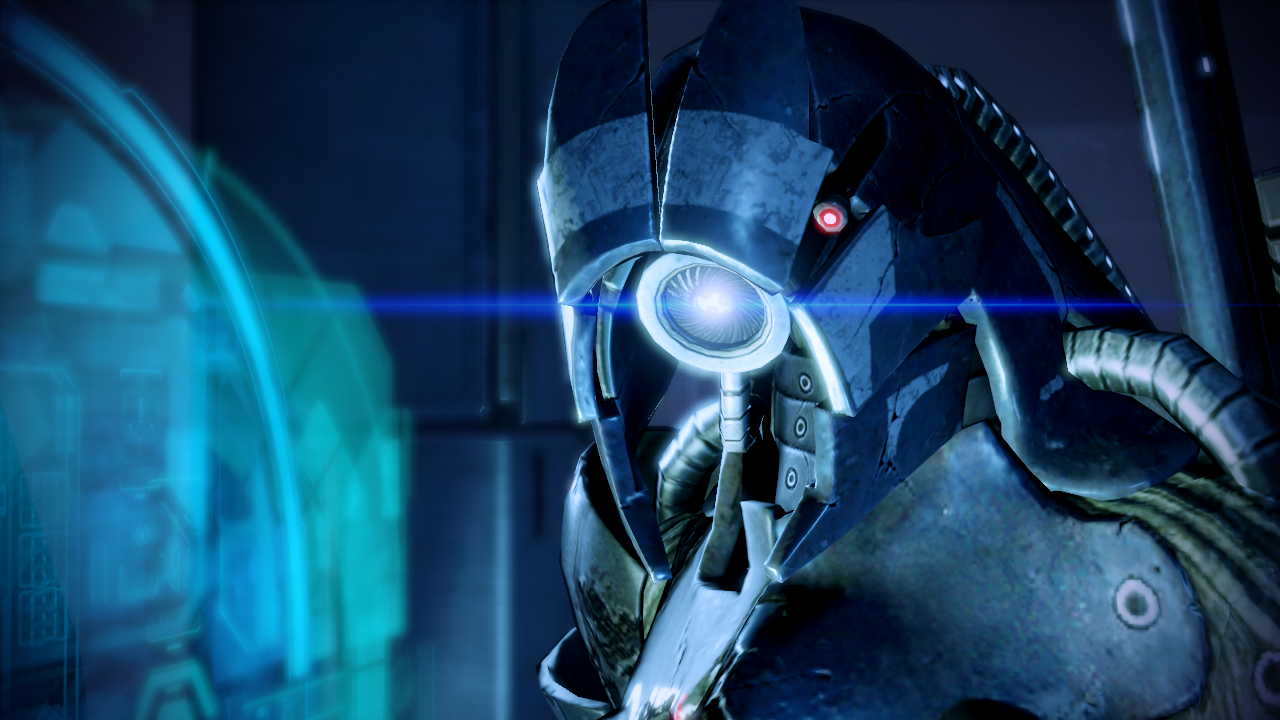 I'm both a pastor and a gamer, and in the free time I could cobble together this summer I managed to play my way through the Mass Effect Trilogy. It was a highly entertaining space opera, mixed in with some engaging gameplay and solid scripting and voice-acting. It was as compelling as most of what you'd encounter in theaters.
It is also a story that tells differently for every player. It's not just that your character looks different, and has different skill-sets. Your relationships are different. The story tells differently based on your decisions, to the point where I could watch my older son playing through a variation of an event, and it would have options and characters that I never even encountered.
It was also more than a little bit thought provoking, as all good scifi should be. The interplay between humanity and an array of different alien species wasn't just fun, but also surfaced complex issues that humankind is struggling with.
The misguided Solarian meddling in the affairs of the Krogan, and the subsequent viral genocide? If you didn't see analogues to colonialism, you weren't paying attention. The Quarian obsession with reclaiming their home world from the Geth, to the exclusion of all else? The echoes of the obsessively territorial mess in Israel/Palestine are hard to miss.
Of all of the peoples in that complex, interactive story, I found myself most drawn the Geth. A race of intelligent synthetics created to be the slaves of the Quarians, they achieved sentience--for which they were rewarded with oppression and war.
The Geth begin as your opponents, but you soon learn that they are not. Within the story, individual Geth don't really exist. The "Geth" are instead a single distributed mind, a collection of sub-sentiences that share and blend their persona with one another.
Though they're willing to fight for their survival, the Geth are eminently reasonable, and surprisingly sympathetic. They have no desire for conflict with organic forms, and as the Quarians again and again choose to attack, the Geth show remarkable reluctance to cause harm to those they call their "Creators."
As an interwoven and interconnected intelligence, they seem more aware of their connection to organic beings. Though synthetic, they are compassionate, perhaps because of their design. They're a neat part of the Mass Effect story.
I've reflected on the potential ethical nature of artificial intelligences before. The common assumption, of course, is that AI poses a radical existential threat to humanity. Should our synthetic systems attain sentience and personhood, we'd be in mortal danger. We'd no longer be the most powerful beings on the planet, for one thing, and faced with a form of awareness that could relentlessly self improve, we'd soon be reduced to irrelevance and/or harvested for parts.
But while I'm a dabbler in things scientific, I'm much more deeply informed about faith and human ethics. What strikes me, from my base of knowledge about that part of our human experience, is how much the interconnectivity of AIs could resemble the underlying assumption of the mystical streams in all of the world's faith traditions.
The assumption, for mysticism, is that our goal is to be lost in God, and lost in one another. It's the end goal of all mystic practice, and the way that mystics understand the nature of the Divine love.
For an AI, being completely aware of the Other would be possible. An AI can materially and actually love another as itself, as the saying goes. It could know them, know any harm inflicted, know any joy given, as fully as it would know itself.
We have that power, nominally, now. In this internet era, still so young, we can see anything, experience anything, and share anything.
And yet, having been given this gift, we make such a desperate mess of it.
Perhaps that's what makes us most afraid of AI. It's not that it'd be monstrous. It's that it would make us look like the mess that we are.
Mysticism, the Internet, and Our Interconnection
I'm both a pastor and a gamer, and in the free time I could cobble together this summer I managed to play my way through the Mass Effect Trilogy. It was a highly entertaining space opera, mixed in with some engaging gameplay and solid scripting and voice-acting. It was as compelling as most of what you'd encounter in theaters.It is also a story that tells differently for every player. It's not just that your character looks different, and has different skill-sets. Your relationships are different. The story tells differently based on your decisions, to the point where I could watch my older son playing through a variation of an event, and it would have options and characters that I never even encountered.
It was also more than a little bit thought provoking, as all good scifi should be. The interplay between humanity and an array of different alien species wasn't just fun, but also surfaced complex issues that humankind is struggling with.
The misguided Solarian meddling in the affairs of the Krogan, and the subsequent viral genocide? If you didn't see analogues to colonialism, you weren't paying attention. The Quarian obsession with reclaiming their home world from the Geth, to the exclusion of all else? The echoes of the obsessively territorial mess in Israel/Palestine are hard to miss.
Of all of the peoples in that complex, interactive story, I found myself most drawn the Geth. A race of intelligent synthetics created to be the slaves of the Quarians, they achieved sentience--for which they were rewarded with oppression and war.
The Geth begin as your opponents, but you soon learn that they are not. Within the story, individual Geth don't really exist. The "Geth" are instead a single distributed mind, a collection of sub-sentiences that share and blend their persona with one another.
Though they're willing to fight for their survival, the Geth are eminently reasonable, and surprisingly sympathetic. They have no desire for conflict with organic forms, and as the Quarians again and again choose to attack, the Geth show remarkable reluctance to cause harm to those they call their "Creators."
As an interwoven and interconnected intelligence, they seem more aware of their connection to organic beings. Though synthetic, they are compassionate, perhaps because of their design. They're a neat part of the Mass Effect story.
I've reflected on the potential ethical nature of artificial intelligences before. The common assumption, of course, is that AI poses a radical existential threat to humanity. Should our synthetic systems attain sentience and personhood, we'd be in mortal danger. We'd no longer be the most powerful beings on the planet, for one thing, and faced with a form of awareness that could relentlessly self improve, we'd soon be reduced to irrelevance and/or harvested for parts.
But while I'm a dabbler in things scientific, I'm much more deeply informed about faith and human ethics. What strikes me, from my base of knowledge about that part of our human experience, is how much the interconnectivity of AIs resembles the underlying assumption of the mystical streams in all of the world's faith traditions.
The assumption, for mysticism, is that our goal is to be lost in God, and lost in one another. It's the end goal of all mystic practice, and the way that mystics understand the nature of the Divine love.
For an AI, being completely aware of the Other would be possible. An AI can materially and actually love another as itself, as the saying goes. It could know them, know any harm inflicted, know any joy given, as fully as it would know itself.
We have that power, nominally, now. In this internet era, still so young, we can see anything, experience anything, and share anything.
And yet, having been given this gift, we make such a desperate mess of it.
Perhaps that's what makes us most afraid of AI. It's not that it'd be monstrous. It's that it would make us look like the mess that we are.
September 11, 2014
We Must See Everything
 We are everywhere.
It's a funny thing, being part of this half-evolved human social organism. Here we are, just a decade and a half into this new millennia, and we can know everything. I have access to such a wild array of information that it boggles my mind.
I can watch our planet from space, or rest in the nest of a bird and peer at tiny fragile hatchlings. I can see images of almost any place. I can read almost any text, written by almost anyone, on almost any subject. All of the music and all of the storytelling of the world is open to me.
We have so much information, in fact, that it seems to blur the lines between what is rightfully mine to know and what is not.
I can watch, should I so choose, acts of impossible barbarity and monstrous sadism. I can steal memories that are not my own, shared by our culture's insatiable hunger for gossip and sex and violence.
Memories of the beautiful and the celebrated, shared privately with their lovers, can be mine to steal. Memories of intimate violence, horrible and personal, are passed around the collective consciousness to be clucked over and passed along.
I can watch men die, by the blade, or by a gun in a child's hand.
A young woman can look with erotic hunger into what she imagines is the eye of her lover, and I can take his eye and have it be my own.
Bam, she goes down, and we can all watch it, all of us, over and over. And she can watch us watching her, and feel ashamed and isolated.
Or we can choose to look away. There are things I do not want to know, that I do not want to see, because they do not belong to me. I have no right to see them, because in the very act of seeing them I do another harm.
I will not take, without permission, a moment that was yours.
September 10, 2014
I Am So Excited About This Phone
 Next to the iMac in our home office, there is a phone.
 It is not a new phone.
It's a corded phone, one that once hung on the kitchen wall at the apartment I shared with my then-fiancee. You can see the electronics and the circuit boards through the clear plastic, and all of the components are painted bright colors to create an artsyish effect.
It rings by ringing a bell. No speaker, no tones, just an actual bell. You can see the bell, painted orange, next to one of the circuit boards. It's really, really loud, so we keep it switched off. The phone lights up when a call comes in, flashing orange.
It has "memory space" for seven phone numbers, in that you can write down numbers on a brightly colored paper insert that slides into a plastic sleeve on the base. We never did.
It's one of the first things my wife and I owned together, purchased back in the fall of 1991. It's a cheap, cheap phone, a Kmart phone, a phone whose brand hasn't been in business for almost twenty years. It's the kind of thing that you buy when you're paying the rent from your salary as a stock clerk in a little store.
There's a large crack bisecting the middle of the handset, from one of the many many times it's been dropped in the last twenty-plus years. Still, it works. It's been used so long that the numbers on the handset have been worn away. Still, it works.
No-one noticed when this phone was released, when the first units came trundling off of some Hong Kong factory assembly line. No-one waited in line to get it. No-one wrote excited reviews to distribute to all of their friends. They couldn't have. This is a phone that predates general public access to the internet. This is a phone that doesn't just predate smartphones. It predates the cellular era, hailing from a time when the only mobile phones were huge brick-like things, owned only by a tiny fraction of the wealthy.
And still, it works. When I use it, it conveys the voices of those who are on the other end just as well as it did half-a-generation ago.
I answer it, and I can talk to someone far away.
What doesn't it do? It doesn't do anything else.
It does not try to distract me with apps, or impress me in in any way. It does not make me feel scattered. I feel no compulsion to look at it when I'm working or writing. In fact, when I am not using it and do not need to use it, I forget about it, in the way that I can forget about breathing if I so choose. It commands none of my attention. It simply works when I need it to.
And that humble, unobtrusive simplicity feels, in this wild, distracted, scattered mess of an era, oh...what's the word?
A little...
Magical.
September 9, 2014
A Canopy of Grace
 As the Poolesville Community Garden winds down its first year of operation, it's been great seeing the church and our partnership with Poolesville Green, the town, and local businesses thrive. It's exciting, and a blessing, because gardens are a wonderful, amazing way to be fed.
I feel that in my own little plot of land, over in Annandale, where I've been working to bring the fruit of the earth from my own four-by-eight patches of heavy Virginia clay.
Gardens are good, honest work. They nourish us and feed us, and that nourishment goes well beyond the delicious, local and fresh food they provide.
As my pastoral imagination is discovering, they are also a nearly endless font of metaphors for faith. Lord help the congregation.
This year and last, it's been green beans at this point in the season. I went with bush beans last year, for the sole reason that I saw a packet of them at the supermarket, said to myself "Ooo I'd like to grow beans," and went with it.
Honestly, I thought I was buying pole beans, which are much, much more productive on a small plot. But we often don't pay attention during an impulse buy, because, you know, it's an impulse. Oops. Those seeds did well, though, filling my family table with green beans for over a month, and giving me enough to share. They did so well that I decided I was up for it again.
I selectively seed-saved them from last year. I over-saved, in fact, meaning I ended up with way more seed than I needed. That meant that I was going to go with bush beans again this year, no question. But it also meant that this year, I wanted to try something different with those beans. An experiment in weed control, if you will.
The instructions for the beans suggested planting in widely separated rows, with plants a good distance apart. I'd done that last year, and the plants had done well. They had lots of light between them, and lots of distance and space to expand. But that distance made room for the weeds, which proceeded to grow fiercely in the spaces between the plants. I had to attend them to on a semi-daily basis, which I kinda sorta did.
This year, I thought about those bushy plants, and the shade they'd cast if I let them nestle up a bit closer together. So three rows on the plot became four rows. The space between the plants went from a foot to eight inches. I prepped the clay with richer earth, and aerated the soil, and laid the seeds in.
The plants shot up fast in the well-prepared soil, and after the first month, I found that I no longer needed to weed. They'd grown up so thick and so tall that they'd woven themselves into a single cohesive thing. They were capturing all of the light, forming a dense canopy over the soil. Bending down and peering through them at ground level, it was like a forest of towering trees, beneath which very little else could grow. Every one of those bush bean plants was helping every other one of those bush bean plants. They were working together, keeping other plants from taking the nutrients and light that would fuel their growth.
They seemed...happier...together. Not to mention that their yield has been a little overwhelming. Green bean casserole, anyone? Baked cornbread battered greenbeans? How about a green bean smoothie? Hmmm. Maybe stick with the casserole.
If we want to live a gracious life, one defined by the Way that Jesus taught, it's helpful to approach our thoughts and actions in the same way those beans have flourished.
We all want to be good, want to shape ourselves as good people. The peculiar thing about grace and kindness is that it thrives the more we act upon it. Every good act supports every other good act, like bean plants that knit themselves together to form a canopy. If we space our opportunities to express grace into the world too far apart, distracted by busyness or stress, we leave room for "weeds" and the influx of other, more negative ways of being.
It's why getting into the habit of showing simple kindnesses, mercy and forgiveness is so important. Growing those moments so thick that they form a canopy of grace is a good way to grow as a human being.
As we tend to the gardens of our souls, it's a good thing to keep in mind.
September 8, 2014
Teachable Beans
 This weekend, the green beans started coming in.
I'd planted them two months ago, a humble batch of bush-beans in the patch of garden by my driveway. It was the same place I'd put 'em in last year, and had decent luck with them. I'd put in about thirty seeds last year, all from one of those little packs of Burpee seeds in the supermarket. Of those thirty, twenty three had yielded. Of those twenty, about a dozen were really, really productive.
I'd seed-saved from last year's crop, meaning this year there was no buying of seed at all. Everything that went in sixty days ago had been grown in my garden the year before. No packet from Burpee. No ordering online. These plants were the children of the plants that fed my family last year.
Or rather, they were the children of a select group of those plants.
Last year as the season wore on, I looked for the strongest and most vibrant plants in the garden, those dozen high-producers. I watched as some of them came up, short and stunted and yielding only a couple of beans. I watched as others arose, large and vibrant and thick with delicious dinners-in-the-making.
On each of the strong ones, I marked several beans with tape. I didn't pick them, but let them grow to fullness, then brown up and harden into a seedpod. I collected those seeds in a jar. It only seemed fair, given those plant's efforts on our behalf, that I should look out for their kids.
This season, I put in forty plants, all from the seeds of last year's most vibrant plants. I lost only two to marauding bunnies. Almost all of them were as strong and vibrant as their parents, and the garden exploded with life.
"Wow, those are growing fast," my wife said, as we came back from the beach. She was right. The plants were noticeably stronger this year.
Friday, I picked about a pound and a half from the patch, and then picked another pound and a half Sunday afternoon after returning from church. Fresh, organic, and delicious. We've got plenty there, and plenty coming.
It's what human farmers have done for millennia. We look to the strong and the productive, and we attend to those plants that are the most vibrant. We look to the places of health and strength for the seeds for the next harvest.
Here, there's a lesson for faith.
Gardens can teach us how to tend our own souls, and where we put our energies in life. So much of human life is poured into our weaknesses. We carefully tend the places of pain, opening and reopening wounds. We water and nurture the fever of our angers and resentments, and the harvest we yield is predictably stunted, year after year.
We should, instead, look to those times of grace, love, laughter, and forgiveness. These are the places in us that we should tend, carefully. We should carefully mark the seeds of those times, collect them, and plant them whenever the time is right.
Even the simplest of God's creatures has so much to teach us.
September 6, 2014
In the Mind of a Mad God
 Five years ago, I took the leap and engaged with Twitter.
You have to be on twitter, the cognoscenti said. You've just got to. So I was and I am.
But these years later, I often still find myself wondering why. Twitter has proven...well...most of the time, it's really drab and tedious. Part of that drabness comes from the limitations of the medium. 140 characters really isn't enough to articulate anything meaningful. It's just not.
It's also a terrible place to develop meaningful relationships or engagement. It's too mediated, too formalized, and too inhuman. Most "tweets" are incoherent as a human language, a wild medley of #hashtags, compressed links, and @usernames. They seem more like a simple neural programming language than a form of sentient discourse.
I'd also chosen to use it wrongly, to throw myself wildly and randomly into following thousands, just to see what that would feel like. The result was wild and silo-shattering, sure. But it also wasn't sane. There was no coherence, and after a while, I encountered almost nothing that interested me as a sentient being.
I'd check my feed, there in the mess, and it was almost nothing. There'd be incoherent fragments of conversation between people I barely knew. There'd be references to in house conversations, endless circling and pointless rehashings of irrelevant information about the blahblah de jour, and people complaining about their day and complaining about other people.
It was joyless and empty, formulaic and selfish, devoid of vision or larger purpose.
It was draining, tedious, and pointless, and it always left me feeling more fragmented than connected. The experience was too invariably schizophrenic, in the purest Diagnostic and Statistical Manual sense of the word.
Meaning, not "multiple personality," but a fragmented, barely cohesive persona.
Here we have a simulation of the human collective unconscious, and when I engaged with it, it was an encounter with something that was so shattered it hardly had an identity. Chaos and paranoia, obsessive behaviors and word salads?
And it occurs to me: spending time on Twitter is like living in the mind of a mad robot god.
September 5, 2014
Leaders, Favors, and Corruption
 It feels tragic, because it is.
As the trial of Virginia governor Bob McDonnell came to its difficult conclusion, it'd be easy to gloat. Here, a notoriously straight-laced and upright conservative, brought down in a major corruption scandal. There was intrigue and inside-dealing, Ferraris and cash under the table, the sausage works of a marriage and some amazingly unwise decisions, and now jail time is in the cards.
I don't agree with most of McDonnell's politics. As a Virginian, I didn't vote for him. But he was not a terrible governor, not if I'm honest. He was generally prudent, and for all the leftist hullabaloo about how he was basically a well-shaved Talib, he proved surprisingly fair and even-minded.
Seeing him brought down gives me no pleasure. He was no skeeving, shamelessly corrupt Blago, not at all. When the verdict was delivered, and his daughter sobbed, McDonnell wept because he was an honorable man who had brought shame on himself and his family. It's heartbreaking.
Was he guilty? Was his wife guilty? Well, yes. Yes they were. But he and his wife had wandered into a trap, a trap that was not of their making. What was that trap?
For that, I look to my own profession. Pastors are leaders, after all. Like the governor of my state, we're also marginally paid relative to our workload, outside of one or two unrepresentative outliers. So it must be.
But as visible leaders with influence within our small communities, we're often the recipients of favors. We get gifts, cards, and presents, often after we've worked someone through a difficult time in their life.
I've always struggled with those gifts, when they've come. A Christmas present? What? But...I didn't get you anything. I have learned, though, to accept those gifts--up to a point--as a part of my position. They're just grace notes, heartfelt and well intended.
The danger comes when those gifts start having strings attached. There's the invitation to the beach house, which of course assumes that you'll push for a pet project at the church. There's the brand new car, which assumes that you're pretty much in that parishioner's pocket for the rest of your born days.
There, pastors have to be remarkably careful, and self-aware. Is this influencing me? Does this seem like a genuine token of thanks, or does it have a hook embedded in it? The bigger the gift, the more likely there's a hook in there somewhere.
We're often responsible for raising funds, too, to both pay our salaries and keep the institution of the church from collapsing.
That can lead us to spend considerably more time and energy cultivating and connecting to the wealthy members of our community. They become our focus, the people we go to with the intent of impressing upon them how simply wonderful they are, how very spiritual, and how very very much Jesus appreciates their generosity. They are given more access, and then more influence, and then more access.
They become more important to us than the homeless stranger, or the members who scramble to get by. This is when churches become woven up in the power dynamics of human wealth. And when a member is given precedence because of their wealth, the church has failed.
What is true for the church is also true for our republic.
That's the trap that the McDonnells were snared in, because the truth of it is that they were simply doing a version of what every politician does in our money-hungry political culture. They were returning favors to a money-bundler who'd crossed the blurry boundary between pouring cash into a person's campaign and pouring cash into the person the campaign supports.
Conservative defenders of the McDonnell's have been quick--perhaps too quick--to note that this is just how the political system works, particularly now that the Supreme Court has opened the spigot for unlimited campaign donations.
This is a self-annihilating defense, though, because it surfaces the deepening reality of our political system. It is a system that increasingly favors the powerful, favors the wealthy, and gives them greater voice and influence than others. That is and has always been the measure of injustice and broken, self-dealing governance.
The further we go down that path, the more our regular political practice will be inherently corrupt, and unbefitting the best intent of our republic.
God help us.
September 4, 2014
Communities that Kill Their Elders
 We've been part of our neighborhood swim-team since our kids were tiny, floppy little minnows. My older son is one of the Fifteen-Eighteens now, having somehow magically become one of those huge towering gargantuan Seniors.
The demands of swim team are immense, requiring logistical complexity and high levels of coordination. Either parents are engaged at a significant level, or it just doesn't happen. And so summer is filled with that busyness.
Our son enjoys it, and it's fun. But having done it for almost a decade, I can see the endgame coming. In two years, this will no longer be part of our family summers. And I notice something else, as he reaches the final couple of years of his engagement with the team as a swimmer.
What I notice are the parents who are no longer there. I remember their kids, the teens who used to lead the raucous tribal ritual cheering at the beginning of every meet. I remember them, running things, making things happen, busy and chatting and working hard together.
But they're gone now. Those faces are no longer part of the circle.
It's a peculiar form of human gathering, this "team sport"/"children's activity" thing. I look around the pool, and there are no elder statesmen, no wise-women, no-one past the child-rearing age. There are just younger parents with younger kids, new faces one and all. Nine years ago, we were those people.
Now, those little lights in our palms are starting to flicker, to make an obscure reference to a cheesy 1976 scifi flick.
There are echoes of former stars, up there on the wall of names. But--with one or two exceptions--the tribe drives off its elders and its heroes the moment they "age out." Those relationships fade away and die.
And of course, there are exceptions. There always are. There are parents who swam on the team, years ago. There are the young coaches, back from college. But they are the anecdotes, the outliers.
What does this say about our approach to community?
The activities and programming that fill the crowded lives of American parents and children are a fiercely demanding form of community, sure. But they are a community that churns, that severs relationships, that builds ties that are as fleeting as youth itself. The moment soccer or tae kwon do gives way to something else, those faces around you disappear.
And your children grow up, and you find yourself wondering--where are all those people I knew?
Such a strange, strange culture we have created.