David Williams's Blog, page 85
June 6, 2014
Don't Stop Believin'
 I'd never, ever, ever have thought it.
I was there when the song came out, way back when. If you'd asked me, at that point in time, if I thought it was destined to be a classic, I'd have laughed in your face.
"Don't Stop Believin'? The Journey song? Thirty years from now, my not-even-dating-their-mother-yet children will be singing this?"
Hah, I would have gone. Hah!
Overwrought and radiant with the Velveeta-Cheez of that peculiar era, I'd have never have placed it as anything other than the stuff of momentary nostalgia as my generation sagged into middle age.
Yet, at the pool during a swim meet this last winter, it was piped in after some pop-stuff that I'd be hard pressed to identify. And the kids sang along, not half-heartedly, either. They belted it out, loud and strong and together. Kids. Not parents. Kids. These are kids who were two decades from being conceived when it was out there on the radio, or on one-a-them newfangled CD thingummies.
It's a central part of the repertoire of my younger son's School of Rock House Band, the song they end on, the one that everyone piles on stage and sings along with.
It's going to feature in an end of year choir performance. The song keeps surfacing.
Why?
It's hard to say.
Why does culture pass on one song, rather than another? Why does a society value and hold on to a thread of music? Sometimes it's beauty, and sometimes it's intensity or silliness or grace.
And sometimes we just like it, because it's goofy or it evokes a feelin' we..um..want to hold on to.
Human beings can be strange that way.


June 5, 2014
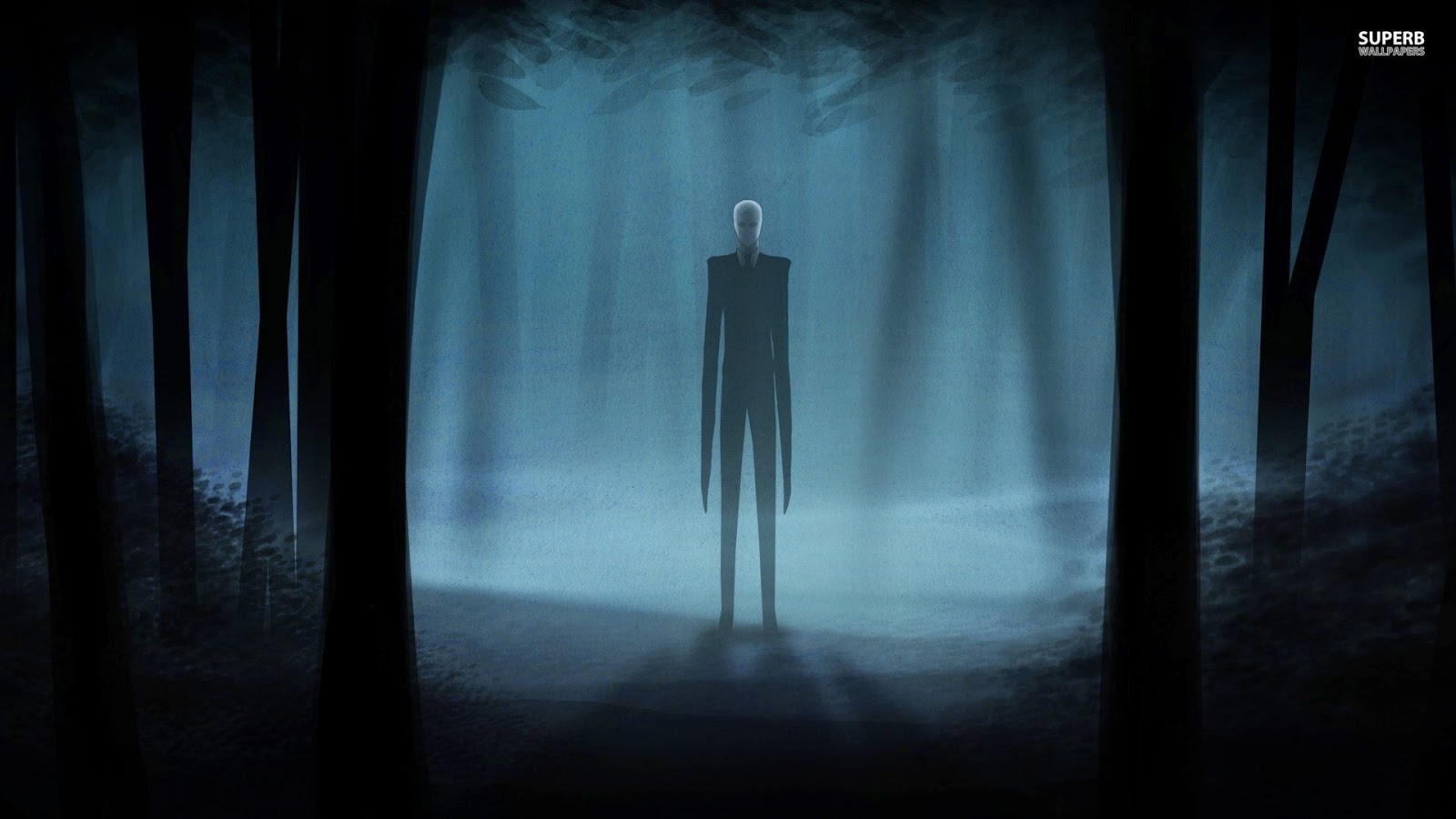
Slenderman, Creepypasta, and Our Stories of Horror
 When I was a boy, I loved horror stories. They were fascinating and terrifying, and I'd lose myself in the reading of them. Stories of primal ooze and ancient evil, of death and terror in the darkness, of blood and fang and strangled cries?
Oh yeah. Those books came home by the dozen from my local library, and cost me countless hours of sleep.
There were the hours spent reading furtively at the foot of my bed, as my eyes picked out the tales of terror from the darkness. Then there were the hours trying to go to sleep, as every creak and susurration of the world around me was interpreted as imminent doom.
Was it the slime that rose from the deep that gurgled under the floorboards? Was it the horror of something that should have long ago been claimed by death that creaked beneath my bed? Whichever way, I'd lie there, very awake, very aware of my eight-year-old mortal frailty.
My sons take after their dad, and so they'd read scary stories. In this new era of instant media, they'd increasingly watch them and read them online. Which is why the ghost-tales of horror from the site Creepypasta were well known to me, and why the character of Slenderman--a terrible figure who stalks and kills in the woods--was familiar.
These stories were little more than the same tales I'd hear as a boy, ones that took the form of quasi-reality. "It's been said that..." "Rumors have it that this might have happened..." "...And there, stuck in the door of the car, was the hook."
It was nothing more than ghost stories, mixed in with the classical framework for the telling of such tales. People play along, pretending it's more and more real. As the story gets passed along, it gets embellished with more personal flourishes, until the boundaries between the real and the story are blurry. That's the way of good storytelling--around a fire, as the listeners stare wide-eyed into the darkness--has always worked.
Which made this last week's peculiar story from Wisconsin so hard. Two girls, obsessed with the ghost stories on Creepypasta and Slenderman, stabbing another girl 19 times in the woods. It was brutal, savage, heartlessly monstrous. And yet seeing the pictures of the arrest, it's clear: these are girls, not women, not even close.
Here are kids, at that peculiar, awkward, difficult transition between childhood and adulthood. They've lost themselves in a dark story, abandoning credulity in a strange fever-dream of early adolescence.
Somewhere, something broke in one or both of those girls, and they lost themselves in a story of horror. It became something they believed they inhabited.
As creatures of narrative, who spin our lives out as a story, that's something that impacts us all. There are stories we tell so that we can laugh, and so that we can pretend. Stories help us more deeply understand truth, forcing us beyond a mechanical literalism, demanding that we think, imagine, and grow. That was my Teacher's method, after all.
But there are also other stories that become so woven into us, repeated over and over again, that we become them.
Our narratives of anger, of hatred, of bitterness and resentment? Those shape and form us. Our endless commercialized tales of empty sex and retributive violence? Those become us. The stories that rise from our faith that do not build us up in grace, but turn our eyes away from the reality we are helping to shape? They are equally dangerous.
Stories are not product. They have power.
It's a difficult truth, and one our culture struggles to grasp.
June 4, 2014
The Boltzmann God
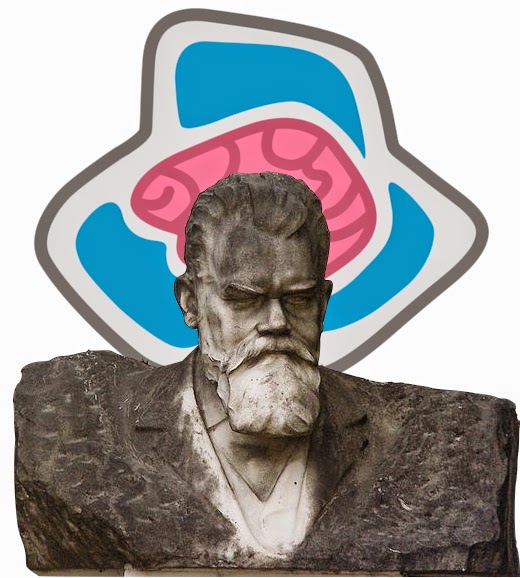 One of the more fascinating bits of silliness you'll encounter if you play around with modern cosmology is the idea of the Boltzmann Brain.
I've encountered this idea in various writings, most recently in my reading of Max Tegmark's latest book. It's a fascinating thought exercise.
Ludwig Boltzmann was a physicist and philosopher who lived at around the turn of the last century. He's a bona fide giant in the field. He came up with equations that explain things that...well...honestly...I don't have much use for in my day-to-day work as a pastor.
He didn't come up with the idea of the Boltzmann brain, but it was named after him.
The core of the concept is that--given Boltzmann's assertion that our highly-ordered universe is just a low-entropy sliver of a massively energetic and infinitely larger system--intelligence is just as likely to arise sui generis as evolve.
It's immensely improbable, sure. But in the endless recombination of energies and ephemeral structures that would churn up from a functionally infinite and timeless chaos, such a thing would happen.
Meaning that awareness--sentience--could simply come into being. It does not have to evolve. It could simply be.
As that thought exercise goes, it tends to involve speculation that our awareness--and our whole universe, in some versions--is just as likely to be a Boltzmann brain event. There'd be no way to know the difference. We could easily be just seconds old, coalesced from the eternal wildfire of the tohu wabohu.
Please, please, no one tell this to Ken Ham.
It's also a concept that seems to have more purchase now that creation looks to be multiversal. The dizzying energies of this cosmology lend themselves to some pretty insane potential realities.
What I find fascinating about this concept lies not in the possibility of a human cerebral cortex just manifesting itself in the void. Instead, the idea that sentience itself might arise as an inherent part of being plays interestingly off of my own theological musings.
Why not a Boltzmann God?
June 3, 2014
I Can't Hear You, You're Talking Too Loud
 Summer has rolled in, slowly but surely, and that means a farkle-change for my trusty motorcycle. Farkles are, of course, those little aftermarket add ons that improve a bike.
 As mine's a VStrom 650, the most practical and versatile bike in the known universe, my farkles are of the rational sort. There's a tall windscreen for keeping the snow and rain from impacting my body in the winter. There are heated grips and plugs for heated garments to keep me toasty, or at least stave off frostbite in the -15 wind chills out there on the highway in the dead of January. There are handguards to route the cold air away from extremities. Stuff like that.
But with summer, that changes. The big screen comes off, so that air can move more freely around me, and a smaller stock screen goes back on. The hand guards come off.
That means, with all that airflow change, that my world gets a lot louder. My effective but inexpensive full-face helmet howls through the atmosphere. There's nothing but noise, overwhelming, immense noise.
There is so much noise that I can't hear anything at all.
This is not a good thing. I need to hear. I need to hear sirens and horns. I need to be able to hear people talking to me afterwards.
And so into my ears go earplugs.
I am choosing to hear less, so that I can hear more. Having less input helps me make out the signal, and to weed out the noise. It also makes sure I'm not deafened, as my traumatized inner ear simply shuts down.
I wonder, in this net-culture where information howls by us and through us in an unfiltered hurricane roar, if maybe we might need this. There's too much, a relentless outpouring of data, so much so that it gets harder and harder to pick out what's important. It all calls for our attention, all of it, as we get louder and louder and better and better and pressing those loud buttons.
Panic! Conflict! Urgency! Click here! Danger! Sex! Violence! Click here!
Louder and louder it gets, and I wonder if we're able to hear anything at all.
June 2, 2014
The Strange Predestination of Clinton Richard Dawkins
It was a peculiar quote, in a peculiar interview.
The quote came from atheist author and biologist Richard Dawkins, who'd talked a little bit about how much he appreciates Christian ritual. The interview went on, and in it, he was talking about life, and his sense that all of us have a destiny that we fulfill. His quote went thusly:
I think there are always paths not taken but if a different path is taken, I think there is a magnetic pull. There is a sort of something that pulls you back to the pathway having taken a fork in the road.It struck me as peculiar because, well, I don't believe it describes the nature of existence, certainly not in any meaningful way. That I disagree with Dawkins on how the universe works might seem like a no-brainer. I'm a theist, a Christian, and a person of faith. He's an atheist, radically secular, and argues that faith is inherently monstrous.
But when it comes to this one, well, I'd sort of thought he and I might be in agreement. Dawkins has argued--and did in his book The God Delusion--that the universe is a multiverse. It's an infinite, endlessly blossoming churn of being, in which every possibility is actualized.
If you're Dawkins, that means every possibility except God, of course. Of course. Don't even think that.
That's how I see God's vast and impossibly dizzying work in creation. Within the framework of multiversality, we are utterly free. We can choose, and our choosing is both informed by probability and shapes it. That's both liberating and terrifying.
I know, from my faith, that my life could be very very different now. There have been decision points that would have radically altered my path. In some of those points, grace poured in, and I was guided to make decisions that have shaped my life for the better. Relationships have been healed. Breaches have been restored.
In other of those places, I chose poorly, and things were broken that did not need to be broken. Hurts were inflicted. In other of those places, my inaction meant that injustices festered and grew. Those things stayed broken.
I know that my intentionality--coupled with my integrity as a person, and the moral and ethical core that I've embraced--had and will have influence over the little flicker of being I inhabit. There is no road I *must* take. I have no single destiny. There are things that are more probable, yes. But one path that will draw me on unwilling? No.
God does not force us to follow. God does not need to.
Which is weird, because all of a sudden, it seems that Richard Dawkins may be more of a classical Calvinist than I am.
May 30, 2014
Richard Dawkins and "Secular Christianity"
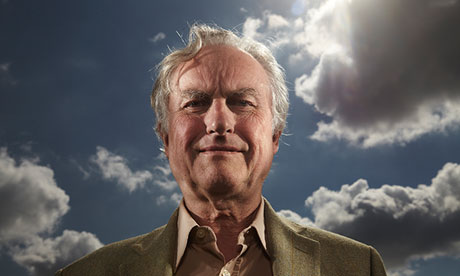 It was a little odd, I'll confess, to see recent reportage of die-hard neoatheist Richard Dawkins asserting that he's Christian.
"Secular Christian," of course, but still.
If you've ever read anything by Dawkins, that statement might seem like a coding flaw in the Matrix, or perhaps a sign that the upcoming Left Behind movie is going to come out at a particularly auspicious moment. No, actually, scratch that. I think the last thing the studio wants is the Rapture right before it opens. Poof, there goes your target audience.
Whichever way, here arguably the world's most famously strident atheist is saying: "I am a mumblemumble Christian."
It seems peculiar.
What Dawkins is trying to say, honestly, is something completely in line with a position he's stated and restated over the years. He likes the ritual. He enjoys caroling, and pageants, stockings and trees and Old Saint Nick. Even the churchy ritual itself, with vicars and funny hats and incense, there's appeal in that. There's something comforting about it, something vewy Bwitish that puts him at ease, even if he thinks most of it is utterly absurd.
So there it is. He's a secular Christian.
But can such a thing even exist? Are there "secular Christians?"
On the on hand, of course there are. There have always been. Tradition and authority, pomp and ritual, these things have been a part of Christianity almost from the git-go. Oh, it took them a few centuries to get rolling, but roll they have.
On the other hand, of course, I'm not sure that's what I would describe as Christian in the first place. Ritual means very little, unless it serves a deeper purpose. The forms and structures of Christianity have often become nothing more than the ritual trappings of secular society. One has only to look at the rather awkward origin story of the Church of England for evidence of that.
Being Christian, as my teacher George MacDonald puts it over and over again, means nothing more and nothing less than doing what Jesus tells us to do. Nothing else matters. A disciple follows the teachings of their master. Period.
Ritual is only meaningful insofar as it reinforces that radical commitment. What does that look like?
Live your life humbly and graciously. Make decisions guided by a compassion not just for your family, friends, tribe, or nation, but for all beings. Even enemies. Particularly enemies.
Which means, oddly enough, that I think there can be secular Christians. "I'm not sure about the God-thing," they say. "But I can do those things that Jesus asks. I can live that way." I don't know if Dawkins falls into that category. It might be interesting to ask him.
Ultimately, I think that's what counts. Jesus did too, of course.
May 29, 2014
Throwing Paul Under the Bus
 There they were, the dad and his daughters, picnicking before an outdoor concert. They were just a yard behind me to my left. We were waiting together for the show to start, and as I sipped my refreshing pilsner and soaked up the late-day sun, I did some good old-fashioned eavesdropping.
 Daughter One was tall and dark clad, sitting in front of Dad and Daughter Two. Daughter Two was a young woman, perhaps in her early twenties. She was wearing a funky little hat and modest but graceful clothing, a pageboy bob framing her face. Dad was in his fifties, trim and tan, with a Ron Burgundy mustache that was just a tiny bit too large for his pleasantly impish face, a face that could be seen echoed in his daughter.
Dad was talking to Daughter Two about Jesus.
And Lord have mercy, was she not enjoying it. She was enduring it, being polite, trying not to say anything encouraging. It was one of those conversations that will be recounted later to Daughter One, I suspect, although describing it as a conversation isn't particularly accurate.
It was a monologue delivered at slightly more volume than was entirely necessary, the sort of thing that Dad had cobbled together at whatever church Dad was attending. "How to Talk To Your Liberal Daughter Back from College about Jesus," or so I'm sure the pamphlet goes.
So he talked, talked about how radical Jesus was, how unusual he was for his day, that sort of thing. It wasn't bad stuff, not really, but it wasn't a conversation she wanted to be having. "Sure, Dad." "Well, I don't know." "Uh huh."
There was no asking, or any real back and forth.
Then, Dad started in about Paul. How Paul had completely ruined Christianity, how he'd taken the radical things Jesus had done and messed them all up. Jesus never said most of the things Paul said, intoned Dad, with Dadly Authority. Paul really said some stupid things about women, Dad said, with Dadly Certainty. Paul came later than the Gospels, said Dad with utter Dadly Confidence, and turned the Jesus of the Gospels from a revolutionary thing into something completely different.
Oh Lord, was it hard not to jump in. Were I Russian, or Israeli, I'd have insinuated myself in a heartbeat. And despite my near-pathological introversion, I almost did. But as I watched them, drawn to theological conversation like a moth to a flame, Daughter Two saw me and met my eyes. She gave me a sheepish little smile. "Sorry you have to hear this," it said. I gave her a shrugging grin back. "I feel you," it said, and she registered it.
I wasn't going to wade in, because it would have made her more uncomfortable. "Now Dad's Getting Into It With A Strange Pastor." Yeah, that'd help her a whole bunch.
It was still tempting, not just because Dad was factually wrong, though he was. Wherever Dad goes to church, they clearly don't teach about the dating of Paul's letters and how the Gospels were written.
But because Paul deserves none of that rap. None of it.
Oh, he gets that a whole bunch, as folks try to adapt the New Testament to our egalitarian culture. It's a familiar critique, one I heard a whole bunch in the progressive church in which I grew up. But it's just not right.
The more you get into historical critical study of the Bible, the more obvious that becomes. Paul himself--not the followers who wrote in his name, but Paul himself--was certainly not Jesus. But the heart of what Paul taught in the seven letters we can attribute to him with integrity harmonizes beautifully with the Jesus we hear in the Gospels. If you really get into the scholarship--the serious, objective, critical scholarship--the Paul that emerges is a remarkable person. Perfect? No.
An Apostle bearing the same sacred and transforming message that Jesus himself bore, one that shattered cultural expectations, class lines, and gender roles? Yes.
You just can't throw that guy under the bus.
May 28, 2014
The Diagnosis
 Another mass killing echoes in our collective consciousness this week, for a while, at least.
It's spun differently this time, as we chatter and screech in our social media trees like startled monkeys. It is misogyny, this time, that has become the focus of our #hashtag uproar. We also note that the killer had a small collection of guns, one of which was used in the killing. And he was privileged--wealthy and lacking nothing materially. These are all certainly part of that horror, but his darkness seems deeper and more indiscriminate than all of those things taken individually.
Yes, he was a virulent misogynist. And yet four of the six dead were men. Yes, he loved the easy power of the gun. But half of those who died--his roommate and his friends, all Asian, all men--were stabbed to death.
There is more at play here.
The crass, hateful, and starkly self-absorbed rantings of the latest "killer-of-many" were remarkable only for their strange shallowness. This is not the Unabomber, caught up in some falsely "noble" fantasy of bringing down the machine. This was just a soul that had fallen in on itself like a black hole, lost in a remarkably banal hatred.
"Girls don't like me, and I desire them. That makes me feel powerless, so I'll kill all of them." Like rape, these murders were just about power.
That was as far as his ethos went. He had become blind to everything else. At no point in his rantings, in his feedback loop of solipcistic self immolation, did he ever think that perhaps people did not like him because he did not like them. He had lost awareness of women--or other men, really--as persons, as sentient and self-aware beings.
If you view people as soulless objects and/or projections of your own frustrations and hungers, they don't like that. So. Very. Simple. And yet that most basic knowledge was not in him.
"Girls don't like me." It's so stupid, such an impossibly stupid thing to use as a justification for shattering the hopes and lives of others. But as that dark old Boomtown Rats song goes, what reason do you need?
Ultimately, there are no valid reasons behind such horrors.
It was striking how little got through to him. Those who view such hateful behavior as best dealt with with a good solid beating had their swing at him. Police reports show that'd been tried. He'd acted out, drunk at a party, striking and pushing women. The other partygoers had beaten him to the ground, and kicked him into submission, as others called the cops. That only deepened his hatred.
Those who'd talk it through, exploring feelings? That failed, too. He'd been in and out of therapy, as his concerned parents had tried to break through his increasingly toxic isolation. He's mentally ill, in need of help and healing. That was the thought, and at least it was hopeful, trying to set a life on a restorative path. But those interventions, unless they cast a clear alternate future before a blighted soul, can do little.
I hear talk of mental illness being the cause, and yet I'm not sure it's so easy. His rantings are not the word-salad of the schizophrenic. He was able to mask it, easily, when confronted.
They were not incoherent. They represent an internally cohesive way of viewing the world. I have known many people living with mental illness, struggling with clinical depression or mania or any one of the many ways our complex brains can malfunction. They do not yearn to harm others.
What was at play in Isla Vista represented an ethos, meaning a set of enacted beliefs that gives a person their integrity.
There is a name for that state of being, one that we seem to have grown strangely coy about using.
Evil, that word is.
We worry that this seems harsh, and that it seems judgmental. Yet if there is good, there must be evil. If we affirm that compassion, mercy, justice, lovingkindness, and graciousness are states of being that constitute a way in which we should live, then there are also ways in which we should not live.
Misogyny, for instance, is evil. I would name it as such. It is evil to simultaneously despise and objectify half of humankind. Fetishizing violence over others is evil. It is evil to desire the harm of other beings as an affirmation of your own power. If we take those memes into ourselves, we become them. We actualize them. We are them.
Is it a sickness? Yes, of sorts, but not necessarily one that's part of our individual meatware wiring. Evil has to do with software. It's learned. It's socioculturally installed and updated.
It is chosen, then chosen again, carved into us until the furrow in us is so deep that we lose ourselves in it.
That is true for human beings, and for cultures as a whole.
It has always been our curse.