David Williams's Blog, page 38
September 18, 2019
Reading Positivity
As I greeted folks on the way out of the service this last Sunday, a parishioner asked a question. I'd referenced two books in the sermon, one a dystopia and the other a grim recounting of the inescapability of climate change. "So...do you ever read anything happy or uplifting?" she asked.
To which I said...uh...um...er. Hmmm. Do I? Huh. Nothing popped to mind.
It was a telling and very legit question. The stories that we hear do have this tendency to shape our souls. So I went back to my Goodreads account, and checked on the 35 books I've read so far this year.
Eleven of them are generally positive, hopeful, and/or uplifting in tone.
Of those, the best were:
BORN A CRIME, Trevor Noah's memoir, which was a tale of striving, resilience, and a respectful, warm love letter to his mom.
THE MONK OF MOHKA, by Dave Eggers, the true story of a Yemeni immigrant who overcame amazing odds to succeed in life.
THE GOOD SHEPHERD, by C.S. Forester, about the captain of a destroyer trying to protect a convoy from U-Boat attack.
THREE WAYS TO CAPSIZE A BOAT, a wacky, funny true story about learning to sail, written by the first drummer of the band Genesis.
TAKING ON DIVERSITY, by Dr. Rupert Nacoste, a professor at NC State who's hopeful about racial dialogue and healing;
MEDITATIONS OF THE HEART, by Howard Thurman, the mystic teacher who guided MLK.
It's good not to focus on the negative. So...what hopeful things are you reading?
To which I said...uh...um...er. Hmmm. Do I? Huh. Nothing popped to mind.
It was a telling and very legit question. The stories that we hear do have this tendency to shape our souls. So I went back to my Goodreads account, and checked on the 35 books I've read so far this year.
Eleven of them are generally positive, hopeful, and/or uplifting in tone.
Of those, the best were:
BORN A CRIME, Trevor Noah's memoir, which was a tale of striving, resilience, and a respectful, warm love letter to his mom.
THE MONK OF MOHKA, by Dave Eggers, the true story of a Yemeni immigrant who overcame amazing odds to succeed in life.
THE GOOD SHEPHERD, by C.S. Forester, about the captain of a destroyer trying to protect a convoy from U-Boat attack.
THREE WAYS TO CAPSIZE A BOAT, a wacky, funny true story about learning to sail, written by the first drummer of the band Genesis.
TAKING ON DIVERSITY, by Dr. Rupert Nacoste, a professor at NC State who's hopeful about racial dialogue and healing;
MEDITATIONS OF THE HEART, by Howard Thurman, the mystic teacher who guided MLK.
It's good not to focus on the negative. So...what hopeful things are you reading?


September 17, 2019
As You Wish
I asked
The Creator of the Universe
I said
Hey
Really?
Can I really
do
Anything I want?
And They just
Met My EYE
For an instant wide as the sky
Then with a smile
soft as newfallen Snow
said
Anything at all
Anything you like
However you can
Whatever you're able
Yes
Yes to it all.
And I laughed
Feeling my wild unfettered
Freedom
And I turned
Ready to
Go and do
But then
A touch
Light as the Noonday desert Sun
Their hand on
My shoulder
They said
in a voice
Quiet and Dark as a
Distant Deepening Gathering
Storm at Sea
And when you're
Done
They said
When you've done
They said
All that you wished
All that you want
All that you will
I will
Because I love you
Like Fire
Like Fire, do I love you
I will
Tell you in the Fires of
My Love
Exactly
Precisely
What that Meant
The Creator of the Universe
I said
Hey
Really?
Can I really
do
Anything I want?
And They just
Met My EYE
For an instant wide as the sky
Then with a smile
soft as newfallen Snow
said
Anything at all
Anything you like
However you can
Whatever you're able
Yes
Yes to it all.
And I laughed
Feeling my wild unfettered
Freedom
And I turned
Ready to
Go and do
But then
A touch
Light as the Noonday desert Sun
Their hand on
My shoulder
They said
in a voice
Quiet and Dark as a
Distant Deepening Gathering
Storm at Sea
And when you're
Done
They said
When you've done
They said
All that you wished
All that you want
All that you will
I will
Because I love you
Like Fire
Like Fire, do I love you
I will
Tell you in the Fires of
My Love
Exactly
Precisely
What that Meant
September 12, 2019
The Trauma Machine
 Forgiveness, healing, and forgetting are all woven up together as a single thing in our souls.
 When we have been wounded, that wound creates both physical trauma and soul trauma. It's a part of how we are made, one of the ways human creatures learn to steer away from those things that harm and break us. Moments of trauma form deep and powerful memory in us, memory that stirs in us fear and anger, anxiety and crushing depression.
Those memories, when stirred, return us to that place of harm. Our traumatic memory, at best, is a prophylactic, as the reaction trauma stirs makes us rise up against similar potential harm. But it takes a toll. It rises, unbidden, in moments where there is no danger. It stirs in us, warning that we must fight or flee, when something minor recalls that hurt. A smell. A particular sound. A voice that reminds us of his voice. A face that could be hers. The sharp retort of a celebratory firework, harmless and far away. The sound of sirens.
Those memories of trauma are fierce and bright and cut deep into us. They can break us and keep us broken, always shattering and reshattering, never able to move on.
Healing comes from a particular form of remembering, as our memories of trauma are overlaid with countervailing experience. We learn that we can go out without fear. We learn to trust others again. We learn to overcome. We change. It's hard. It takes time.
It's not that we forget the harm that was done, but our remembering becomes different. We allow it to be changed. We human beings, whose memory is malleable and who can recall the same event differently as time and retelling blurs and shifts it in us? That is how we heal from trauma. That's how we are restored.
But now? Now we never need forget, not for an instant, not a moment. This strange overlaying synthetic meta-mind of images and sounds that we have created? This "internet?"
It allows us to return to our traumatic moments, to re-see and to re-experience them just as they were. It allows us to never, ever, ever forget, not one bit of it, not one detail. No part of our lives. No part of our history. None of it needs heal, ever.
We return to those moments of collective trauma through glass lenses, in hi def and surround sound, ruminating over them, refreshing them in ourselves, returning to moments of pain and horror just as clearly as when we first experienced them. Ten years can pass. Twenty. Hundreds. Traumatic moments never need pass, never can be changed by reflection, will never be dulled, because these aren't human memories. They are the memories of steel, machine memories, sharp as blades, cutting deep into us over and over and over again.
Pain and fear and rage, none of which we can ever escape.
What a strange thing we have done to ourselves.
September 6, 2019
The Crucifier's Prayer
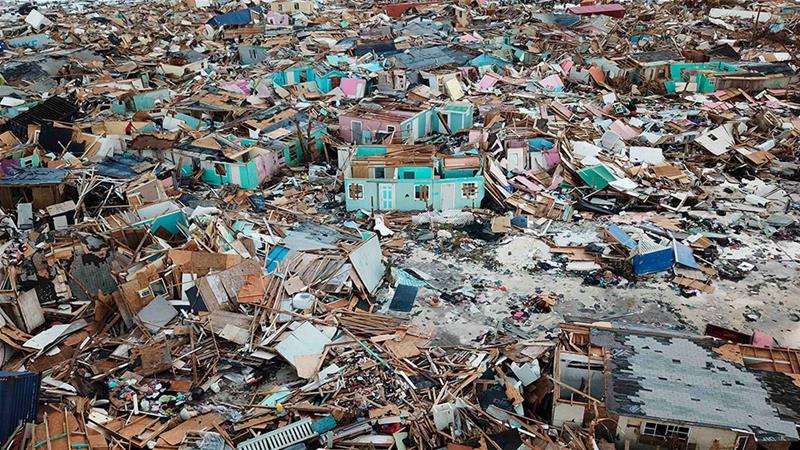 For the past week, the reports and images have come through, day after day. It made a peculiarly appropriate backdrop to my writing lately, as I work my way through a manuscript exploring the Christian response to climate change.
What was initially forecast to be a minor tropical system, one that would dissipate after crossing the mountains of Hispaniola? It blossomed into a monster, a beast of a storm, one bearing winds and surge that meant that once again we would be hearing the words "historic" and "catastrophic."
The forecast, twitchy and uncertain, seemed for a while to plant the storm squarely across the peninsula of Florida, as our machine-minds projected out likely scenarios, calculating and recalculating the probabilities using wildly complicated mathematical modeling.
But for all of our models, the storm did what it did, growing fiercer than we'd predicted, and lingering over a Bahamanian paradise for over a day, meting out destruction layered on top of destruction. We who are now used to watching storm chasers stream video and locals putting up videos were left momentarily blinded, unable to peer into winds that were more than twice the power of that derecho that tore through our area a few years back.
When it finally passed, at its own monstrous leisure, it left a paradise as a ruin.
Why? It is our human nature to wonder at the reason for things, particularly events that make us recoil in horror. In our desire for control we want to assign blame to the suffering, or to celebrate the deliverance of the righteous, particularly if we happen to have escaped this time out. But storms do what they do, on their scale and not ours. God makes the rain fall on the righteous and the unrighteous alike, as Jesus reminded us in the Sermon on the Mount. Tragedy befalls both the kind and the cruel.
Against this, we wish to have power. We want our selves, our communities, our nation, to have power. To prosper. So we pray from our ego. We pray from our desire for the integrity of our material selves.
But what are my prayers, against the storm? What is the purpose of such a prayer? Unlike a prayer for healing, or a prayer for a change of heart, a prayer that calls for a storm to turn from us has implications beyond ourselves.
Am I to proclaim with joy that I am certain my prayers stalled a storm elsewhere, so that I and my property might be spared while others know terror and ruin instead? Am I to declare that the Creator of the Universe favors my safety over the life of a terrified child, torn from the arms of their father, water filling their lungs as they are swept into oblivion?
Let them suffer, that I may not, we cry to the heavens. Take them instead, we cry.
This is the prayer of the crucifier. I may ask for deliverance, being a human and finite creature. I will certainly give thanks for life and being when it comes. But I am not the center of things. There are times, my Master taught, when the cross will come to me, and I must take it up and bear it. It can mean loss of everything this world offers, life included.
It seems like a thing that any disciple of Jesus would know.
What Jesus calls us to is not to live ever removed from tragedy. What matters is how we respond to those events that shake our lives, or leave the lives of others in ruin. For our own moments of brokenness and mortality, we're reminded to remain resilient, to place our hope and trust in a God who transcends us infinitely. Where we see our neighbor struggling, we're called to stand fast in compassion, helping as we can, seeing their suffering as our own, remaining all the while strong in our sympathy.
No matter how often these storms rise or how they affect us, our ethical ground remains the same.
And as our world grows harsher and harder, that's a ground that will be tested.
August 13, 2019
The Miracle of Strangers
 Earlier this summer I found myself, through the joys of flight scheduling, with multiple hours to kill at Chicago O'Hare. It would have been easy, I suppose, to fill the time noodling about on my phone, flitting from social media to email to a gaming app.
 But with hours spent sitting on my behind on planes already a central part of my day, I just couldn't stomach the thought of that level of inactivity. So, after a delicious Smoothie King lunch, I decided to walk the concourses. Which I did.
For nearly two hours.
Seven miles of walking, according to my fitness app, all through the swirl of thousands of travelers heading to destinations all across the planet.
My intent was to keep a little fit, but as I walked and watched the flow of humanity around me, I began to pay attention to the faces of that river of strangers. Thousands upon thousands of strangers, people that I have never seen before, and will never likely see again.
Families with children.
A large tour group of Japanese tourists.
A Somali woman and her daughter.
A Mennonite girl, traveling alone.
So many faces passed by that I couldn't help but marvel at how full the world is of souls we don't know, and marvel more deeply still at how intimate and accurate our ability to recognize the faces of others is. In this teeming throng, my eyes dancing from face to face, I didn't for one instant mistake someone for someone I knew. Every one of those people was unfamiliar, and that unfamiliarity seemed as I walked to be a marvel of God's creation. So many unique persons, each with their own story, each uniquely gifted with their own graces and possibilities.
It's one of the miracles of humanity, and a marvel of our richness as persons. In a time when we so often fear those who are unfamiliar, those moments as I walked through a flow of faces were an unanticipated blessing, a reminder of the strange holiness of our encounter with the stranger.
July 19, 2019
Mercy for the Fool
I dreamed I met a man
A man
With absurd hair
And a false tan
Stuffed clumsy into an ill fitting
Suit
Wandering alone
In the abandoned streets
Of a once proud city
The sun beat down
Merciless
The air thick smothering wet
His face bright red
His awkward suit
Damp with
Sweat
"I am so hot,"
He said eyes down
to the burning road
"So hot."
And though he was a
fool
and the
King of Fools
I said
I lifted his face to mine and
I said
"Here."
And I blew soft
On his face
And a cool wind rose
To play through his
Absurd hair
Slicked flat back with sweat
"O God,"
he sighed
Closing his hell-weary eyes
"That feels
So Good."
A man
With absurd hair
And a false tan
Stuffed clumsy into an ill fitting
Suit
Wandering alone
In the abandoned streets
Of a once proud city
The sun beat down
Merciless
The air thick smothering wet
His face bright red
His awkward suit
Damp with
Sweat
"I am so hot,"
He said eyes down
to the burning road
"So hot."
And though he was a
fool
and the
King of Fools
I said
I lifted his face to mine and
I said
"Here."
And I blew soft
On his face
And a cool wind rose
To play through his
Absurd hair
Slicked flat back with sweat
"O God,"
he sighed
Closing his hell-weary eyes
"That feels
So Good."
June 13, 2019
Bonus Plants
 My garden this year is different, as it is every year.
Strawberries and potatoes, green beans and a pepper and tomatoes, all of which I've planted before. This year, kale and carrots were added to the mix, filling up the two new raised beds that sit outside my kitchen window. That, I expected.
Most of the soil that fills those two raised beds came from the compost pile I started in the fall two years ago. That dirt was once the leaves on the trees in my back yard, and the grass that grows in the front. It also contains the remains of a hundred home-made meals. Eggshells and hunks of red pepper, the tops of zucchini and the bottoms of broccoli. Every bit of plant matter left over from our fridge, those purchased vegetables and fruits that we kind of, um, forgot were in there. That, and shredded bills, munched on by worms and bacteria, all of it now a rich organic mass of new earth, wheelbarrow upon wheelbarrow full of earth.
It's good stuff, and the carrots and kale have come along nicely.
But there's more. From the soil in which the carrots began to sprout, other plants arose. Some were weeds, the inevitable grasses that try to shoulder their way into a crop. But others weren't. A little sproutling, obviously the beginnings of a tomato plant. Another batch of sprouts, which from their leaves and vigor were clearly squash. Perhaps zucchini. Perhaps spaghetti squash. I'm not quite able to tell the difference. Most likely spaghetti squash, as that's what I attempted to grow two years ago.
They sprang up, and I had to ask myself...what do to with them?
On the one hand, that was My Carrot Patch. My plan was for Carrots. Carrots were integrated into the vision and the mission for that particular location in the garden. When I visualized that raised bed, my metric for success was a mass of delicately-leafed carrot tops. Not Tomatoes. Not Squash. Those were not part of the plan.
I could, I suppose, have uprooted all of them. I did take out some of the squash, which rose everywhere all at once. But the bonus tomato I staked and watered. The remaining squash I guided to a trellis day by day, its riotous cthulhu-squidward tendrils redirected gently away from the carrots.
Because growth...good growth, life-giving growth...isn't often the thing we expect or plan for.
June 7, 2019
The Season of Growth
 It's summer now, and the garden is in full swing. Every season, my garden is different.
Some years, there are strawberries, so many that I run out of jam jars to fill with them. Other years, the squirrels and chipmunks and voles have gotten to 'em first.
Some years, the green beans spring like a riot from the earth, and I'm sharing bags of beans with family and neighbors and random passers-by. And other years, the same beans seem a little tired, loafing out of the identically enriched soil, yielding a couple of fresh picked dinner side dishes but little more.
It's part of the delight of a garden that it is every year new and unanticipated. That newness comes because it is...assuming we're not "gardening" on an industrial scale...an organic thing, a living thing, one that we can encourage and nurture but that isn't utterly under our control.
And it also comes because we, as we water and weed and plant and weed some more, can always try new things in our soil. Every plant is different, with different life cycles and needs. For me, this season, there were carrots, which I'd never tried before, but which have worked wonderfully in the loose, rich soil from my compost pile. I'd not realized, before I researched carrots on the Virginia Tech agriculture school page, that carrots were biennials, and that the sweet, starchy root is simply the fuel for the flowers that grow in year two.
There was kale, which I have loved since I was a child. OK, sure, I was a weird kid, but I loved it, just like I loved spinach and collard greens. Must have been my southern heritage. The kale I planted last Fall gave us sweet, nutty greens through the winter, and is now a menacing riot of edible, tasty seed-pods, which I'm planning on using for the planting this Fall. The kale I planted in the spring did great...and attracted scores of lovely white butterflies. Oh, what lovely white butterflies, I thought.
But while summer's pretty fluttering butterflies don't eat kale, their eggs hatch into caterpillars. And caterpillars love kale nearly as much as I do. Which I will remember for my greens, the next time summer arrives.
In this gardening time, we are reminded that every new season of life brings with it opportunity for untasted flavors and learning. And with every new thing, there come challenges, things that nibble and bore and wilt. That's no reason not to rejoice in the new things that God is always working...just a reason to keep aware, and to adapt, and to delight in both the challenge and the discovery.
May 28, 2019
The Dark Side of Story
 It was a lovely little gathering at a denominational meeting, as I and another dual-class pastor/author sat with folks and talked faith and storytelling.
We chatted about our books, about the literature that we loved, about the stories that shaped us. We talked about how story is the ground of faith, and how mythopoetic narratives create a sense of self in a way that data simply cannot. We talked about the use of fiction in liturgy and teaching, and gave examples. It was a good, solid, earnest Presbyterian bit of thinkery.
After many other good questions and conversation, my colleague offered up the rich question: we've talked about how story can shape us in positive ways. In what ways can story be less helpful?
There were some well-considered answers around the table, thoughtful reflections on the obscurity of narrative as a means of speaking truth, and about human subjectivity and our capacity for misunderstanding as we engage with such truth.
There were reflections on the dangers of stories that were cloyingly sweet, the clumsy Christian tendency to create bludgeoningly didactic books and films, in which all of the characters are transparent stereotypes and THE MESSAGE IS IN ALL CAPS. It is no small irony that our "evangelical" stories are so often told in ways that only those who already believe can enjoy them.
It was a wonderful dialogue. As one of the two folks at the "front" of the room, I pitched out my thoughts on the subject early. Well, one of my thoughts. As the conversation continued, another occurred to me. But the role of the person at the front of the room isn't to pontificate endlessly, no matter how much caffeine you drank right before the session. You contribute, give a perspective, and then support, and listen.
The answer I left unspoken was this: Story is a soul-shaping magic, but it is not necessarily a good magic.
Stories can be evil.
Storytelling as a means of forming personal and collective identity can make us more just, more compassionate, more open, and more gracious. It can force open our imaginations to receive a new blessing. It can deepen our welcome to the stranger, and set our souls at peace.
And it can also do precisely the opposite thing. We can tell stories of our own lives that make us more anxious, more hateful, and more bitter. Our narratives of the people around us can twist them into chimerae, allowing us to project our anxiety and rage onto that false Other. They abuse us! They are monsters! We, the victims, the paragons of virtue! We can mutter these things to ourselves for a lifetime.
We can tell stories of our lives together that deepen our collective resentments towards the stranger, that heighten our distrust of neighbor, and that dehumanize those we need to hate. We recount their corruption and brutality, heightening our contempt of Them, reinforcing the bright shiny truth of Us. We make up stories that cast Us as perfect and noble and good, and Them as demonic god-foe monstrosities, irredeemable enemies, unworthy of love.
Our stories can make our hearts leap at the thrill of violence, hunger for possessions, and view others as meat for our pleasure. They can make us cynical and cold and brutal.
Fiction can call us into a higher truth. It can also be a deepening lie upon a lie.
A story can tell a deep magic of compassion. It can just as easily be a coldwoven curse, written in the blood of ego, filling our soul with worms.
May 18, 2019
My Sweet Enemy

HoneysuckleIs myEnemy
Strangling my DogwoodMurdering my BlueberriesSmothering myHolly
And yet
As I watch
On a new summer's twilight
The young couple stopsAnd HeLaughingTakes flowers for her hair
Then a womanAlone
Presses her faceInto its warmSweetWelcome
O my Enemy
How worthy you areof Love